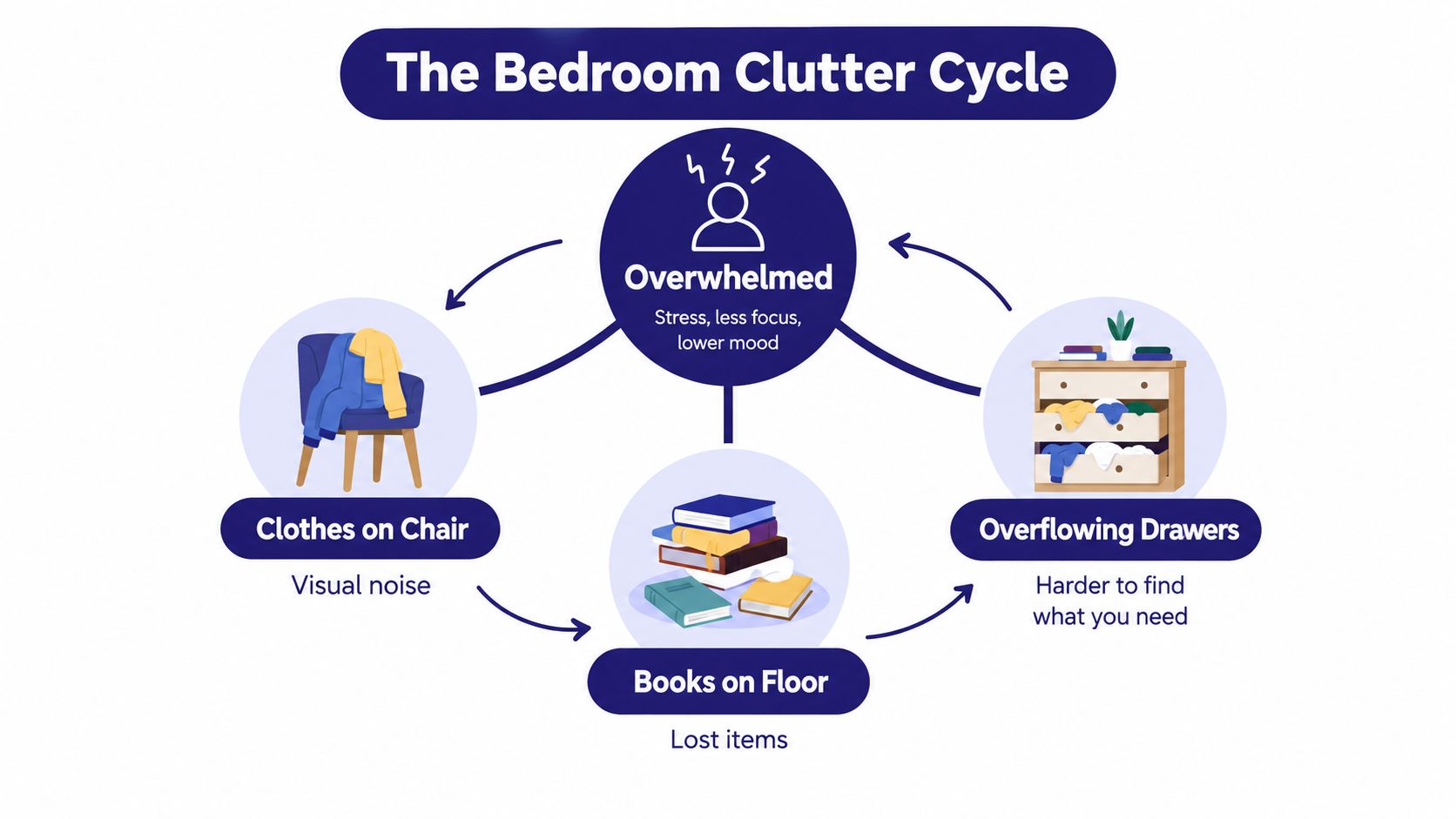
You know the room is getting out of hand when the chair becomes a second wardrobe, books collect beside the bed, and opening a drawer means pushing yesterday's clothes back inside. The bedroom may not be the largest room in the home, but it has to support sleep, dressing, storage, and sometimes work or study without feeling crowded.
Good storage solutions for bedrooms start with a layout decision, not a shopping list. The right piece depends on how much floor space you have, whether you expect to move, how often the room's function changes, and whether you want storage to blend into the architecture or remain useful furniture you can take with you.
Why Bedroom Storage Feels Like a Puzzle
A bedroom creates a particular kind of clutter because its contents are used throughout the day. Clothes come off near the bed, books stay within reach, accessories gather on the nearest surface, and items that don't have a clear home slowly occupy walking space. The room then feels stressful, even when the total amount of belongings isn't unusual.
Consider a typical bedroom with one wardrobe, a small chest of drawers, and a bed. Folded clothing may fit in the drawers, but shoes, bags, spare bedding, seasonal clothes, and everyday accessories still need somewhere to go. If every category competes for the same horizontal surfaces, the room becomes difficult to reset.
Think upward before spreading outward
The most useful shift is from horizontal thinking to vertical thinking. Instead of adding another low cabinet that extends farther into the room, look for ways to use wall height, the full height of a wardrobe, the space above a headboard, and the area beneath the bed.
Tall storage can hold folded clothing or accessories while preserving more open floor area. Wall-mounted shelves can keep books and smaller items off the floor, though they need careful placement so the room doesn't feel visually busy. A narrow chest may also work better than a wide one if the problem is a lack of floor width rather than a lack of storage volume.
Practical rule: Use the floor for furniture you need to access often, and reserve higher or less convenient areas for seasonal and occasional items.
This principle applies beyond the bedroom. If your home has an unused loft or awkward upper-level space, these loft storage ideas for Dublin homes can help you think about moving rarely used belongings out of the bedroom altogether.
The broader furniture market reflects why this planning matters. A major forecast estimates the global bedroom furniture market at USD 126.80 billion in 2025, with a projection of USD 132.49 billion in 2026 and USD 165.07 billion by 2031, equivalent to a projected 4.49% CAGR from 2026 to 2031 (Mordor Intelligence). Storage isn't a decorative afterthought. It has become part of how people expect bedrooms to function, particularly where homes need to support several activities in one room.
Built-Ins versus Freestanding Storage
You own the room, plan to stay, and want every awkward corner used. A built-in wardrobe may suit that situation. If you rent, expect to move, or like changing the layout, freestanding furniture gives you more room to adapt. The choice is less about which looks better and more about how firmly you want storage tied to the property.
Built-in storage can appear to belong to the room from the start. A fitted wardrobe may run from wall to wall, use an alcove, and create one calm, consistent surface. Sliding doors can also reduce the clearance needed in front of the wardrobe, which helps when floor space is limited.
That polished result comes with permanence. Installation may involve fitting work, wall changes, patching, or repainting. If the bed or room function changes later, the storage may no longer suit the layout. Renters may not be able to install it, and homeowners who move could leave the investment with the property rather than take it with them.
Freestanding furniture works more like a set of movable building blocks. A wardrobe, dresser, chest, armoire, or sideboard can shift when the bed moves, change as your storage needs develop, or travel to another home. You can also sell it, pass it to a family member, or restyle it without altering the walls.
Compare the decision by lifestyle
| Consideration | Built-in storage | Freestanding storage |
|---|---|---|
| Visual effect | Flush, wall-to-wall finish that matches the architecture | More varied, with furniture character |
| Layout changes | Usually difficult after installation | Generally easier to rearrange |
| Moving home | Usually remains in place | Can travel with you |
| Renovation risk | May require fitting work and wall changes | Usually involves less alteration |
| Storage shape | Can be built to fit one specific wall or alcove | Available in different widths, heights, and functions |
| Resale and reuse | Value may be tied to the property | Can be reused, sold, or repurposed |
Built-ins suit homeowners who expect to stay and want one wall configured for long-term use. Freestanding pieces suit changing layouts, renters, and anyone who wants storage with a clearer resale or reuse path.
Recent design coverage has highlighted renewed interest in freestanding and hybrid storage, including armoires, antique dressers, and sideboards, because these pieces can move or be restyled without a full renovation (Livingetc). Built-ins remain useful. The practical lesson is that the most attractive storage isn't always the most flexible storage.
A hybrid arrangement can balance both priorities. Use a fitted wardrobe for daily hanging clothes, then add a freestanding dresser for folded items or accessories. If your needs change, the dresser can move while the main storage remains in place.
Measuring Your Space for Smart Layouts
A storage purchase should begin with a tape measure, not a guess about how much clothing you own. A piece can have generous internal capacity and still make the room uncomfortable if it blocks a doorway, interferes with a window, or leaves too little space to walk around the bed.
Start with the room itself
Measure the room's floor length and width, recording the full dimensions rather than estimating from visible open space. Then note fixed features, including radiators, outlets, vents, skirting boards, windows, and built-in elements. A simple sketch on paper is enough if it includes the position of each feature.
Next, check the door and window movements. Measure the door swing and identify the area that must remain clear when the door opens. Do the same for windows, especially if a dresser or tall wardrobe could limit ventilation, access, or natural light.
Finally, measure the ceiling height. Tall furniture can increase capacity without spreading across the floor, but only if it fits comfortably beneath the ceiling and can be carried through the home during delivery. Check stairwells, hallways, and turns as well as the final room.
Test the layout before buying
Use painter's tape to mark the proposed footprint of a wardrobe, dresser, or storage bed on the floor. Walk through the room, open the door, pull out imagined drawers, and stand beside the bed as if you were getting dressed. This reveals problems that a product photo won't show.
A useful planning sequence is:
- Mark fixed circulation paths. Keep the route to the door, bed, and window usable.
- Place the largest storage first. Test the wardrobe or chest before adding shelves and smaller pieces.
- Check opening space. Hinged doors and drawers need room in front of them, while sliding doors reduce that requirement.
- Match scale to the room. Slim, tall furniture may add capacity without overwhelming a narrow bedroom.
- Review visual weight. A piece that technically fits can still make the room feel dense if it is too deep, dark, or bulky.
Furniture scale depends on the room, not only on the dimensions printed on a label. Guidance on measuring floor dimensions, door swings, windows, and ceiling height reinforces the need to assess the whole layout before choosing individual pieces.
Creative Solutions for Small Bedrooms
Small bedrooms benefit from combining several modest improvements rather than relying on one oversized storage unit. A tall dresser, under-bed container, wall shelf, and storage ottoman each solve a different problem. Together, they can reduce floor clutter while keeping frequently used items accessible.
A tall, narrow dresser is often more practical than a wide, low model when floor width is limited. One comparison uses an 18 by 30 inch footprint against an 18 by 60 inch footprint, showing how a narrower vertical shape can preserve more walking space while still providing useful drawer capacity (Cozey).
Under-bed storage is especially useful for spare linens, off-season clothes, and items you don't need every morning. Measure from the floor to the lowest point of the bed frame before choosing containers. One storage guide identifies 9 inches or more of clearance as suitable for most rolling bins and similar containers, while it lists typical clearances of 6 to 7 inches for standard frame and box spring beds, 4 to 6 inches for low-profile platform beds, and 10 to 11 inches for platform beds with 4-inch risers (Clutterless Nest).
Match each storage type to the job
| Storage Type | Best For | Space Efficiency |
|---|---|---|
| Tall narrow dresser | Folded clothing, accessories, and smaller garments | Uses height while limiting floor width |
| Under-bed containers | Seasonal clothing, bedding, and occasional items | Uses space that would otherwise remain empty |
| Storage bed | Bedrooms needing concealed, built-in compartments | Combines sleeping furniture with storage |
| Wall-mounted shelves | Books, accessories, and display items | Uses wall area rather than floor area |
| Storage ottoman | Blankets, pillows, and items used around the bed | Adds seating and concealed storage |
| Sliding-door wardrobe | Hanging clothes in a compact room | Avoids the forward clearance of hinged doors |
Sliding-door wardrobes can improve space efficiency in compact rooms because they eliminate the clearance zone required by hinged doors. A technical review reports roughly 30% better space efficiency in small environments and identifies 24-inch depth as a practical balance between usable hanging volume and room presence (Academia.edu).
A flexible interior also matters. Adjustable dividers let you reassign cabinet space between hanging clothes, folded garments, shoes, and accessories instead of leaving fixed compartments underused. Research on wardrobe design found that flexible divider systems significantly improve space use (BioResources).
For a broader look at compact layouts, these space-saving ideas for studios offer useful inspiration for treating every zone as part of one connected plan.
Choosing Durable Materials and Finishes
The right material depends on the piece's job, how often it will be handled, and the type of wear it will face. A dresser used every morning needs drawers that open smoothly and surfaces that can tolerate repeated contact. A high shelf for spare bedding may face less handling but still needs stable construction and dependable support.
Solid wood offers a natural appearance and can suit traditional, transitional, or contemporary rooms depending on its design and finish. It may also be repairable or refinished in ways that aren't practical for every manufactured surface. The trade-off is that it can cost more, weigh more, and require attention to changes in humidity and everyday marks.
Engineered wood covers several construction approaches, so the label alone doesn't tell you everything. Look at the edges, joints, back panels, drawer bottoms, hardware, and finish rather than judging only the printed wood effect. A well-designed engineered piece can provide a consistent appearance and practical stability, while a poorly assembled one may feel less substantial in use.
Inspect the parts you touch
Open and close every drawer you can. Listen for catching or scraping, check whether the drawer sits evenly, and look at how much usable space remains after the slides and frame take up room. For wardrobes, inspect the hanging rail, shelf supports, door alignment, and interior adjustability.
Finishes also change the maintenance experience. A smooth sealed surface may be easier to wipe clean, while a textured or distressed finish can make minor marks less noticeable. Glossy surfaces may show fingerprints more readily, and pale finishes can make dust visible in certain lighting. These aren't reasons to avoid a finish. They're reasons to choose one that suits your routine.
A useful buying habit: Judge storage furniture with the doors and drawers open. The internal layout, hardware, and accessible capacity matter more than the front view alone.
Heavy items need appropriate support. Books, folded blankets, and packed drawers place different demands on shelves and runners than lightweight accessories. Ask how the piece is intended to be used, whether shelves can be adjusted, and whether the furniture needs to be secured to the wall, particularly in homes with children or pets.
Material choice should also reflect how long you expect the piece to serve its current purpose. Freestanding furniture may be reused in another room, while a built-in may be selected for a precise architectural fit. In both cases, inspect construction and finish in person where possible instead of assuming that a higher price automatically guarantees a better match for your room.
Maintaining Organization Over Time
A storage system fails when it depends on perfect habits. If putting an item away requires too many steps, people tend to leave it on the chair, floor, or nearest surface. Organization lasts longer when the storage location matches how the room is used.
Begin by assigning broad homes rather than creating an elaborate classification system. Hanging clothes belong together, folded everyday clothing gets a drawer, accessories use a small tray or divided section, and occasional items go higher or beneath the bed. Keep the categories simple enough that another person in the household can follow them.
Make the room easy to reset
Use a short evening reset to return visible items to their homes. Books go back to a shelf, worn clothing goes to the laundry area or a designated airing spot, and accessories return to their drawer or tray. The purpose isn't to make the bedroom look staged. It's to prevent small decisions from becoming a large weekend project.
A useful system includes:
- Daily access zones: Keep frequently used clothing and accessories between waist and shoulder height.
- Occasional storage: Place seasonal clothing and spare bedding in higher shelves or under-bed containers.
- Return points: Add a hook, basket, or valet surface for items that otherwise land on a chair.
- Clear labels: Label bins by function, such as winter bedding or travel items, rather than by vague descriptions.
- One-in, one-out review: When a drawer or shelf becomes difficult to close, assess the contents before adding more storage.
Do a periodic audit when the storage starts resisting you. Remove items that no longer fit, repair pieces that are damaged, and move rarely used belongings away from prime access areas. If the wardrobe is full but the bedroom still looks untidy, the problem may be the distribution of space rather than the total amount of furniture.
Let the system change with you
Storage needs shift when a child grows, a home office moves into the bedroom, or two people begin sharing one wardrobe. Adjustable shelves, movable dividers, freestanding dressers, and modular pieces make those transitions easier because they can be reassigned without rebuilding the room.
You don't need to solve every future need at once. Choose a layout that works now, leave some flexibility in the internal arrangement, and review the room when your routines change. For households that want hands-on help with decluttering and assigning homes to belongings, resources such as Alabama home organization services can provide a separate starting point for the organization process.
The most effective bedroom storage is the system you can maintain without constant effort. It should make the next tidy-up obvious, keep useful items within reach, and preserve enough open space for the room to feel restful.
Woodstock Furniture & Mattress Outlet offers bedroom furniture that includes storage beds, dressers, chests, nightstands, wardrobes, and related pieces, with in-store guidance to help you compare scale and layout. Visit Woodstock Furniture & Mattress Outlet to explore options in person and test which storage approach fits your bedroom, whether you're furnishing a new home or replacing one key piece.
Leave a Reply
You must be logged in to post a comment.