Could a mattress feel defective and still fall short of its warranty's test? A warranty covers defects in materials or workmanship as defined in its terms. It generally does not cover normal softening, changes in comfort or damage from misuse. The document also states the remedy, such as repair, replacement or refund.
In the United States, written consumer-product warranties must disclose their terms and conditions clearly. For a mattress claim, the gap between a bed feeling like a hammock and meeting the warranty's measurable sagging threshold can matter more than the number of years printed on the warranty. The foundation must also match the stated requirements, and the law tag and proof of purchase may be needed to document the claim.
What a Mattress Warranty Covers at a Glance
A mattress warranty is a defect-remedy agreement. It responds when materials or workmanship fail in the way the document defines, and it stays quiet about how the bed feels after a year of nightly use. The Magnuson-Moss Warranty Act of 1975 requires written consumer-product warranties to disclose their terms and conditions in clear, understandable language, as the Federal Trade Commission's guide to federal warranty law explains. No manufacturer has to offer a written warranty at all, but once one is offered, the warrantor must follow the promises and limitations it wrote.
A document you can use identifies four things: the covered product, the length of coverage, the remedy (repair, replacement or refund), and the conditions attached to a claim. It may be labeled limited rather than full, which means coverage can shift by defect, by year, by component or by remedy. Same mattress brand, three different answers, depending on which clause applies.
| Situation | Usually covered | Typical reason |
|---|---|---|
| Manufacturing defect in materials or workmanship | Yes | The defect is the covered risk |
| Sagging beyond the stated measurement | Yes, if the threshold is met | Measured against a set indentation limit |
| Normal softening or gradual wear | No | Ordinary aging is typically excluded |
| Comfort preference, such as a firmer or softer feel | No | Subjective, so it falls under a separate sleep trial policy if one exists |
| Stains, liquid damage or odor | No | Treated as care or misuse |
| Physical damage, cuts or tears | No | Accidental damage |
| Foundation or base that is inadequate | No | Support requirements were not met |
| Pest infestation | No | Often listed as an excluded condition |
Two complaints can sound identical on the phone and land in different rows. A two-year-old quilted mattress with a measured 1.9-inch dip is a sagging claim. The same bed with a coffee ring spreading across the cover is a stain exclusion, and the dip stops mattering.
The reading rule that saves arguments: if a specific repair or part isn't identified as covered, don't assume it is.
Written promises vary by maker, and reading them is a habit worth carrying into every room you furnish. Buyers comparing case goods often find the clearest language on pages like these Amish craftsmanship guarantees, where construction promises sit beside the coverage terms rather than buried in a separate file.
Pull your own warranty out, sort your complaint into one row, and you'll know whether you're filing a defect claim or asking for a comfort favor before you pick up the phone.
Exclusions and Conditions That Can Void a Claim
Denials usually don't hinge on the size of the dip. They hinge on what the bed was sitting on. Support is a condition of coverage, not a comfort suggestion, and it's the first thing an inspector checks. Four items in the written terms decide whether your measurement even counts:
- Center support under a queen or king. Large sizes generally need a rigid center rail, and a frame without one flexes under two sleepers.
- Maximum slat spacing. The document gives a number. Measure the gaps with a tape rather than eyeballing them.
- Foundation type required. A box spring, a platform or a solid foundation are not interchangeable if the warranty names one.
- Adjustable base approval. Only the models the maker approves preserve coverage.
One published 10-year limited policy is blunt about this: coverage can be excluded when the foundation, base or frame is inadequate, and impressions tied to an unsupportive foundation or an adjustable-base problem are not treated as mattress defects, according to the Stearns & Foster mattress and flat foundation warranty terms. A mattress resting on a slatted frame with wide gaps can look convincingly saggy with nothing wrong inside it at all.
Use rules sit beside the support rules and get read just as rarely. Commercial use, a removed law tag, an unauthorized alteration, and a required protector, rotation schedule or cleaning method are common conditions. Whether a specific exclusion holds up depends on the wording of the document and on the law in your state.
Routine care is part of the bargain, and different constructions need different handling. Mattress care instructions by type cover rotation, protector use and cleaning for foam, innerspring and hybrid builds.
Match the foundation in your bedroom to the specification before you measure anything or file anything.
Measuring Sagging Against the Warranty Threshold
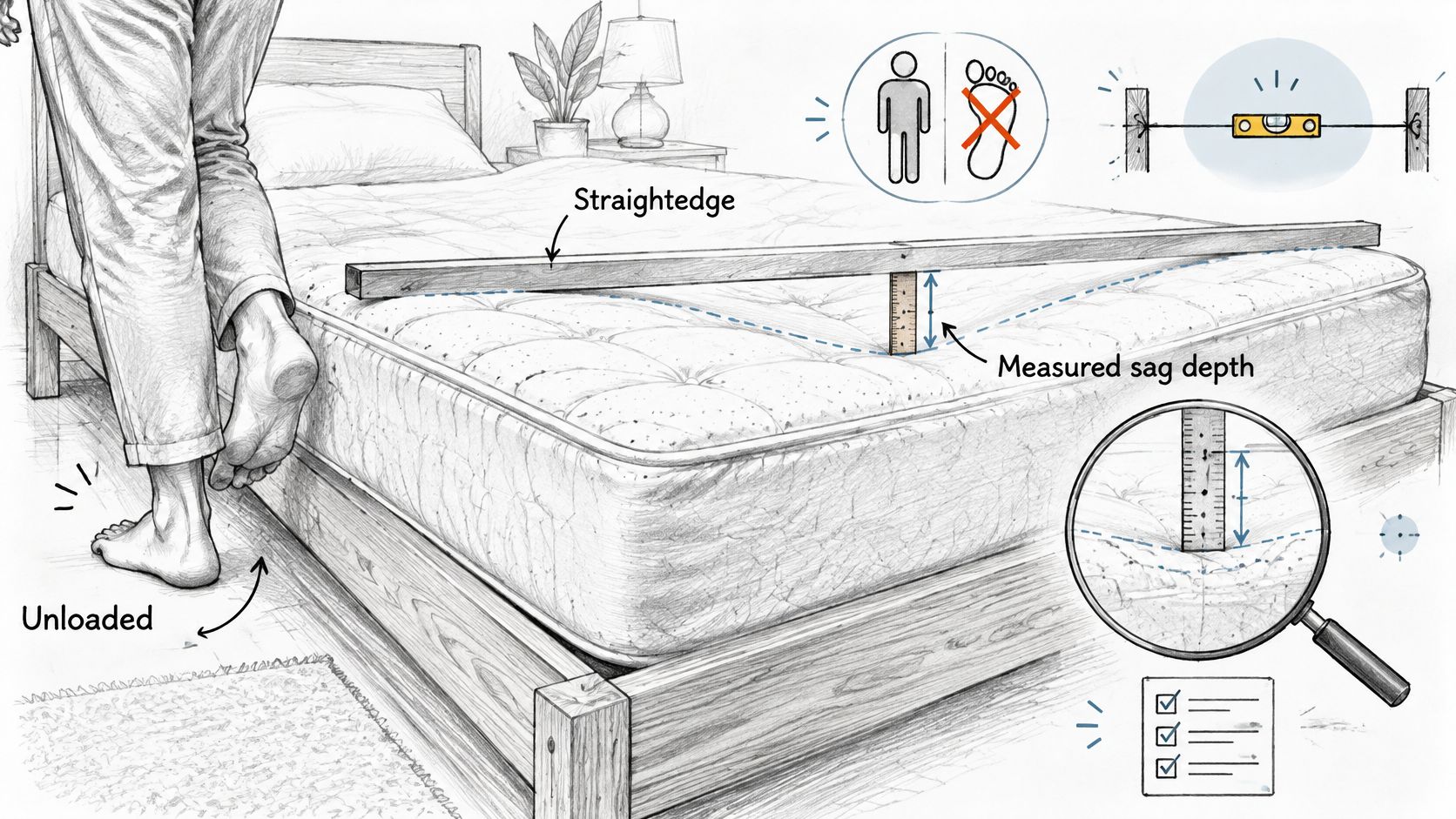
Feel isn't the test. Depth is. A mattress can feel unsupportive while the measurable dip sits well below the number in the document, and that gap is where most sagging claims die. The measurement happens with nobody on the bed, because a mattress is built to conform under load.
Here's the sequence an inspector follows:
- Clear the bed. Remove bedding, topper and pillows so the surface is bare.
- Bridge the dip. Lay a straightedge across the area, or pull a string taut between two high points.
- Measure the deepest point. Use a ruler held vertically from the underside of the straightedge down to the surface.
- Photograph it with the ruler in frame. Document the date, the model and the full surface, not just the close-up.
The brand's own method in the warranty controls, so follow the instructions as written rather than improvising. Sealy's 10-year limited warranty, for example, covers deterioration producing a visible indentation greater than 1.5 inches on quilted or tufted mattresses, or greater than 0.75 inches on flat-top mattresses without quilting or tufting, and treats shallower depressions as normal, per the Sealy mattress warranty information.
| Mattress type | Example threshold (Sealy 10-year limited policy) | What to measure |
|---|---|---|
| Flat-top, no quilting or tufting | Greater than 0.75 inches | Unloaded indentation depth |
| Quilted or tufted top | Greater than 1.5 inches | Unloaded indentation depth |
| Published range across policies | Roughly 0.75 to 1.5 inches | Confirm the exact figure in the warranty for your model |
That range shows up across published examples, with qualifying thresholds falling roughly between 0.75 and 1.5 inches, as Serta's guide to comparing mattress warranties notes. Take a quilted model with a measured 1-inch dip. It can feel clearly less supportive at night and still fall under the 1.5-inch line, which means the claim doesn't qualify on that policy.
Keep the comfort conversation and the defect conversation separate. A sleep trial, a retailer return window and a manufacturer warranty each follow their own rules, and a failed claim isn't a failed purchase.
Before you blame the mattress, rule out the base beneath it, since a flexing frame can mimic a sag. Then measure, photograph and compare the number to the figure printed for your model. If the dip clears the threshold and the bed has given out, these signs your mattress needs replacing help you separate a warranty matter from a replacement decision.
Prorated and Non-Prorated Remedies Explained
Think of a prorated remedy as a trade-in credit. The older the mattress, the smaller the credit, and the larger your share of the replacement price. A non-prorated remedy replaces the mattress without that age-based charge, though shipping or inspection fees can still apply.
| Feature | Prorated remedy | Non-prorated remedy |
|---|---|---|
| How the owner's cost changes | Share of replacement cost typically rises as the mattress ages | Replacement is not charged by age, but fees may still apply |
| Shipping and inspection | Check the document; charges may apply | Check the document; charges may apply |
| What to read in the terms | Proration schedule and calculation method | Fees, inspection rules and remedy limits |
| Typical wording | Prorated or pro-rated | Non-prorated or no proration |
The labels at the top of the document matter just as much. A limited warranty can restrict remedies, while a full warranty has to meet federal standards for remedy and duration. Neither label promises a new mattress at no cost for the whole term, and some policies change the remedy as the years pass.
Federal law also draws a line between a product warranty and a service contract. The FTC's guidance on written warranties and service contracts describes a written warranty as a promise about materials, workmanship, repair, replacement or refund, while a service contract is a paid agreement for maintenance or repair over a set period. That's why a checkout protection plan and a manufacturer warranty shouldn't be judged as the same product. The same guidance notes that implied warranties can last as long as four years in some states, though the exact period depends on your jurisdiction.
Run one worked example before you buy: price the same defect in year two and in year eight, and note what you'd pay each time. A long term with heavy proration late in the schedule protects you less than a shorter term with a flat remedy.
How to File a Warranty Claim Step by Step
A claim is a paperwork exercise with a deadline. Work through these in order, and most of the avoidable denials disappear.
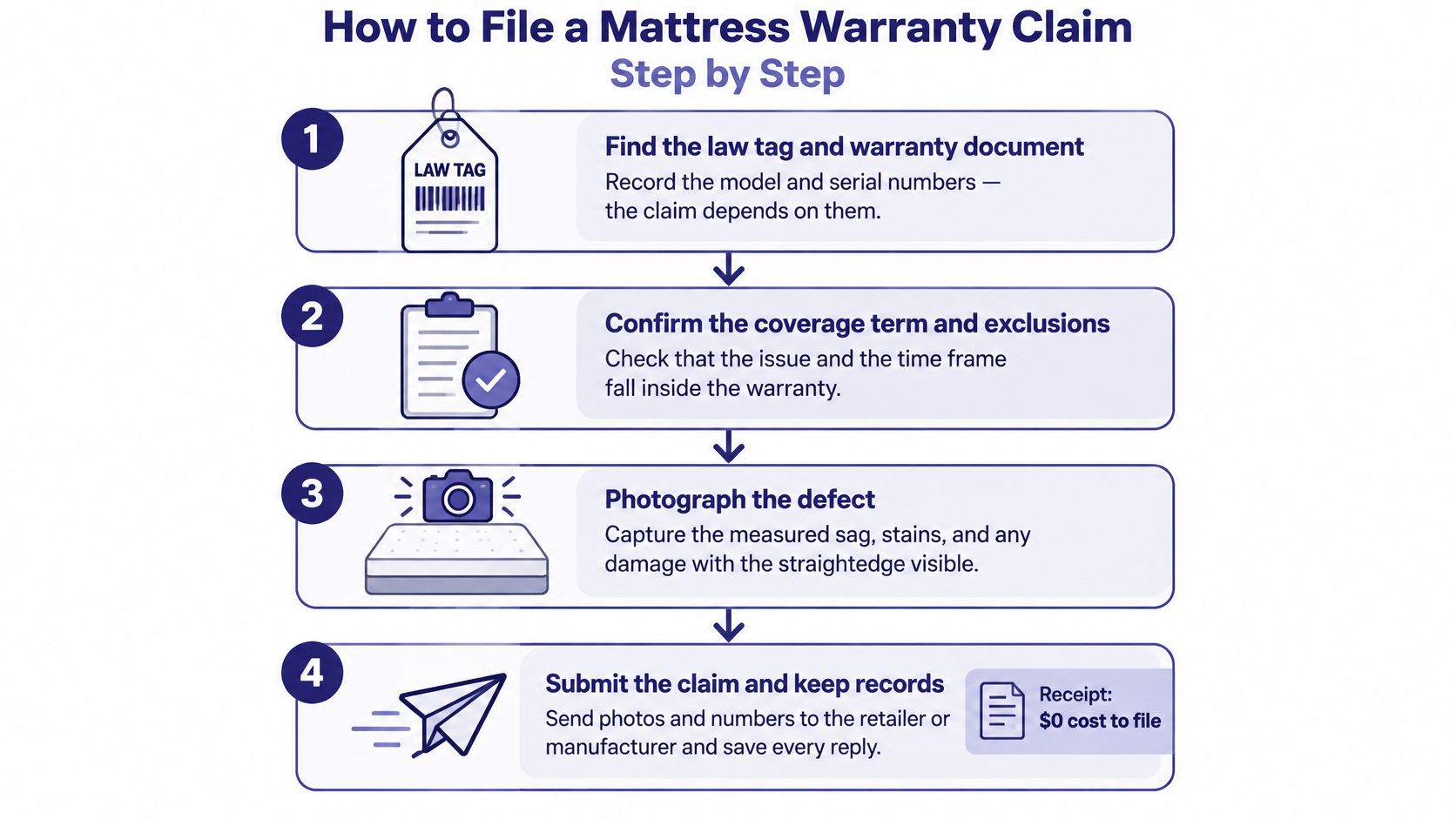
- Find the law tag and the warranty document. Record the model and serial numbers, because the claim depends on them and they're hard to recover later.
- Confirm the start date and coverage period. Check whether registration was required at purchase, since some brands ask for it.
- Photograph the defect. For sagging, measure the unloaded indentation using the brand's method and keep the ruler visible in the frame.
- Verify the foundation and photograph it too. An unsupported base gives the reviewer a reason to close the file.
- Identify who handles the claim. Some brands route service through the retailer, others straight through the manufacturer.
- Submit everything within the stated period. Receipt or order confirmation, serial information, photographs and a short written description of the fault.
- Ask what the claim involves. Inspection visits, shipping charges and fees vary, and you're entitled to know them before you agree.
- Get the claim number and keep every reply. A written record settles disputes about who said what.
The most common slip is getting rid of the mattress, or moving it to another room, before the defect is documented. Once the evidence is gone, so is the ability to support your claim.
Say a buyer notices a dip in month 14. She measures 1.4 inches with a straightedge, photographs it with the ruler in frame, checks that her frame meets the slat spacing in the document, and sends all three items to the manufacturer. The claim number arrives the same week, and the conversation stays about the defect rather than about her story.
The same process in video form, if you prefer watching it once:
Comparing Warranty Lengths Across Brands
Length is the easiest figure to market and the least useful one on its own. Consumer Reports reported in 2023 that the typical manufacturer mattress warranty lasts 10 years, that some run 12 to 25 years, and that a small number are lifetime warranties, according to Consumer Reports' guidance on getting what you need from a warranty.
Sleep Advisor's 2024 listing put published periods anywhere from 1 year to lifetime, including these examples, per Sleep Advisor's mattress warranty comparison:
| Brand | Reported period (2024 report) | Check before relying on it |
|---|---|---|
| Casper | 10 years | Remedy, proration and fees |
| Helix | 10 to 15 years | Remedy, proration and fees |
| IKEA | 25 years | Remedy, proration and fees |
| Nectar | Lifetime | Remedy, proration and fees |
| Puffy | Lifetime | Remedy, proration and fees |
Terms change, and these figures were reported in 2024, so confirm the current wording with the brand rather than shopping from a table. The middle column is a starting point, not a promise.
Which structure suits which sleeper comes down to temperament. A buyer planning to keep one mattress for a decade or more should weigh the proration schedule carefully, because the value of year 12 depends on what it costs to use it. A buyer who wants a simple, predictable remedy should compare inspection and shipping rules first, since those fees apply even on a legitimate claim. Sleeping position, firmness preference and the foundation you already own still decide whether the mattress fits, and no warranty clause fixes a bed that's wrong for you.
Confirm These Warranty Terms Before You Buy
Federal rules require written warranty terms to be available before you pay. The FTC's business guidance on warranty law explains that a written warranty on a covered consumer product must be designated as full or limited. The label alone does not explain what a mattress warranty covers, so read the terms beneath it.
Ask to see the warranty document and compare it with the sleep trial or exchange policy. A trial addresses comfort preference; a warranty covers defined defects. Mark the start date, any registration requirement, the sag threshold for your specific model, and whether the manufacturer or seller handles claims.
Before checkout, find the sentence that covers your main concern and the one that explains when a claim can be denied.
Your comfort preferences, the required foundation, and the trial period still affect whether a mattress suits you. Woodstock Furniture & Mattress Outlet offers mattresses from several brands, along with delivery options. Its staff can help you review the documents in person. Bring the model name and the foundation you plan to use, then compare the written terms.
Woodstock Furniture & Mattress Outlet sells furniture, mattresses, and home decor at its Georgia locations, and offers design services. Bring your questions about foundations, protectors, and claim procedures when you visit or explore the retailer's offerings at Woodstock Furniture & Mattress Outlet.
Leave a Reply
You must be logged in to post a comment.