Tag: mattress warranty

  • Stearns & Foster Mattresses: What to Expect

    Stearns & Foster Mattresses: What to Expect

    You're in the aisle with a phone full of reviews and a tag that already feels like a commitment. One comment reads like a quiet hotel night. The next says the middle gave up, the sleeper ran warm, or the plush feel faded sooner than expected. You can hold both stories at once. They often aren't describing the same model, the same body, or the same base.

    Stearns & Foster mattresses sit in a premium hybrid category, which means the logo doesn't lock in one sensation. Foam thickness, firmness, sleep position, body weight, and whatever is under the mattress all push the result around. What follows stays with grounded expectations. There's no verdict that one bed wins for every sleeper, and no promise that a higher tag buys a set number of comfortable years.

    Why Stearns & Foster Mattresses Confuse Shoppers

    The name already sounds expensive, so people arrive with a story half-written. Hotel-style praise says the bed feels finished. Complaint threads mention sag, heat, or a comfort drop after a few years. Those reactions can all be partly true, because this isn't one mattress with one personality. It's a premium hybrid line, and the feel moves when the build and the sleeper change.

    A thicker comfort layer lets a shoulder sink. A firmer build holds a stomach sleeper's middle up. A lighter person may barely dent a surface that a heavier back sleeper finds too soft. Put that same model on a frame with wide gaps and it can feel uneven, which is how a base problem gets blamed on the brand.

    Decisions the reviews won't make for you

    Online arguments collapse a lot of variables into a thumbs-up or a thumbs-down. On the floor, we narrow it to a few calls you can make:

    • Sleep position: Which posture needs the most help, especially if you roll from side to back.
    • How deep you want to settle: A slow contour is a different job from a surface you can turn on without a struggle.
    • Heat versus hug: Air paths in a hybrid matter more if you sleep warm. A thick foam top can still hold warmth.
    • The base: The mattress can't do its job on a support system that flexes.
    • The seller's paperwork: Trial length and fees follow the store you buy from, not the stitching on the border.

    On the floor: When we ask someone to lie in the position they actually sleep in, the review war usually shrinks. They're no longer judging the brand. They're judging one foam depth under one set of hips.

    That is the buying problem, not a product tour. The premium label still needs a paper trail, and that trail is not a comfort claim. If you want a second plain-language pass before you treat the comment section as a verdict, premium mattress guidance for Columbus homeowners walks through the same tension between a luxury name and a body-specific choice.

    How Stearns & Foster Became a Luxury Mattress Brand

    The premium label didn't start as a mattress slogan. It started as a textile shop.
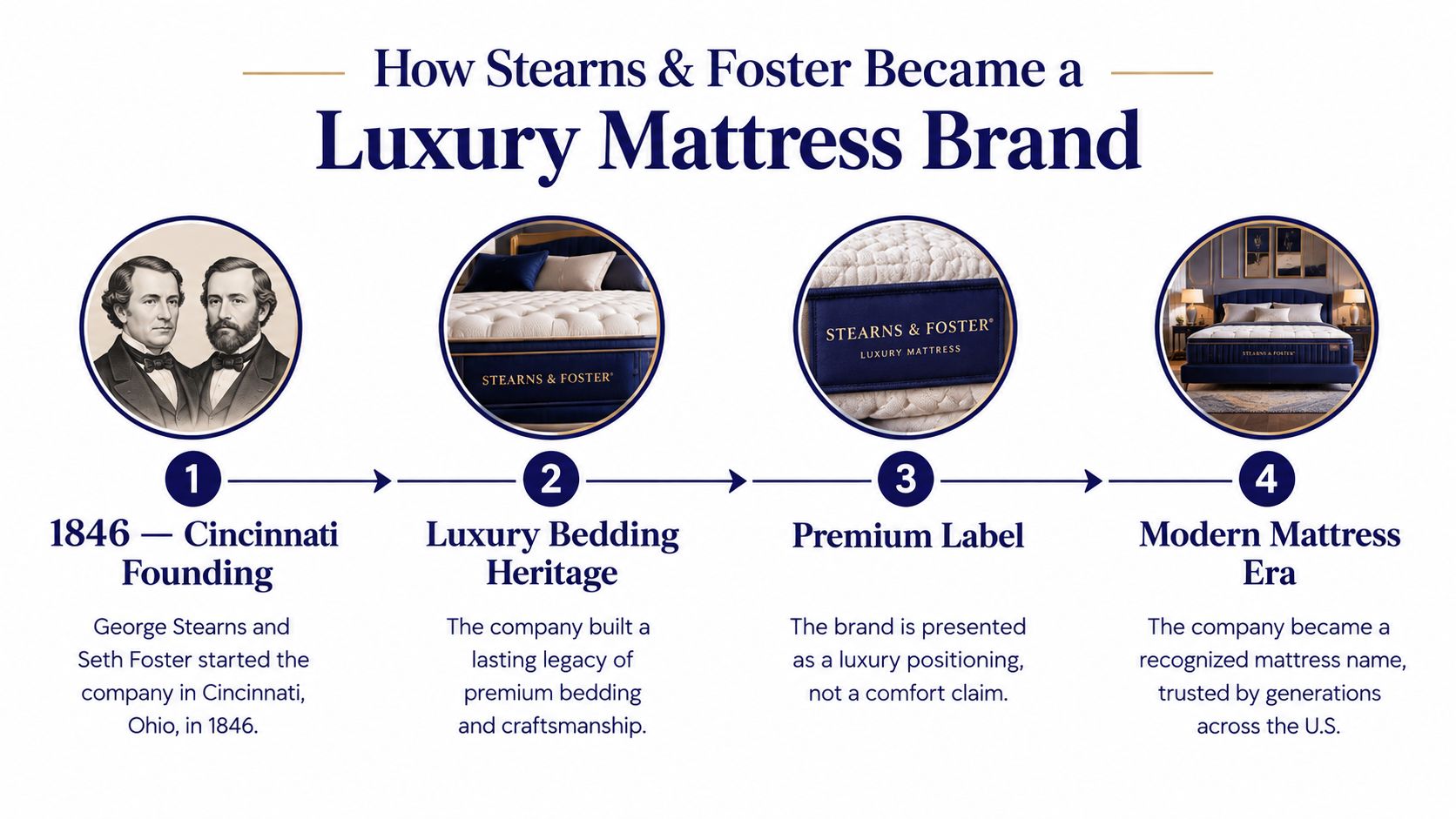
    A timeline infographic detailing the history of Stearns & Foster luxury mattress brand from 1846 to present.

    From carriage goods to a distinct line

    In 1846 George Sullivan Stearns and Seth Cutter Foster founded the company in Cincinnati, the first goods were cotton wadding and upholstery for horse-drawn carriages, the work later moved into mattresses for high-end hotels, Sealy acquired the company in December 1983 after more than 135 years in textiles and bedding, a hand-stitched look was relaunched in 2009 to stand apart in the premium segment, and the span from 1846 to 2026 is about 180 years, which is the path told in the Stearns & Foster company history. Picture a workshop that learned cloth by dressing carriages, then specialized until that craft showed up in a bedroom.

    Stearns & Foster now sits inside the broader Tempur Sealy corporate family and still operates as its own luxury line. That note explains a corporate chart. It doesn't mean every current mattress shares one feel, one foam stack, or one lifespan.

    What heritage does not prove

    Hand stitching, hotel supply, and a long textile past are reasons the brand presents itself as luxury. They aren't a lab result for pressure relief, and they aren't a calendar for how many years your hips will stay happy.

    A long company story can explain a price tier. It can't stand in for a lie-down in your usual sleep position.

    The carriage-to-bedroom path is specialization, not a comfort guarantee. A shop that once padded seats learned bedding, then kept a separate luxury identity after it joined a larger family. The dates can stop there. The useful next question is what's stacked inside the mattress.

    What Is Inside a Stearns & Foster Mattress

    Open the hybrid as two jobs sharing one tick. TEMPUR-Indulge memory foam is described as an exclusive comfort material that conforms and can ease localized pressure, while ventilated coils and AirVents are meant to supply elastic support and routes for warm air to move, which is how the Reserve collection construction is framed.
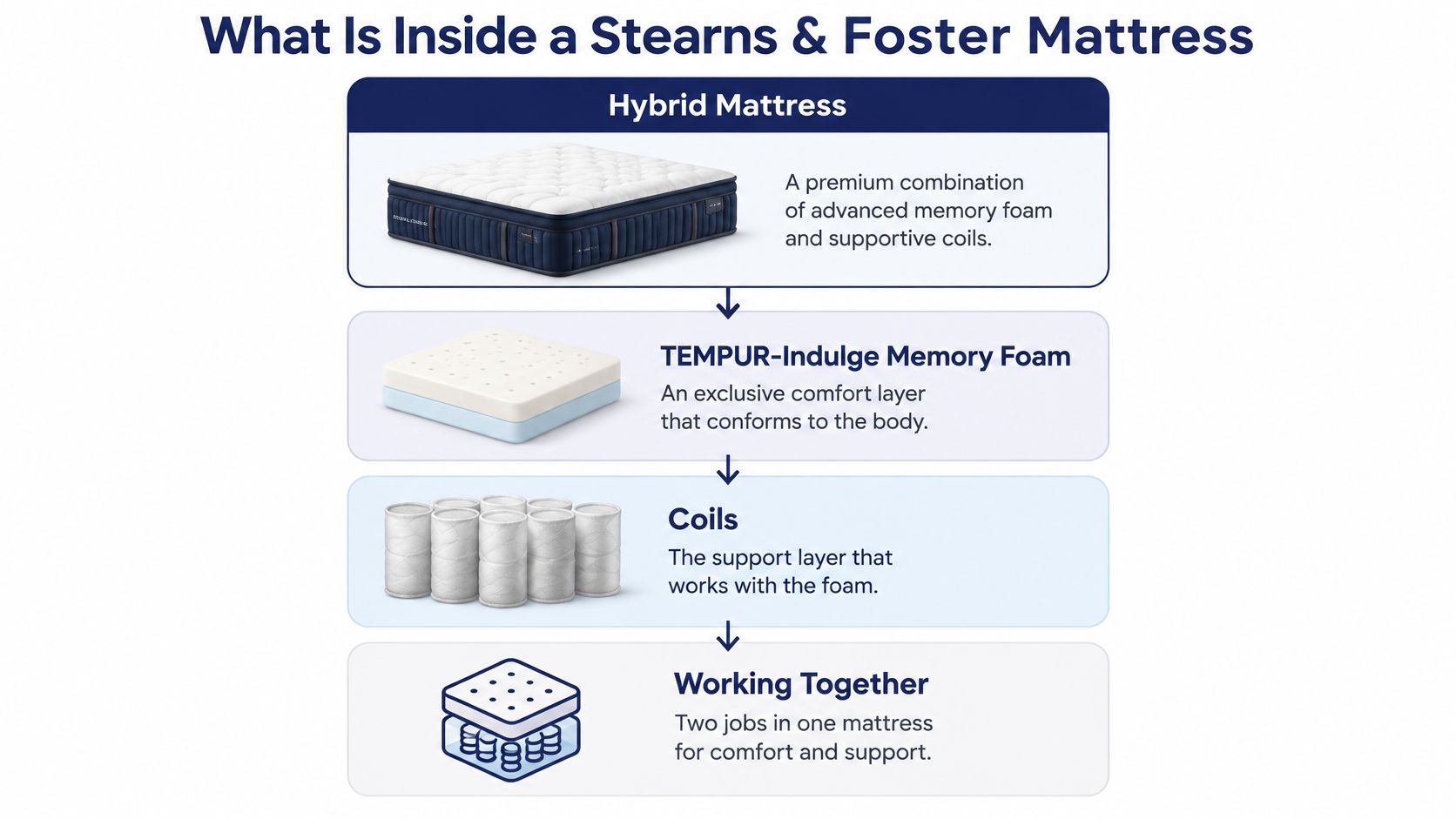
    An infographic showing the components of a Stearns and Foster hybrid mattress including foam and coils.

    Foam does the hugging. Coils do the pushing back. If you only shop the top layer, you'll miss why turning feels different from an all-foam bed. If you only shop the coils, you'll miss why a shoulder either gets relief or fights the surface.

    Coil inside a coil

    IntelliCoil is the brand's patented coil-in-coil design, a smaller coil inside a larger one so the support unit can respond differently across the mattress, and the same production story says more than 400 certified master craftspeople take part, with each mattress personally inspected and signed, as described in the 2026 luxury collections announcement. The brand positions that coil response as adaptable support for back, side, and stomach sleeping.

    That signature is a labor-intensive check. It isn't a forecast of how the bed will feel in year eight.

    Picture a seat with a soft top over a springy frame. The top follows your outline. The springs push back so turning isn't like climbing out of a foam pit. Foam still conforms, which is the point of pressure relief, and coils still have to rebound. Neither layer cancels the other.

    What to judge besides the logo

    Firmness and foam thickness change how far you sink in and how readily heat stays near the body. Two mattresses can share a border style and sleep nothing alike if one carries a thicker, slower foam top.

    • Foam's job: Contour and localized pressure relief. A deep layer can also hold warmth.
    • Coils and vents' job: Push back and give warm air a path. They don't make every sleeper feel cool.
    • The inspection's job: A person checks and signs the build. That doesn't set a comfort expiration date.

    Shop the model, not the family name alone. Once the parts have names, the next step is matching them to a body.

    Feel Profiles and the Sleepers They Suit

    Side sleepers usually need room at the shoulder and hip. Back sleepers usually need the waist supported without the hips dropping into a hammock. Stomach sleepers generally need a surface that doesn't let the midsection collapse. Those three jobs can live in one hybrid family and still require different firmness.

    The drawing below is a simple picture of that idea, contour changing with position and weight, before any collection name gets involved.
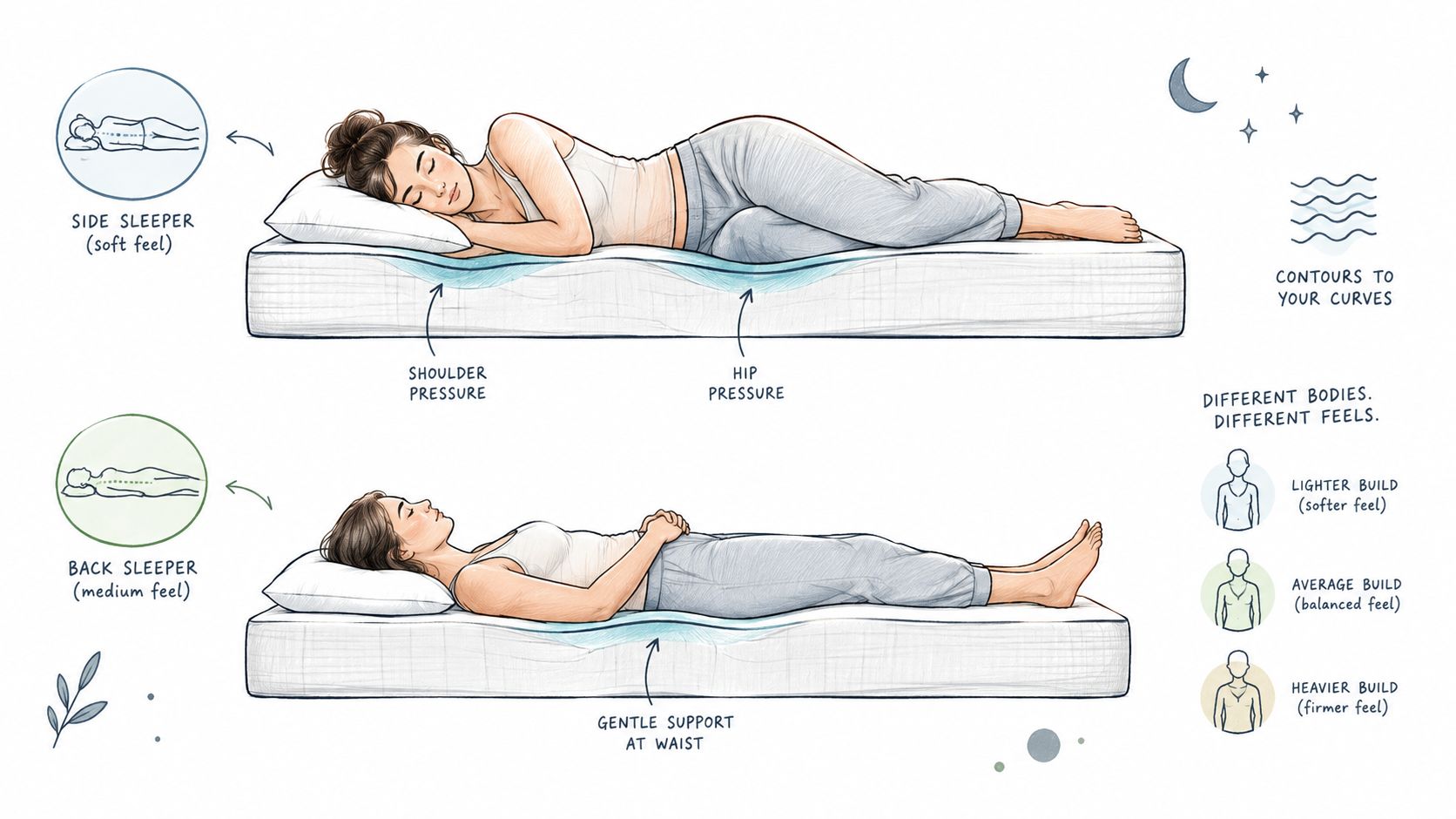
    An illustration showing how different body positions and weights affect the contouring of a mattress surface.

    The hybrid aim is contour plus easier repositioning and more airflow than a typical all-foam bed. Foam thickness and firmness still decide how deep someone settles and how much warmth they notice. A premium cover doesn't do that math for you.

    Who tends to like this feel

    Someone who sleeps hot should ask how the vents and coils are supposed to move air, then lie still long enough to notice whether warmth builds. Someone who turns often will care more about rebound than about a plush first impression. Someone who wants a deep, slow hug may be happier on a more foam-forward bed, even when this line is carefully made.

    Collections differ, so a model name isn't a feel. Studio, Estate, Lux Estate, Lux Hybrid, and Reserve aren't interchangeable labels. You have to feel the specific stack.

    There's no public price list in this comparison. Treat the line as a premium choice and ask a plainer question. Does that spend match the years you expect to keep the mattress, the position you actually sleep in, and the budget you'll have when it's time to replace it?

    Who should keep looking

    If you want to sink and stay sunk, a hybrid's push-back can feel like the bed is arguing with you. If you need a very firm plane for stomach sleeping, don't accept the plushest pillow-top as the default. A well-made mattress can still be the wrong shape for your body.

    The short video below shows how a hybrid is meant to respond when someone changes position. Treat it as a picture of the idea, then test it with your own shoulder and hip.

    A model name is a family nickname. Firmness and foam depth are the actual personality.

    Comfort shopping often stops at that nickname. The base and the paperwork are what decide whether a later problem is even covered.

    Warranty Support Rules and Trial Expectations

    A trial answers whether you like the feel. A warranty answers whether the product failed in a covered way. Mixing those two is how a comfort change gets mistaken for a replacement.
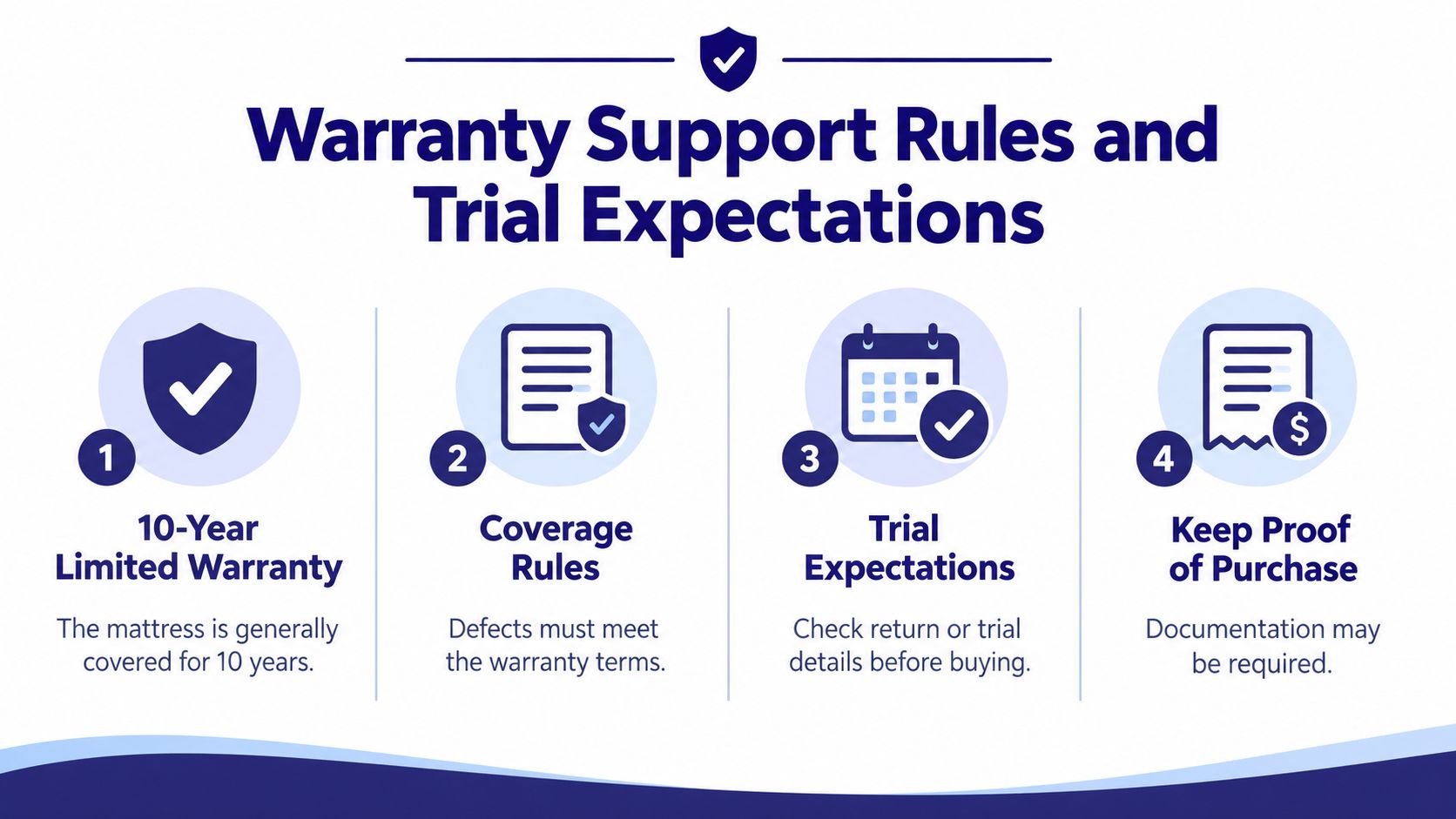
    An infographic titled Warranty Support Rules and Trial Expectations detailing four key steps for mattress customers.

    Trial length follows the seller

    Mattresses purchased directly from Stearns & Foster are described with a 90-night sleep trial, with guidance to keep the bed at least 30 days so materials can adjust, while other sellers and collections can differ and fees for returns, exchanges, pickup, or shipping may apply, which is the split laid out in Stearns & Foster trial terms by seller. A model name alone doesn't set your return window. Read the policy from the store that will take the mattress back.

    The base can void the claim

    The standard mattress and non-adjustable foundation coverage is a 10-year limited warranty for manufacturing defects under proper handling and normal use, and queen or king setups need continuous support from a rigid bridge bar with at least five support legs or five hardwood cross-slats each at least 3 inches wide and no more than 4 inches apart, plus center support, as spelled out in the mattress and flat foundation warranty. Excessive spacing or a weak center can let the foundation flex, distort the load, and put coverage at risk. Comfort preference isn't what that warranty is for.

    An unsuitable base can void coverage, and a claim may require proof of purchase, the law tag, and photographs, which is why foundation and documentation rules belong in the buying conversation. Before delivery, measure slat width and spacing, confirm the center leg meets the floor, and check that an adjustable base is rated for the mattress plus the sleeper.

    A dip you notice may be too shallow

    Common mattress warranties exclude sagging unless it reaches at least 1.5 inches, generally measured with nobody on the bed, the threshold described in mattress warranty sag guidance and tied there to how Consumer Reports explains these claims. A visible impression can still be too shallow to qualify. Photograph it, follow the written measurement, and don't assume a dip you feel at night meets the test.

    Keep three ideas apart. A structural defect is a covered failure only when it meets the written test. Normal compression is foam and coils settling with use. Comfort decline is "I don't love this anymore," which a trial might address and a warranty often won't. Rotate or support the mattress the way its care instructions say. That won't freeze the feel. It does keep you inside the conditions the warranty assumes.

    How Stearns & Foster Compares with Other In-Store Brands

    Rules for one brand don't rank a showroom. The useful comparison is which sleeper job each line is built to do.

    On the floor, Stearns & Foster is the premium hybrid in the Tempur Sealy family, with TEMPUR-Indulge foam, ventilated coils, and a hand-checked build. Tempur-Pedic is the related premium line people cross-shop when they want more of a foam hug and less coil rebound. Sealy is the broader sister brand when the luxury tier is more mattress than the sleeper needs. That isn't a quality ranking. It's a fit note.

    What to learn by lying down

    Helix, Nectar, DreamCloud, Sierra Sleep by Ashley, and Jamison are on the same floor, along with adjustable bases and foundations. There's no reason to invent their foam stacks or prices here. The differences you can learn in person show up in a quiet ten minutes:

    • First lie-down: The surface feels slow, springy, or somewhere between.
    • Turning: You can roll without bracing an elbow, or you can't.
    • Heat: Warmth builds while you stay still, or it doesn't.
    • Edge: You can sit to tie a shoe without the side collapsing.
    • Adjustable base: A head-up position is part of the plan, and the base is rated for the load.

    A higher upfront price is a bet on expected years of use, your position, and your replacement budget. It isn't a scoreboard. Independent review aggregators report an estimated average lifespan of about 11.9 years for Stearns & Foster mattresses, while individual owner reports describe substantial sagging or lost comfort after roughly three to seven years, which GoodBed's Stearns & Foster review summary presents without calling that a failure rate. Durability still varies by model, body weight, sleep position, foundation, temperature, and how much of a body impression you're willing to see.

    The maker highlights premium foam and pocketed coils. CertiPUR-US addresses emissions, chemical restrictions, and foam performance standards, not a promise that the whole mattress stays comfortable for a set number of years. Don't treat that certification, or the 10-year warranty already discussed, as predictable longevity.

    If you're sorting other coil brands with the same neutral lens, a clear look at differences between Serta and Beautyrest is a useful companion. Neither name has to lose for Stearns & Foster to make sense for a specific sleeper, and neither has to win.

    Ask which body the mattress is built to carry, not which logo should take home a trophy.

    How to Choose a Stearns & Foster Mattress

    You don't need another layer diagram. You need a sequence you can finish in one visit.

    1. Name the position that needs the most help. If you sleep on your side for most of the night, shop the shoulder and hip first, even if you start the night on your back.
    2. Pick rebound or sink. Easier turning points toward this coil-and-vent hybrid. A deeper, slower settle may point you toward a foam-forward neighbor on the same row, and that's a fine outcome.
    3. Match the base to the warranty's idea of support. If the frame, platform, or adjustable base can't carry the mattress properly, the feel you liked in the showroom won't be the feel at home, and coverage can disappear.
    4. Read the seller's trial in writing. Don't assume a figure from the brand's own site applies until that seller's page says so, including any fees.

    After you stand back up

    Lie down in your usual position for more than a quick sit. If two models feel close, choose the one that still feels right when you roll, not the one that impressed you in the first ten seconds. Bring the person who shares the bed if you can. Their hip width and heat tolerance aren't a footnote.

    Ask whoever is walking the row to point out firmness and foam differences across the models, not just the collection name. A practical model-by-model pass such as compare Stearns & Foster mattress models can prep the questions, then the lie-down still has to happen.

    Woodstock Furniture & Mattress Outlet is one place to do that comparison, at its North Georgia Sleep Centers, where Stearns & Foster sits with Tempur-Pedic, Sealy, Helix, Nectar, DreamCloud, Sierra Sleep by Ashley, and Jamison. Staff can talk through delivery, setup, and warranty paperwork without turning the visit into a countdown. A clear-eyed choice is the point, even when another brand fits your body better.


    Woodstock Furniture & Mattress Outlet carries Stearns & Foster alongside other hybrid and foam lines in its North Georgia Sleep Centers, so you can compare feel, bases, and warranty paperwork in one visit. The team can walk through setup and the questions a spec sheet leaves open. When you're ready to lie down in your usual sleep position, visit Woodstock Furniture & Mattress Outlet.
  • Beautyrest Mattress Warranty: A Guide to Coverage & Claims

    Beautyrest Mattress Warranty: A Guide to Coverage & Claims

    You finally pick out a new mattress, get it delivered, and sleep on it for the first few nights with that feeling that you made a smart investment. Then the paperwork shows up. The comfort part is easy. The warranty language usually isn't.

    That’s where many get stuck with a beautyrest mattress warranty. They assume the document is either a safety net for every problem or a maze designed to deny every claim. The truth sits in the middle. A mattress warranty is real protection, but it only applies to specific problems, and the owner has a role in keeping that protection valid.

    Think of it less like a vague promise and more like a partnership agreement. Beautyrest agrees to stand behind certain manufacturing defects. You agree to use and care for the mattress properly. When both sides do their part, the warranty makes a lot more sense and feels much less intimidating.

    Your Mattress Warranty A Promise of Quality Sleep

    A mattress warranty matters most after the excitement of buying has worn off. You’re not reading it because you're bored on a Saturday afternoon. You’re reading it because you want to know what happens if something goes wrong.

    Most shoppers have the same questions. If the mattress starts dipping, is that covered? If it feels softer than it did at first, is that a defect? If something tears or cracks, what proof do you need? Those are fair questions, and they’re exactly where warranty wording tends to become frustrating.

    The useful way to look at a warranty is this. It’s not a comfort guarantee. It’s not a promise that your preferences will never change. It’s a written promise that the mattress will be free from certain manufacturing defects for a defined period, as long as it has been used correctly.

    A good warranty protects you from a product problem. It doesn’t protect you from every life problem that happens to the product.

    That difference clears up a lot of confusion right away. If a mattress develops a covered defect, the warranty may help. If the issue comes from normal wear, a spill, an unsupportive base, or a simple change in comfort preference, the warranty usually won’t apply.

    That’s why the owner’s role matters so much. Keeping your receipt, using the right support system, protecting the fabric, and following care guidance aren’t small details. They’re part of how you preserve your rights under the warranty.

    Once you understand that, the fine print stops feeling like a trap. It becomes a checklist.

    Understanding Your Beautyrest Warranty Coverage Terms

    A warranty gets much less intimidating once you translate the label into plain English. For Beautyrest mattresses purchased directly from Beautyrest.com after March 2025, the policy is a 10-year limited, non-prorated warranty, according to NapLab’s summary of the current Beautyrest warranty terms.

    A diagram illustrating a 10-year limited, non-prorated mattress warranty with a sketch of a protected bed.

    Those three words, 10-year, limited, and non-prorated, tell you almost everything about the agreement. They also show why your role as the owner matters. Beautyrest is promising coverage for certain product defects during that time, and you are agreeing to use and care for the mattress in a way that keeps that promise valid.

    What limited means

    Limited tells you the warranty has boundaries. It covers specific manufacturing defects, not every problem a sleeper might notice over time.

    That point matters because mattress issues fall into different buckets. A product flaw is one bucket. Normal softening, an accidental spill, or a support problem are different buckets. The warranty is written for the first one.

    A good way to read the word limited is this: the manufacturer is standing behind how the mattress was made, while the owner is responsible for how the mattress is used and protected.

    What non-prorated means

    Non-prorated means the warranty’s value does not shrink as the years pass within the covered term.

    A prorated warranty can reduce the manufacturer’s share of the remedy as the product gets older. A non-prorated warranty keeps that part simpler. You are not trying to calculate a smaller and smaller coverage value in year six or year eight.

    Practical rule: Non-prorated usually makes the financial side of a claim easier to understand because there is no declining value schedule during the stated term.

    What defects are actually covered

    The current policy covers specific manufacturing defects, not general dissatisfaction. The details shoppers usually care about most are:

    • Sagging in pillowtop models: Depressions or sagging that exceed 1.5 inches
    • Sagging in all-foam models: Depressions that exceed 0.75 inches
    • Foam defects: Foam flaws that cause splitting or cracking
    • Cover defects: Problems such as unraveling stitching or faulty handles

    Many claims often become confusing. A customer may say, “My mattress is sagging,” and mean it feels less supportive than it did at first. Warranty language asks a narrower question. Is there a measurable defect that exceeds the stated threshold for that mattress type?

    Why measurement matters so much

    Two mattresses can show different claim results even if the owners describe the problem the same way.

    Suppose you own a pillowtop Beautyrest and the spot where you sleep looks lower. The next question is not whether it feels annoying. The next question is whether the visible depression is deep enough to meet the warranty standard.

    Now compare that with an all-foam model. The qualifying depth is different there, so the inspection standard changes too.

    That is why the warranty works more like a written checklist than a comfort conversation. The mattress type matters. The depth matters. Your records and setup matter too.

    Other terms worth knowing

    A few other rules shape how the agreement works in real life:

    • Coverage begins at delivery
    • It applies to the original purchaser
    • It cannot be transferred to a later owner
    • It applies only in the regions listed by the warranty
    • If the original model has been discontinued, a comparable replacement may be used

    These details may sound administrative, but they often decide whether a claim goes smoothly. If the receipt is missing, the ownership history is unclear, or the mattress was not kept in claim-ready condition, the process gets harder fast.

    The safest approach is to treat the warranty like a partnership agreement. Beautyrest covers qualifying manufacturing defects. You keep the mattress properly supported, reasonably protected, and well documented so that coverage is still there if you ever need to use it.

    What The Beautyrest Warranty Does Not Cover

    You wake up with a sore back, look at the mattress, and notice your side seems lower than it used to. From your point of view, something is clearly wrong. From the warranty’s point of view, the next question is different. Is this a manufacturing defect, or is it normal wear, damage, or a support problem?

    That distinction is the heart of the fine print.

    A Beautyrest warranty works like a partnership agreement. The manufacturer stands behind defects in materials and workmanship. The owner’s role is to keep the mattress in a condition that can be fairly inspected and properly supported. If either side of that agreement breaks down, coverage can too.

    The exclusions that cause the most confusion

    Many denied claims fall into a few familiar categories. The mattress may feel softer than it did when new. It may show impressions that are visible but still below the warranty threshold. The issue may come from a stain, a tear, a burn, pests, or a base that does not support the mattress evenly. Adjustable bases also follow their own warranty rules rather than the mattress warranty.

    That can feel frustrating, especially when the bed is no longer comfortable. But comfort changes and warranty defects are not the same thing.

    Here is a simple way to sort it out. The warranty usually does not cover three buckets:

    • Normal wear: expected softening and minor impressions from regular use
    • Damage: stains, burns, tears, or contamination that affect the mattress
    • Setup issues: problems linked to an inadequate foundation or other support issue

    Beautyrest Warranty At-a-Glance Covered vs. Not Covered

    Covered Manufacturing Defects Common Exclusions (Not Covered)
    Sagging or depressions that exceed the qualifying threshold for the applicable mattress type Softening that happens with normal use
    Foam splitting or cracking caused by a product flaw Body impressions that do not exceed the required depth
    Cover defects such as unraveling stitching or faulty handles A comfort preference change
    Stains, burns, tears, or vermin
    Damage linked to an inadequate foundation
    Adjustable bases under the mattress warranty

    Why comfort complaints and defect claims are treated differently

    This is the part that catches many mattress owners off guard. A bed can stop feeling good long before it meets the warranty definition of a defect.

    That is because every mattress changes somewhat with use. Foams break in. Quilting settles. Your body, sleep position, and pressure points can change too. Those changes can be real and annoying without proving the mattress was built incorrectly.

    A good store should be honest about that. An uncomfortable mattress deserves attention, but a warranty claim still has to match the written defect standards.

    You can have a mattress that feels wrong without having one that qualifies for warranty service.

    Why stains and support problems matter so much

    These exclusions are easier to understand if you picture a warranty inspection like a mechanic checking an engine. If the parts are covered in spilled fluid or the car has been driven with the wrong support under it, the inspection gets harder and the cause of the problem gets less clear.

    A stain can raise questions about what reached the materials inside. An uneven or weak base can create dipping, bending, or stress that starts below the mattress, even though the top surface is where you notice it. That is why the owner’s side of the partnership matters so much.

    Keeping the mattress clean is part of protecting the claim, not just protecting the fabric. If you ever need help with cleanup basics, Calibre Cleaning's guide offers practical at-home steps.

    If you remember one idea from this section, keep this one. The warranty is strongest when the mattress stays clean, properly supported, and easy to inspect.

    How to Protect Your Investment and Your Warranty

    A lot of warranty trouble starts long before anything goes wrong with the mattress. It starts on an ordinary day. The receipt gets tossed in a drawer, the protector never gets added, or the bed goes onto a frame that looks fine but does not fully support it. Months later, if a concern shows up, those small choices can matter as much as the mattress itself.

    That is why this part of ownership helps to view the warranty as a partnership agreement. Beautyrest promises coverage for qualifying defects. Your role is to keep the mattress clean, properly supported, and identifiable so the cause of a problem is easier to verify.

    A pencil sketch illustration showing hands cleaning or wiping down the surface of a mattress.

    The care habits that matter most

    A few simple habits do most of the work:

    • Keep proof of purchase: Save your receipt somewhere easy to find. A photo or digital backup helps because paper receipts fade, tear, and disappear.
    • Leave the law tag attached: That tag works like the mattress’s ID card. If a claim is ever needed, it helps confirm exactly what you own.
    • Use a mattress protector: A waterproof protector helps prevent stains and moisture problems that can complicate warranty review.
    • Use proper support: Place the mattress on a foundation or frame that gives even, stable support across the surface.
    • Rotate on a regular schedule: Rotation helps the mattress wear more evenly under normal use, especially if the same sleeper stays in the same spot night after night.
    • Clean spills quickly: Fast cleanup can keep a small accident from becoming a lasting stain or moisture issue.

    Why rotation still matters

    Rotation is easy to ignore because wear develops slowly. From across the room, the mattress may look unchanged. Up close, the comfort layers can be breaking in more in one area than another.

    A good comparison is rotating tires on a car. It does not repair damage or correct a defect. It helps normal wear happen more evenly, which makes it easier to judge the mattress on its actual condition instead of preventable uneven use.

    For everyday upkeep, a practical home-cleaning reference like Calibre Cleaning's guide can help you handle routine mattress care without overdoing moisture or harsh methods.

    Protect the top and support the bottom

    The top and bottom of the bed do different jobs. The protector shields the sleep surface. The base carries the weight.

    If the base is weak, bowed, or uneven, the mattress above it can start showing the stress. That can confuse the picture during a warranty review because the visible problem may be on the mattress while the root cause sits underneath it.

    This is one of the easiest points for shoppers to miss. A mattress is only one part of the sleep system. The warranty tends to work best when the whole setup is doing its share.

    Here’s a quick visual refresher on basic mattress care habits and setup awareness:

    A simple owner checklist

    If you want a short routine to follow, use this:

    • Right after delivery: Save the receipt and take a clear photo of the law tag.
    • Before first use: Add a quality protector.
    • During setup: Check that the frame or foundation feels level and secure.
    • Every so often: Rotate the mattress and look for any visible changes.
    • After any spill or accident: Clean and dry the area promptly.

    Owner mindset: The strongest warranty claim usually comes from a mattress that has been cared for consistently and documented well.

    Customers feel much more confident when they know they have done their part. If a true defect appears later, good care habits make the process clearer, cleaner, and easier to support.

    The Step-by-Step Beautyrest Warranty Claim Process

    When something looks wrong with a mattress, many owners freeze because they assume the process will be combative. It doesn’t have to be. The clearest claims usually come from clear evidence and a calm, organized approach.

    The first thing to know is that Beautyrest’s current setup is simpler than its older structure. Before March 2025, warranties varied by model and law label code. For example, older L models had a 25-year total warranty with 10 years non-prorated and a sagging standard of 0.75 inches or less, while M models had 15 years total with impressions up to 1.5 inches, according to Beautyrest’s pre-March warranty archive. The newer standardized approach is easier for shoppers to understand because it replaces those tiers with one clearer framework for qualifying direct purchases.

    An infographic detailing the five steps of the Beautyrest warranty claim process, from documentation to final resolution.

    Step one document the problem carefully

    Start with the basics. Take clear photos of the mattress from multiple angles. Photograph the entire bed, the close-up issue area, the law tag, and the support system underneath.

    If the concern is a depression or sag, document it carefully and consistently. Don’t eyeball it and send one dim photo. Try to show the issue in a way that makes the mattress condition easy to evaluate.

    Write down what you’ve noticed. Include when you first saw the issue, whether it has changed over time, and whether the mattress is being used on its intended support system.

    Step two gather your warranty claim checklist

    Before you contact anyone, collect the information you’re likely to need. This saves time and reduces back-and-forth.

    Your Warranty Claim Checklist should include:

    • Proof of purchase: Your original receipt or order confirmation
    • Product identification: A photo of the law tag and any relevant model details
    • Issue photos: Good lighting, wide shots, and close-ups
    • Support photos: The foundation, frame, and any visible center support
    • Short written summary: A simple explanation of the problem and when it appeared

    If you’ve ever registered another home product before, you already know the pattern. A good comparison is the kind of product documentation process shown in the warranty for Ecuadane products, where ownership details and product identification matter from the start.

    Step three contact the right party first

    In many mattress situations, the retailer where you purchased the mattress is the best first stop. They can often explain the next step, confirm what documentation is needed, and help you avoid common mistakes.

    If the retailer is unavailable, the verified warranty details note that Beautyrest provides direct support channels for claims. That matters because it gives owners a path forward even if the original seller can’t assist.

    A warranty claim usually moves faster when the customer sends complete information the first time.

    Step four prepare for inspection

    Some claims require inspection or further review. In these circumstances, proper setup and mattress condition are important.

    Make sure the mattress is accessible. Remove bedding. Be ready to show the support system underneath. If the issue is a visible depression, present the mattress in a way that makes the condition easy to assess.

    Try not to “help” your case with exaggerated descriptions. Clear and factual beats dramatic every time. A mattress claim is strongest when the evidence speaks for itself.

    Step five understand the possible outcomes

    A claim doesn’t always end with a brand-new identical mattress. Depending on the findings and the warranty terms, the resolution may involve repair, replacement, or a comparable model if the original has been discontinued.

    That’s normal. Warranty remedies are about correcting a covered defect under the stated terms, not recreating the exact original buying moment.

    If a claim is denied, that doesn’t always mean someone acted unfairly. It often means the issue fell outside the coverage terms, the defect threshold wasn’t met, or the mattress condition prevented approval. That’s frustrating, but it’s also why careful setup, care, and documentation matter so much before any problem arises.

    Manufacturer Warranty vs Store Protection Plans Explained

    This is one of the biggest points of confusion in a mattress store. People hear the words “warranty” and “protection” and assume they mean the same thing. They don’t.

    A manufacturer warranty is included with the mattress and focuses on defects in materials or workmanship. A store protection plan is usually optional and is designed more like accident coverage for specific mishaps that a manufacturer warranty doesn’t handle.

    The car analogy that makes this easier

    Think about a car. The manufacturer’s powertrain warranty covers defects in the vehicle itself. It doesn’t cover coffee spilled on the seats, a torn interior panel, or a parking lot mishap.

    A store protection plan works more like separate coverage for the life accidents that happen after purchase. That’s why the two aren’t interchangeable.

    A hand-drawn illustration comparing a manufacturer warranty to a retail store protection plan for products.

    Side-by-side comparison

    Manufacturer warranty Store protection plan
    Included with the mattress Usually optional
    Focuses on manufacturing defects Often focuses on accidental damage or specific incidents
    Uses the manufacturer’s rules and defect standards Uses the plan provider’s rules and covered events
    Doesn’t function as a comfort guarantee Doesn’t replace reading the contract

    When each one matters

    If the foam splits because of a product flaw, that’s the kind of issue a manufacturer warranty is built to address. If someone spills something on the mattress or causes accidental damage, that usually falls outside the manufacturer warranty.

    That doesn’t mean everyone needs an added plan. It means shoppers should understand what risk they’re trying to solve. Households with kids, pets, frequent snacks in bed, or a history of spills may think about protection differently than a guest room owner who keeps the bed lightly used and carefully maintained.

    Buy a protection plan only if you understand what it covers, what it excludes, and why it fits your household.

    The best choice is an informed one. Not an automatic yes, and not an automatic no.

    How Woodstock Furniture & Mattress Outlet Can Help

    A warranty is easiest to live with when someone explains it clearly before delivery day. That’s where a knowledgeable mattress team can make a real difference. Good guidance helps customers match the mattress to the right support system, understand basic care, and keep the documents they may need later.

    That support also matters if a concern comes up after the sale. A well-established local retailer can often help customers start the conversation, organize what information is needed, and understand whether they’re dealing with a likely defect, a comfort issue, or a support problem. That kind of clarity saves time and lowers stress.

    For many shoppers, the essential value isn’t just the mattress itself. It’s having experienced people walk through the details in plain language so the paperwork doesn’t feel overwhelming. A warranty is easier to trust when you understand it from the beginning.


    If you'd like help comparing mattress types, understanding foundation requirements, or talking through what warranty language really means before you buy, Woodstock Furniture & Mattress Outlet offers a hands-on shopping experience with knowledgeable staff who can help you make a confident decision.