Tag: closet organization

  • Closet Organization Systems: A Practical Buying Guide

    Closet Organization Systems: A Practical Buying Guide

    You pull a shirt from the closet and a stack of folded clothes shifts onto the floor. The shelf above is too shallow for the things you need to store, while the hanging space is crowded with items you rarely wear. A closet organization system can help, but only if it fits your room, belongings, and living situation. Renters, in particular, may need storage that works without permanent changes.

    What Closet Organization Systems Are and Why They Matter

    A closet organization system is a coordinated arrangement of storage components, such as hanging rods, shelves, drawers, bins, and shoe racks. Some systems are freestanding and easy to move. Others attach to the walls, adjust to different needs, or are designed as built-ins. Their purpose is to make the available space easier to use, not merely to make the closet look tidy.

    That distinction matters. A row of bins may hide clutter without making daily items easier to find. A better layout puts frequently worn clothes within reach, gives folded garments a stable surface, and keeps the floor clear enough to access the rest of the closet.
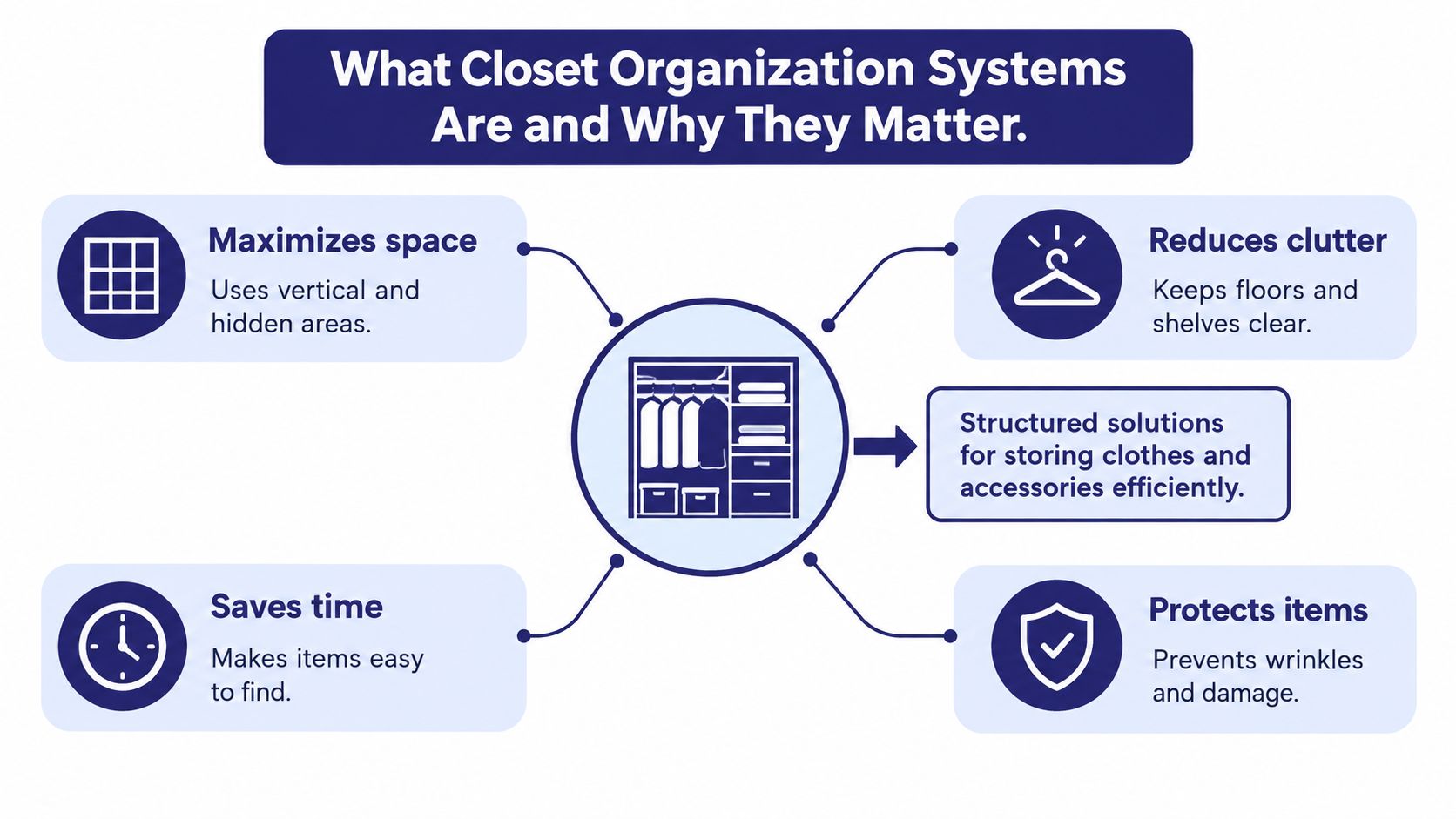
    A diagram illustrating the benefits of closet organization systems including space maximization, clutter reduction, time saving, and item protection.

    Why a system can help

    When storage has a clear place for different belongings, getting dressed can take less searching and reshuffling. Separating hanging clothes from folded items also reduces the chance that stacks topple each time you take something from the bottom. A system won't remove belongings you no longer use, but it can make what you keep more visible and accessible.

    The need for organized storage isn't limited to large walk-in closets. A 2024 U.S. consumer survey found that 55% of homeowners said they didn't have enough home-storage solutions, such as cabinets, benches, shelves, or racks, to give everything a proper place. The survey covered home storage broadly, not closets alone, but it shows why closet planning can be part of a larger effort to create usable storage around the home. (2024 U.S. homeowner storage survey)

    Start with what the closet needs to do

    Think about the items that cause the most trouble. If shirts and jackets crowd the rod, a second hanging level may help. If shoes and folded clothes compete for shelf space, adjustable shelves or drawers may suit them better. If the problem is a lack of storage in a rental, a portable wardrobe may be more practical than a wall-mounted installation.

    The right system depends on space, belongings, and daily habits, not on one universal closet plan. A small freestanding piece can be enough for a narrow closet, while a larger shared space may need several distinct zones.

    Comparing Closet System Types and Who Each Fits Best

    Different system types solve different problems. The main choices are freestanding units, modular systems, wire shelving, and custom built-ins. Compare them by how they attach, whether they can move with you, and how much flexibility you need, rather than assuming one category works for every home.

    Freestanding units

    Wardrobes and armoires provide hanging space and may include shelves or drawers. Because they don't require a permanently installed closet framework, they can suit renters, bedrooms without closets, or households that need portable storage. The tradeoff is that the unit occupies floor space, so check that doors and drawers can open without blocking pathways.

    Modular systems

    Modular pieces combine components that can be rearranged or expanded. They can be a practical option if you want to tailor a layout without committing to a fully built-in design. You'll need to confirm that the available widths and heights fit your closet, and that assembly and wall attachment, if required, are appropriate for your home and lease.

    Wire shelving

    Wire systems leave items visible and allow air to move around stored belongings. They're often used in utility and linen closets, but the open grid can be less suitable for small objects or delicate folded items. Don't assume a shelf can hold a particular load just because it's made of metal; span, supports, fasteners, and installation all matter.

    Custom built-ins

    Built-ins are designed for a particular space and can use its walls and vertical area efficiently. They're a more permanent choice, which can make them a poor fit for a renter or someone expecting to move soon. Before choosing one, consider whether the added fit and fixed installation suit how long you plan to stay and how you use the room.

    A September 2022 storage report found that more than 53% of homeowners in homes larger than 2,000 square feet had wire organizers or a built-in closet organizer, and 27% upgraded their closet system after moving in. The figures illustrate that closet storage can be both an existing home feature and a later project. (September 2022 storage report)

    For another homeowner-focused perspective on planning a fitted layout, see this closet organization guide for South Jersey homeowners.

    Materials and Load Limits to Know Before You Buy

    A shelf's material alone doesn't tell you how much weight it can safely hold. Unsupported span, fastener penetration, the number of fasteners, panel density, and anchor quality all affect performance. A sturdy-looking shelf can still sag if it's too long for its supports or attached to the wall with unsuitable hardware.

    As a general benchmark, a shelf spanning 24–36 inches may support approximately 50–75 pounds under a static, evenly distributed load. At a 36–48 inch span, the approximate capacity may fall to 40–50 pounds. These are not universal ratings for every product, so use them as context and follow the manufacturer's tested specifications for the actual shelf and installation. (closet shelf span and load guidance)

    Shelf span Approximate load capacity Notes
    24–36 inches 50–75 pounds Static, evenly distributed load
    36–48 inches 40–50 pounds Longer spans may need added support

    Distributed weight isn't the same as a heavy stack

    A load rating for weight spread across a shelf doesn't automatically apply to a concentrated pile. A dense stack of books, shoes, or folded linens puts more pressure in a smaller area. If a shelf will hold heavy or tightly grouped items, check the manufacturer's guidance for that use rather than relying on a distributed-load figure.

    Practical rule: Keep regularly loaded shelves within the manufacturer's tested span and load range. Add a center support or vertical panel when the design calls for one.

    Check the wall connection

    Whenever possible, secure the system to structural studs using the specified hardware. If studs aren't available where you need the supports, choose anchors with a rated capacity that exceeds the calculated load, including the shelf, brackets, and contents. Follow installation instructions for the wall type; drywall alone shouldn't be treated as a reliable support method without appropriate rated anchors.

    This is especially important for renters. Ask the property manager what attachments are permitted before drilling, and make sure the system's weight and anchoring needs suit the approved installation. A freestanding unit avoids many wall-attachment questions, though it still needs to fit the room and remain stable in use.

    Measuring Your Closet and Planning the Layout

    Measure before choosing a system. A product that looks suitable online may be too deep for a door to close over, or too tall for a closet with a low ceiling. Write down the clear dimensions and note anything that could interfere with installation or everyday access.
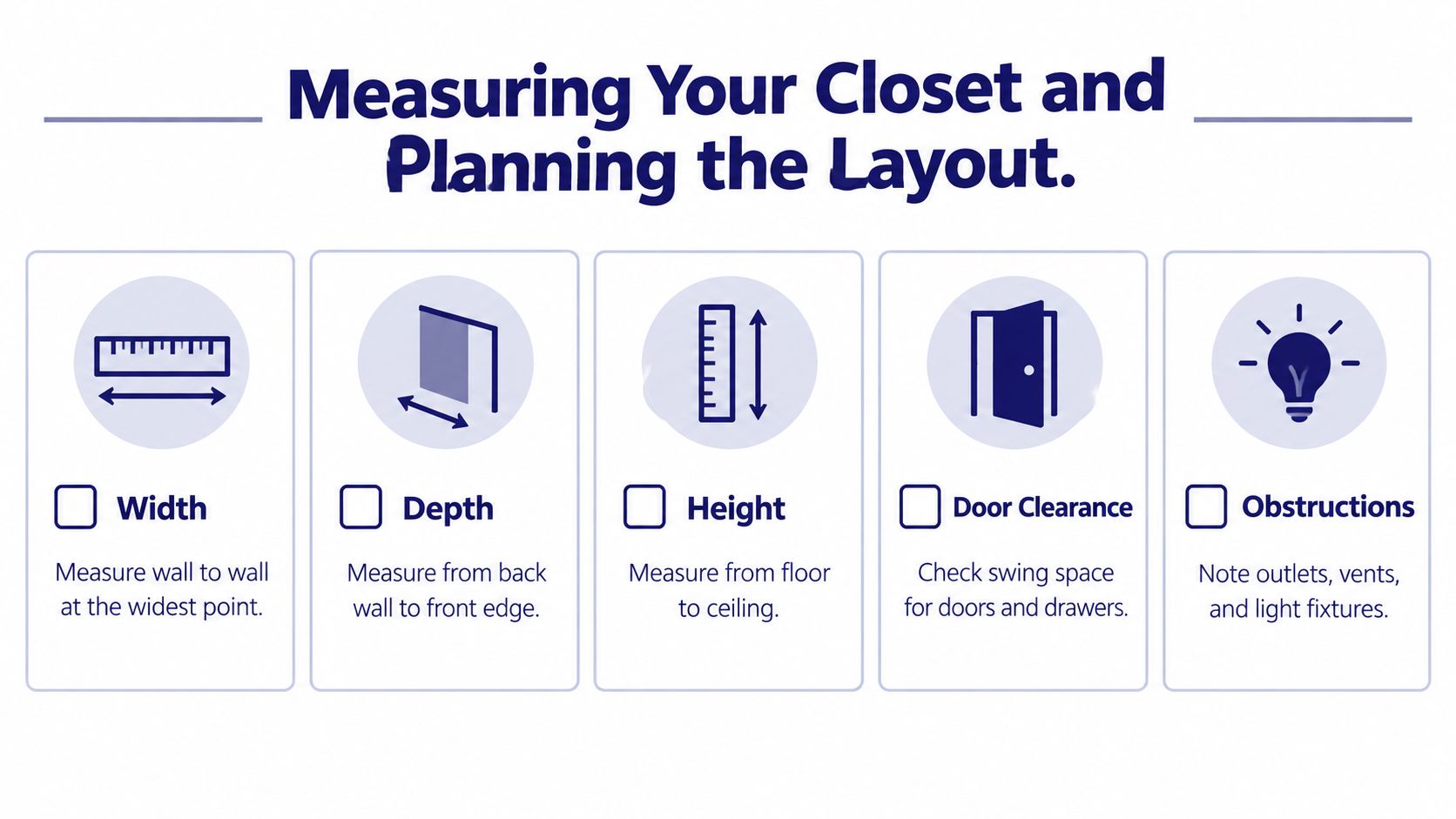
    A guide infographic illustrating the essential steps for measuring a closet when planning a layout.

    Record the usable space

    Measure width from wall to wall, depth from the back wall to the front edge, and height from the floor to the ceiling. If the walls or floor aren't perfectly even, note that too. Record door swing and clearance for drawers, and mark outlets, vents, light fixtures, and existing shelving that might limit where components can go.

    Then inventory the belongings you plan to store. Separate clothes that hang from those you fold, and set aside space for shoes, bags, and accessories. If two people share a closet, identify which items each person needs to reach daily. That inventory gives you a more useful starting point than choosing a layout based only on an attractive display.

    Put daily items where they're easy to reach

    Place the items you use most often in convenient locations, then assign less-used or seasonal belongings to harder-to-reach areas. The 2010 ADA Standards use a forward-reach range of 15 to 48 inches above the floor, which can serve as a practical reference for frequently accessed clothing and accessories. It's a helpful planning benchmark, not a substitute for adapting the layout to the people who use the closet. (2010 ADA Standards reference for reach range)

    Preserve airflow

    Closets also need ventilation. Building Science Corporation identifies relative humidity above approximately 80% as a condition associated with mold growth in closets and recommends airflow paths that help equalize closet temperature and pressure with adjacent rooms. (Building Science Corporation on closet airflow and humidity)

    Avoid blocking return grilles with bins, and don't close off an intended door undercut or transfer opening when arranging storage. In humid areas, leave airflow paths open and avoid crowding dense clothing storage tightly against every surface where practical.

    Choosing a System Based on Space, Budget, and Lifestyle

    A useful choice balances three things: the physical room, the amount you want to spend, and how you use your belongings. A system that holds a lot but makes daily items hard to see may not solve the problem. Similarly, a permanent installation may be a mismatch if you expect to move.

    Consider a renter in a small apartment. A freestanding wardrobe or a combination of removable hanging organizers and a portable drawer unit may provide useful storage without permanent wall changes. The tradeoff is floor space, so measure the room and check that doors, drawers, and walkways remain clear.

    A family sharing a walk-in closet has a different challenge. Instead of filling every wall with identical shelving, assign separate zones for each person and for different storage needs. Open shelves can make folded clothes easier to spot, while drawers keep smaller items contained. If seasonal belongings take up too much room, set aside a designated area for items that aren't in current use rather than mixing them into everyday storage.
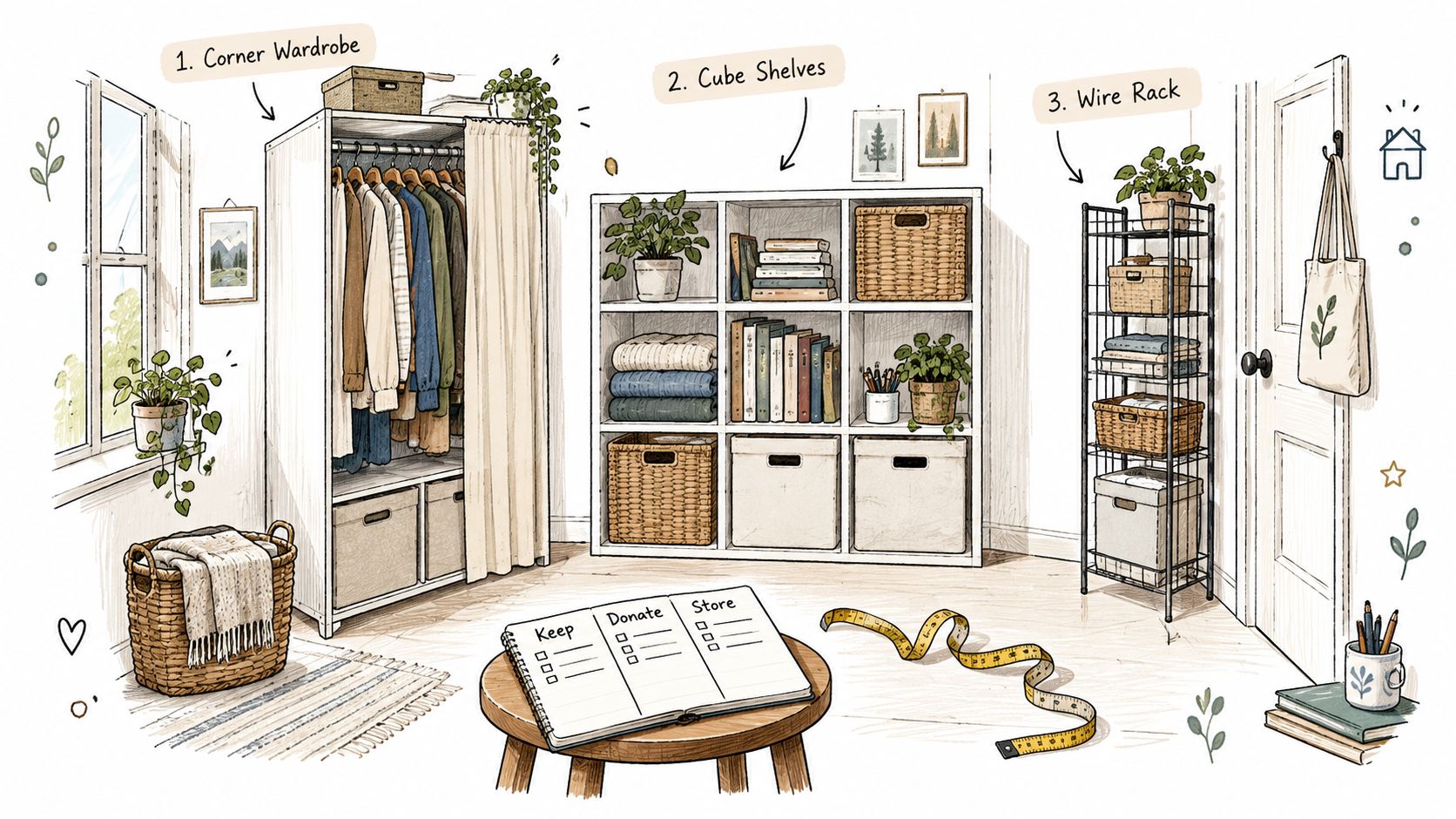
    A cozy, hand-drawn illustration showing a organized room with a wardrobe, cube shelves, and a wire rack.

    For a homeowner planning to stay in the home, a built-in may be worth considering if the closet's existing layout wastes space or doesn't suit the household. Compare that investment with adjustable or modular alternatives, and decide whether you want the system to remain in place if your needs change.

    A workable closet is the one you can use and reset without turning putting clothes away into another chore.

    Before adding more capacity, ask whether everything needs to stay in the closet. A visible, easy-to-edit arrangement can be more useful than extra shelves that make it easier to hold items you rarely wear. Choose the simplest layout that supports your routines and makes the belongings you want to keep easy to find.

    Installation and Maintenance Options and What They Cost

    Installation can be a do-it-yourself project, a professional job, or a mix of the two. Freestanding furniture typically avoids permanent closet construction, though you'll still need to assemble it and confirm it sits safely in the room. Modular systems may require careful assembly and wall attachment; built-ins usually need accurate measurement and installation suited to the walls and product.

    If you're renting, check your lease or ask the property manager before drilling or making any other lasting change. For a portable system, keep the assembly instructions and hardware together so you can dismantle and move it more easily. A hybrid approach can also work: have a qualified installer handle the structural work while you organize clothes and accessories afterward.

    Costs vary with size, materials, drawers, accessories, delivery, and installation, so compare itemized quotes rather than relying on a broad label such as “custom.” Wire shelving is generally a more economical category, modular systems offer a middle ground, and custom built-ins typically require a larger investment. Ask what the quoted price includes, including measurements, hardware, removal of existing fixtures, and any wall repair.

    Maintain the system you choose

    Use cleaning guidance for the specific finish and material. Check that fasteners and brackets remain secure, and adjust shelves or rods when your storage needs change. Do not overload a component because it has held a lighter load without problems; use the product's instructions and rated limits.

    A flexible system can also make later changes easier. If your wardrobe shifts from mostly hanging clothes to more folded items, adjustable shelves may save you from replacing the whole layout. That flexibility has value, but only if the system's components can be repositioned safely and the wall attachments remain suitable.

    Getting Local Design Help and Planning Your Purchase

    A local furniture or storage consultant can help translate measurements and storage needs into a workable layout. Bring photos of the closet, your measurements, and a rough list of what you need to store. Be clear about whether you rent or own, whether you can drill into the walls, and whether the system may need to move later.

    Ask how each option attaches, what wall types it supports, what load limits apply, and which parts are included. If you're comparing quotes, check that they describe comparable materials, components, installation, and service. The Federal Trade Commission says advertisers need a reasonable basis for objective claims before publishing them, so statements such as “fits any closet” or “doubles storage” should be backed by measurable specifications and clear conditions. (FTC advertising substantiation policy)

    Woodstock Furniture & Mattress Outlet offers armoires and wardrobes with hanging space, shelves, drawers, and removable closet rods for clothing storage. Seeing a piece in person can help you judge its size and layout, especially if you're considering a portable option instead of permanent installation.


    Bring your measurements and photos to Woodstock Furniture & Mattress Outlet and ask about wardrobes and armoires that suit your room and storage needs. The team can help you compare practical options in person, including pieces with hanging space, shelves, drawers, and removable closet rods. Visit Woodstock Furniture & Mattress Outlet to explore what may fit your home.
  • Storage Solutions for Bedrooms: A Practical Guide

    Storage Solutions for Bedrooms: A Practical Guide

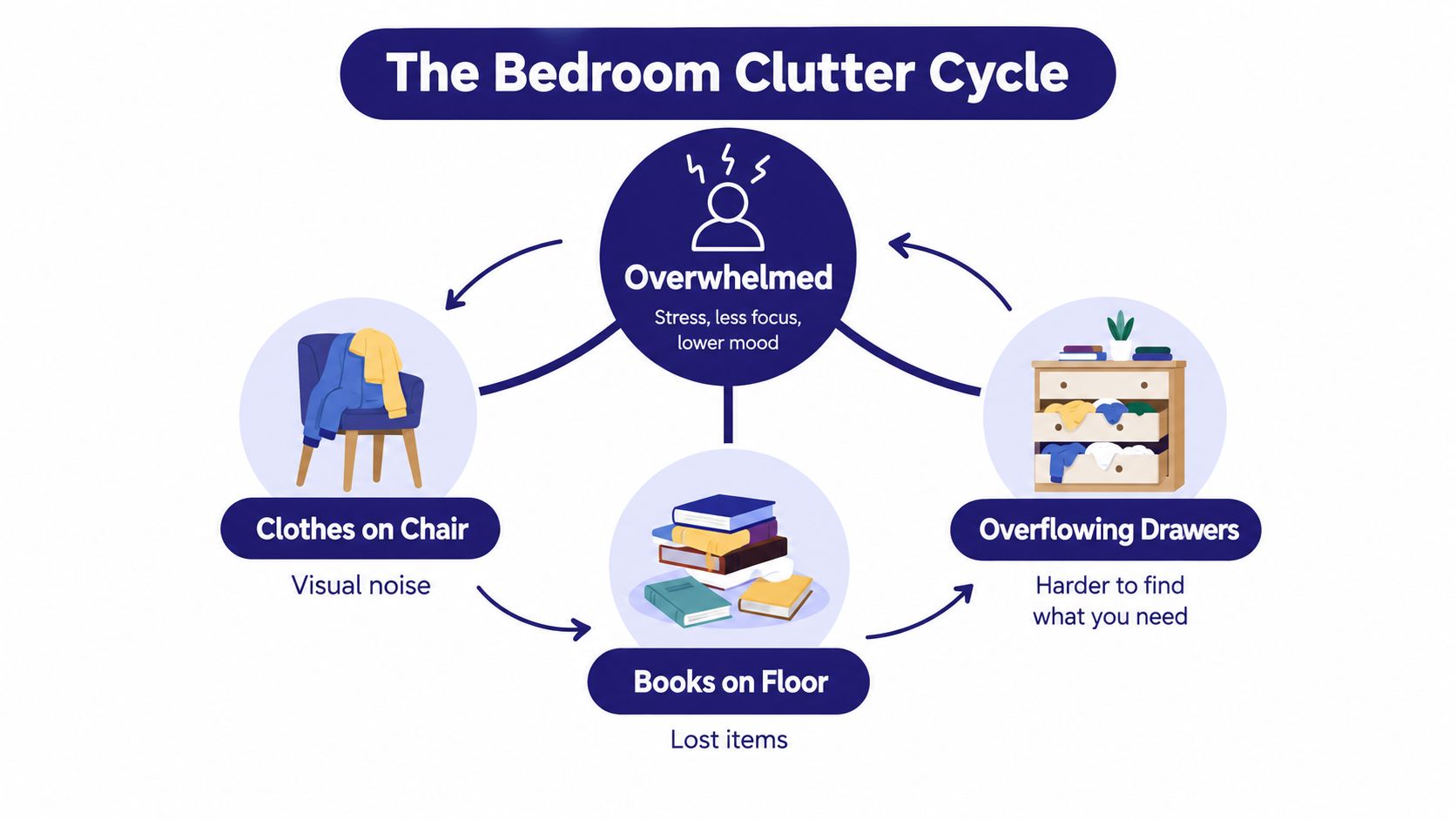
    You know the room is getting out of hand when the chair becomes a second wardrobe, books collect beside the bed, and opening a drawer means pushing yesterday's clothes back inside. The bedroom may not be the largest room in the home, but it has to support sleep, dressing, storage, and sometimes work or study without feeling crowded.

    Good storage solutions for bedrooms start with a layout decision, not a shopping list. The right piece depends on how much floor space you have, whether you expect to move, how often the room's function changes, and whether you want storage to blend into the architecture or remain useful furniture you can take with you.

    Why Bedroom Storage Feels Like a Puzzle

    A bedroom creates a particular kind of clutter because its contents are used throughout the day. Clothes come off near the bed, books stay within reach, accessories gather on the nearest surface, and items that don't have a clear home slowly occupy walking space. The room then feels stressful, even when the total amount of belongings isn't unusual.

    Consider a typical bedroom with one wardrobe, a small chest of drawers, and a bed. Folded clothing may fit in the drawers, but shoes, bags, spare bedding, seasonal clothes, and everyday accessories still need somewhere to go. If every category competes for the same horizontal surfaces, the room becomes difficult to reset.

    A circular diagram illustrating the bedroom clutter cycle, showing how mess leads to feeling overwhelmed and stressed.

    Think upward before spreading outward

    The most useful shift is from horizontal thinking to vertical thinking. Instead of adding another low cabinet that extends farther into the room, look for ways to use wall height, the full height of a wardrobe, the space above a headboard, and the area beneath the bed.

    Tall storage can hold folded clothing or accessories while preserving more open floor area. Wall-mounted shelves can keep books and smaller items off the floor, though they need careful placement so the room doesn't feel visually busy. A narrow chest may also work better than a wide one if the problem is a lack of floor width rather than a lack of storage volume.

    Practical rule: Use the floor for furniture you need to access often, and reserve higher or less convenient areas for seasonal and occasional items.

    This principle applies beyond the bedroom. If your home has an unused loft or awkward upper-level space, these loft storage ideas for Dublin homes can help you think about moving rarely used belongings out of the bedroom altogether.

    The broader furniture market reflects why this planning matters. A major forecast estimates the global bedroom furniture market at USD 126.80 billion in 2025, with a projection of USD 132.49 billion in 2026 and USD 165.07 billion by 2031, equivalent to a projected 4.49% CAGR from 2026 to 2031 (Mordor Intelligence). Storage isn't a decorative afterthought. It has become part of how people expect bedrooms to function, particularly where homes need to support several activities in one room.

    Built-Ins versus Freestanding Storage

    You own the room, plan to stay, and want every awkward corner used. A built-in wardrobe may suit that situation. If you rent, expect to move, or like changing the layout, freestanding furniture gives you more room to adapt. The choice is less about which looks better and more about how firmly you want storage tied to the property.

    Built-in storage can appear to belong to the room from the start. A fitted wardrobe may run from wall to wall, use an alcove, and create one calm, consistent surface. Sliding doors can also reduce the clearance needed in front of the wardrobe, which helps when floor space is limited.

    That polished result comes with permanence. Installation may involve fitting work, wall changes, patching, or repainting. If the bed or room function changes later, the storage may no longer suit the layout. Renters may not be able to install it, and homeowners who move could leave the investment with the property rather than take it with them.

    Freestanding furniture works more like a set of movable building blocks. A wardrobe, dresser, chest, armoire, or sideboard can shift when the bed moves, change as your storage needs develop, or travel to another home. You can also sell it, pass it to a family member, or restyle it without altering the walls.

    Compare the decision by lifestyle

    Consideration Built-in storage Freestanding storage
    Visual effect Flush, wall-to-wall finish that matches the architecture More varied, with furniture character
    Layout changes Usually difficult after installation Generally easier to rearrange
    Moving home Usually remains in place Can travel with you
    Renovation risk May require fitting work and wall changes Usually involves less alteration
    Storage shape Can be built to fit one specific wall or alcove Available in different widths, heights, and functions
    Resale and reuse Value may be tied to the property Can be reused, sold, or repurposed

    Built-ins suit homeowners who expect to stay and want one wall configured for long-term use. Freestanding pieces suit changing layouts, renters, and anyone who wants storage with a clearer resale or reuse path.

    Recent design coverage has highlighted renewed interest in freestanding and hybrid storage, including armoires, antique dressers, and sideboards, because these pieces can move or be restyled without a full renovation (Livingetc). Built-ins remain useful. The practical lesson is that the most attractive storage isn't always the most flexible storage.

    A hybrid arrangement can balance both priorities. Use a fitted wardrobe for daily hanging clothes, then add a freestanding dresser for folded items or accessories. If your needs change, the dresser can move while the main storage remains in place.

    Measuring Your Space for Smart Layouts

    A storage purchase should begin with a tape measure, not a guess about how much clothing you own. A piece can have generous internal capacity and still make the room uncomfortable if it blocks a doorway, interferes with a window, or leaves too little space to walk around the bed.

    Start with the room itself

    Measure the room's floor length and width, recording the full dimensions rather than estimating from visible open space. Then note fixed features, including radiators, outlets, vents, skirting boards, windows, and built-in elements. A simple sketch on paper is enough if it includes the position of each feature.

    Next, check the door and window movements. Measure the door swing and identify the area that must remain clear when the door opens. Do the same for windows, especially if a dresser or tall wardrobe could limit ventilation, access, or natural light.

    Finally, measure the ceiling height. Tall furniture can increase capacity without spreading across the floor, but only if it fits comfortably beneath the ceiling and can be carried through the home during delivery. Check stairwells, hallways, and turns as well as the final room.

    Test the layout before buying

    Use painter's tape to mark the proposed footprint of a wardrobe, dresser, or storage bed on the floor. Walk through the room, open the door, pull out imagined drawers, and stand beside the bed as if you were getting dressed. This reveals problems that a product photo won't show.

    A useful planning sequence is:

    1. Mark fixed circulation paths. Keep the route to the door, bed, and window usable.
    2. Place the largest storage first. Test the wardrobe or chest before adding shelves and smaller pieces.
    3. Check opening space. Hinged doors and drawers need room in front of them, while sliding doors reduce that requirement.
    4. Match scale to the room. Slim, tall furniture may add capacity without overwhelming a narrow bedroom.
    5. Review visual weight. A piece that technically fits can still make the room feel dense if it is too deep, dark, or bulky.

    Furniture scale depends on the room, not only on the dimensions printed on a label. Guidance on measuring floor dimensions, door swings, windows, and ceiling height reinforces the need to assess the whole layout before choosing individual pieces.

    Creative Solutions for Small Bedrooms

    Small bedrooms benefit from combining several modest improvements rather than relying on one oversized storage unit. A tall dresser, under-bed container, wall shelf, and storage ottoman each solve a different problem. Together, they can reduce floor clutter while keeping frequently used items accessible.

    A tall, narrow dresser is often more practical than a wide, low model when floor width is limited. One comparison uses an 18 by 30 inch footprint against an 18 by 60 inch footprint, showing how a narrower vertical shape can preserve more walking space while still providing useful drawer capacity (Cozey).

    Under-bed storage is especially useful for spare linens, off-season clothes, and items you don't need every morning. Measure from the floor to the lowest point of the bed frame before choosing containers. One storage guide identifies 9 inches or more of clearance as suitable for most rolling bins and similar containers, while it lists typical clearances of 6 to 7 inches for standard frame and box spring beds, 4 to 6 inches for low-profile platform beds, and 10 to 11 inches for platform beds with 4-inch risers (Clutterless Nest).

    Match each storage type to the job

    Storage Type Best For Space Efficiency
    Tall narrow dresser Folded clothing, accessories, and smaller garments Uses height while limiting floor width
    Under-bed containers Seasonal clothing, bedding, and occasional items Uses space that would otherwise remain empty
    Storage bed Bedrooms needing concealed, built-in compartments Combines sleeping furniture with storage
    Wall-mounted shelves Books, accessories, and display items Uses wall area rather than floor area
    Storage ottoman Blankets, pillows, and items used around the bed Adds seating and concealed storage
    Sliding-door wardrobe Hanging clothes in a compact room Avoids the forward clearance of hinged doors

    Sliding-door wardrobes can improve space efficiency in compact rooms because they eliminate the clearance zone required by hinged doors. A technical review reports roughly 30% better space efficiency in small environments and identifies 24-inch depth as a practical balance between usable hanging volume and room presence (Academia.edu).

    A flexible interior also matters. Adjustable dividers let you reassign cabinet space between hanging clothes, folded garments, shoes, and accessories instead of leaving fixed compartments underused. Research on wardrobe design found that flexible divider systems significantly improve space use (BioResources).

    For a broader look at compact layouts, these space-saving ideas for studios offer useful inspiration for treating every zone as part of one connected plan.

    Choosing Durable Materials and Finishes

    The right material depends on the piece's job, how often it will be handled, and the type of wear it will face. A dresser used every morning needs drawers that open smoothly and surfaces that can tolerate repeated contact. A high shelf for spare bedding may face less handling but still needs stable construction and dependable support.

    Solid wood offers a natural appearance and can suit traditional, transitional, or contemporary rooms depending on its design and finish. It may also be repairable or refinished in ways that aren't practical for every manufactured surface. The trade-off is that it can cost more, weigh more, and require attention to changes in humidity and everyday marks.

    Engineered wood covers several construction approaches, so the label alone doesn't tell you everything. Look at the edges, joints, back panels, drawer bottoms, hardware, and finish rather than judging only the printed wood effect. A well-designed engineered piece can provide a consistent appearance and practical stability, while a poorly assembled one may feel less substantial in use.

    Inspect the parts you touch

    Open and close every drawer you can. Listen for catching or scraping, check whether the drawer sits evenly, and look at how much usable space remains after the slides and frame take up room. For wardrobes, inspect the hanging rail, shelf supports, door alignment, and interior adjustability.

    Finishes also change the maintenance experience. A smooth sealed surface may be easier to wipe clean, while a textured or distressed finish can make minor marks less noticeable. Glossy surfaces may show fingerprints more readily, and pale finishes can make dust visible in certain lighting. These aren't reasons to avoid a finish. They're reasons to choose one that suits your routine.

    A useful buying habit: Judge storage furniture with the doors and drawers open. The internal layout, hardware, and accessible capacity matter more than the front view alone.

    Heavy items need appropriate support. Books, folded blankets, and packed drawers place different demands on shelves and runners than lightweight accessories. Ask how the piece is intended to be used, whether shelves can be adjusted, and whether the furniture needs to be secured to the wall, particularly in homes with children or pets.

    Material choice should also reflect how long you expect the piece to serve its current purpose. Freestanding furniture may be reused in another room, while a built-in may be selected for a precise architectural fit. In both cases, inspect construction and finish in person where possible instead of assuming that a higher price automatically guarantees a better match for your room.

    Maintaining Organization Over Time

    A storage system fails when it depends on perfect habits. If putting an item away requires too many steps, people tend to leave it on the chair, floor, or nearest surface. Organization lasts longer when the storage location matches how the room is used.

    Begin by assigning broad homes rather than creating an elaborate classification system. Hanging clothes belong together, folded everyday clothing gets a drawer, accessories use a small tray or divided section, and occasional items go higher or beneath the bed. Keep the categories simple enough that another person in the household can follow them.

    Make the room easy to reset

    Use a short evening reset to return visible items to their homes. Books go back to a shelf, worn clothing goes to the laundry area or a designated airing spot, and accessories return to their drawer or tray. The purpose isn't to make the bedroom look staged. It's to prevent small decisions from becoming a large weekend project.

    A useful system includes:

    • Daily access zones: Keep frequently used clothing and accessories between waist and shoulder height.
    • Occasional storage: Place seasonal clothing and spare bedding in higher shelves or under-bed containers.
    • Return points: Add a hook, basket, or valet surface for items that otherwise land on a chair.
    • Clear labels: Label bins by function, such as winter bedding or travel items, rather than by vague descriptions.
    • One-in, one-out review: When a drawer or shelf becomes difficult to close, assess the contents before adding more storage.

    Do a periodic audit when the storage starts resisting you. Remove items that no longer fit, repair pieces that are damaged, and move rarely used belongings away from prime access areas. If the wardrobe is full but the bedroom still looks untidy, the problem may be the distribution of space rather than the total amount of furniture.

    Let the system change with you

    Storage needs shift when a child grows, a home office moves into the bedroom, or two people begin sharing one wardrobe. Adjustable shelves, movable dividers, freestanding dressers, and modular pieces make those transitions easier because they can be reassigned without rebuilding the room.

    You don't need to solve every future need at once. Choose a layout that works now, leave some flexibility in the internal arrangement, and review the room when your routines change. For households that want hands-on help with decluttering and assigning homes to belongings, resources such as Alabama home organization services can provide a separate starting point for the organization process.

    The most effective bedroom storage is the system you can maintain without constant effort. It should make the next tidy-up obvious, keep useful items within reach, and preserve enough open space for the room to feel restful.


    Woodstock Furniture & Mattress Outlet offers bedroom furniture that includes storage beds, dressers, chests, nightstands, wardrobes, and related pieces, with in-store guidance to help you compare scale and layout. Visit Woodstock Furniture & Mattress Outlet to explore options in person and test which storage approach fits your bedroom, whether you're furnishing a new home or replacing one key piece.

  • Clothes Storage Solutions for Small Bedrooms: Smart Ideas

    Clothes Storage Solutions for Small Bedrooms: Smart Ideas

    You've probably tried the obvious fixes already. A basket lands under the bed, a bench collects sweaters, and a narrow dresser gets pushed against the only wall that seems available. Then a drawer won't open fully, the wardrobe door catches the bedroom door, or the walkway becomes so tight that the room feels harder to use than before.

    The practical answer isn't adding more containers. Clothes storage solutions for small bedrooms have to match the room's geometry, including furniture depth, door swing, ceiling height, and the clear space needed to reach drawers and hanging clothes. After measuring compact bedrooms in North Georgia homes and apartments, the most useful rule is straightforward: decide what the room can physically support before choosing the furniture.

    Measure the Room Before You Buy Anything

    Start with a floor plan, not a shopping list. Sketch each wall and record its length, ceiling height, windows, doors, radiators, vents, and outlets. Use a 25-foot tape measure, and take each measurement twice. A rushed first reading can be off just enough to turn a workable wardrobe into an obstruction.

    Mark the direction of every door swing on the sketch. Include the bedroom door, closet door, and any hinged wardrobe doors you're considering. A piece can fit along a wall and still fail if its open door occupies the same space as the room entrance.

    A helpful infographic outlining six essential steps for measuring a room accurately before purchasing new furniture.

    Record the details that reduce usable space

    Photograph each wall straight-on after measuring it. The photographs give you a second reference when the sketch becomes crowded with notes. They also help you spot features you might otherwise forget, such as a baseboard that pushes furniture forward or a ceiling slope that reduces the height available for shelving.

    North Georgia homes, especially subdivisions built around the late 1990s, can include soffits, bulkheads, sloped ceilings, and awkward mechanical locations. Treat those features as fixed boundaries rather than small inconveniences.

    Practical rule: Bring the sketch and photographs when you shop. “It should fit” isn't a measurement.

    A useful independent guide recommends keeping wardrobe depth around 45 to 60 cm and leaving at least 60 cm of clearance in front for comfortable access, particularly when you're planning a tight layout (Homes & Gardens' small-bedroom clothes storage guidance). That clearance is about everyday use, not just installation. If you can't stand comfortably in front of the unit, you won't use its storage efficiently.

    Edit Your Wardrobe Before You Store It

    Storage furniture can't solve a volume problem created by clothing you no longer wear. Put every garment on the bed and sort it into keep, donate, and repair piles. Try questionable pieces on in good light, because an item that looks acceptable on a hanger may not earn space once you consider fit, condition, and how often you reach for it.

    Use a simple test: would you choose to buy this item today? If the answer is no and there's no practical reason to keep it, place it in the donation pile. Bag donations immediately and arrange a drop-off, otherwise the bags can become permanent residents of the bedroom.

    Assign space by clothing category

    Count what you own before selecting drawer widths or rail layouts. Separate tees, trousers, dresses, sweaters, outerwear, sleepwear, and accessories. Someone with a small number of dresses but a large sweater collection needs a different interior arrangement from someone whose wardrobe is mostly hanging garments.

    A useful planning ratio is 50% for everyday clothing, 30% for seasonal storage, and 20% as breathing room. This ratio is a planning heuristic rather than a universal rule. It prevents the common mistake of filling every shelf at purchase, leaving no room for folding, retrieving, or adding an occasional garment.

    Keep prime space for daily use

    Daily clothing belongs between shoulder and eye level whenever possible. Seasonal pieces can move to higher shelves or under-bed storage, provided the containers remain accessible enough that you won't avoid the swap. The wardrobe should make routine dressing easier, not turn every outfit into a small excavation project.

    A capacity guide suggests a mixed wardrobe layout of about 50% hanging space, 30% shelving, and 20% drawers, while installation guidance recommends keeping hanging rails no more than about 85% full to reduce wrinkling and improve retrieval (Horizon Bespoke Joinery's wardrobe storage guide). Use those figures as a starting point, then adjust them to the categories you own.

    Match Furniture to Your Actual Dimensions

    Take the floor plan to the showroom and bring the tape measure. A freestanding wardrobe that looks compact in a large display can consume valuable circulation space in a small bedroom. Measure the body, doors, handles, and any trim that projects beyond the stated cabinet depth.

    For hanging clothes, a wardrobe depth of about 60 cm, or 24 inches, is standard because it accommodates adult hangers and door movement. Shallow units around 45 to 50 cm can work in narrow rooms, children's rooms, or for occasional use, while 55 to 60 cm generally suits everyday clothing storage (Furniture.co.uk's wardrobe depth guide). Shelves-only storage can be shallower, around 30 to 45 cm, but shirts and trousers need at least 55 cm to hang properly according to another wardrobe planning guide (Slide Systems' wardrobe depth advice).

    Furniture Type Standard Dimensions (D x W x H) Compact Option Best For
    Freestanding wardrobe About 60 cm deep, width varies, height varies About 45 to 50 cm deep Hanging clothes without built-in work
    Dresser Depth and width vary by drawer design Narrow chest with fewer or slimmer drawers Folded clothes along a short wall
    Under-bed unit Height must match the measured gap Low lidded container or drawer Seasonal garments and spare linens
    Vertical storage Height depends on ceiling and access Stacked shelves or a shorter tower Rooms with limited floor width

    Under-bed storage requires measurement from the floor to the underside of the bed base, not to the mattress. Standard bed frames typically provide 6 to 7 inches, platform beds 4 to 12 inches, and beds on risers 8 to 14 inches, so container height should follow the actual gap (DG Floors' under-bed storage guide).

    A tall unit can increase capacity without extending into the walkway, but only if you can reach its upper shelves safely. A 7-foot, or 2.2 m, ceiling can typically support either two levels of short hanging or one level of long hanging with shelves (Homes & Gardens' small-bedroom clothes storage guidance). Built-ins usually fit irregular walls more precisely, but they cost more and aren't convenient for renters who may move.

    For readers comparing fitted options, the guide to South Jersey closet organizers is useful because it highlights how internal planning can matter as much as the cabinet's outside footprint.

    DIY and Multi-Purpose Storage Moves

    A narrow gap beside a dresser can become useful without adding a full cabinet. In one North Georgia ranch bedroom where the hallway closet ended near the bedroom door, a tension rod installed in a 12- to 18-inch gap handled scarves, belts, and a few pairs of trousers hung vertically. The rod needed a smooth, solid mounting surface and a load appropriate to the manufacturer's instructions, not a crowded collection of heavy garments.

    Over-the-door organizers work well for shoes, accessories, and lightweight folded items when drilling isn't allowed. Check the product's stated load rating, door thickness, and clearance around the frame. A rack rated for 30 to 40 pounds may still be unsuitable if the door can't close freely or the hinges already feel strained.

    An infographic titled DIY and Multi-Purpose Storage Moves showing five simple tips to maximize small bedroom space.

    Use forgotten vertical and horizontal zones

    An IKEA Kallax-style 1×4 cube unit laid on its side can create open compartments under a bed, but measure the unit's finished height before buying. It only works if the bed clearance is higher than the unit, and the open ends need enough room for you to slide clothing containers in and out.

    A hinged-lid ottoman can replace a blanket chest in a 10-by-10-foot room, giving you a seat and concealed space for sweaters. Keep the contents light enough that lifting the lid remains easy. In an attic bedroom, a wooden ladder secured to a ceiling joist can hold off-season coats, but ceiling structure, fasteners, and local rental rules must be checked before installation.

    Rental check: Never assume a tension rod, over-door rack, or ceiling-mounted solution is harmless. Confirm the wall, door, ceiling, and lease can support it.

    For larger layout changes, Jennifer Gilmer Kitchen & Bath advice offers useful context on converting a small bedroom into a more dedicated storage area. The same principle applies on a smaller scale: define the room's usable geometry before adding storage.

    A short visual walkthrough can also help you compare these approaches before reaching for tools:

    Layout and Styling That Make the Room Breathe

    Storage works only when the rest of the room can function around it. Keep a 30-inch walking lane from the door toward the far wall, and leave at least 24 inches in front of a wardrobe or dresser that needs drawer or door clearance. Those dimensions prevent you from placing a unit where it technically fits but becomes frustrating to use.

    Put the tallest piece against the wall with the highest ceiling. That placement lets the eye read more open floor area and reduces the visual effect of a low ceiling or sloped section. If the room has one awkward corner, use it for height rather than forcing a wide dresser across the longest uninterrupted wall.

    Make visibility and lighting part of the plan

    A full-length mirror mounted inside a closet door saves floor space. A mirror placed opposite a window can also carry daylight deeper into the room, although it should be positioned so it doesn't create glare while you're dressing.

    Wardrobes deeper than 22 inches can develop dark back corners. A slim motion-sensor LED strip makes those areas easier to use, provided the light is compatible with the cabinet and doesn't interfere with the door or clothing.

    Keep the finish calm. One substantial piece of art above the dresser is usually easier to read than a crowded gallery wall, and bedding in two tones gives the room a quieter visual field. The point isn't minimalism for its own sake. It's making the bed, hanging zone, and dresser feel like separate functions rather than one mass of furniture.

    For more ideas on organizing a fitted storage area around real room constraints, consult this Aureli Construction closet guide. Use the concepts selectively, especially if your room has sloped ceilings, vents, or limited access.

    Budgeting and Shopping Without the Buyer's Remorse

    Start with the dimensions that can make a purchase fail: wardrobe depth, dresser width, bed clearance, door swing, and the walkway in front of the unit. Don't spend on baskets until you know the furniture will fit. A container that is too tall for the bed or too deep for a shelf is clutter with a label.

    Then divide spending by function. Put more of the budget into the piece you'll operate every day, such as a dresser with full-extension drawer slides or a wardrobe with adjustable shelves. Hardware that feels rough, binds, or limits access can make otherwise usable capacity frustrating.

    Tier Item Spend Level Typical Price Range
    Must-measure Wardrobe, dresser, under-bed unit Protect the fit first Price depends on dimensions and construction
    Worth prioritizing Main dresser and wardrobe hardware Higher share of the budget Quality 6-drawer dresser, $350 to $700 new or $150 to $300 secondhand
    Freestanding option Wardrobe or armoire Moderate to higher $200 to $600
    Easy to replace Fabric drawers, labeled bins, basic hooks Lower Choose flexible pieces that can move with the layout

    The listed ranges are practical shopping benchmarks for North Georgia rather than guarantees. Condition, material, construction, and local availability change the price, especially in secondhand furniture.

    Test the piece before committing

    A showroom visit lets you open drawers fully, check whether handles project into the walkway, and compare the stated depth with the actual door and trim. A local store such as Ashley Homestore in Dawsonville can help you examine freestanding pieces, while a Habitat for Humanity ReStore in Gainesville can offer secondhand options that require closer inspection.

    A useful budget rule is to put 70% toward one anchor piece and 30% toward accessories. Be cautious with any storage solution that arrives unassembled in a box smaller than its listed dimensions. That doesn't automatically mean the product is unsuitable, but it does mean you should verify the construction, panels, hardware, and finished measurements before assuming the advertised capacity.

    A Simple Routine to Keep It Working

    A small bedroom doesn't need a dramatic cleaning project every few months. It needs a repeatable routine that keeps clothing in its assigned zone and protects the clearances you measured at the beginning.

    Start with a weekly reset. A two-minute nightly sweep of the floor and dresser tops catches the items that otherwise become permanent piles. Return shoes to their designated area, move worn clothing to laundry or an airing spot, and keep the wardrobe entrance clear.

    Use small edits instead of large recoveries

    Once a month, return stray items to their assigned zones and remove something that no longer fits, works, or gets worn. Seasonal clothing can move between prime hanging space and higher shelves or under-bed containers, but keep the process simple enough that you won't postpone it indefinitely.

    A seasonal deep pass should include vacuuming under-bed units, checking containers for moisture or dust, and confirming that nothing has drifted into the door swing. If furniture moved, rerun the depth and clearance measurements. Geometry can change through small shifts, especially when a bed, dresser, and wardrobe share a tight wall.

    Keep the system accountable

    Once a year, repeat the full wardrobe audit and compare the contents with the 50/30/20 planning ratio described earlier. Drop a donation bag at a North Georgia thrift location such as the Goodwill on Atlanta Highway instead of letting it sit beside the dresser.

    Use this short checklist as a screenshot or printout:

    • Drawer hardware: Tighten loose pulls and check that drawers open fully.
    • Wardrobe interior: Confirm hanging rails aren't overcrowded and shelves remain reachable.
    • Textile protection: Refresh cedar blocks if you use them and replace damaged storage bags.
    • Labels: Label any new bins before putting them away.
    • Clearances: Check doors, vents, radiators, and the walking lane.
    • Under-bed access: Vacuum the floor and confirm containers still slide out.
    • Room measurements: Recheck depth and circulation whenever furniture moves.

    Small bedrooms reward small habits. Consistency keeps the storage plan intact better than an occasional burst of organizing.

    If you're comparing a wardrobe, narrow chest, or dresser in person, Woodstock Furniture & Mattress Outlet offers armoires, wardrobes, narrow chests, and dressers that can be evaluated alongside your room measurements. Bring your floor plan to a location so the team can help you compare dimensions, drawer access, and the trade-offs between a movable piece and a more fitted solution.

  • 8 Nursery Storage Ideas for a More Organized Room

    8 Nursery Storage Ideas for a More Organized Room

    How can a nursery stay organized when the things you reach for most often keep changing, while the room itself has limited floor space? Clutter usually comes from a mix of clothing, linens, diapers, toys, and small daily-care supplies, not from one storage failure. The useful question is where each category belongs.

    Floor space can handle flexible bins. Walls can carry vertical organization. Closets are suited to clothing, while dressers and changing furniture can keep daily-care supplies close to the point of use. These eight nursery storage ideas focus on real constraints, including changing clothing sizes, nighttime access, visibility, room flow, future use, and child safety.

    A good system doesn't need to fill every corner. It needs to make frequent tasks easier without blocking the crib, changing area, door, or walking path. If you're also furnishing a compact bedroom, these small bedroom space-saving tips can help you think through the wider layout. When proportions and storage features are difficult to judge online, you can explore nursery and bedroom furniture in person at Woodstock Furniture & Mattress Outlet.

    1. Vertical Wall Storage with Open Shelving

    How can a nursery gain storage without giving up floor space for a crib, changing station, chair, and clear walking paths? Wall-mounted shelves, cubbies, and slim corner units move supplies upward, leaving the floor open for movement.

    Start by measuring the wall, the available height, and the space around doors and furniture. Adult-accessible shelves suit blankets, books, baskets, and soft toys used during dressing or bedtime. Items within a toddler's reach require closer review. Open shelving still needs secure brackets, stable baskets, and objects suited to the child's stage.

    Practical rule: Use open shelves for items that caregivers can identify and retrieve safely. Place supplies requiring supervision higher up.

    A practical layout might put labeled baskets on the lowest shelf that adults can reach, folded blankets in the middle, and a few books higher up. Keep heavier items on lower shelves, and leave enough space to see what each container holds. Matching baskets reduce visual clutter, while labels help caregivers find socks, blankets, or spare outfits quickly, especially during nighttime care.

    Visibility is the main advantage of this setup. You can see when a basket is empty, but dust and visual busyness are trade-offs. Use containers for loose supplies rather than filling every shelf with individual items.

    The Government of Canada's safe nursery guidance recommends baskets or canvas bins without sharp corners for organizing baby toys. Choose those softer containers, secure the wall-mounted unit properly, and keep small items like button batteries, coins, and loose toy parts away from a child's reach.

    2. Closet Organization Systems with Dividers and Rods

    Baby clothing creates a special storage problem because the garments are small, numerous, and quickly outgrown. A closet can handle that change better when you divide it by size and use, rather than placing every item on one crowded rod.

    A second hanging rod can separate current clothing from the next size or from seasonal pieces. For example, current everyday clothing might occupy the most accessible section, while larger sizes stay grouped in labeled containers or on a separate rod. The exact arrangement depends on the closet's height and the furniture below it, so measure the usable vertical space before buying an organizer.

    Keep current clothing visible

    Place the clothes used most often at adult eye level. Folded onesies, sleepers, socks, and accessories can go into labeled bins on shelves, while hanging outfits remain grouped by size or type. Leave some open capacity instead of filling every shelf, since a closet that starts overcrowded becomes difficult to update after laundry day.

    A lower rod can make part of the closet easier for a growing child to access later. However, lower placement also changes what a toddler can reach, so keep items such as accessories, cords, and unsuitable garments out of reach when necessary. Door-mounted organizers can hold small accessories, but check that they don't interfere with the door's swing.

    A comparison chart showing the pros and cons of vertical shelving versus multi-functional nursery storage furniture.

    A labeled “outgrown” section also helps prevent the closet from becoming a mixture of current and finished sizes. Move items out as they stop fitting, then decide whether they belong in keepsake storage, a donation container, or another room.

    For a visual example of organizing nursery clothing and storage zones, watch this nursery storage organization video.

    3. Under-Crib Storage Drawers and Rolling Bins

    The space beneath a crib can store backup linens without adding another cabinet or dresser. Low-profile drawers and rolling bins are useful for crib sheets, mattress protectors, swaddles, sleep sacks, and other items that need to stay nearby but don't need to remain visible.

    Start with the measurement that determines whether this idea will work: the clearance beneath the crib. Measure the available height, width, and depth, including room for the drawer or bin to roll out. A container that technically fits but catches on the crib frame will quickly become frustrating, especially during a nighttime change.

    A pencil sketch of a baby crib with two rolling storage drawers underneath, featuring soft nursery illustrations.

    Match the container to the contents

    Use clear bins when visibility matters, or label opaque containers with large, simple descriptions. One bin might hold spare sheets, another extra blankets, and another seasonal clothing. Keeping categories separate prevents you from pulling every container out to find one clean sheet.

    Reserve under-crib storage for items that suit the location. Bedding and soft goods are sensible uses, while fragile items, liquids, or small pieces that could become accessible during play deserve a different home. Sturdy containers are preferable for heavier contents, and rolling hardware should move smoothly without sharp edges or loose components.

    Under-crib storage also has a future-use question. As the crib changes configuration or becomes a toddler bed, the clearance may change. Choose bins that can move to a closet or bedroom if the furniture layout evolves, rather than treating the storage as permanently tied to the crib.

    4. Multi-Functional Furniture with Built-In Storage

    A changing table, dresser, or storage ottoman can solve more than one problem within the same footprint. This is useful when a nursery doesn't have space for separate changing, clothing, blanket, and seating pieces.

    A dresser with a changing topper can place diapers, wipes, lotions, and spare clothing directly below the changing surface. Wider drawers can hold folded garments and linens, while a storage ottoman near a glider can contain blankets and provide a place to sit. The right choice depends on what the room already lacks, not just on how many functions a product lists.

    Plan for the furniture's second phase

    Consider whether the piece will remain useful after diaper changes become less frequent. A dresser that works as clothing storage in a child's bedroom may have more practical value than a changing table that has no later role. Finishes and proportions matter here. A nursery-specific appearance may feel appropriate now, while a simpler design can transition more easily as the room changes.

    Drawer organization should reflect actual routines. Put the supplies used together in the same zone, but don't compress every category into one deep drawer. Shallow dividers or small bins can keep socks, creams, and accessories from disappearing beneath larger items.

    Stability is a central part of this idea. The furniture tip-over prevention checklist from the American Home Furnishings Alliance says a federal furniture safety standard was applied in September 2023 to new clothing storage furniture over 27 inches tall. The same guidance still recommends anchoring these pieces to the wall as a precaution and placing heavier items in lower drawers. Follow the manufacturer's instructions and review the furniture's stability before adding a changing setup or storing heavy supplies.

    5. Wall-Mounted Pegboards and Hanging Organizers

    Small nursery items are difficult to manage because they don't fit neatly into large drawers. A pegboard or wall-mounted hanging system can give pacifier clips, bibs, hats, teethers, and similar accessories a visible place near the changing area.

    Pegboards differ from fixed shelves because hooks, baskets, and small trays can be repositioned. That makes them suitable for a room where the contents change from newborn-care supplies to toddler accessories. You can begin with a few items near the changing station, then adjust the layout when those supplies are no longer part of the daily routine.

    A flexible wall system is useful only when the wall remains calm. Leave empty space so you can change the arrangement without creating a crowded cluster.

    Place frequently used items where an adult can reach them without stepping away from the changing surface. That placement improves workflow, but it also means the board may be accessible to a growing child. Small objects, cords, clips, and detachable hooks should be moved higher or into closed storage before a child can reach them.

    Build zones instead of visual clutter

    A painted pegboard can coordinate with the nursery, but appearance shouldn't determine the layout. Use one basket for bibs, a hook for a diaper bag, and a small labeled container for accessories. Keep the categories narrow enough that you can return each item quickly.

    Before installation, identify wall structure, mounting hardware, and the board's total load. A pegboard is not a substitute for a secure cabinet, and its hooks should not carry more weight than the hardware supports. In a rental, a freestanding or removable organizer may be more suitable if wall modifications aren't allowed.

    6. Fabric Baskets and Stackable Bins for Flexible Storage

    Portable containers suit nurseries where the layout and storage needs keep changing. A fabric basket can move from a shelf to a glider, while a plastic bin can shift from beneath the changing station to a closet. They provide a practical starting system before you commit to permanent furniture.

    Assign one container to one clear category. Keep blankets, toys, out-of-season clothing, diapers, and linens separate rather than combining them in one large basket. A readable label gives each item a defined place, so caregivers can return supplies without searching through mixed contents.

    Choose visibility based on frequency

    Clear or semi-transparent bins show what remains before you open them. Fabric baskets create a softer appearance and hide visual clutter, but similar baskets need labels. Handles are useful when supplies travel between changing and feeding areas.

    Stacking preserves limited floor area, yet access and stability must guide the arrangement. Keep the stack low and place frequently used items in the easiest position to reach. A taller stack may store more, but retrieving the bottom bin repeatedly can make the system frustrating.

    Soft containers without sharp corners support an open-storage approach described in Canadian public-health nursery guidance. Placement still matters. Keep small toys, cords, and unsuitable supplies beyond a child's reach, and check that containers do not block doors, vents, or the walking path around the crib.

    Measure the available shelf or floor depth before buying. A bin that fits the width may still obstruct a drawer, door, or nearby furniture. Leave enough clearance to lift the lid or pull the container forward without moving other items.

    The main advantage is reconfiguration. As clothing sizes change or toys separate into new categories, you can relabel, relocate, or repurpose the containers instead of replacing the entire storage system.

    7. Over-the-Door Organizers and Hanging Storage

    The back of a nursery door or closet door can hold supplies without taking up another section of floor or wall. Pocket organizers work well for diapers, wipes, bibs, spare crib sheets, mattress protectors, and other lightweight items that need regular access.

    A clear pocket organizer makes restocking easier because you can see what remains. An opaque fabric version keeps the room visually quieter and can suit a closet door where appearance matters less. Either way, the organizer should match the door's movement. Check the swing direction, available clearance, and whether the pockets rub against nearby furniture.

    Keep weight balanced

    Put heavier items in lower pockets and lighter items higher up. Distribute the contents rather than loading one side, and inspect the hooks or mounting points for strain. A door organizer that causes the door to drag, fail to close, or swing into furniture isn't creating useful storage.

    Interior closet doors are often a good location for items that need access but don't need to stay on display. The main nursery door may be better for lightweight items used during nighttime care, provided the organizer doesn't narrow the path or interfere with quick movement.

    This approach also requires a small-item review. Diaper creams, pacifiers, bottle accessories, and similar supplies can become hazards if a child can reach them. Move items upward or into child-resistant storage as the child becomes more mobile. The organizer is a convenience feature, not a replacement for supervision or safe placement.

    Over-the-door storage is especially useful for renters because it can add capacity without permanent wall installation. It won't replace a closet or dresser, but it can absorb the loose categories that otherwise collect on the changing table.

    8. Closet Hanging Organizers and Shelf Dividers

    A closet rod can hold more than hanging clothes. Hanging shelves, shoe organizers, garment bags, and shelf dividers create separate zones for folded clothing, bedding, accessories, keepsakes, and soft toys without requiring a new cabinet.

    Start by sorting items into three practical groups: current-use clothing, next-size or seasonal items, and occasional or keepsake pieces. Current clothing deserves the clearest access. Larger sizes can remain visible but less central, while special outfits and keepsakes can occupy garment bags or higher sections.

    Use one hanging organizer for one size grouping or category. A label such as “current sleepers” is more useful than a broad label such as “baby items,” especially when several caregivers share the room. Shelf dividers can keep folded stacks upright, but don't overload the rod or place too much weight on one section.

    Access test: If you need to remove three unrelated stacks to reach one daily-use item, the closet has too many categories in the same zone.

    The system should also be easy to revise. As clothing sizes change, move finished items out and shift the next group forward. Keep a little room for seasonal pieces and laundry rather than planning around a completely full closet.

    Distribute weight evenly across hangers and organizers, and follow the closet hardware's capacity guidance. Check that hanging pockets don't touch the floor, block the door, or create a climbing invitation. Shelf dividers and organizers can improve visibility, but they still need sensible placement as the child grows.

    Nursery Storage: 8-Item Comparison

    Storage Solution Implementation Complexity Resource Requirements Expected Outcomes Ideal Use Cases Key Advantages
    Vertical Wall Storage with Open Shelving Low–Moderate: simple mounting, stud placement recommended Shelves, brackets, baskets; moderate cost, uses wall space Maximizes vertical space, keeps items visible and reachable Small nurseries, display + frequent-use storage Frees floor area, flexible styling, cost-effective vs built-ins
    Closet Organization Systems with Dividers and Rods Moderate–High: may require custom layout or pro install Multiple rods, shelves, dividers, labeled bins; moderate–high cost Centralized, dust-protected clothing storage that scales with sizes Homes with dedicated closets and many clothing sizes High capacity, protects garments, efficient rotation by size/season
    Under-Crib Storage Drawers and Rolling Bins Low: plug-and-play or simple install Low-profile drawers/bins with casters; low cost Utilizes under-crib void for linens and extras; quick access Tight spaces needing hidden linen/toiletry storage Out-of-sight access, mobile, preserves floor footprint
    Multi-Functional Furniture with Built-In Storage Moderate: furniture selection, assembly, anchoring Changing-dresser hybrids, ottomans; higher upfront cost Combines functions and storage in one footprint, long-term use Small rooms needing multiuse pieces; long-term investment Consolidates functions, saves floor space, transitions as child grows
    Wall-Mounted Pegboards and Hanging Organizers Low–Moderate: simple mounting, modular setup Pegboard panels, hooks, baskets; affordable Highly customizable, visible organization for small items Organizing small/frequently used items; evolving storage needs Flexible reconfiguration, high visibility, affordable
    Fabric Baskets and Stackable Bins for Flexible Storage Very Low: no installation required Baskets/bins in assorted sizes; very low cost Portable, reconfigurable containment for toys, linens, clothes Renters, temporary setups, flexible room layouts Portable and affordable, easy to add/remove, versatile
    Over-the-Door Organizers and Hanging Storage Very Low: hang over door, no tools typically needed Pocketed organizers or hangers; low cost Uses unused door plane for quick-access items Small nurseries with doors; frequently accessed supplies No permanent install, removable, efficient use of wasted space
    Closet Hanging Organizers and Shelf Dividers Low–Moderate: hang from rod, insert dividers Hanging shelves, pocket organizers, fabric dividers; low cost Multiplies usable closet space and separates sizes/types Closets with limited shelving needing more vertical use Maximizes closet capacity, inexpensive, easy to reconfigure

    Build a Nursery Storage System That Can Change

    The most useful nursery storage system starts with the room, not a product category. Measure the available wall, closet, crib, and furniture clearances. Mark where drawers open, where the door swings, and where you need an unobstructed path around the crib and changing area.

    Next, identify what needs daily access. Diapers, wipes, creams, spare clothing, and feeding supplies belong near the relevant care zone, while outgrown clothing, seasonal items, and extra linens can occupy less convenient storage. Assign clothing to the closet first, then use dressers, baskets, shelves, and under-crib bins for the categories that remain.

    Low storage can support safe access for suitable items, but it shouldn't become a place for every small object. The American Academy of Pediatrics guidance on toy-box safety says toy boxes should have a supported hinged lid that stays open at any angle, along with ventilation holes or a gap to help prevent entrapment. It also recommends open shelves when possible. If you use a toy box, choose one with those safety features rather than treating any lidded container as equivalent.

    A concise safety review should include:

    • Secure anchoring: Anchor tall or freestanding storage according to the manufacturer's instructions and review wall attachment after rearranging furniture.
    • Stable loading: Put heavier contents lower, balance hanging organizers, and avoid unstable stacks.
    • Clear movement: Check that bins, baskets, and door organizers don't obstruct the crib, changing area, doorway, or walking route.
    • Small-item control: Keep pacifiers, clips, cords, creams, and other potentially hazardous items away from a child's reach as mobility develops.
    • Ongoing separation: Nursery toy-safety guidance recommends keeping older children's toys separate from younger children's toys and reviewing toys and furnishings for safety recalls.

    You don't need to install all eight ideas at once. Start with one or two changes that address the biggest daily problem, such as a dresser near the changing station or labeled bins for clothing sizes. Revisit the categories as your child grows, because a system that works for newborn supplies may need different access rules and storage locations later.

    Woodstock Furniture & Mattress Outlet can help you compare nursery furniture proportions, dressers, changing setups, and storage features in person. The right solution will depend on your home's layout, the room's measurements, and your family's routine.


    Visit Woodstock Furniture & Mattress Outlet to explore nursery furniture, dressers, chests, cribs, mattresses, and storage pieces for different room layouts. Bring your measurements and daily routine so you can compare proportions and choose a setup that supports access, future use, and safe organization.