You're standing in front of your sofa, comparing two very different centerpieces. One offers a firm place for a laptop, coffee mug, and remote. The other invites you to put your feet up, adds a soft seat for guests, and may hide blankets or toys inside. Both can look right in the room, which is why the coffee table vs ottoman decision often feels harder than expected.
The practical answer depends on what your living room needs to do every day. Do you work from the sofa, eat during movie night, host friends, manage children and pets, or mainly want a comfortable place to rest your legs? The guide below treats the choice as a task-performance decision, using function, clearance, storage, materials, and placement rather than style alone.
| Feature | Coffee table | Ottoman |
|---|---|---|
| Main function | Stable surface for drinks, books, remotes, décor, and laptops | Footrest, flexible seating, and soft central surface |
| Surface stability | Firm and predictable without accessories | Usually needs a firm tray for secure serving |
| Storage | Available in shelf, drawer, or lift-top designs | Often available as concealed interior storage |
| Seating | Generally not intended as seating | Can provide an extra seat |
| Comfort | Hard surface, sometimes with lower shelf storage | Cushioned and comfortable for legs or casual seating |
| Flexibility | Usually remains in one position | Smaller or caster-equipped designs can move more easily |
Why the Coffee Table vs Ottoman Decision Trips Up So Many Shoppers
You sit down on the sofa and start running through the room's real jobs. Where does the laptop go during a quick work session? Where do dinner plates land on movie night? What happens when a child wants floor space to play, or a dog cuts across the middle of the room? That is why the coffee table vs ottoman choice feels harder than it first appears.
Both pieces can look right. Both can fit the same spot. They fail for different reasons.
A coffee table gives you a firm, predictable surface, but it can feel unforgiving in a room where people want to stretch out, climb up, or grab an extra seat. An ottoman softens the center of the layout and often handles feet, guests, and hidden clutter well, but it usually asks you to add a tray before it can do the job of a true tabletop. The confusion starts because shoppers are often comparing appearance first, while daily performance is what decides whether the piece feels helpful or annoying after a few weeks.
Start with the room's actual jobs
A living room rarely has just one assignment. It may need to support:
- Laptop work: a surface that stays steady while you type.
- Casual dining: a place where plates and drinks can sit without wobbling.
- Relaxing: somewhere comfortable to rest your legs after a long day.
- Family activity: room for toys, blankets, books, pets, and people to share the same zone.
- Hosting: an extra perch for a guest, not only a place to set down a mug.
This is why multifunctionality matters so much in furniture buying. Residential buyers made up 81.2% of the multifunctional-furniture market in 2025, according to Mordor Intelligence's market overview. In plain terms, many households are asking one piece to do two or three jobs, not one.
That is the sticking point.
If your household needs a stable platform every day, a soft center piece will ask for workarounds. If comfort, safer edges, or flexible seating matter more, a hard table may solve one problem while creating another. Once you judge the piece by tasks first, the decision becomes clearer, and later measurements like width, reach, and walking clearance stop feeling abstract.
What a Coffee Table and an Ottoman Each Do Best
A coffee table belongs primarily to the surface tradition of furniture. Its job is to provide a stable, cleanable platform for drinks, books, remotes, food, electronics, and décor. The top gives objects a predictable place to sit, and the table defines the center of the seating arrangement without asking you to add an accessory first.
Its cultural role developed alongside coffeehouse culture and the practice of serving and sharing refreshments. Coffee reached the Ottoman Empire during the 16th century, and the first public coffeehouses in Istanbul are traditionally dated to 1554–1555, when merchants from Aleppo and Damascus opened establishments in the Tahtakale district. By the end of the 16th century, coffeehouses had spread to cities including Cairo, Damascus, Aleppo, Bursa, Edirne, Thessaloniki, and Baghdad. European coffeehouses followed in Oxford in 1650, London in 1652, Marseille in 1654, Vienna in 1683, and Paris in 1689, as described in this history of Ottoman coffee culture.
The coffee table's basic role
A coffee table works as a hard horizontal surface. Depending on its design, it may also include a lower shelf, drawer, or lift-top compartment, but its central purpose remains the same: hold objects securely within reach.
That makes it especially useful when the living room supports writing, working, eating, or serving. The top can be wiped clean according to the manufacturer's care guidance, and you won't need to place a tray underneath every glass or plate.
The ottoman's basic role
An ottoman belongs to the upholstered-seating tradition. It originated as a footrest and evolved into a multifunctional living-room piece that can provide cushioned support, casual seating, storage, and sometimes a temporary surface.
An upholstered top isn't automatically a table surface. A firm, tray-compatible top can make an ottoman more versatile, but a soft or uneven cushion can make liquid containers unstable. The tray creates the hard plane that the upholstery doesn't provide on its own.
The key distinction is straightforward:
A coffee table prioritizes a stable surface. An ottoman prioritizes softness, comfort, and flexible seating.
Neither identity is better in every room. A coffee table is built around placing and using objects. An ottoman is built around supporting people, with surface use added through design or accessories.
How to Measure Your Room for Either Piece
Your living room has to do real work. One evening the center piece holds dinner plates and a laptop. The next morning kids cut through the room, or a dog stretches out right where you planned to place it. That is why measuring first matters more than choosing wood, fabric, or shape. A piece that looked balanced in a showroom can feel awkward at home if it steals legroom, blocks the walking path, or sits at the wrong height for everyday tasks.
Use this measuring sequence
Measure the sofa's usable length. Start with the part people sit on, not the full outside arm-to-arm width if the arms are bulky. A widely used rule of thumb is to keep the center piece near two-thirds of the sofa length, or roughly 60–70% of the sofa's seating width. That usually keeps it large enough to serve the seats in front of it without taking over the whole arrangement. The same proportion works well for an ottoman, especially with a sectional where the center piece needs to feel connected to the seating rather than stranded in the middle of the room.
Check the height against the seat. Height changes how the piece performs. For drinks, snacks, and laptop use, the top should generally sit level with the sofa seat or a little lower. One sizing guide suggests about 1–2 inches below the seat cushion in this coffee-table sizing guide. If an ottoman runs too high, your knees may sit at an awkward angle when you use it as a footrest. Too low, and it becomes less convenient for sitting down briefly or reaching a tray without hunching forward.
Reserve the operating gap. The distance between the sofa and the piece affects comfort every day. Aim for approximately 14–18 inches so you can stretch your legs, stand up easily, and still reach a remote or mug without leaning too far. A gap of less than about 12 inches often feels tight, while more than 18 inches can make the surface less useful in practice as explained in this living-room layout guidance.
Protect the main route through the room. Keep primary circulation approximately 36 inches wide. Painter's tape helps here. Mark the footprint on the floor, then walk the route as your household typically does, while carrying laundry, guiding a child, or opening a storage door nearby.
Account for movement. A coffee table usually claims the same footprint all day. An ottoman can be more forgiving if it has casters or a smaller base, because you can slide it aside when the room needs open floor space for play, guests, or cleaning.
| Measurement | Recommended Range | Why It Matters |
|---|---|---|
| Coffee table length | Near two-thirds of sofa length | Keeps the center piece proportional to the seating |
| Coffee table width | Confirm against the sofa, chairs, and walkway | Prevents the table from overwhelming circulation |
| Height relative to sofa | Equal to or slightly below the seat, with about 1–2 inches below as a useful reference | Keeps drinks and devices accessible without creating a visual block |
| Sofa-to-piece gap | Approximately 14–18 inches | Balances reach distance with legroom |
| Main walkway | Approximately 36 inches wide | Preserves a usable route around the seating area |
| Smallest comfortable gap | More than about 12 inches | Reduces knee contact and cramped movement |
| Ottomans in compact rooms | Smaller footprint or casters | Makes the center piece easier to move when needed |
For adjacent surfaces, check side tables too. Their height and footprint affect how open the seating area feels, especially if you already have a large center piece. These rustic side table sizing tips can help you coordinate nearby tables without crowding the main path.
Comparing Function, Storage, and Durability
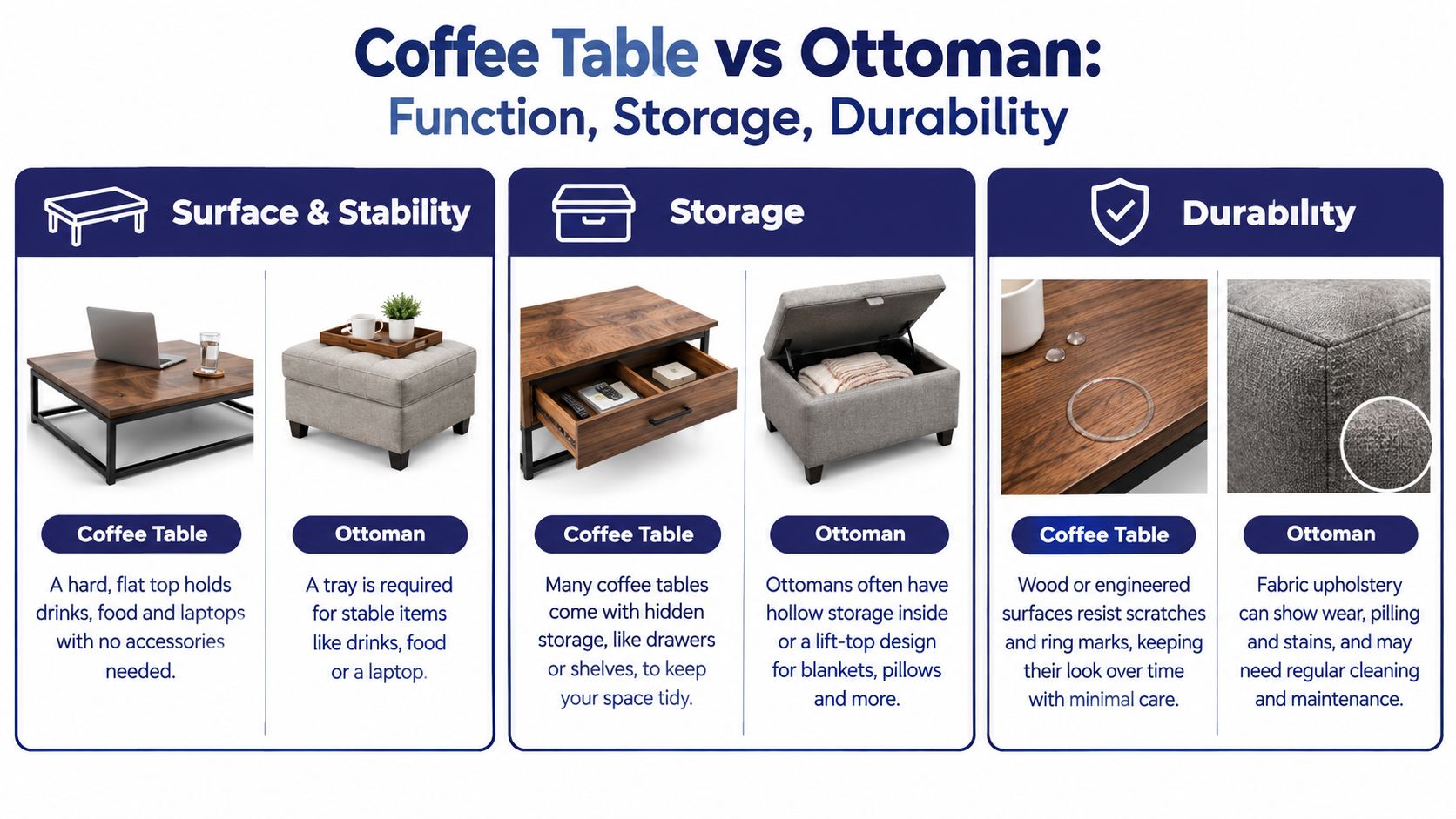
The difference becomes clearest when you test each piece against the same household task. Ask whether the top must support weight and movement, whether people need to sit on it, and whether the room needs storage more than display space.
Surface and stability
A hard coffee-table top supports drinks, food, remotes, books, and laptops without an additional layer. That matters for remote work or dining in front of the TV, where you may need to reposition an object with one hand while using the other.
An ottoman can perform the same serving role when its top is firm or when you add a stable tray. The tray creates a level surface, but it also becomes another item to move, clean, and store when you want the ottoman available for feet or seating.
Most important surface difference: A coffee table is ready for hard-surface tasks. An ottoman usually needs a tray before it can handle them reliably.
Storage and seating
Storage changes the equation for households managing blankets, toys, books, and controllers. Many ottomans offer a concealed interior, while coffee tables may provide storage through an open shelf, drawer, or lift-top design rather than through upholstery.
The ottoman also adds a function that a conventional coffee table generally doesn't. Someone can sit on a suitably designed ottoman, and the same piece can support legs between visits. That flexibility comes at the cost of a less dependable bare surface.
Materials and daily wear
Upholstery performance is commonly evaluated with the Martindale abrasion test under ISO 12947-2. The test records rubbing cycles until visible wear or thread breakage, and higher counts indicate greater abrasion resistance. Neutral upholstery guidance places approximately 15,000–30,000 Martindale cycles in the medium-duty residential range, while 30,000–50,000 or more is associated with heavy-duty use as outlined in this upholstery-fabric guide.
For a heavily used family room, choosing upholstery rated at least 30,000 cycles is a defensible target. That doesn't guarantee a particular service life, and different testing methods aren't interchangeable. Shoes, pets, food, cleaning products, sunlight, and the fabric's weave also affect real-world performance.
Most important durability difference: An ottoman requires an upholstery rating and care plan. A coffee table avoids fabric abrasion but needs protection from moisture, heat, impacts, scratches, and edge damage.
Real-World Use Cases and Room Placement
The right choice depends on the job your living room handles most often. A piece that works beautifully for feet-up lounging can feel clumsy for laptop work. A surface that makes dinner in front of the TV easy can become a hard obstacle when kids start chasing the dog around the sofa.
The remote worker and movie-night diner
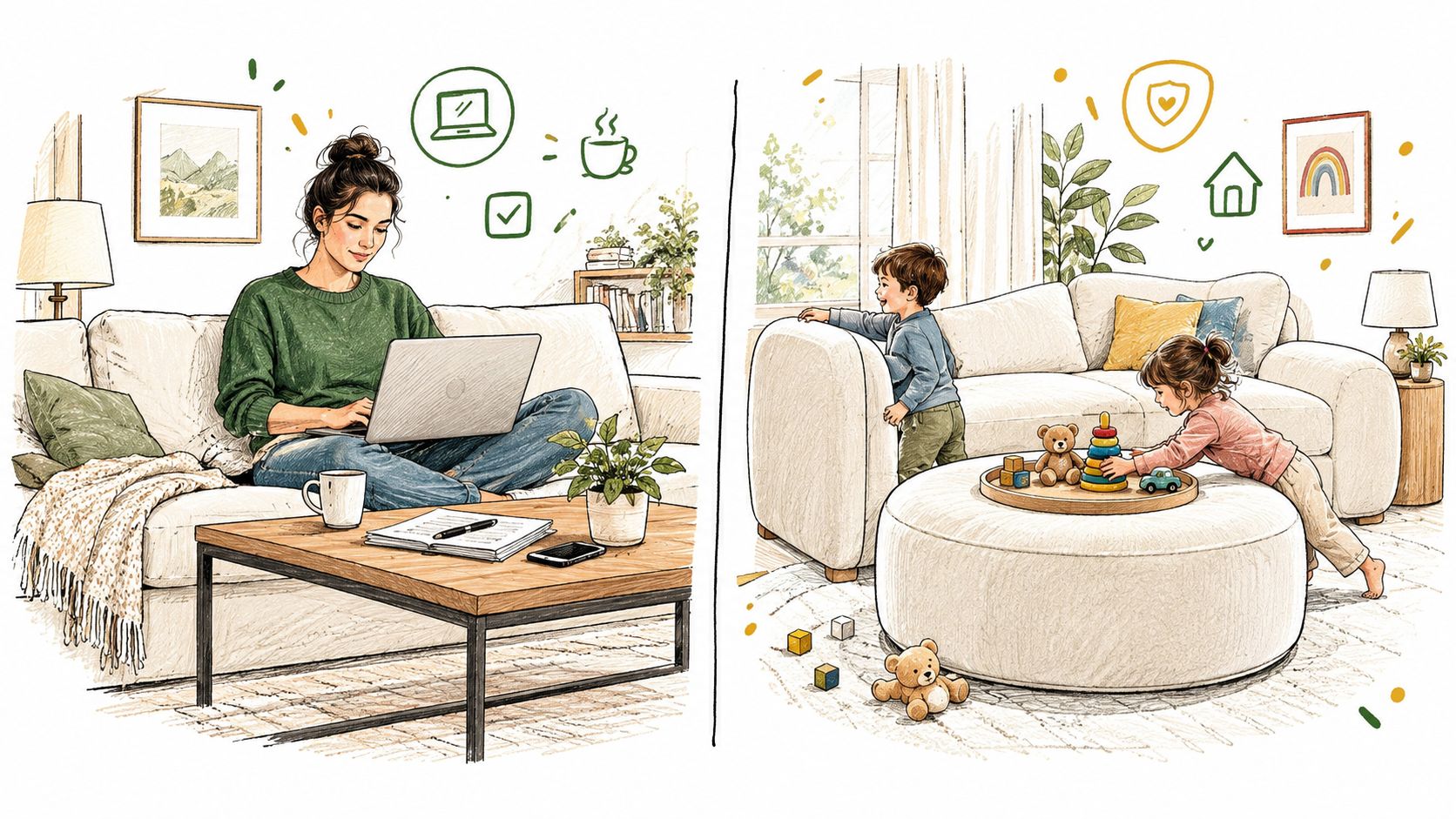
If your room regularly turns into a desk or dinner spot, a coffee table usually makes the day run more smoothly. The firm top gives a laptop, plate, or drink a stable place to land, and that matters when you are typing, using a mouse, or balancing a bowl during a long show.
Placement still decides whether that setup feels good. Keep the table within the 14–18-inch gap from the sofa so you can reach it without hunching forward, and make sure the room still protects an approximately 36-inch walkway around it. A beautiful table that sits too low, too far away, or too deep into the traffic path will feel wrong in daily use.
The household with kids and pets
A busy family room often favors an ottoman. The softer edges are easier to live with when children tumble onto the rug or a pet cuts across the room at full speed. An ottoman can also hold blankets and toys inside, then switch roles and become a footrest or extra seat a few minutes later.
The trade-off shows up the moment someone brings in juice boxes, puzzle pieces, or a coffee mug. The top is less steady than a table, so a tray helps create a level zone for snacks and small items. If this room gets heavy use, the upholstery choice matters just as much as the shape.
The frequent entertainer
For homes that host often, an ottoman can act like a flexible middle of the room. One night it is a footrest. The next, it is extra seating with a tray on top for drinks. That kind of shift works well when guests move around and the room needs to stay relaxed rather than fixed.
Some hosts still need a dependable drop zone every day for mail, a laptop, or decorative objects. In that case, a coffee table can be the steadier anchor, while soft accents and textiles add warmth around it. If you want that layered look, these elegant cashmere home decor ideas fit naturally with either choice.
The small-space renter
A renter with limited floor area often gets more from a movable ottoman than from a fixed coffee table. It can serve as storage, seating, and a place to rest your feet, then slide aside when you need the floor open. If the room has one narrow circulation route, a compact shape or casters make repositioning much easier.
The best placement is the one that lets the piece do its job without forcing everyone to walk around it all day.
Our Honest Recommendation for Choosing Between Them
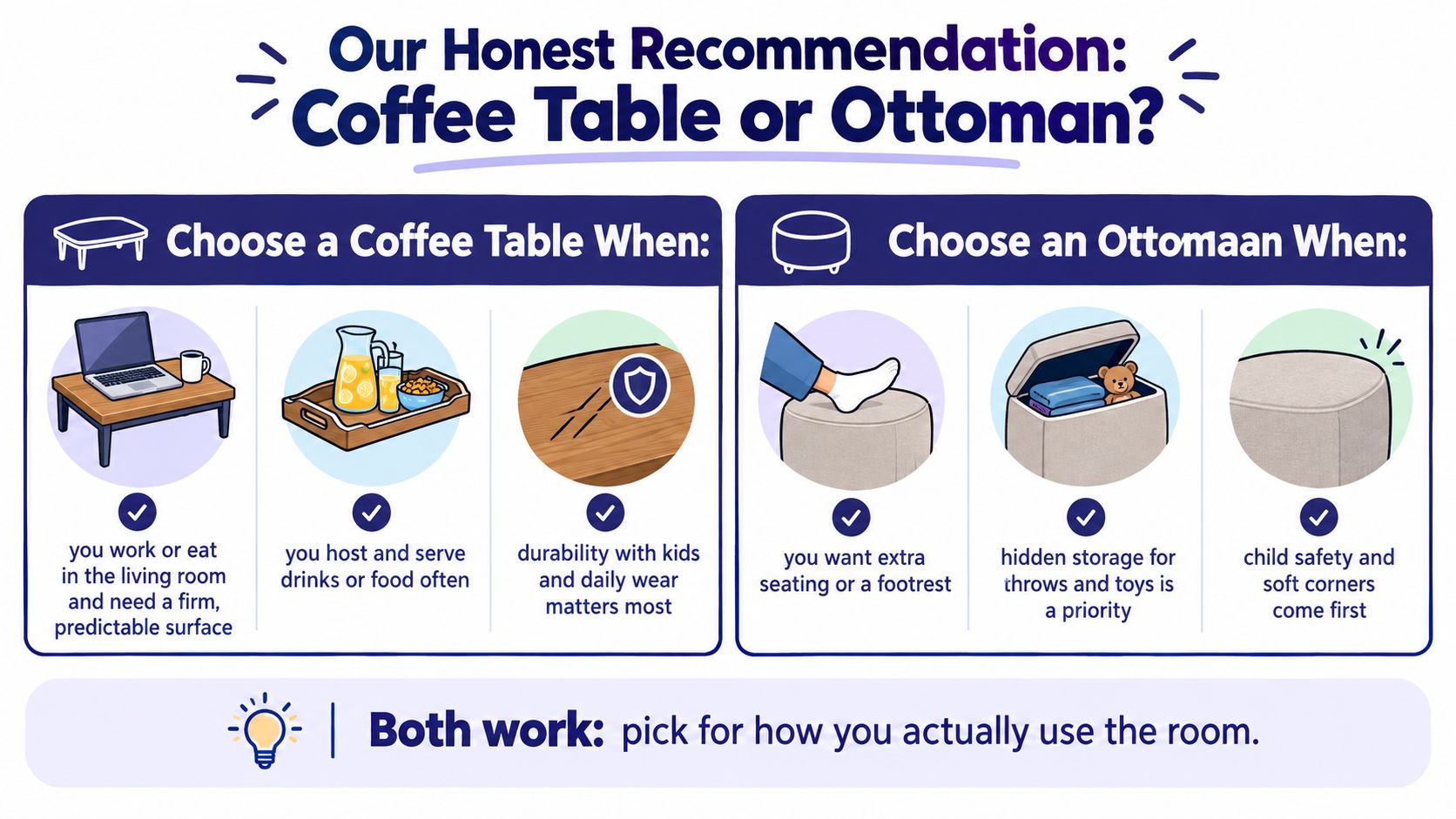
Choose a coffee table when your central priority is a firm, predictable surface. It's the more direct fit for laptop work, dining in the living room, serving drinks, and displaying décor, provided the room can absorb a permanent piece without narrowing circulation.
Choose an ottoman when comfort, reconfigurable seating, leg support, or hidden storage matters more. Accept that a tray may be necessary for stable drinks and food, and check the upholstery rating before placing it in a high-use family room.
A middle path can work well. An ottoman with a firm, tray-compatible top can cover several roles, while a coffee table paired with upholstered stools can add seating and softness without sacrificing the main work surface.
Before you decide, measure the sofa, confirm the piece length, reserve the 14–18-inch gap, protect an approximately 36-inch walkway, and ask which tasks must work without another accessory. You can also visit a Woodstock Furniture & Mattress Outlet showroom in North Georgia to sit, reach, test tray placement, and compare coffee tables with cocktail or storage ottomans in person.
Woodstock Furniture & Mattress Outlet offers living-room furniture, including coffee tables, cocktail ottomans, seating, storage pieces, and décor for different room layouts. Visit Woodstock Furniture & Mattress Outlet to test the height, reach, upholstery, and movement of both options with guidance from knowledgeable staff.
Leave a Reply
You must be logged in to post a comment.