You've measured the wall, found a sectional that technically fits, and still can't open the front door without bumping into the chaise. That's the problem with many small living rooms: the sofa's width looks acceptable on paper, while its depth, return, and relationship to doors turn everyday movement into an obstacle course.
Modular sectionals for small spaces solve that problem only when you plan beyond the wall measurement. The right choice accounts for the full footprint, delivery route, door swings, open walkways, coffee-table clearance, and the possibility that your room will serve a different purpose later. This guide focuses on those hidden variables, so you can test a layout before committing to a heavy piece of furniture.
Why Modular Sectionals Fit Small Rooms Better
A fixed sectional can look perfect in a showroom and fail immediately at home. The long side may sit neatly against the wall, but the return could block the route to the kitchen, cover a heating vent, or leave no practical place for a desk chair. In a compact room, that failure isn't cosmetic. It affects how you carry laundry, host guests, watch television, and move through the home every day.
Modular seating developed around a different idea. Individual pieces can be separated, rearranged, or expanded instead of locking you into one permanent shape. Harvey Probber's 1944 introduction of rearrangeable sofa sections is widely cited as an important milestone in the modern modular sectional, while design historians trace the broader modular idea to at least the 18th century and its formalization through movements such as the Bauhaus in the 1920s. The concept gained renewed attention in the 1960s and 1970s as flexible living became more common. Dwell's history of modular sofas places today's adaptable sectionals in that longer design story.
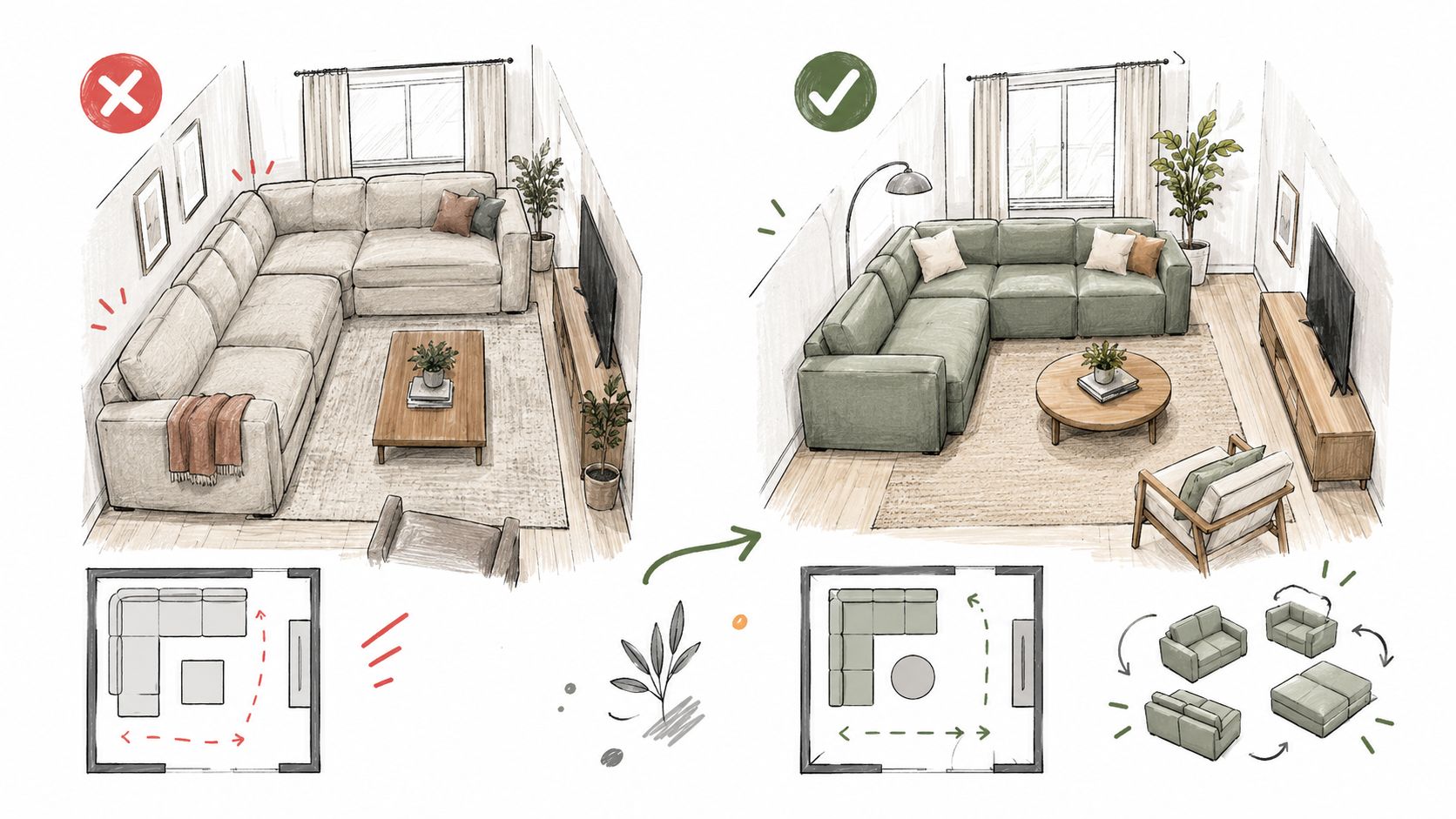
The practical advantage is straightforward. You might use an L-shape during the week, separate the chaise when you need a clear floor for guests, and move the pieces into a new arrangement after relocating. That adaptability suits apartments, condos, and multifunctional rooms where one area may serve as a living room, office, dining zone, and passageway.
Practical rule: Modularity earns its space when your room, household, or routine may change. If the layout will never change and a simpler sofa already fits comfortably, fixed seating may be the more sensible purchase.
Adaptable furniture also has a delivery advantage. Separate modules can be easier to carry through narrow halls, stair turns, and apartment entrances than a single assembled frame. For broader low-maintenance furnishing ideas, Interiors by DeX's low maintenance guide offers useful context on choosing surfaces and arrangements that are easier to live with.
The category's renewed popularity reflects that practical appeal. Google Trends interest in modular furniture has more than tripled since 2019, according to the historical overview from Dwell. That doesn't mean every modular sectional belongs in every small room. It means shoppers are increasingly looking for furniture that can respond to changing floor plans rather than forcing the room to respond to the furniture.
Measuring Your Space for a Modular Sectional
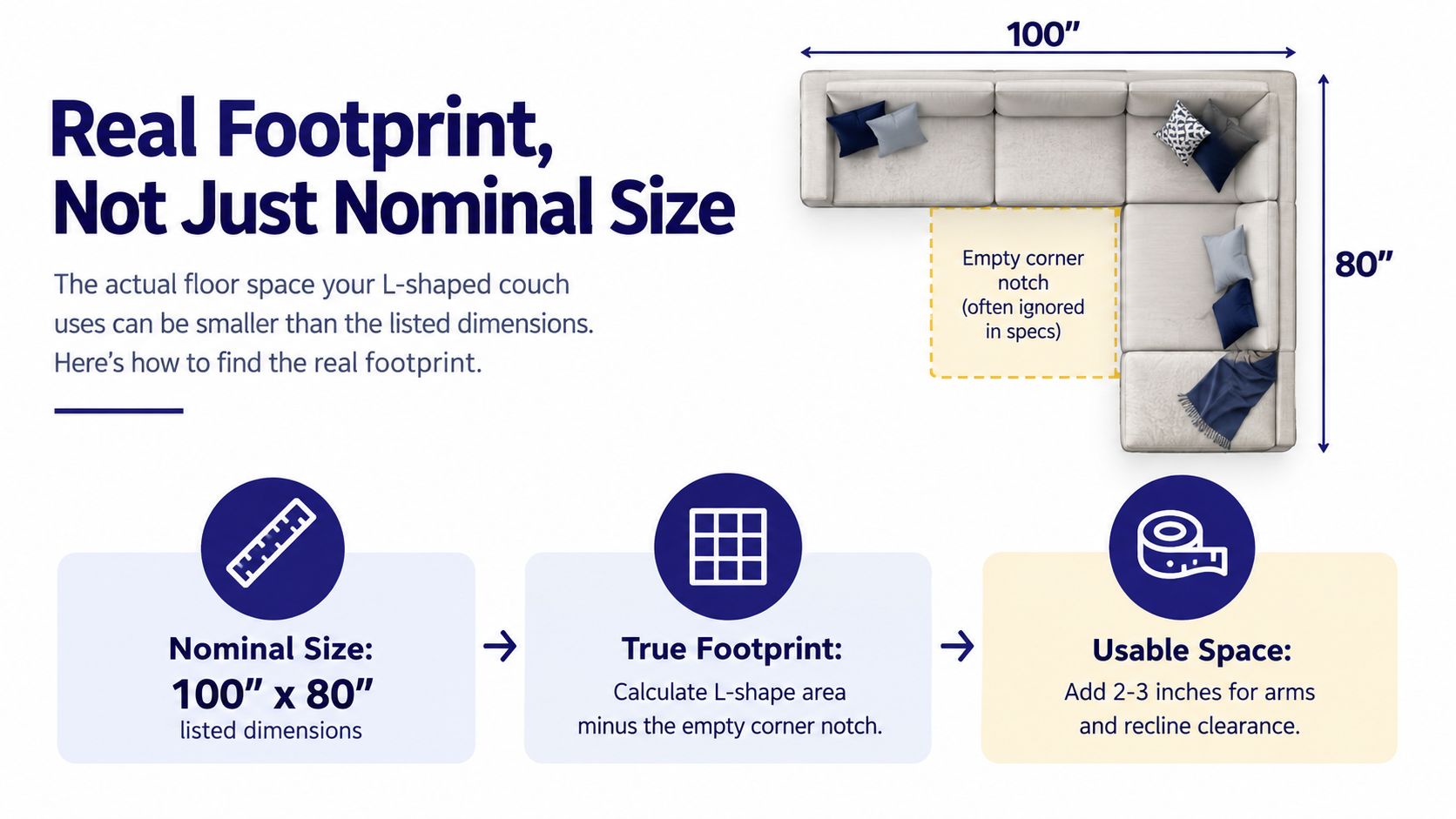
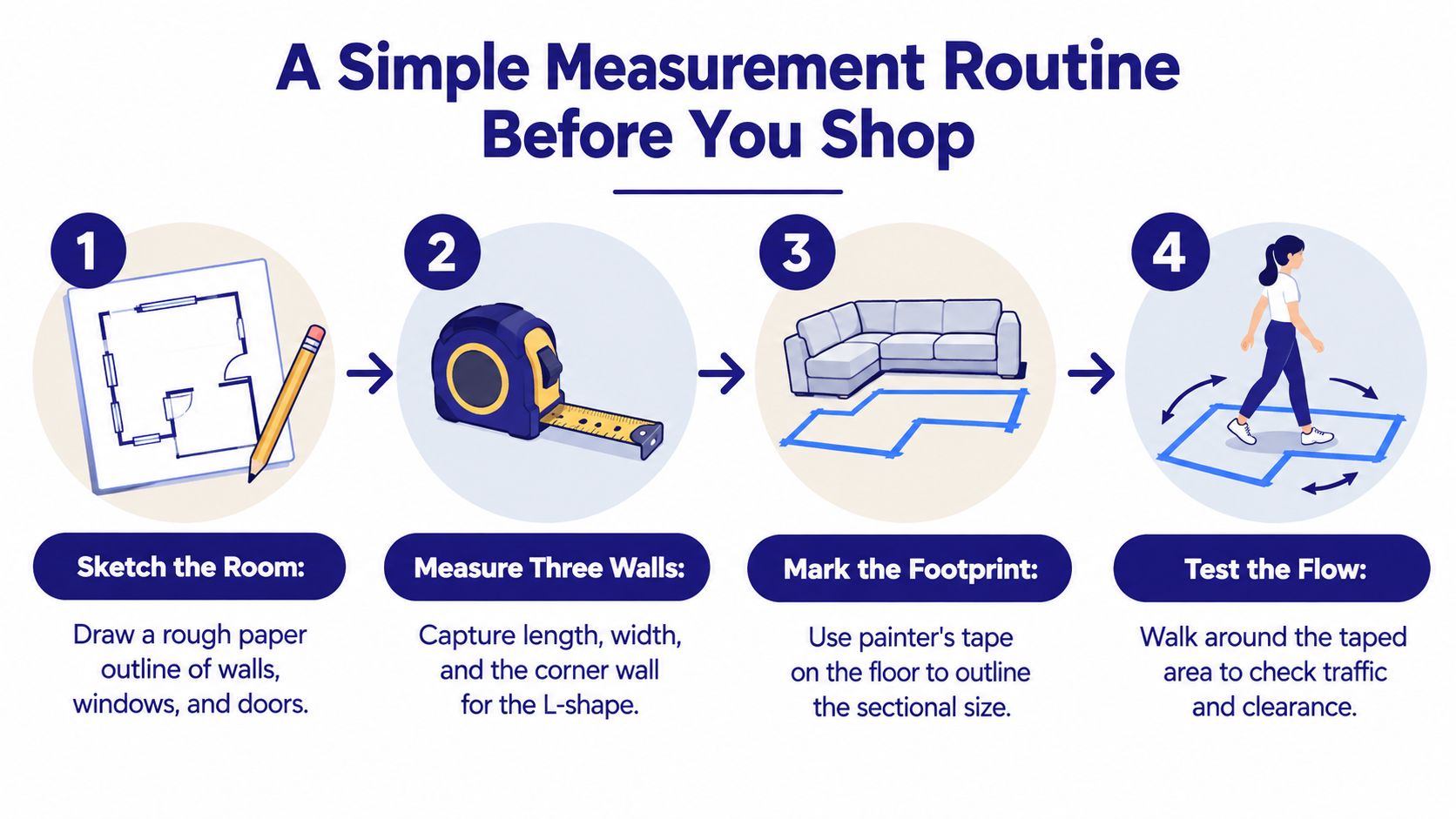
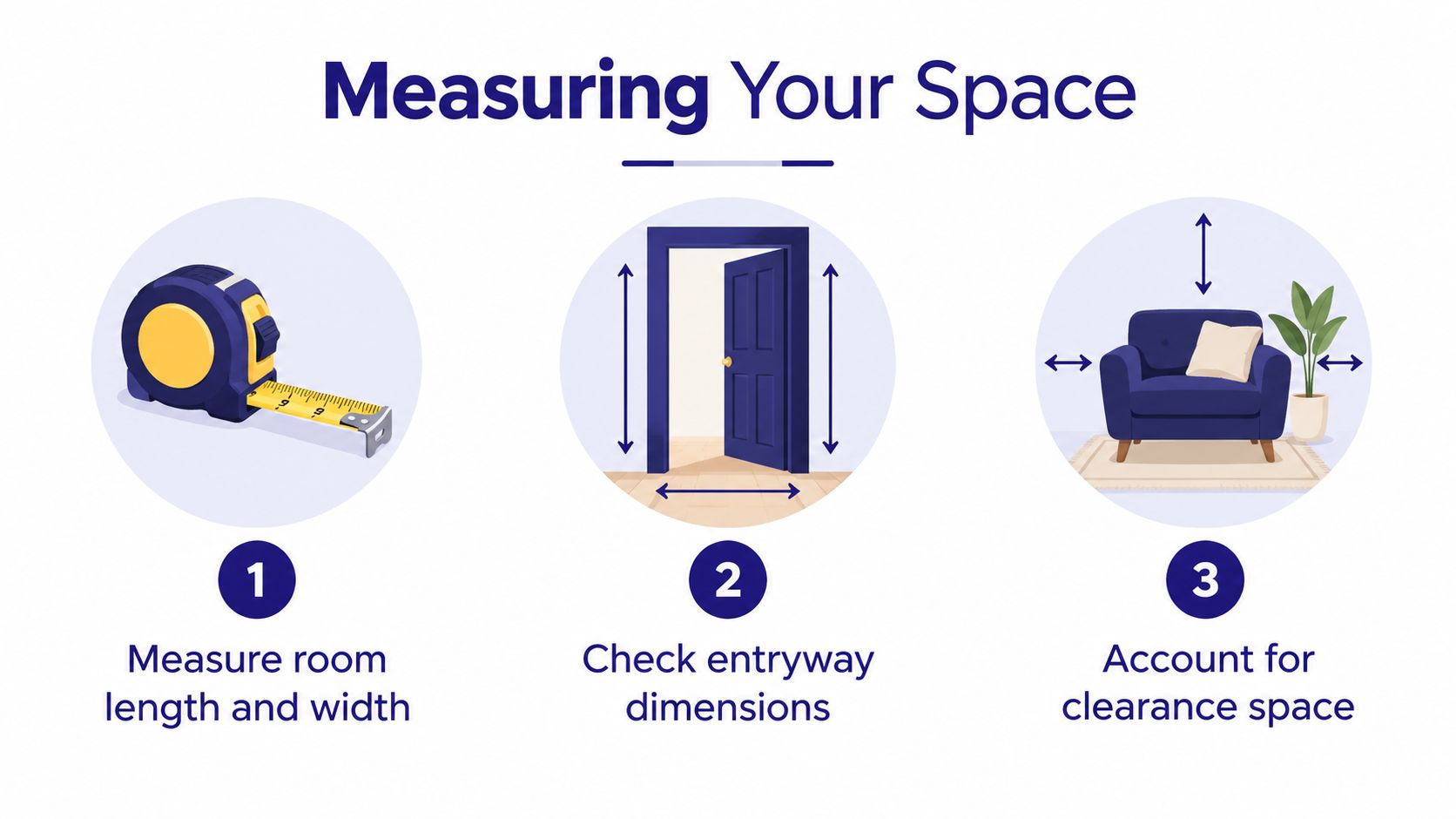
A sectional can fit between two walls and still make the room unusable. A door may need the same floor area, a hallway may cut through the seating zone, or a chaise may block access to another room. Measure the room before browsing products, including usable length and width, doors, windows, radiators, vents, outlets, built-ins, and adjoining-room routes.
For many compact living rooms, start with a long side of 84 to 95 inches and a short return of 58 to 70 inches. Interior Insider's sectional arrangement guide notes that a small rectangular room around 10 by 13 to 12 by 16 feet can accommodate an L-shaped, two-piece sectional when the main wing leaves a 30-inch walkway. Use these figures as planning ranges rather than guarantees.
Depth can determine whether the room feels open or crowded. Aim for approximately 32 to 36 inches overall depth, with a chaise no longer than 60 to 70 inches, based on Architectural Digest's small living room guidance. Check the chaise projection separately. A sectional may fit the available wall but still intrude into the route people use to enter, cross, or leave the room.
Measure the room in layers
Use painter's tape to mark the proposed footprint on the floor. Include the arms, back, chaise, and any end table. Walk through the taped layout, open every door fully, pull out drawers, and stand where someone would enter from the hallway. This test exposes conflicts that a wall-to-wall measurement misses.
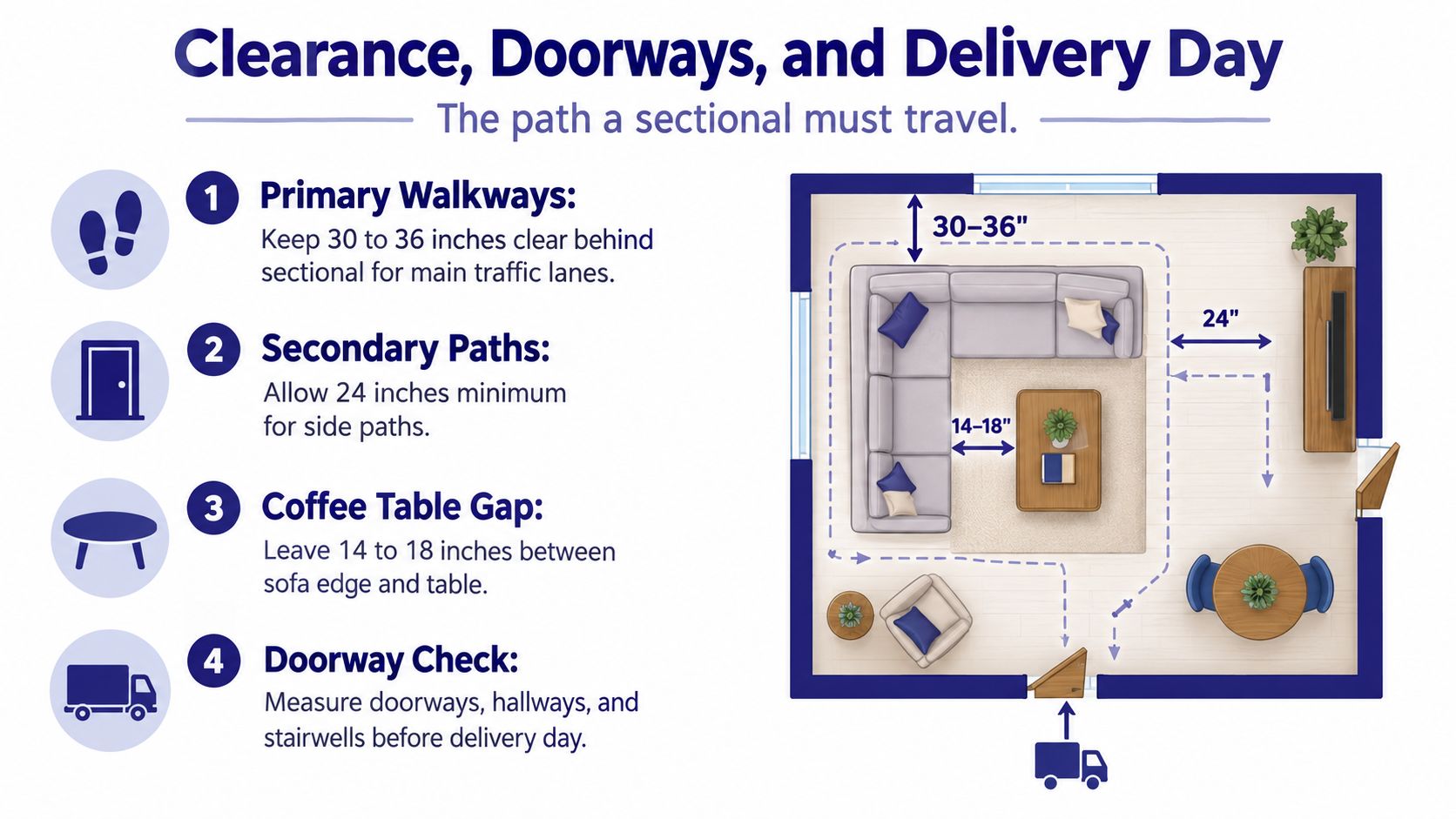
Keep 30 to 36 inches of clear circulation space on open sides wherever possible. Cozey's sectional size guide recommends at least 36 inches on open sides and describes 42 to 48 inches as more comfortable for high-traffic paths. Between the sofa and coffee table, preserve at least 14 to 18 inches. If a door swing, vent, or passage uses part of that gap, reduce the furniture footprint rather than treating the clearance as available seating space.
Room dimensions also change the workable sectional size. A compact sectional around 90 to 100 inches per side may suit a 10 by 12 foot room when clearance remains available. A standard sectional around 100 to 110 inches per side generally needs at least a 12 by 14 foot room, according to Item Fits' room-sizing guidance. Subtract space occupied by doors and reserve room for movement. For future flexibility, tape an alternate module arrangement as well. A configuration that works today should still leave a usable route if the chaise changes sides or separates later.
Before visiting a showroom, record:
- Room dimensions: Measure finished wall to finished wall.
- Obstacles: Note windows, vents, radiators, outlets, and built-ins.
- Door swings: Mark the full arc, not just the doorway opening.
- Delivery route: Measure entry doors, hallways, stairs, and tight turns.
- Clearance: Tape the sofa, table, and walking paths on the floor.
Placement Strategies That Improve Flow
A sectional's dimensions tell you whether it can occupy the room. Placement determines whether the room remains usable. Start by drawing a scaled floor plan, even if it's on graph paper. Mark doors and openings first, then place the sofa, coffee table, television, desk, and any furniture that can't move.
Test the circulation before the styling
Keep one route through the room unobstructed. In many apartments, that means preserving a direct line from the entry to the kitchen or bedroom rather than filling the center with a chaise and table. Put the sectional's longest side along the most stable wall, then use a corner to absorb the return and recover otherwise awkward space.
Don't automatically push every inch of the sofa against the wall. A small gap can help with baseboards, vents, curtain movement, and access for cleaning. On the other hand, floating a deep sectional in the middle of a narrow room may create two cramped corridors instead of one useful path.
Use tape or paper templates to test at least two arrangements before ordering. One version might place the chaise in the corner. Another might separate the chaise and use it as a movable seat or ottoman. RBA Home Plans' advice on how to maximize every square foot is useful beyond sofas because the same principle applies to storage, work areas, and open floor.
Keep the center useful
A coffee table should support the seating zone without becoming a second obstacle. Preserve 14 to 18 inches between table and sofa, as noted in the earlier sizing guidance from Architectural Digest. If that gap leaves too little room to walk, choose nesting tables, a narrow table, or a movable ottoman instead.
Common placement mistakes include:
- Blocking the primary route: A chaise that reaches into the entry path will make the room feel smaller every time you cross it.
- Ignoring door clearance: A cabinet or sectional arm can stop a door from opening fully, even when the sofa itself fits.
- Overfilling the seating zone: Extra chairs and oversized tables often remove the openness the sectional was meant to create.
- Choosing the television wall first: Sightlines matter, but they shouldn't override the route through the room or access to windows.
In a studio, a linear modular arrangement can divide sleeping and living areas without building a wall. In a narrow living room, an L-shape usually works better when the short return points toward a corner rather than projecting into the room's center.
Choosing the Right Configuration
The most useful configuration is the one that gives you comfortable seating without consuming the routes and functions the room needs. A compact L-shape, a loveseat with chaise, and a two-piece modular layout can all work, but they behave differently once doors, windows, and furniture clearances enter the plan.
| Configuration | Best For | Typical Width |
|---|---|---|
| Compact L-shape | Rooms with a usable corner and a defined seating zone | 90 to 105 inches |
| Loveseat and chaise | Apartments needing a lounge position without a full-size sofa | 90 to 105 inches |
| Two-piece modular layout | Renters or rooms that may need future rearrangement | 84 to 95 inches for the main side |
| U-shape | Open studios or larger compact rooms that need a contained conversation area | Depends heavily on circulation and room proportions |
A compact L-shape usually delivers the most seating per occupied wall. It works well when the return can sit against a short wall or in a corner. The trade-off is commitment to that corner, especially if the chaise isn't reversible. Check whether the modules can switch sides before assuming the configuration will suit a future home.
The loveseat-and-chaise arrangement feels less imposing than a full corner sectional and can give one person a dedicated place to stretch out. It still requires careful attention to chaise depth, since the short side may project farther into the room than expected. If the living room doubles as an office, a movable ottoman can be more useful than a permanent chaise because you can clear it when a desk chair needs space.
A simple two-piece setup gives you the strongest reconfiguration potential. You can connect the pieces for a conventional sectional, separate them into two seats, or shift their relationship when the room changes. That flexibility may matter more than adding another seat today.
Choose the return side from the room
Stand at the room entrance and identify which corner is least disruptive to movement. Place the return there if it doesn't block a door, radiator, window access, or the route to another room. If both sides appear possible, a reversible chaise or individually finished modules reduce the risk of choosing the wrong orientation.
U-shaped sectionals deserve caution. They can define a living zone in an open studio, but the enclosed footprint may consume the very circulation space a small room needs. Povison's 2026 modular sectional guidance points out that many existing guides provide broad size rules but don't fully address door swings, walk paths, and viewing distances. Those variables should decide whether a U-shape is practical, not the seating count alone.
A configuration that can become smaller is often more valuable than one that only becomes larger.
Selecting Fabrics and Practical Features
Once the footprint works, choose materials based on how the sectional will be used. A compact sofa often receives more concentrated traffic than a large-room sofa because it serves as the primary seat, lounge, guest seat, and sometimes a work surface. Fabric should tolerate that routine without requiring you to treat the room like a showroom.
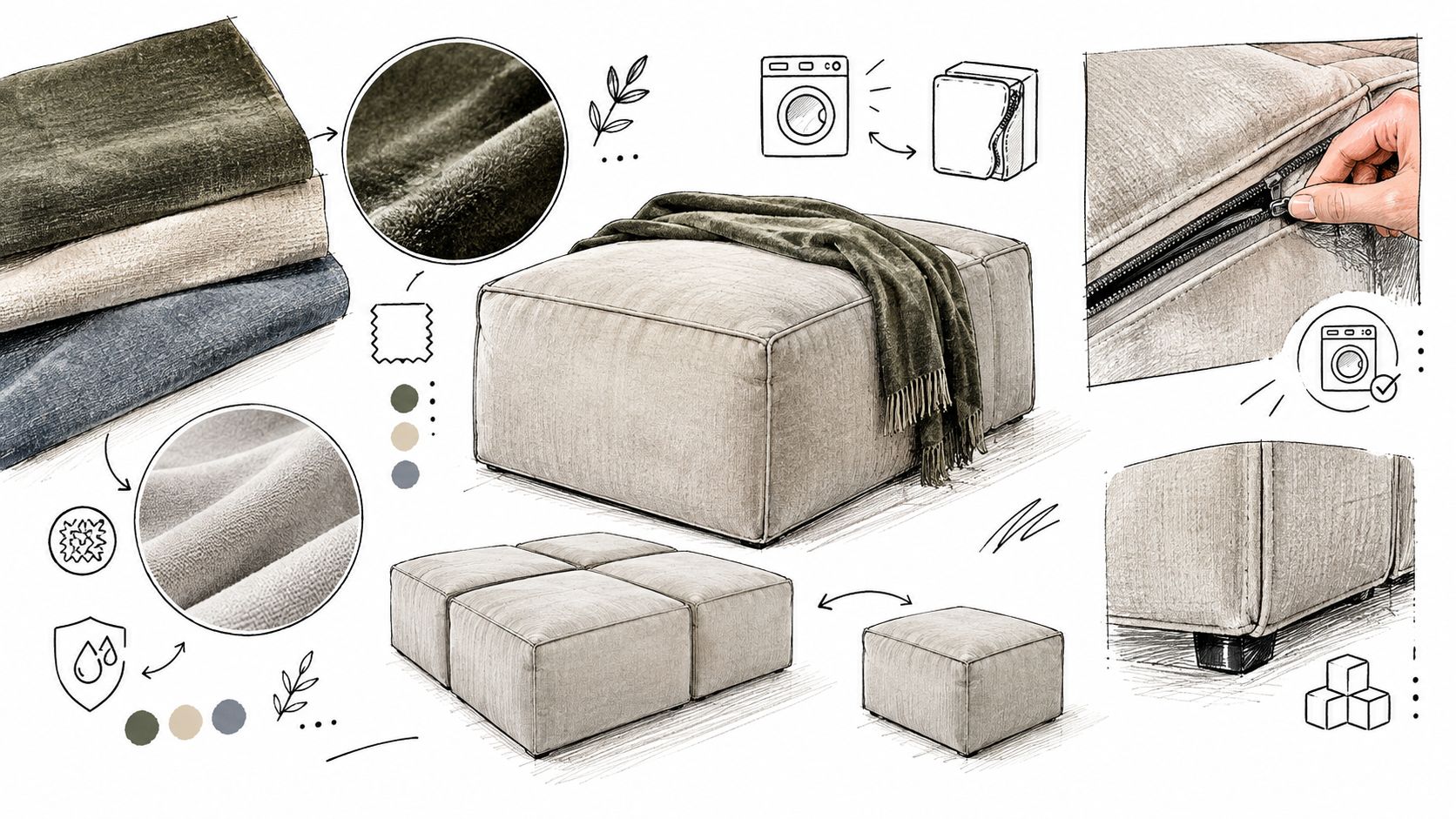
Performance fabrics can make sense for households with children, pets, or frequent entertaining because many are designed to resist everyday stains and wear. Verify the care instructions rather than relying on the phrase “performance fabric.” Some systems offer removable covers, while others only allow spot cleaning. Those are different maintenance experiences.
Machine-washable covers can be helpful, but ask what the warranty permits, whether replacement covers remain available, and whether all upholstered sections can be removed. A modular system may also develop visible seams between pieces, especially when cushions shift. On hard floors, modules can slide unless the connector system or an appropriate rug keeps them aligned.
Keep visual weight under control
Lighter colors and textured neutrals can help a compact room feel more open, but they aren't automatically easier to maintain. Pale upholstery shows certain stains and pet hair clearly. Darker colors can feel grounded and may disguise everyday marks, yet a bulky dark sectional can make a small room feel visually dense.
Look for features that reduce mass, such as slim arms, a lower back, or raised legs that allow some floor to remain visible. Rounded edges can soften the appearance of a large block, while a low-profile base may create a contemporary look but can be harder for some people to stand from.
Storage chaises are useful when they replace a separate storage ottoman or cabinet. They aren't useful if the lid is difficult to lift, the compartment is shallow, or the chaise orientation prevents access. Built-in USB ports can be convenient near a primary seating position, but they add value only if the location works with your room's outlets and daily habits.
Current modular designs increasingly include low profiles, rounded edges, textured neutrals, USB ports, and storage chaises, according to Living Spaces' modular sectional overview. Treat those features as options to evaluate, not a checklist to complete.
For the wall behind a compact sectional, a few carefully chosen accents may add personality without consuming floor area. Jessie's Home's modern canvas prints provide one example of using vertical decoration instead of adding another table, cabinet, or floor accessory.
Final Checklist Before You Buy
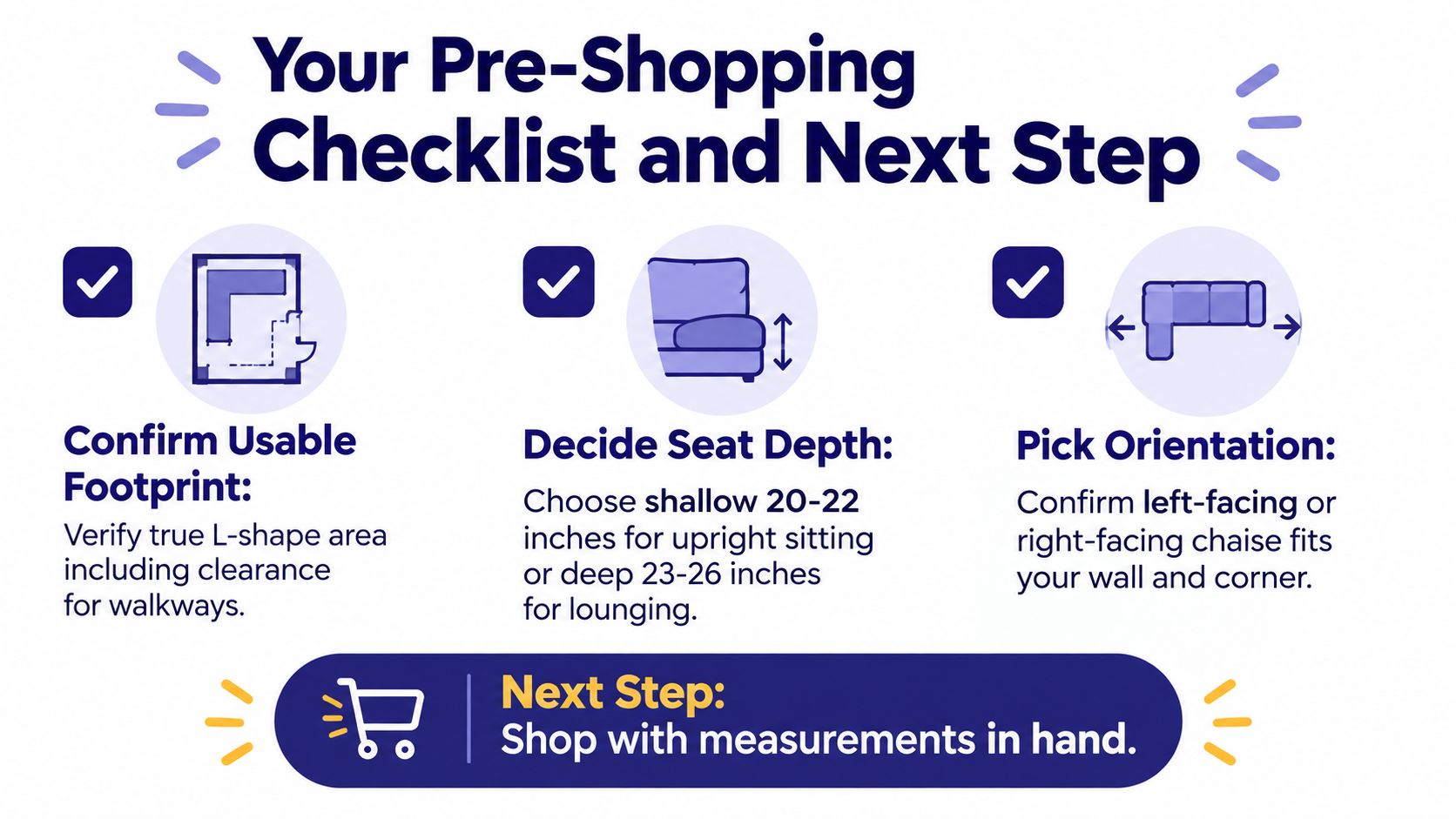
A modular sectional should pass a floor-plan test, a movement test, and a future-use test. If it passes only the showroom comfort test, you haven't finished evaluating it.
Confirm the physical fit
- Measure the complete footprint: Record the main width, return depth, overall depth, and chaise length.
- Mark every obstruction: Include door swings, windows, vents, radiators, outlets, and built-ins.
- Protect circulation: Preserve the planned open route and verify that the sectional won't narrow it at a doorway.
- Check table clearance: Leave the required gap between the sofa and coffee table, or choose a smaller movable surface.
- Test delivery access: Measure the entrance, hall, stairs, and turns. Ask how many modules arrive and whether connectors need special handling.
Confirm the living experience
Sit in the exact module style if possible. Check seat depth, arm width, back height, cushion movement, and how easily you can stand. A visually light sofa can still feel physically deep, while a compact piece can feel cramped if the arms consume too much seating width.
Then ask what happens later. Can the chaise switch sides? Can you separate the modules? Are additional pieces available? Can you order replacement covers or cushions? The answers determine whether modularity is a practical long-term feature or just a connector between fixed pieces.
Don't ignore the maintenance trade-off. Modular sectionals can make moving and rearranging easier, but they also introduce seams, connectors, and multiple cushions that need alignment. Choose that complexity when it solves a real problem in your home.
The right sectional isn't the largest one that fits. It's the one that leaves the room functional after it arrives.
Visit a showroom with your measurements, taped floor plan, and delivery-path notes. Seeing the seat depth, fabric texture, module connections, and chaise proportion in person can reveal issues a product photo won't show.
Woodstock Furniture & Mattress Outlet offers modular sectional options, including configurable sectional pieces and special-order possibilities, along with hands-on help comparing layouts and features. Bring your room measurements and traffic plan when you visit Woodstock Furniture & Mattress Outlet, so the team can help you assess what fits your space before you commit.