
You've found a sofa that fits the wall, but the room still feels wrong. The ottoman blocks the path to the kitchen, the front door can't open fully, or there's no comfortable way to stretch your legs without crowding the coffee table. In a compact home, those problems usually come from measuring furniture as isolated pieces instead of planning the sofa, ottoman, walkways, and delivery route together.
A small sofa with ottoman can be one of the most adaptable seating arrangements for an apartment, studio, or multipurpose living room. It can support everyday lounging without permanently defining the room, but only if its proportions, construction, and placement suit the way you live.
Why a Small Sofa With Ottoman Fits Modern Living
A studio apartment often has to function as a living room, office, guest area, and exercise space. On a quiet evening, you may want to pull an ottoman close and put your feet up. The next afternoon, you may need to move it aside for guests, floor exercise, children's play, or a clearer route between the entry and kitchen.
That flexibility is the main reason to consider an ottoman instead of a fixed chaise. A chaise creates a permanent extension and commits the room to one orientation. A movable ottoman can provide leg support when you want it, then become an extra seat, occasional table, or storage unit when the room's needs change.
Practical rule: In a small room, movable comfort often works better than permanent bulk.
A compact sofa also gives you more freedom than a large sectional or an oversized loveseat with a deep fixed return. You can place the ottoman in front of either side, angle it slightly for conversation, or move it away from the sofa when you need an open floor. That makes the arrangement useful for both solitary lounging and casual hosting.
The ottoman's history helps explain this adaptability. It began as a low, cushioned platform and later developed into smaller upholstered furniture for bedrooms and sitting rooms. Its low profile and lack of a back or arms still allow it to perform several roles without visually closing off the room. (The documented history of the ottoman) traces this change from expansive communal seating to a flexible accessory.)
A small sofa with ottoman isn't automatically the right answer. A fixed chaise may be more comfortable for someone who always lounges in the same position, while separate chairs may work better for a household that hosts frequent conversation. The ottoman arrangement makes the most sense when you value reconfiguration, open pathways, and more than one use from each piece.
Measuring Your Room and Planning the Layout
Wall width is only the starting point. A sofa may fit between two walls and still leave too little space to walk, open a door, reach a window, or use the ottoman comfortably.
A small living room may be near 130 square feet, with a common example measuring 10 by 13 feet, according to residential room-sizing and layout guidance. That same guidance describes typical three-seat sofas as approximately 78 to 90 inches wide and 36 to 40 inches deep, with about 30 to 36 inches of front clearance for comfortable movement. Consumer Reports offers a more direct starting point for compact rooms, recommending that shoppers consider sofas under 80 inches wide. (Consumer Reports' sofa-buying guidance also emphasizes measuring the complete delivery path.)
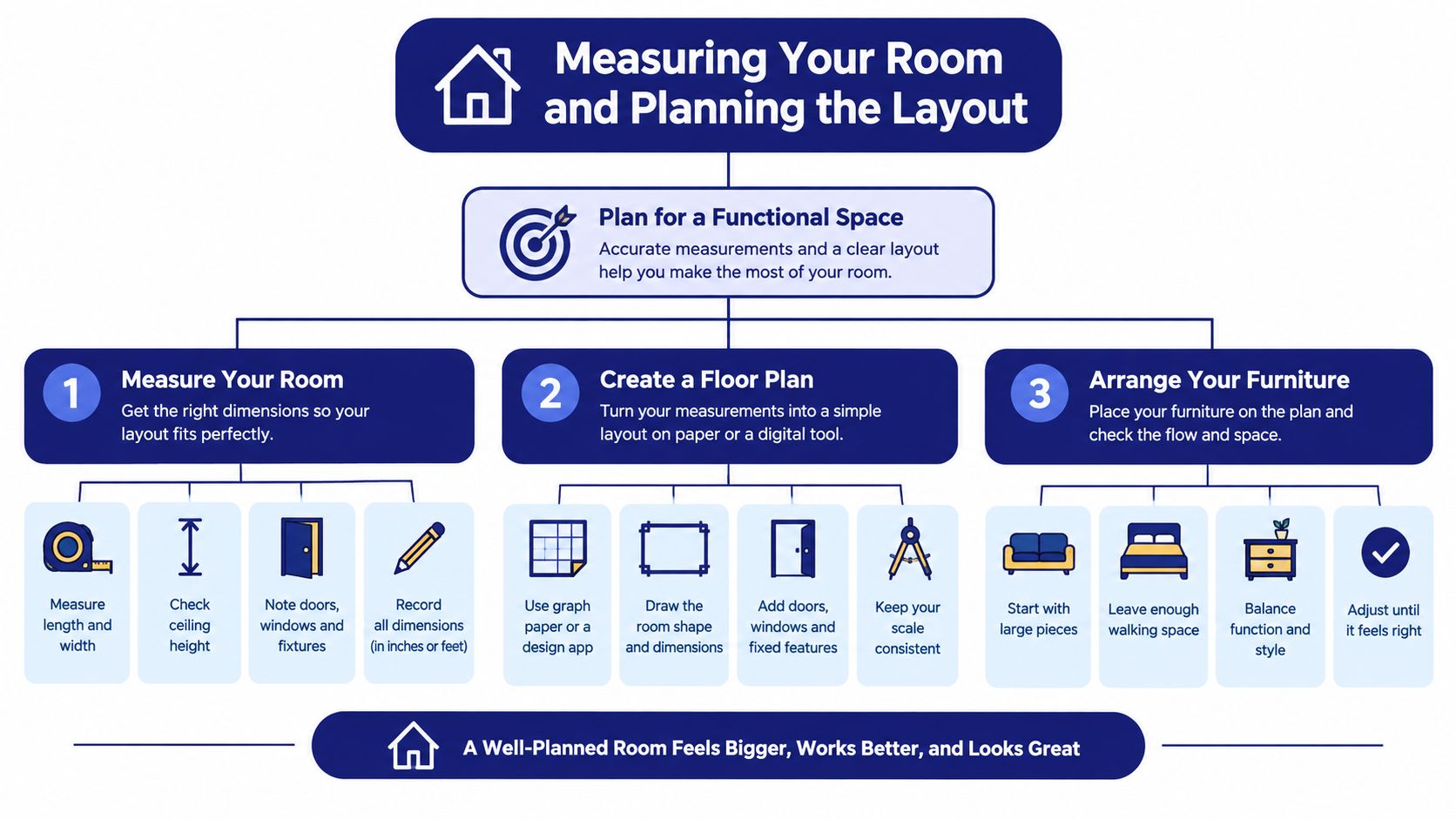
Use a three-part measurement process
Measure the room's usable area. Record wall lengths, door swings, windows, radiators, vents, outlets, and any built-in features. The usable area is smaller than the room's total floor area once those fixed elements are accounted for.
Measure both furniture footprints. Write down the sofa's overall width and depth, then measure the ottoman separately. Don't rely on a product name such as “apartment sofa” or “compact.” Those labels don't tell you how much floor space the complete arrangement requires.
Measure the route into the room. Check the entry door, interior doors, stairs, turns, elevator, and any narrow hallway. A sofa that fits the final location can still fail at the building entrance or a tight landing.
Keep the main walkway about 24 to 30 inches wide, and plan approximately 14 to 18 inches between the sofa's front edge and the ottoman, based on practical ottoman arrangement guidance. The shorter spacing favors relaxed leg support. The longer spacing makes it easier to pass through the room.
| Zone | Recommended Clearance |
|---|---|
| Main walkway | 24 to 30 inches |
| Sofa to ottoman | 14 to 18 inches |
| Comfortable sofa front movement zone | 30 to 36 inches |
Before ordering, apply painter's tape to the floor around the proposed sofa and ottoman footprints. Sit where you normally sit, extend your legs, walk past the arrangement, open nearby doors, and approach the seating from the entry. If the taped layout feels congested, the finished furniture won't solve that problem.
For more ideas about making a compact apartment feel open, Alex Trend Painters' guide to maximizing small spaces offers useful decorating context. Use those ideas after the functional layout works, not as a substitute for measuring circulation.
Choosing Materials and Styles for Daily Use
A sofa's visual scale comes from more than its width. Low arms, exposed legs, and a clean back can make a compact piece feel lighter, while thick arms, deep cushions, and a skirted base can make the same footprint appear fuller.
Material choice should follow household use. A home with pets, children, frequent spills, or daily lounging needs a different upholstery conversation than a formal sitting room used occasionally. Recent U.S. consumer research reported that comfort was a selection criterion for 99% of respondents, followed by preferred size at 98%, color at 97%, and easy cleaning at 96%. The same research reported that 78% expected a sofa to last about 15 years, while 88% preferred performance fabric. (The consumer findings reinforce why “small” shouldn't mean occasional-use or lightly built.)

Compare upholstery by the work it must do
Performance fabrics can be practical for active households, but ask what the label means, how the fabric should be cleaned, and whether the manufacturer provides a rating or care code. “Performance” is a category to investigate, not proof that every fabric will respond identically to stains or abrasion.
Leather offers a distinct surface and can be wiped more easily in some situations, but it can show scratches, color variation, and wear patterns. Its feel also changes the character of a small sofa, often making a compact frame look more polished.
Linen blends and textured fabrics can bring softness and visual interest, yet they may show wrinkling, marks, or compression more readily. Request the cleaning code before deciding, especially if the sofa and ottoman will be used together every day. For practical household stain considerations, Maid in America's furniture and carpet cleaning tips provide useful maintenance context.
Look closely at the sitting experience
A compact sofa can lose useful seating width through thick arms. Compare the internal seat width, not just the outside measurement. Check whether the seat depth lets you sit upright without pressure behind the knees, while still giving enough room to lounge.
Cushion feel also matters. A soft cushion may feel inviting at first but require regular recovery and adjustment. A firmer cushion can offer more stable support but may not suit someone looking for a relaxed, sink-in seat. Sit on the sofa and place your feet on the ottoman. Your hips, knees, and lower back should feel supported rather than forced into a raised or cramped position.
Style should serve those measurements. A rolled arm may suit a traditional room, while a clean, raised base may preserve visual openness in a narrow space. Neither is automatically more comfortable or durable. The right choice depends on the usable seat, the fabric's care requirements, and the way your household will use both pieces.
Understanding the History and Multifunctional Role of the Ottoman
An ottoman earns its place in a small room because it was never limited to one job. It began as a low wooden platform covered with cushions, used as broad, shared seating associated with the Ottoman Empire. As the form moved into European interiors, it shifted scale and use, becoming smaller and easier to place in bedrooms, sitting rooms, and beside sofas. The language history of the furniture term is documented in the furniture term's documented history).
By the 19th century, European ottomans often appeared in circular or octagonal forms. Hinged tops added storage, and that change still matters now. In a tight living room, hidden storage can remove clutter from the floor, which often does more for the room's comfort than choosing a more decorative shape.
The ottoman's long history also explains why it works so well in awkward layouts. Its core traits are low height, cushioning, and absence of a back or arms. Those details keep it visually light and physically movable, which helps when a compact sofa already takes up most of the fixed seating footprint.
Match the function to your routine
Use matters more than labels. In front of a sofa, an ottoman supports your legs. Shift it to the side and it becomes an occasional seat. A firm, flat top can hold a tray for drinks or a book, while a hinged version can store blankets, remotes, or toys that would otherwise crowd a narrow room.
The mistake I see in small spaces is treating every ottoman as interchangeable. A piece that works well as a footrest may be too soft for regular sitting, or too padded and unstable for use as a surface. One with storage may solve clutter but still fail if the lid is awkward to open once the sofa is in place, or if its size tightens the path through the room.
That is the trade-off. A multifunctional ottoman should reduce pressure on the room, not create a new circulation problem. Choose one that fits the way you sit, store, and move around the sofa, and it will keep working even as the room's routine changes.
Evaluating Construction Quality and Durability
Compact furniture deserves close inspection because every lost inch affects the sitting experience. A narrow sofa with thick arms may have much less usable seat width than its exterior dimensions suggest. A small ottoman can also receive heavy wear because people rest their feet on it, sit on it, move it, and sometimes use it as a surface.
Consumer Reports identifies a kiln-dried hardwood frame combined with eight-way hand-tied springs as a top-quality upholstery construction, while noting that fabric categories such as commercial grade, performance, and indoor/outdoor are among the more durable groups to investigate. These are construction characteristics to ask about, not guarantees that every product with a particular label will perform the same way. (Its furniture quality guide explains why specific construction information is more useful than broad quality language.)
Ask what is inside the frame
A showroom description should answer more than whether the sofa “feels solid.” Ask for:
- Frame material: Find out whether the frame uses kiln-dried hardwood or another specified material, and ask how the joints are constructed.
- Suspension type: Learn whether the piece uses eight-way hand-tied springs, another spring system, or webbing.
- Cushion composition: Ask about the foam, fiber, down, or blended fill, and how the cushions are expected to recover after use.
- Upholstery care: Request the cleaning code, fabric specifications, and any limitations around stain treatment.
- Warranty terms: Check what the warranty covers, how long it applies, and whether labor or replacement components are included.
A matching sofa and ottoman can share a fabric and still have different internal construction.
That distinction matters when the ottoman functions as an extra seat or receives daily foot traffic. Inspect its base, seams, top support, and moving hardware if it has storage. A hinged lid should open smoothly and close securely. A loose or thinly supported top may become uncomfortable or unstable under repeated use.
Durability also depends on care. Rotate or fluff cushions as directed, avoid sitting on arms, keep the ottoman from scraping against hard flooring, and follow the upholstery cleaning instructions. A performance label won't compensate for unsuitable use, neglected maintenance, or a frame that doesn't match the household's demands.
Making Smart Choices About Sustainability and Longevity
Compact furniture isn't automatically sustainable, and a sustainability label doesn't answer every practical question. The more useful test is whether the sofa and ottoman can remain useful, serviceable, and adaptable over time.
A 2025 survey of 1,500 U.S. adults found that 57% were more likely to buy furniture labeled sustainable, while 55% identified price as the main barrier. The same research reported that 27% questioned durability or quality, 23% cited limited availability or styles, and 15% lacked information about sustainability claims. (The survey findings show why a label alone doesn't provide enough evidence.)
Independent 2025 research on more sustainable sofa concepts found that comfort and quality, resistance over time, design, and price mattered more to respondents than environmental impact. About 77% said they would consider such products, while fewer than half expressed high purchase likelihood, according to the reported sofa research. Look at the practical lifespan first, then assess the environmental information.

Check the evidence behind the claim
Use these questions before accepting broad wording such as “eco-friendly” or “sustainable”:
- Can parts be serviced? Ask whether covers, cushions, casters, hinges, or other components can be replaced.
- Are materials identified? Look for material composition, recycled-content claims, and relevant certifications rather than a general label.
- Will the layout adapt? A separate ottoman can outlast a fixed chaise as your room or routine changes, but only if both pieces are built for their intended uses.
- Can the pieces be reused? Consider repair, reupholstery, resale, donation, and disposal options before purchase.
- Is the claim supported? Request documentation for objective environmental statements and review the expected lifespan without assuming that compact means disposable.
The Federal Trade Commission states that advertising must be truthful and non-deceptive, and that advertisers need a reasonable basis, meaning objective evidence, for express or implied claims. Its advertising substantiation policy is a useful standard for reading furniture language. Treat phrases such as “built to last,” “most durable,” or “fits any small room” cautiously unless the seller can support them with specific evidence.
At Woodstock Furniture & Mattress Outlet, shoppers can discuss smaller-scale sofas and matching ottoman options, including custom-order upholstery configurations, while checking dimensions, fabric details, and layout suitability in person. Visit Woodstock Furniture & Mattress Outlet with your room measurements, taped layout notes, and delivery-path dimensions so the conversation stays focused on how the set will function in your home.
Leave a Reply
You must be logged in to post a comment.