If both mattresses have springs inside, why should the word hybrid tell you which one will feel better? It doesn't tell you enough. In an innerspring vs hybrid mattress comparison, the thickness of the cushioning, the way the coils respond, and your sleeping position usually tell you more than the category name.
Start with what isn't working on your current bed. Sore shoulders, difficulty turning over, overheating, and feeling your partner move are different problems. A useful comparison connects each problem to the parts of a mattress that might help, rather than assuming a newer-sounding label means a better fit.
Innerspring vs Hybrid at a Glance
Innerspring and hybrid at a glance
| Feature | Innerspring | Hybrid | What to check |
|---|---|---|---|
| Comfort layer above coils | Under about 2 inches of soft material | Often 2 to 3 inches or more of memory foam, latex, polyfoam, microcoils, or fiber | Layer list and thickness on the spec sheet |
| Support core | Metal coil system as the main support | Coil core paired with thicker comfort layers | Coil type, including Bonnell or pocketed |
| Label meaning | Traditional term with a fairly common meaning | No universal technical definition; proportions set by each maker | Compare specifications rather than the name |
| Motion and contour | Responsive support and easier movement | Foam can add contouring and pressure redistribution | Lie on the surface in your usual position |
These are practical category descriptions, not a universal manufacturing standard. Bedding News Now's mattress-type comparison notes that there's no universally accepted definition of hybrid, so manufacturers decide how they combine cushioning and springs.
That leaves considerable room for differences. A hybrid with a shallow, resilient comfort package can feel quite different from one with substantial, slow-contouring foam. Likewise, an innerspring with a cushioned surface doesn't necessarily feel hard just because springs provide its main support.
Read the specification sheet before choosing a category
Look for the comfort-layer list, not just the total mattress height. A tall mattress might include substantial support material without providing the particular shoulder cushioning you need. Ask which materials sit nearest your body and how thick those individual layers are.
Next, identify the coil system and cover fabric. A description that says only premium springs or cooling cover doesn't explain much about construction. Ask whether the coils are interconnected or individually pocketed, and what the cover is made from.
A useful comparison starts with similarly firm mattresses. Comparing a plush hybrid against a firm innerspring mixes together construction differences and firmness differences, making it difficult to know which feature you prefer.
Practical rule: Compare the layers and the core, not the name on the label.
A conventional innerspring can fit your body better than a hybrid if its cushioning relieves pressure without letting your pelvis sink excessively. Treat the category as a starting filter, then judge the actual mattress.
How Coils and Comfort Layers Change the Feel
Press your hand into two mattresses with the same label and you can get two different answers. One lets your palm sink into slow foam. The other pushes back with a springy lift. The label did not create that difference. The stack of materials did.
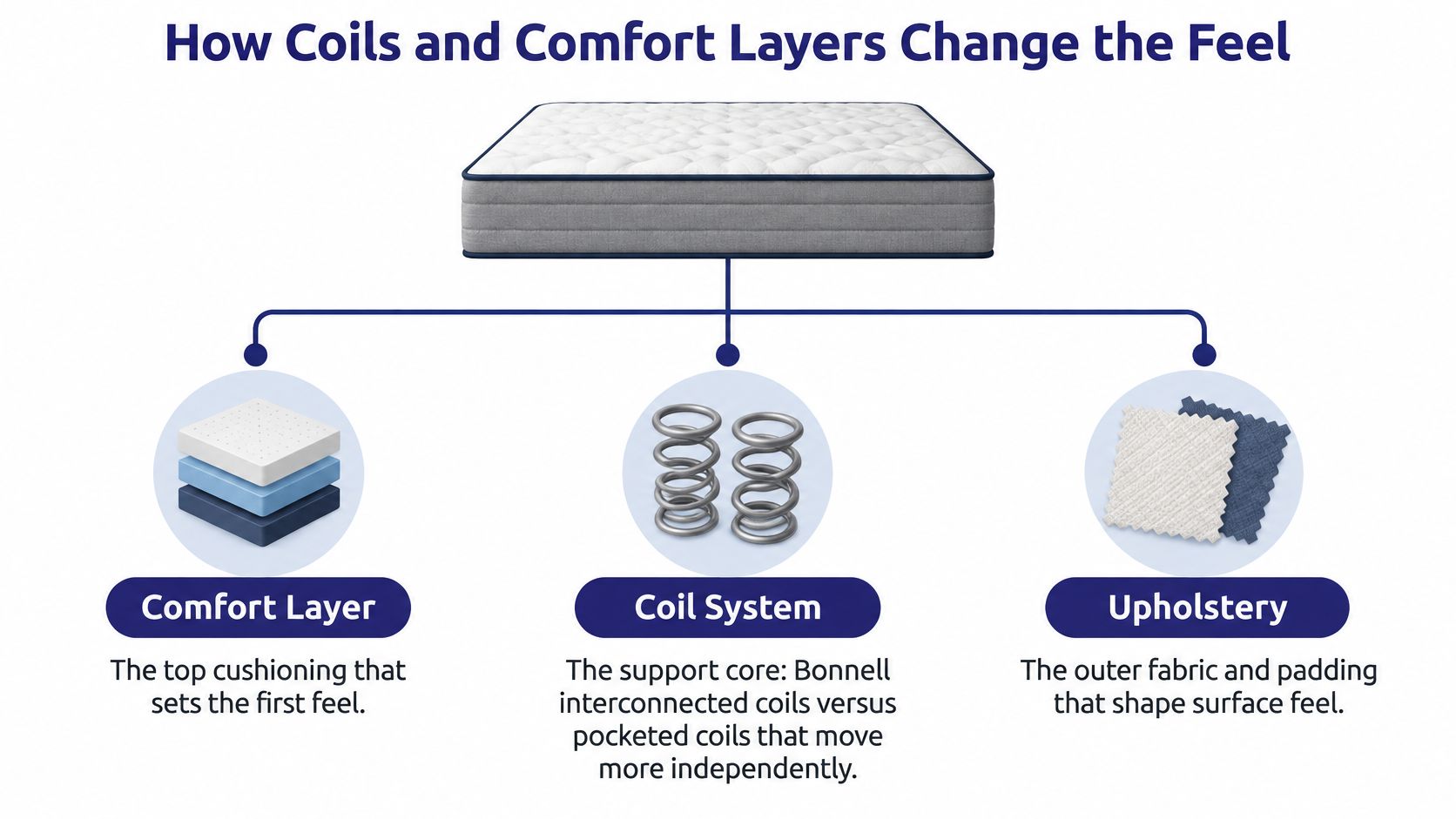
Your first impression comes from the materials nearest your body, but those materials do not work alone. The comfort layer, coil system, and upholstery combine to create the finished feel.
This diagram separates the parts you will want identified on a specification sheet.
Start with the cushioning
Traditional innersprings usually carry a thinner cushion over the springs, while hybrids add a thicker comfort package with foam, latex, or small microcoils. Evidence for an exact inch cutoff is limited, so read the layer list instead of shopping by a number.
Thickness still does not tell you everything. Memory foam can provide a close contour, while latex or microcoil cushioning can produce a more buoyant response. Ask what the layer does, not merely how much of it the mattress contains.
Upholstery includes the padding and fabric surrounding the support system. A quilted surface can change your first impression before you substantially compress the deeper layers. A thick quilt can feel plush at first touch even when the support below is quite firm.
Look underneath the surface
Bonnell coils connect neighboring springs through helical wires, so movement spreads across a wider area. Pocketed coils sit in individual fabric sleeves and compress more independently, concentrating support closer to the loaded area.
Do not assume every innerspring uses interconnected springs or that the hybrid name guarantees a particular coil design. Read the actual construction description and check whether the coils are linked or pocketed.
Coil quantity also needs context. Historical Utah State University Extension guidance gives traditional reference points of at least about 300 coils for a full, approximately 400 for a queen, and approximately 480 for a king.
Reference coil counts for traditional innersprings
| Mattress size | Approximate coil count | What it tells you |
|---|---|---|
| Full | At least about 300 coils | A traditional reference point, not a quality score |
| Queen | Approximately 400 coils | Compare the count with wire thickness, turns, and coil type |
| King | Approximately 480 coils | A reference point; manufacturers use different layouts |
That extension publication also explains that fewer coil turns provide less resistance and support, while cotton batting and urethane foam change surface feel and help keep sleepers from feeling the springs. Manufacturers can alter the feel of the same coil unit by changing those upholstery layers.
Judge coil type, wire thickness, turns, and layer construction together. A large coil count by itself does not establish comfort, support, or durability.
Support and Pressure Relief by Sleep Position
Construction type predicts less than effective firmness, contouring, pressure distribution, body mass, and sleeping posture. Support means holding your body in a comfortable position; pressure relief means avoiding excessive concentration of load at places such as your shoulders and hips.
A review of mattress biomechanics and healthy sleep emphasizes these interacting factors and describes evidence generally favoring medium-firm surfaces over very firm ones for many adults with nonspecific low-back pain. That isn't a prescription for every body or a guarantee that changing mattresses will resolve pain.
Use your position as a starting point
Construction tendencies by sleeping position
| Sleep position | Tends to suit | Why |
|---|---|---|
| Side sleeper | Hybrid with a soft-to-medium comfort layer | Foam layers can redistribute pressure at shoulders and hips |
| Back sleeper | Medium-firm surface of either type | Supports the lower back without letting the hips sink too far |
| Stomach sleeper | Firmer, responsive surface, often an innerspring | A firmer surface helps limit excessive hip sinkage |
| Combination sleeper | Innerspring for easier turning, or hybrid if pressure relief matters more | Responsive coils help with repositioning; foam adds cushioning |
For a side sleeper, a cushioned surface should let the shoulder settle without leaving the waist unsupported. For a stomach sleeper, that same amount of cushioning might allow uncomfortable sinking through the midsection. Your body's response matters more than a showroom firmness label.
What sleep studies can tell you
A controlled field study published in Sleep followed 60 healthy adults across 2,242 nights as they transitioned to a spring mattress, finding a 2% increase in the proportion of deep sleep and a 2% reduction in light sleep. Participants also reported 40% fewer nights involving tossing and turning and 45% fewer aches and pains.
The study tested a particular spring mattress using a pre-post design, not random assignment between standardized innerspring and hybrid alternatives. Those results show that a spring mattress can perform well, not that every spring mattress will deliver the same improvements.
A mattress can feel soft at the surface and still support you well. Firmness and support aren't interchangeable.
Choose the surface that accommodates your shape without uncomfortable pressure or excessive sinkage. Either construction can meet that requirement.
Motion, Heat and Durability Compared
Sharing a mattress introduces a separate question: what happens on your side when someone moves on the other? Pocketed coils generally limit how much neighboring springs participate in a movement, while interconnected systems transmit pressure more broadly. A hybrid's cushioning may add dampening, but the finished mattress needs testing as a whole.
The coil arrangements below help explain why two spring-based mattresses can behave differently.
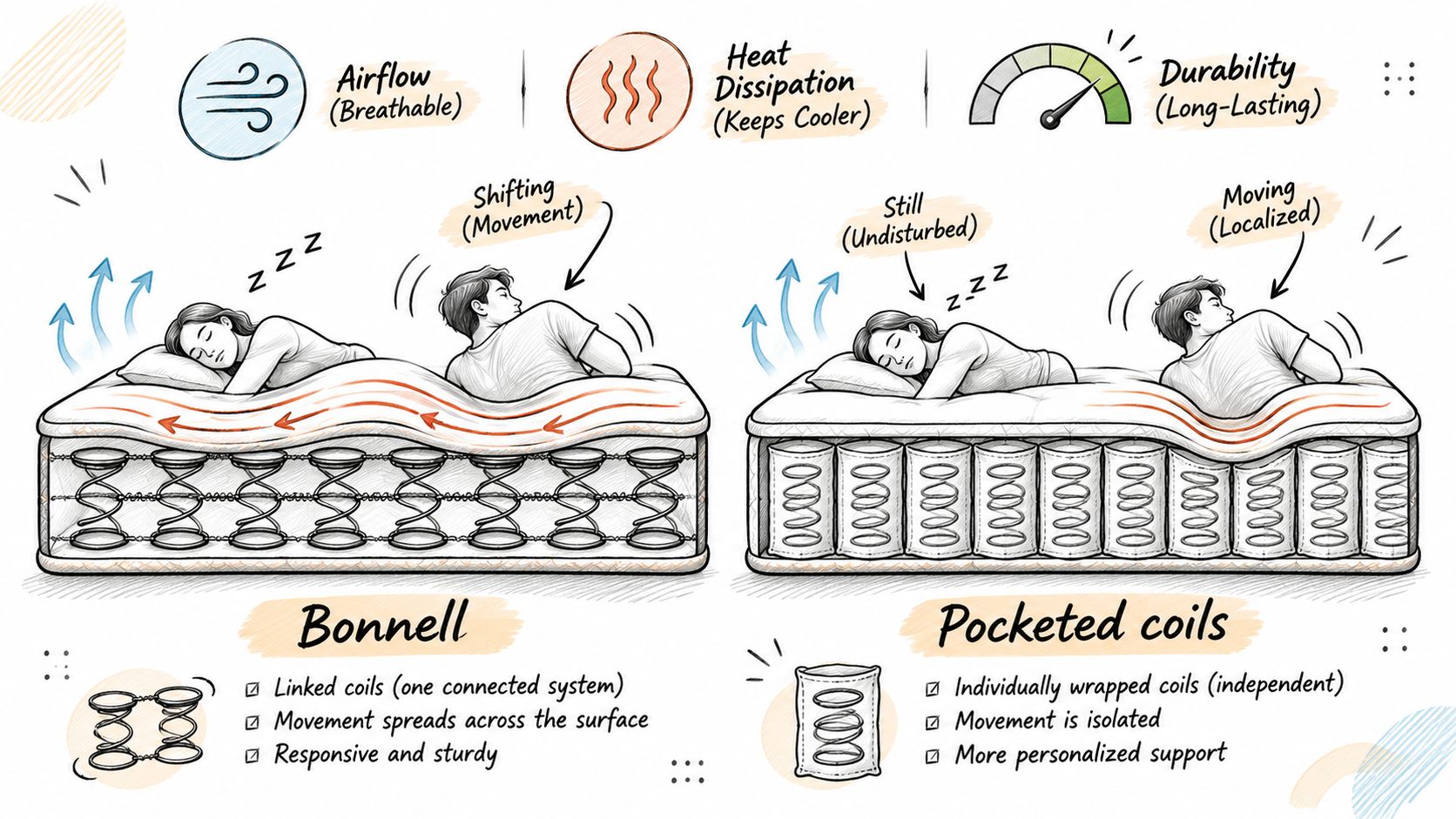
Coil design strongly influences movement transfer. Comfort materials and ventilation deserve separate attention when judging heat.
Cooling claims need context
Open spaces around coils allow airflow, but your body rests against the comfort package above them. Dense foam and close contouring can retain warmth, so a hybrid isn't automatically cooler than a simpler innerspring.
Amerisleep's mattress-buying overview describes a 2026 materials study in which ventilation alone produced a 1.905°C temperature difference, while the best configuration incorporating phase-change material achieved 7.310°C. Those are material-test results, not promised changes in bedroom temperature, skin temperature, or overnight sleep quality.
Ask what was tested and under what conditions. A cool-to-the-touch cover is a different feature from sustained overnight temperature regulation.
If your concern is waking up drenched at 3 a.m., Lila's discussion of perimenopause-related night sweats offers context beyond bedding choices. A mattress shouldn't be treated as a diagnosis or a guaranteed solution for persistent sweating.
Compare performance without promising a lifespan
Motion, heat and durability at a glance
| Factor | Innerspring | Hybrid | What to check |
|---|---|---|---|
| Motion transfer | Pocketed coils compress independently; Bonnell systems transmit pressure through the network | Coil design matters, with additional dampening possible from comfort layers | Have a partner shift while you lie still |
| Heat | Open coils generally permit airflow | Dense foam can retain heat; ventilated and cooling-layer designs may perform differently | Foam density, coil openness, cover, and cooling materials |
| Durability | No reliable category-wide lifespan established by the evidence discussed | No reliable category-wide lifespan established by the evidence discussed | Warranty terms, foam density, coil gauge, and layer construction; expected replacement timing remains unknown |
A warranty describes coverage under stated conditions. It doesn't promise that the mattress will remain comfortable for its entire term.
Compare material specifications and exclusions rather than assuming added layers mean added useful life. For hot sleepers and couples with different temperature preferences, the actual ventilation and comfort package deserve more weight than the construction name.
How to Test Both Types in the Showroom
A showroom visit works better when you repeat the same routine on each mattress. Otherwise, you may choose the one you tested most carefully rather than the one that fits.
Use the opening steps below to make the comparison more like your normal sleep setup.
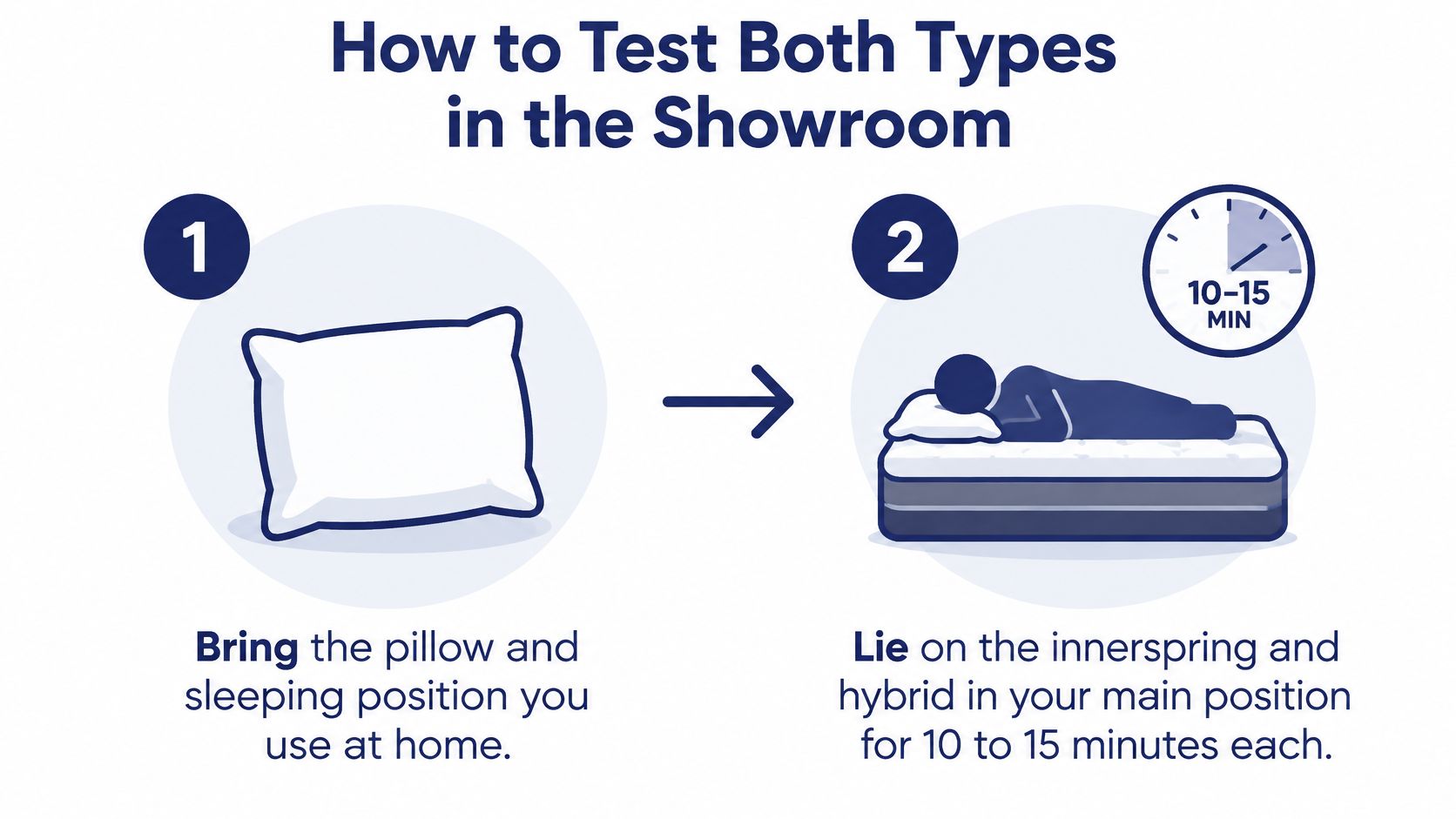
Follow a repeatable routine
Bring your usual pillow and use your normal sleeping position. Your pillow changes the position of your head and neck, especially on your side. Testing every mattress with a different display pillow adds another variable.
Give each mattress an unhurried trial. Don't make the decision after briefly sitting down or pressing the surface with your hand. Stay in your main sleeping position long enough to notice developing pressure, rather than judging only the initial softness.
Move into your other common position. Notice whether your shoulder feels compressed, your hip sinks uncomfortably, or your lower back feels unsupported. A mattress that works only in the position you started in may not suit how you sleep.
Test with your partner when possible. Stay still while your partner rolls over and gets out of bed, then switch roles. Don't substitute bouncing a hand on an empty mattress for feeling movement while both sleepers are lying down.
Turn over, sit up, and use the edge. Check whether changing position feels easy and whether the perimeter feels secure when you sit or lie near it. A comfortable center doesn't tell you how the edge will behave.
Match the sensation to the specifications. Ask for the comfort materials, individual layer thicknesses, coil type, and cover fabric. Record the model and firmness designation so you don't accidentally compare a different version later.
Confirm the practical details before deciding. We offer delivery options, so ask our team what applies to your purchase and access situation. Also review mattress weight, base compatibility, rotation instructions, trial and return terms, and warranty requirements rather than assuming they're identical across models.
For an additional visual reference while preparing your showroom questions, you can watch this video.
The clearest result is a mattress that feels comfortable in your usual positions, allows the movement you need, and has specifications that make sense of what you felt. If neither option does that, keep comparing rather than choosing a category by default.
Which Construction Fits Your Situation
Knowing your sleeping position helps only if you use it when choosing. A 2026 survey of 1,006 U.S. adults reported by Fox 21 found that 82% believed they knew their sleeper type, yet only 40% let that information influence their purchase; hybrids represented 29% of purchases or intended purchases, compared with 11% for innersprings.
That gap illustrates an easy mistake: choosing the name before defining the need. Your household, comfort priorities, and budget should determine which features deserve attention.
Match the mattress to its job
Common household situations and the construction that often fits
| Situation | Often a fit | Reason |
|---|---|---|
| Hot sleeper or warm bedroom | Innerspring with open coils, or hybrid with ventilated and cooling layers | Airflow and cooling materials matter more than the name |
| Couple with different temperature or firmness needs | Hybrid, if one sleeper needs pressure relief or less partner disturbance | Foam layers can dampen movement and soften the transition |
| Rental, guest room, or occasional use | Innerspring | A simpler build may cost less initially; check warranty terms |
| Children's room | Either, based on firmness and support specifications | Compare the firmness rating and support core rather than the type |
| Several beds on a budget | Innerspring, unless pressure relief is a priority | A lower-complexity build may cost less across multiple beds |
An innerspring may be the better value when you prefer familiar responsiveness, easy repositioning, and less enveloping cushioning. Strong edge support can also matter if you regularly sit on the bed to dress, but verify the perimeter rather than assuming every spring mattress provides it.
A hybrid may justify its added materials when shoulder pressure or partner disturbance is the problem you need to solve. However, a shared hybrid doesn't automatically provide different firmness levels for each sleeper. Both people still need to test it.
Let the household budget include the whole setup
Say you're furnishing a guest room and replacing your own mattress. You might choose a straightforward innerspring for occasional guests and spend more on pressure relief for the bed you use nightly. That's a needs-based decision, not a judgment that one category is universally superior.
For renters, mattress weight and moving access can affect convenience. For any household, a required foundation, delivery arrangements, or return charges can change the total cost. A higher price doesn't automatically mean a longer useful life, and there isn't a reliable replacement deadline you can infer from the label.
Before deciding, answer these questions:
- Position and pressure: How do you sleep, and where does your current bed feel uncomfortable?
- Overnight disruption: Is heat, partner movement, or difficulty turning your main concern?
- Household fit: Who will use the bed, how often, and what can you comfortably spend on the complete setup?
Neither construction is a universal winner. The specific mattress's layers, coil design, and firmness determine whether it fits your situation.
At Woodstock Furniture & Mattress Outlet, we sell furniture, mattresses, and home decor, and we offer delivery options to help with your purchase. Visit Woodstock Furniture & Mattress Outlet to compare innerspring and hybrid mattresses in person, bring your specification questions, and ask our team about delivery options and the return terms that apply to the models you're considering.
Leave a Reply
You must be logged in to post a comment.