If memory foam always means soft and innerspring always means firm, why can mattresses with the same label feel so different? Because the label tells you only part of the story. Firmness, comfort-layer thickness, coil design and your own body often matter more than the category name.
An innerspring vs memory foam mattress comparison is most useful when it starts with what isn't working today. Maybe you wake when your partner turns, feel pressure at your shoulder or struggle to roll out of a deep cushion. Each problem calls for a different test, not an automatic switch to another material.
Innerspring vs Memory Foam at a Glance
Neither construction wins on every measure. Innerspring mattresses generally offer a buoyant feel, while memory foam offers closer contouring. The better fit depends on how you sleep and which trade-offs you're comfortable accepting.
Innerspring and memory foam compared on core criteria
| Criterion | Innerspring | Memory foam |
|---|---|---|
| Support core | Steel coils, interconnected or pocketed | Usually dense polyfoam beneath viscoelastic comfort layers |
| Pressure relief | Thicker comfort layers provide more cushioning | Strong contouring at shoulders and hips |
| Motion isolation | Pocketed coils generally isolate better than connected coils | Generally strong, dampens movement well |
| Ease of movement | Buoyant, usually easier to reposition | Deep contouring can feel restrictive when turning |
| Heat retention | Generally lower, air moves through coils | Often higher, open-cell designs and infusions may reduce buildup |
| Edge support | Generally stronger perceived support | Foam density and perimeter reinforcement determine edge stability |
| Typical price | Model, size and comfort-layer materials set the price | Model, size and comfort-layer materials set the price |
Read tendencies, not promises
Words such as generally matter. A heavily cushioned spring mattress can feel less responsive than a lightly cushioned one. An all-foam mattress with a reinforced perimeter may feel steadier at the edge than another foam model.
The categories also overlap. A hybrid combines coil support with substantial foam or other comfort layers, so it can share traits from both columns. A mattress containing memory foam isn't necessarily an all-foam mattress.
Price deserves the same model-by-model approach. Neither label establishes what you'll pay or whether the mattress will suit you. Compare the actual size, layers and support system rather than assuming a category represents a particular budget.
Start with your priorities: Choose the sleep problems you most want to solve before comparing features.
For example, a hot sleeper who changes positions frequently might prioritize temperature and turning effort. A light sleeper sharing a bed might put partner disturbance ahead of bounce. Use those priorities to decide which candidates deserve a longer trial.
How Each Construction Is Built
Say you're comparing mattresses that look nearly identical under their quilted covers. Ask to see the layer descriptions, starting at the bottom. That's where the differences become easier to understand.
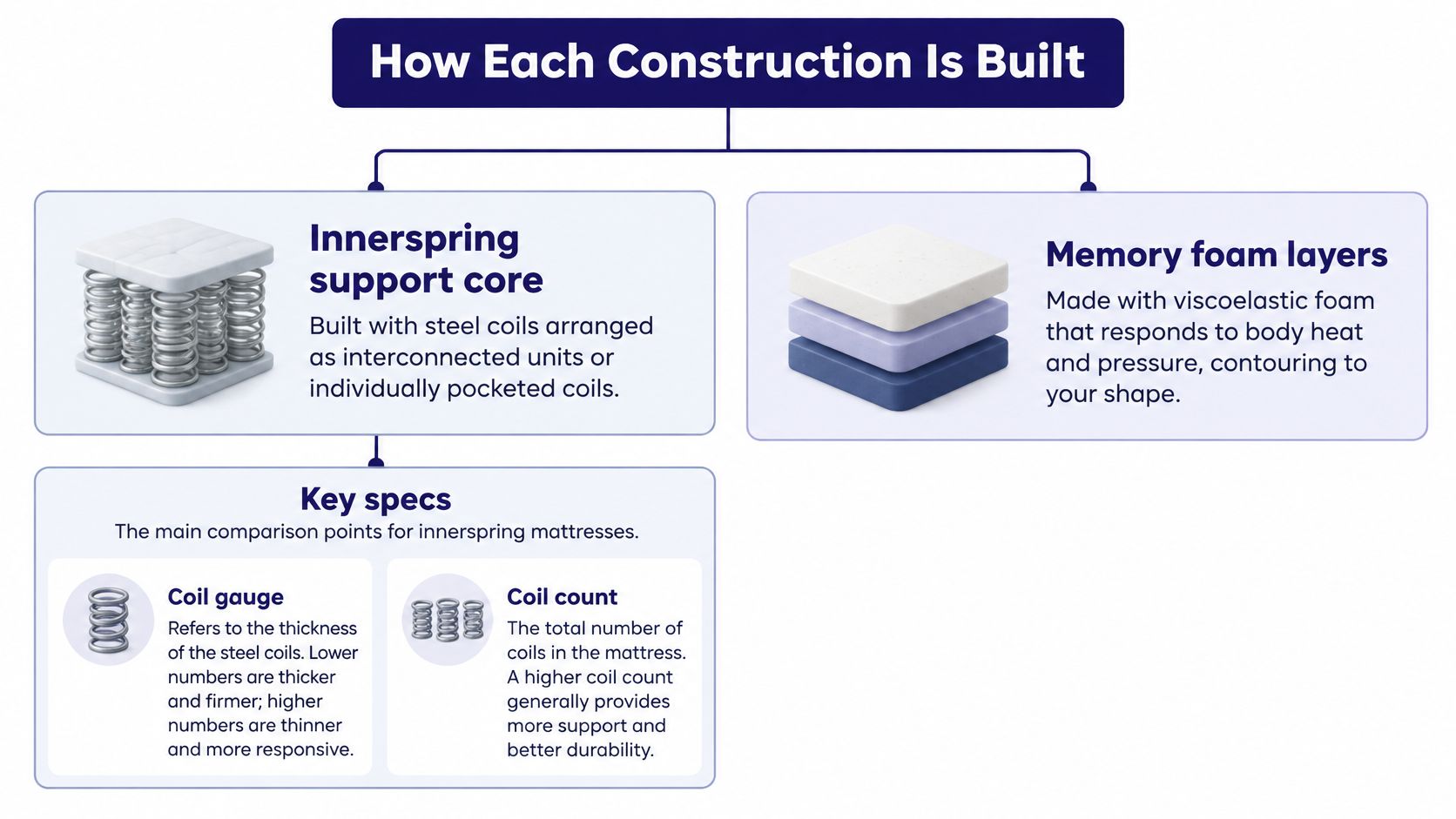
An innerspring support core uses steel coils arranged as interconnected units or individually pocketed springs. The core provides mechanical support and rebound. Padding above it determines how directly you feel that spring system, so a pillow top can change the surface substantially without changing the core.
The diagram separates the support structure from the cushioning above it.
Look beneath the cover
Memory foam is viscoelastic polyurethane foam, meaning it responds to load and body heat and recovers more slowly after compression. Its aerospace origins and later adaptation for bedding are described in The New York Times's account of memory foam development.
In an all-foam build, memory foam commonly sits above a firmer foam support base. In a hybrid, it sits above coils. These aren't interchangeable constructions, even when both descriptions emphasize memory foam.
Foam density describes mass per volume, not firmness by itself. Formulation and layer thickness also affect how far you settle into the surface.
Use this list when reading a product tag:
- Coil type, gauge and count: Gauge describes wire thickness; count is most useful when comparing the same mattress size and similar coil designs.
- Foam density and identity: Ask which layers are memory foam and which are other polyurethane foams.
- Comfort-layer thickness: Identify how much cushioning separates you from the support core.
- Required base: Confirm whether the mattress needs a separate foundation or can rest directly on an approved support frame.
Cooling infusions describe another feature, not a replacement for this basic construction information.
Pressure Relief and Firmness for Your Body
In a North Carolina study, 128 healthy adults slept at home on seven mattresses for approximately four weeks each, and firmness significantly affected 9 of 11 major sleep measures, according to the RTI Press mattress study. Participants differed substantially in which mattress produced their best results.
That finding supports testing for individual fit. It doesn't establish that a particular construction treats pain, especially because the participants were healthy and generally reported low morning pain.
Pressure relief and support aren't opposites. You need enough surface give to cushion prominent areas and enough underlying resistance to prevent excessive sinking. A mattress can feel pleasantly plush at first yet leave your pelvis too low once you settle.
Match the surface to your position
Side sleepers should pay attention to the shoulder and hip touching the mattress. If those areas feel compressed, try a different firmness or comfort layer rather than assuming all spring mattresses will feel the same.
Back sleepers should look for a relaxed, supported posture without the pelvis dropping into a hollow. Stomach sleepers should check whether the midsection sinks enough to leave the lower back feeling arched.
Keep your pillow reasonably consistent while comparing mattresses. A different pillow can change how your neck feels and confuse the comparison; the SunnyBay guide to easing sleep-related neck pain offers additional context for evaluating sleep position and pillow support.
Run a body-fit check
- Settle into your usual sleeping position. Give the surface time to respond rather than judging it from a quick sit.
- Check whether your hips sink disproportionately compared with your shoulders and torso.
- Slide a hand beneath your lower back. Notice a large unsupported gap or uncomfortable pressure, but don't treat hand clearance as a medical measurement.
- Roll toward the edge and back. Assess whether you can move without bracing or pushing hard against the mattress.
A comfortable first impression matters, but it shouldn't replace checking your posture after you've settled.
Try contrasting firmness levels within each construction before ruling either category out. Use your own pressure, posture and movement observations instead of treating a firmness label as a standardized measurement.
If discomfort is persistent, worsening or accompanied by other symptoms, seek medical guidance rather than expecting a mattress change to provide a diagnosis.
Motion Isolation and Ease of Movement
Motion isolation means absorbing someone else's movement. Responsiveness means making your own movement easier. Those are different goals, and a mattress can perform well at one while feeling less comfortable for the other.
This illustration highlights the contrast between a springy surface and slower-recovering foam.
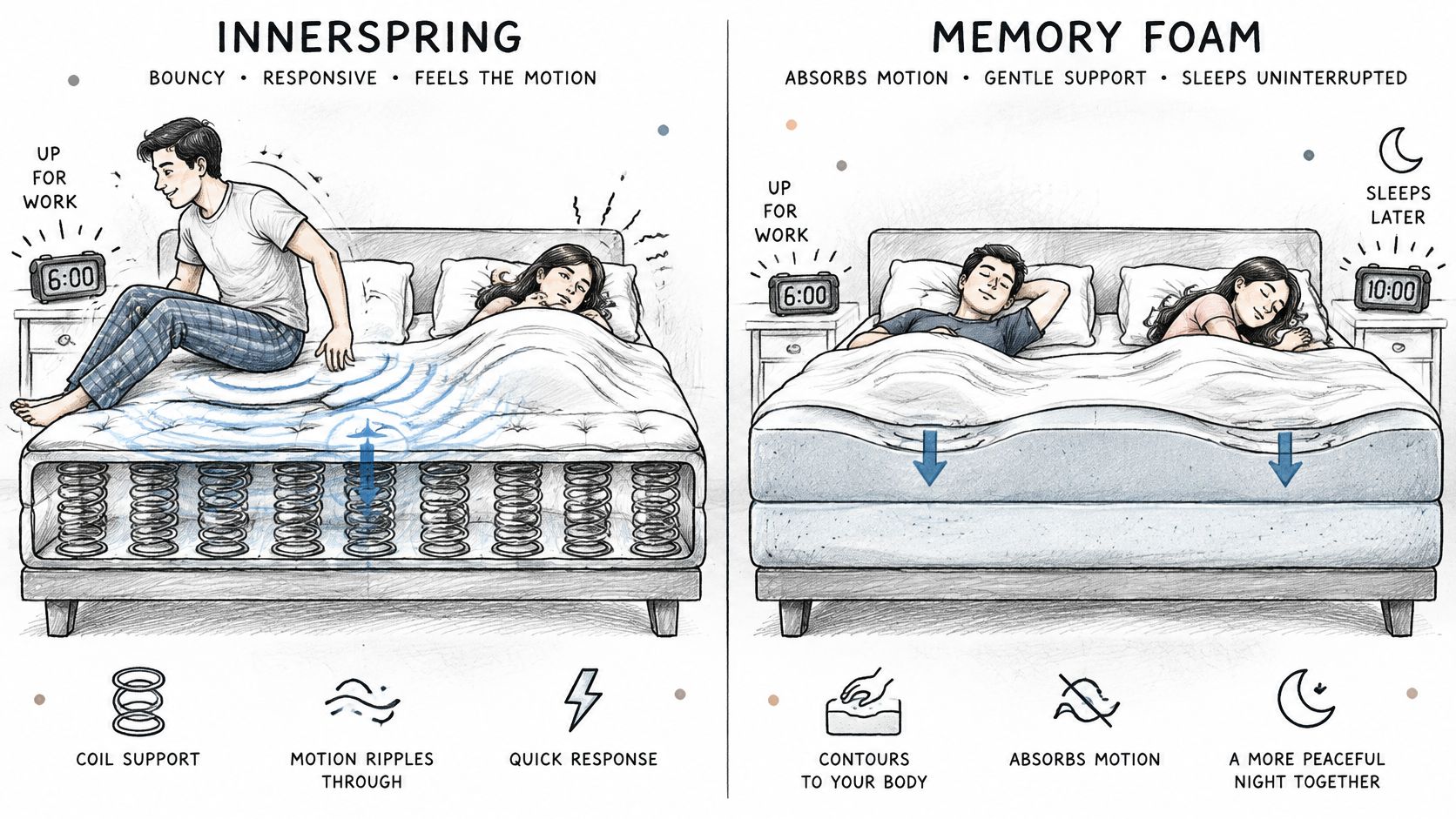
Memory foam's slow recovery helps absorb movement, while coils compress and rebound more quickly; pocketed coils generally limit partner disturbance better than connected coils, as explained in GQ's mattress testing methodology. All-foam designs generally remain a useful starting point when maximum motion dampening is the priority.
Say your partner gets up during the night. You might prefer the reduced disturbance of foam, but your partner may find a deep contour harder to get out of. A pocketed-coil design with cushioning could be worth comparing, provided you both test it.
Test together, then switch roles
- Lie down together in your usual positions. If useful, place a glass of water on a stable nightstand as a secondary movement marker. Your own sensation matters more than the water.
- Have one partner get up and sit back down near the edge.
- Ask the other partner to roll over, then switch roles.
- Describe the disturbance: Did you feel a brief ripple, a bounce or enough movement to interrupt relaxation?
A nightstand isn't connected directly to the mattress, so it can't reliably measure motion transfer. Don't reject a mattress solely because the glass moves, or accept one because it doesn't.
For another look at mattress comparison, this video provides a visual reference.
After testing partner disturbance, each person should turn independently and sit at the edge. Note whether you can stand comfortably without feeling as though you're climbing out of a depression.
Don't optimize for stillness alone. A contour that absorbs movement may also restrict turning, and close cushioning can feel warm. The right compromise needs to work for both sleepers.
Heat and Cooling in Real Sleep
Coil cavities leave pathways for air to move through the support core, helping carry heat away by convection. Traditional memory foam surrounds more of your body, leaving less space for air movement at the sleeping surface.
In Sleep Foundation's temperature-control testing, temperature-neutrality ratings were strongest among hybrid and innerspring models, while gel-memory-foam all-foam beds commonly ranged from fair to good. Its recommended comparison includes spending 10 to 15 minutes on a candidate under normal bedding rather than judging the initial cool touch.
A cool touch isn't a cool night
Open-cell foam structures and gel, graphite or copper infusions may reduce heat buildup. They don't eliminate the effects of deep contouring, thick comfort layers or insulating bedding.
An industry-reported thermal-manikin finding discussed in GoodBed's memory foam guide also favored innerspring heat dissipation. Treat that as construction-level context, not proof that every spring mattress will sleep cooler than every foam mattress.
The useful question isn't whether the tag says cooling. It's whether the complete bed stays comfortable for you after you've settled into it.
Cooling check: Compare sustained warmth, not just the sensation when your hand first touches the cover.
Make the comparison realistic
Wear clothing similar in weight to your usual sleepwear. Where the showroom permits it, compare candidates with similar bedding rather than testing one uncovered and another beneath a heavy blanket.
Notice warmth beneath your back and hips, where you have the most contact with the surface. Also distinguish feeling warm from feeling trapped in the contour. Those sensations can occur together, but they aren't the same problem.
For a hot sleeper, coil-based construction, a breathable cover and less foam between the body and coil core are sensible starting points. Don't strip away needed cushioning just to gain airflow, though. A cooler surface that creates shoulder pressure still misses the goal.
Your room temperature, protector, sheets and duvet remain part of the sleep system. A showroom comparison can narrow your options, but it can't reproduce every condition in your bedroom.
Who Each Mattress Suits Best
Choose in this order: firmness, posture and mobility first, construction second. The orthopedic evidence summarized in this review published in the Journal of Orthopaedics and Traumatology favors medium-firm surfaces over very firm or very soft options for several comfort and low-back-pain outcomes, while also identifying important differences among studies.
Medium-firm is a starting point, not a prescription. Your weight, preferred position and sensitivity affect how a surface feels, and manufacturers' firmness descriptions aren't identical.
Turn your sleep problem into a trial
The stereotype that springs provide support and foam provides pressure relief is incomplete. Both need a suitable combination of surface cushioning and underlying support.
Starting points by sleeper situation
| Sleeper situation | Starting point to test | In-store check |
|---|---|---|
| Hot sleeper | Coil-based or hybrid with a breathable cover | Compare heat buildup after settling under normal bedding |
| Side sleeper with shoulder or hip pressure | Memory foam or a thicker comfort layer | Check pressure relief without disproportionate hip sinking |
| Couple with different schedules | Pocketed coils or an all-foam design | Run the partner-movement test with one person rolling |
| Back sleeper needing neutral alignment | Medium-firm surface in either construction | Use the lower-back hand check alongside overall posture |
| Combination sleeper who changes positions often | Innerspring or hybrid | Assess effort when rolling toward the edge and back |
| Sleeper with pressure-sensitive joints | Memory foam with an adequate comfort layer | Notice whether shoulder and hip pressure eases |
Account for competing needs
Couples may need to negotiate between motion dampening and easy turning. Older adults and anyone who finds getting out of bed difficult should give edge sitting and standing as much attention as lying comfort.
People with back pain may also face a conflict between cushioning tender areas and maintaining a supported posture. More softness isn't automatically the answer, and neither is a harder surface.
A hybrid belongs on the trial list when you want foam contouring alongside a coil core. It isn't automatically a compromise you'll prefer, because its upper layers can still feel deep or restrictive.
Treat the table as a list of hypotheses to test, not a ranking. Keep the candidates that solve your actual problem without introducing a more troublesome one.
Price, Durability and Signs of Wear
Price changes with model, size and comfort-layer materials. A higher price doesn't establish that a mattress will suit your body, and a lower price doesn't tell you which trade-offs you'll experience.
Compare construction specifications within your budget. Coil gauge and design, foam density, cushioning materials and the supporting base all deserve attention, but no single specification guarantees a fixed lifespan.
Separate mattress wear from base problems
A lasting dip where you sleep, a collapsing edge or a surface that no longer rebounds deserves inspection. Comfort layers can compress with use, and a weakened support system may stop holding the body evenly.
New morning stiffness or more frequent waking can prompt that inspection, but neither proves the mattress is responsible. Changes in activity, health, pillows or sleep habits may also matter.
Check the structure beneath the mattress before replacing it. Loose frame connections, damaged slats or inadequate support can affect the bed's feel; if you're also choosing bedroom furniture, Gulmohar Wood Works' explanation of why choose solid wood furnishings offers material-selection context, separate from mattress compatibility.
Inspect before deciding
- Record the change. Note where you feel discomfort, when it began and whether it improves away from your usual bed.
- Inspect the unloaded mattress for lasting depressions and check the edges and base for damage.
- Read the warranty in writing. Identify what it covers, how impressions are assessed and which support requirements apply.
- Compare replacements against your current mattress's firmness and comfort-layer construction, not just its category.
A mattress that feels different is a reason to reassess fit, not automatic evidence that you chose the wrong material.
A topper may change surface cushioning, but it won't repair a damaged support core or unstable frame. Correct a base problem before expecting a new mattress to solve it.
If replacement is appropriate, repeat your posture, movement and pressure checks. Your next mattress might use the same construction with a different firmness or layer arrangement.
Confirm Safety and Specs Before You Buy
Federal flammability requirements apply regardless of whether a mattress contains coils, memory foam or another cushioning material. Compliance is separate from comfort, airflow and the way the surface responds to your body.
Under 16 C.F.R. Part 1632, mattresses and mattress pads undergo smoldering-cigarette ignition testing, with char length limited to 2 inches (5.1 centimeters) in any direction from the cigarette's nearest point, according to the Consumer Product Safety Commission's mattress guidance. The guidance also describes permanent labeling with the month and year of manufacture and the manufacturer's location.
Check documentation, not material slogans
Manufacturers and importers must retain prototype test records for three years under the requirements described in the Federal Register mattress-standard document. Testing and documentation support compliance, not a retailer's general description of a material as natural or breathable.
A compliant mattress isn't fireproof. Nor does the presence of foam or steel coils establish that one mattress is safer than another.
Keep safety documentation, warranty coverage and comfort testing as separate checks. A warranty describes specified coverage and conditions; it isn't a promise that the mattress will remain comfortable for every sleeper.
Bring a clear buying checklist
- Read the permanent label. Look for the manufacturing date and manufacturer location, and request clarification if information is unclear.
- Get the warranty terms in writing. Check coverage, exclusions, required support and any applicable claim procedures.
- Confirm the layers. Match the firmness description to the comfort-layer thickness and materials rather than relying on the display name.
- Compare a small group of finalists in the same size. Record coil specifications, foam information and base requirements so you're comparing equivalent details.
- Lie down in your normal position. Allow time to settle, then check pressure, turning effort, edge stability and partner disturbance.
Write a short sleeper profile before visiting: usual position, current discomfort, heat sensitivity, partner movement and any difficulty getting in or out of bed. Bring your notes and use consistent testing conditions across candidates.
We offer delivery options, so include access and setup questions in your planning. Confirm what applies to your purchase rather than assuming every mattress or base has the same arrangements.
Your decision should come from a mattress you've tried and specifications you understand. There's no need to force a choice between material labels when a different firmness or layer combination may fit better.
Woodstock Furniture & Mattress Outlet sells furniture, mattresses and home decor, with delivery options available to customers. Bring your sleeper profile to Woodstock Furniture & Mattress Outlet and compare firmness levels in innerspring and memory foam options, with staff available to walk through specifications and answer questions before you decide.