If you flip from your side to your back, then wake up half on your stomach with the blanket twisted around your legs, you’re not doing sleep “wrong.” You’re probably a combination sleeper. Around Woodstock, I hear people describe it as feeling like a sleep rotisserie. They don’t stay in one position long, and they’re tired of waking up sore, hot, or fighting their mattress every time they move.
That usually creates a very specific kind of frustration. A mattress may feel soft and pleasant for the first few minutes in a showroom, then feel slow and grabby at night. Or it may feel supportive on your back, but too firm on your shoulder when you roll to your side. The best mattress for combination sleepers isn’t about chasing the fanciest label. It’s about finding a mattress that can keep up with your movement without losing support.
Are You a Combination Sleeper? Here’s What That Means
A combination sleeper is someone who changes positions through the night instead of staying mostly on their back, side, or stomach. You might fall asleep on your side, roll onto your back at midnight, then end up on your stomach before morning. That pattern is common, and it changes what your mattress needs to do.
A side sleeper asks the mattress for cushioning at the shoulder and hip. A back sleeper asks for steadier support through the middle. A stomach sleeper usually needs enough lift to keep the midsection from sinking too much. If you do all three, your mattress has to adjust with you.
The real-life signs
You may be a combination sleeper if any of these sound familiar:
- You wake up in a different position than the one you started in.
- You feel “stuck” in certain beds and have to work to roll over.
- Your soreness moves around from shoulders one day to lower back the next.
- Your partner notices your movement more than you do.
- You like one mattress at first, then dislike it after a full night because it only works in one position.
Some sleepers don’t need a softer bed or a firmer bed. They need a bed that responds faster.
That’s why shopping can feel confusing. Many mattresses are built to shine for one main position. Combination sleepers need a broader range of performance. They need a mattress that doesn’t punish movement.
Why this problem is solvable
This isn’t guesswork. Once you know what your body is asking for during those position changes, the showroom starts making more sense. You stop focusing on whether a mattress feels “nice” for 30 seconds, and start asking better questions about support, response, and pressure relief.
The Three Pillars of a Great Combination Sleeper Mattress
A mattress for a combination sleeper has to do three jobs at once. It has to cushion pressure points, keep your spine supported, and let you change positions without a delay in the surface. If one of those jobs is missing, the whole bed can feel wrong by the end of the night.

The easiest way to understand these pillars is to picture what happens during a real turn. Your shoulder lifts, your hips rotate, and your weight shifts across the mattress in stages, not all at once. A bed that works for combination sleeping keeps up with that sequence. A bed that does not can create pressure, twist your midsection, or make you work to roll.
Responsiveness
Responsiveness is how quickly the mattress surface rebounds after you move. For combination sleepers, that matters because every position change is a small coordination test between your body and the bed.
If you turn from your side to your back and the foam is still holding the shape of your shoulder, that is motion lag. You feel a split second of resistance. It is a small problem in the moment, but over a full night it can mean more effort, more partial wake-ups, and more frustration.
Hybrid mattresses, latex models, and some faster-response foams usually do a better job here than slow, dense memory foam. The key idea is simple. Your mattress should reset quickly enough that your next movement feels easy, not delayed.
Balanced support
Support is the part that keeps your body from folding out of alignment as your position changes. A lot of shoppers hear “support” and assume it means a hard mattress. That is not the goal. Good support means the bed holds up the heavier parts of your body without jamming up the lighter parts.
For combination sleepers, support has to stay consistent through movement. Your hips should not drop too far when you land on your back. Your waist and lower back should not feel stranded without support. And when you turn onto your side, your shoulder needs enough room to settle without pulling your spine sideways.
Here is a simple way to read the warning signs:
| Need | What it feels like when it’s missing |
|---|---|
| Support under the midsection | Lower back tightness or hammock-like sinking |
| Enough give at the shoulder and hip | Numb arm, sore shoulder, hip pressure |
| Even support during movement | Awkward twisting when changing positions |
In a showroom, this is one of the easiest things to miss because your body may feel fine lying still for a minute. The better test is to roll slowly through your usual positions and notice whether one area drops faster than the rest.
Pressure relief
Pressure relief is the cushioning that spreads out force at the shoulders, hips, and ribcage. It is what keeps a mattress from feeling sharp or jammed in side sleeping.
Combination sleepers need enough pressure relief for the positions that create the most concentrated load, usually the side. But they also need that cushioning to stay controlled. Too little relief feels hard and pinched. Too much can let you sink so far that turning becomes harder and your alignment slips.
A good way to judge it is to stay on your side for several minutes, then switch to your back and stomach if those are part of your normal pattern. If the comfort only works in one position, the mattress is solving one problem and creating another.
Practical rule: If a mattress feels comfortable only when you stay perfectly still, it probably isn’t a strong match for combination sleeping.
Why the three pillars have to work together
These three qualities are connected. Fast response without pressure relief can feel pushy at the shoulder. Pressure relief without enough support can let the hips drift down. Strong support without easy surface recovery can make each turn feel clumsy.
That is why combination sleepers often get the best results from mattresses with balance rather than extremes. In plain terms, you want a bed that cushions the parts that press in, holds up the parts that carry more weight, and gets out of your way when you move.
Mattress Constructions Explained for Combination Sleepers
A mattress construction matters because it changes how your body moves through the night. For a combination sleeper, that is not a small detail. It affects how easily you roll from your side to your back, how quickly the surface catches up with you, and whether your hips and shoulders stay supported during the turn.

A simple way to judge each type is to ask two questions in the showroom. Does the bed recover quickly after you move? Does it keep your body level in more than one position? Those two checks reveal a lot about whether a mattress will feel easy or frustrating at 2 a.m.
Innerspring
Traditional innerspring mattresses usually feel buoyant and easier to move on. Your body rests more on the surface, so changing positions often takes less effort. If you dislike the slow, hugged-in feeling, this construction often feels refreshingly straightforward.
That quick pushback can help combination sleepers because the mattress is not hanging onto the shape of your last position. The tradeoff is comfort at the shoulders and hips. Some innersprings feel fine on your back, then start to feel sharp when you stay on your side for a few minutes.
Who often likes them
- Sleepers who want bounce and a more traditional feel
- People who switch positions often and want less resistance while turning
- Those who care about edge stability for sitting or sleeping near the side
Memory foam
Memory foam is built to contour closely and absorb motion well. That can feel great for pressure relief, especially if your shoulder tends to jam up on firmer surfaces. It can also reduce how much of a partner's movement reaches you.
For combination sleepers, the main question is speed. Some memory foams recover slowly, so the bed can feel a bit like wet sand after you move. Your body turns first, and the surface catches up a moment later. That lag is what some shoppers describe as feeling stuck, even if the mattress is otherwise comfortable.
Foam is still worth trying. Newer foam designs vary a lot, and some feel much quicker than older all-foam beds.
Latex
Latex usually has a buoyant, springy feel with lighter contour than memory foam. It cushions the body, but it does not usually let you sink as far. Many combination sleepers like that balance because the mattress gives some pressure relief without creating much motion lag.
Latex works a little like a shoe sole with good rebound. You compress it, and it pushes back quickly. That fast recovery can make turns feel more natural, especially for sleepers who rotate through three positions instead of just two.
The feel is distinctive. Some shoppers love it right away. Others need a few minutes to decide whether that lively surface feels pleasantly supportive or just different from what they are used to.
A mattress can relieve pressure and still stay easy to move on. Combination sleepers often do best in that middle ground.
Hybrids
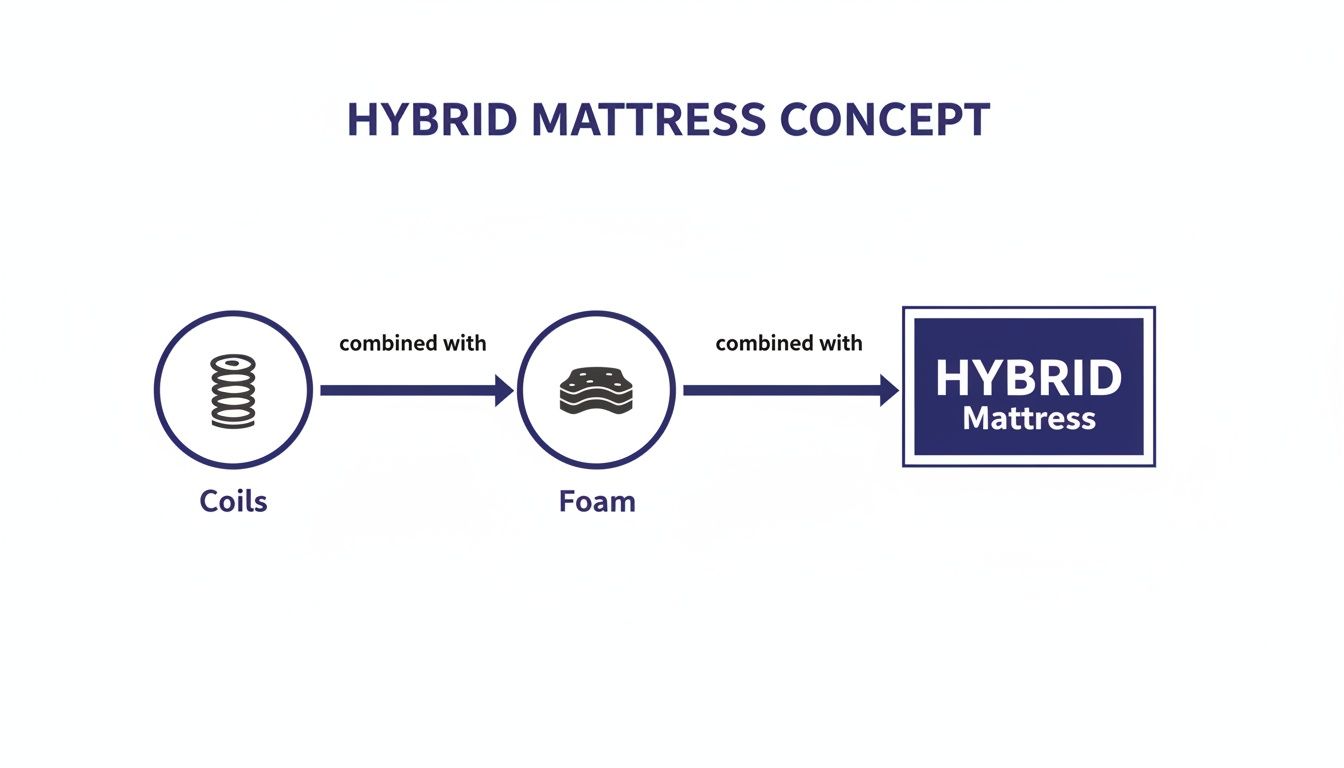
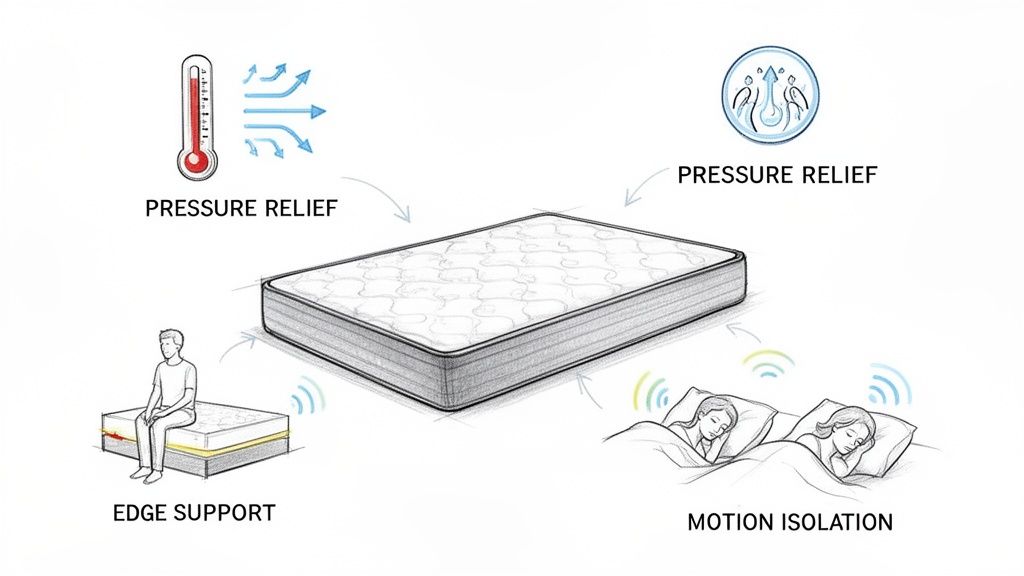
Hybrid mattresses combine a coil support core with foam or latex comfort layers. That mix often works well for combination sleepers because it addresses the mechanics of switching positions from both directions. The coils help the mattress spring back after movement, while the comfort layers soften the sharper pressure points.
Zoned hybrids deserve special attention if your weight is concentrated more through the hips and midsection. In plain language, zoning means one part of the mattress is built to hold you up a bit more than another part. For a combination sleeper, that can help during the moment of transition, when your hips are shifting but your shoulders have not fully landed yet.
The caution with hybrids is that the label alone does not tell you enough. One hybrid can feel quick and balanced. Another can feel plush and slow because the comfort layers are thick and soft. In the showroom, lie on your side for a few minutes, roll to your back, then to your stomach if that is part of your pattern. Pay attention to whether the mattress feels ready for you when you move, or whether you have to wait for it to rebound.
A simple comparison
| Construction | Movement feel | Pressure relief feel | Best fit for |
|---|---|---|---|
| Innerspring | Quick, bouncy, easy to turn | Usually lighter contour | Sleepers who want lift and airflow |
| Memory foam | Can range from slow to moderate | Usually deeper contour | Sleepers who want close body shaping |
| Latex | Buoyant and fast | Moderate contour | Sleepers who want easier movement with cushion |
| Hybrid | Balanced response | Balanced contour | Sleepers who want both movement and pressure relief |
The best construction depends on what your body is fighting right now. If turning feels like work, start with latex, innerspring, or a quicker-feeling hybrid. If your shoulder or hip gets sore first, foam and hybrids may deserve a closer look, but test how fast the surface recovers before you decide.
How to Choose the Right Firmness Level
You roll from your side to your back at 2 a.m., and the mattress that felt cozy at bedtime suddenly feels like wet sand or a hardwood floor. That is usually a firmness problem, but not in the way people assume.
Firmness is the feel of the surface. Support is how well the mattress keeps your body aligned. Combination sleepers need both, because your body is asking the bed to do two jobs at once. It has to cushion the parts that press in first, then hold you level as your weight shifts to a new position.

What the firmness scale actually means
Most brands use a rough scale from soft to firm. Lower numbers usually let your body sink more. Higher numbers usually feel flatter and push back faster.
For combination sleepers, the safest starting point is usually medium to medium-firm. That range often gives enough cushion for side sleeping without letting the hips drop too far when you roll onto your back or stomach.
The key idea is simple. You are not shopping for the softest bed you can tolerate or the firmest bed you can endure. You are looking for a surface that keeps up with your movement pattern.
Why the middle often works best
A very soft mattress can act like a deep couch cushion. It may feel pleasant at first, but when you turn, your heavier parts can sink before the rest of you catches up. That creates motion lag. Your spine can twist for a moment while the mattress slowly reshapes underneath you.
A very firm mattress creates the opposite problem. It can keep your torso level, but your shoulder and hip may take too much of the load when you lie on your side. Then you start shifting just to escape pressure, not because you naturally change positions.
Medium to medium-firm often lands in the useful middle because it helps with three things:
- Pressure relief for side sleeping so your shoulder and hip are not bearing all the force
- Support for back and stomach moments so your midsection does not sag
- Quicker, easier repositioning because you are not stuck in a deep impression
Body weight changes the feel
The same mattress can feel different from one person to the next. A lighter sleeper may stay closer to the top of the bed and experience a medium mattress as firmer. A heavier sleeper may press farther into the comfort layers and experience that same mattress as softer.
That is why firmness labels are starting points, not final answers.
A practical way to adjust for your body
- If you are lighter and mostly side/back, start around medium or a touch softer if pressure builds at the shoulder.
- If you are average weight and switch often, medium to medium-firm is usually a smart first stop.
- If you are heavier or spend part of the night on your stomach, look for a firmer feel or stronger support under the hips and midsection.
A short video can help if firmness scales still feel abstract:
Use your positions to judge firmness, not your hand
In a showroom, a mattress can feel soft when you press on it with your palm and still feel too firm once your shoulder settles in. The reverse is true too. A plush pillow top can feel inviting for 30 seconds, then make turning feel like climbing out of a hammock.
Your body gives better clues than the tag does. When you test firmness, lie on your side first and notice whether your shoulder sinks enough to relax. Then roll to your back and check whether your hips feel supported instead of swallowed. If stomach sleeping is part of your pattern, spend a minute there too. Your hips should stay level with the rest of your body, not dip forward.
A good firmness level for a combination sleeper feels balanced during the switch, not just pleasant in the first position. That balance is what helps prevent pressure points, low back strain, and the little bursts of effort that can disturb sleep all night long.
Your In-Store Mattress Testing Checklist
You’re in the showroom. The mattress feels good for the first 20 seconds. Then you roll from your side to your back and suddenly notice two things. Your shoulder had nowhere to go, and the bed takes a beat too long to catch up with your movement.
That second part matters more for combination sleepers than many shoppers realize. You are not only testing comfort in one position. You are testing how the mattress responds while your body is changing positions, because that transition is where pressure, support, and motion lag all show up at once.

Start with your real sleep pattern
Bring your usual pillow if you can. If you sleep with one knee bent, test that way. If you tend to drift from side to back before you fall asleep, repeat that exact sequence on each mattress.
A showroom test works best when it looks like your actual night, not a stiff pose on a display bed. Shoppers often lie flat on their backs for a minute, then make a decision from that. For a combination sleeper, that misses the whole point. Your body needs to feel what happens during the turn, not just at the starting line.
Use this four-step test
Settle into your first position for at least two minutes
Start in the position you use most. Give your shoulder, rib cage, hips, and lower back time to sink to their natural depth. Quick tests can hide pressure points that only show up after your muscles stop bracing.Roll the way you naturally roll
Move from side to back, or back to stomach if that is part of your pattern. Notice whether the surface responds quickly or feels delayed. A mattress with too much motion lag can feel like wet sand under your hips and shoulders. You move, but the bed is still catching up.Check whether support follows you
On your back, pay attention to the space around your lower back and waist. You want contact, not a big gap, but you also do not want your hips sinking lower than the rest of your trunk. On your side, notice whether your midsection feels suspended or gently held up. Support should travel with your body as you change posture.Use the full mattress, including the edge
Sit on the side, then lie close to the perimeter. Combination sleepers often roam more across the surface at night. If the edge folds too easily, the bed can feel smaller than its dimensions suggest, especially for couples.
Showroom shortcut: If turning takes effort from your abs, shoulders, or knees, the mattress may be absorbing too much of your movement instead of helping you through it.
If you have back pain, hip pain, or jaw tension
Support through the middle third of the mattress becomes more important once pain is already in the picture. During a position change, your hips and rib cage act a bit like the center of a bridge. If the center drops too far or too suddenly, surrounding joints often feel the strain.
That is why zoned support can be worth testing in person. The goal is not to feel a dramatic line across the bed. The goal is to notice that your heavier areas stay level enough during movement that rolling feels smooth instead of effortful. If nighttime tension overlaps with clenching, facial soreness, or related sleep issues, this guide on sleep and TMJ therapy may also be useful.
Questions worth asking in the store
These questions tend to get better answers than “What’s your most popular model?”
- Which beds here are easiest to turn on without feeling stuck?
- Can you show me a model with stronger support under the hips and midsection?
- Which mattress has a faster response time when someone changes positions?
- Does this model feel more buoyant on top, or more contouring around the body?
- How would this suit someone who switches between side and back sleeping?
- If I carry more weight through my hips, what would you change about the feel?
A quick comparison note
If you’re shopping in person and want to compare several constructions in one stop, a store like Woodstock Furniture & Mattress Outlet can let you try hybrids, memory foam, and adjustable-base pairings side by side. That kind of apples-to-apples testing usually teaches you more than another online top-10 list, because you can feel how each material handles the actual mechanics of turning, settling, and starting over in a new position.
Building a Complete Sleep System for Better Sleep
The mattress does most of the heavy lifting, but it doesn’t work alone. Combination sleepers often focus so hard on the bed that they ignore the pieces above and below it. Then they bring home a good mattress and still wake up with a cranky neck or tight jaw.
The pillow matters more than people expect
If you rotate between side and back sleeping, your pillow has to manage two different neck angles. Too tall, and your head gets pushed forward on your back. Too flat, and your head drops on your side.
That’s why many combination sleepers do well with a middle-ground pillow. You want enough loft to support side sleeping, but enough compressibility to avoid overextending the neck when you roll onto your back.
Your pillow should adapt when you move. It shouldn’t force you to pick one position and stay there.
Adjustable bases can help certain sleepers
An adjustable base isn’t necessary for everyone, but it can be useful if your body feels better with slight elevation at the head or legs. Some combination sleepers find that a subtle change in position eases pressure, reduces strain through the lower back, or makes settling in more comfortable.
If jaw tension, facial pain, or disrupted sleep are part of the picture, it can also help to look beyond the mattress itself. For readers dealing with those overlapping issues, this resource on sleep and TMJ therapy offers a helpful explanation of how sleep problems and jaw discomfort can interact.
Protectors and foundations are performance pieces too
A mattress protector isn’t only about spills. It also helps preserve the feel of the mattress by guarding the comfort layers from moisture and everyday wear. For people sensitive to heat or surface feel, choosing a protector that doesn’t radically change the hand feel of the mattress matters.
Your foundation matters too. If the support underneath is weak or uneven, a mattress can feel softer, less stable, or less supportive than it should. That can confuse the buying process because you may blame the mattress for a problem coming from underneath it.
Think in layers, not products
A complete sleep system works when the pieces support the same goal:
- Mattress for support, pressure relief, and easier movement
- Pillow for neck alignment across multiple positions
- Base or foundation for stable support
- Protector and bedding that don’t fight the feel of the mattress
When those layers cooperate, the whole bed feels more predictable. And predictability matters when your body changes position all night.
What to Expect When You Buy a Mattress from Us
Buying a mattress should feel clear, not mysterious. Most shoppers want the same basic things. They want to compare respected brands, understand what they’re lying on, and know what happens after they choose.
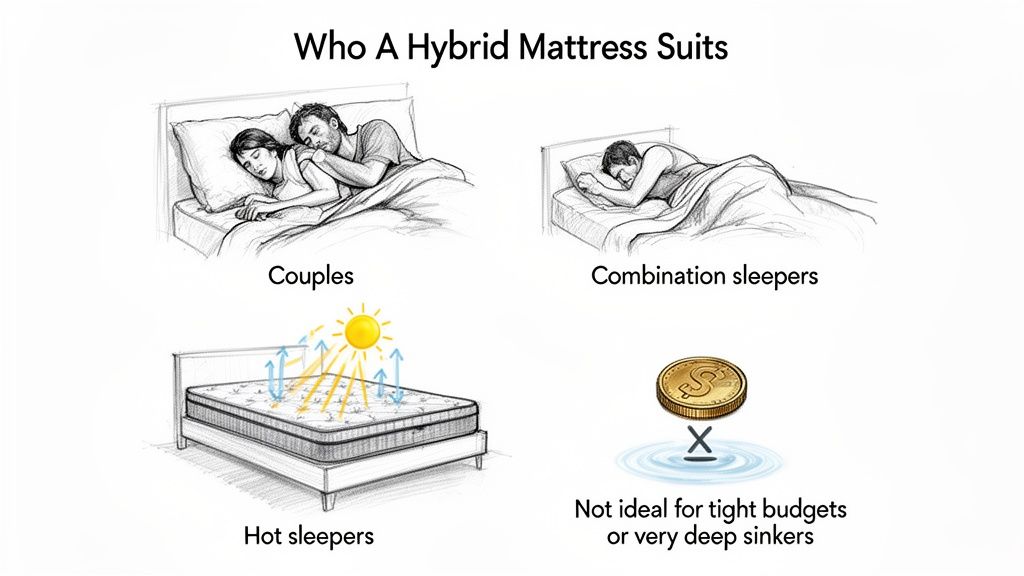
At our stores, that usually starts with a conversation about how you sleep. If you’re a combination sleeper, the useful details aren’t just your size or your budget. It’s whether you switch from side to back, whether your shoulder gets sore, whether you sleep warm, and whether your partner is sensitive to movement.
What you can compare in person
Woodstock Furniture & Mattress Outlet carries a range of mattress brands and sleep products, including Tempur-Pedic, Sealy, Helix, Nectar, DreamCloud, Stearns & Foster, Jamison, and adjustable bases and accessories. That gives shoppers a chance to compare different feels and constructions instead of assuming all foam or all hybrids feel alike.
A curated selection can be helpful here. Too many mattresses without guidance can be overwhelming. A smaller, better-organized comparison often makes patterns easier to notice.
Comfort exchange and delivery support
A comfort exchange policy exists for a simple reason. A mattress can feel promising in the showroom, but your body still needs time to adjust at home. The exchange process is there to help if the comfort choice misses the mark.
Delivery and setup matter more than people think, too. A mattress performs best when it’s installed on the correct support system and handled carefully from the start. Professional setup can remove some of the hassle and reduce the chances of a preventable support problem on day one.
The practical expectation
You shouldn’t expect a helpful mattress shopping experience to feel like pressure. You should expect questions that narrow the field, clear explanations of tradeoffs, and straightforward answers about policies, setup, and next steps.
That’s the standard most shoppers are really looking for.
Your Path to More Restful Nights
The best mattress for combination sleepers usually does three jobs well. It responds quickly when you move, supports your spine in more than one position, and relieves pressure at the spots that bear the most weight. If one of those is missing, the mattress may feel good for a minute and frustrating for a full night.
For many shoppers, hybrids and responsive foam designs are worth close attention because they often balance movement and comfort well. Firmness matters too. A medium to luxury-firm feel is often the most practical starting point for people who rotate between side, back, and sometimes stomach sleeping. From there, body weight and pain points help fine-tune the choice.
The biggest mistake is shopping by label alone. “Cooling,” “firm,” and “plush” don’t tell you enough by themselves. Your body needs a mattress that works while you’re turning, settling, and changing positions in real time.
If you’re narrowing it down in person, keep it simple:
- Move on the mattress, don’t just lie still
- Check shoulder and hip pressure
- Notice whether your lower back feels supported
- Test the edge
- Ask how the construction affects movement
That process gives you a much better shot at finding the right fit than chasing hype.
If you’d like to compare options in person, Woodstock Furniture & Mattress Outlet offers a way to test different mattress constructions, firmness levels, and sleep accessories with guidance from a team that can help translate what you’re feeling into a more confident decision.