Which piece stores more, a dresser or a chest? Most shoppers answer that the tall one wins, then measure the wrong thing: the outside of the case rather than the drawers inside it and the floor space the open drawers will need.
A six-drawer chest and a six-drawer dresser can hold similar volume and behave nothing alike in a room. One frees wall for a nightstand and puts folded clothes above eye level. The other keeps every drawer within reach without bending. Neither is the better piece in general.
The comparison that settles the argument uses measurements: dimensions, drawer layout, a fit test you can run with a tape measure, and the safety requirements that apply to both forms. The right piece is the one that still works once the bed, the doors and the walking route are in place.
Dresser vs Chest Side by Side
Which matters more once a piece is in your room: its label, or how it fits and how easily you can use its drawers? A dresser is generally a wide, waist-high case, sometimes paired with a mirror. A chest is usually taller than it is wide, with drawers stacked in one vertical column. That narrower shape can leave more wall space, while using more height.
Names are less consistent than shapes. A published survey of American regional usage recorded 37 responses for the name of a chest of drawers: “bureau” accounted for 52.5%, and “dresser” for 15.6%. In British English, “dresser” or “Welsh dresser” can also refer to a shelved display piece for tableware. Check the product description and specifications, not the label alone.
Compare how each form works in everyday use:
| Criterion | Dresser | Chest |
|---|---|---|
| Typical shape | Wide, waist-high case piece | Tall, vertically stacked unit |
| Mirror support | Common, sometimes designed to hold a mirror | Uncommon, usually no mirror base |
| Floor footprint | Wider, lower | Narrower, taller |
| Drawer access | Several columns at waist height | Stacked rows, upper drawers harder to reach |
| Vertical storage | Uses more wall width | Uses more height in a narrower footprint |
| Common placement | Along a long wall, opposite the bed | Narrow wall, corner or between windows |
Drawer height decides who can reach what
Drawers near waist height are often easier for adults to see into and reach without stretching. A dresser may therefore suit items used daily, provided its width fits the room. A chest puts upper drawers higher, which can be inconvenient for a shorter user, a child, or anyone with shoulder trouble. Consider who will use each drawer and how often.
Wall width also shapes the choice. A dresser may need 60 inches or more of wall, while a chest can provide storage in a narrower space by stacking drawers upward. The useful comparison is drawer count: check the layout, reach, and whether the piece still works after accounting for nearby furniture and walking space.
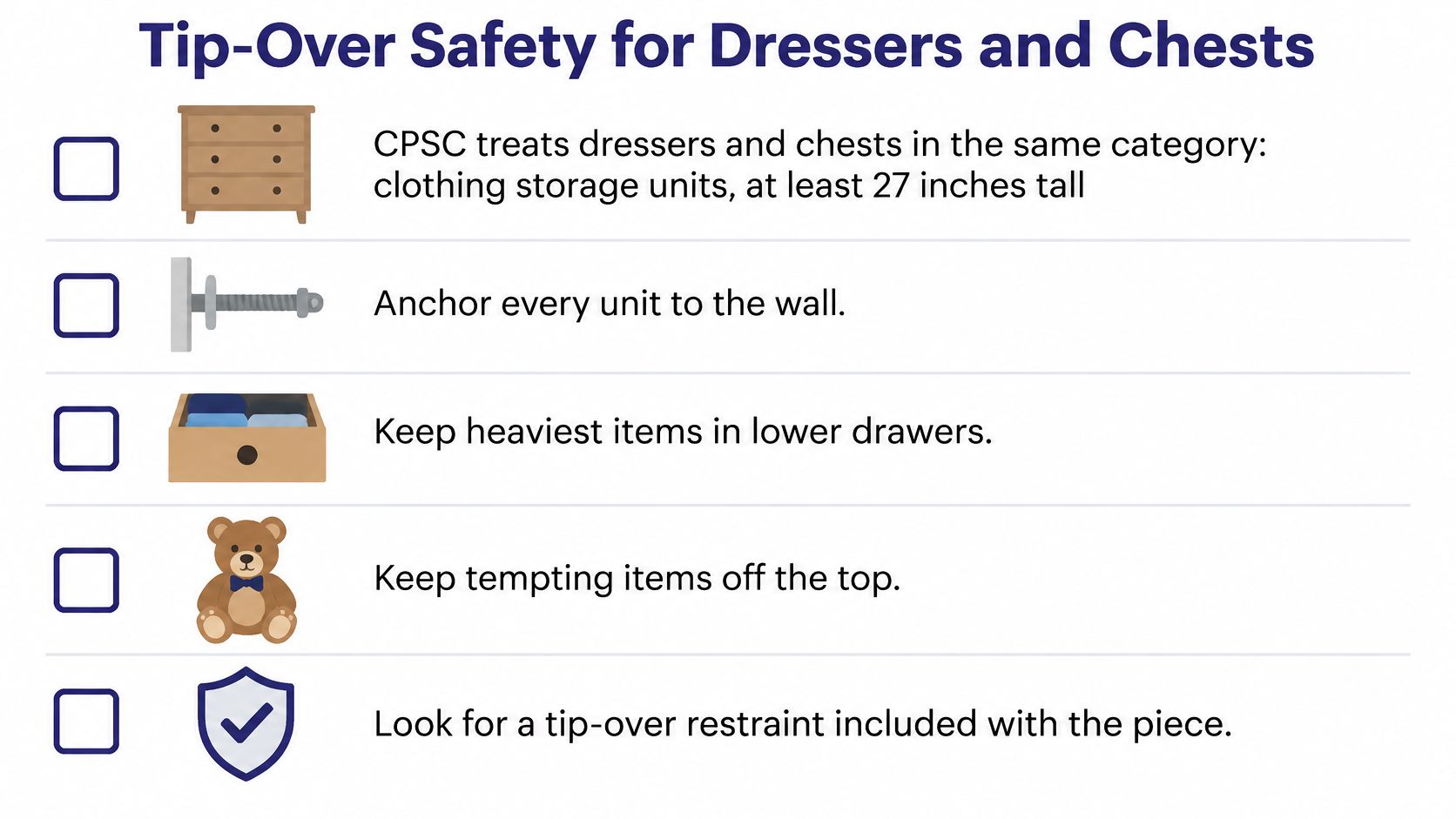
Both forms need the same attention to tip-over safety. Keep this checklist in view while comparing placement and access.
Dimensions and Drawer Counts for Each Form
How much storage remains useful after a piece is in place depends on more than its label. Typical dimensions help narrow the choice, while drawer arrangement and interior measurements show what the piece can hold.
| Form | Typical height | Typical width | Typical depth | Drawers |
|---|---|---|---|---|
| Low dresser | 30-34 in | 48-60 in | 18-20 in | 4-6 |
| Wide dresser with mirror base | 32-36 in | 60-72 in | 18-20 in | 6-9 |
| Standard chest | 40-46 in | 30-36 in | 18-20 in | 5-6 |
| Tall chest | 48-56 in | 30-36 in | 18-20 in | 6-8 |
These are typical ranges across common retail lines, not a published standard. For any specific model, follow the manufacturer's specification sheet. Dimensions can vary because each case combines drawer fronts, rails, a top and a base. For example, five drawer fronts that are each 7 inches high, plus a 1-inch top and a 4-inch plinth, add up to 40 inches before accounting for the rails. That arithmetic illustrates how a stack of drawers contributes to overall height; it does not establish a standard chest height.
How to read a spec sheet
Outside width, height and depth describe how much room the case occupies. Drawer depth, interior width and interior height describe usable storage. Two pieces with matching outside dimensions can still hold different amounts.
A six-drawer dresser that is 60 inches wide may divide its drawers into two side-by-side banks. A six-drawer chest that is 32 inches wide stacks them in one column, so each drawer is narrower and may be deeper. Count usable drawers, not just fronts: six shallow drawers work for socks, folded shirts and linens, while six deep drawers suit bulkier items such as sweaters and bedding.
Compare the interior height of the deepest drawer and the interior width of the widest one. Those measurements help establish whether the storage fits your belongings, while the outside dimensions reveal what the room gives up.
Measure the inside: drawer interior width, depth and height decide what fits. The case dimensions show how much floor and wall space the piece occupies.
The form has never been limited to one scale. The Metropolitan Museum of Art records an American chest of drawers probably made in Salem, Massachusetts, between 1675 and 1700, as well as a related Massachusetts chest dated 1750 to 1790. The latter measures 30.5 inches high, 33.75 inches wide and 20 inches deep. A piece called a chest can therefore be shorter and wider than a low dresser available today.
Before shopping, note the piece's outside width, depth and height, then record its drawer count and arrangement. Add the interior dimensions of the deepest and widest drawers, the top's width and depth if you plan to use it for a mirror or lamp, and whether an anti-tip restraint is included. These details make the comparison practical: the right choice is the one whose usable drawers and dimensions still work after placement.
How to Test Whether a Piece Fits Your Room
Will the piece still work once the room is arranged? A dresser or chest can fit against a wall and still block a route, collide with a door, or leave too little room to open its drawers. Research on the global bedroom-furniture market identifies smaller urban living spaces as a driver of demand for multifunctional, space-efficient storage. A tall chest can use less wall width, but it does not automatically leave more walking room.
Use a tape measure and pencil, then test the whole setup before deciding.
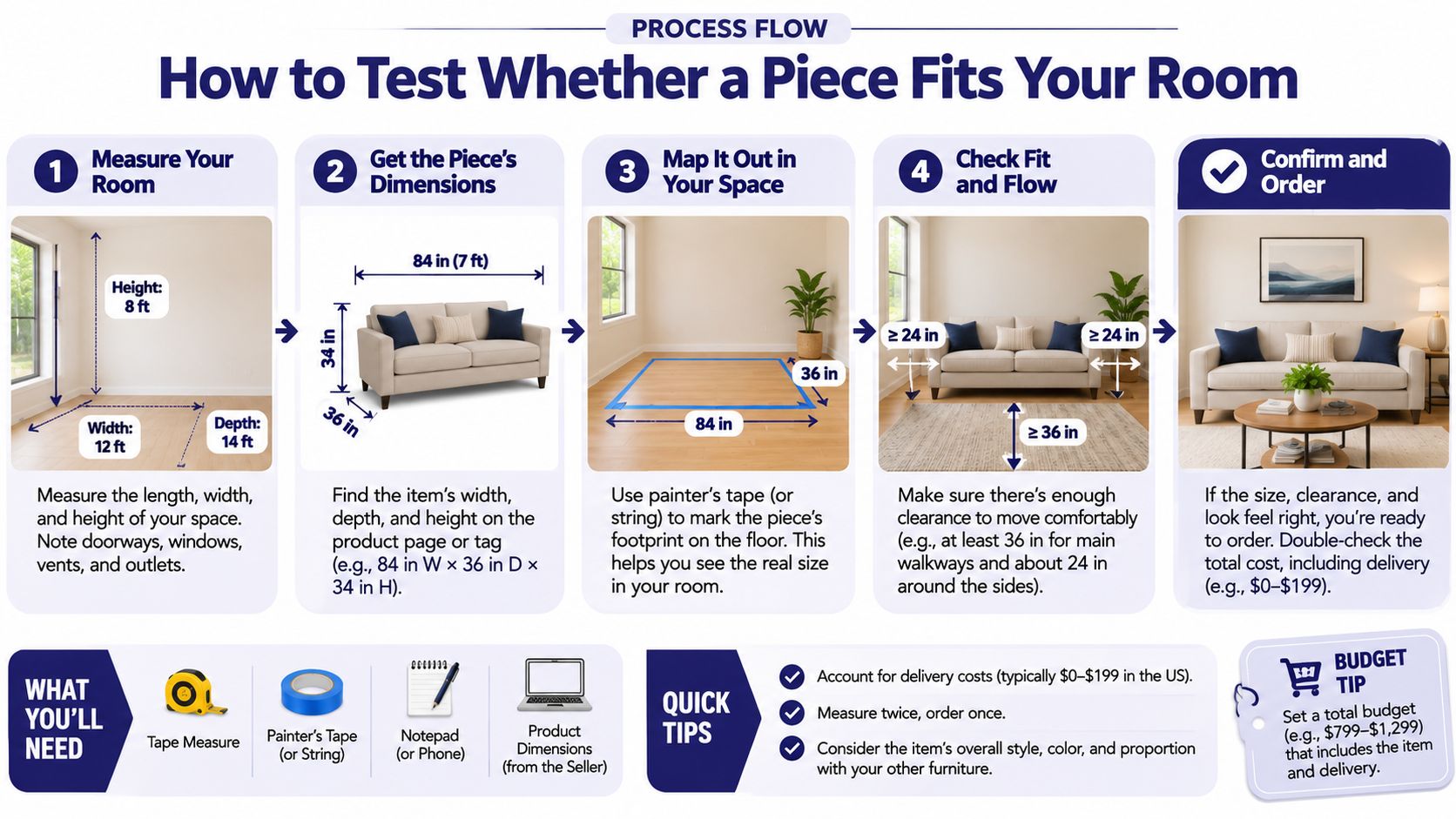
- Measure the wall. Mark its usable width and note windows, doors, outlets, and heat registers. A dresser that covers the room's only outlet may be a poor fit even if its width is less than the wall's.
- Check the walking route. Measure from the wall to the bed or seating, then account for the space needed to pass the furniture. A piece that leaves a narrow route can make the room awkward to use.
- Map the drawer-opening zone. Measure from the unit's back to the front of an open drawer, with extra working room in front. Check that the zone does not overlap a bed corner, chair, or door swing.
- Check mirror placement. If you plan to use a mirror, compare the unit's height with the mirror's position and the eye level of the person who will use it.
- List storage needs. Write down the categories that need separate drawers, such as folded clothes, linens, diapers, or shared household items. Decide which items need their own space.
- Compare the list with usable drawers. Check the drawer interiors on the product specifications. A drawer that is too shallow or narrow for its intended contents may not count as useful storage.
- Plan the anti-tip restraint. Identify where the unit can be secured and whether the required hardware can be used at that location. A piece that cannot be anchored safely may not work in that spot.
For renters who cannot fasten furniture to a wall, consider whether a suitable fastener-free anchoring option can secure the unit. In a room with more than one purpose, plan the furniture around both uses and keep the route between them clear. These renter-friendly bedroom space tips offer general ideas for making a bedroom feel more spacious.
Check the route with drawers open: The room needs to work when someone is using the furniture, not only when every drawer is closed.
Run it on one wall
Take a 66-inch wall as a hypothetical. A 60-inch dresser leaves 6 inches of wall, so it cannot share that wall with the 32-inch nightstand planned at one end. A 36-inch chest leaves 30 inches for the nightstand. Pairing it with under-bed storage for out-of-season clothing can make up for capacity the chest gives up. The right fit depends on the whole arrangement: wall space, walking room, drawer access, and the amount of storage the household can use.
Which Option Suits Each Room and Household
Match the layout first, then the household. The lookup below covers the arrangements that come up most often.
| Room or need | Usually better fit | Why |
|---|---|---|
| Long bedroom wall with space for a mirror | Dresser | Waist-height drawers and a surface that can hold a mirror |
| Narrow wall or corner | Chest | Uses height instead of width |
| Shared room needing separate drawers | Wide dresser | More drawer columns for simultaneous access |
| Small room with bed on one side | Chest | Preserves the walking route |
| Matching set with a wardrobe | Depends on depth | Combined depth must leave clearance |
| Nursery or children's bedroom | Either, anchored | Both forms need anchoring and placement away from climbing routes |
The long-wall row is about access, not style. Drawers at waist height let two people pack for a trip at once without stepping around each other, and the top takes a mirror without a separate vanity. The narrow-wall row is about geometry: a 32-inch chest buys the same vertical storage in half the wall a dresser needs.
A shared room changes the math in favor of width. Two people dividing a chest end up stacking categories on top of each other, while two banks of drawers let each person claim a side. The small-room row reads the other way, because a chest can sit in a corner while the bed keeps its side of the floor open.
Matching sets need combined math: a wardrobe, chest and dresser in the same finish still have to clear each other's drawer fronts and door swings. Add the depths before you add the pieces.
A nursery is the row people get wrong, because the name on the label isn't the deciding factor. The Consumer Product Safety Commission's guidance on clothing storage units classifies both dressers and chests as clothing storage units, which means safety turns on the whole piece and how it's placed rather than on whether it's wide or tall. The agency warned consumers in 2025 to stop using unstable tall fabric dressers, citing tip-over and entrapment hazards, and a separate recall covered restraint straps supplied with certain dressers and four-drawer chests. Support staff and family will value a piece that's anchored and kept clear of climbing routes far more than one that matches the crib.
Rooms change use, and the right choice follows the room. A guest room that becomes a nursery needs anchoring and a route away from the crib. A rental's rules on wall fasteners belong in the decision too, because a chest that can't be secured isn't a safer chest.
Tip-Over Safety for Dressers and Chests

Would you judge tip-over safety by whether a piece is called a dresser or a chest? The label does not determine the requirement. The CPSC defines a clothing storage unit as freestanding furniture intended to store clothing, with drawers or hinged doors, that is at least 27 inches high, weighs at least 30 pounds and provides at least 3.2 cubic feet of enclosed storage. The definition includes dressers, chests, drawer chests, bureaus, armoires, chifferobes and door chests.
A wide, low dresser can still tip if a child pulls on an open drawer. A tall chest can present the same risk. The shape changes how the piece fits the room, but safe use depends on securing the unit and following its instructions.
The reported toll shows why restraint matters. From January 2000 through April 2022, CPSC identified 234 reported fatalities involving clothing-storage-unit tip-overs, including 199 children. CPSC also estimated 84,100 related injuries treated in U.S. hospital emergency departments from 2006 through 2021, an annual average of about 5,300. Children accounted for 72 percent.
Young children were especially vulnerable. Of the 199 child fatalities, 171, or 86 percent, involved children aged 3 or younger, according to CPSC's final rule document on the clothing storage unit standard. A child can pull on a bottom drawer whether the unit is wide or tall, so consider climbability along with the piece's dimensions.
- Identify the model. Record the model number from the label and keep it with your receipts, so you can match the piece to a recall notice.
- Check the restraint. Covered units must ship with an approved anti-tip restraint. If it is missing, contact the seller before assembly.
- Install it as instructed. Use the specified hardware and placement, securing it to a stud where the instructions require one. Anchoring is usually a quick job with a drill and the hardware that ships in the box.
- Keep weight low. Put heavier items in lower drawers and leave the top clear of objects a child could climb toward.
- Check for recalls. Search the CPSC recall listings by model, and register the product if the maker offers registration.
Anchoring reduces risk, but does not replace supervision or careful placement. Choosing the shorter form alone does not remove the need for a restraint.
Confirm Your Measurements Before You Shop
Will the piece still work once it is in place? Start with the room, not the name on the tag. Record the wall width, clearance beside the bed or seating, walking route, and the locations of outlets, windows, and studs. Then use the earlier fit test and drawer-count check to judge whether the form suits the placement and household.
Before choosing a specific model, confirm its exact dimensions and interior drawer depth. Check that drawers can open without blocking a walkway, and that the anti-tip restraint is included and the model has no recall. A tape measure and the manufacturer's specifications can answer many of these questions at home. If comparing pieces in person would help, bring your measurements.
A design service can help map the available wall space and consider anchor points; delivery options can help with getting a chosen piece home. Woodstock Furniture & Mattress Outlet sells furniture and home decor and offers design services and delivery options. Visit Woodstock Furniture & Mattress Outlet with your measurements to compare which form is likely to work after placement.
Leave a Reply
You must be logged in to post a comment.