For upright seating, plan around 20 to 22 inches of usable seat depth; for relaxed lounging, aim for 23 to 25 inches, measured from the front edge of the seat cushion to the back. The right number depends on the shortest regular user and the room, not just how a sofa looks in a product listing.
How deep should a sofa be if two models have the same overall measurement but feel different to sit on? The key is to separate overall depth, which tells you how much floor the sofa occupies, from usable seat depth, which tells you how much space you have to sit. Cushions, posture and reclining can change that usable space, so measuring the actual seating area is more informative than comparing exterior dimensions alone.
Recommended Sofa Depth Ranges at a Glance
For conversation, reading or working, a usable seat depth of 20 to 22 inches is a practical starting point. For relaxed lounging with the back cushions in place, consider 23 to 25 inches, provided you can still lean back comfortably and rest your feet on the floor.
| Use case | Usable seat depth | Overall sofa depth | What changes the fit |
|---|---|---|---|
| Upright conversation, reading or working | 20 to 22 in | Standard three-seat about 34 to 37 in | Firm cushion and back position |
| Relaxed lounging with back cushions | 23 to 25 in | About 38 to 43 in | Lumbar support and feet reaching the floor |
| Shorter users or older adults | Shallower end, about 20 in with a firm cushion | Standard three-seat about 34 to 37 in | Ability to keep the back supported while feet rest flat |
| Mixed-height households | Set by the shortest regular user first | Choose a depth that lets the shortest user sit back with feet supported | Whether one seat can serve all members |
The overall-depth figures are planning references, not a guarantee of how much sitting room a sofa provides. A room-planning guide reports standard three-seat sofas at about 34 to 37 inches overall, with deep-seat models adding roughly 4 to 6 inches. Check the individual product's dimensions, because its frame and back design can make the usable seat much shallower than its outside measurement suggests.
A single depth won't suit every body or posture. A 2025 seat-depth experiment found that 15.8 inches received the best comfort and lowest discomfort ratings among the six depths tested with the study's university-student participants. That finding is specific to its test conditions, but it's a useful reminder that upright seating and lounge seating can call for different dimensions.
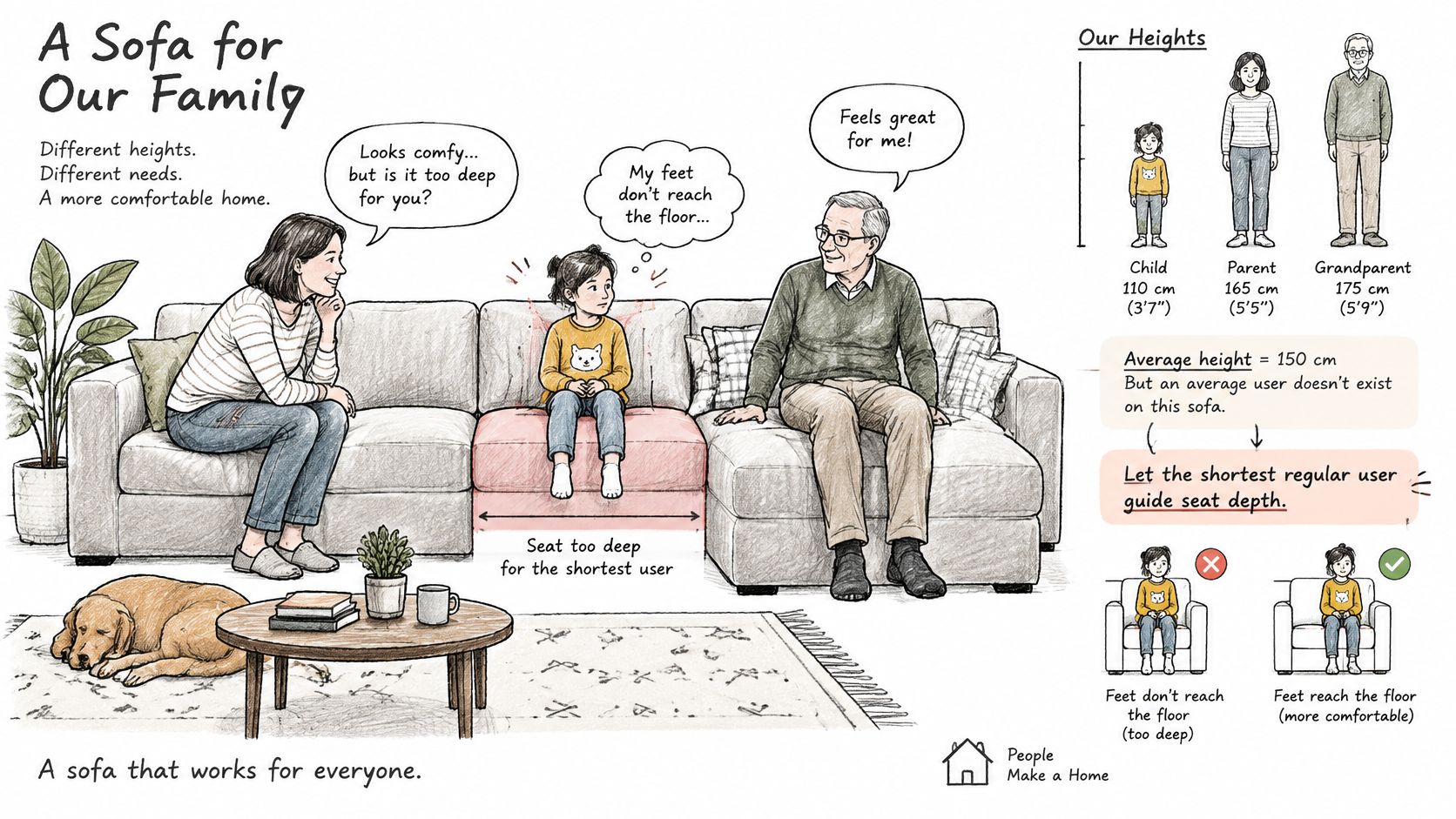
When several people use the sofa, start with the shortest regular user, not the household's average height. The fit test matters more than choosing a number that looks balanced on paper.
Usable Seat Depth, Cushions and Reclining
A product listing's overall depth can be misleading if you're trying to figure out how the sofa will feel. Overall depth runs from the front of the sofa to its back and includes the frame, back cushions and, in a reclining model, the mechanism. Usable seat depth measures the sitting space from the front edge of the seat cushion to the face of the back cushion.
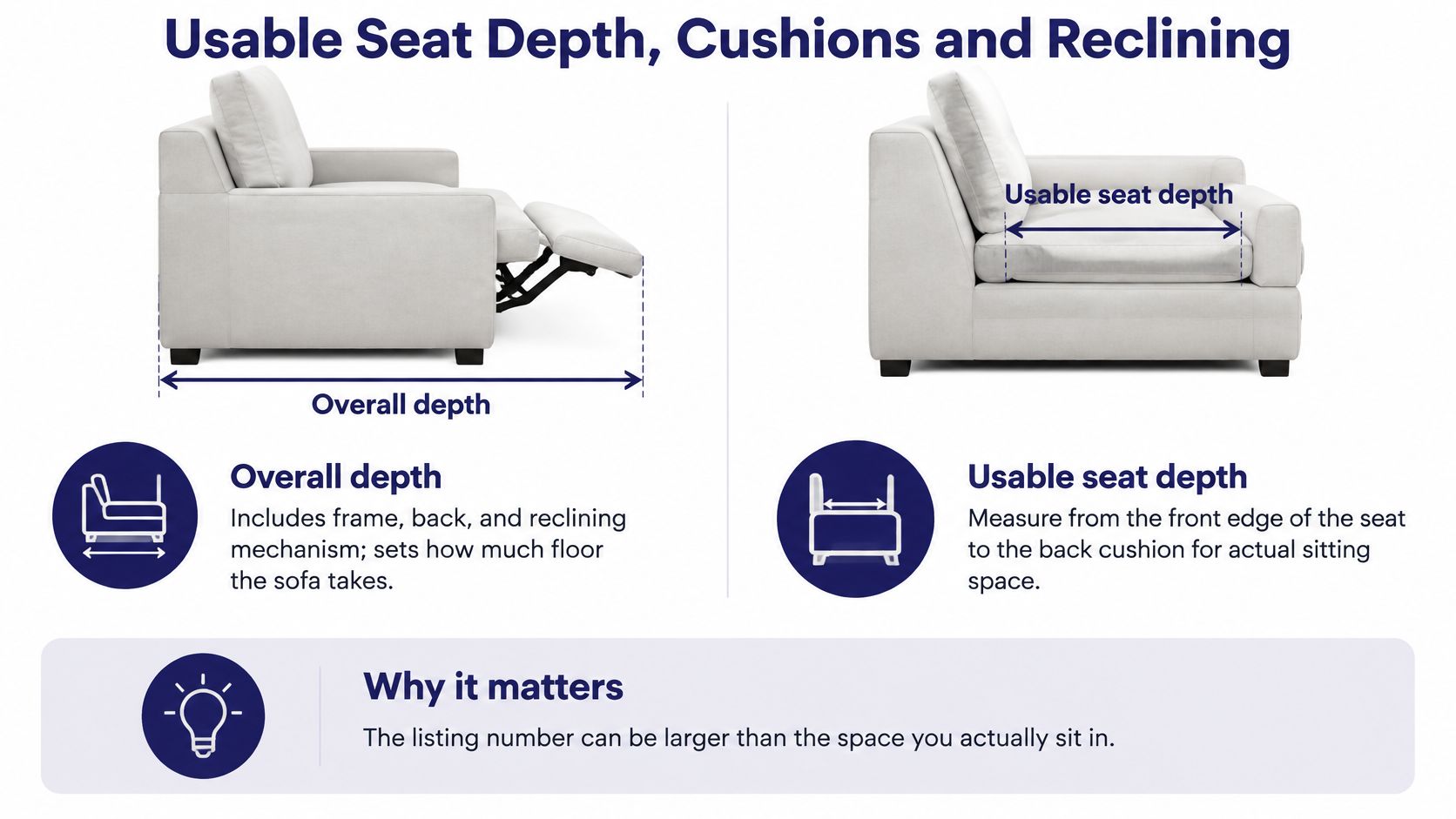
A sofa seat-depth guide from Koala gives a commonly cited usable range of 20 to 24 inches, measured from the front of the seat cushion to the face of the back cushion. Treat it as a reference, not a rule: cushion firmness, back-cushion thickness, the sitter's proportions and preferred posture all affect how the same measurement feels.
To compare models, ask for the seat depth with the back cushions installed. Measure from the front edge of the seat cushion to the point where the back cushion will support your lower back. A thick fixed back can take up more sitting space than loose pillows, which may compress or move when you sit. Decorative pillows can reduce the space further, so a sofa that seems deep enough when empty may feel short once it's arranged for everyday use.
Try the cushions in their real positions
Sit back against the cushion with decorative pillows removed, then put them in their usual positions. Notice whether your lower back stays supported and your feet can reach the floor without scooting forward. If the back cushions are loose, try moving them and see whether that makes the seat usable for different people.
Reclining changes the sofa's footprint as well as how you sit. Measure the sofa at its deepest point when fully reclined, and check the space behind it if the back moves or opens. For related troubleshooting when a seat feels uncomfortable or worn, practical seating fixes for sagging sofas can help you distinguish a depth issue from a support problem.
How to Measure Yourself and Your Sofa
Start with your body, because the sofa needs to fit the person sitting in it. The relevant measurement is buttock–popliteal length, the horizontal distance from the back of your pelvis to the back of your knee while seated. The U.S. adult anthropometric tables report these approximate values:
| Percentile | Women (in) | Men (in) |
|---|---|---|
| 5th | 18.07 | 17.36 |
| 50th | 19.76 | 19.02 |
| 95th | 21.57 | 21.06 |
These are population measurements, not individual recommendations. Use your own fit test to decide whether a particular sofa supports your thigh without pressing behind your knee.
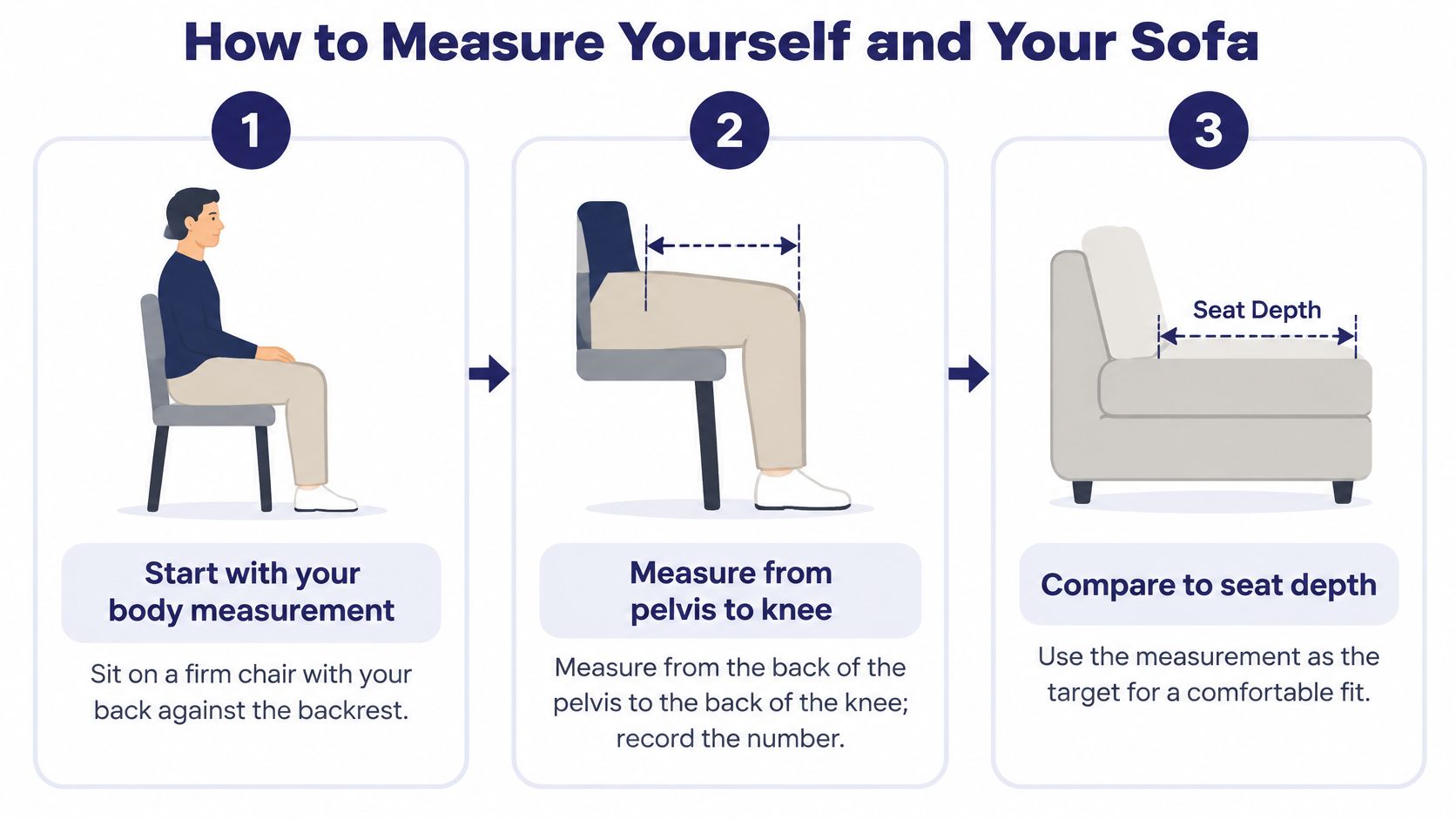
Measure your seated body length. Sit on a firm chair with your back against its backrest. Measure horizontally from the back of your pelvis to the back of your knee, and record the result.
Choose a target based on how you'll sit. Use the range for the sofa's main job, such as upright reading or relaxed lounging. The aim is to support most of your thigh without forcing your lower back away from the cushion.
Measure the sofa with the back cushion in place. Measure from the front edge of the seat cushion to where the back cushion meets it. Ask the retailer how its stated seat depth was measured if the product listing doesn't make that clear.
Check the knee and thigh fit. Sit fully back and notice whether the seat supports most of your thigh without pressing behind your knee. Pressure at the knee can make it uncomfortable to stay seated.
Check your back and feet together. Keep your lower back against the cushion and see whether your feet reach the floor. If you have to slide forward to plant your feet, the seat may be too deep for you.
Repeat the test for regular users. Ask each person who will use the sofa often to try it, starting with the shortest. A deep seat that leaves someone's feet unsupported can encourage them to perch forward or slump.
Checking Sofa Depth Against Your Room
A common planning mistake is measuring only the wall behind the sofa. That doesn't account for the sofa's front edge, a reclining mechanism, a door swing or the space needed to walk around furniture. Measure the maximum front-to-back projection of the sofa, then map that full footprint on the floor.
The room-clearance guide gives 36 inches of clear width as a general U.S. ADA walking-surface benchmark, and a 60-inch turning circle where wheelchair turning space is required. These are accessibility planning benchmarks, not rules for every private home. Use the clearance that suits the people who need to move through your room.
Make a full-size floor test
Use painter's tape to mark the sofa's front and back edges, including the deepest point when reclined. Place a chair or box where the coffee table is meant to go, then walk the main route several times. Check whether anyone has to twist sideways, whether doors can open fully and whether the layout still works with side tables in place.
Don't rely on the catalog measurement if cushions or a recliner extend farther than the stated depth. A room can look clear before the sofa arrives and feel crowded once people sit down or recline. If the taped footprint narrows the main route below the relevant clearance target or forces sideways movement, try a shallower sofa or rearrange the furniture.
Depth for Families, Kids and Older Relatives
A household with two teenagers and a frequently visiting grandparent may not get a good fit from choosing a depth based on everyone's average height. The teenagers may enjoy stretching out, while the grandparent may need a seat that makes it easier to sit back with feet supported and stand up steadily. In that situation, a moderately deep sofa plus a deeper chair may serve more people than one deep sectional.
For an older adult or someone with reduced leg or core strength, consider a moderate usable depth around 20 to 23 inches, a firmer cushion, a higher seat and sturdy arms. These features can offer more support during sitting and standing than a deep, low, soft seat. A deep lounge sofa may still suit taller users or relaxed reclining, but it shouldn't be the only seating option if household members struggle to rise from it.
Make one sofa more adaptable
Loose back cushions can shift to change how much room a person has behind their back. A lumbar pillow can bring support forward for a shorter sitter, while a footrest may help a child sit comfortably without sliding to the edge. These adjustments are useful, but they don't replace checking whether each person can sit back and keep stable foot contact.
Ask the people who'll use the sofa most to try it in their usual posture. One person may sit upright, another may curl up, and someone else may need a supportive arm to stand. Their own experience is more useful than having a family member judge the fit on their behalf.
Choosing Your Depth and Testing It in Person
Use a simple decision rule: start with the shortest regular user's fit, then choose a depth that suits the sofa's main use. For frequent upright reading, conversation or working, begin at the shallower end. For lounging, consider a deeper seat only if the sitter can maintain back support and rest their feet comfortably.
If two options seem close for a mixed-height household, the shallower one is often easier to adapt. A cushion can add support behind someone on a shallow seat, while a fixed deep seat is harder to shorten. Loose back cushions may give you more flexibility, but try them in the position you expect to use day to day.
Sit on the sofa in person with its regular back cushions in place. Check your back, knees and feet together, and ask how the listed seat depth was measured before ordering for several people. If you can't test it before purchase, review the return terms so you know what options you have if the fit doesn't work at home.
Woodstock Furniture & Mattress Outlet offers sofas and in-person help comparing dimensions, so you can check how overall depth and usable seat depth differ before choosing. Visit Woodstock Furniture & Mattress Outlet to sit on sofas at different depths and ask the team to walk through the measurements with you.
Leave a Reply
You must be logged in to post a comment.