Tag: sofa buying guide

  • Best Couch for Heavy People: A Complete Buyer’s Guide

    Best Couch for Heavy People: A Complete Buyer’s Guide

    You sit down at the end of a long day, and the couch answers with a creak. One cushion sinks lower than the others. The arm feels loose. A seat that looked comfortable in the store now feels like it’s folding inward every time you use it.

    If that sounds familiar, you’re not being too picky. A lot of people shopping for the best couch for heavy people have already been through this cycle once, sometimes more than once. The frustration usually isn’t just about comfort. It’s about wasting money on a sofa that looked fine on day one and wore out much too fast.

    The good news is that strong sofas aren’t a mystery. You don’t need to guess, and you don’t need to rely on marketing language. If you know what to look for inside the frame, under the cushions, and in the dimensions, you can spot the difference between a couch that merely looks substantial and one that’s built for daily heavy use.

    Why Finding a Sturdy Couch Can Feel So Frustrating

    A lot of sofa shopping goes wrong before anyone even sits down. The couch looks deep, plush, and inviting. The upholstery feels soft. The showroom lighting helps. Then real life starts. A few months later, the middle seat dips, the back pillows collapse, and getting up from the sofa takes more effort than it should.

    That experience wears people down. It also creates doubt. You start wondering whether every couch is basically the same under the fabric, or whether you need to spend far more money just to get something that lasts.

    Why many shoppers feel misled

    Part of the frustration is that many furniture descriptions focus on style first and construction second. You’ll see color names, design trends, and room photos long before you see the details that matter most for support.

    For heavier individuals, couples, or busy families, that missing information matters a lot. A couch can look oversized and still have a weak internal build. A wide sectional can still sag early if the support system and cushions aren’t up to the job.

    A sofa doesn’t fail all at once. It usually fails in stages. First the seat softens, then the frame starts shifting, then the whole couch feels tired.

    The hidden cost of replacing furniture too soon

    The problem isn’t only that a couch gets uncomfortable. It’s that replacing furniture early is expensive, inconvenient, and discouraging. You have to shop again, arrange delivery again, and hope you make a better choice the next time.

    That’s why the best couch for heavy people isn’t just the one with the highest listed weight capacity. It’s the one built to hold up across the whole ownership experience. That includes the frame, the suspension, the cushions, the upholstery, and how well the shape fits your body.

    A sturdy couch should let you relax without wondering whether the seat is wearing out underneath you. That’s a reasonable expectation, not a luxury.

    What Really Makes a Couch Strong A Look Inside

    Sofas are often judged from the outside. The stronger way to shop is to think like a builder. Every durable couch depends on three core parts working together: the frame, the suspension, and the rated weight capacity.

    An infographic titled What Makes a Couch Strong illustrating the frame, suspension, and cushions components.

    Start with the frame

    The frame is the skeleton of the sofa. If it flexes too much, every other part of the couch wears out faster.

    A stronger build usually starts with kiln-dried hardwood. Kiln drying removes excess moisture from the wood so it’s less likely to warp over time. That matters because a warped frame can throw the whole sofa out of balance, especially under repeated heavy use.

    Materials matter here. A couch made with particleboard or weaker composite materials may feel acceptable at first, but it often won’t have the same long-term rigidity as a hardwood frame. When the frame shifts, you’ll often notice it first in the arms, front rail, or center seat.

    Suspension does more work than most shoppers realize

    The suspension sits below the cushions and above the frame. It absorbs weight, helps distribute pressure, and keeps the seat from bottoming out.

    Two common strong options are:

    • Eight-way hand-tied support: Often considered a premium construction method because the springs are tied in multiple directions for balanced support.
    • Heavy-duty sinuous springs: These can also perform well when the gauge and installation are solid.

    Think of suspension like the foundation under flooring. If the floor joists are weak, the nicest hardwood on top still feels bouncy and unstable. Sofas work the same way. A thick cushion can’t compensate for weak support underneath.

    Practical rule: If a sofa feels supportive for the first minute but starts to feel unstable when you shift your weight, the issue may be underneath the cushion, not inside it.

    Weight capacity tells you whether the maker designed for real load

    This is one of the few numbers shoppers should always ask for. Industry experts recommend sofas that support at least 250 to 300 pounds per seat or a total weight limit of 1000 pounds or more, while standard couches often max out at 600 to 800 pounds total, which can lead to premature wear for heavier individuals or families, according to guidance on couch capacity benchmarks.

    That doesn’t mean every household needs the highest-capacity model available. It means a listed capacity gives you evidence that the sofa was engineered with load in mind, rather than solely styled to look substantial.

    A quick checklist you can use

    Part What to look for Why it matters
    Frame Kiln-dried hardwood or similarly robust construction Helps resist warping and loosening
    Suspension Well-built spring support system Prevents sinking and uneven wear
    Capacity Clearly stated seat or total load rating Shows the sofa was designed for support

    If a retailer or manufacturer can’t tell you what the frame is made of, what supports the seat, or what weight the sofa is rated for, that’s useful information too. It means you should slow down and ask more questions before buying.

    The Unsung Hero of Sofa Longevity High-Density Cushions

    A couch can have a solid frame and still disappoint you if the cushions collapse. Many shoppers are surprised by this. They buy a sofa that feels comfortable in the store, only to find that the seats flatten far sooner than expected.

    The key term to know is foam density. Density doesn’t mean the cushion feels rock hard. It refers to how much material is packed into the foam and how well that foam resists long-term compression.

    A line drawing illustration showing a person sitting on a sofa with high-density foam and durable coils.

    Why density matters more than showroom softness

    Premium sofas for heavier individuals use high-density foam cushions, typically measuring 1.8 lbs per cubic foot or higher, and that specification can mean the difference between a sofa lasting 3 to 5 years versus one that maintains its comfort and structure for 10+ years, based on high-density sofa construction guidance.

    That’s a major difference in everyday use. Lower-density foam tends to compress faster under repeated pressure. Once that happens, the seat doesn’t just look flatter. It changes how your hips, lower back, and legs are supported.

    What shoppers often get confused about

    Many people assume a softer seat is automatically more comfortable. In the short term, it can feel that way. But for heavier use, very soft cushions often lose shape quickly and stop supporting the body evenly.

    A better question is this: does the cushion recover after pressure, or does it stay compressed?

    Look for signs of better cushion construction:

    • Ask for the foam density: If the salesperson doesn’t know, ask them to check the product specs.
    • Press and release the cushion: It should bounce back without feeling hollow.
    • Sit in one spot, then another: A weak cushion often feels very different from seat to seat.

    The ideal cushion for heavy use usually feels supportive first and plush second. That can seem less impressive in the showroom, but it often feels better after months of daily sitting.

    The frame and cushion have to match

    A strong cushion on a weak frame won’t save the sofa. A strong frame with weak foam won’t feel good for long either. The best couch for heavy people needs both.

    That’s why cushion questions aren’t optional. If you’ve had a couch that looked fine from across the room but felt exhausted after a year, this is often the reason.

    Choosing Upholstery That Withstands Real-World Use

    A couch doesn’t wear out only from the inside. Fabric takes the daily friction. People slide into the seat, lean against the arms, stretch across the chaise, spill drinks, and clean spots. If the upholstery isn’t durable, the sofa can look tired even when the frame is still in decent shape.

    Many buying guides stop at weight limits, but they don’t do much with the bigger ownership question. Fabric durability, maintenance, and warranty details affect whether the sofa remains worth owning. That gap is noted in guidance on total cost of ownership for heavy-use furniture.

    Comparing common upholstery choices

    Different materials solve different problems. The best choice depends on how your household uses the sofa.

    Upholstery type Where it helps What to watch for
    Performance fabric Busy homes, frequent use, easier cleanup Ask how it should be cleaned to avoid damage
    Leather Easy surface wipe-down, classic look Quality varies, so touch and inspect the thickness and finish
    Tightly woven fabric Good everyday balance of comfort and durability Loose weaves can show wear sooner

    Performance fabrics appeal to many families because they’re often easier to maintain after spills or heavy daily use. Leather can also make sense for some shoppers because surface messes are often simpler to wipe away, though the feel and upkeep vary by leather type and finish.

    Think beyond the day you bring it home

    When you compare sofas, ask questions that reflect long-term use, not just first impressions:

    • How will this fabric age: Does it tend to pill, stretch, or show pressure spots?
    • How should it be cleaned: Some materials are forgiving, others need more careful upkeep.
    • What does the warranty cover: A fabric warranty and a frame warranty are not the same thing.

    A beautiful sofa can become frustrating if the seat deck starts looking polished, the arm panels get fuzzy, or the fabric holds every small mark. Upholstery should match your household's reality, not just your ideal version of it.

    The practical lens to use

    If you’ve ever said, “The couch still works, but it already looks worn out,” then upholstery deserves more attention on your next purchase. A sofa for heavier use needs an exterior that can keep pace with the structure underneath it.

    Finding Your Perfect Fit Dimensions Seat Depth and Height

    Strength matters. Fit matters just as much. A couch can be durable and still feel wrong if the proportions don’t support your body well.

    For many people, sofa comfort is tied directly to mobility and joint strain. Seat height, arm firmness, and seat depth can all affect how easy it is to sit down, settle in, and stand back up. That’s one reason the right sofa is often a health decision, not just a decorating choice, as noted in Bassett’s discussion of custom furniture for big and tall comfort.

    A line drawing illustration showing a person sitting on a sofa, highlighting seat height and seat depth measurements.

    Seat depth affects posture more than people expect

    Seat depth changes how your back and legs interact with the sofa. If the seat is too deep, you may have to perch on the edge or slouch to use the back cushion. If it’s too shallow, your thighs may not feel supported.

    A better fit usually lets you sit back with support behind you while keeping your feet planted comfortably. That balance can make a meaningful difference in how your body feels after a longer stretch of sitting.

    Proper seat depth can support better spinal alignment and reduce the need to constantly reposition yourself.

    Seat height can make daily use easier

    People often overlook seat height until they try to stand up from a sofa that sits too low. A lower profile may look stylish, but it can be harder on knees, hips, and lower back.

    Armrests matter here too. Firm, usable arms can help with weight transfer when you sit down or push yourself up. Soft, floppy arms may look cozy, but they don’t offer the same help.

    A simple fit test to use in the showroom

    Instead of asking “Is this comfortable?” ask more specific questions while sitting:

    1. Can you sit all the way back without curling forward?
    2. Do your feet rest naturally, or do you feel perched?
    3. Can you stand up without a struggle?
    4. Do the arms help, or do they collapse when you lean on them?

    Those answers tell you more than a quick sit ever will.

    If you’re also thinking ahead about upkeep, it helps to understand basics like cleaning stubborn sofa stains before you choose a fabric, especially in homes where the couch sees daily meals, pets, or kids.

    Fit should match your body, not just the room

    A lot of people buy according to floor plan first. That’s understandable, but it can backfire. The right sofa should fit your body and your home at the same time. If one has to win, your body should.

    That’s especially true when you’re shopping for the best couch for heavy people. Support isn’t only about whether the couch can hold weight. It’s also about whether it supports you well every single day.

    How to Test a Sofa In-Store and Understand Warranties

    You sit down in a showroom, and for the first 30 seconds almost any sofa can feel decent. The harder question is what it will feel like after a year of daily use, repeated standing and sitting, and the full load going through the same few stress points over and over. That is the difference between a quick comfort test and a durability test.

    An illustration showing three steps to check couch quality: sit test, frame test, and warranty check.

    A sturdy sofa should feel settled, not nervous. If the frame and support system are doing their job, the couch stays composed when you change positions, press on the arms, or sit in the spots that usually wear out first.

    Use a short stress test, not a quick sit

    Treat the showroom test like checking a ladder before climbing it. You are not trying to judge style alone. You are checking whether the structure feels calm under load.

    Start with the seat you think you will use most, then test the center seat and one end. Shift your weight side to side. Sit down with normal force instead of lowering yourself cautiously. Stand up and sit back down a few times. Press on both arms with your hands the way you would at home when adjusting your position.

    Look for warning signs such as creaking, side-to-side sway, arm movement, or a seat that feels dramatically softer in one spot than another. If staff allow it, lift one front corner slightly. Better-built frames usually feel more unified and less prone to twisting.

    Some retailers also share practical buying and delivery advice in person. If a larger sofa may be difficult to get into your home, it helps to streamline your move with a two-person team before delivery day so the piece is handled with better control.

    Questions that reveal how the sofa is built

    A salesperson may start with fabric colors or sale pricing. Bring the conversation back to construction. That is where long-term ownership costs are decided.

    Ask these questions plainly:

    • What is the frame made from?
    • What supports the seat under the cushion, such as springs, webbing, or a platform?
    • What foam density is used in the seat cushions?
    • Is there a stated weight limit for the sofa or for each seat?
    • Are the arms and back attached in a way that resists loosening over time?
    • What parts of the sofa are covered separately under warranty?

    Those answers help you compare sofas on engineering, not just first impression. If a seller cannot explain the frame, support system, or cushion materials, that usually means you do not have enough information to judge value.

    Here’s a short visual walkthrough of what that inspection mindset looks like in practice.

    Read warranties like a repair bill waiting to happen

    A warranty is not only reassurance. It is also a clue. It shows which parts the manufacturer expects to hold up, and which parts may wear out sooner.

    Look for separate coverage for the frame, cushions, and any reclining or motion components:

    Warranty area Why it matters
    Frame Shows whether the maker stands behind the structure
    Cushions Seat comfort and support often decline here first
    Reclining or motion parts Mechanical repairs can be expensive and inconvenient

    Read the exclusions closely. Many furniture warranties cover manufacturing defects but not the gradual softening, flattening, or loss of support that owners notice first. Labor can also be excluded, which means the part may be covered while the service visit is not.

    That detail matters. A couch with a stronger frame warranty but weak cushion coverage may still cost more to live with if the seats lose support early. For heavy-use households, the best value usually comes from a sofa that is engineered well and backed clearly in the areas that fail most often under real use.

    Making Your Investment Last Delivery and Maintenance

    A durable couch can still have a rough start if delivery goes badly. Heavy-duty sofas are often larger, deeper, and harder to maneuver than standard pieces. Before purchase, measure doorways, hallways, stair turns, and the room where the sofa will live.

    That planning saves frustration. It also helps you think through where the couch should go for long-term use, not just where it can be dropped on delivery day.

    Delivery planning is part of sofa ownership

    If you’re moving a substantial sofa into a tighter home or apartment, logistics matter more than people expect. Even a well-built piece can get scuffed, scraped, or awkwardly handled if the move is rushed. A practical overview like streamline your move with a two-person team can help you think through why furniture handling and coordination matter, especially with larger seating.

    Once the sofa is in place, avoid dragging it by one arm or one corner. Uneven lifting puts unnecessary stress on joints and legs.

    Small maintenance habits make a real difference

    The best couch for heavy people should be built well, but good habits still matter.

    • Rotate loose cushions: This helps distribute wear more evenly.
    • Clean spills promptly: Stains set faster than often realized.
    • Vacuum creases and under cushions: Grit and debris can wear fabric over time.
    • Follow the care instructions for your upholstery: Fabric and leather need different approaches.

    Think in years, not in the first weekend

    A sofa isn’t just a purchase. It’s a piece you’ll use while reading, recovering, hosting, watching movies, and taking naps you didn’t plan to take. That’s why the smartest way to buy is to think about the total ownership experience.

    Choose a couch with a structure that supports real weight, cushions that keep their shape, fabric that matches your household, and dimensions that make daily sitting easier on your body. When all of those pieces line up, you’re much more likely to bring home a sofa that still feels right years later.


    If you want to test sofas with this checklist in mind, Woodstock Furniture & Mattress Outlet is one place where North Georgia shoppers can compare living room seating in person, ask detailed construction questions, and get help thinking through fit, durability, delivery, and room layout before making a decision.

  • How to Choose a Sofa That Fits Your Life and Your Living Room

    How to Choose a Sofa That Fits Your Life and Your Living Room

    Here’s a simple truth learned after years in this business: good sofa choices come from a simple formula. Plan your space, get honest about your lifestyle needs, and know what real quality looks like.

    You need to start by measuring your room and all the doorways first. Then, think hard about how you and your family will actually use the sofa every single day. Only then should you start looking at fabrics and styles. This practical-first approach is your best defense against buyer's remorse and helps you end up with a sofa you'll love for years.

    Starting Your Sofa Search With a Plan

    A new sofa isn't just another piece of furniture. It’s often the heart of the home. It’s where you crash after a long day, where the family piles up for movie night, and where you catch up with friends. Because it plays such a huge role in your daily life, starting with a solid plan is the key to choosing a sofa that truly fits your life, not just your living room.

    Before you let yourself fall for a specific style or a trendy color, you have to do the foundational work. This is the stuff that grounds your search in the reality of your home and your habits. Getting this right transforms the whole process from overwhelming to empowering.

    Assess Your Lifestyle Needs First

    How are you really going to use this sofa?

    Answering that question with total honesty is one of the most important things you'll do. A sofa destined for a formal, rarely-used living room is a completely different piece of furniture than one that’s the command center for a busy family.

    Ask yourself these key questions to figure out what you need:

    • Who is using this sofa? Is it just for you and a partner? Or does it need to stand up to kids, pets, and a steady stream of guests? This single question will steer everything from the size you pick to the upholstery you choose.
    • What happens here? Is this your go-to napping spot? The binge-watching throne? Or is it more for upright, formal conversations? A deep, plush sofa is a lounger's dream, but a shallower, firmer one offers much better support for sitting and chatting.
    • Got kids or pets? If the answer is yes, then durability and easy cleaning just shot to the top of your list. You'll want to look at performance fabrics or certain types of leather that can handle spills and claws, rather than delicate materials like silk or linen.

    Measure Everything. Twice.

    One of the most common problems people face is buying a sofa that’s too big for their space. Even worse? Buying one that won't even fit through the front door. You can completely avoid that delivery-day disaster by taking detailed measurements before you even start shopping.

    A tape measure is your most important tool in this process. Seriously. Ten minutes of measuring now will save you from a massive headache and the disappointment of having to return a sofa you’ve already fallen in love with.

    Grab a tape measure and get the numbers for these three critical areas:

    1. Your Room: Measure the length and width of the room, especially the wall where the sofa will go. A helpful pro tip is to use painter's tape to outline the sofa's footprint on the floor. This simple trick helps you visualize exactly how much space it will take up and makes sure you have plenty of room to walk around it.
    2. Your Entry Points: Measure the height and width of every doorway, hallway, and staircase the sofa needs to navigate. Don't forget to account for tricky corners or low-hanging light fixtures.
    3. The Sofa Itself: When you're shopping, always find the sofa's official dimensions—length, depth, and height. The diagonal depth is often the most critical number; it determines if the piece can be tipped and angled through a tight doorway.

    Finding the Right Sofa Shape for Your Space

    Once you’ve got your measurements, it’s time for the fun part: finding a sofa shape that actually works with your room's flow and how you live in it. This isn't just about looks; it's about function. The right shape can anchor a conversation area, make a small room feel bigger, or create that perfect cozy corner you've been dreaming of.

    You'll see everything from standard three-seaters to large sectionals and clever sleeper sofas. Each one solves a different problem and fits a different kind of home.

    Matching Sofa Configurations to Your Home

    The right sofa shape doesn't just fit—it enhances your living space. A classic three-seat sofa, for instance, is a go-to for a reason. It’s versatile enough for most traditional living rooms, offering ample seating without totally dominating the space. It’s a reliable choice for apartments and mid-sized homes alike.

    A loveseat, which is really just a cozy two-seater, is well-suited for smaller dens, home offices, or as a partner to a larger sofa. You get comfortable seating without eating up a ton of floor space.

    Then you have the sectional sofa, a practical solution for big families or anyone who loves to entertain. An L-shaped sectional can tuck neatly into the corner of an open-concept living area—something we see a lot in North Georgia homes—carving out an inviting spot for everyone to gather. U-shaped sectionals offer even more room, making them ideal for media rooms where everyone can have a spot.

    • Standard Sofas (Three-Seaters): Suited for defined living rooms where you need a straightforward, versatile seating solution.
    • Loveseats (Two-Seaters): Excellent for smaller spaces, entryways, or paired with a larger sofa to create a full conversation set.
    • Sectional Sofas (L-Shape or U-Shape): Ideal for large or open-concept rooms, maximizing seating and helping to define specific zones within the space.
    • Sleeper Sofas: A practical choice for homes without a guest room, offering a place for visitors to stay overnight without sacrificing style.

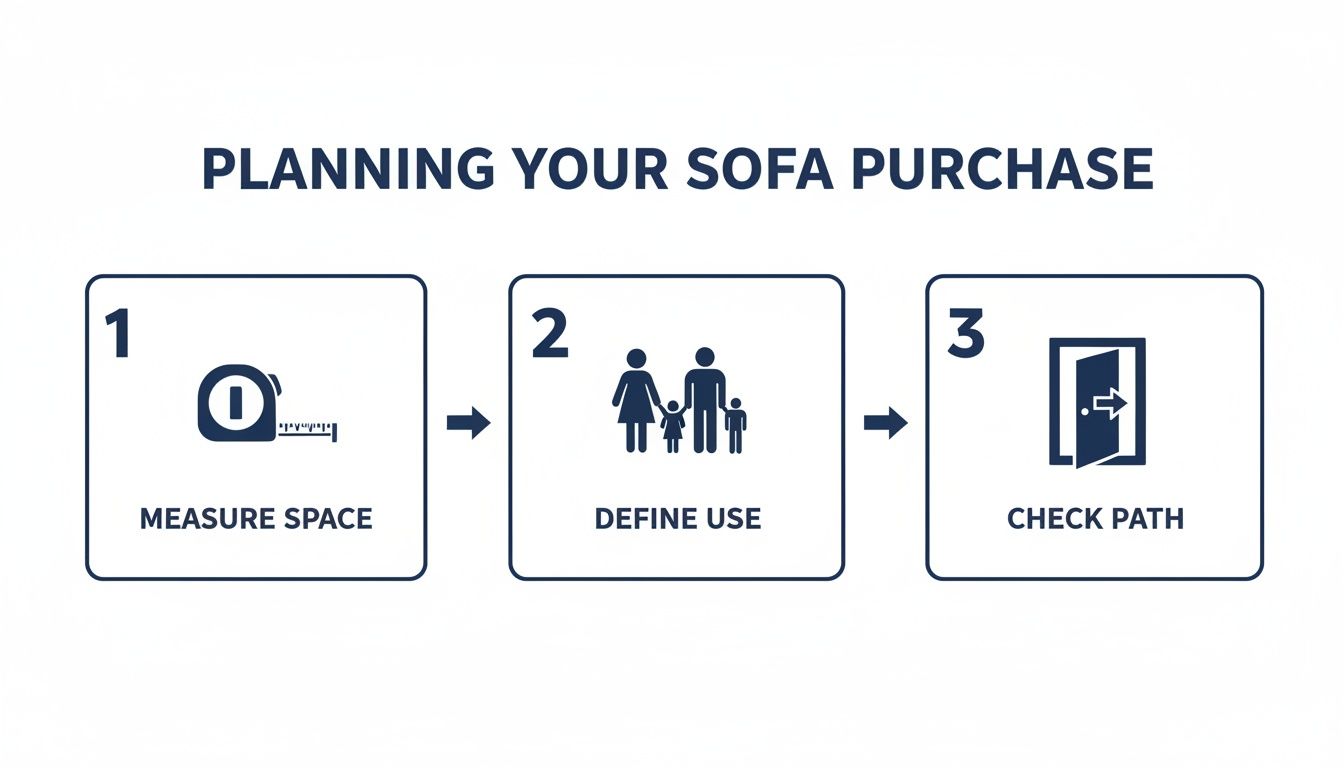
    The graphic below breaks down a simple way to think about your sofa purchase, from measuring the room to thinking about its purpose.

    A three-step guide for planning a sofa purchase: measure space, define use, and check path.

    This just drives home the point: understanding your space and your needs before you start shopping is the key to choosing with confidence.

    Visualizing the Sofa in Your Room

    Even with all the right numbers, it can be tough to truly picture how a large piece of furniture will feel once it's actually in your room. One of the most helpful tricks is to use painter's tape to outline the sofa's dimensions right on your floor.

    This simple move gives you a real-world sense of scale. You can see exactly how much real estate the sofa will take up and make sure you still have room to walk around. Try walking around the taped-off area. Does it feel natural, or are you bumping into things? Does it block a doorway? Is there enough room for a coffee table? A great next step is to consult a detailed guide to sofa dimensions to make sure your choice fits comfortably.

    By mapping it out first, you take all the guesswork out of the equation. You can test different spots and layouts without having to move a single heavy object, making sure the final choice is one you'll love.

    Peek Under the Hood: What Makes a Sofa Last

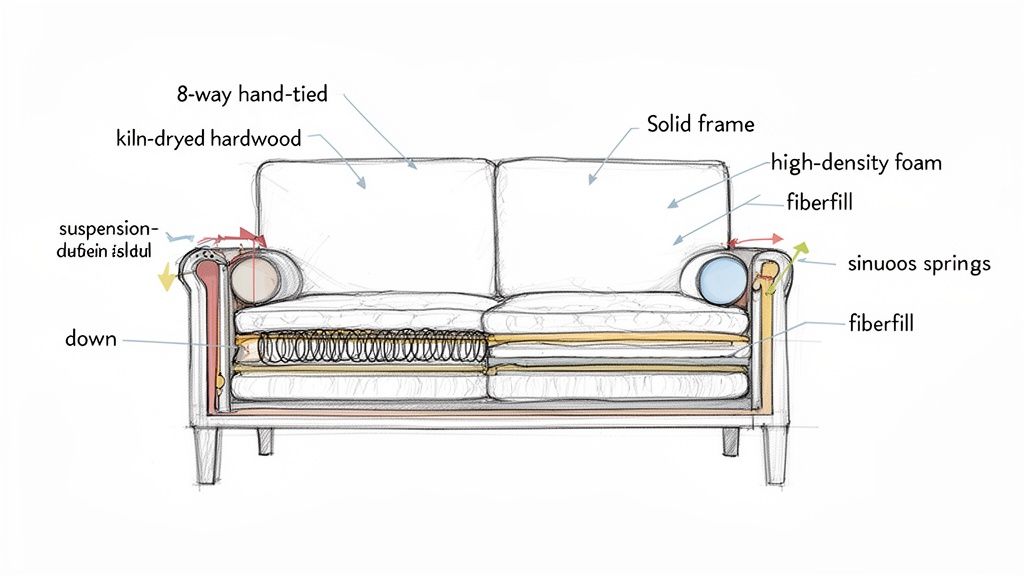
    The fabric and style of a sofa are what you fall in love with, but what’s hidden inside is what makes it last. It all comes down to the frame, the suspension system, and the cushion construction. These are the core components that dictate how well a sofa will stand up to movie nights, energetic kids, and years of daily life.

    Knowing a little about these elements helps you look past the pretty upholstery and ask the right questions. It’s how you choose a sofa that’s built to be the lasting centerpiece of your home, not just a temporary placeholder.

    Detailed diagram illustrating the internal components and construction of a sofa, showing frame, springs, foam, and filling materials.

    Think of it this way: a beautiful sofa with a weak frame or sagging cushions won't be comfortable or satisfying for very long. Let's break down what truly matters.

    The Foundation: A Sturdy Frame

    The frame is the skeleton of your sofa. It provides all the structural integrity. You’ll want a frame made from materials that resist warping, twisting, and breaking over time. A frame built from kiln-dried hardwood is known for its durability.

    Kiln-drying is a process that removes moisture from the wood, which is critical for preventing it from bending or cracking as the humidity levels in your home change. Strong, dense hardwoods like oak, maple, or ash are considered some of the best materials for the job.

    On the other hand, frames made from softer woods like pine are more common in budget-friendly options but can be more susceptible to damage. It's also smart to be wary of frames made mostly of particleboard, MDF, or plastic, as they simply lack the long-term resilience of solid wood.

    The way the frame is joined together is just as important as the wood itself. Quality construction uses techniques like:

    • Dowels and corner blocks: These reinforce the joints, keeping the frame square and stable through years of use.
    • Screws and glue: This combination creates a much stronger bond than staples alone, which can easily loosen over time.

    When you're shopping, don't be shy about asking how the frame is built. A knowledgeable salesperson should be able to tell you about a well-built piece, and it’s a key sign of the furniture's overall quality.

    The frame truly is the backbone of your sofa. To help you understand the differences in durability and value, here's a quick comparison of common materials.

    A Quick Look at Sofa Frame Materials

    Frame Material Durability Typical Cost Best For
    Kiln-Dried Hardwood Excellent $$$ Long-term investment, high-traffic areas.
    Solid Hardwood Very Good $$ Everyday use, offers great value and longevity.
    Softwood (e.g., Pine) Fair $ Light use, budget-conscious buyers.
    MDF/Particleboard Poor $ Temporary or very low-use furniture.

    Ultimately, a solid, well-constructed frame is the first thing you should confirm before falling in love with a sofa's style. It's the difference between a piece that lasts for three years and one that lasts for decades.

    The Support System: Springs and Suspension

    Underneath the cushions lies the suspension system. Its job is to provide support and keep you from sinking straight to the frame. The type of suspension has a massive impact on both comfort and durability.

    One of the most traditional and durable systems is 8-way hand-tied springs. In this method, individual springs are tied together by hand from front to back, side to side, and diagonally. This creates an interconnected web that distributes weight evenly, offering long-lasting support. It is considered a gold standard in the industry.

    A more common and still very reliable option is sinuous spring suspension, sometimes called "S-springs." These are S-shaped steel wires that run from the front of the frame to the back. When installed correctly with high-quality steel, sinuous springs provide a comfortable and durable foundation. You'll find them in many well-made sofas today.

    Be more cautious with webbing suspension, which uses fabric or elastic straps stretched across the frame. It's generally a lower-cost alternative that can be prone to stretching and sagging over the years.

    The Comfort Layer: Cushion Construction

    Finally, the cushions are what you actually feel—they determine the immediate comfort of your sofa. Cushion filling is a balancing act between comfort, maintenance, and longevity, with each type offering different benefits.

    High-density foam is a very popular choice for seat cushions because it provides firm support and holds its shape well. The density rating tells you about its durability; a higher number means the foam is heavier and will last longer before compressing. Often, this foam core is wrapped in softer materials like polyester fiber (Dacron) or a down-and-feather blend to create a plusher top layer.

    • Down-blend cushions: These offer that luxurious, sink-in feeling but require regular fluffing to maintain their shape. They create a relaxed, lived-in look that's incredibly inviting.
    • High-density foam cushions: These provide a firmer, more supportive seat and a crisper, more tailored appearance. They bounce back quickly and require less maintenance than down.
    • Fiberfill cushions: Usually made from polyester, these are a cost-effective option that can feel soft, but they tend to compress more quickly over time and may need replacing sooner.

    The best way to know what you prefer is to sit on a few different types. The "right" cushion is a personal choice, but understanding what's inside helps you predict how it will feel—and wear—in the long run.

    Choosing Upholstery for Real Life

    The upholstery you choose is the single most visible part of your sofa. It's the fabric or leather that sets the style, determines how it feels, and—most importantly—dictates how it will stand up to your actual, day-to-day life.

    Get this choice right, and you'll have a sofa that can handle spilled juice, muddy paws, and years of Sunday afternoon naps. Get it wrong, and you might face a world of frustration. This decision is about so much more than color; it's about picking a material that fits the reality of your household.

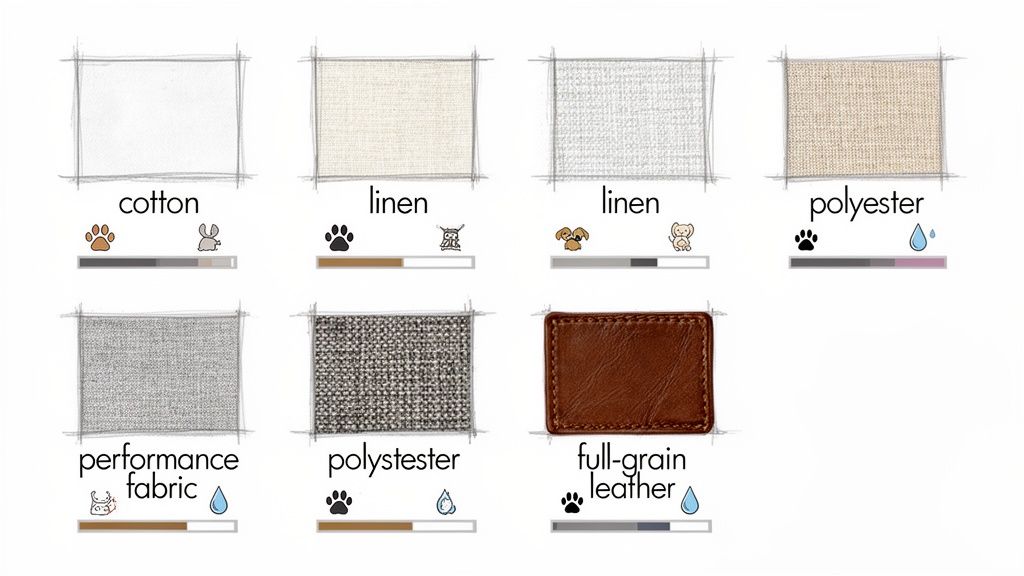
    Guide to sofa fabrics: cotton, linen, polyester, performance fabric, leather, showing pet and water resistance.

    Fabric Sofas: From Natural to Synthetic

    Fabric upholstery opens up a massive world of colors, textures, and patterns, making it a super versatile choice for any home. The fibers used are either natural, synthetic, or a blend of both, and each brings something different to the table.

    Natural fibers like cotton and linen feel fantastic. They're breathable and have a soft, comfortable hand. Cotton is a solid, durable choice but can be a magnet for stains and wrinkles unless it’s blended with something else. Linen gives off that beautiful, relaxed vibe but isn't the toughest, making it better for a formal living room than a family den.

    On the other hand, synthetic fibers are engineered for pure durability. Materials like polyester and microfiber are incredibly popular because they resist fading, stains, and general wear and tear. Microfiber, with its super-tightly woven threads, is especially great at repelling liquids, making it a go-to option for families with kids.

    Performance Fabrics for Busy Households

    If your home is a hub of activity with kids, pets, or just a lot of people coming and going, performance fabrics are a game-changer. These aren't just regular fabrics; they're textiles treated on a molecular level to repel stains, moisture, and even odors.

    Spills often just bead up on the surface instead of soaking in, which gives you a precious few moments to blot them away before they become a permanent part of the sofa's story.

    Brands like Crypton and Sunbrella have become known for producing fabrics that are unbelievably durable but don't sacrifice a soft feel or stylish look. They offer some serious peace of mind.

    Before you commit, it's always a smart move to check the fabric's cleaning requirements. Taking a minute for understanding upholstery cleaning codes will tell you exactly how to care for the material, which is critical for keeping it looking great for years.

    The Timeless Appeal of Leather

    Leather is a classic for a reason. It's known for its incredible durability and the way it develops a rich, unique character over time. A good leather sofa can last for decades with the right care, but not all leather is created equal. Understanding the different grades is key.

    • Full-Grain Leather: This is the top tier, coming from the outermost layer of the hide and keeping all the natural markings. It’s tough and breathes beautifully.
    • Top-Grain Leather: The next grade down, top-grain leather has its surface sanded just enough to remove imperfections for a more uniform look. It's still very durable, just a little less breathable than full-grain.
    • Split-Grain Leather: This comes from the lower layers of the hide. You’ll often find it on the sides and back of sofas as a cost-saving measure. It’s not as durable as the top layers.
    • Bonded Leather: This is a lower-cost option, made from leather scraps shredded and bonded together with adhesive. It gives you the look of leather but doesn't have the durability or longevity of a genuine hide.

    For families, a protected or semi-aniline leather is a fantastic option. It has a protective topcoat that makes it more resistant to spills and scratches, giving you the classic durability of leather with much easier maintenance.

    The Final Checks Before You Commit

    Okay, you're in the home stretch. You’ve pinpointed the style, picked the right upholstery, and you're confident in the frame's construction. But before you make a final decision, a few last-minute checks can be the difference between a pretty good purchase and one you'll love for years.

    This is where you make sure everything adds up—from how it feels to sit on, to the total cost, to how it will actually get into your house. Taking a moment now saves you from any nasty surprises later.

    Take It for a Test Drive: The In-Person Comfort Test

    Reading reviews online is a great starting point, but there’s simply no substitute for parking yourself on a sofa in person. Comfort is incredibly subjective, and a quick "sit test" in the showroom reveals more than any spec sheet ever could.

    When you get to the store, don't just politely perch on the edge. Sit on it like you would at home.

    • Lounge for real. Lean back, kick your feet up if you can, and see how the sofa actually supports you when you're relaxing. Does the back hit you in a weird spot? Is it too low?
    • Check the seat depth. When your back is against the cushions, can your feet rest flat on the floor? If they're dangling, the seat is probably too deep for you. If your knees are pointing up toward the ceiling, it's likely too shallow.
    • Feel out the armrests. Are they a comfortable height for resting an arm or even your head during a nap? An armrest that's too high, too low, or rock-hard can become a major source of irritation over time.

    Helpful advice: If you can, bring the other key decision-makers (or sitters!) with you. A sofa that feels like a dream to someone who's 5'4" might feel all wrong to a person who is over six feet tall. Getting everyone's input ensures the sofa works for the whole household.

    Budgeting Beyond the Sticker Price

    That price tag you see is just the beginning. To get a true sense of your total investment, you have to account for the extra costs that often pop up at the end. Getting a clear, all-in price before you commit is critical.

    Be on the lookout for these common add-ons:

    • Delivery Fees: Always ask what delivery costs and what it includes. Some services are "white glove," meaning they bring it inside, set it up, and haul away the packaging. Others are just a curbside drop-off, leaving the rest to you.
    • Fabric Protection Plans: Retailers will often offer an optional plan to cover accidental stains and damage. Think hard about your lifestyle here—if you have kids or pets, the extra peace of mind might be worth the cost.
    • Old Furniture Removal: Need your old sofa hauled away? See if the store offers this service and what the fee is. It can save you a huge headache.

    Getting clarity on these details up front means no sticker shock when the final bill comes.

    Understanding the Fine Print: Delivery and Policies

    Last but not least, get the full scoop on the logistics and policies that kick in after you've paid. Knowing what to expect makes the entire process way less stressful.

    Chat with your salesperson about how the delivery actually works. Will they call you to schedule a specific time? Do you need to clear a path or measure doorways again for the delivery team?

    Just as important are the store's official policies. Take a minute to look over the warranty information—what exactly does it cover, and for how long? And make absolutely sure you understand the return policy. Knowing the timeframe and any conditions for a return gives you a safety net in case the sofa just doesn't work in your space the way you imagined.

    Even after you’ve done all the homework, there are always a few last-minute questions that pop up right before you’re ready to buy. It’s completely normal. Making a purchase like a sofa is a huge commitment, and you want to get it right.

    To help you cross the finish line with confidence, we’ve put together answers to some of the questions we hear most often from shoppers in our showrooms.

    How Long Should a Good Sofa Last?

    A well-built sofa is an investment that should be a fixture in your home for years to come. If you choose a piece with a solid, kiln-dried hardwood frame and a quality suspension system, you can reasonably expect it to last anywhere from 7 to 15 years. Sometimes even longer with the right care.

    Of course, its lifespan really depends on how you use it. A sofa in a busy family room is going to see a lot more action and wear than one sitting pretty in a formal living room. The upholstery and cushion quality are also massive factors. For instance, high-density foam cushions will keep their shape and support way longer than a basic, low-density fiberfill.

    Are Attached Cushions a Bad Idea?

    Attached cushions have some drawbacks to consider. While they might seem convenient because they stay put, they're often a sign that a manufacturer is reducing costs. Why? Because they don't have to fully upholster every side of the cushion, which saves them time and money.

    But the biggest issue is maintenance. Attached cushions rob you of the ability to flip and rotate them.

    Being able to rotate your cushions is one of the best things you can do to make them wear evenly. It prevents those dreaded "butt divots" from forming in your favorite spot and seriously extends the life and look of your entire sofa.

    Plus, if an attached cushion gets a nasty stain or a tear, cleaning and repairing it becomes a much bigger headache. Detachable cushions just give you more flexibility for keeping your sofa looking great for the long haul.

    Is a Deeper Sofa More Comfortable?

    Not for everyone. Comfort is incredibly personal, and the right seat depth for you comes down to your height and how you prefer to sit.

    A deep-seated sofa can feel incredibly luxurious for lounging, napping, or curling up with a good book. But for sitting upright during a conversation, it can actually be awkward, especially if you're on the shorter side and your feet can't touch the floor. A typical seat depth is somewhere between 21 and 24 inches.

    • If you're an upright sitter: Look for a depth around 21-22 inches. This lets you sit back against the cushions for support while keeping your feet flat on the floor.
    • If you're a lounger: A depth of 23-25 inches gives you that extra room to tuck your feet up or really recline.

    Anything deeper than 26 inches starts to feel more like a daybed, and you'll probably need a small army of throw pillows just to get enough back support to chat with guests. The only real way to know for sure is to try them out.

    How Do I Know If a Sofa Will Fit My Style Later?

    Trends will always come and go, but a classic, well-proportioned sofa will almost never look dated. If you want your sofa to have real staying power, focus on timeless silhouettes—like a simple track arm or a classic roll arm—in a versatile, neutral fabric.

    Think of your sofa as the canvas, not the entire painting. You can easily refresh your living room's entire vibe over the years with new throw pillows, blankets, and a different area rug. These accent pieces are where you can play with trendy colors and patterns without committing to a big-ticket item. A sofa with clean lines and a simple form gives you a foundation that can adapt to your changing tastes for a decade or more.


    At Woodstock Furniture & Mattress Outlet, our team has heard every question in the book, and we're here to help you find a sofa that fits your home, lifestyle, and budget. The best way to find "the one" is to come see the options for yourself. Visit one of our North Georgia showrooms to test-drive a selection of styles and feel the quality in person.

    Explore our collection of sofas and sectionals online to get started.