
You wake with a sore shoulder, a tender hip, and the familiar feeling that your mattress is working against you. A softer bed seems like the obvious answer, but after a few nights your middle may sink too far and leave your spine feeling twisted. For side sleepers, the best memory foam mattress is not the plushest model. It's the one that cushions the shoulders and hips while keeping the waist and spine supported.
The right choice depends on pressure relief, firmness, foam construction, cooling, and movement. Use the comparison below as a practical starting point, then test how each design feels with your own body.
| Memory foam construction | What it may feel like | Best suited to | Main trade-off |
|---|---|---|---|
| Traditional memory foam | Deep, close contouring | Side sleepers who like a hugged-in feel | Can retain more heat |
| Gel-infused foam | Contouring with added temperature-management features | Side sleepers who enjoy foam but sleep warm | Cooling performance varies by construction |
| Open-cell foam | A less dense, potentially more breathable foam feel | Sleepers wanting contouring with less heat buildup | May feel less deeply enveloping |
| Copper-infused foam | Adaptive cushioning with an infusion intended to help manage heat | Side sleepers comparing pressure relief and temperature control | The overall mattress design still matters more than one material |
| Memory foam hybrid | Foam cushioning over a coil support system | Side sleepers who want pressure relief, airflow, and easier movement | Usually feels more responsive and less deeply cradling than all-foam |
Why Side Sleepers Need Different Mattress Support
You go to bed comfortable, turn onto your side, and wake several hours later with your shoulder pressed painfully into the mattress. Your hip may feel bruised too, even though the rest of your body seems relaxed. That pattern isn't random. Side sleeping concentrates pressure around the shoulders and hips instead of distributing your weight across a broader surface.
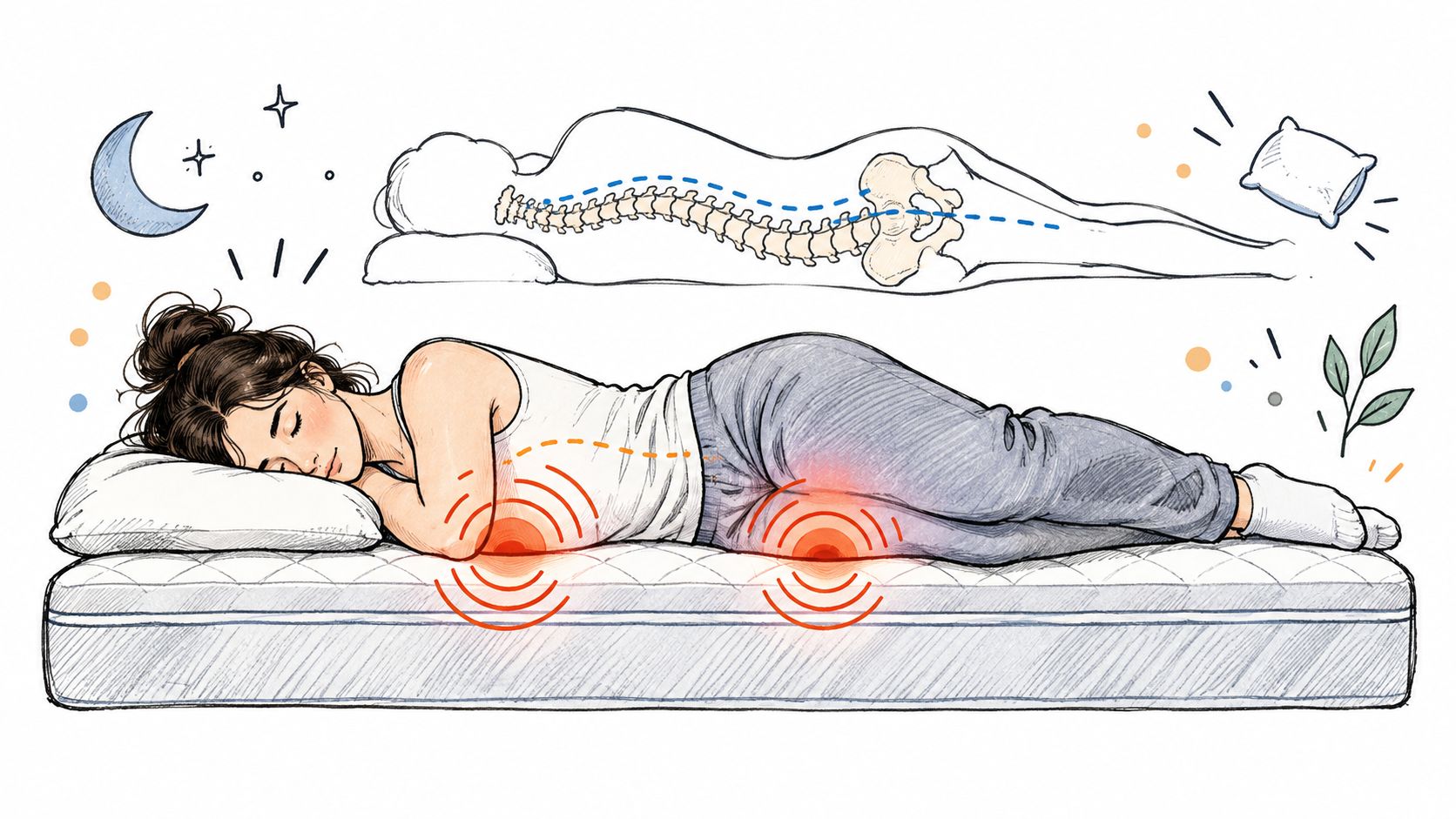
A firm, flat surface can resist the shoulder and hip instead of allowing them to settle into the comfort layers. A very soft surface creates the opposite problem. It may let the pelvis drop too far, causing the spine to bow rather than remain relatively straight.
Sleep Foundation explains that side sleepers and people under 130 pounds can experience sharper pressure points and may need a softer mattress. Its guidance also notes that suitable side-sleeper mattresses commonly use thicker comfort layers, allowing the body to sink enough to support a straighter spinal position. You can also improve the surrounding sleep setup with a properly matched pillow, and this pillow guide from MedAmerica Rehab Center offers useful guidance on choosing pillow support.
Pressure and alignment must work together
A clinical review of mattress determinants found pressure-related pain across body regions after lying down for 10 minutes, with discomfort increasing over time, as summarized by Sleep Foundation's pressure-relief research. That matters because a quick test on the edge of a mattress tells you almost nothing about how your shoulder and hip will feel after sustained side sleeping.
Another peer-reviewed study discussed in the same Sleep Foundation resource found that mattresses distributing pressure more effectively improved sleep quality, including more stage 3 and 4 non-REM sleep and fewer micro-arousals. The practical lesson is straightforward: look for contouring that relieves concentrated pressure, but check that your waist and midsection don't collapse into the bed.
Practical rule: If your shoulder feels pushed upward, the mattress may be too firm. If your pelvis feels noticeably lower than your shoulders, it may be too soft.
How Memory Foam Provides Pressure Relief for Side Sleepers
Memory foam works by responding to body heat and weight. As your shoulder and hip press into the surface, the foam gradually conforms around those areas instead of pushing back like a rigid, flat material. That creates a broader contact area, which can make pressure feel less concentrated.
The most useful way to evaluate a memory foam mattress is to think in layers:
- The comfort layer determines how quickly your shoulder and hip begin to sink into the surface.
- The transition layer limits excessive compression and helps prevent your body from dropping directly into the support core.
- The support core gives the mattress its underlying structure and helps maintain a stable sleeping position.
A side sleeper typically needs enough comfort material to accommodate the width of the shoulder and hip. If the comfort layer is too thin or too firm, those areas may stop against the mattress before the rest of the body is supported. If it's excessively soft, the foam can feel enveloping at first but make movement and alignment more difficult.
What the contour should feel like
Good contouring feels like the mattress is filling the gaps beneath your waist and along your side rather than leaving parts of your body unsupported. You should feel cushioned at the shoulder and hip, but not trapped so far that rolling over becomes a chore.
This is why memory foam is often a strong candidate for side sleepers. Its conforming design is suited to moving pressure away from the two areas most stressed in side sleeping. A study summarized by Sleep Foundation also connects better pressure distribution with improved sleep quality, although individual comfort still depends on body shape, weight, temperature preference, and the mattress's complete construction.
Density isn't the same as firmness
Shoppers often assume a denser foam automatically means a firmer mattress. Those characteristics are related to construction but aren't identical. A mattress can combine a supportive base with a softer, thicker upper layer, producing cushioning at the surface without losing structure underneath.
Pay attention to the whole build rather than choosing based on one label. Soft comfort material over a stable support core can solve the pressure problem more effectively than a mattress that is soft from top to bottom.
Finding the Right Firmness Level for Your Body Weight
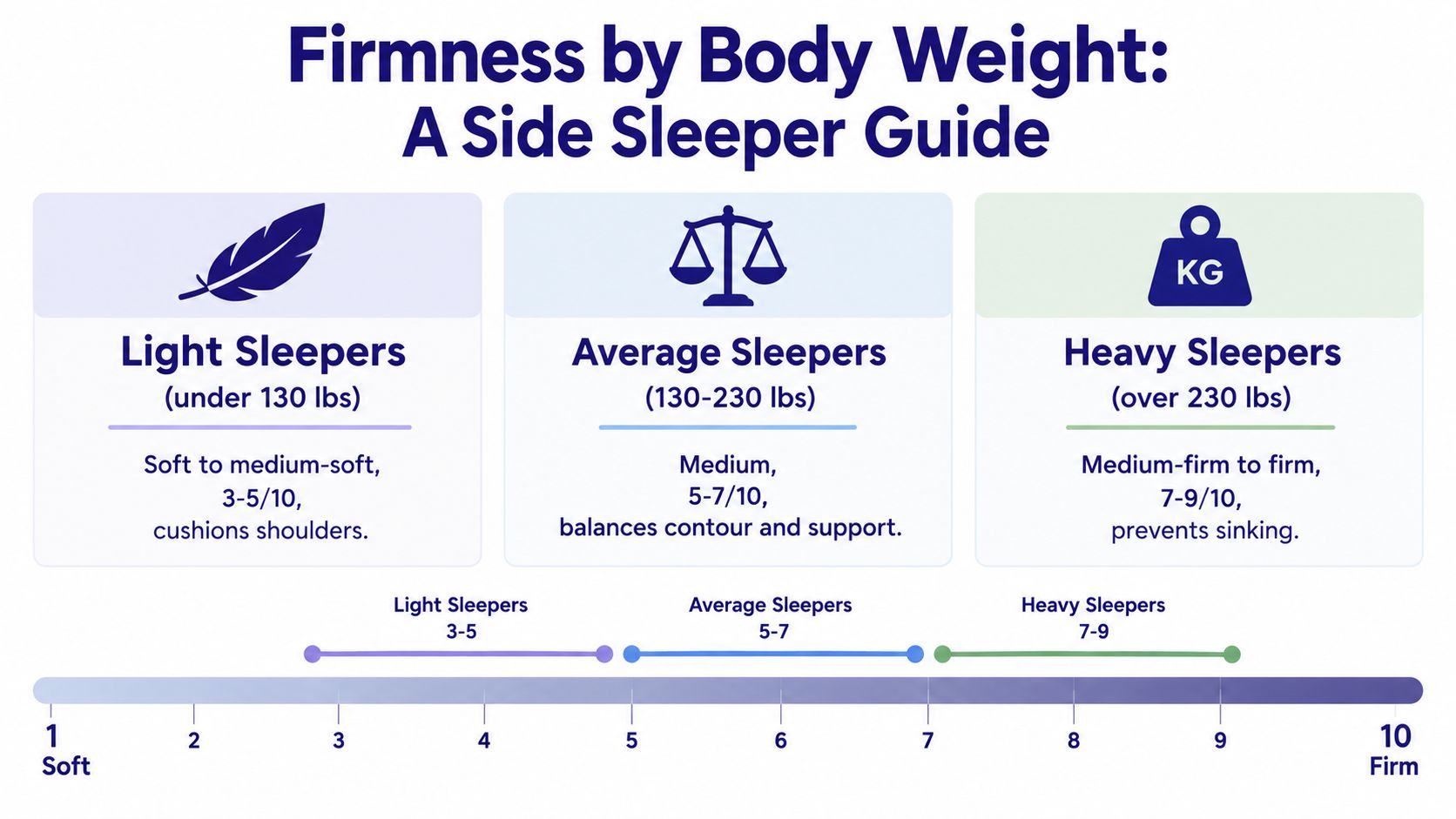
Firmness labels aren't universal, and your weight changes how much you compress the same mattress. A lighter side sleeper may experience a model as firmer because the comfort layers compress less. A heavier sleeper may feel more sink and need stronger underlying support.
Sleep Foundation's guidance places side sleepers into useful starting ranges:
- Under 130 pounds: Medium-soft or soft can provide the extra cushioning needed around the shoulders and hips.
- Between 130 and 230 pounds: Medium is a practical starting point because it balances surface contouring with support.
- Over 230 pounds: Medium-firm can help limit excessive sinkage while still allowing pressure-sensitive areas to settle.
Sleep Foundation's expert testing places the general side-sleeper sweet spot around 5 to 6 on a 10-point firmness scale in its side-sleeper mattress guidance. AARP cites medical experts who place a broader recommended range around 4 to 6.5 out of 10, while warning that excessive firmness can cause soreness and excessive softness can contribute to back pain and stiffness in its side-sleeper mattress advice.
Foam variations change the experience
Traditional memory foam usually provides the slowest response and deepest hug. It can suit a side sleeper who wants the shoulder and hip to sink gradually into a cushioned surface, but it may feel warm and make repositioning slower.
Gel-infused foam adds gel to the foam construction as part of a temperature-management strategy. It can be worth testing if you like close contouring but tend to notice heat around your hips and shoulders.
Open-cell foam uses a more airflow-oriented structure. It may feel less dense and less enveloping than traditional foam, which can help sleepers who want cushioning without as much of an enclosed sensation.
Copper-infused foam is another approach used in some designs to address heat management while retaining adaptive comfort. Don't judge it by the infusion alone. The thickness of the comfort layer, the cover, the base, and the mattress's firmness still determine how it performs for your body.
Use these brackets to narrow the field, not to make the final decision. Your shoulder width, hip shape, preferred sleeping feel, and tendency to change positions can make one medium mattress feel very different from another.
Memory Foam Types and Their Cooling Differences
Traditional memory foam is popular because it reacts slowly and forms a close cradle around the body. That same close fit can reduce airflow directly around the sleeper, especially when a thick comfort layer allows substantial sinkage. If you wake warm but love the pressure relief, changing to a firmer mattress isn't always the best first move. A different foam structure or a hybrid base may preserve support while making the surface feel less enclosed.
Compare the main approaches
| Foam approach | Side-sleeper benefit | Cooling consideration |
|---|---|---|
| Traditional | Deep cushioning for shoulders and hips | Often the warmest-feeling option |
| Gel-infused | Contouring with added heat-management intent | May help, but results depend on the complete build |
| Open-cell | A potentially airier foam structure | Can feel less slow and dense |
| Copper-infused | Pressure-relieving foam with an infusion used in some cooling designs | Infusion doesn't replace breathable construction |
| Hybrid memory foam | Foam pressure relief with a coil-based support core | Coils can provide more airflow and responsiveness |
The National Council on Aging cites independent expert testing in which memory foam models performed especially well for side-sleeping pressure relief. Pressure mapping showed low buildup at the shoulders and hips, and one benchmark design used roughly 3 inches of contouring foam with gel and copper infusions for pressure redistribution and heat management, as described in its side-sleeper mattress resource. Nappedia guidance cited there identifies shoulder peak-pressure levels below 30 mmHg as a useful threshold for maintaining capillary blood flow.
Choose the balance, not the feature label
A hot sleeper who also has shoulder pain may prefer a medium-soft memory foam construction with cooling materials. Someone who dislikes sinking may be better served by medium foam over a more responsive base. If airflow and easy movement matter more than motion isolation, a memory foam hybrid deserves comparison.
Recent expert roundups continue to identify memory foam as a strong pressure-relief option for side sleepers, while also recognizing that hybrids can be more suitable for people who need airflow or bounce, as noted in the National Council on Aging memory foam guide. Cooling features can improve the experience, but they won't fix a mattress that leaves your shoulder compressed or your pelvis unsupported.
Zoned Support and Motion Isolation for Side Sleepers
A side sleeper doesn't need identical support across the entire mattress. The shoulder and hip need room to settle, while the waist often needs enough lift to prevent the spine from curving downward. Zoned support addresses that difference by varying firmness across the sleep surface.
A typical zoned design may use softer material beneath pressure-sensitive areas and firmer material through the center. The exact layout differs by mattress, so don't assume every “zoned” model will feel the same. Lie in your usual position and notice whether your waist feels supported rather than suspended above a gap or pushed upward.
Where zoning helps
Zoning can be particularly useful when a standard uniform mattress creates one of two problems:
- The surface feels too flat: Your shoulder and hip meet resistance before they can settle comfortably.
- The whole mattress feels too soft: Your pressure points feel comfortable, but your midsection sinks with them.
- Your partner needs a different feel: A split adjustable setup or separate comfort choices may provide a better compromise than forcing one uniform surface to suit both sleepers.
Motion isolation adds another practical benefit for couples. Memory foam absorbs movement close to where it occurs, so a partner turning or getting out of bed may create less disturbance across the sleep surface than on a highly responsive mattress.
For couples: Test motion transfer while one person lies on their side and the other changes position. Pressure relief matters, but a mattress that helps you stay asleep after your partner moves may be the more useful choice.
Cooling, zoning, and motion isolation should be judged together. A deep all-foam design may isolate movement very well but feel slow to move on. A hybrid may offer more airflow and edge stability but transmit more movement. Woodstock Furniture & Mattress Outlet carries memory foam, gel memory foam, hybrids, and brands including Tempur-Pedic, Sealy, Helix, Nectar, DreamCloud, Stearns & Foster, Sierra Sleep by Ashley, and Jamison, giving shoppers a chance to compare constructions in person rather than relying on labels alone.
What to Expect From Sleep Trials and Warranties
A mattress can feel comfortable during a short showroom visit and still need a longer evaluation at home. Your body may need time to adapt to a different firmness, and side sleepers often notice pressure or alignment issues only after spending a full night in one position.
Many sleep trials are described as lasting 90 to 120 nights, but the exact terms vary by manufacturer and retailer. Confirm the start date, any required adjustment period, return fees, pickup arrangements, and whether the foundation must meet specific requirements. Don't treat a trial as risk-free until you understand those conditions in writing.
Ask these questions before committing
- When does the trial begin? Some policies start at delivery, while others use another defined date.
- Is a minimum adjustment period required? A retailer may ask you to keep the mattress for a specified period before initiating a return.
- How does the return work? Check who arranges pickup and whether transportation or restocking charges apply.
- What happens to the mattress afterward? Some companies coordinate donations or recycling, while others specify a different process.
Warranty coverage commonly addresses manufacturing defects and sagging beyond a defined depth. It generally doesn't treat normal softening over time as a defect, and exclusions can apply when the mattress sits on an unsuitable foundation, has stains, or shows damage from improper handling.
Test the mattress deliberately
Lie on your side in the position you use at home. Bring the pillow height you normally need if possible, relax your shoulder, and check whether your spine feels reasonably level. Try changing positions, sit near the edge, and ask your partner to move if motion isolation is important.
A knowledgeable salesperson should explain construction, policy terms, and compatibility with an adjustable base without pushing you toward a particular firmness. The purpose of testing isn't to find a universally perfect mattress. It's to identify the model whose compromises fit your body and sleep habits.
Common Mistakes Side Sleepers Make When Choosing a Mattress
The most common mistake is choosing the softest mattress because the shoulder and hip hurt on a firm one. A plush surface can relieve immediate pressure, but if your pelvis sinks deeper than your upper body, you may wake with stiffness or feel unsupported when turning.
Another shopper chooses a firm mattress because it feels stable when sitting or lying briefly on their back. Once they spend the night on their side, the shoulder and hip encounter the same unyielding surface that caused the original problem. Firmness should be judged in your normal position, not from the edge of the bed.
The errors that change the outcome
- Ignoring body weight: A mattress that feels supportive under a lighter sleeper may compress more beneath a heavier sleeper. Use the Sleep Foundation ranges as a starting point, then test how the surface responds to you.
- Testing only for a few minutes: Side-sleeping pressure can build with time. Stay long enough to notice whether your shoulder relaxes and whether your waist remains supported.
- Focusing on foam technology alone: Gel, open-cell, and copper infusions can affect the feel and temperature experience, but they can't compensate for an unsuitable firmness or weak support structure.
- Forgetting movement: Deep contouring can feel comfortable until you need to roll over. If you change positions often, compare a responsive memory foam hybrid with an all-foam model.
- Overlooking the pillow: A mattress can't correct every alignment issue. Pillow height affects the space between your head and the mattress, so evaluate the entire sleep setup.
A useful store visit compares at least one tightly contouring design, one balanced medium model, and one more responsive hybrid or zoned option. Pay attention to the difference between relief and collapse. Relief lets your shoulder and hip settle while your body feels supported. Collapse makes the mattress feel comfortable for a moment, then unstable.
Visit Woodstock Furniture & Mattress Outlet to compare memory foam, gel memory foam, hybrid mattresses, adjustable bases, pillows, and protectors with knowledgeable staff. Bring your usual sleep position and describe where your current mattress fails, so the team can help you test options for shoulder pressure, hip cushioning, spinal alignment, cooling, and movement without relying on a firmness label alone.
Leave a Reply
You must be logged in to post a comment.