
Tag: pressure relief mattress

  • Best Memory Foam Mattress for Side Sleepers: Top 5 Picks

    Best Memory Foam Mattress for Side Sleepers: Top 5 Picks

    You wake with a sore shoulder, a tender hip, and the familiar feeling that your mattress is working against you. A softer bed seems like the obvious answer, but after a few nights your middle may sink too far and leave your spine feeling twisted. For side sleepers, the best memory foam mattress is not the plushest model. It's the one that cushions the shoulders and hips while keeping the waist and spine supported.

    The right choice depends on pressure relief, firmness, foam construction, cooling, and movement. Use the comparison below as a practical starting point, then test how each design feels with your own body.

    Memory foam construction What it may feel like Best suited to Main trade-off
    Traditional memory foam Deep, close contouring Side sleepers who like a hugged-in feel Can retain more heat
    Gel-infused foam Contouring with added temperature-management features Side sleepers who enjoy foam but sleep warm Cooling performance varies by construction
    Open-cell foam A less dense, potentially more breathable foam feel Sleepers wanting contouring with less heat buildup May feel less deeply enveloping
    Copper-infused foam Adaptive cushioning with an infusion intended to help manage heat Side sleepers comparing pressure relief and temperature control The overall mattress design still matters more than one material
    Memory foam hybrid Foam cushioning over a coil support system Side sleepers who want pressure relief, airflow, and easier movement Usually feels more responsive and less deeply cradling than all-foam

    Why Side Sleepers Need Different Mattress Support

    You go to bed comfortable, turn onto your side, and wake several hours later with your shoulder pressed painfully into the mattress. Your hip may feel bruised too, even though the rest of your body seems relaxed. That pattern isn't random. Side sleeping concentrates pressure around the shoulders and hips instead of distributing your weight across a broader surface.
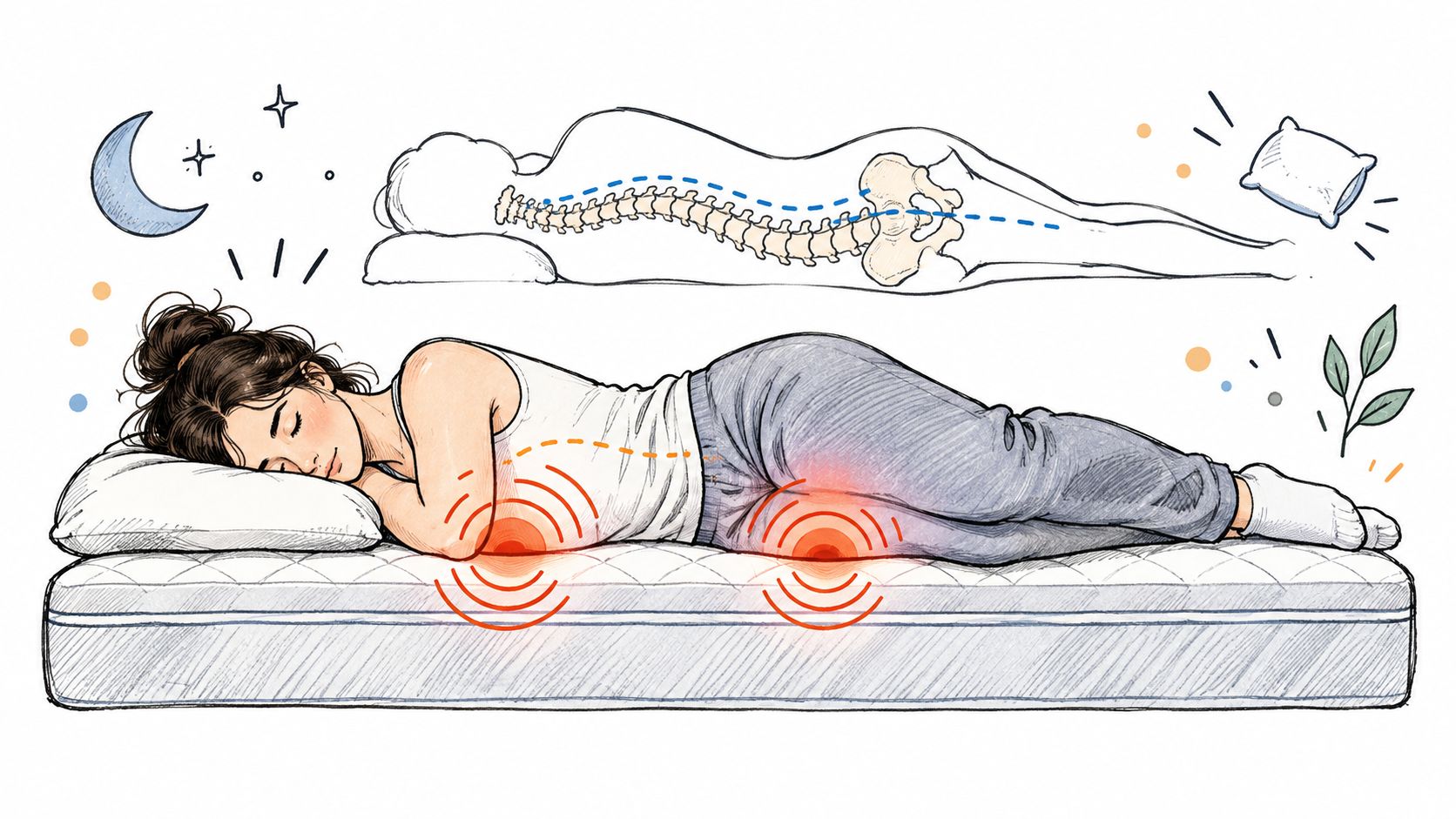
    A woman sleeping on her side experiencing hip and shoulder pain due to an improper mattress alignment.

    A firm, flat surface can resist the shoulder and hip instead of allowing them to settle into the comfort layers. A very soft surface creates the opposite problem. It may let the pelvis drop too far, causing the spine to bow rather than remain relatively straight.

    Sleep Foundation explains that side sleepers and people under 130 pounds can experience sharper pressure points and may need a softer mattress. Its guidance also notes that suitable side-sleeper mattresses commonly use thicker comfort layers, allowing the body to sink enough to support a straighter spinal position. You can also improve the surrounding sleep setup with a properly matched pillow, and this pillow guide from MedAmerica Rehab Center offers useful guidance on choosing pillow support.

    Pressure and alignment must work together

    A clinical review of mattress determinants found pressure-related pain across body regions after lying down for 10 minutes, with discomfort increasing over time, as summarized by Sleep Foundation's pressure-relief research. That matters because a quick test on the edge of a mattress tells you almost nothing about how your shoulder and hip will feel after sustained side sleeping.

    Another peer-reviewed study discussed in the same Sleep Foundation resource found that mattresses distributing pressure more effectively improved sleep quality, including more stage 3 and 4 non-REM sleep and fewer micro-arousals. The practical lesson is straightforward: look for contouring that relieves concentrated pressure, but check that your waist and midsection don't collapse into the bed.

    Practical rule: If your shoulder feels pushed upward, the mattress may be too firm. If your pelvis feels noticeably lower than your shoulders, it may be too soft.

    How Memory Foam Provides Pressure Relief for Side Sleepers

    Memory foam works by responding to body heat and weight. As your shoulder and hip press into the surface, the foam gradually conforms around those areas instead of pushing back like a rigid, flat material. That creates a broader contact area, which can make pressure feel less concentrated.

    The most useful way to evaluate a memory foam mattress is to think in layers:

    1. The comfort layer determines how quickly your shoulder and hip begin to sink into the surface.
    2. The transition layer limits excessive compression and helps prevent your body from dropping directly into the support core.
    3. The support core gives the mattress its underlying structure and helps maintain a stable sleeping position.

    A side sleeper typically needs enough comfort material to accommodate the width of the shoulder and hip. If the comfort layer is too thin or too firm, those areas may stop against the mattress before the rest of the body is supported. If it's excessively soft, the foam can feel enveloping at first but make movement and alignment more difficult.

    What the contour should feel like

    Good contouring feels like the mattress is filling the gaps beneath your waist and along your side rather than leaving parts of your body unsupported. You should feel cushioned at the shoulder and hip, but not trapped so far that rolling over becomes a chore.

    This is why memory foam is often a strong candidate for side sleepers. Its conforming design is suited to moving pressure away from the two areas most stressed in side sleeping. A study summarized by Sleep Foundation also connects better pressure distribution with improved sleep quality, although individual comfort still depends on body shape, weight, temperature preference, and the mattress's complete construction.

    Density isn't the same as firmness

    Shoppers often assume a denser foam automatically means a firmer mattress. Those characteristics are related to construction but aren't identical. A mattress can combine a supportive base with a softer, thicker upper layer, producing cushioning at the surface without losing structure underneath.

    Pay attention to the whole build rather than choosing based on one label. Soft comfort material over a stable support core can solve the pressure problem more effectively than a mattress that is soft from top to bottom.

    Finding the Right Firmness Level for Your Body Weight

    Firmness labels aren't universal, and your weight changes how much you compress the same mattress. A lighter side sleeper may experience a model as firmer because the comfort layers compress less. A heavier sleeper may feel more sink and need stronger underlying support.

    Sleep Foundation's guidance places side sleepers into useful starting ranges:

    • Under 130 pounds: Medium-soft or soft can provide the extra cushioning needed around the shoulders and hips.
    • Between 130 and 230 pounds: Medium is a practical starting point because it balances surface contouring with support.
    • Over 230 pounds: Medium-firm can help limit excessive sinkage while still allowing pressure-sensitive areas to settle.

    Sleep Foundation's expert testing places the general side-sleeper sweet spot around 5 to 6 on a 10-point firmness scale in its side-sleeper mattress guidance. AARP cites medical experts who place a broader recommended range around 4 to 6.5 out of 10, while warning that excessive firmness can cause soreness and excessive softness can contribute to back pain and stiffness in its side-sleeper mattress advice.
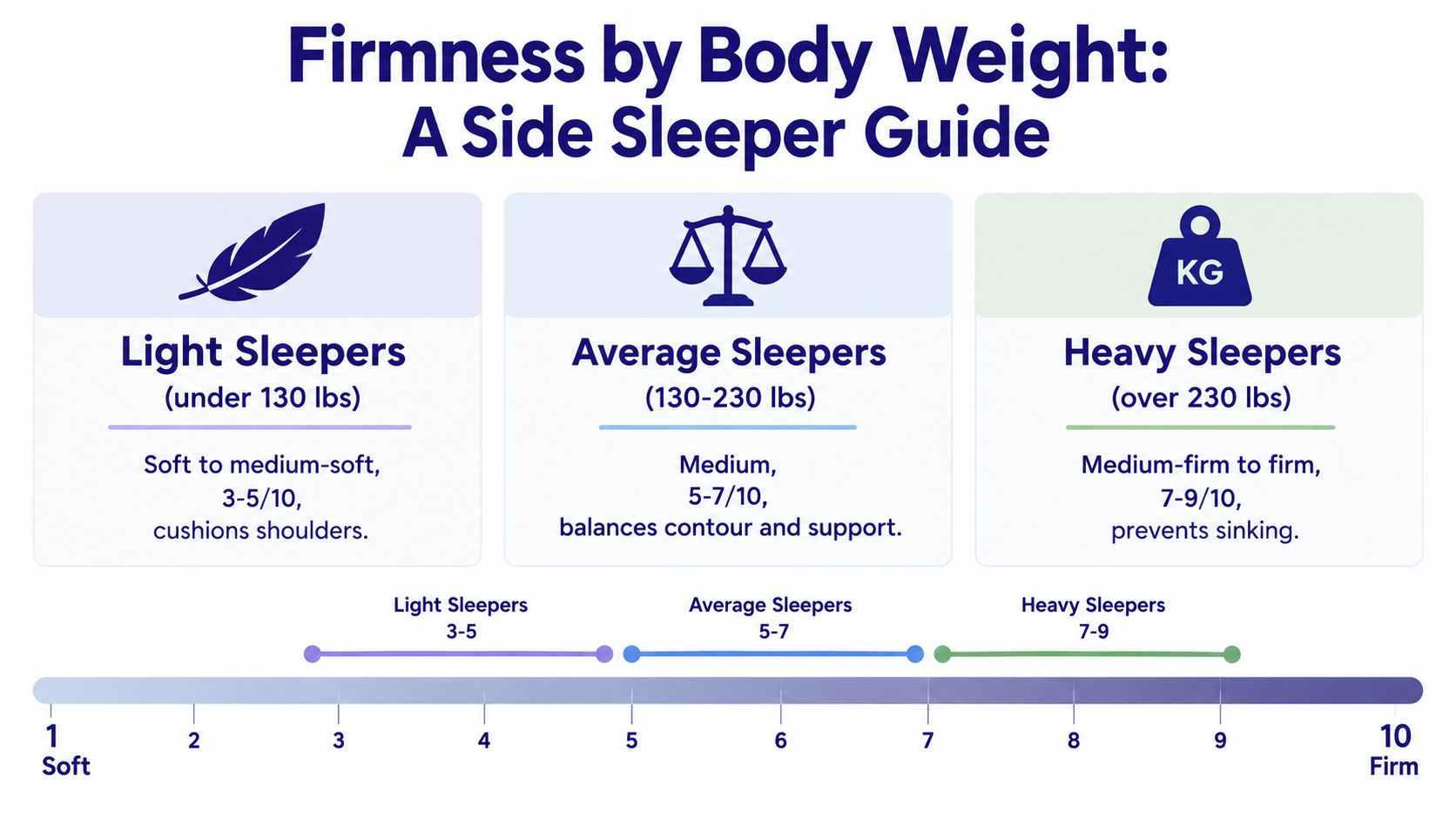
    A chart showing recommended mattress firmness levels for side sleepers categorized by their body weight ranges.

    Foam variations change the experience

    Traditional memory foam usually provides the slowest response and deepest hug. It can suit a side sleeper who wants the shoulder and hip to sink gradually into a cushioned surface, but it may feel warm and make repositioning slower.

    Gel-infused foam adds gel to the foam construction as part of a temperature-management strategy. It can be worth testing if you like close contouring but tend to notice heat around your hips and shoulders.

    Open-cell foam uses a more airflow-oriented structure. It may feel less dense and less enveloping than traditional foam, which can help sleepers who want cushioning without as much of an enclosed sensation.

    Copper-infused foam is another approach used in some designs to address heat management while retaining adaptive comfort. Don't judge it by the infusion alone. The thickness of the comfort layer, the cover, the base, and the mattress's firmness still determine how it performs for your body.

    Use these brackets to narrow the field, not to make the final decision. Your shoulder width, hip shape, preferred sleeping feel, and tendency to change positions can make one medium mattress feel very different from another.

    Memory Foam Types and Their Cooling Differences

    Traditional memory foam is popular because it reacts slowly and forms a close cradle around the body. That same close fit can reduce airflow directly around the sleeper, especially when a thick comfort layer allows substantial sinkage. If you wake warm but love the pressure relief, changing to a firmer mattress isn't always the best first move. A different foam structure or a hybrid base may preserve support while making the surface feel less enclosed.

    Compare the main approaches

    Foam approach Side-sleeper benefit Cooling consideration
    Traditional Deep cushioning for shoulders and hips Often the warmest-feeling option
    Gel-infused Contouring with added heat-management intent May help, but results depend on the complete build
    Open-cell A potentially airier foam structure Can feel less slow and dense
    Copper-infused Pressure-relieving foam with an infusion used in some cooling designs Infusion doesn't replace breathable construction
    Hybrid memory foam Foam pressure relief with a coil-based support core Coils can provide more airflow and responsiveness

    The National Council on Aging cites independent expert testing in which memory foam models performed especially well for side-sleeping pressure relief. Pressure mapping showed low buildup at the shoulders and hips, and one benchmark design used roughly 3 inches of contouring foam with gel and copper infusions for pressure redistribution and heat management, as described in its side-sleeper mattress resource. Nappedia guidance cited there identifies shoulder peak-pressure levels below 30 mmHg as a useful threshold for maintaining capillary blood flow.

    Choose the balance, not the feature label

    A hot sleeper who also has shoulder pain may prefer a medium-soft memory foam construction with cooling materials. Someone who dislikes sinking may be better served by medium foam over a more responsive base. If airflow and easy movement matter more than motion isolation, a memory foam hybrid deserves comparison.

    Recent expert roundups continue to identify memory foam as a strong pressure-relief option for side sleepers, while also recognizing that hybrids can be more suitable for people who need airflow or bounce, as noted in the National Council on Aging memory foam guide. Cooling features can improve the experience, but they won't fix a mattress that leaves your shoulder compressed or your pelvis unsupported.

    Zoned Support and Motion Isolation for Side Sleepers

    A side sleeper doesn't need identical support across the entire mattress. The shoulder and hip need room to settle, while the waist often needs enough lift to prevent the spine from curving downward. Zoned support addresses that difference by varying firmness across the sleep surface.

    A typical zoned design may use softer material beneath pressure-sensitive areas and firmer material through the center. The exact layout differs by mattress, so don't assume every “zoned” model will feel the same. Lie in your usual position and notice whether your waist feels supported rather than suspended above a gap or pushed upward.

    Where zoning helps

    Zoning can be particularly useful when a standard uniform mattress creates one of two problems:

    • The surface feels too flat: Your shoulder and hip meet resistance before they can settle comfortably.
    • The whole mattress feels too soft: Your pressure points feel comfortable, but your midsection sinks with them.
    • Your partner needs a different feel: A split adjustable setup or separate comfort choices may provide a better compromise than forcing one uniform surface to suit both sleepers.

    Motion isolation adds another practical benefit for couples. Memory foam absorbs movement close to where it occurs, so a partner turning or getting out of bed may create less disturbance across the sleep surface than on a highly responsive mattress.

    For couples: Test motion transfer while one person lies on their side and the other changes position. Pressure relief matters, but a mattress that helps you stay asleep after your partner moves may be the more useful choice.

    Cooling, zoning, and motion isolation should be judged together. A deep all-foam design may isolate movement very well but feel slow to move on. A hybrid may offer more airflow and edge stability but transmit more movement. Woodstock Furniture & Mattress Outlet carries memory foam, gel memory foam, hybrids, and brands including Tempur-Pedic, Sealy, Helix, Nectar, DreamCloud, Stearns & Foster, Sierra Sleep by Ashley, and Jamison, giving shoppers a chance to compare constructions in person rather than relying on labels alone.

    What to Expect From Sleep Trials and Warranties

    A mattress can feel comfortable during a short showroom visit and still need a longer evaluation at home. Your body may need time to adapt to a different firmness, and side sleepers often notice pressure or alignment issues only after spending a full night in one position.

    Many sleep trials are described as lasting 90 to 120 nights, but the exact terms vary by manufacturer and retailer. Confirm the start date, any required adjustment period, return fees, pickup arrangements, and whether the foundation must meet specific requirements. Don't treat a trial as risk-free until you understand those conditions in writing.

    Ask these questions before committing

    1. When does the trial begin? Some policies start at delivery, while others use another defined date.
    2. Is a minimum adjustment period required? A retailer may ask you to keep the mattress for a specified period before initiating a return.
    3. How does the return work? Check who arranges pickup and whether transportation or restocking charges apply.
    4. What happens to the mattress afterward? Some companies coordinate donations or recycling, while others specify a different process.

    Warranty coverage commonly addresses manufacturing defects and sagging beyond a defined depth. It generally doesn't treat normal softening over time as a defect, and exclusions can apply when the mattress sits on an unsuitable foundation, has stains, or shows damage from improper handling.

    Test the mattress deliberately

    Lie on your side in the position you use at home. Bring the pillow height you normally need if possible, relax your shoulder, and check whether your spine feels reasonably level. Try changing positions, sit near the edge, and ask your partner to move if motion isolation is important.

    A knowledgeable salesperson should explain construction, policy terms, and compatibility with an adjustable base without pushing you toward a particular firmness. The purpose of testing isn't to find a universally perfect mattress. It's to identify the model whose compromises fit your body and sleep habits.

    Common Mistakes Side Sleepers Make When Choosing a Mattress

    The most common mistake is choosing the softest mattress because the shoulder and hip hurt on a firm one. A plush surface can relieve immediate pressure, but if your pelvis sinks deeper than your upper body, you may wake with stiffness or feel unsupported when turning.

    Another shopper chooses a firm mattress because it feels stable when sitting or lying briefly on their back. Once they spend the night on their side, the shoulder and hip encounter the same unyielding surface that caused the original problem. Firmness should be judged in your normal position, not from the edge of the bed.

    The errors that change the outcome

    • Ignoring body weight: A mattress that feels supportive under a lighter sleeper may compress more beneath a heavier sleeper. Use the Sleep Foundation ranges as a starting point, then test how the surface responds to you.
    • Testing only for a few minutes: Side-sleeping pressure can build with time. Stay long enough to notice whether your shoulder relaxes and whether your waist remains supported.
    • Focusing on foam technology alone: Gel, open-cell, and copper infusions can affect the feel and temperature experience, but they can't compensate for an unsuitable firmness or weak support structure.
    • Forgetting movement: Deep contouring can feel comfortable until you need to roll over. If you change positions often, compare a responsive memory foam hybrid with an all-foam model.
    • Overlooking the pillow: A mattress can't correct every alignment issue. Pillow height affects the space between your head and the mattress, so evaluate the entire sleep setup.

    A useful store visit compares at least one tightly contouring design, one balanced medium model, and one more responsive hybrid or zoned option. Pay attention to the difference between relief and collapse. Relief lets your shoulder and hip settle while your body feels supported. Collapse makes the mattress feel comfortable for a moment, then unstable.


    Visit Woodstock Furniture & Mattress Outlet to compare memory foam, gel memory foam, hybrid mattresses, adjustable bases, pillows, and protectors with knowledgeable staff. Bring your usual sleep position and describe where your current mattress fails, so the team can help you test options for shoulder pressure, hip cushioning, spinal alignment, cooling, and movement without relying on a firmness label alone.
  • Best Mattress for Pressure Relief: A Shopper’s Guide

    Best Mattress for Pressure Relief: A Shopper’s Guide

    You go to bed tired and wake up tired, but that is not the frustrating part. The frustrating part is the soreness. Your shoulder feels pinched. Your hip feels bruised. Your lower back feels tight before your feet even hit the floor.

    A lot of people describe this as “my mattress just isn’t comfortable anymore.” That may be true, but the more useful phrase is poor pressure relief. Once you understand that term, shopping gets much easier.

    This guide is built to help you think like a smart mattress shopper, not just scroll through another list of “top picks.” The best mattress for pressure relief depends on how you sleep, how much you weigh, what kind of feel you like, and whether you need simple everyday comfort or something closer to home-care support.

    That Familiar Ache Waking Up With Sore Hips and Shoulders

    A common story goes like this. You fall asleep fine, roll over a few times, and then wake up feeling like one side of your body took the hit all night.

    For side sleepers, that usually means the hips and shoulders. For back sleepers, it may feel more like tension across the lower back or tailbone. For stomach sleepers, the strain often shows up through the midsection and lower back.

    Why that soreness happens

    Your body is not flat. A mattress is.

    When the mattress surface does not bend and cushion where your body sticks out most, those areas take extra force. That force builds where your body presses hardest into the bed. Those are your pressure points.

    Think about lying on your side on a carpeted floor. The carpet is technically soft, but your shoulder still complains because the floor underneath does not give enough. Some mattresses act the same way. They have surface softness, but not real contour.

    The important part most shoppers miss

    Many people assume they need a firmer mattress because they are sore. Sometimes the opposite is true. If your shoulder and hip feel jammed, the bed may be too firm on top, even if it still feels supportive overall.

    That is one reason stories about solving hip pain with the right mattress resonate with so many shoppers. The pain often is not random. It is usually a clue that the surface is pushing back in the wrong places.

    Tip: If you wake up and the ache fades after you have been moving around for a few minutes, your mattress may be creating overnight pressure rather than daytime posture problems.

    What Exactly Is Pressure Relief in a Mattress

    Pressure relief means a mattress spreads your weight across a wider area so one body part does not take too much force.

    That sounds technical, but the idea is simple. A better pressure-relieving mattress lets heavier parts of your body sink in enough to feel cushioned, while still holding the rest of you in a healthy position.

    Pressure relief is not the same as support

    These two terms get mixed together all the time.

    • Pressure relief is about comfort at the contact points. Shoulders, hips, ribs, tailbone.
    • Support is about alignment. It helps keep your spine from dipping, twisting, or bowing.

    A mattress can be supportive but still feel harsh. It can also feel soft at first and still fail to support your body well enough through the night.

    A simple analogy that helps

    Press your hand into wet sand. It gives way and molds around your palm. The force spreads out.

    Now press your hand onto concrete. Almost all the force goes to the highest points of contact.

    That is the difference between good and poor pressure relief.

    A mattress with strong pressure relief behaves more like the sand. It meets the curves of your body. A mattress with weak pressure relief behaves more like the concrete. It resists your shape and creates hot spots.

    If you want another plain-language perspective, this guide to finding the best pressure relief mattress does a nice job connecting restorative sleep with body contouring and comfort.

    A short visual can help make that feel easier to picture:

    Where pressure points usually show up

    The main pressure points depend on how you sleep:

    • Side sleepers: shoulders and hips
    • Back sleepers: lower back, tailbone, and sometimes shoulder blades
    • Stomach sleepers: hips, chest, and knees

    The body parts that carry more weight or stick out farther need the mattress to give a little more in those spots.

    How pressure mapping fits in

    Pressure mapping is a testing method that uses sensors to show where force builds up on the mattress surface.

    You do not need lab gear to use the idea. In plain terms, pressure mapping answers this question: Where is your body getting jammed into the bed?

    That matters because a mattress should not just feel nice when you first lie down. It should spread load well enough that your body is not fighting the surface all night.

    Key takeaway: The best mattress for pressure relief does two jobs at once. It cushions your pressure points and keeps your spine from drifting out of line.

    How Mattress Materials Influence Pressure Relief

    Materials shape the feel more than marketing names do. “Cooling comfort,” “luxury support,” and “premium sleep system” can mean almost anything. Foam, latex, coils, and air systems tell you much more.

    Memory foam

    Memory foam is the classic pressure-relief material.

    It softens and contours around the body, which is why many people feel it hugging the shoulders and hips. If you like a close, cradled feel, memory foam often makes immediate sense.

    The tradeoff is feel. Some sleepers love that slow-molding sensation. Others feel like it holds them too tightly.

    Latex

    Latex relieves pressure in a different way.

    Instead of a deep hug, it usually gives a more lifted or floating feel. It contours, but with more spring back. People who dislike the “stuck” sensation of some foams often prefer latex.

    That does not make it universally better. It just means the contour is gentler and more responsive.

    Traditional innersprings

    A basic innerspring usually gives the least pressure relief of the main mattress categories.

    Why? Coils support weight well, but without thick comfort layers above them, they do not contour closely enough at the hips and shoulders for many sleepers. That is why older mattresses often leave side sleepers especially sore.

    Hybrids

    Hybrids combine foam or latex comfort layers with a coil support core.

    This is why so many shoppers land here. A hybrid can cushion pressure points without losing the support and easier movement that coils provide. It often feels more balanced than an all-foam mattress.

    A practical example is the DreamCloud-style build: pillow-top comfort, gel memory foam for contour, and coils underneath for support and airflow.

    Adjustable air and specialty relief systems

    Air-adjustable mattresses are a different category. They let you change firmness by adjusting air chambers inside the bed.

    That matters because pressure relief is personal. A mattress that feels perfect on your side may feel too soft on your back. More adjustability can help you fine-tune that.

    A 2021 Cochrane systematic review found that reactive air and gel surfaces could reduce the risk of pressure ulcers by 37% to 53% compared to standard foam mattresses (PMC). That is not the same as saying every consumer mattress works like a medical surface, but it does show how much material choice can affect pressure distribution.

    Mattress Material Pressure Relief Comparison

    Material Pressure Relief Quality Feel Best For
    Memory foam High Deep contour, close hug Side sleepers, people who want strong cushioning
    Latex Moderate to high Buoyant, responsive, more “on” than “in” Sleepers who want contour without much sink
    Innerspring Lower in many basic designs Bouncy, flatter surface feel People who prioritize a traditional feel over contour
    Hybrid High Balanced, cushioned top with supportive base Many body types and mixed sleep positions
    Adjustable air High and customizable Changes based on setting People who want fine-tuning or changing firmness needs

    One easy shopping shortcut

    When you lie on a mattress, ask yourself one simple question.

    Do I feel cushioned at the sharpest parts of my body, or do I feel the bed pushing back at them?

    That answer often tells you more than the brand story.

    Matching Your Mattress to Your Sleep Position and Body Weight

    The best mattress for pressure relief is not one mattress. It is the mattress that matches how your body meets the bed.

    Infographic

    Side sleepers need more cushioning at two key spots

    If you sleep on your side, most of your weight funnels into the shoulder and hip on the mattress side.

    That usually means you need more give in the comfort layers. A mattress that feels “nice and firm” for a back sleeper can feel punishing for a side sleeper after several hours.

    Pressure mapping tests have rated certain hybrid models like the Helix Midnight Luxe at 8.7/10 for pressure relief for side sleepers, with thick foam comfort layers reducing peak pressures at the hips and shoulders by up to 20% to 30% compared to traditional innerspring designs (Sleep Foundation).

    Back sleepers need balance, not just softness

    Back sleepers usually do well when the mattress allows a bit of contour under the lower back while still keeping the midsection from dropping too far.

    Too firm, and the lower back can feel unsupported because the mattress does not meet the curve. Too soft, and the hips may sink lower than the chest.

    This is why many back sleepers like a medium-firm feel with some cushioning on top.

    Stomach sleepers need restraint through the middle

    For stomach sleepers, the issue is less about shoulder pressure and more about hip sink.

    If the middle of the body drops too much, the lower back bends into an uncomfortable arch. That is why stomach sleepers often prefer a firmer, flatter feel on top.

    That does not mean rock hard. It means enough resistance to keep the hips from dipping too far.

    Body weight changes how firmness feels

    A mattress does not feel the same to every person.

    A lighter sleeper may lie on a medium mattress and barely sink into the comfort layers. A heavier sleeper may experience that same mattress as much softer because they engage more of the bed.

    If you have a lighter body weight

    Softer comfort layers often work better because you need enough sink to activate the pressure-relieving part of the mattress.

    If the bed is too firm, you may float on top of it and feel sharp pressure at the shoulders or hips.

    If you are in the middle range

    Many medium to medium-firm hybrids and foams feel balanced here. This is the range where the widest mix of mattress types can work well.

    If you have a heavier body weight

    You usually need stronger support underneath the comfort layers so you do not bottom out. That can mean firmer foam, sturdier coils, or a mattress built specifically for higher loads.

    The goal is still pressure relief. The path to get there is just different.

    Shopping shortcut: Do not ask, “Is this mattress soft or firm?” Ask, “Does this feel right for your sleep position and your body weight?”

    A Practical Checklist for Your Mattress Hunt

    Walking into a mattress store without a clear filter is like grocery shopping when you are hungry. Everything starts to sound good.

    A short checklist helps you sort useful comfort from flashy language.

    Start with your body, not the brand

    Write down these answers before you shop.

    • Primary sleep position: Are you mostly on your side, back, stomach, or a mix?
    • Main pain point: Shoulder soreness, hip pressure, lower back tension, or general stiffness?
    • Body weight range: Lighter, average, or heavier build?
    • Temperature preference: Do you sleep hot, cool, or somewhere in the middle?
    • Movement needs: Do you want a hugging feel, or do you prefer easy repositioning?

    Think about who else uses the bed

    If you share a mattress, pressure relief becomes a two-person problem.

    One sleeper may want more contour. The other may want more pushback. In that case, hybrids and adjustable designs often make sense because they tend to balance comfort and support well.

    Use product design as a clue

    Hybrid mattresses like the DreamCloud are often ranked highly because gel memory foam and zoned coils help distribute weight more evenly. Pressure mapping shows they can reduce peak pressures by 15% to 25% compared to standard innersprings (Mattress Clarity).

    That does not mean every hybrid is automatically right for you. It means you should pay attention to what is inside the mattress, not just the label on the side.

    Questions worth asking in store or online

    What are the top layers made of

    This tells you whether the feel will be more hugging, buoyant, or firm on the surface.

    How thick are the comfort layers

    More substantial comfort layers often matter for side sleepers and anyone sensitive at the shoulders or hips.

    Does the mattress come in more than one firmness

    That matters if the design sounds right but the showroom sample feels a little off.

    Can I test it in my real sleep position

    Sitting on the edge tells you almost nothing about pressure relief.

    What happens if it does not work out

    You want clear information about trial periods, exchanges, and warranty support. No guessing.

    One final filter

    If a mattress only feels comfortable in one exact pose and starts feeling strained when you settle naturally, keep looking.

    Pressure relief should feel easy, not fragile.

    How to Properly Test a Mattress for Pressure Relief

    A quick bounce test is not enough. Neither is pressing your hand into the top panel.

    Pressure relief only shows up when your body is in the position where it usually hurts.

    In-store testing that helps

    Wear comfortable clothes if you can. Take off your jacket. Put your phone down. Then lie in your normal sleep position.

    Stay there long enough for your body to settle. A mattress often feels different at minute one than it does after several minutes when your muscles relax.

    Pay attention to these signals

    • Shoulders: Do they feel cushioned, or blocked from sinking enough?
    • Hips: Do they feel gently cradled, or like they are carrying too much weight?
    • Lower back: On your back, does the mattress meet your waist comfortably?
    • Ease of movement: Can you roll without fighting the surface?

    A simple hand test

    If you are on your back, slide a hand under your lower back.

    If there is a huge empty space, the mattress may be too firm on top for your shape. If your hips are plunging and your spine feels curved, it may be too soft.

    This is not a perfect test, but it helps.

    At-home trial habits that matter

    Your first night is not the whole story.

    New mattresses can feel unfamiliar even when they are right. Your body may also need a little time to stop bracing against your old bed’s bad habits.

    Keep notes for at least the early part of your trial:

    • Morning soreness: better, worse, or unchanged
    • Sleep interruptions: tossing, turning, waking to reposition
    • Partner disturbance: if relevant
    • Where pressure shows up: shoulder, hip, back, or neck

    Tip: Judge patterns, not single nights. One rough night can come from stress, temperature, or a late dinner. Repeated soreness in the same area is more useful feedback.

    What a good test feels like

    The right mattress does not need you to “get used to pain.” It may feel different from your old bed, but your body should not feel trapped, jammed, or sharply compressed at its heaviest contact points.

    Beyond the Mattress Accessories That Improve Pressure Relief

    Sometimes the mattress is the main fix. Sometimes the bigger improvement comes from the whole sleep setup.

    Mattress toppers can soften a too-firm surface

    If your mattress still has good support but feels harsh at the shoulders or hips, a topper can add another cushioning layer.

    This is usually most helpful when the existing mattress is structurally sound but too firm on top. It is much less helpful when the mattress is sagging or uneven underneath.

    Pillows affect pressure more than people expect

    A pillow changes how your neck, shoulders, and upper spine line up.

    For side sleepers, a pillow that is too low can drop the head and add shoulder strain. For back sleepers, a pillow that is too tall can push the head too far forward. Good pressure relief is not just below you. It also depends on what is holding your head up.

    Adjustable bases change how weight is distributed

    Raising the head and feet slightly can reduce the load on certain areas, especially the lower back and hips.

    This matters for everyday comfort, but it can matter even more for people with limited mobility or those who spend extended time in bed.

    Adjustable air mattresses like the Saatva Solaire offer up to 50 unique firmness settings per side, allowing users to reduce interface pressures with a level of precision that standard foam cannot match (Sleep Advisor).

    One practical example

    A shopper might pair a conforming mattress with an adjustable base to fine-tune comfort over time. Stores such as Woodstock Furniture & Mattress Outlet carry mattresses, adjustable bases, and sleep accessories in one place, which can be useful if you want to test how the full setup feels together instead of judging the mattress alone.

    Your North Georgia Partner in Finding Lasting Comfort

    Pressure relief is one of those things that sounds abstract until you lie on two different mattresses back to back. Then it becomes obvious.

    One bed pushes against your shoulder. Another lets it settle in naturally. One makes your hip feel loaded. Another spreads that weight out so your body can relax.

    That is why visiting a showroom can still be valuable, especially if you are deciding between very different feels like Tempur-Pedic, Sealy, Helix, Nectar, and DreamCloud. Reading about contour is helpful. Feeling it is better.

    What an in-person test gives you

    • Real comparison: You can feel the difference between foam, hybrid, and more responsive designs within minutes.
    • Body-based feedback: Your own shoulders, hips, and back tell you more than a spec sheet can.
    • Better questions: Once you feel a few mattress types, it becomes easier to describe what you want.

    For North Georgia shoppers, the goal is not to get pitched. It is to leave with a clearer sense of what your body needs for lasting comfort.

    Frequently Asked Questions About Pressure Relief

    What is the difference between pressure relief and support

    Pressure relief is the mattress’s ability to cushion heavier contact points like hips and shoulders.

    Support is what keeps your spine in a healthier position. You usually need both. A mattress that only feels soft can still let your body sag. A mattress that only feels supportive can still feel harsh.

    Can a firm mattress still have good pressure relief

    Yes, sometimes.

    A mattress can feel firm overall and still have a comfort layer that cushions pressure points well. This is common in firmer hybrids with a padded top. The mistake is assuming that “firm” always means “hard on the body.”

    What if I am shopping for a bed-bound loved one

    That requires more caution than a typical comfort purchase.

    While most mattress guides focus on general aches, a critical part of pressure relief is bedsore prevention for people with limited mobility. Consumer content often overlooks medical-grade foam options or how pairing a conforming mattress from brands like Sealy or Tempur-Pedic with an adjustable base can reduce bedsore risk by 50% to 70%, which matters for the 2.5 million Americans affected annually (Sleepopolis).

    If this is your situation, it is wise to focus on prolonged pressure management, ease of repositioning, and whether a more medically oriented surface is appropriate.

    How long does it take to know if a mattress is helping

    Usually not in one night.

    Your body may need a little time to adjust, especially if your old mattress caused ongoing strain. Look for trends over a stretch of nights. If your hip or shoulder pain keeps showing up in the same way after an initial adjustment period, that is useful information.

    Is pressure relief only important for side sleepers

    No.

    Side sleepers usually notice it first because they carry more force through narrower contact points. But back sleepers and stomach sleepers also need pressure relief, just in different places and in different amounts.


    If you want help narrowing down the best mattress for pressure relief for your sleep position, body type, and comfort preferences, visit Woodstock Furniture & Mattress Outlet and spend time testing different feels in person. A knowledgeable team can help you compare foam, hybrid, and adjustable options without turning the process into guesswork.