Your mattress feels firmer than you'd like, your shoulder gets uncomfortable, or you keep waking up warm. Before replacing the whole bed, you're considering a topper, but the choice between latex and memory foam isn't obvious from a product photo.
The useful question in a latex vs memory foam mattress topper comparison isn't which material wins. It's which material's behavior matches the way you sleep, and whether changing the surface will address what's bothering you.
Why Latex and Memory Foam Toppers Feel Different
A mattress topper is a removable comfort layer placed above your mattress. It changes the cushioning you feel near the surface without replacing the support core underneath. That distinction matters: a bed that needs softer cushioning presents a different problem from one with a worn-out foundation or sagging core.
Latex is cellular rubber made from liquid latex. It compresses under your weight and springs back quickly when you move. Memory foam is viscoelastic polyurethane, a material that responds to body heat and pressure and returns to shape more slowly, producing a closer, more enveloping contour.
The basic tradeoff: Latex responds to your movement with buoyancy. Memory foam settles around you with a slower hug.
Those descriptions identify material tendencies, not fixed firmness levels. A soft latex topper can feel quite different from a firm latex model, just as memory foam products can differ substantially in sinkage and response. Thickness, density, firmness, and cover fabric all influence the result.
For a broader explanation of these materials in complete beds, Suburban Furniture's mattress comparison provides useful context. With toppers, the existing mattress remains part of the equation, so the same topper won't feel identical on every bed.
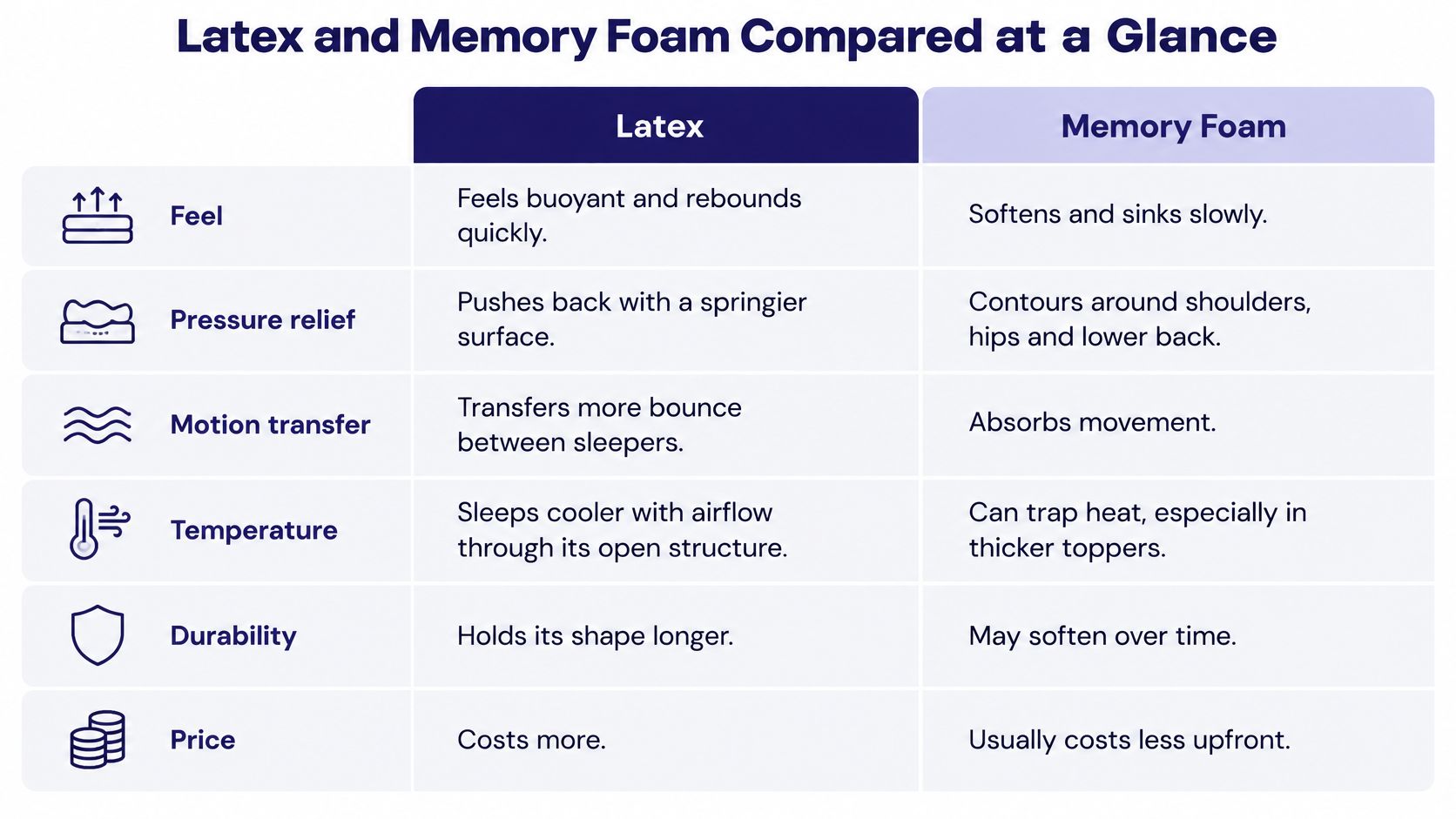
Latex and Memory Foam Compared at a Glance
| Criterion | Latex topper | Memory foam topper |
|---|---|---|
| Feel | Buoyant, responsive, sleeper sits closer to the surface | Slow, deep contour, sleeper feels cradled |
| Pressure response | Buoyant, spreads pressure over a wider area | Deeper conforming at shoulders and hips, slower recovery |
| Motion transfer | Transmits more movement, easier to change position | Tends to absorb movement, less felt by a partner |
| Heat retention | Generally more breathable in independent testing | Often holds more body heat |
| Durability | Considered resilient; natural latex studied as potentially more durable than polyurethane foams | Lifespan tracks density and construction |
| Odor after unboxing | Natural latex has a rubber scent | New foam may have a noticeable initial smell |
Read these differences as tendencies rather than rankings. More bounce is helpful when you turn frequently, but it may be less appealing when your priority is reducing the movement you feel from a partner. Likewise, deeper cushioning can feel soothing to someone who likes a close contour and restrictive to someone who wants to move freely.
The visual comparison offers another way to recognize the contrasting surface responses.
Use the comparison to identify your priority
Start with what interrupts your sleep rather than trying to choose the material with the most appealing descriptions. If your shoulder presses uncomfortably into a firm bed, cushioning deserves attention. If turning feels difficult, a very deep contour may not be the change you need.
The broader mattress advice from Groen's Fine Furniture can help you distinguish material preferences from complete-mattress construction. A topper is only part of that construction, so a material comparison shouldn't replace checking the bed beneath it.
Keep product specifications alongside these general descriptions. Thickness, firmness, density, and cover fabric can shift every row, which makes comparing actual products more useful than choosing by material name alone.
How Feel, Pressure Relief and Motion Transfer Differ
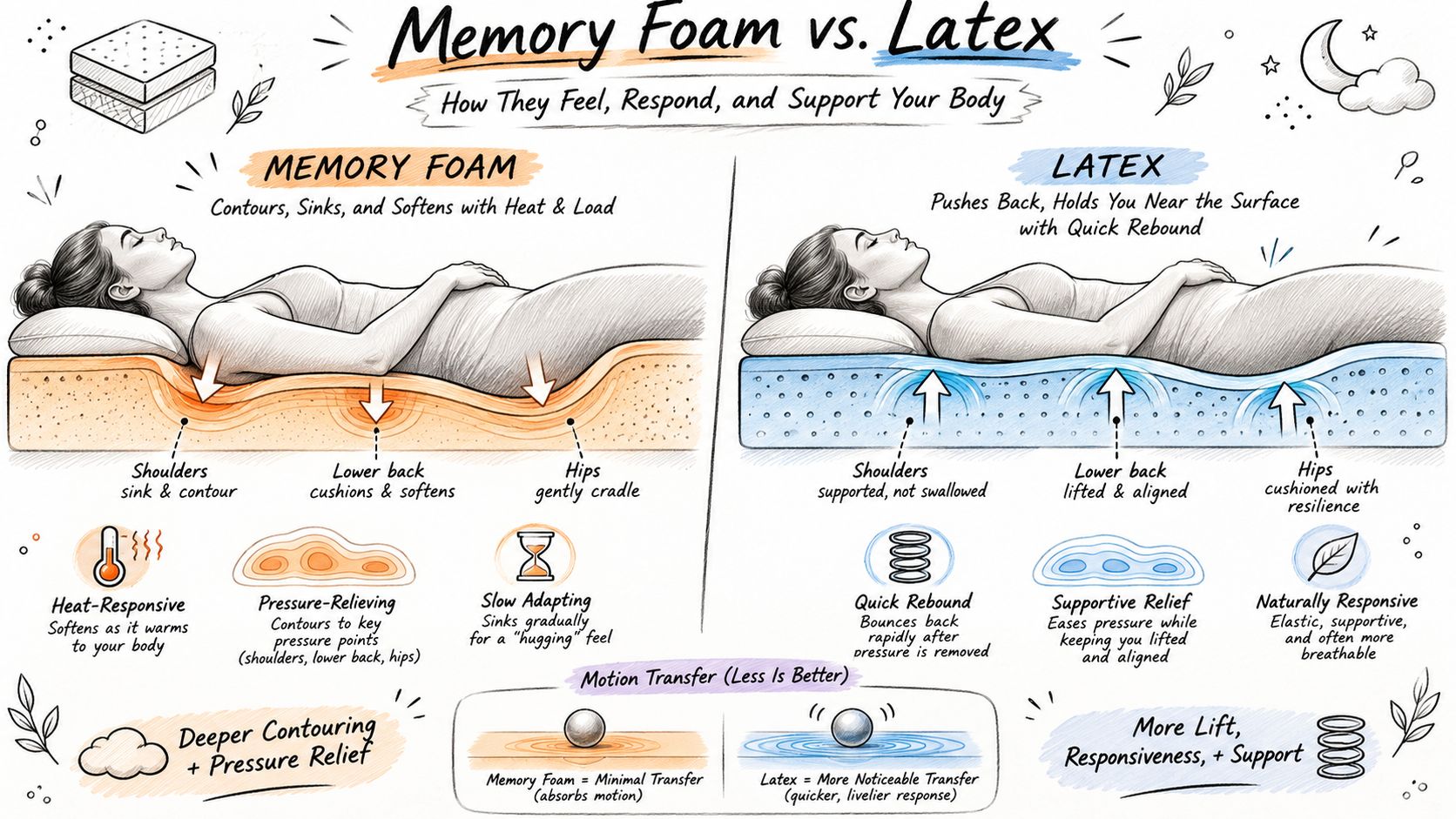
Memory foam yields gradually beneath loaded areas, including the shoulders, hips, and lower back. Latex also cushions those areas, but its quicker pushback produces a more lifted sensation. Neither response tells you, by itself, whether the surface will feel comfortable.
This illustration highlights the difference between close contouring and a more buoyant surface.
What pressure measurements actually tell you
In a peer-reviewed pressure-mapping comparison, latex reduced peak contact pressure on the torso and buttocks by as much as 35.1% compared with polyurethane foam, while up to 96.1% of measured body-surface area remained in the low-pressure range on latex versus 91.8% on polyurethane foam; measurements lasted six minutes in front, side, and back positions.
In plain language, the test found lower pressure at the most heavily loaded locations and more measured surface area experiencing relatively low pressure on latex. That's useful evidence of pressure distribution, but it isn't a promise that a particular latex topper will eliminate discomfort.
The comparison was against polyurethane foam, and it shouldn't be stretched into proof that every latex topper outperforms every memory-foam topper. Short pressure measurements also don't establish long-term sleep quality or clinical outcomes. Firmness, thickness, sleeping position, and the underlying mattress can change what happens beneath your body.
Comfort isn't a pressure-map score. A surface can distribute pressure effectively and still feel too springy, too enveloping, or too firm for your preferences.
Think of the distinction as pressure distribution versus preferred sensation. Some people enjoy feeling the material settle closely around them. Others feel more comfortable when cushioning supports them nearer the surface, even if both options reduce the harshness of the mattress below.
Motion absorption and freedom to move
Memory foam's slow recovery tends to absorb movement rather than quickly returning that energy across the surface. That can reduce how much of a partner's turning you notice. Latex's more elastic response usually brings more bounce, but it also lets the surface recover promptly beneath you as you change position.
A useful hands-on check is to lie in your usual sleeping position, then roll naturally without pushing yourself upright first. Notice whether you're moving across the surface or climbing out of an impression. With a partner, also compare how much movement reaches your side when they turn.
For an additional visual comparison of the materials, the following video provides another viewing option.
A held-in-place feeling can be reassuring to a deep-contour sleeper and frustrating to someone else. The pressure figures don't establish a universal comfort winner, and greater motion isolation doesn't automatically make a surface easier to sleep on.
Heat, Airflow and Sleeping Temperature
If you wake up warm, adding cushioning without considering airflow can leave the original problem unresolved. Memory foam's close contour can retain warmth around the body, while latex generally offers a less enclosing sleeping surface. Still, neither material controls the entire sleep environment.
The cover, mattress protector, sheets, blankets, mattress underneath, and bedroom conditions all affect how warm you feel. A breathable topper beneath heavy bedding may not produce the improvement you expect.
Separate sleeping warmth from emissions
A controlled study of eight polyurethane mattresses found that volatile organic compound emissions increased significantly under simulated sleeping conditions, with higher heat the main factor and humidity and carbon dioxide having smaller effects.
That finding concerns emissions, not a direct comparison of how hot latex and memory-foam toppers feel. The researchers tested mattresses rather than toppers, so the results don't establish an emissions level for the product you're considering. They also don't establish that every polyurethane product poses a health risk.
The practical connection is narrower: conventional memory foam is polyurethane-based, and heat and ventilation deserve attention. Don't use the study as a reason to assume that all memory foam is unsafe or all latex is emission-free.
Make changes you can evaluate
If warmth is your main complaint, assess the complete surface rather than relying on a cooling label.
- Check the cover and protector. Ask what they're made from and whether their construction allows airflow.
- Examine ventilation. Compare perforated or ventilated designs with solid foam, rather than treating every topper in a category as equivalent.
- Balance density and durability. Lower-density foam may be worth comparing, but it isn't an automatic cooling solution and may involve a longevity tradeoff.
- Reduce unnecessary enclosure. Consider a thinner comfort layer if deep sinkage leaves you feeling surrounded by foam.
- Adjust the room and bedding. Use lighter bedding and a comfortable, cooler room setting before judging the topper alone.
For someone who likes memory foam's contour, ventilated construction may be a reasonable compromise. Someone who dislikes both warmth and deep sinkage may find latex a more suitable starting point. Testing the actual bedding combination tells you more than a material label, particularly if your current protector or blankets are contributing to the problem.
Odor and Off-Gassing Questions Answered
A noticeable new-foam smell doesn't, by itself, establish a health risk. The opposite assumption is also unreliable: a product with little odor isn't automatically emission-free. Smell, measured VOC concentration, and health risk are different questions.
A memory-foam mattress emissions study indexed by the EPA evaluated two newly manufactured mattresses over 32 days, with modeled average total VOC concentrations of approximately 20 and 33 micrograms per cubic meter during that period and estimated one-year averages of 2.7 and 4.2 micrograms per cubic meter. Individual chemical concentrations were below available health-based benchmarks, and total VOC levels were within available indoor-air-quality recommendations.
The study didn't conclude that the tested mattresses posed a likely health risk to consumers. It also wasn't a topper study, so those concentrations shouldn't be assigned to a topper in your bedroom.
Airing and material details matter
New memory foam may have a noticeable initial odor. Natural latex can have a distinctive rubber scent that diminishes with airing, while synthetic and blended latex shouldn't automatically be treated as equivalent to natural latex. An independent discussion of topper odors also identifies the lack of topper-specific emissions measurements, an important limit when interpreting mattress findings.
Use a practical unpacking routine:
- Choose a ventilated location. Unwrap the topper where air can circulate, rather than immediately enclosing it under bedding.
- Allow airing time. Set aside several days if practical, follow the manufacturer's directions, and allow longer if odor remains bothersome.
- Avoid direct heat. Don't place the foam against a heater or try to accelerate airing with intense warmth.
- Read the complete material description. Include the foam, cover, adhesives, and any additional layers when requesting product information.
Read certification labels precisely
Look for a named third-party standard, such as CertiPUR-US for polyurethane foam or OEKO-TEX Standard 100 for textile components, and check what the specific certification covers. A foam certification doesn't automatically certify the cover or the finished topper.
A certification means a tested product met the requirements of that standard. It doesn't prove the topper is risk-free in every home.
For a nursery, a chemically sensitive household member, or a bedroom with limited airflow, request composition and certification details before choosing. Allow extra airing time rather than assuming that either material category guarantees odor-free use.
Durability and What Wears Out First
Check for persistent body impressions, uneven cushioning, edge sagging, or a noticeable loss of firmness before focusing on a topper's age. A surface that no longer recovers can change how your body rests even when the cover still looks presentable.
Comfort layers usually wear before support cores, and higher-density foam generally lasts longer than lower-density foam, according to the durability guidance discussed by Vinson Fine Furniture. That guidance also describes natural-rubber latex foam as potentially more durable than conventional polyurethane and polyurethane memory foam, while noting that construction and density matter.
Resilience isn't a fixed lifespan
Latex's elastic cellular structure helps it recover after compression. That makes it a useful candidate when retaining a responsive feel is a priority, but it doesn't make every latex topper equally durable. Natural, synthetic, and blended formulations shouldn't be treated as interchangeable.
Memory foam can remain a sensible choice when its contouring behavior addresses your main comfort need. Its durability needs to be judged through density and construction rather than the phrase memory foam alone. Conventional polyfoam is also a separate comparison category, not another name for memory foam.
Several practical variables influence how either topper wears:
- Material formulation and density. Request the actual specification, not just a comfort description.
- Thickness and loading. Your body weight and the amount of compression affect how the layer performs.
- The base mattress. An uneven sleeping surface changes the conditions beneath the topper.
- Care and ventilation. Follow cleaning and drying instructions, and rotate or flip only when the product's construction permits it.
Treat the warranty as coverage, not a comfort forecast
There isn't a defensible single lifespan for every latex or memory-foam topper. A long warranty doesn't establish how long you'll find the surface comfortable, and changing comfort may not meet the conditions for a covered defect.
Read what the warranty covers, what it excludes, and what evidence you'd need for a claim. Also distinguish a removable topper that has worn out from an underlying mattress that has developed its own problems.
Before replacing the topper: Remove it and inspect the mattress separately. You need to know which layer has changed before deciding what to replace.
Choosing the Right Topper for Your Sleep
| Sleeper or situation | Material that often fits | Why it fits | Watch for |
|---|---|---|---|
| Side sleeper wanting contour at shoulders and hips | Memory foam, often 2 to 3 inches to test, as discussed in Wirecutter's topper testing | Deeper conforming around pressure points | Slower repositioning and possible warmth |
| Combination sleeper or frequent position changer | Latex | Quicker rebound and easier turning | Less deep sink than memory foam |
| Hot sleeper | Latex, or ventilated memory foam | Latex is generally described as more breathable; ventilation matters for any foam | Cover fabric and room temperature still affect comfort |
| Mattress that feels too firm | Memory foam for maximum softening, latex for a lighter lift | Adds a comfort layer above a firm core | A topper doesn't fix a sagging or unsupportive core |
| Bouncy, responsive feel preferred | Latex | Buoyant surface that returns to shape quickly | Feels less cradling to deep-contour sleepers |
| Household sensitive to odor | Either, after airing and checking certifications | Suitability follows material formulation and airing time | Ask for composition details and allow extra airing before use |
These matches are starting points, not verdicts. A side sleeper who changes positions frequently might prefer softer latex over a closely conforming memory foam. A warm sleeper who enjoys a close hug may accept a ventilation-focused memory-foam design rather than switch to a feel they don't enjoy.
Make the comparison personal
Write down your usual sleep position, preferred firmness, heat complaint, and odor tolerance before shopping. Describe the problem specifically: shoulder pressure, difficulty turning, partner movement, or waking warm. That gives you a clearer basis for comparison than asking for a universally better material.
Request the topper's composition, density or latex type, thickness, cover materials, and warranty terms. Check fit and care instructions as well, especially if adding height will affect your fitted sheet.
Where a hands-on comparison is available, try a mattress with and without a topper and spend time in your normal sleeping position. Turn naturally and compare your shoulder and hip cushioning without assuming that the softest initial impression will be the most comfortable overnight.
If the mattress has a sagging or unsupportive core, address that problem rather than expecting another comfort layer to correct it. At Woodstock Furniture & Mattress Outlet, we sell mattresses alongside furniture and home decor, so the conversation can include whether you need a surface adjustment or a different mattress. We also offer delivery options when you're planning a replacement.
Woodstock Furniture & Mattress Outlet offers furniture, mattresses, and home decor, with delivery options available to customers. Visit Woodstock Furniture & Mattress Outlet to discuss what feels uncomfortable about your current bed and get help weighing a comfort-layer change against replacing the mattress.
Leave a Reply
You must be logged in to post a comment.