
A platform bed generally doesn't need a separate box spring when its slats, legs, and center support meet the mattress manufacturer's written requirements; a slat gap of about 3 inches is a common starting point, not a universal approval. You'll need a different support arrangement if the platform falls short or the mattress warranty requires a particular foundation.
But if a bed looks sturdy, does that mean it supports your mattress correctly? Not necessarily. The useful question isn't whether you own a platform bed, but whether your particular mattress is approved for the support underneath it.
When a Platform Bed Does Not Need a Box Spring
A platform bed generally doesn't need a box spring because its built-in deck, slats, or metal grid carry the mattress directly. The platform performs the support job that a separate foundation would otherwise provide.
That can work for memory-foam, latex, hybrid, and some innerspring mattresses. As Coleman Furniture's platform-bed guide explains, compatibility comes from the mattress manufacturer's support requirements, not the platform label alone. A traditional flexible box spring may be unsuitable when the mattress requires a rigid, non-flexing surface.
Find your support situation
The distinctions below help separate a mattress-support problem from a frame-construction problem.
When a platform bed needs a box spring or foundation
| Situation | Box spring or foundation needed? | Why |
|---|---|---|
| Platform meets the mattress warranty spacing and center support | No | The deck or slats carry the mattress directly |
| Slat gaps wider than the warranty limit | Yes, an approved foundation, or fix the slats first | Unsupported sections of foam can sag between slats |
| Queen or king with no center rail or center legs | Yes, an approved foundation arrangement, or add center support | The middle of the deck may flex under load; a foundation alone doesn't necessarily correct this |
| Warranty names a required foundation | Yes, the type the warranty specifies | Coverage may depend on the specified support |
| Old flexing box spring under a rigid-support foam or hybrid | No, remove the incompatible box spring | Uneven compression and possible warranty conflict |
| Approved adjustable base on a platform with clearance | Only if the mattress requires it | Follow the mattress and base specifications; don't assume another layer belongs above the adjustable base |
The important distinction is approved support versus additional support. Adding another layer doesn't automatically make a bed more suitable, and a foundation can't be assumed to strengthen an inadequately supported frame.
For example, a mattress approved for a rigid deck may need nothing between itself and a qualifying platform. Another mattress might require a named foundation even though the bed underneath looks nearly identical.
Practical rule: Read the mattress warranty first, then test the platform against it.
Measure Your Platform Before You Skip the Box Spring
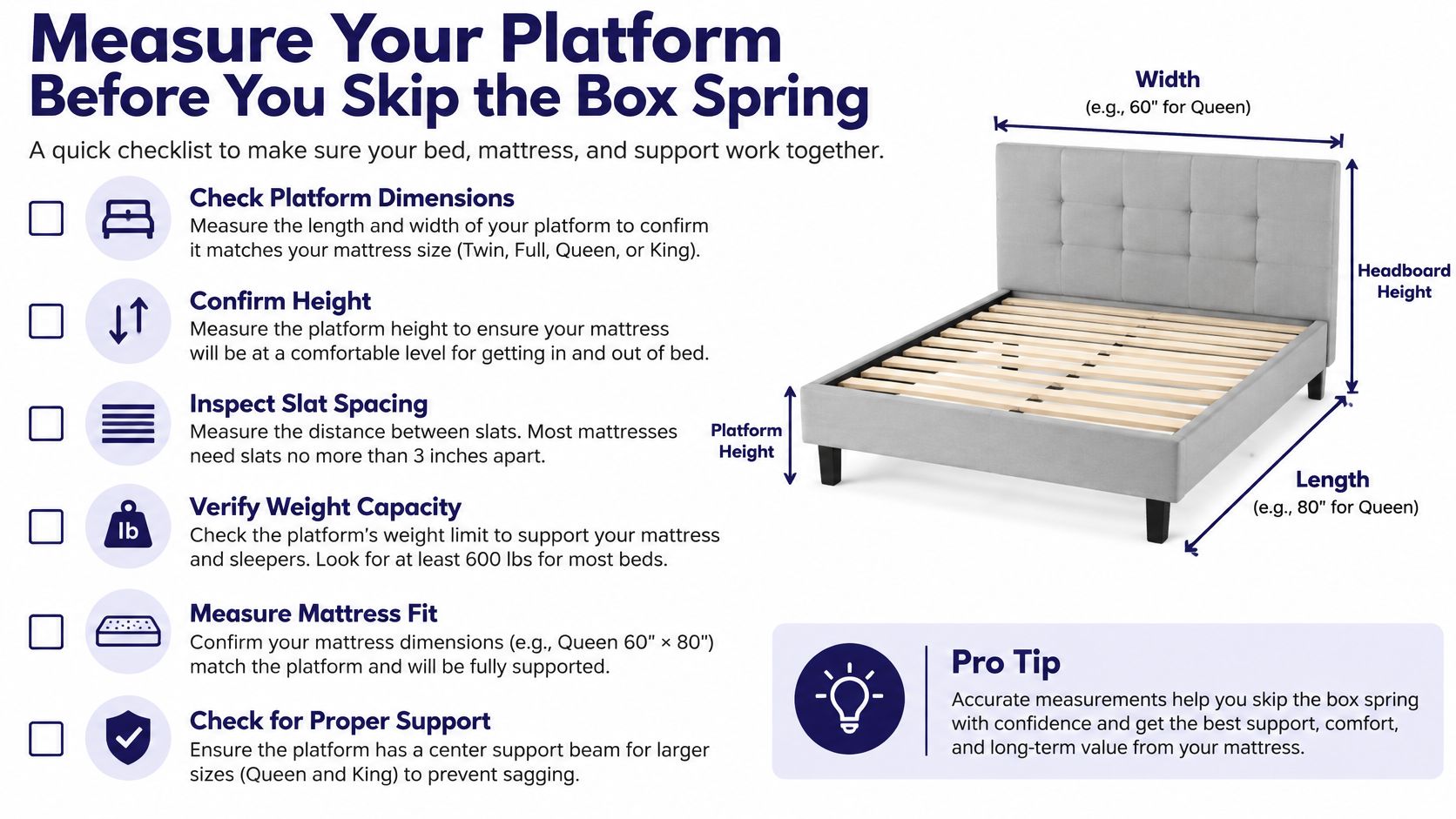
A platform bed either passes or fails on a handful of numbers, and judging from across the room is how good frames get misjudged. Gather a tape measure, a flashlight, and a notepad. Remove the mattress, with help if you need it, so you can inspect the actual support surface instead of estimating through the upholstery.
Take measurements at the bed
Measure the open slat gap. Place the tape between the inside edges of adjacent slats, not from center to center. The clear opening is the space a mattress can press into, so that is the number a spacing requirement means. The Meliusly slat-spacing guide identifies approximately 3 inches as a common maximum gap and notes that some written requirements permit up to 4 inches. Check several openings, including the widest-looking ones, since a single outlier can matter more than the average.
Record slat width and thickness separately. Shoppers often treat spacing, width, and thickness as one measurement, but a written requirement can specify each on its own. Biltrite's foundation guidance describes published requirements including slats at least 3 inches wide, along with the leg-count examples shown below. A separate Beloit Mattress warranty example specifies solid-wood slats at least 0.75 inches thick. These are examples to compare against your mattress's requirements, not universal construction standards.
Count the legs and inspect floor contact. Get low and shine the flashlight beneath the bed. A center leg suspended above the floor works like a chair leg that doesn't touch: it contributes nothing until the frame sags far enough to reach it.
Inspect the middle of larger frames. For queen, king, and California king beds, look for rigid center reinforcement with support reaching the floor. A decorative rail can look identical to a structural one from above, so check the frame instructions before counting it.
Compare the weight rating. Find the frame's documented capacity and compare it with the combined mattress-and-sleeper weight. Some manufacturers state capacity including the mattress and some exclude it, so confirm which figure yours reports rather than assuming.
Look for movement or damage. Press on the unloaded deck and inspect for loose slats, bowing, cracked wood, or connections that shift. This catches obvious problems. It does not replace a documented weight rating.
Use this checklist while the support surface is exposed.
Compare the frame layout
Minimum leg count and center support by bed size
The following published examples come from the Biltrite guidance cited above; your manufacturer's specification controls.
| Bed size | Minimum legs | Center support |
|---|---|---|
| Twin | 4 | No separate center rail required in the cited examples; confirm the mattress warranty's support clause |
| Full | 4 | No separate center rail required in the cited examples; confirm the mattress warranty's support clause |
| Queen | 5, including center | Rigid center rail or center legs reaching the floor |
| King | 5, including center | Rigid center rail or center legs reaching the floor |
| California king | 5, including center | Rigid center rail or center legs reaching the floor |
Write down every measurement and photograph the underside before the mattress goes back on. A clear record of gaps, slat dimensions, leg contact, and center reinforcement is what turns an educated guess into a decision.
How Mattress Warranties Set the Real Limit
The mattress warranty's support or foundation clause is the deciding document. Read the care instructions too, since the manufacturer may explain acceptable bases there rather than in the main warranty text.
The diagram provides a visual reference for the dimensions you're checking.
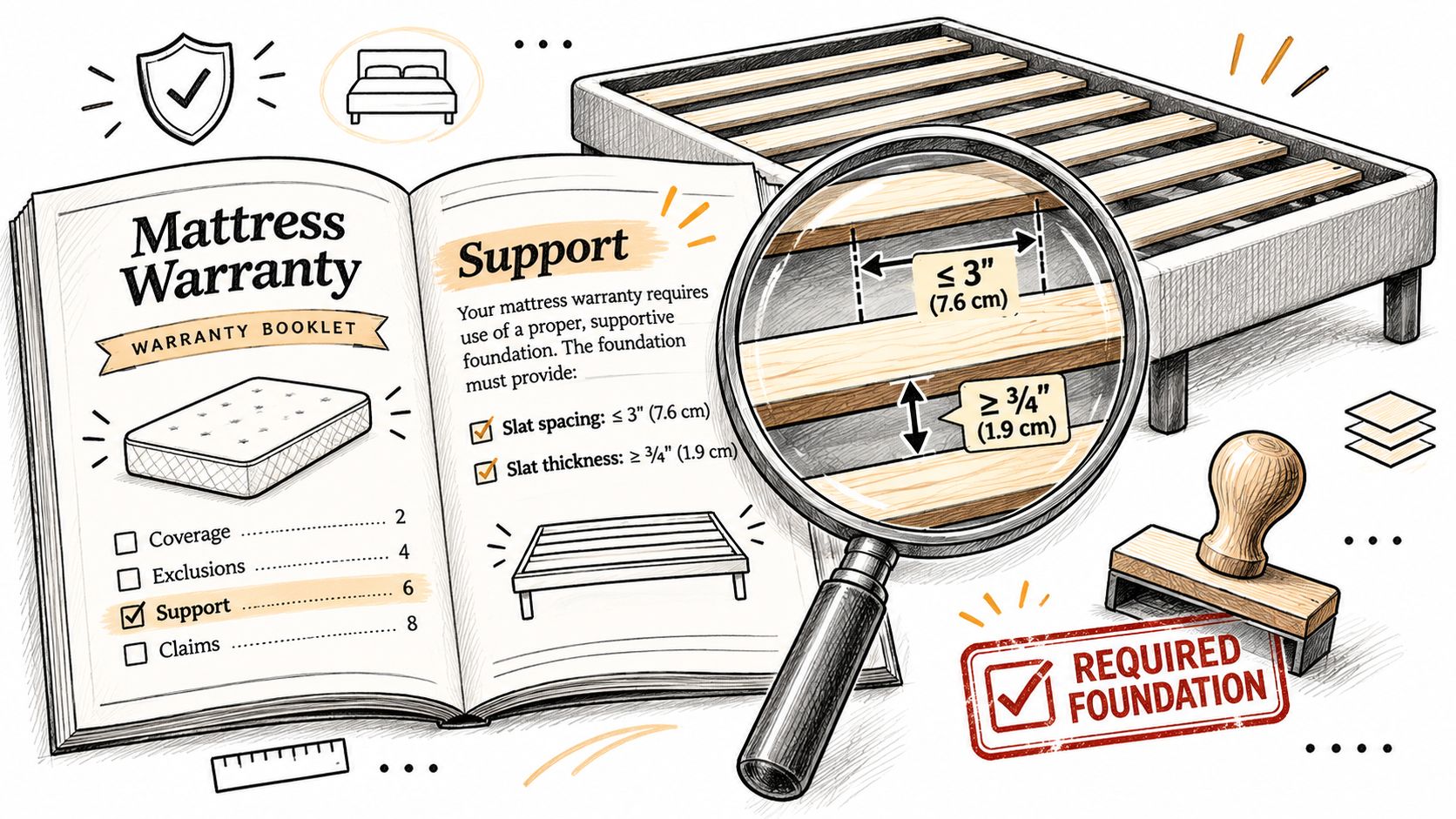
FitRestFuel's mattress-warranty spacing guide describes published clear-gap requirements around 3 to 4 inches, with some foam and latex warranties requiring tighter spacing near 2 to 3 inches. That's why a general recommendation can't substitute for the instructions for your exact model.
Match every requirement to evidence
Find the relevant documents. Confirm the mattress model, then locate its support clause and care sheet. Don't assume another model from the same brand has identical requirements.
Compare each term with your notes. Check the approved support type, clear spacing, slat dimensions, center reinforcement, and any stated load requirements. Mark anything you can't verify.
Request written clarification. If a term is vague or a measurement is close to the limit, send the mattress maker your dimensions and photographs before buying or installing. Ask whether that specific configuration is approved.
Keep the answer. Save the reply with your receipt, warranty document, and frame information. A verbal reassurance is harder to reference later.
For a hypothetical example, suppose a foam mattress requires gaps of 2 inches or less, but your platform has 3.5-inch openings. That setup fails the stated requirement even if the frame feels sturdy when you press on it.
A sturdy frame and a warranty-compatible support surface aren't necessarily the same thing.
Plywood and bunkie boards also change the support arrangement. Ask for written approval of the proposed material and installation rather than assuming that covering the gaps settles every requirement.
For another visual explanation, use the video below.
A complete check leaves no unresolved item: the support is permitted, the measurements comply, and any exception is documented.
Box Spring and Platform Support Compared
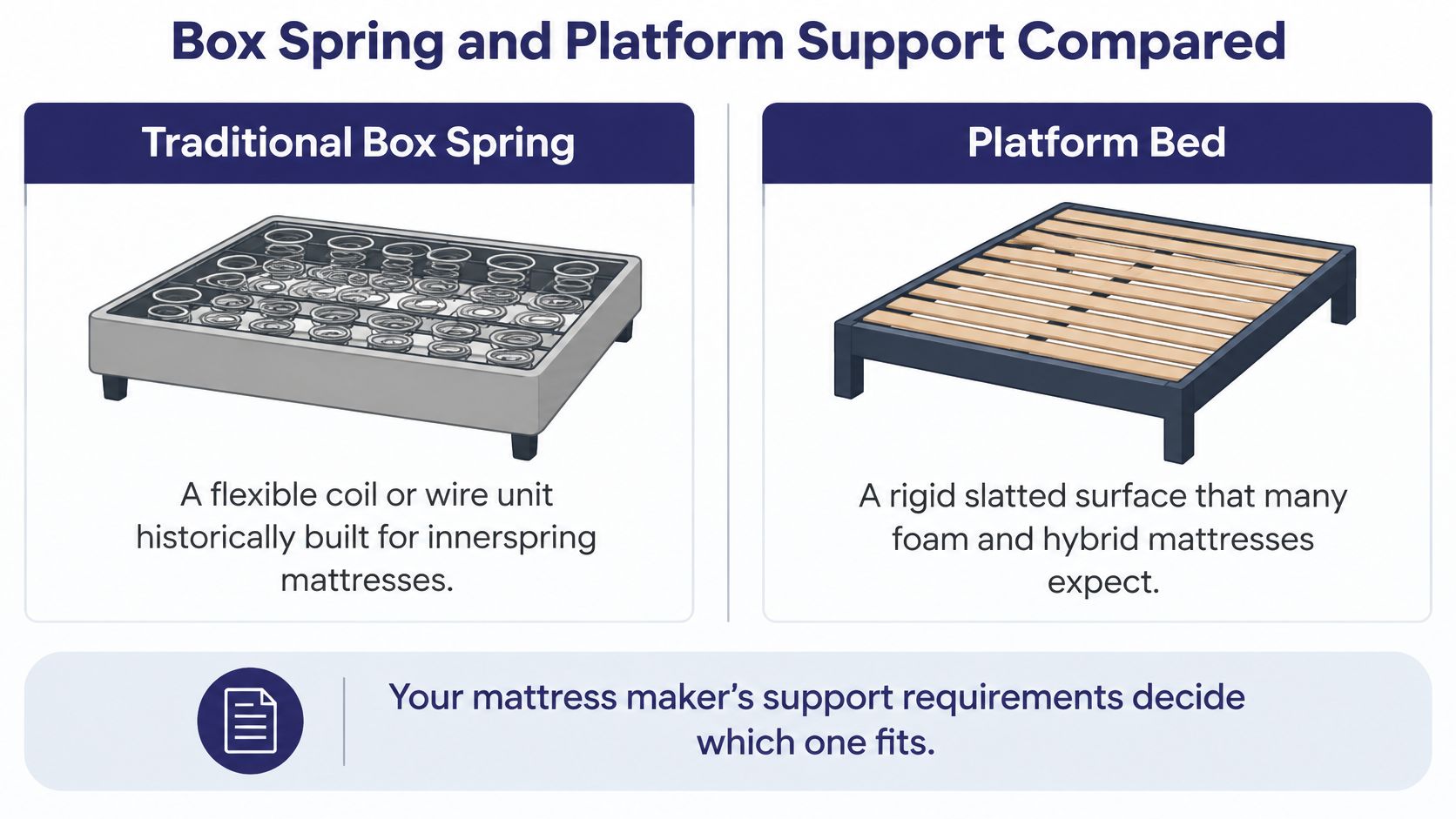
Start with the mattress, then identify the support it expects. The terms box spring and foundation are often used casually, but they don't always describe the same construction.
A traditional box spring uses a flexible coil or wire system historically paired with innerspring mattresses. Many newer foam and hybrid mattresses instead require a rigid foundation, solid platform, or approved adjustable base, as explained in Yawnder's mattress-support guide.
Match the construction to the mattress
Support types and the mattresses they usually suit
| Support type | How it supports | Usually suits | Height effect |
|---|---|---|---|
| Traditional box spring | Flexible coil or wire unit | Innerspring mattresses designed for it | Adds noticeable height |
| Solid platform deck | Rigid, continuous surface | Foam, latex, and hybrid mattresses with compatible rigid-support specifications | No added foundation height |
| Slatted platform with close spacing | Slats with gaps inside the warranty limit | Foam and hybrid mattresses within the spacing specification | No added foundation height |
| Approved adjustable base | Powered articulating base | Models the mattress maker approves | Check the base's installed height and clearance |
These categories describe likely matches, not blanket approvals. An innerspring mattress doesn't automatically require a traditional box spring, and a foam mattress isn't automatically approved for every solid surface.
Look at construction details rather than relying on a fabric cover or a product nickname. If the documentation says “foundation,” confirm whether it means rigid support or a spring-based unit.
Consider the finished bed height
A separate foundation also changes where the mattress sits. Measure from the floor to the proposed top of the mattress, then consider sitting down, standing up, and reaching the floor comfortably.
Check the headboard as well. A taller stack can cover part of it, while a lower stack may expose a gap that wasn't noticeable before.
Removing an existing box spring isn't always the right answer either. Some mattress models expressly allow or require a particular foundation, so identify approved support types first. Then confirm that the platform's deck, slats, center structure, and ventilation match those requirements.
When a Box Spring or Foundation Still Makes Sense
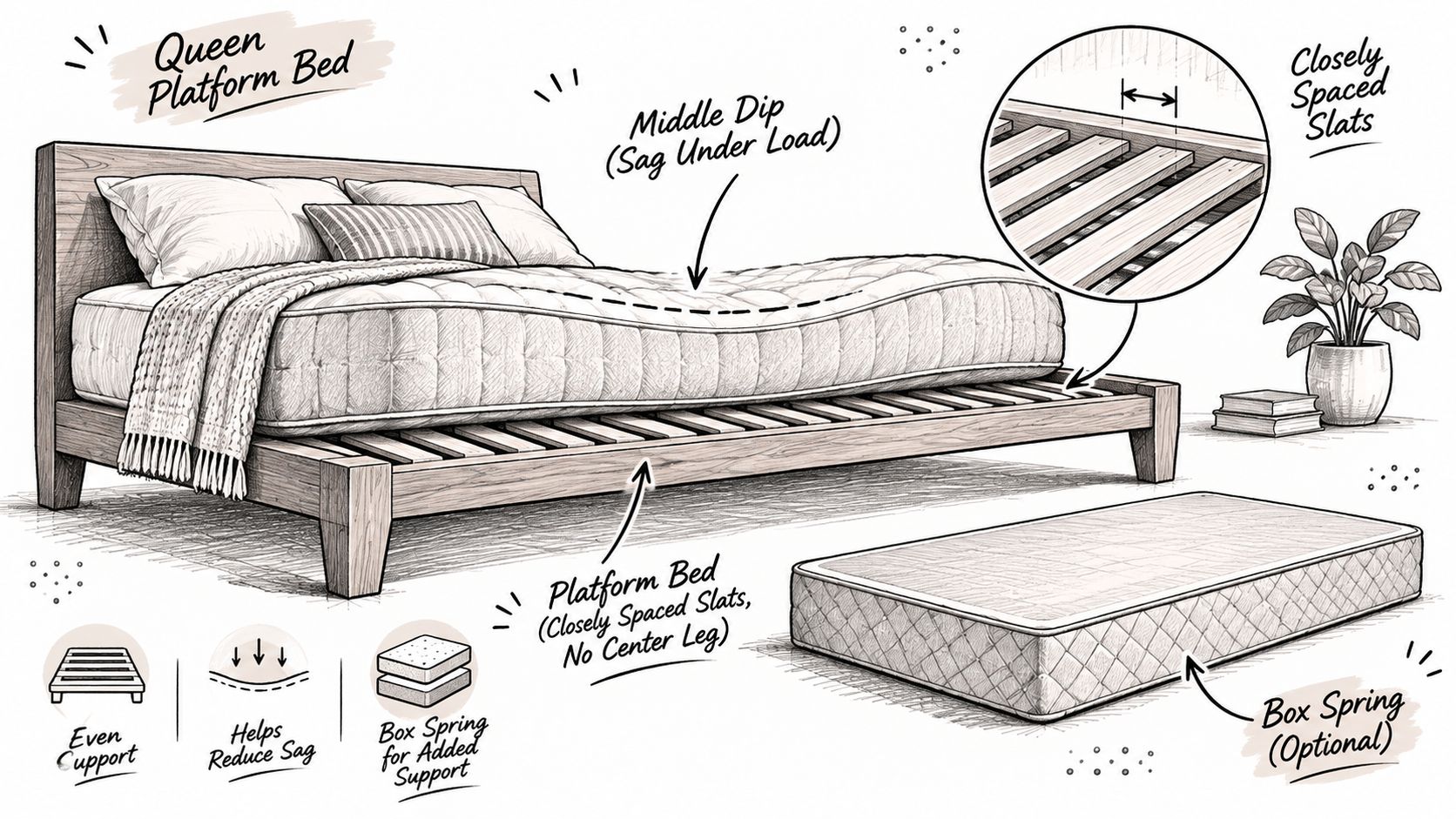
Say a queen platform has closely spaced slats but no center leg, and the middle dips under load. Adding a box spring might make the dip less visible, but it doesn't establish a supported path from the center of the bed to the floor.
That's a platform problem first. Vancouver Furniture's platform-bed guidance emphasizes checking center support, leg-to-floor contact, capacity, and written approval for proposed workarounds rather than treating an added box spring as an automatic safeguard.
Correct the underlying problem first
Use this order when the current setup doesn't qualify:
Repair the platform appropriately. Correct loose connections or poor leg contact. Use manufacturer-compatible center reinforcement or replacement slats rather than improvising structural changes.
Recheck the finished arrangement. Measure the openings again, verify floor contact, and compare the modified frame with the mattress documentation.
Choose an approved foundation if needed. Add one when the mattress requires it or when an approved foundation arrangement resolves a remaining compatibility issue. Confirm that the frame can carry it.
Don't use plywood, a bunkie board, or an old box spring merely because it's available. Each creates a different arrangement that needs approval, and none should be treated as a repair for damaged frame components.
Fix the structure that carries the weight before adding another layer above it.
A foundation makes sense when it performs a required support function. It's less useful when it conceals a weakness that remains underneath.
Adjustable Bases and Thinner Mattresses
Replacing only the mattress can change what your existing platform needs to do. A thinner foam, latex, or hybrid model may require rigid support, while another mattress may be intended for a specific foundation or approved adjustable base.
Yechen's mattress-foundation guide highlights why these choices should be evaluated together: platform rigidity, ventilation, installed height, and adjustable-base clearance all affect compatibility. Mattress thickness alone doesn't tell you which support is suitable.
Check the combination before ordering
For direct-to-platform use, confirm that the new mattress accepts your existing support surface. If the platform qualifies, there's no reason to replace it because the mattress is new.
For a platform plus foundation, identify the approved foundation and its installed dimensions. Check the complete assembly rather than approving the mattress and frame separately.
For an adjustable base, confirm both mattress approval and compatibility with the surrounding bed frame. Inspect fixed rails, drawers, and other components that could obstruct installation or movement.
An adjustable base needs room to operate, not just room to sit inside a frame. Follow its installation instructions and don't assume that removing platform slats is permitted.
Check how you'll use the finished bed
A thickness change can alter bed entry even when the support itself is compatible. Compare the proposed mattress-top position with your current setup and note whether sitting or standing already feels awkward.
If you expect to add an adjustable base later, check the frame arrangement now. Otherwise, you may choose a mattress that works today but discover that the bed obstructs the future base.
Keep approvals for the mattress, platform, and adjustable base together. If the mattress requires a separate support component, select it alongside the mattress so the complete setup can be checked before delivery.
Decide with Confidence Before You Skip the Box Spring
You can make the final decision without guessing. Use the measurements and documentation to place your setup into the appropriate category.
- Everything qualifies. If the mattress permits a platform and every support requirement is met, use it without a separate box spring.
- Something falls short. Choose a permitted platform correction or the approved foundation arrangement, then verify the finished result.
- A requirement is unclear. Get written confirmation from the mattress maker before committing to the setup.
Keep a simple compatibility record
Save your measurement notes, photographs, frame specifications, warranty page, and any written approval in the same folder. That gives you a useful reference if you replace the mattress or change the support later.
Check planned changes before delivery too. A different mattress thickness or an adjustable base can affect fit even when your current arrangement works.
You don't need to add a box spring just to be cautious. You need a documented match between the mattress and the structure carrying it, with unresolved questions answered before installation.
We offer furniture, mattresses, home décor, and design services to help you consider the bed as part of the whole room. Bring your platform measurements, photographs, and mattress warranty when you visit Woodstock Furniture & Mattress Outlet, so we can talk through support options, clearance, and headboard fit together.
Leave a Reply
You must be logged in to post a comment.