
You've found a chair that looks right for the corner, but you want more than a place to sit. It needs to recline toward the television, turn toward conversation, and leave the walkway open when the footrest is out. Then you start comparing handles, remotes, swivel bases, and lift functions, and the differences become less obvious.
A recliner swivel chair is easier to evaluate when you separate what moves, how you control it, and whether it fits your body and room. Start with those decisions, rather than upholstery color or a long feature list.
Recliner Swivel Chair Types at a Glance
A recliner swivel chair typically combines a reclining back, an extending footrest, and a seat that rotates around its base. Those movements aren't necessarily independent. A handle might release the footrest while body pressure changes the back angle, or a motor might coordinate both.
Recline control and base movement are separate choices. Manual and powered controls can be paired with different base arrangements, but manufacturers don't offer every possible combination.
Compare the mechanism before the extras
Recliner swivel chair types at a glance
| Type | Recline control | Swivel base | Typical trade-off |
|---|---|---|---|
| Manual pushback | Push back with body weight | Stationary or gliding support, with swivel on swivel models | No power needed for reclining; effort rests with the user |
| Manual lever or pull-tab | Lever or handle at the side | Fixed or swivel base | Reach and grip matter; the handle releases or controls movement |
| Power recline, single motor | Remote or switch | Fixed or swivel base | Low-effort adjustment; needs power and an outage plan |
| Power lift and recline | Remote with a lift function | Specify a swivel base with a lock if rotation is needed | Lift can assist rising; lift and swivel should be used separately |
| Swivel on glide base | Manual or power recline | Rotating base with gliding motion or floor-contact glides, confirm which | Gliding motion and floor sliding aren't the same feature |
| Swivel with locking base | Manual or power recline | Rotates and locks in place | Lock can help control movement; confirm engagement and permitted use |
The table includes fixed-base alternatives because a chair that reclines doesn't automatically swivel. Likewise, power recline doesn't automatically include lift, and a swivel-glider description doesn't confirm a locking function.
Before choosing a type, answer these questions:
- Who operates it? Consider the user's reach, grip, leg strength, and ability to close the footrest.
- Where does power come from? Identify an accessible outlet and a cord route outside the moving mechanism.
- What supports the base? Note hard flooring, carpet, rug edges, and the manufacturer's floor-protection requirements.
Choose the mechanism that matches your daily routine, then check the actual model's specifications. A category name is a starting point, not a complete description.
Manual Versus Power Recline in Daily Use
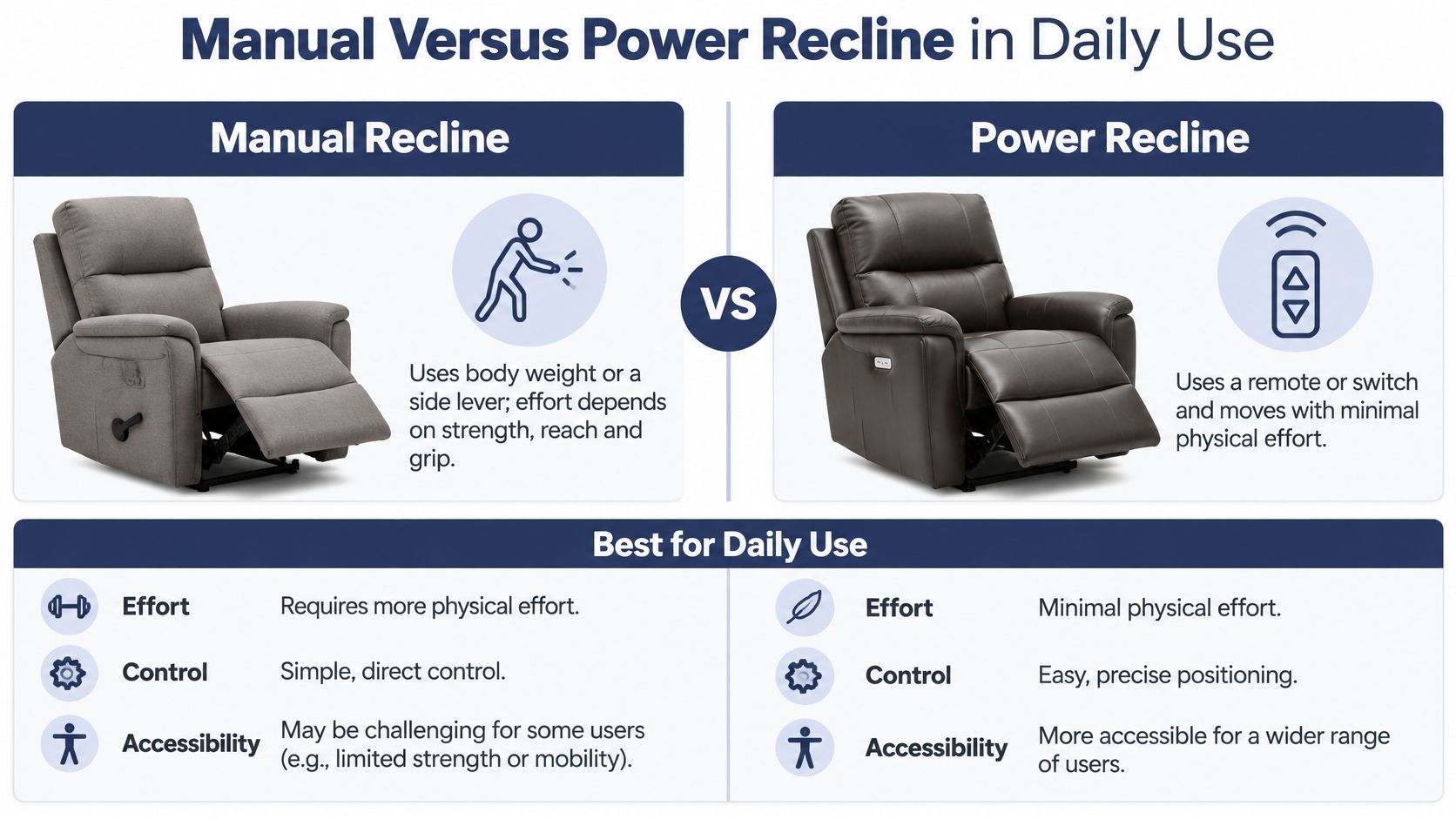
The daily difference is straightforward: manual reclining asks your body to do more of the work; power reclining asks you to operate a control. Neither approach is automatically the better choice.
With a pushback chair, you press against the back while bracing as directed by the manufacturer. A side lever or pull-tab changes how you initiate movement, but you may still need leg pressure to close the footrest. Test the return to upright, not just the easier-looking opening action.
What the motor actually controls
A single-motor recliner generally moves linked components through a coordinated sequence. Don't assume you can leave the back upright while placing the footrest anywhere you like. Ask for a demonstration of the positions you'll use for television, reading, and conversation.
A lift-and-recline chair adds a function that raises and tilts the seat to assist rising. Lift and recline are different operations, even when they share a handset. Independent adjustment requires the appropriate mechanism and controls, not a remote with more buttons.
Motorized positioning is part of the category described in DataIntelo's reclining-armchair market report, but its relevance to your home is practical: can you reach, identify, and hold the controls comfortably?
Questions a feature list won't answer
- Outage behavior: What happens if electricity fails while you're reclined?
- Emergency return: Is backup power, a manual release, or another return method provided? Ask to see its instructions.
- Obstruction response: Does the mechanism stop when it encounters something, and under what conditions?
- Service access: Can a technician reach the motor, transformer, handset connection, and linkage? Are replacement parts available?
More motors mean more powered components to diagnose and service, though that alone doesn't establish reliability. Ask about the specific chair rather than assuming all powered mechanisms behave alike.
Practical rule: Choose power because it solves an operating difficulty or provides a useful adjustment, not because it appears higher on a feature list.
A manual chair may suit a renter who moves frequently, a room without a convenient outlet, or someone who values a simpler operating system. Power remains an option, not a default.
Swivel Bases and Rotation Options Compared
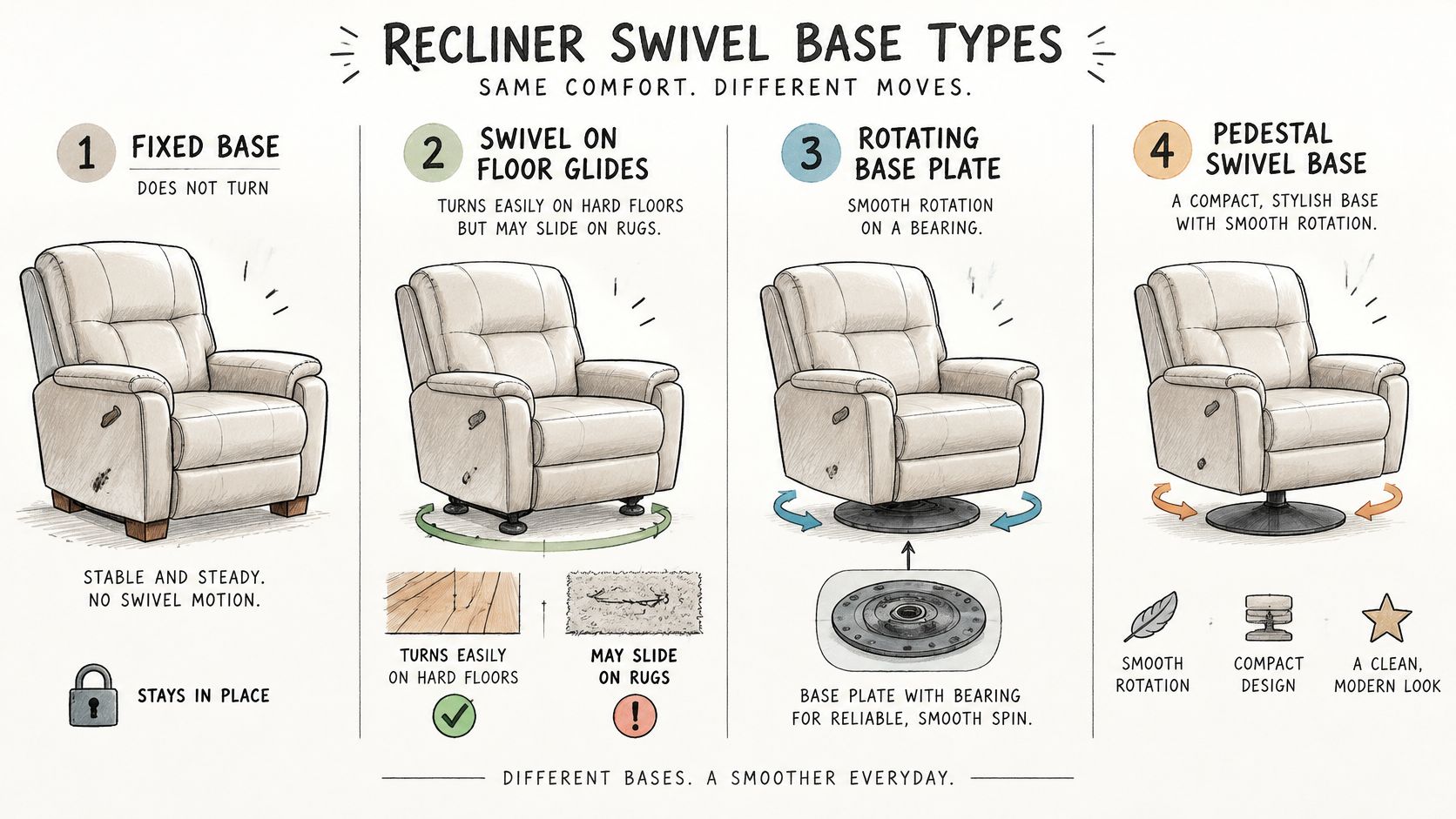
A chair can turn without moving across the floor. That distinction matters because swiveling, gliding, and sliding describe different movements, even when product descriptions place them together.
A fixed base doesn't rotate. A bearing-mounted swivel allows the upper chair to turn while its supporting base stays in place. A locking swivel adds a pin, lever, or other restraint intended to hold the permitted position.
Know what “glide” means
A swivel glider commonly combines rotation with a back-and-forth gliding mechanism. Floor glides, by contrast, are contact pieces beneath furniture. They don't establish whether the chair has a true swivel bearing or a gliding suspension.
If a description mentions rotation on floor glides, ask the seller to demonstrate what moves. A base that slides easily on hard flooring may behave differently on carpet, and uncontrolled sliding isn't a substitute for a designed swivel.
For broader room-layout ideas involving turning seating, Lewis and Sheron Textiles offers a seating guide for Atlanta homeowners. Reclining seating needs an additional check because its extended back and footrest occupy more space than an upright accent chair.
Measure the swept space
Say your chair faces the television beside a side table. Upright, it turns toward the doorway without contact. Reclined, the footrest may sweep into that table before the chair reaches the same direction.
A full turn requires clearance around the entire swept outline, not merely the base. A limited rotation range still needs testing at both ends of its permitted travel.
- Working-position arc: Measure rotation with the back and footrest in the positions you use.
- Lock operation: Confirm where the lock engages, including whether engagement is permitted while reclined. Don't force an unsupported position.
- Floor compatibility: Check that the contact surface and any protective pad meet the manufacturer's instructions.
A seat with the swivel lock disengaged can move when you shift your weight. The lock should engage fully, but it doesn't turn the base or footrest into a standing platform. Treat rotation as another movement to evaluate alongside recline and, where fitted, lift.
Fit Measurements That Decide Comfort
A chair can list eight recline positions and still leave your lower back hanging. Judge the backrest angle and footrest geometry together, because they work like a two-part hinge: change one and the other shifts where your hips and knees end up.
General ergonomic guidance places a supported recline around 110° to 130°. That range gives you a starting point for comparison. The functional-recliner study of young adults tested specific pairings and found 125° backrest with 60° footrest strongest for short-term comfort in that group. The study combined subjective ratings with an EEG measure, so treat its best pairing as a useful benchmark rather than a lifetime prescription.
The useful question remains whether your body stays supported in the position you will use. Compare chairs in your usual shoes, and bring a tape measure and a simple room sketch.
Fit and clearance reference values
| Measurement | Reference value or method | What it tells you |
|---|---|---|
| Supported recline angle | Approximately 110° to 130°, general ergonomic guidance | A common range for a relaxed, supported back; compare chairs within it rather than treating one angle as ideal |
| Backrest and footrest pairing | 125° backrest with 60° footrest, from the linked young-adult study | The strongest short-term comfort combination in that study, not a universal setting |
| Seat depth | Compare with thigh length, buttock to back of knee | Thigh support without seat-edge pressure behind the knees |
| Seat height | Compare with floor-to-knee height | Whether sitting and rising feel manageable |
| Armrest height | Compare with seated elbow height | Whether your elbows can rest without shrugging or leaning |
| Footprint and reclined depth | Measure with the back reclined | Clearance from walls, walkways, and doors |
| Swivel arc | Measure permitted rotation in the working position | Room to turn without striking nearby objects or entering occupied space |
| Maximum user weight | Read the stated capacity on the specification sheet | Whether the chair's rating accommodates the user, separate from comfort or tested mechanism life |
A showroom fitting sequence
- Start with the sightline. Sit facing the intended television or reading direction. Notice whether you must lift your chin or lean forward to see comfortably.
- Use your everyday position. Recline as you would at home, rather than judging only the upright seat or maximum extension.
- Check the lumbar contour. Your lower back should feel supported without a cushion pushing your pelvis forward or making you slide.
- Evaluate leg support. Check the footrest's length and contact points. Avoid pressure behind the knees, and notice whether the lower legs feel supported.
- Record the seat dimensions. Compare depth, height, and armrest height with your thigh, knee, and elbow measurements. Check them under your seated weight, because cushion compression changes the fit.
- Measure the occupied space. Record the closed footprint, reclined depth, and rotation envelope against your wall and walkway measurements.
The tested 125° and 60° pairing describes short-term leisure posture in healthy young adults. It is a comparison point, not a prescription for every body or medical condition.
A stated weight capacity tells you whether to consider a chair. It doesn't tell you whether the chair fits.
Durability and Verified Claims Before You Buy
A weight rating tells you whether a chair can hold you. A mechanism test tells you how the reclining hardware behaves under repeated use. Those are separate answers, and neither one converts into a promised number of years in your living room.
The U.S. General Services Administration upholstered-furniture test method defines a recliner cycle as closed to television position, then full recline, then back to closed, and runs for 25,000 cycles or until failure, inspecting every 2,000 cycles. A useful report names the procedure, the load applied, the inspection interval, and any failures. A cycle count on its own tells you very little about what happened during those cycles.
Ask what was actually tested
The European EN 13759 procedure also covers hand- and power-operated reclining mechanisms, testing them with a test person or dummy rather than setting a universal pass-or-fail service-life limit.
When a manufacturer cites either method, ask for the report or a technical summary. The method existing doesn't mean this particular chair passed it.
- Complete assembly: Did testing cover the swivel base, recline linkage, footrest, frame, and power controls, or only selected components? The base carries sideways load when you rotate to stand, so a recline-only test leaves your transfer out of the chair unexamined.
- Load and failure criteria: What load was applied, and what counted as failure?
- Inspection records: Were looseness, deformation, or changes in operation written down?
- Electrical duty cycle: How long may the motor run before it needs a rest?
- Warranty scope: Which components, labor, and transport costs are covered, and for how long?
During a demonstration, notice sideways wobble, rough movement, or a lock that resists you. Ask what causes it before deciding whether it signals wear or a mechanism design you would have to live with.
Separate specifications from testimonials
The Federal Trade Commission's advertising guide requires objective advertising claims to be truthful, non-deceptive, and supported by appropriate evidence. "This recliner relieves lower back pain" is an objective health claim and needs study-level support behind it. "This recliner is 34 inches wide in the closed position" is a measurement you can check with a tape in the showroom.
Reviews help you build a question list to bring to the showroom; they aren't performance tests. The FTC endorsement rules explain why one buyer's experience shouldn't be presented as what most buyers should expect.
Check seat width, swivel range, recline operation, and warranty terms against the documentation. A reviewer's comfort report describes that reviewer's body and that reviewer's room, not the fit geometry of yours.
Upholstery, Frame and Size Choices
Upholstery changes what you touch, how you clean the chair, and how visible everyday marks may be. It doesn't establish the quality of the mechanism underneath.
Fabric covers a wide range of weaves, piles, and textures. Leather also differs by type and finish, which affects appearance, care, and response to use and sunlight. Ask for the exact material description rather than relying on labels such as premium or performance.
Read construction details literally
An abrasion or colorfastness rating describes a particular test, not how the chair will look after years in your home. Cleaning codes identify permitted cleaning approaches, but you should also obtain the upholstery manufacturer's care instructions before choosing a cleaner.
- Frame: Ask whether the structure uses hardwood, engineered wood, metal, or a combination, and how the joints and mechanism attach.
- Cushion: Compare stated foam density and fill construction. Density isn't the same as firmness, and a generic high-density label isn't a complete specification.
- Surface details: Feel the upholstery in the seated position. Inspect arm seams, stitching, piping, and other areas your hands and clothing will contact.
The frame supports the forces created during reclining and rotation, so material names alone don't explain construction. Connection details matter too.
Size labels aren't measurements
Treat compact, standard, and oversized as shopping categories, not standardized dimensions. A compact chair may still extend too far into a walkway, while an oversized seat may place the armrests beyond a smaller person's comfortable reach.
Match each category to your measured seat width, depth, and reclined footprint. If the larger chair fits the room but leaves you leaning sideways for support, its extra width isn't an advantage for you.
Choosing by Room, Age and Work Setup
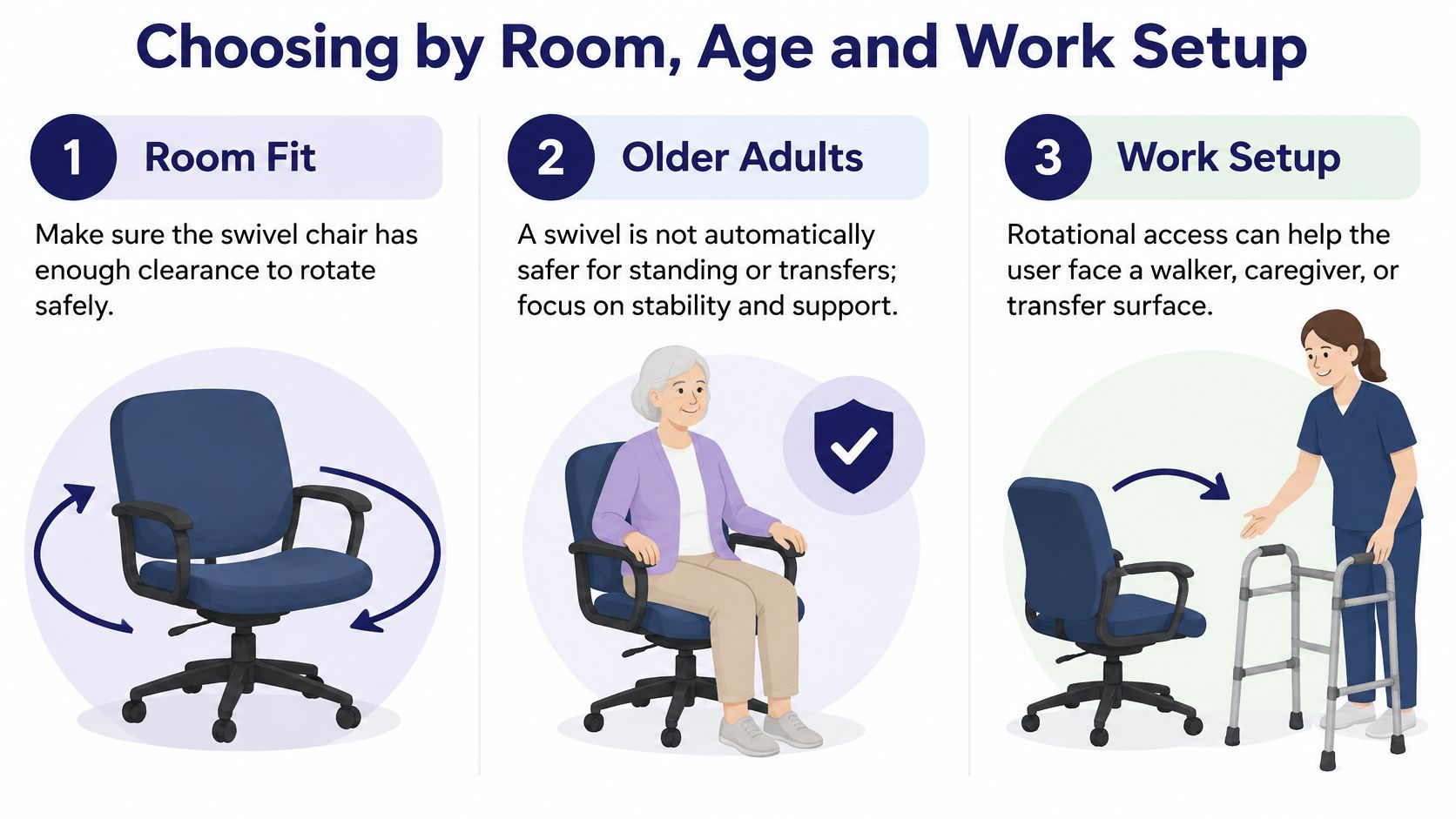
A swivel isn't automatically safer for standing or transfers. Being able to turn toward a walker, caregiver, or transfer surface is rotational access. Remaining stable while moving into or out of the chair is a separate requirement.
Age-friendly furniture is a category discussed in Mordor Intelligence's furniture-for-aging-population report, but a category label doesn't establish that a particular chair suits someone's mobility needs. Evaluate the person, the chair, and the transfer method together.
Put transfer stability ahead of convenience
For someone who needs assistance rising, check whether the swivel locks, whether the chair stays stable during the intended movement, whether lift and recline operate separately, and whether the approach space accommodates their equipment.
A lift mechanism doesn't replace appropriate transfer technique or supervision. If recovery, balance, or wheelchair transfers are involved, ask an occupational or physical therapist to help assess suitability rather than testing an unfamiliar transfer alone.
Requirements by household case
| Case | Priority features | Check before buying | Trade-off to weigh |
|---|---|---|---|
| Small room | Compact base; manual or compact power recline; floor-compatible base | Reclined depth and full swivel arc against walls and walkways | Extended depth may reach into the walkway |
| Older adult | Lift if needed; swivel lock; suitable armrest height | Independent operation; lock engagement; stability while rising | Power introduces outage planning; some users may prefer manual operation |
| Home office | Locking swivel; lumbar support; useful upright setting | Desk clearance, seat height, and working angle | Full recline may not suit typing |
| Renter or shared home | Manageable mechanism; accessible service components | Delivery route, parts availability, and service details | Repair arrangements are manufacturer-specific |
| Households with children or pets | Swivel lock; documented obstruction response on powered models | Rotation clearance and pinch points near the base | Moving mechanisms require supervision and clear space |
Match the priority to the activity
In a small room, prioritize usable open space, not just a narrow closed chair. A recliner that forces someone into the footrest's path whenever they cross the room may be the wrong layout choice, even if it fits neatly upright.
For a home office, test the chair at the actual desk relationship. Check whether the armrests clear the desktop and whether you can reach the keyboard without abandoning back support. A comfortable television position doesn't establish a suitable typing position.
With children or pets, inspect the spaces around the linkage and base before operating anything. Don't test an obstruction feature with a hand, foot, or animal; request the manufacturer's description and demonstration procedure.
Decision filter: Choose the features that solve your household's actual difficulties. More movement isn't always more useful.
If stable transfers and easy controls matter most, prioritize those over decorative extras. If your main problem is a tight corner, prioritize the rotation envelope and reclined depth.
Confirm Fit in Person Before You Buy
Bring a tape measure, your body measurements, and a room sketch that shows doors, walkways, outlets, and nearby furniture. Add photographs of the corner and delivery route so you can discuss details that a floor plan might miss.
Record seat depth, seat height, armrest height, closed footprint, and full reclined depth on the same worksheet. Leave space for notes about operating effort and the positions you can achieve, not just the specifications.
Test the complete routine
- Settle into position: Stay in your intended reading or television posture for several minutes. Notice pressure, sliding, and whether you keep repositioning yourself.
- Operate the controls: After learning their layout, try finding the lever or handset buttons by touch. Check that you can reach the control without leaning awkwardly.
- Check permitted rotation: Have the chair's operating limits demonstrated, including lock engagement and cord management.
- Try the return movement: Close the footrest and return upright. For a lift chair, practice sitting and rising with the swivel secured, using assistance if needed.
Bring your durability questions and ask to see the documents behind the answers. Request the tested load, cycle-test information, motor duty instructions, warranty terms, and return policy rather than relying on a verbal summary.
Plan how it reaches the room
Confirm the chair's delivery dimensions and whether any components are designed to detach for access. Measure doorway openings, stair turns, and landings, and clarify who handles assembly and final placement.
We offer delivery options, so ask which arrangements apply to your home and what preparation is needed. If a manual chair fits your body and room better than a powered model, that's a sound outcome, not a compromise you need to justify.
Woodstock Furniture & Mattress Outlet offers design services and delivery options to help you plan for a recliner swivel chair beyond its showroom footprint. Visit Woodstock Furniture & Mattress Outlet with your measurements and room photos to compare seating positions, discuss layout, and check the operating details before you decide.
Leave a Reply
You must be logged in to post a comment.