
You're standing in a showroom, rubbing two upholstery swatches between your fingers while your dog sheds beside you or your cat studies the sofa corner. One fabric feels soft but shows every hair. Another wipes clean but may reveal claw marks. A third has an impressive abrasion rating, yet the label says nothing about allergies, seam strength, or what happens after an accident.
The best sofa material for pets isn't one universal fabric. It's the material whose construction and care requirements match your pet's actual habits. Claws, shedding, spills, and allergens create different problems, so the right choice starts by identifying which problem matters most in your home.
Why Sofa Material Matters in a Pet Household
A sofa in a pet home gets used differently from one reserved for people. Dogs bring outdoor dirt, moisture, claws, and shedding into direct contact with the cushions. Cats may climb, knead, scratch, or concentrate their activity on one arm and corner. If more than one animal shares the sofa, that exposure accumulates faster.
Pet ownership also makes this a mainstream furniture concern. In 2024, 45.5% of U.S. households, approximately 59.8 million homes, owned at least one dog, while 32.1%, or about 42.2 million homes, owned at least one cat, according to the American Veterinary Medical Association's pet ownership statistics. A pet-friendly sofa isn't a niche purchase. It's a practical consideration for a substantial part of the housing market.
Start with four questions
Before comparing microfiber with leather, identify the type of work your upholstery must do:
- Durability: Will the sofa handle daily sitting, jumping, digging, or repeated pressure?
- Cleanability: Can you remove hair, muddy paw marks, drool, and accidental spills within the manufacturer's care instructions?
- Claw resistance: Does the surface avoid exposed loops and open spaces that claws can catch?
- Allergen behavior: Will the fabric retain dander and dust, or can you vacuum and wipe it effectively?
These qualities overlap, but they aren't interchangeable. A smooth surface may release hair easily while still showing scratches. A durable fabric may withstand repeated rubbing but hold allergens in its weave. Treat the material name as a starting point, not a complete answer.
Practical rule: Choose upholstery for the damage your pet actually causes, not for the most impressive number on a specification sheet.
The Materials Compared Side by Side
The table below is a quick reference, not a ranking. “Microfiber,” “leather,” and “performance fabric” describe broad material families, and construction varies within each family. A tightly woven synthetic and a loose textured synthetic may behave very differently even if both are labeled polyester.
| Material | Durability | Cleanability | Claw Resistance | Best Fit |
|---|---|---|---|---|
| Microfiber | Strong starting point when densely woven | Usually practical for routine spot cleaning, subject to code | Good against snagging because the surface has few accessible loops | Shedding dogs, active households, everyday lounging |
| Leather | Wipes easily, but surface damage depends on hide and finish | Strong for hair and many surface spills | Mixed, scratches and punctures can remain visible | Calm pets and households prioritizing wipe-down care |
| Performance synthetics | Often designed for heavy-use upholstery, verify the test method | Varies by cleaning code and finish | Good when the weave is tight and low-loop | Accidents, children, dogs, and frequent use |
| Woven natural blends | Varies widely by weave and fiber content | Often more care-sensitive | Lower when the weave is open or looped | Lower-pet-contact rooms or homes with gentle pets |
Abrasion testing helps compare repeated rubbing, but it doesn't measure every pet problem. A Kvadrat guide to fabric performance indicators explains that Martindale uses a figure-eight motion with standard wool, while Wyzenbeek uses back-and-forth rubbing with cotton duck or wire mesh.
For pet households, upholstery specified at approximately 30,000 or more Wyzenbeek double rubs or 40,000 or more Martindale cycles is a useful starting point, but those figures aren't interchangeable. They also don't predict claw punctures, pilling, seam slippage, fading, staining, or hair retention. Ask for the exact test method, fabric construction, cleaning code, and warranty before treating a rating as meaningful.
Microfiber and Tightly Woven Synthetics
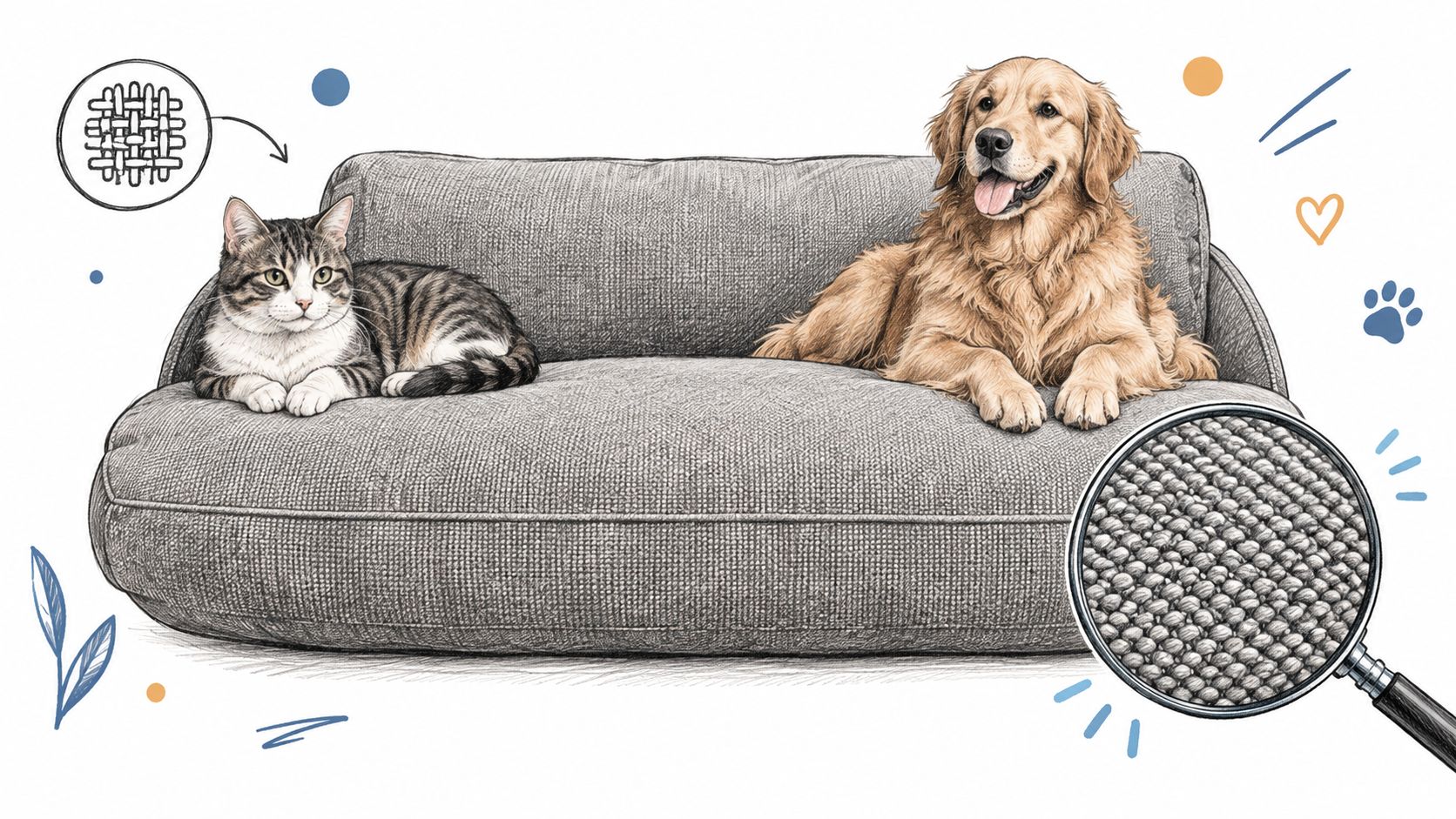
Microfiber is often a practical choice because of its surface structure. Dense microfiber has a compact, low-pile construction, so claws have fewer loops to catch and loose hair has fewer places to settle. That makes it a sensible starting point for homes with dogs, cats, children, or frequent sofa use.
Look past the word microfiber
“Microfiber” describes a fine, dense construction, not one identical fiber recipe. A smooth performance polyester may release hair differently from a brushed microfiber, and backing, finishing, pile height, and seams all affect the lived experience.
The reviewed comparative figures report contract-grade microfiber at roughly 35,000 to 50,000 Martindale cycles, compared with approximately 15,000 to 20,000 for cotton blends and 8,000 to 12,000 for linen, as discussed in this upholstery material checklist. These figures are directional rather than universal. Fiber content, weave, backing, finishing, and test protocol can change the result.
A high rating still doesn't make microfiber claw-proof. Cats can damage cushion corners or seams, and determined scratching can mark almost any upholstery. The advantage is that a tight, flat face removes some of the easy snag points found in bouclé, chenille, and loosely woven linen.
Check the cleaning code
Many microfiber and synthetic upholstery options use a W or W/S cleaning code, but never assume the code from the fabric name. W generally indicates water-based cleaning methods, while W/S allows water-based or solvent-based methods, subject to the manufacturer's directions. Test a hidden area or swatch first, because an unsuitable cleaner can leave rings or alter the finish.
Run your fingers across the swatch. Look for exposed loops, catch a fingernail lightly against the surface, and see whether hair brushes away or disappears into the texture. Then ask how the seams and cushion corners are constructed. Fabric can test well while a high-stress seam becomes the first visible failure point.
Leather and Protected Leather
Leather solves one pet problem exceptionally well: surface cleanup. Hair and dander don't embed in the same way they can with woven upholstery, and many everyday spills can be wiped before they soak into the material. That makes finished or protected leather appealing for homes with shedding dogs and owners who prefer a quick wipe-down routine.
The trade-off appears when claws meet the surface. A cat's scratch can leave a visible line, and a deeper puncture or gouge may remain permanently. Some marks soften into a lived-in patina, while others look like damage, depending on the hide, finish, color, and depth of the scratch.
Finish changes the maintenance experience
Protected or pigmented leather generally has a surface finish that helps slow absorption and simplifies routine care. More natural finishes can feel supple and show more of the hide's character, but they may also respond more visibly to oils, spills, and friction. The important question isn't which category sounds most premium. Ask how the finish is intended to be cleaned and how it responds to repeated contact.
Leather also transfers temperature more readily than many fabrics. Some pets settle comfortably on it, while others prefer a warmer throw or cushion. Dark denim can transfer dye to lighter upholstery, and frequent digging can wear the finish even when the leather itself remains structurally sound.
Leather is easy to clean, not automatically resistant to claws. If scratching is a regular behavior, compare the cleaning benefit with the visibility of permanent marks.
For a calm dog that sheds heavily, protected leather may be convenient. For a cat that kneads or scratches the sofa, a tightly woven synthetic can offer a more forgiving surface. Neither choice eliminates maintenance. They reduce different types of work.
Performance Fabrics and Slipcover Systems
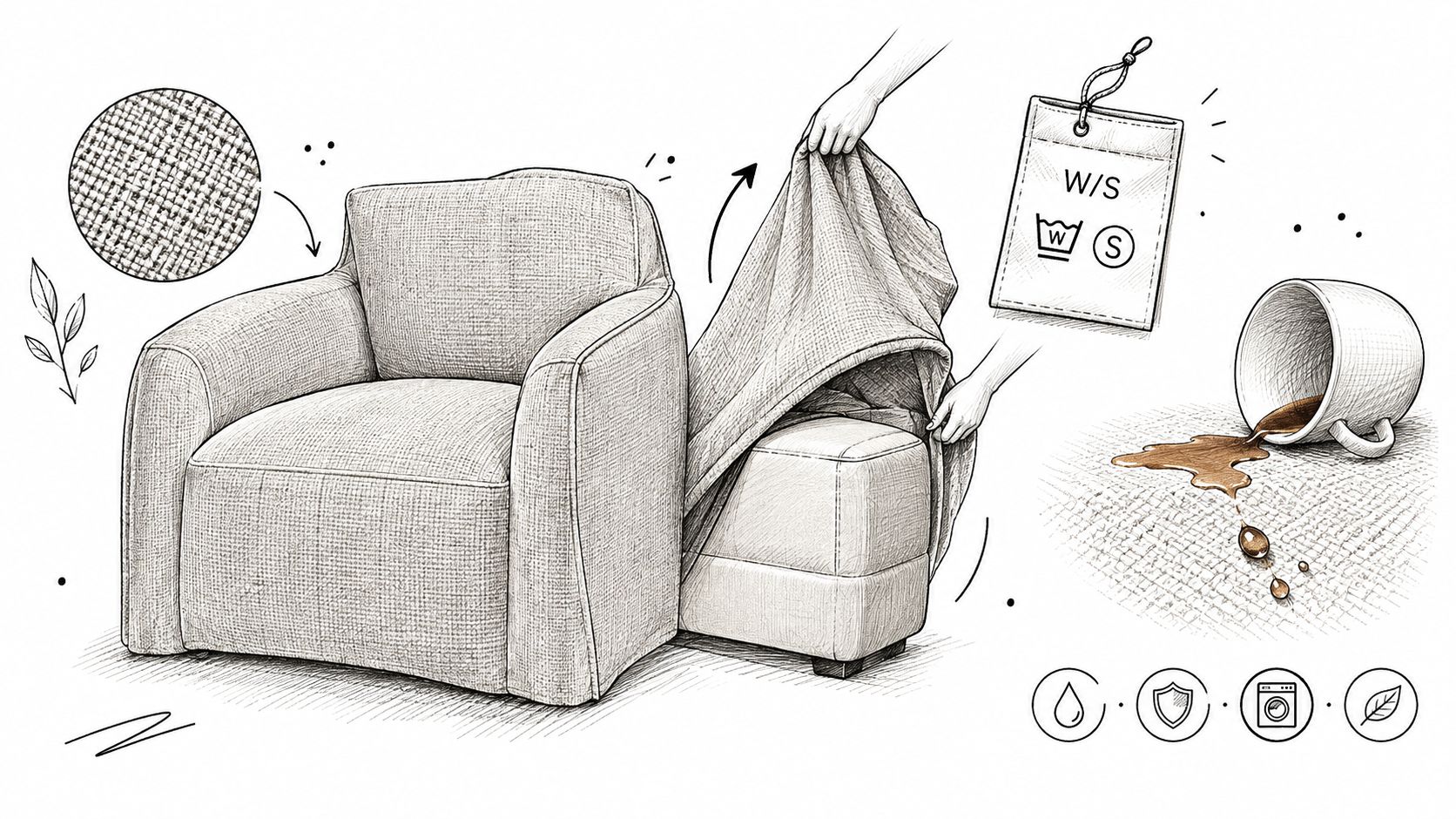
Performance upholstery usually combines a woven or knitted textile with a stain-resistant, moisture-repellent, or soil-release finish. Common constructions include tightly woven polyester and solution-dyed acrylic, but the label alone doesn't tell you how the fabric behaves after years of cleaning.
Read the cleaning code before the marketing copy
- W: Follow the manufacturer's approved water-based method. This can suit households that expect food, mud, or pet accidents, but excess moisture can still create problems.
- S: Use the specified solvent-based approach. It may offer an alternative to water cleaning, but it isn't a permission to use any household solvent.
- W/S: Either water-based or solvent-based methods may be allowed, depending on the care instructions. The exact product and technique still matter.
A removable cushion cover changes the maintenance equation. Hair, odor, and minor stains can be addressed away from the frame, provided the cover is washable and the care label permits it. Ask whether replacement covers are available, whether the cover can be removed without damaging the upholstery, and whether the cushion inserts have their own protection.
A finish can repel liquid without making the entire sofa waterproof. Marketing terms such as “pet-proof” may describe a useful treatment, but they don't guarantee resistance to claw puncture, seam failure, odor retention, or repeated misuse. Weave, backing, cushion construction, and cleaning access matter just as much.
The following video can help shoppers think about removable-cover maintenance as a system rather than a single fabric feature.
Before choosing a performance textile, request the abrasion method and rating, the cleaning code, the warranty language, and any instructions for re-treating repellency. A finish is one layer of protection. It can't compensate for an open weave or weak seam construction.
Matching Material to Your Pet Profile
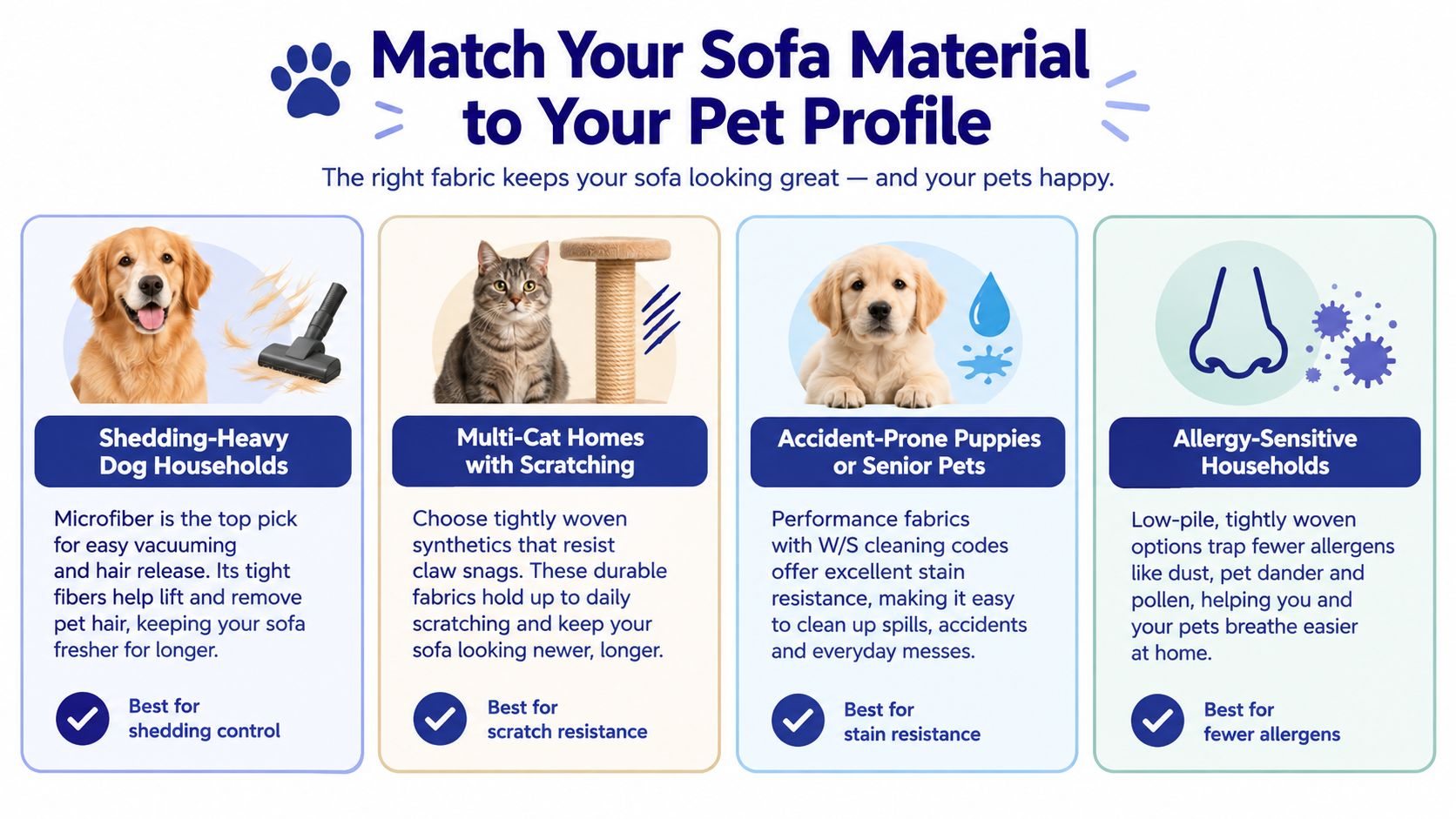
Your pet's behavior should determine which feature gets priority. A shedding dog, a scratching cat, and an older pet with accidents create different upholstery requirements.
If shedding is the main problem
Choose a smooth microfiber, flat performance synthetic, or protected leather if your priority is removing hair. Leather offers the simplest wipe-down surface, while microfiber and tight synthetics can let hair remain near the surface for a vacuum or brush. Mid-tone colors can make ordinary shedding less conspicuous, but color doesn't change how much hair the fabric holds.
If your cats scratch or knead
Put construction ahead of fiber labels. Look for a tight, low-loop weave with no obvious raised loops for claws to catch. A dense synthetic may be more forgiving than a loose linen blend or bouclé, while leather may clean easily but show scratches clearly. A scratching post placed near the sofa is part of the upholstery strategy, not an afterthought.
If accidents are the concern
Prioritize W or W/S upholstery, removable covers, and cushion access. Performance fabric can make spot treatment easier, but follow the care label and act promptly. A removable cover is especially useful when the household includes a puppy, a senior pet, or an animal recovering from illness.
If allergies shape the decision
Smooth, nonporous surfaces such as protected leather or tightly finished faux leather may be easier to wipe and vacuum. Low-pile, tightly woven textiles can also support a consistent cleaning routine, but no sofa material is hypoallergenic. Upholstered furniture can retain dust and pet allergens, and this review of indoor allergen reservoirs identifies upholstered furniture and woven textiles as important places where allergens can accumulate.
At the showroom, bring your decision down to physical checks:
- Feel the surface: Search for loops, loose yarns, and rough areas that could catch claws.
- Test hair release: Rub a pet-hair-colored cloth or your hand over the swatch, then brush or vacuum it.
- Ask for the code: Confirm W, S, or W/S in writing.
- Inspect the edges: Look closely at seams, corners, and cushion closures.
- Request care instructions: Ask whether a spot-clean test can be performed on a sample.
Care Habits That Extend Any Sofa
Even the best sofa material for pets needs a routine. Vacuum cushions, crevices, and the space beneath them with an upholstery attachment instead of waiting until hair and dander become visible. For shedding breeds, selecting the right grooming tool can reduce what reaches the sofa, and these PetScy brush buying tips provide useful context for choosing a brush for a double coat.
Rotate and flip cushions only when the manufacturer allows it. This spreads pressure across seating areas, but it won't fix a cushion that has already lost its shape. Keep a washable throw on the pet's preferred corner, especially if one animal always returns to the same place.
Match cleaning to the label
Spot-clean promptly within the approved cleaning code. Don't saturate a cushion because a surface finish repels liquid, and don't apply a household cleaner without checking compatibility. Removable covers should be washed exactly as directed, since heat, agitation, or unsuitable detergent can change their fit and appearance.
Nail trimming and scratching posts prevent damage before it reaches the upholstery. A fabric protector may help with some soils, but it can't turn a loose weave into a claw-resistant surface or make a delicate finish immune to abrasion.
Microfiber care and leather care aren't interchangeable. Microfiber may need vacuuming and controlled spot cleaning, while leather usually needs approved wiping and conditioning guidance. For shoppers comparing swatches, Woodstock Furniture & Mattress Outlet offers sofas with performance-fabric options, including Crypton upholstery described for stain resistance, moisture repellency, and easier cleaning, as well as leather choices for households prioritizing surface maintenance. Visit the showroom to compare the weave, finish, cushion construction, and care instructions in person.
Pet-Friendly Sofa Questions Answered
Is any sofa material truly hypoallergenic?
No. A material can be easier to wipe and less likely to retain visible debris, but it can't eliminate airborne allergens. Cleaning habits, vacuuming, and removable washable covers matter alongside the upholstery choice.
Do dark fabrics hide pet hair better?
Only when the pet's coat contrasts less with the fabric. A black sofa can display light hair clearly, while a pale sofa can show dark hair. Mid-tone patterns may disguise everyday shedding, but color won't reduce accumulation.
Are slipcovers better than built-in upholstery?
They can be easier to maintain when they're removable and washable. Built-in upholstery may offer a cleaner fit and fewer shifting layers. Check the care label, cover availability, and replacement options before deciding.
What should I expect after five to seven years?
Expect visible wear in the pet's favorite area, especially if the animal jumps, digs, sheds heavily, or uses the sofa daily. A well-matched material and consistent care can help preserve the sofa, but no upholstery remains untouched by real household use.
Woodstock Furniture & Mattress Outlet offers sofas, sectionals, leather options, and performance fabrics that can be compared by feel, construction, and cleaning requirements. Visit Woodstock Furniture & Mattress Outlet to discuss your pet's habits with the showroom team and evaluate swatches before choosing.
Leave a Reply
You must be logged in to post a comment.