
[3028]
You're comparing nursery furniture, checking dimensions, and trying to avoid one more complicated decision. Then you see a crib advertised with a mattress included. The bundle looks like a practical shortcut, especially when you're furnishing a room for the first time.
That convenience can be real, but the crib and mattress shouldn't be treated as unrelated pieces. A bundled crib is a safety-critical sleep system. Its value depends on whether the mattress fits the crib correctly, remains firm and flat, and is approved for that specific sleep space.

Why the bundle needs closer attention
A crib may look sturdy while the included mattress creates a problem through an undersized fit, excessive thickness, or a surface that compresses too easily. Parents can also assume that a mattress supplied with one crib will work in a portable crib, play yard, or replacement frame. That assumption can create gaps or change the way the sleep surface behaves.
The safer mindset is to evaluate the package as one coordinated product. Start with the manufacturer's dimensions and warning label, then consider firmness, fitted-sheet compatibility, cleaning, replacement availability, and intended use.
Practical rule: “Mattress included” describes what comes in the box. It doesn't replace the need to verify that the mattress is suitable for the crib.
A good bundle should make the safety checks easier, not encourage you to skip them. The important questions are concrete: Does the mattress match the crib's specified size? Does it lie flat? Can you identify the correct fitted sheet and obtain a compatible replacement if needed? Those answers matter more than the convenience of receiving both items together.
Federal Crib and Mattress Dimensions Explained
For a standard full-size crib, the CPSC defines the interior sleeping area as 52 3/8 inches, plus or minus 5/8 inch, in length, and 28 inches, plus or minus 5/8 inch, in width. The mattress must measure at least 27 1/4 inches by 51 1/4 inches and must be no more than 6 inches thick. These requirements are outlined in the CPSC's crib mattress guidance.
The figures aren't just manufacturing details. They limit the open space around the mattress, where an infant could become trapped between the mattress and crib sides.
How to check a bundled crib
Use this sequence before assembly or sleep use:
- Find the crib label. Look for the warning label, product identification information, and the manufacturer's specified mattress dimensions.
- Read the included mattress information. Confirm its length, width, thickness, and intended crib type. If the packaging doesn't provide those details, ask the retailer or manufacturer before relying on the mattress.
- Compare the measurements. The supplied mattress should fall within the crib's stated requirements, not merely be described as a “standard crib mattress.”
- Check the fit after assembly. Place the mattress in the correct support position and inspect the perimeter. It should sit flat and leave no concerning gap around the edges.
- Keep the documentation. Instructions, labels, and model information can help if you need replacement parts or a compatible mattress later.
The CPSC also references ASTM F2933 in its crib-mattress rules, so product labeling and compliance information can help you make a more informed purchase. A label isn't a substitute for checking the physical fit, but missing or unclear information deserves attention.
Before replacing the mattress: Measure the crib and compare the replacement with the manufacturer's stated dimensions. Don't assume that a mattress marketed for a full-size crib will fit every crib frame.
Exact fit remains important after purchase. Avoid substituting an undersized mattress or choosing a thicker model because it feels more comfortable to an adult. In an infant sleep space, preserving the intended clearance and mattress height is more important than adding plushness.
Evaluating Crib Mattress Types and Firmness
A crib mattress should provide a firm, flat sleep surface. The American Academy of Pediatrics recommends placing an infant on their back on a firm, flat surface in a crib that meets current safety standards. It also recommends using only a fitted sheet and keeping pillows, loose blankets, and soft bedding out of the sleep space, as explained in the AAP safe-sleep guidance.
That standard changes how you should assess materials. Adult mattresses often emphasize pressure relief and cushioning. An infant mattress needs stable support and a surface that doesn't develop a deep indentation under light pressure.
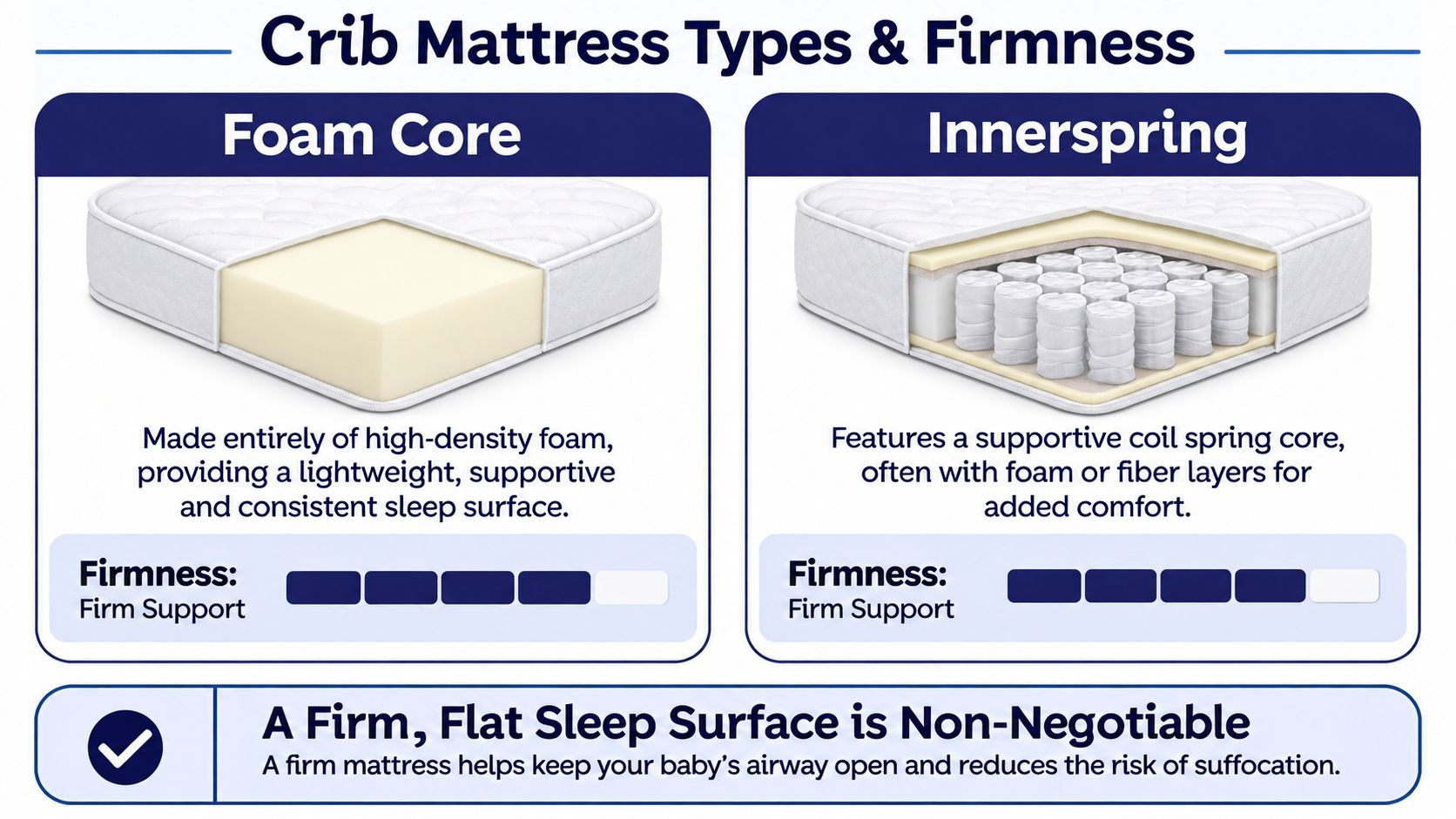
Common constructions
Foam-core mattresses are usually lightweight and easy to handle during sheet changes. Their performance depends on the foam's firmness, density, cover, and construction. A foam mattress should return to a flat shape rather than remaining visibly bowed or compressed.
Innerspring mattresses use coils beneath their surface layers. Their firmness depends on the coil system, padding, edge construction, and cover. The presence of springs alone doesn't prove that a mattress is suitable, so inspect the finished sleep surface and confirm its crib compatibility.
Memory foam deserves particular caution. A soft or contouring surface can create an indentation around the infant. That type of pressure relief may be appropriate in some adult products, but it doesn't match the firm, flat sleep surface recommended for infant sleep.
A simple inspection
Press the center of the mattress with your hand. It should feel firm and recover without a lasting depression. Check the edges for bowing, unevenness, or exposed construction, then place the mattress in the crib and confirm that it remains flat.
Don't add a topper to make the mattress softer or more comfortable. An extra layer can change the mattress's thickness, firmness, and fit. Use the supplied fitted sheet or one explicitly designed for that mattress, and avoid combining products that haven't been identified as compatible.
The following video can help parents think through safe sleep setup alongside the written guidance:
A mattress that feels less plush to an adult may be the more appropriate choice for an infant. Focus on a stable, level surface and a secure fit, not on the kind of cushioning you'd seek in an adult bed.
Recent Federal Safety Standards and Incident Data
Crib mattress regulation developed in response to documented hazards. The CPSC recorded 494 incidents associated with crib mattresses between January 2010 and April 2021, including 139 fatalities and 355 nonfatal incidents, as described in its announcement of the federal crib-mattress safety standard.
On January 26, 2022, the CPSC approved a mandatory federal safety standard addressing hazards such as excessively soft mattresses, lacerations from coil springs, inadequate warnings, and gaps between mattresses and the flexible sides of play yards or portable cribs. The agency said the requirements would apply by fall 2022 and would include improved markings, labeling, instructions, and a firmness test intended to reduce suffocation risks.
What the standard helps with
The rule gives manufacturers clearer performance and information requirements. For parents, that can make product identification, instructions, and intended use easier to evaluate. It also reinforces the importance of firmness and construction, rather than leaving the decision to appearance or marketing language.
Federal oversight doesn't mean every mattress can be moved from one sleep product to another. A full-size crib and a portable crib may have different dimensions and side flexibility. A mattress made for a full-size crib can create a dangerous gap when placed in a play yard or portable crib.
Compatibility still belongs to the buyer
The CPSC advises using the mattress supplied with a play yard, or one that specifically identifies the compatible brand and model. It also warns against stacking mattresses or adding supplemental padding. Those points matter when a bundled crib encourages the assumption that one mattress is suitable for every nursery product.
Retain the instructions and product labels after opening the box. If you're considering an aftermarket mattress, confirm the intended crib type, model compatibility, dimensions, thickness, and firmness before purchasing it. The presence of a federal standard improves the information available to families, but it doesn't remove the need to match each mattress to the sleep product it was designed for.
Bundle Value and Long-Term Ownership Considerations
A crib with a mattress included may simplify the initial purchase, but the lowest upfront cost isn't always the most flexible option over time. The mattress may have a nonstandard size, a cover that is difficult to clean, or no clearly documented replacement path. Those limitations can matter after a spill, illness, loss of firmness, or a need for a second compatible fitted sheet.
Compare the ownership experience
| Question | Included mattress | Separate mattress |
|---|---|---|
| Initial setup | Convenient, because the components arrive together | Requires a separate compatibility check |
| Fit control | Depends on the bundle's documentation and construction | Lets you select a model for the exact crib |
| Replacement planning | May be simple if the manufacturer offers the same model | Can be clearer when replacement availability is documented |
| Maintenance | Depends on the cover and cleaning instructions | You can compare cover materials and care requirements |
| Future flexibility | May be limited by a proprietary or unusual size | May offer more choice, provided the fit remains correct |
A bundled mattress can provide good practical value when the crib manufacturer clearly documents its dimensions, intended use, care instructions, and replacement availability. It can also reduce the chance that a parent purchases an incompatible mattress separately.
A separate purchase may make more sense when you need a washable cover, a documented replacement option, or control over construction. That choice adds responsibility, because the replacement still has to meet the crib's dimensions and thickness requirements. Convenience and control sit on opposite sides of the decision.
Questions worth asking before committing
- Can the exact mattress be replaced? Ask for the model name or product number, not just a general description.
- How should the cover be cleaned? Confirm whether the cover is removable and follow the manufacturer's care directions.
- What happens if the mattress arrives damaged? Review the retailer's return process and the manufacturer's warranty terms.
- Will the child use another sleep product later? A full-size crib mattress may not fit a portable crib or play yard.
- Can you obtain a correctly fitted sheet? The sheet should be designed for the specific mattress and should remain snug.
Long-term value means maintaining a safe fit and firm surface, not simply paying less at the beginning.
Budget planning should include replacement access and maintenance. A bundle is worth considering when it supports consistent safe use throughout the crib's practical life. If the mattress becomes difficult to identify, clean, or replace, the original convenience may not last.
Parent Checklist for Cribs With Mattress Included
Use the checklist while comparing products, opening the package, and preparing the nursery. A written record of the model number, dimensions, instructions, and retailer contact details can save time later.
Before purchase
- Read the crib label: Record the specified mattress length, width, and thickness.
- Verify the included mattress: Confirm its measurements and intended use rather than relying on the phrase “standard size.”
- Ask about replacements: Find out whether the same mattress or an explicitly compatible model can be purchased later.
- Review care information: Check how the cover and surface should be cleaned.
- Confirm support: Ask whether the product includes assembly instructions, warranty information, and the required hardware.
- Plan the fitted sheet: Select a sheet made for that mattress, with a snug fit and no loose fabric.
For a broader nursery planning list, EasyRegistry's guide for expectant parents can help you organize other essentials without losing sight of the sleep surface itself.
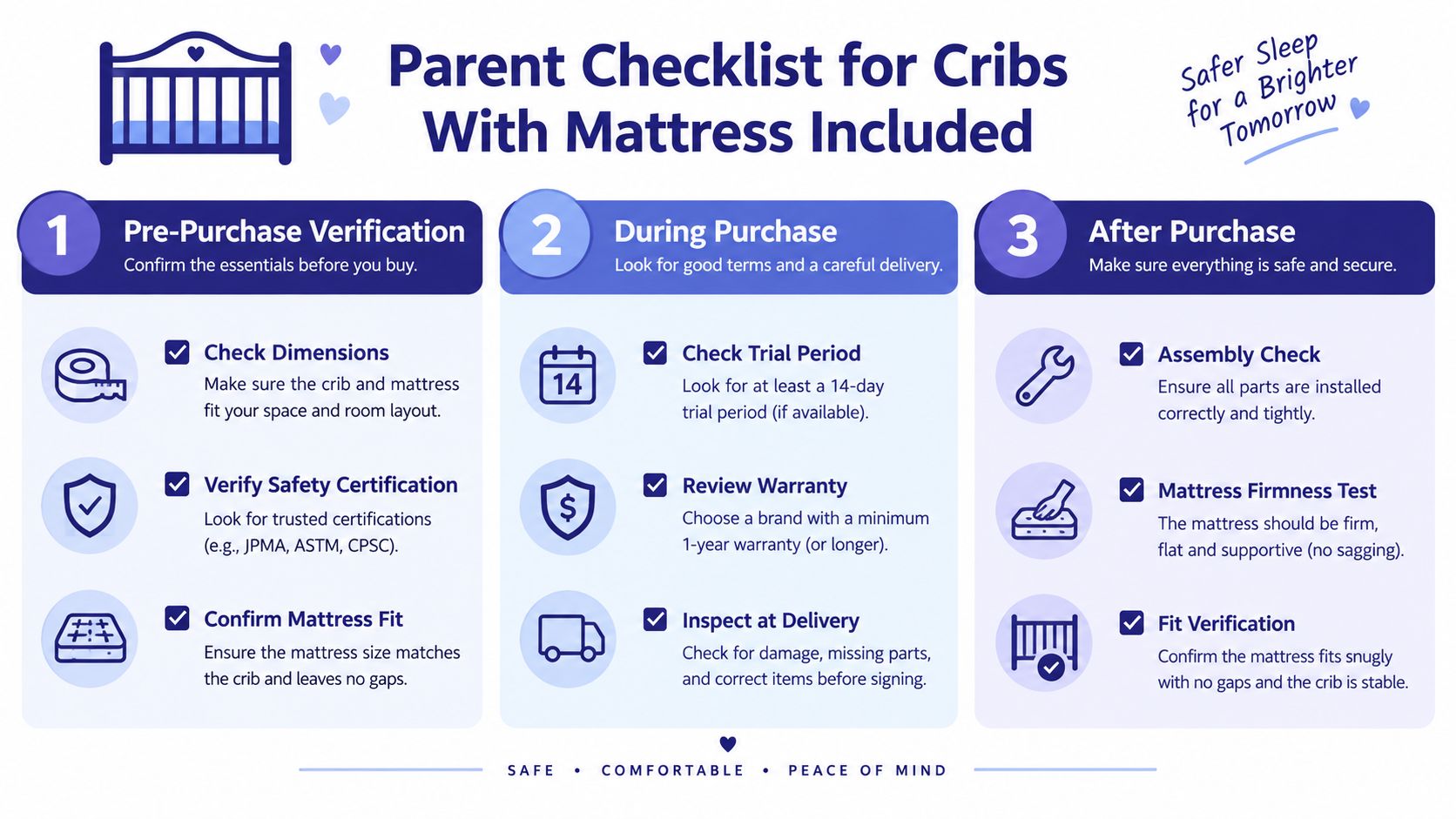
When the package arrives
- Inspect the mattress: Look for damage, unusual odors, visible deformation, or a surface that doesn't lie flat.
- Assemble the crib exactly: Follow the manufacturer's instructions and don't modify the frame or support system.
- Check the fit: Place the mattress in the intended position and inspect all sides for gaps.
- Test the surface: Press the center and edges. The mattress should remain firm and flat without a lasting indentation.
- Keep the paperwork: Store labels, instructions, receipts, and warranty documents together.
During use
Keep only the fitted sheet on the mattress. Don't add pillows, loose blankets, toppers, padding, or another mattress. Recheck the surface after cleaning, moving the crib, or changing the mattress, and stop using a product that becomes damaged, warped, excessively soft, or incompatible with the crib.
Making an Informed Nursery Decision
A parent may begin with a simple question: “Does this crib include a mattress?” A better question is, “Do these two components work together safely, and can I maintain that fit over time?” That change in wording shifts attention from the box contents to the actual sleep environment.
A hands-on inspection can make the decision clearer. You can examine the mattress label, compare the stated measurements with the crib's warning information, check whether the surface lies flat, and ask how a replacement would be sourced. Those details are difficult to evaluate from a product title alone.
What confident buying looks like
Confident buying doesn't mean finding a product with the most features. It means understanding the specific trade-offs:
- A bundle can simplify setup, but it still requires a fit check.
- A lightweight mattress can make sheet changes easier, but construction and firmness remain the priority.
- A separate mattress can offer more choice, but you must verify every measurement and compatibility detail.
- A lower initial cost can lose its value if replacement and cleaning options are unclear.
Knowledgeable staff can also help explain manufacturer specifications and point out differences between full-size cribs, portable cribs, and play yards. That conversation should support your decision, not replace your responsibility to read the label and inspect the product.
The safest choice is the one you can identify, assemble, use, clean, and replace without guesswork. Treat the crib and mattress as one integrated sleep system, and the purchase becomes less confusing because each question has a practical purpose.
Woodstock Furniture & Mattress Outlet offers nursery furniture, mattresses, and hands-on guidance for families comparing sleep products and planning a complete room. Visit Woodstock Furniture & Mattress Outlet to examine available options, ask specific fit and care questions, and get practical help without pressure.
Leave a Reply
You must be logged in to post a comment.