Tag: crib safety

  • Cribs with Mattress Included: Safety, Sizing, and Selection

    Cribs with Mattress Included: Safety, Sizing, and Selection

    [3028]

    You're comparing nursery furniture, checking dimensions, and trying to avoid one more complicated decision. Then you see a crib advertised with a mattress included. The bundle looks like a practical shortcut, especially when you're furnishing a room for the first time.

    That convenience can be real, but the crib and mattress shouldn't be treated as unrelated pieces. A bundled crib is a safety-critical sleep system. Its value depends on whether the mattress fits the crib correctly, remains firm and flat, and is approved for that specific sleep space.

    A young woman looking thoughtfully at a crib bundle package in a store while holding a shopping list.

    Why the bundle needs closer attention

    A crib may look sturdy while the included mattress creates a problem through an undersized fit, excessive thickness, or a surface that compresses too easily. Parents can also assume that a mattress supplied with one crib will work in a portable crib, play yard, or replacement frame. That assumption can create gaps or change the way the sleep surface behaves.

    The safer mindset is to evaluate the package as one coordinated product. Start with the manufacturer's dimensions and warning label, then consider firmness, fitted-sheet compatibility, cleaning, replacement availability, and intended use.

    Practical rule: “Mattress included” describes what comes in the box. It doesn't replace the need to verify that the mattress is suitable for the crib.

    A good bundle should make the safety checks easier, not encourage you to skip them. The important questions are concrete: Does the mattress match the crib's specified size? Does it lie flat? Can you identify the correct fitted sheet and obtain a compatible replacement if needed? Those answers matter more than the convenience of receiving both items together.

    Federal Crib and Mattress Dimensions Explained

    For a standard full-size crib, the CPSC defines the interior sleeping area as 52 3/8 inches, plus or minus 5/8 inch, in length, and 28 inches, plus or minus 5/8 inch, in width. The mattress must measure at least 27 1/4 inches by 51 1/4 inches and must be no more than 6 inches thick. These requirements are outlined in the CPSC's crib mattress guidance.

    The figures aren't just manufacturing details. They limit the open space around the mattress, where an infant could become trapped between the mattress and crib sides.

    How to check a bundled crib

    Use this sequence before assembly or sleep use:

    1. Find the crib label. Look for the warning label, product identification information, and the manufacturer's specified mattress dimensions.
    2. Read the included mattress information. Confirm its length, width, thickness, and intended crib type. If the packaging doesn't provide those details, ask the retailer or manufacturer before relying on the mattress.
    3. Compare the measurements. The supplied mattress should fall within the crib's stated requirements, not merely be described as a “standard crib mattress.”
    4. Check the fit after assembly. Place the mattress in the correct support position and inspect the perimeter. It should sit flat and leave no concerning gap around the edges.
    5. Keep the documentation. Instructions, labels, and model information can help if you need replacement parts or a compatible mattress later.

    The CPSC also references ASTM F2933 in its crib-mattress rules, so product labeling and compliance information can help you make a more informed purchase. A label isn't a substitute for checking the physical fit, but missing or unclear information deserves attention.

    Before replacing the mattress: Measure the crib and compare the replacement with the manufacturer's stated dimensions. Don't assume that a mattress marketed for a full-size crib will fit every crib frame.

    Exact fit remains important after purchase. Avoid substituting an undersized mattress or choosing a thicker model because it feels more comfortable to an adult. In an infant sleep space, preserving the intended clearance and mattress height is more important than adding plushness.

    Evaluating Crib Mattress Types and Firmness

    A crib mattress should provide a firm, flat sleep surface. The American Academy of Pediatrics recommends placing an infant on their back on a firm, flat surface in a crib that meets current safety standards. It also recommends using only a fitted sheet and keeping pillows, loose blankets, and soft bedding out of the sleep space, as explained in the AAP safe-sleep guidance.

    That standard changes how you should assess materials. Adult mattresses often emphasize pressure relief and cushioning. An infant mattress needs stable support and a surface that doesn't develop a deep indentation under light pressure.
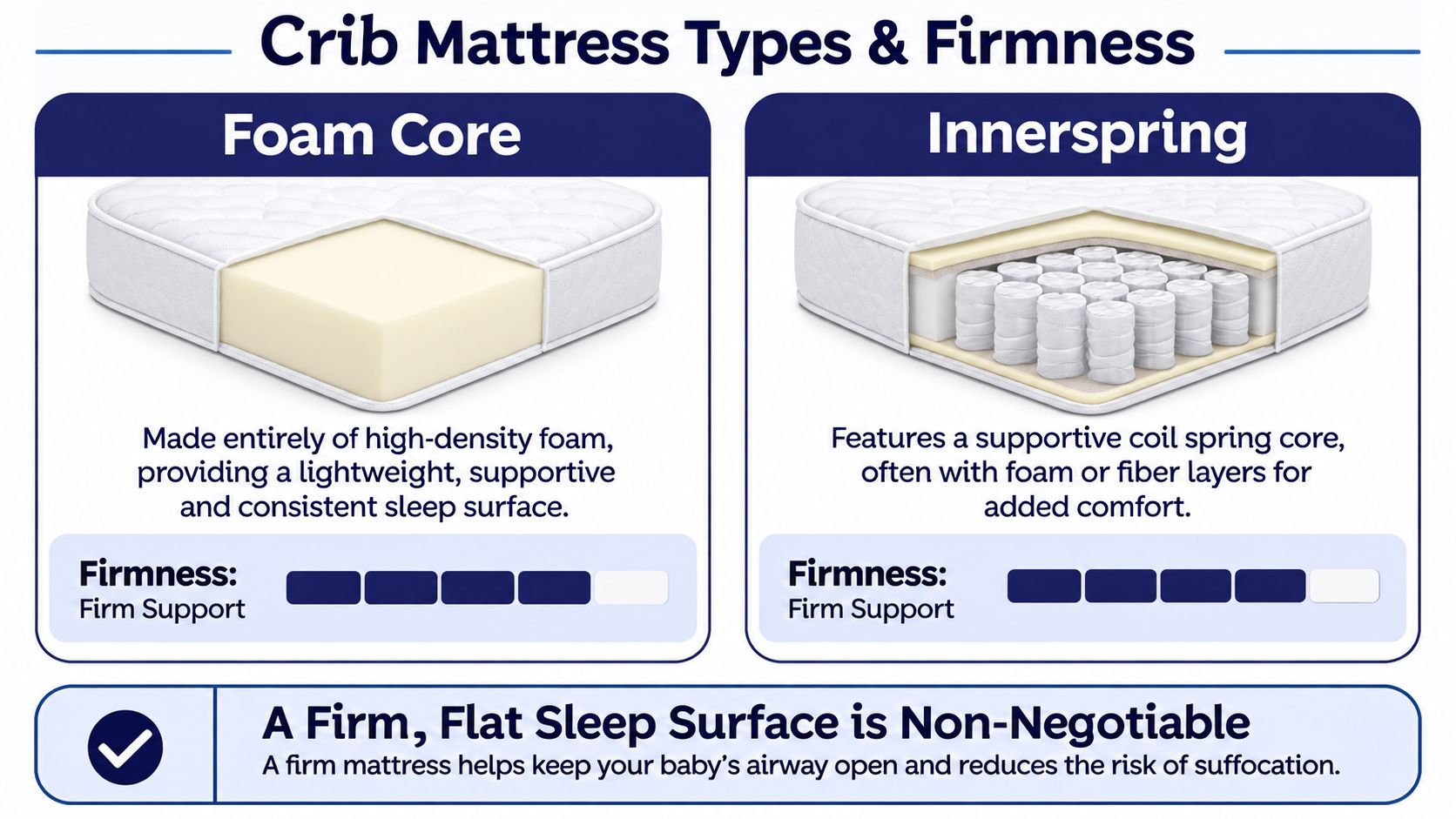
    An infographic comparing foam core and innerspring crib mattresses, highlighting their firm support for infant safety.

    Common constructions

    Foam-core mattresses are usually lightweight and easy to handle during sheet changes. Their performance depends on the foam's firmness, density, cover, and construction. A foam mattress should return to a flat shape rather than remaining visibly bowed or compressed.

    Innerspring mattresses use coils beneath their surface layers. Their firmness depends on the coil system, padding, edge construction, and cover. The presence of springs alone doesn't prove that a mattress is suitable, so inspect the finished sleep surface and confirm its crib compatibility.

    Memory foam deserves particular caution. A soft or contouring surface can create an indentation around the infant. That type of pressure relief may be appropriate in some adult products, but it doesn't match the firm, flat sleep surface recommended for infant sleep.

    A simple inspection

    Press the center of the mattress with your hand. It should feel firm and recover without a lasting depression. Check the edges for bowing, unevenness, or exposed construction, then place the mattress in the crib and confirm that it remains flat.

    Don't add a topper to make the mattress softer or more comfortable. An extra layer can change the mattress's thickness, firmness, and fit. Use the supplied fitted sheet or one explicitly designed for that mattress, and avoid combining products that haven't been identified as compatible.

    The following video can help parents think through safe sleep setup alongside the written guidance:

    A mattress that feels less plush to an adult may be the more appropriate choice for an infant. Focus on a stable, level surface and a secure fit, not on the kind of cushioning you'd seek in an adult bed.

    Recent Federal Safety Standards and Incident Data

    Crib mattress regulation developed in response to documented hazards. The CPSC recorded 494 incidents associated with crib mattresses between January 2010 and April 2021, including 139 fatalities and 355 nonfatal incidents, as described in its announcement of the federal crib-mattress safety standard.

    On January 26, 2022, the CPSC approved a mandatory federal safety standard addressing hazards such as excessively soft mattresses, lacerations from coil springs, inadequate warnings, and gaps between mattresses and the flexible sides of play yards or portable cribs. The agency said the requirements would apply by fall 2022 and would include improved markings, labeling, instructions, and a firmness test intended to reduce suffocation risks.

    What the standard helps with

    The rule gives manufacturers clearer performance and information requirements. For parents, that can make product identification, instructions, and intended use easier to evaluate. It also reinforces the importance of firmness and construction, rather than leaving the decision to appearance or marketing language.

    Federal oversight doesn't mean every mattress can be moved from one sleep product to another. A full-size crib and a portable crib may have different dimensions and side flexibility. A mattress made for a full-size crib can create a dangerous gap when placed in a play yard or portable crib.

    Compatibility still belongs to the buyer

    The CPSC advises using the mattress supplied with a play yard, or one that specifically identifies the compatible brand and model. It also warns against stacking mattresses or adding supplemental padding. Those points matter when a bundled crib encourages the assumption that one mattress is suitable for every nursery product.

    Retain the instructions and product labels after opening the box. If you're considering an aftermarket mattress, confirm the intended crib type, model compatibility, dimensions, thickness, and firmness before purchasing it. The presence of a federal standard improves the information available to families, but it doesn't remove the need to match each mattress to the sleep product it was designed for.

    Bundle Value and Long-Term Ownership Considerations

    A crib with a mattress included may simplify the initial purchase, but the lowest upfront cost isn't always the most flexible option over time. The mattress may have a nonstandard size, a cover that is difficult to clean, or no clearly documented replacement path. Those limitations can matter after a spill, illness, loss of firmness, or a need for a second compatible fitted sheet.

    Compare the ownership experience

    Question Included mattress Separate mattress
    Initial setup Convenient, because the components arrive together Requires a separate compatibility check
    Fit control Depends on the bundle's documentation and construction Lets you select a model for the exact crib
    Replacement planning May be simple if the manufacturer offers the same model Can be clearer when replacement availability is documented
    Maintenance Depends on the cover and cleaning instructions You can compare cover materials and care requirements
    Future flexibility May be limited by a proprietary or unusual size May offer more choice, provided the fit remains correct

    A bundled mattress can provide good practical value when the crib manufacturer clearly documents its dimensions, intended use, care instructions, and replacement availability. It can also reduce the chance that a parent purchases an incompatible mattress separately.

    A separate purchase may make more sense when you need a washable cover, a documented replacement option, or control over construction. That choice adds responsibility, because the replacement still has to meet the crib's dimensions and thickness requirements. Convenience and control sit on opposite sides of the decision.

    Questions worth asking before committing

    • Can the exact mattress be replaced? Ask for the model name or product number, not just a general description.
    • How should the cover be cleaned? Confirm whether the cover is removable and follow the manufacturer's care directions.
    • What happens if the mattress arrives damaged? Review the retailer's return process and the manufacturer's warranty terms.
    • Will the child use another sleep product later? A full-size crib mattress may not fit a portable crib or play yard.
    • Can you obtain a correctly fitted sheet? The sheet should be designed for the specific mattress and should remain snug.

    Long-term value means maintaining a safe fit and firm surface, not simply paying less at the beginning.

    Budget planning should include replacement access and maintenance. A bundle is worth considering when it supports consistent safe use throughout the crib's practical life. If the mattress becomes difficult to identify, clean, or replace, the original convenience may not last.

    Parent Checklist for Cribs With Mattress Included

    Use the checklist while comparing products, opening the package, and preparing the nursery. A written record of the model number, dimensions, instructions, and retailer contact details can save time later.

    Before purchase

    • Read the crib label: Record the specified mattress length, width, and thickness.
    • Verify the included mattress: Confirm its measurements and intended use rather than relying on the phrase “standard size.”
    • Ask about replacements: Find out whether the same mattress or an explicitly compatible model can be purchased later.
    • Review care information: Check how the cover and surface should be cleaned.
    • Confirm support: Ask whether the product includes assembly instructions, warranty information, and the required hardware.
    • Plan the fitted sheet: Select a sheet made for that mattress, with a snug fit and no loose fabric.

    For a broader nursery planning list, EasyRegistry's guide for expectant parents can help you organize other essentials without losing sight of the sleep surface itself.
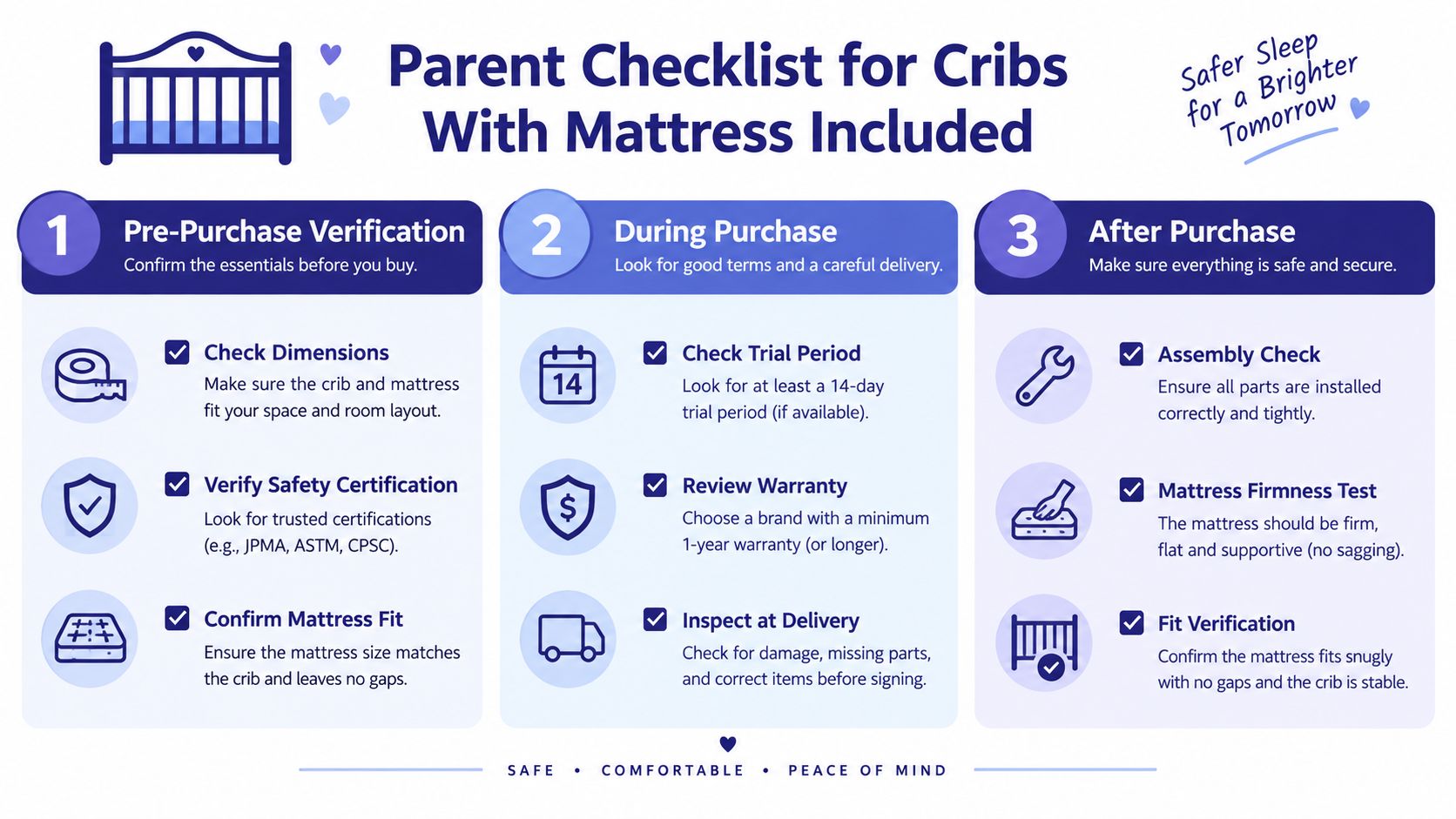
    A safety checklist infographic for parents buying a crib with a mattress, outlining pre-purchase, purchase, and assembly steps.

    When the package arrives

    • Inspect the mattress: Look for damage, unusual odors, visible deformation, or a surface that doesn't lie flat.
    • Assemble the crib exactly: Follow the manufacturer's instructions and don't modify the frame or support system.
    • Check the fit: Place the mattress in the intended position and inspect all sides for gaps.
    • Test the surface: Press the center and edges. The mattress should remain firm and flat without a lasting indentation.
    • Keep the paperwork: Store labels, instructions, receipts, and warranty documents together.

    During use

    Keep only the fitted sheet on the mattress. Don't add pillows, loose blankets, toppers, padding, or another mattress. Recheck the surface after cleaning, moving the crib, or changing the mattress, and stop using a product that becomes damaged, warped, excessively soft, or incompatible with the crib.

    Making an Informed Nursery Decision

    A parent may begin with a simple question: “Does this crib include a mattress?” A better question is, “Do these two components work together safely, and can I maintain that fit over time?” That change in wording shifts attention from the box contents to the actual sleep environment.

    A hands-on inspection can make the decision clearer. You can examine the mattress label, compare the stated measurements with the crib's warning information, check whether the surface lies flat, and ask how a replacement would be sourced. Those details are difficult to evaluate from a product title alone.

    What confident buying looks like

    Confident buying doesn't mean finding a product with the most features. It means understanding the specific trade-offs:

    • A bundle can simplify setup, but it still requires a fit check.
    • A lightweight mattress can make sheet changes easier, but construction and firmness remain the priority.
    • A separate mattress can offer more choice, but you must verify every measurement and compatibility detail.
    • A lower initial cost can lose its value if replacement and cleaning options are unclear.

    Knowledgeable staff can also help explain manufacturer specifications and point out differences between full-size cribs, portable cribs, and play yards. That conversation should support your decision, not replace your responsibility to read the label and inspect the product.

    The safest choice is the one you can identify, assemble, use, clean, and replace without guesswork. Treat the crib and mattress as one integrated sleep system, and the purchase becomes less confusing because each question has a practical purpose.


    Woodstock Furniture & Mattress Outlet offers nursery furniture, mattresses, and hands-on guidance for families comparing sleep products and planning a complete room. Visit Woodstock Furniture & Mattress Outlet to examine available options, ask specific fit and care questions, and get practical help without pressure.

  • Are Bumper Sets for Cribs Safe? Your 2026 Guide

    Are Bumper Sets for Cribs Safe? Your 2026 Guide

    You're standing in the nursery aisle, or scrolling late at night, looking at coordinated crib bedding sets that make the whole room feel finished. The quilt matches the sheet. The skirt matches the lamp shade. And the bumper set around the crib makes everything look softer, warmer, more complete.

    That reaction is understandable. A nursery is emotional. Parents want it to feel calm, welcoming, and cared for.

    The problem is that what looks complete in a catalog isn't always what belongs in a crib. “Bumper sets for cribs” are one of the most confusing examples. Some listings still use old product language. Some stores mix legal terms with safety advice. Some parents hear “bumpers are banned” and assume that means every crib liner of any kind is illegal. Others hear “mesh is breathable” and assume it must be recommended.

    Neither shortcut helps when you're trying to set up a safe sleep space for a newborn.

    If you're also thinking about textures, bedding, and choosing safe nursery fabrics, that's a smart place to focus your energy. Fabric choices matter throughout the room. They just don't change the basic rule for the crib itself.

    The Dream Nursery vs The Safe Nursery

    A lot of expecting parents start the same way. They pick a wall color, save a few nursery photos, and begin building a look. The crib often becomes the visual center of the room, so it's easy to see why bumper sets for cribs became popular for so long. They make the crib look dressed.

    But a crib isn't a decorative frame. It's a sleep space for an infant who can't reliably move away from hazards.

    What parents usually want

    Most families aren't trying to take risks. They're trying to solve familiar concerns:

    • A softer look: The wooden slats can feel plain or stark.
    • A finished collection: Matching bedding creates a polished room.
    • Protection worries: Some parents worry about arms or legs slipping between slats.
    • Gift set convenience: Bundled nursery sets make decisions feel easier.

    Those are real reasons people consider bumpers. They just don't outweigh sleep safety.

    A beautiful nursery should support safe sleep, not compete with it.

    Where the confusion starts

    The confusion usually comes from mixed messages. One source says bumpers are banned. Another says only padded ones are banned. A product listing uses terms like liner, guard, breathable, or mesh, and suddenly the issue feels harder than it should.

    In practice, the safest way to think about it is simple. If something adds soft material or unnecessary barrier material inside the crib, slow down and question it. Marketing language often sounds reassuring. Safe sleep guidance is usually more direct.

    That's the tension many parents feel. They want the nursery to look warm and intentional, but they also want to know they're following current safety rules. Both goals matter. Safety just comes first.

    The Federal Ban on Padded Crib Bumpers Explained

    A parent walks into a nursery store, sees a crib dressed with a matching bumper, and assumes it must still be acceptable if it is being shown that way. That is a reasonable assumption. It is also where a lot of confusion starts.

    Padded crib bumpers are federally banned in the United States. Under the Safe Sleep for Babies Act of 2021, the U.S. Consumer Product Safety Commission banned the manufacture, sale, and importation of padded crib bumpers. The ban took effect on November 12, 2022, according to the CPSC crib bumper FAQs.

    An infographic explaining the federal ban on padded crib bumpers and inclined sleepers for baby safety.

    Why the law changed

    The ban followed years of documented injury and death reports tied to padded bumper use. The CPSC reported 113 infant deaths associated with crib bumpers or bumper pads from January 1990 through March 2019, and 113 nonfatal incidents from January 2008 through March 2019 in its final rule on crib bumpers and liners.

    Those cases involved hazards parents can easily underestimate in a real nursery. A baby can press their face against a padded surface and not move away effectively. Ties and attached sections can also create strangulation and entrapment risks. In practice, the concern is not whether a bumper looks soft or secure. The concern is whether it adds a hazard inside an infant sleep space.

    What counts as a banned bumper

    For parents shopping in North Georgia, the legal wording matters because store labels and online listings are not always clear. A product marketed as part of a crib bedding set may still fall under the ban if it is designed to line the inside perimeter of the crib with padded material.

    That includes the traditional cushioned bumper many families remember from older nursery displays. If it is padded and intended to sit along the inside of the crib, treat that as a product to avoid.

    What this means in real shopping situations

    I often tell parents to ask one plain question before they buy anything for the crib: Is this item meant to stay inside the crib while my baby sleeps? If the answer is yes, it deserves extra scrutiny.

    In local stores, ask staff whether the item is a padded crib bumper, whether it is being sold for infant sleep use, and whether it complies with current federal law. If the answers are vague, skip it. Clear, current safety guidance should never depend on guesswork.

    The practical takeaway is simple. You do not need to compare bumper thickness, tie style, or fabric quality. For padded crib bumpers, the legal and safety answer is already settled.

    Padded vs Mesh vs Vertical Liners What Parents Should Know

    A parent in a North Georgia showroom will often point to a mesh liner or slat cover and ask the question I hear all the time: if padded bumpers are out, is this version okay? The answer takes a little sorting out because product labels, federal rules, and pediatric guidance do not always use the same line.

    Here is the practical distinction. Some products may not fall under the federal ban discussed earlier, yet they still add material to the inside of the crib. For newborn sleep spaces, that is enough reason to be cautious.

    The legal distinction

    Parents need to separate legality from best practice for sleep safety.

    Non-padded mesh liners are generally treated differently from padded bumpers under federal law. Vertical slat covers create more confusion because product descriptions are not always clear, and store staff do not always explain whether the item is meant to remain inside the crib during sleep.

    That leaves families with two separate questions:

    1. Is this product prohibited under current federal rules?
    2. Would a pediatric safe sleep professional recommend putting it in an infant's crib?

    For many nursery purchases, those answers line up neatly. In the bumper category, they often do not.

    Crib liner options, a safety comparison

    Liner Type Legal Status AAP Recommendation Primary Concern
    Padded crib bumper Federally banned Not recommended Suffocation, strangulation, entrapment
    Non-padded mesh liner Not generally included in the padded bumper ban Not part of a bare crib setup Extra material inside the crib, possible entanglement or attachment concerns
    Vertical slat cover or similar guard Listings can be unclear, so parents should verify use and design carefully Not part of a bare crib setup Barrier material inside the crib, labeling confusion, attachment risks

    What parents should do with that information

    The safest buying decision is usually the simplest one. Skip the search for a “safer bumper alternative” and put that budget toward a well-made crib, a firm mattress, and fitted sheets that stay snug.

    I understand why families still look at mesh products. Parents worry about an arm or leg slipping through the slats, or they are trying to recreate the finished nursery look they saw online or in a display. In day-to-day pediatric safety practice, those worries are common, but liners are rarely the right fix.

    For North Georgia parents shopping locally, ask clear questions before anything goes in the cart: Is this designed to attach inside the crib? Is it intended to stay in place while a baby sleeps? Is the product being recommended for an infant, or for an older child in a different stage? If the answer is fuzzy, walk away.

    Retail confusion is common in this category. Safety standards should not depend on a salesperson's guess or a packaging photo that looks reassuring.

    A good rule in the store is simple. If the product's job is to line, cushion, or cover the inside perimeter of the crib, it does not belong on the newborn must-have list.

    Why a Bare Crib Is the Safest Crib

    The safest crib setup is refreshingly plain. The American Academy of Pediatrics recommends a bare crib, meaning parents should not put crib bumpers, liners, pillows, quilts, comforters, or stuffed toys in the crib, as noted in the CPSC crib safety tips reflecting AAP guidance.

    A line art drawing of a baby crib surrounded by a teddy bear, mobile, and safe sleep label.

    What should be in the crib

    For everyday use, think in essentials:

    • A firm, flat crib mattress: It should fit the crib properly and sit securely.
    • A fitted sheet: It should stay taut with no loose fabric.
    • Nothing else inside the sleep space: No decorative extras, even if they came with the set.

    That simplicity is the point. Babies don't need a styled bed. They need a clear, stable sleep surface.

    Why this standard is easier to follow

    Parents sometimes hear “bare crib” and think it sounds cold or overly strict. In practice, it removes guesswork. You don't have to decide whether a small pillow is probably fine, whether a liner seems breathable enough, or whether a rolled blanket only counts during naps.

    The rule is easier than the exceptions. If it isn't the fitted sheet or the mattress, it stays out.

    Keep the crib for sleep. Put the soft, decorative, and sentimental items elsewhere in the room.

    Common items to move out of the crib

    A crib often becomes a landing spot for nursery gifts and cute accessories. Before baby sleeps there, clear out the extras.

    • Stuffed animals: Better on a shelf than in the crib.
    • Heirloom blankets: Display them over a chair or keep them stored.
    • Sleep positioners and padded accessories: They add clutter to a space that should stay open.
    • Matching set pieces: If the set includes decorative pieces, use only what belongs outside the crib.

    For many families, this shift is less about giving something up and more about understanding what the crib is for. It isn't the visual centerpiece of the nursery. It's the safest sleep zone in the room.

    Creating a Beautiful and Safe Nursery Without Bumpers

    A nursery can still feel layered, cozy, and personal without bumper sets for cribs. In fact, most of the room's style should come from the parts of the nursery that aren't inside the crib.

    A charming nursery room featuring a wooden crib, a round rug, and whimsical woodland animal decorations.

    Where to put the color and softness instead

    Start with the larger surfaces in the room, not the sleep space.

    • Fitted crib sheets: A patterned fitted sheet can add theme and color while still keeping the crib setup simple.
    • Crib skirt: This gives the crib a finished look without adding anything around the baby.
    • Area rug: A rug brings warmth to the room visually and physically during late-night feedings.
    • Window treatments: Curtains or shades can carry the color story better than crib accessories ever could.

    Details that add personality safely

    The most successful nurseries usually build style through layers around the crib.

    A painted accent wall, removable decals, framed prints, and a well-placed mobile can do more for the room than padded bedding ever did. The key with a mobile is placement. It should be secure and out of baby's reach.

    A reading corner also helps the room feel complete. A glider, a side table, a lamp with soft light, and a small basket for books create a useful zone that contributes more to daily life than decorative crib padding.

    A safe nursery doesn't have to look stripped down. It just asks you to decorate the room instead of decorating the inside of the crib.

    A simple design approach that works

    If parents feel stuck, I usually suggest building the nursery in this order:

    1. Choose the crib and dresser first. Those are your anchor pieces.
    2. Pick one textile direction. That might be floral, woodland, stripes, or simple solids.
    3. Repeat that theme outside the crib. Use curtains, art, a rug, and storage bins.
    4. Keep the crib interior minimal. Let the sheet be the only visible fabric inside.

    That approach gives you a room that still feels intentional. It also avoids the old habit of treating a crib like a decorated bed, which is where many bumper decisions started.

    A North Georgia Parents Guide to Nursery Shopping

    If you're shopping locally in North Georgia, an in-person visit can make nursery decisions easier. Photos help, but crib scale, mattress fit, drawer function, and finish quality are all easier to judge when you can see them yourself.

    That matters even more when you've ruled out bumper sets for cribs and want the room to feel complete in other ways. In a showroom, parents can compare crib silhouettes, dresser heights, wood tones, and practical storage options without relying on packaging claims.

    Questions worth asking in a local store

    Bring a short list and keep it practical.

    • Can you show me cribs that meet current CPSC safety standards?
    • Which nursery collections work well for parents who want a simple, AAP-aligned crib setup?
    • What fitted sheet sizes match this mattress exactly?
    • How much storage does this dresser offer for daily baby items?
    • Is this finish easy to clean after normal nursery use?

    Those questions keep the focus where it belongs. You're not shopping for a staged photo. You're shopping for a room you'll use every day.

    What to look at beyond the crib

    A good nursery purchase often comes from the supporting pieces. Check whether the dresser top works for a changing pad, whether the nightstand has enough surface area for feeding essentials, and whether the chair fits the room without crowding pathways.

    If you're building your checklist, a practical resource on essential items for a working nursery can help you think beyond décor and focus on what makes the room easier to live in.

    A local mindset that helps

    North Georgia families often shop with real-life constraints in mind. They're thinking about room size, grandparents visiting, hand-me-down pieces, and whether a nursery can later become a toddler room. That's a smart approach.

    The best nursery shopping conversations usually sound grounded. Which crib feels sturdy. Which dresser gives you enough storage. Which pieces still work when the baby stage moves fast. Once you remove crib bumpers from the equation, the rest of the room gets simpler to design well.


    If you'd like hands-on help comparing nursery furniture, mattresses, and room layouts, Woodstock Furniture & Mattress Outlet is a useful North Georgia resource. Their team can help you look at nursery pieces in person, ask the right safety and sizing questions, and build a room that feels thoughtful, practical, and worth the drive.