You pull a shirt from the closet and a stack of folded clothes shifts onto the floor. The shelf above is too shallow for the things you need to store, while the hanging space is crowded with items you rarely wear. A closet organization system can help, but only if it fits your room, belongings, and living situation. Renters, in particular, may need storage that works without permanent changes.
What Closet Organization Systems Are and Why They Matter
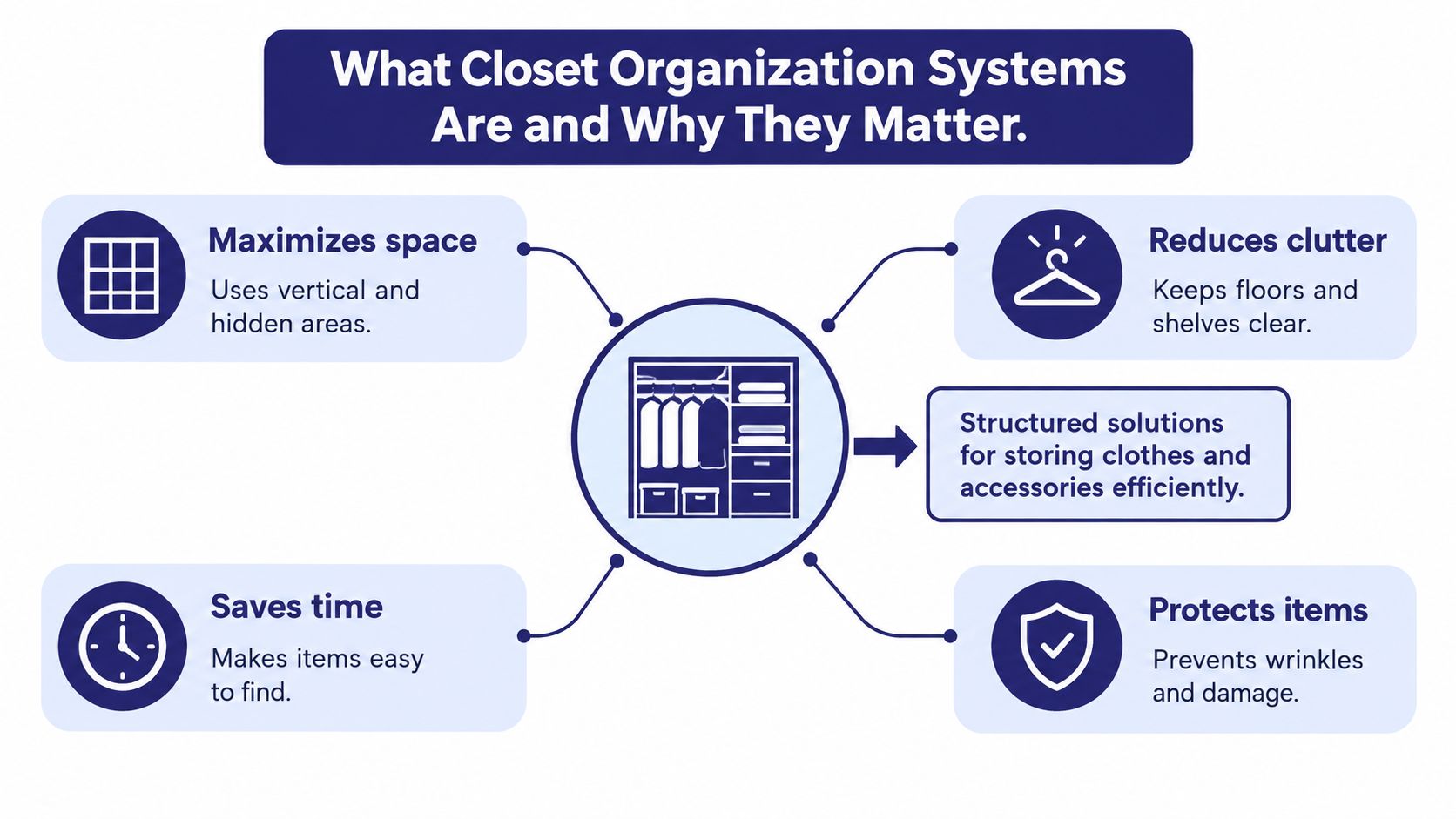
A closet organization system is a coordinated arrangement of storage components, such as hanging rods, shelves, drawers, bins, and shoe racks. Some systems are freestanding and easy to move. Others attach to the walls, adjust to different needs, or are designed as built-ins. Their purpose is to make the available space easier to use, not merely to make the closet look tidy.
That distinction matters. A row of bins may hide clutter without making daily items easier to find. A better layout puts frequently worn clothes within reach, gives folded garments a stable surface, and keeps the floor clear enough to access the rest of the closet.
Why a system can help
When storage has a clear place for different belongings, getting dressed can take less searching and reshuffling. Separating hanging clothes from folded items also reduces the chance that stacks topple each time you take something from the bottom. A system won't remove belongings you no longer use, but it can make what you keep more visible and accessible.
The need for organized storage isn't limited to large walk-in closets. A 2024 U.S. consumer survey found that 55% of homeowners said they didn't have enough home-storage solutions, such as cabinets, benches, shelves, or racks, to give everything a proper place. The survey covered home storage broadly, not closets alone, but it shows why closet planning can be part of a larger effort to create usable storage around the home. (2024 U.S. homeowner storage survey)
Start with what the closet needs to do
Think about the items that cause the most trouble. If shirts and jackets crowd the rod, a second hanging level may help. If shoes and folded clothes compete for shelf space, adjustable shelves or drawers may suit them better. If the problem is a lack of storage in a rental, a portable wardrobe may be more practical than a wall-mounted installation.
The right system depends on space, belongings, and daily habits, not on one universal closet plan. A small freestanding piece can be enough for a narrow closet, while a larger shared space may need several distinct zones.
Comparing Closet System Types and Who Each Fits Best
Different system types solve different problems. The main choices are freestanding units, modular systems, wire shelving, and custom built-ins. Compare them by how they attach, whether they can move with you, and how much flexibility you need, rather than assuming one category works for every home.
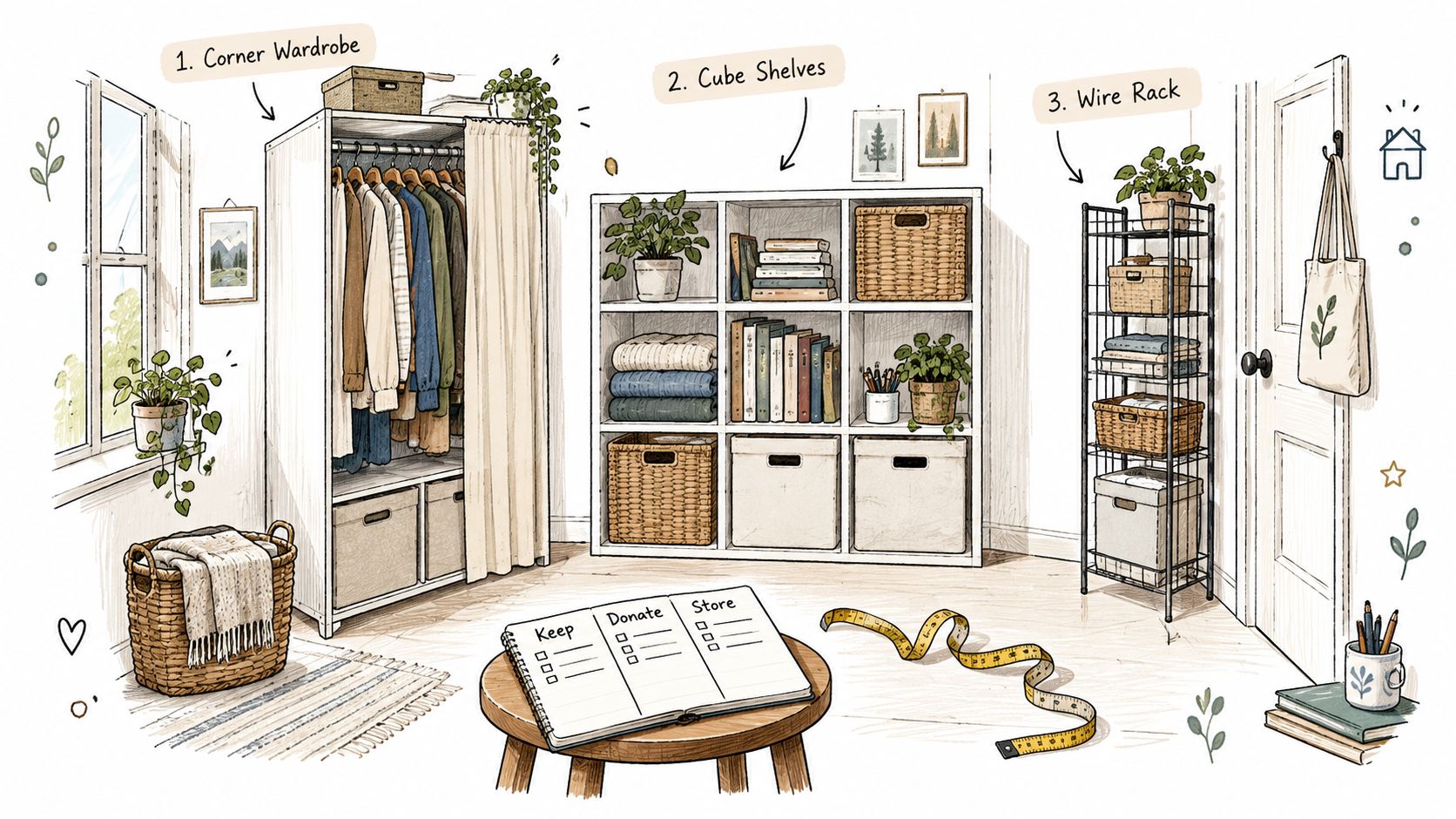
Freestanding units
Wardrobes and armoires provide hanging space and may include shelves or drawers. Because they don't require a permanently installed closet framework, they can suit renters, bedrooms without closets, or households that need portable storage. The tradeoff is that the unit occupies floor space, so check that doors and drawers can open without blocking pathways.
Modular systems
Modular pieces combine components that can be rearranged or expanded. They can be a practical option if you want to tailor a layout without committing to a fully built-in design. You'll need to confirm that the available widths and heights fit your closet, and that assembly and wall attachment, if required, are appropriate for your home and lease.
Wire shelving
Wire systems leave items visible and allow air to move around stored belongings. They're often used in utility and linen closets, but the open grid can be less suitable for small objects or delicate folded items. Don't assume a shelf can hold a particular load just because it's made of metal; span, supports, fasteners, and installation all matter.
Custom built-ins
Built-ins are designed for a particular space and can use its walls and vertical area efficiently. They're a more permanent choice, which can make them a poor fit for a renter or someone expecting to move soon. Before choosing one, consider whether the added fit and fixed installation suit how long you plan to stay and how you use the room.
A September 2022 storage report found that more than 53% of homeowners in homes larger than 2,000 square feet had wire organizers or a built-in closet organizer, and 27% upgraded their closet system after moving in. The figures illustrate that closet storage can be both an existing home feature and a later project. (September 2022 storage report)
A shelf's material alone doesn't tell you how much weight it can safely hold. Unsupported span, fastener penetration, the number of fasteners, panel density, and anchor quality all affect performance. A sturdy-looking shelf can still sag if it's too long for its supports or attached to the wall with unsuitable hardware.
As a general benchmark, a shelf spanning 24–36 inches may support approximately 50–75 pounds under a static, evenly distributed load. At a 36–48 inch span, the approximate capacity may fall to 40–50 pounds. These are not universal ratings for every product, so use them as context and follow the manufacturer's tested specifications for the actual shelf and installation. (closet shelf span and load guidance)
Shelf span
Approximate load capacity
Notes
24–36 inches
50–75 pounds
Static, evenly distributed load
36–48 inches
40–50 pounds
Longer spans may need added support
Distributed weight isn't the same as a heavy stack
A load rating for weight spread across a shelf doesn't automatically apply to a concentrated pile. A dense stack of books, shoes, or folded linens puts more pressure in a smaller area. If a shelf will hold heavy or tightly grouped items, check the manufacturer's guidance for that use rather than relying on a distributed-load figure.
Practical rule: Keep regularly loaded shelves within the manufacturer's tested span and load range. Add a center support or vertical panel when the design calls for one.
Check the wall connection
Whenever possible, secure the system to structural studs using the specified hardware. If studs aren't available where you need the supports, choose anchors with a rated capacity that exceeds the calculated load, including the shelf, brackets, and contents. Follow installation instructions for the wall type; drywall alone shouldn't be treated as a reliable support method without appropriate rated anchors.
This is especially important for renters. Ask the property manager what attachments are permitted before drilling, and make sure the system's weight and anchoring needs suit the approved installation. A freestanding unit avoids many wall-attachment questions, though it still needs to fit the room and remain stable in use.
Measuring Your Closet and Planning the Layout
Measure before choosing a system. A product that looks suitable online may be too deep for a door to close over, or too tall for a closet with a low ceiling. Write down the clear dimensions and note anything that could interfere with installation or everyday access.
Record the usable space
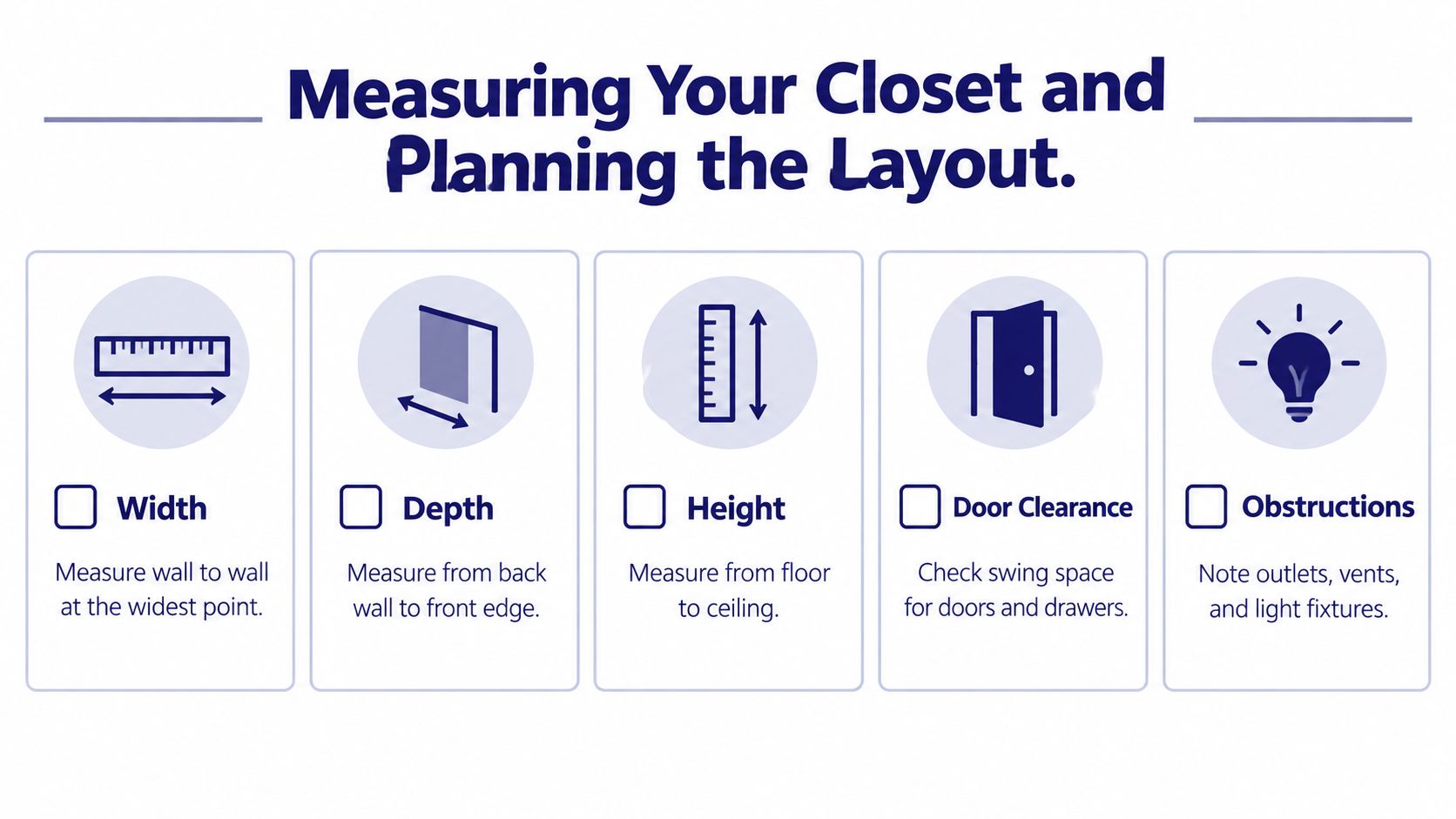
Measure width from wall to wall, depth from the back wall to the front edge, and height from the floor to the ceiling. If the walls or floor aren't perfectly even, note that too. Record door swing and clearance for drawers, and mark outlets, vents, light fixtures, and existing shelving that might limit where components can go.
Then inventory the belongings you plan to store. Separate clothes that hang from those you fold, and set aside space for shoes, bags, and accessories. If two people share a closet, identify which items each person needs to reach daily. That inventory gives you a more useful starting point than choosing a layout based only on an attractive display.
Put daily items where they're easy to reach
Place the items you use most often in convenient locations, then assign less-used or seasonal belongings to harder-to-reach areas. The 2010 ADA Standards use a forward-reach range of 15 to 48 inches above the floor, which can serve as a practical reference for frequently accessed clothing and accessories. It's a helpful planning benchmark, not a substitute for adapting the layout to the people who use the closet. (2010 ADA Standards reference for reach range)
Preserve airflow
Closets also need ventilation. Building Science Corporation identifies relative humidity above approximately 80% as a condition associated with mold growth in closets and recommends airflow paths that help equalize closet temperature and pressure with adjacent rooms. (Building Science Corporation on closet airflow and humidity)
Avoid blocking return grilles with bins, and don't close off an intended door undercut or transfer opening when arranging storage. In humid areas, leave airflow paths open and avoid crowding dense clothing storage tightly against every surface where practical.
Choosing a System Based on Space, Budget, and Lifestyle
A useful choice balances three things: the physical room, the amount you want to spend, and how you use your belongings. A system that holds a lot but makes daily items hard to see may not solve the problem. Similarly, a permanent installation may be a mismatch if you expect to move.
Consider a renter in a small apartment. A freestanding wardrobe or a combination of removable hanging organizers and a portable drawer unit may provide useful storage without permanent wall changes. The tradeoff is floor space, so measure the room and check that doors, drawers, and walkways remain clear.
A family sharing a walk-in closet has a different challenge. Instead of filling every wall with identical shelving, assign separate zones for each person and for different storage needs. Open shelves can make folded clothes easier to spot, while drawers keep smaller items contained. If seasonal belongings take up too much room, set aside a designated area for items that aren't in current use rather than mixing them into everyday storage.
For a homeowner planning to stay in the home, a built-in may be worth considering if the closet's existing layout wastes space or doesn't suit the household. Compare that investment with adjustable or modular alternatives, and decide whether you want the system to remain in place if your needs change.
A workable closet is the one you can use and reset without turning putting clothes away into another chore.
Before adding more capacity, ask whether everything needs to stay in the closet. A visible, easy-to-edit arrangement can be more useful than extra shelves that make it easier to hold items you rarely wear. Choose the simplest layout that supports your routines and makes the belongings you want to keep easy to find.
Installation and Maintenance Options and What They Cost
Installation can be a do-it-yourself project, a professional job, or a mix of the two. Freestanding furniture typically avoids permanent closet construction, though you'll still need to assemble it and confirm it sits safely in the room. Modular systems may require careful assembly and wall attachment; built-ins usually need accurate measurement and installation suited to the walls and product.
If you're renting, check your lease or ask the property manager before drilling or making any other lasting change. For a portable system, keep the assembly instructions and hardware together so you can dismantle and move it more easily. A hybrid approach can also work: have a qualified installer handle the structural work while you organize clothes and accessories afterward.
Costs vary with size, materials, drawers, accessories, delivery, and installation, so compare itemized quotes rather than relying on a broad label such as “custom.” Wire shelving is generally a more economical category, modular systems offer a middle ground, and custom built-ins typically require a larger investment. Ask what the quoted price includes, including measurements, hardware, removal of existing fixtures, and any wall repair.
Maintain the system you choose
Use cleaning guidance for the specific finish and material. Check that fasteners and brackets remain secure, and adjust shelves or rods when your storage needs change. Do not overload a component because it has held a lighter load without problems; use the product's instructions and rated limits.
A flexible system can also make later changes easier. If your wardrobe shifts from mostly hanging clothes to more folded items, adjustable shelves may save you from replacing the whole layout. That flexibility has value, but only if the system's components can be repositioned safely and the wall attachments remain suitable.
Getting Local Design Help and Planning Your Purchase
A local furniture or storage consultant can help translate measurements and storage needs into a workable layout. Bring photos of the closet, your measurements, and a rough list of what you need to store. Be clear about whether you rent or own, whether you can drill into the walls, and whether the system may need to move later.
Ask how each option attaches, what wall types it supports, what load limits apply, and which parts are included. If you're comparing quotes, check that they describe comparable materials, components, installation, and service. The Federal Trade Commission says advertisers need a reasonable basis for objective claims before publishing them, so statements such as “fits any closet” or “doubles storage” should be backed by measurable specifications and clear conditions. (FTC advertising substantiation policy)
Woodstock Furniture & Mattress Outlet offers armoires and wardrobes with hanging space, shelves, drawers, and removable closet rods for clothing storage. Seeing a piece in person can help you judge its size and layout, especially if you're considering a portable option instead of permanent installation.
Bring your measurements and photos to Woodstock Furniture & Mattress Outlet and ask about wardrobes and armoires that suit your room and storage needs. The team can help you compare practical options in person, including pieces with hanging space, shelves, drawers, and removable closet rods. Visit Woodstock Furniture & Mattress Outlet to explore what may fit your home.
What should your bookshelf do first, help you find a book, display objects you care about, give a child independent access to stories, or fit neatly into a compact room? Many bookshelf organizer ideas start with appearance and only later address retrieval, stability, and available space. That order often creates shelves that look composed but become difficult to use.
A useful system balances access, stability, breathing room, and visual proportion. Before arranging anything, identify the room, measure the available width and depth, check the vertical clearance between shelves, and decide whether quick retrieval or styling takes priority. General-purpose bookcase shelves are commonly 10 to 12 inches deep, with shelf spacing often 8 to 12 inches, so those measurements can help you judge whether your books, baskets, and display pieces will fit comfortably. The general bookshelf design benchmark also gives practical context for shelf spans and load planning.
The fifteen ideas below begin with simple sorting systems, then add room-specific placement, display techniques, storage inserts, and safety considerations. Woodstock Furniture & Mattress Outlet's room-planning guidance, including its Design Center and Room Planner tools, can also help you think about a bookcase as part of a larger layout rather than an isolated piece of furniture.
1. Organize by Color
Color sorting turns a bookshelf into a visible part of the room's decorating scheme. Arrange spines through a loose rainbow sequence, group similar shades together, or create a monochromatic section that works with nearby upholstery, artwork, or accent furniture. This approach suits an open living room, a styled home office, or a bookcase positioned where guests see it immediately.
The trade-off is retrieval. If you remember a title or author but not its color, you'll spend longer scanning the shelf. Color works best when the collection is primarily decorative, when you use the shelves as a focal point, or when you can tolerate a less searchable arrangement. Active readers may want to reserve only one section for color display and keep frequently used books categorized elsewhere.
Make color sorting easier to maintain
Start with broad groups rather than trying to create a perfect gradient. A blue section, a warm-toned section, and a neutral section will be easier to preserve when you add new books. Keep the grouping loose, so one new purchase doesn't force a complete shelf reset.
Use a calm background: Neutral walls and furniture let colorful spines stand out without making the room feel busy.
Respect the lighting: Natural light and artificial bulbs can make the same cover color appear different, so arrange the shelf in the light you normally use.
Break up the rows: Small plants, frames, or sculptures can separate color blocks and provide visual pauses.
Protect access: Place books you reach for often at a consistent height, even if that slightly interrupts the color sequence.
A color-organized shelf looks most intentional when the surrounding room has a restrained palette. It doesn't need to be rigid. A few misplaced books can make the arrangement feel lived in rather than unfinished.
2. Organize by Genre or Category
A category system answers the practical question, “Where would I look for this kind of book?” Create sections for fiction, biography, history, cookbooks, professional references, children's books, or any other groups that reflect how your household reads. This is a strong starting point for a home office, family room, personal library, or reading corner where people regularly browse and retrieve books.
Give each category a physical boundary. A bookend, divider, basket, or change in shelf position can signal that one subject ends and another begins. If your shelves are wide, avoid pushing every book into one continuous row. Small breaks make sections easier to recognize and reduce the chance that books will lean into neighboring groups.
Build categories around real behavior
You don't need a complicated classification system. A family might use fiction, nonfiction, children's books, cookbooks, and current reading. A professional office might separate business titles, reference materials, client-related books, and personal reading. The right categories are the ones another person in the home can understand without asking for directions.
Within each category, alphabetize by author if retrieval matters. You can also use a simple mental map, such as nonfiction on the left and fiction on the right, then adjust it as your reading habits change.
Practical rule: Organize by the question you ask when searching, not by a system that looks impressive on paper.
Review the structure occasionally. A category that made sense when you moved in may become awkward after your collection changes. Leave room for movement, especially in active sections, and don't divide books so narrowly that every shelf becomes difficult to maintain.
3. Organize by Size
Do you want a shelf that looks orderly at a glance, or one that helps you find a specific book quickly? Size-based organization favors visual rhythm and flexible storage. Group taller volumes together, then arrange medium and shorter books to create a gradual profile. It can also make use of awkward gaps, with large books on lower shelves and smaller volumes in spaces with limited clearance.
Use the system differently according to the room. In a living room, place tall art books near the bottom, novels at eye level, and smaller books or display objects above. In a home office, matching heights can make reference materials appear calm and organized, while leaving space for boxes, trays, or other supplies. A shelf used for frequent browsing may need a location note, since height does not identify a title as clearly as an author or category system.
Put weight where the furniture can handle it
Large books often weigh more and create stronger visual weight, so lower shelves are a sensible place for them. A general-purpose planning reference estimates fully loaded bookshelves at 20 to 25 pounds per running foot. It also describes practical shelf spans of 30 to 36 inches when using 3/4-inch stock. These benchmarks help when distributing heavy books and organizers, especially across long shelves. See the technical bookshelf planning reference for the design context.
Place tall volumes deliberately: Use lower shelves or the ends of a group.
Use short spaces carefully: Smaller books fit tighter clearances, provided you can remove them without scraping nearby spines.
Add containers with purpose: Boxes and bins can supply height while concealing papers, cables, or small items.
Record the arrangement: A simple inventory preserves retrieval speed when appearance is the main organizing goal.
Size sorting works well as a middle ground. It gives the bookcase a composed shape while allowing room-by-room adjustments and occasional changes to your collection.
4. Organize by Author's Last Name
Alphabetizing by surname remains one of the clearest systems for a collection that readers search directly. Put books by the same author together, then use first names or title order when several authors share a surname. This arrangement is especially practical for extensive personal libraries, professional reference shelves, and households where more than one person needs to find a title reliably.
Decide your rules before you begin. Choose how you'll file co-authored books, edited collections, anthologies, and books written under a pen name. Consistency matters more than the specific rule. If one person files an edited collection by editor and another files it by title, the system will become difficult to trust.
Leave room for the collection to grow
The planning notes for this method recommend leaving about 10 to 15 percent empty space on each shelf for additions. Because that figure is part of the organizing method, treat it as a practical target rather than a requirement. A shelf packed tightly from end to end will be harder to rearrange, and books may rub against neighboring spines when you remove them.
You can mark sections with subtle letter ranges such as A through D or E through H. For a large collection, a spreadsheet can record author, title, category, and shelf location. The planning guidance suggests considering an inventory when a collection exceeds 300 books, but the underlying principle applies at any size: use a record when memory stops being reliable.
Place the most frequently searched authors at comfortable heights. Alphabetical order solves the finding problem, but it doesn't solve reach, weight distribution, or child access by itself.
5. Organize by Frequency of Use
Which books do you reach for every day, and which ones mostly wait on the shelf? Let that answer determine placement. Keep current reads, reference materials, and bedtime books within easy reach. Occasional reading can go on middle or secondary shelves, while rarely opened titles can move higher, lower, or into closed storage.
Match the system to the room. In a home office, place manuals, project references, and notebooks near the desk or at eye level. In a bedroom, give current reading a comfortable shelf instead of using prime space for books you only hope to start. A shelf should work like a well-planned tool drawer: the items used most often stay closest to hand.
Review the arrangement as your routines change. A family might keep children's favorites at child height, adult books above them, and library books waiting for return in a lower basket. Seasonal interests and new projects may shift which titles deserve the easiest access.
Create a current-reading zone: Keep active titles together so they remain visible.
Return completed books: Move finished titles back to their category or into a display area.
Use lower storage strategically: Bins can hold rarely accessed books and reduce visual clutter.
Separate intentions from habits: A small to-be-read stack on a desk or nightstand may serve you better than filling prime shelf space with unread books.
Leave clear access around frequently used books. Decorative objects placed in front of them turn an attractive display into a daily obstacle. Put styling pieces beside the active section, or reserve a nearby shelf for them. This approach gives you both priorities: the collection looks considered, while the books you use most remain easy to remove and replace.
6. Mix Books With Decorative Objects
How should a shelf look when it needs to hold books and personal objects? Start with the room's job. In a living room, framed photographs, plants, sculptures, or travel keepsakes can make the bookcase feel connected to the rest of the space. In a bedroom, leave the easiest-to-reach shelf for current reading and use décor around it. An entryway may benefit from a small tray or storage box, while a home office can combine reference books with a practical container for supplies.
Build the arrangement from the books outward. Group related titles first, then place objects in the gaps or at the ends of those groups. A horizontal stack can support a small, stable item. A taller frame, plant, or vessel may need an open section of its own. Check the shelf depth and material before adding weight, especially on narrow wood or glass shelves.
Make display space work for retrieval
The suggested 60-30-10 balance can provide a visual starting point, with books, decorative objects, and empty space sharing the shelf. Adjust that mix to match your collection. A reader who handles books daily needs wider gaps and fewer objects than someone using the bookcase mainly for display.
Vary scale: Combine a horizontal book stack with a taller frame, plant, or vessel.
Repeat materials selectively: Wood, glass, ceramic, or metal can connect the shelf with nearby furniture.
Leave one area quiet: Empty space prevents a small shelf from feeling crowded.
Choose simple DIY pieces: A painted box, wooden riser, or leftover tile can create height or contain small objects without taking much room.
Keep access clear: Place fragile items beside book groups, not in front of the titles you remove often.
Personal and spiritual objects deserve thoughtful placement. Learn their meaning and choose pieces that suit your relationship to them. The discussion of why people buy Buddha statues provides context for making that choice respectfully.
A mixed shelf succeeds when styling supports use. Secure objects that children or pets could knock down, and keep frequently used books visible and easy to pull out.
7. Organize by Reading Order
Series-based organization turns a bookshelf into a reading path. Keep novels in a series together, place sequels in sequence, and group connected titles so the next book is obvious. This system works for fantasy, mystery, historical fiction, young adult collections, and thematic reading projects.
A child reading a continuing series can see what comes next without searching through the entire room. An adult exploring a subject, such as leadership or a historical period, can create a focused section that supports a deliberate reading plan.
Make the sequence obvious
Use bookends or small dividers to separate one series from another. A discreet card can list the order for visitors or family members who don't know the collection. Keep an active series at a convenient height, especially if someone is reading through it regularly.
A series doesn't need identical editions to look cohesive. Varying spine widths can add texture, while a small horizontal stack at the end can mark the collection without blocking access. Leave space after an established series if you expect to add more books, but don't sacrifice stability to create a decorative gap.
For a mixed collection, combine this system with a broader category structure. Fantasy series can occupy one section, mysteries another, and thematic nonfiction a third. Within each section, reading order provides the final layer. That approach offers more findability than scattering every series across a color-coded or size-based shelf.
8. Organize by Recent Acquisitions or Reading Stack
Which books belong on the shelf you use every day? A rotating reading zone keeps new arrivals, books in progress, recently finished titles, or an upcoming book-club selection close at hand. Limit the rotation to one designated area, so the rest of the collection stays organized by category, series, or author.
This setup fits an active reader's bedroom, a home office, or a family room where people share reading recommendations. It also gives new purchases a visible landing place without forcing every book into a permanent display position. Choose a shelf at a comfortable height, especially if the books change often.
Give each stage a clear place
Mark the stages with small labels, colored cards, or simple shelf sections: new, currently reading, and recently finished. A notebook or reading app can hold completion dates and notes, while a monthly photograph can record the year's reading. Keep the system light enough to update in seconds.
Use these placement rules:
Keep the active section contained: One or two shelves are easier to maintain than a collection-wide rotation.
Place current titles within reach: A reading display loses its practical value if every pickup requires a step stool.
Move finished books back: Return completed titles to their category, series, or author section.
Display real progress: Leave unstarted books in the new-arrivals area instead of filling the active shelf with attractive covers.
Set an exit rule before the stack grows. A finished book might return to its permanent section, an abandoned title might move to a “try later” bin, and a book waiting for someone else might go in a shared basket. These decisions keep the display useful without allowing it to spread across every surface.
9. Use Vertical and Horizontal Stacks Together
Alternating orientations creates visual rhythm and helps you use shelves with different clearances. Keep most books upright for retrieval, then use horizontal stacks to support shorter shelves, fill a gap, or create a platform for a lightweight object. This is one of the more flexible bookshelf organizer ideas because it can support both reading access and styling.
Use vertical rows for books you reach often. Horizontal stacks work better for art books, finished series, or titles you want to display without needing immediately. Keep stacks low enough to remove the bottom book without dismantling the entire pile.
Control lean and pressure
Bookends prevent upright rows from drifting, especially when a shelf isn't full. Choose dividers that match the shelf depth and have enough weight for the books they support. Avoid wedging books so tightly that pulling one title causes neighboring books to fall.
A practical visual pattern might place a vertical group on one side, a horizontal stack in the center, and another vertical group at the other side. Repeat the idea with variation rather than making every shelf identical. One shelf can carry more books, while another can provide display space.
Watch the load as you add objects. A horizontal stack can concentrate weight in a small area, and a long shelf can sag if it lacks support. If a shelf begins to bow, redistribute the books and consider an additional divider or reinforcement rather than styling around the problem.
10. Add Adjustable Shelf Dividers
Adjustable dividers help a shelf respond to books of different heights and to changing storage needs. Use them to separate genres, stop short books from sliding, create a dedicated children's section, or divide books from office materials. This approach is particularly useful in a home office where one bookcase may hold books, binders, paper, and equipment.
Select dividers that sit securely on the shelf and don't scratch the finish. Metal dividers can provide a firm boundary for heavier rows, while wood or acrylic options may blend more subtly into a living-room display. If you rent, freestanding inserts avoid permanent changes to the furniture and usually offer more flexibility than fixed partitions.
Match the insert to the shelf
Measure the shelf depth and the clear distance between shelves before buying organizers. Standard trade paperbacks are commonly 6 × 9 inches, while mass-market paperbacks are often 4.25 × 6.87 inches, according to book size guidance from PaperOr. Those dimensions help you determine whether a divider, basket, or riser will leave enough room for comfortable removal.
Place dividers where they solve a specific problem. A divider at the end of a children's row can keep picture books upright. Another can separate current project materials from permanent reference books. Don't add inserts to every section if the shelf already holds its shape. Too many dividers can reduce usable space and make the bookcase feel cramped.
11. Create Room-Specific Zones
A single organizing rule rarely works equally well in every room. The living room may prioritize display, the home office may prioritize retrieval, and the nursery may prioritize soft, reachable storage. Assign each bookcase a job before deciding how to sort the books.
In a living room, combine categories with objects and keep the visual arrangement compatible with the sofa, tables, lighting, and walking path. In a home office, place active references near the desk and use closed bins for cables, notebooks, and supplies. In a bedroom, keep current reading close to the bed and move decorative pieces away from areas where they can be knocked over.
Design for the person using the shelf
A child's room needs a different arrangement from an adult library. Face a selection of picture books outward on a low shelf or use soft bins that let children browse covers without pulling a tall row forward. Store heavier books lower and keep fragile décor out of reach.
For a compact apartment, choose shallow storage where possible and avoid letting the bookcase interrupt the main circulation path. A narrow unit with clear zones may be more useful than a deep unit that holds more but makes the room feel crowded. The furniture should support the room's function, not force the room to serve the furniture.
12. Use Baskets and Labeled Bins for Hybrid Storage
Bookshelves increasingly need to hold more than books. A family-room unit may store games, controllers, craft supplies, and remote controls. A home-office bookcase may need space for chargers, notebooks, headphones, and paper. Baskets and labeled bins contain those small items without making the open shelves look scattered.
Use one container for one recognizable group. A labeled bin for gaming accessories is easier to maintain than a general “miscellaneous” box. In a child's room, picture-book bins, stuffed-animal baskets, and art-material containers can give children clear places to return items.
Keep the shelf stable
Put heavier bins on lower shelves and reserve upper shelves for lighter objects. Don't overfill a basket until it becomes difficult to lift. A container that requires two hands or causes the shelf to shift is too heavy for that location.
Institutional shelving provides a useful contrast. One library shelving specification rates 600 mm and 900 mm shelf widths at 50 kg load-bearing capacity under AS2273-1979, while another technical specification requires steel shelves to support 75 pounds per square foot without more than 3/16-inch deflection. These are engineered shelving benchmarks, not automatic ratings for residential furniture. They show why homeowners should check the manufacturer's capacity before adding dense books, bins, décor, or electronics. The library shelving specification provides that performance context.
13. Reserve Lower Shelves for Heavy Volumes
Large art books, textbooks, albums, and storage bins belong lower whenever possible. This arrangement improves visual balance and reduces the need to lift dense objects from overhead. It also gives the bookcase a lower center of gravity, which matters in homes with children, pets, or frequent activity around the furniture.
Place medium-weight books in the middle and lighter books or decorative objects higher. If a lower shelf is difficult to access, use it for books you rarely open rather than for daily reference material. A low basket can make that space easier to use while keeping small items contained.
Check for sag before adding more
Shelf material and span affect how much weight a shelf can carry over time. Guidance on 18 mm MDF reports that an unsupported span of 600 to 800 mm may hold about 20 to 25 kg before visible sag appears, while spans beyond 800 mm may drop to roughly 15 to 20 kg. The same guidance warns that creep can develop over six to twelve months, even with moderate loads. Review the MDF bookshelf load guidance before relying on a long shelf for dense storage.
If you see bowing, don't add a decorative riser to hide it. Remove weight, shorten the unsupported span with a divider, or choose a shelf with stronger construction. A neat appearance isn't a substitute for structural support.
14. Organize a Compact or Renter-Friendly Shelf
Small rooms need an arrangement that preserves floor space and keeps everyday items easy to reach. Measure the wall, doorway, nearby furniture, and walking area before choosing a unit. A shallow bookcase, cube shelf, or narrow vertical design may fit better than a deeper piece that creates a bottleneck.
Renters may not be able to make large changes to a wall, but the furniture still needs to resist tipping. Keep heavy books low, avoid placing climbable objects on upper shelves, and use an approved anti-tip method when permitted by the lease and suitable for the wall construction.
Treat anchoring as part of organization
Safety guidance recommends anchoring a bookshelf into a wall stud whenever possible, because drywall alone rarely offers dependable holding power under high load. It also recommends hardware rated for at least 50 pounds and positioning the strap or bracket near the top rear of the unit. Review the bookshelf tip-over prevention guidance before installing an anchor.
For a rental, ask the landlord about acceptable hardware or choose a professional installation route. Keep the upper third visually light, use soft bins for children's spaces, and avoid stacking objects where they can fall into a bed, crib, or walkway. Compact organization succeeds when it reduces both clutter and risk.
15. Build a DIY Organizer With a Clear Job
A DIY insert can solve a narrow problem without replacing the entire bookcase. You might make a simple wooden divider, add a removable riser for short books, build a cubby insert for children's titles, or create a cable box for a home-office shelf. Start with the problem, then choose the material and dimensions.
Measure the inside width, depth, and vertical clearance. Check whether the shelf is level and whether the existing unit can support the added weight. A wooden insert may blend into a traditional room, while clear acrylic can preserve the appearance of an open shelf. Fabric bins are softer for nurseries and playrooms, but they won't provide the same rigid support as a divider.
Keep the project reversible
A renter-friendly organizer should come out without damaging the furniture. Use freestanding pieces, removable liners, and labels rather than permanent adhesive where possible. Sand exposed wood edges, round sharp corners, and make sure the insert can't slide when a child pulls out a book.
A DIY solution is worthwhile when it improves access or stability. It isn't worth adding complexity for a small visual effect. If the project makes books harder to retrieve, concentrates weight on one point, or blocks an anchor location, simplify it.
8-Way Bookshelf Organization Comparison
Method
Implementation complexity
Resource requirements
Expected outcomes
Ideal use cases
Key advantages
Organize by Color
Low (easy to start; ongoing upkeep)
Time to sort; no special tools; works best with varied spine colors
High visual cohesion; slower retrieval
Living rooms, open shelving, design-focused spaces
Strong aesthetic impact; bookshelf as décor; visitor appeal
Organize by Genre or Category
Medium (define and maintain categories)
Labels/dividers; periodic reclassification
Improved discoverability and browsing
Home libraries, family spaces, offices
Functional retrieval; intuitive; scalable
Organize by Size
Low–Medium (measure and place by height)
Time to sort; shelf dividers optional
Maximized capacity; balanced visual rhythm
Living rooms, showrooms, mixed-media collections
Efficient use of space; visual balance; protects delicate books
Organize by Author's Last Name (Alphabetical)
High (requires discipline and rules)
Labels, cataloging effort; possible spreadsheet
Fastest retrieval by author; professional feel
Serious readers, reference collections, home libraries
Maximum findability; scalable; familiar library standard
Organize by Frequency of Use
Medium (requires honest assessment and rotation)
Minimal tools; periodic reassessment
Ergonomic access; faster daily use
Active readers, home offices, bedside areas
Reduces effort; adapts to habits; encourages reading
Fantasy/multi-book series, book clubs, children's shelves
Keeps series together; simplifies next-book retrieval; invites binge reading
Organize by Recent Acquisitions / Reading Stack
Medium (frequent rotation and maintenance)
Dedicated shelf(s); time for rotation and labeling
Dynamic, current collection visibility; motivates reading
Active readers, book club members, bedside/nightstand
Highlights new and current reads; tracks progress; encourages completion
Build a System You Can Keep Using
Start with one primary organizing system. Choose category or author when you regularly search for specific books. Choose frequency of use when the shelf supports daily reading, work, or children's routines. Choose reading order when series and thematic collections shape how you browse. Choose color, size, or mixed display when the bookcase's role is primarily visual.
Then add one supporting styling technique, such as alternating vertical and horizontal stacks, inserting a plant, or placing a framed photo between sections. Combining every method at once usually creates a shelf that looks intentional for a short time but becomes difficult to maintain. A category system with a small display section is often more practical than color sorting, alphabetizing, and rotating books simultaneously.
Keep frequently used books reachable. Put heavier volumes and dense bins on lower shelves, and leave modest breathing room so you can remove books without disturbing the row. For children's rooms and nurseries, use labeled bins, soft containers, and low-access sections for age-appropriate books. Keep fragile objects and unstable stacks away from areas where children sleep, play, or climb.
Check the furniture before loading it. General bookcase shelves are often designed around practical depths and spacing, but the actual capacity depends on the unit's material, span, hardware, and construction. If a shelf bows, books lean sharply, or an organizer makes removal difficult, change the arrangement instead of accepting the problem as part of the design.
Test your arrangement for a few weeks. Notice which books you reach for, which categories become confusing, and where objects collect outside the shelf. Your collection and routines will change, so a useful system should be easy to adjust rather than preserved as a finished display. If candles are part of your décor, keep them stable and separate from heat sources, and use these candle storage tips for collectors when planning a mixed display.
When a bookshelf needs to work with a larger room layout, look at the surrounding seating, desk, lighting, storage, and walking space together. Woodstock Furniture & Mattress Outlet offers home-office bookcases and related furniture, including options such as the Magnolia Manor Antique White Bunching Bookcase, Winslow Brown Open Bookshelf, Amherst Multi Cube Bookcase, and Abby White Open Bookcase with adjustable shelves. Seeing storage pieces in person can help you judge scale, shelf access, and how a finish works with the rest of your room.
Visit Woodstock Furniture & Mattress Outlet to explore bookcases, home-office storage, kids' furniture, and room-planning support for your bookshelf project. Bring your room measurements and a short list of what the shelves need to hold, then ask the team to help you compare practical layouts and storage options.