You find a vintage sectional online, zoom in on the curved arm, the low profile, the faded but handsome fabric, and suddenly your whole living room feels solved. It has more personality than most new sofas. It looks collected, not copied. And it promises that rare design win where comfort and character live in the same piece.
Then the practical questions show up. Will it fit through the doorway? Is that worn upholstery charming or expensive? Are those loose joints fixable, or is the frame already past the point of sensible repair? A sectional sofa vintage piece can be one of the most rewarding furniture buys in a home, but it asks more from the buyer than a standard new sofa does.
That's the part people often skip. They fall in love with the silhouette and only later discover the scale, upkeep, and layout issues that come with older sectionals. The good news is that most of those problems are manageable if you spot them before you buy.
The Enduring Allure of the Vintage Sectional
You spot one in a listing photo and can already see what it would do to the room. A low walnut-framed sectional sharpens a plain apartment. A deep 1970s modular set turns the same space into somewhere people want to stay for hours.
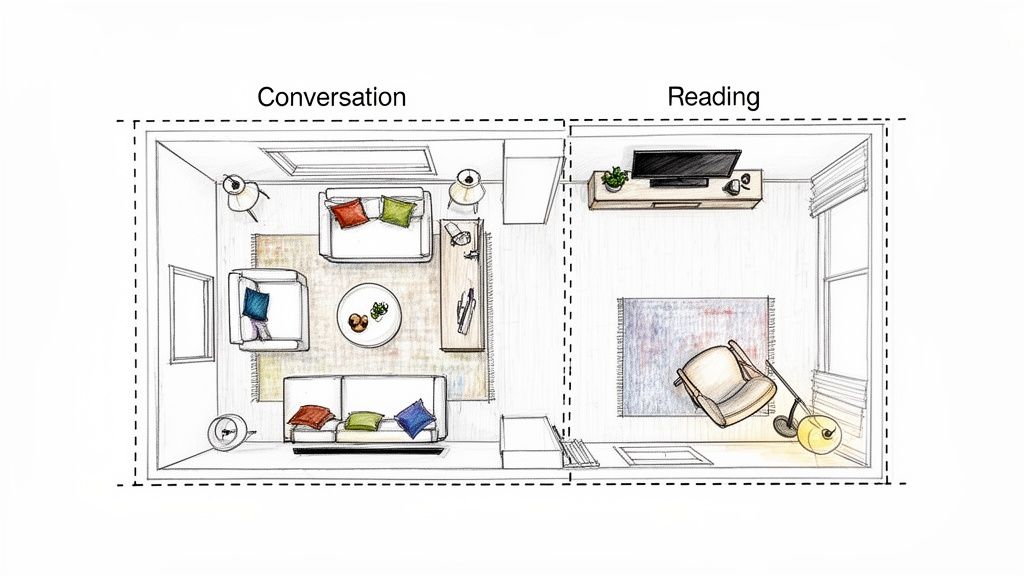
That appeal lasts because vintage sectionals solve two jobs at once. They anchor a room visually, and they shape how the room gets used. Good older examples often create better conversation areas than a standard three-seat sofa and two chairs. They also tend to have stronger silhouettes. Cleaner lines, better proportions, and details like exposed wood, sculpted arms, or corner units that feel intentional instead of bulky.
The history matters, but daily use matters more. A vintage sectional can give a home character that many new sofas miss, especially if you want a room that feels collected rather than showroom-matched. The trade-off is simple. These pieces ask for more judgment at the buying stage. Scale can be awkward, seat depth can feel very different from current sofas, and upholstery that looks pleasantly worn in photos can turn into a full reupholstery bill once it lands in your house.
Practical rule: Buy the sectional for its bones first, its style second, and its current fabric third.
That order saves money. A solid frame, balanced shape, and sensible dimensions can justify new foam, springs, or fabric. A beautiful sectional with a weak frame or impossible footprint usually stays expensive, even after restoration.
Vintage sectionals also reward buyers who are honest about how they live. Some are perfect for sprawling, movie-night comfort. Others look fantastic and sit a little upright. Some break into easy modules. Others are so large or oddly angled that getting them through a stairwell becomes the first real test of ownership.
That mix of beauty and friction is exactly why they stay interesting. A good vintage sectional does more than look distinctive. It earns its place if the proportions work, the construction is sound, and the restoration costs still make sense for your home.
What Defines a Sectional Sofa as Vintage
A seller calls it vintage. You arrive and find a bulky 1990s sectional with fresh fabric and shiny replacement feet. That gap between label and reality is common, which is why vintage should be judged by more than age alone.
With a sectional, I look at four things first: era, silhouette, modular logic, and build. A true vintage piece usually reflects the way people lived in a specific period. You can see it in the proportions, the seat depth, the arm shape, the connectors, and even in how the sections were meant to break apart for delivery or rearranging.
Early origins and the move into modern design
Sectionals started as practical multi-piece seating, then developed into a more deliberate room-planning tool as domestic interiors changed. By the early to mid-20th century, designers were refining them into cleaner, lower forms that feel much closer to what buyers now picture as vintage. That shift matters because older sectionals were not only styled differently. They were built for different room habits, different postures, and often more formal layouts.

For buyers, that history shows up in the details. Earlier and mid-century sectionals often have tighter lines, lighter-looking frames, and a more intentional footprint. Later examples, especially from the 1970s and 1980s, usually give more lounging comfort but take up more visual and physical space. In a smaller modern home, that difference affects far more than style. It affects traffic flow, delivery access, and whether the piece still feels good to live with six months later.
The main eras worth recognizing
A quick visual vocabulary helps separate one period from another and gives a better sense of what ownership will involve.
| Era | What you'll usually notice | Why it matters |
|---|---|---|
| Victorian origins | Multi-piece seating, formal upholstery, adaptable arrangement | Shows the sectional began as a modular solution rather than a single massive sofa |
| Mid-Century period | Lower profiles, cleaner lines, geometric forms, sculptural restraint | Often easier to place in smaller rooms and usually less visually heavy |
| 1970s and 1980s | Plush cushions, bold forms, larger footprints, more obvious modularity | Comfortable and social, but often expensive to reupholster and harder to fit through tight entries |
That last point gets overlooked. A large vintage sectional may be attractive partly because it feels dramatic in a showroom or listing photo. Once it reaches a narrow terrace house, small apartment, or room with one awkward radiator wall, the same scale can become the main problem.
Vintage is also about intended use
A vintage sectional tells you what kind of room it was made for. Mid-century examples often suit structured layouts where each section has a clear role and negative space is part of the look. Later modular sectionals were often built for looser family living, longer sitting sessions, and bigger rooms.
That intended use helps explain why two authentic vintage sectionals can feel completely different in person. One may sit upright, hold its shape, and look sharp from every angle. Another may invite sprawling but need deeper rooms, more clearance, and a bigger restoration budget because there is more upholstery, foam, and seam work to replace.
This is also why style labels alone are weak buying tools. Learning to read proportion and function is more useful than memorizing decades. The same skill helps with case pieces too. If you have ever spent time identifying antique bar cabinet styles, you already know that form, joinery, and intended use usually reveal more than a seller's headline.
A sectional earns the vintage label when its design, materials, and layout logic clearly belong to an earlier period, and when those traits still hold together as a coherent piece rather than a later sofa dressed up to look old.
How to Identify an Authentic Vintage Piece
An authentic vintage sectional usually gives itself away before the seller does. The clues are in the underside, the joinery, the hardware, and the way the whole piece makes structural sense as one design.
That matters because unwary shoppers often pay vintage money for later reproductions, pieced-together sets, or old sectionals that have age but very little quality.
Start where restorers look first
I always want to see the parts that never make the hero photo. Lift the cushions. Check under the deck. Look at the frame from below. Study the seams and the base closely, without tugging anything apart. Sellers tend to focus on fabric and silhouette. The actual story is usually underneath.

The most useful checks are straightforward:
- Maker's mark: Check under the frame, inside the cushion deck, behind the skirt line, and beneath removable sections for labels, stamps, or metal tags. Even a damaged label can confirm period and maker.
- Joinery: Solid wood frames with proper joinery usually age better than board-based frames held together with obvious later staples or crude repairs.
- Hardware: Connectors, brackets, feet, and casters should look consistent across every section. Mixed hardware often means replacements or sections from different sets.
- Materials: Wood species, webbing, springs, upholstery backing, and foam all help date a piece. A sectional can be reupholstered and still be authentic, but the materials beneath the fabric should still line up with its claimed age.
If every visible component looks newly made, treat the sectional as vintage-inspired until the seller proves otherwise.
Separate authenticity from desirability
Age alone does not make a sectional worth buying. Some authentic pieces are expensive mistakes because the frame is tired, the springs are failing, or the previous restoration buried problems instead of fixing them.
That trade-off shows up often with modular sectionals. Later vintage examples offer flexibility, but every extra section adds another place for mismatch, wobble, or connector failure. As described in this history of sofa evolution, the rise of modular seating brought more freedom in layout, but it also created more opportunities for sets to be broken up and recombined over time.
One practical test helps here. Compare the upholstery wear to the frame wear. If the fabric is crisp and recent but the underside hardware looks much older, ask exactly what was replaced. New fabric is often a benefit. New fabric over a loose frame, sagging springs, and tired foam means you may inherit a large restoration bill right after delivery.
Look for period logic, not just period style
Good vintage buying comes down to pattern recognition. If you have experience with identifying antique bar cabinet styles, the method is familiar. Construction, material, wear, and design logic usually tell you more than a seller's headline.
Apply that same approach to a sectional. The legs should suit the era and the scale of the piece. The curve should flow consistently from one section to the next. Arm height, seat height, and cushion profile should feel intentional across the full layout. When one section looks sharper, taller, deeper, or more heavily rebuilt than the others, stop and ask why.
I also look for evidence of honest restoration. Clean reupholstery, rebuilt cushions, and repaired webbing can improve a piece and make it livable for another decade or more. Refinished legs, replaced connectors, and patched frames are not automatic deal-breakers either. The problem starts when the seller cannot explain what was changed, who did the work, or whether the internal structure was addressed at the same time.
A short checklist before you commit
Before I would buy, I would want clear answers to these questions:
- Does every section share the same design language? Mismatched legs, uneven seat heights, or different arm proportions usually point to later substitutions.
- Do the connectors and underside details look consistent across the set? One replaced bracket is manageable. A whole mix of hardware usually means a pieced-together sectional.
- Has the upholstery work added value or covered damage? Ask about foam, springs, webbing, and frame repairs, not just fabric.
- Do the wear patterns make sense? Authentic age tends to show up in logical places such as front rails, arm edges, feet, and connector points.
- Can the seller document provenance or maker details? Original receipts, old labels, past invoices, or even a believable ownership story help support the asking price.
Authenticity is only half the decision. A genuine vintage sectional with poor bones can still cost more to restore than it is worth.
The Critical Step Planning for Size and Layout
The most common mistake isn't buying the wrong style. It's measuring only the wall and assuming the rest will work out. Vintage sectionals punish that shortcut because they often have shapes that don't behave like modern modular seating.
Why vintage sectionals fool the eye
A curved or wedge-shaped sectional can look compact in a photo and turn out to be far deeper in person. A documented Mid-Century sectional measured 100 inches deep because of its curve, and some individual sections measured 51 inches wide, which can exceed typical 32 to 36 inch doorways, according to this vintage sectional listing analysis. That's the kind of detail that leads to failed deliveries and expensive reversals.

Photos also flatten depth. A sectional with a soft radius or angled bumper can project farther into the room than the listing suggests. In a small living room, that projection affects walking paths, sightlines, and where your coffee table can go.
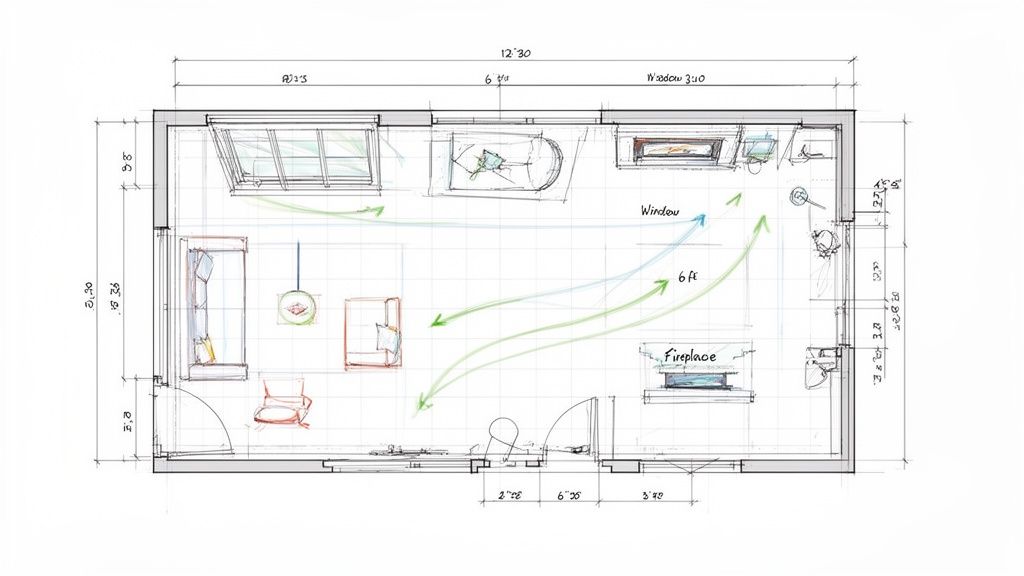
Measure the route, not just the room
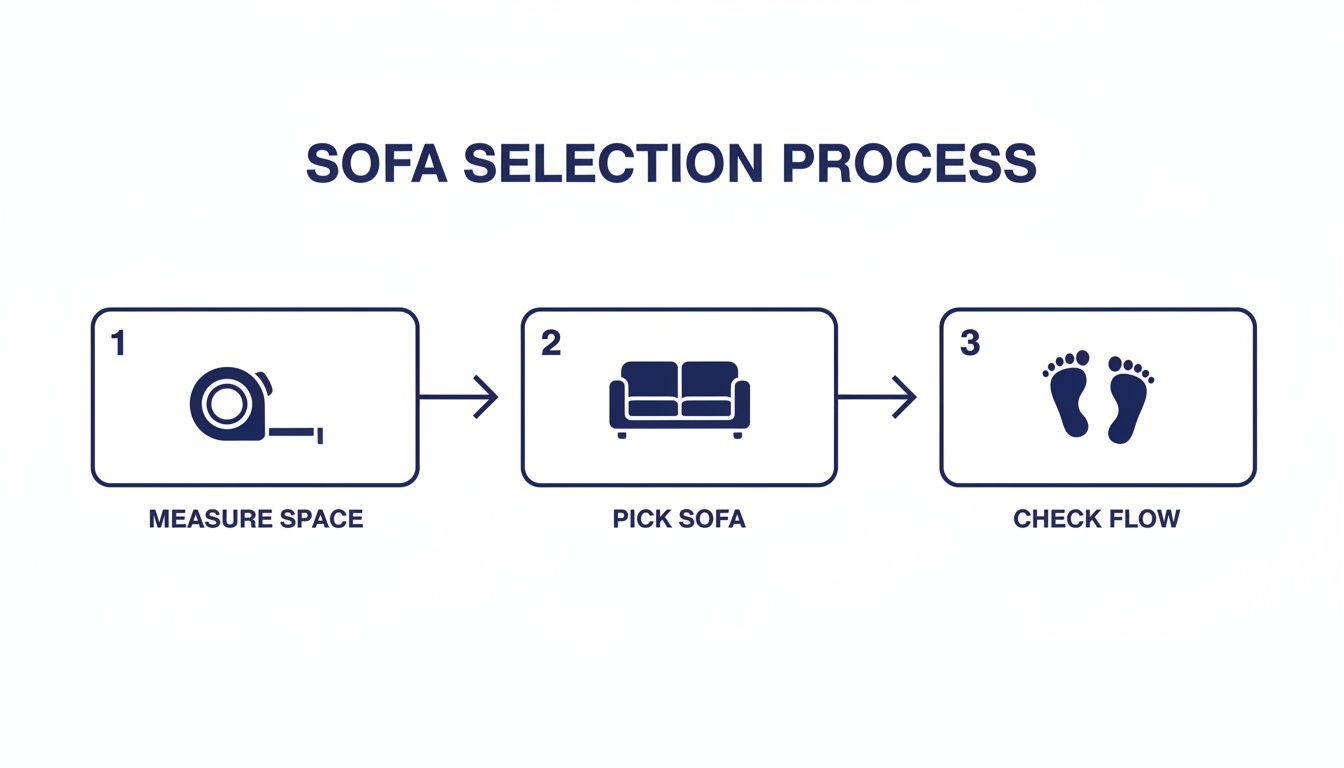
Before you buy, map the sectional's full path into the house.
- Start outside: Measure gate openings, porch turns, apartment corridors, elevator depth, and stair landings.
- Move inward: Check door widths, hallway pinch points, and any sharp interior turns.
- Finish at the room: Mark the footprint on the floor with tape, then walk around it.
That last step matters more than people think. A sectional can fit on paper and still make a room feel blocked once you account for circulation.
A taped outline on the floor exposes bad assumptions fast. It shows whether the chaise end steals the walkway, whether the corner blocks a floor vent, and whether a side table still has a place to land.
What works in smaller homes and what doesn't
Some vintage forms adapt well. Others fight the room every day.
Usually works
- Tight two-piece L-shapes with modest arms
- Sectionals with visible legs, which keep the room feeling lighter
- Lower-profile silhouettes that don't dominate the sightline
Often difficult
- Deep curved units
- Oversized pit-style modular sets
- Fixed corner arrangements with no flexibility in left-right orientation
A vintage sectional should shape the room, not pin it down. If you have to move three other functions just to make the sofa work, the room is already telling you no.
A simple layout filter
Use this test before buying:
| Question | If the answer is yes | If the answer is no |
|---|---|---|
| Can each section physically enter the home? | Keep evaluating | Walk away |
| Can people move around it without sidestepping? | Good sign | Reconsider the scale |
| Does it leave room for at least a rug and one table? | Likely workable | Room may feel overfilled |
| Can it function without being shoved hard against every wall? | Better balance | Layout may feel trapped |
Vintage sectionals reward planning. Without it, even a beautiful piece becomes a daily irritation.
Restoration and Upkeep A Labor of Love
The true assessment begins after delivery. A vintage sectional can look perfect on a sales floor, then reveal tired springs, loose connectors, or stale filling once it becomes part of daily life. Buyers who plan for that reality make better decisions and spend less fixing preventable problems.
Many sellers focus on silhouette, era, and upholstery color. Owners usually end up dealing with a different set of questions. On vintage forums, a common theme is how much upkeep and restoration a sectional needs after purchase, especially once the piece is used every day instead of styled for photos.

Know which problems are cosmetic and which are structural
Start with triage. Fading, light scuffs on wood, softened cushion edges, and minor fabric wear often fall into the normal aging category. They affect appearance, but they do not always affect use.
Structural faults cost more and spread faster. A dipping corner seat, shifting joints, cracked frame members, broken sinuous springs, or sections that no longer lock together cleanly should move to the top of the list. Reupholstery can wait. Frame and support work should not.
Use a simple filter:
- Reasonable DIY jobs: Gentle vacuuming, surface cleaning, tightening accessible hardware, rotating loose cushions, light conditioning of exposed wood, and replacing easy-to-match glides or feet.
- Professional work: Spring replacement, webbing repair, frame reinforcement, connector repair, new foam cut to fit, and full reupholstery.
- Jobs that fool people: Curved backs, tufted sections, and corner units with tension-bearing upholstery. They look manageable until the fabric comes off and the labor multiplies.
That last category is where budgets get blown. A sectional has more seams, more foam, and more labor hours than a standard sofa. If two sections need rebuilding, the restoration bill can overtake the purchase price quickly.
Material-specific wear changes the plan
Materials tell you how the piece has aged and what kind of maintenance it will tolerate. Velvet shows pressure marks, collects dust, and punishes aggressive brushing. Old leather can look sturdy while drying out at the seams. Cane and rattan details may still look intact but feel brittle when weight shifts through the frame.
That means care routines need to match the build. Use upholstery tools with soft suction on pile fabrics. Keep direct sun off older textiles and leather. Check cane or rattan for splitting before anyone starts treating the sectional like a family-room lounger.
The wrong cleaning method creates expensive work. I have seen owners scrub vintage mohair flat, over-oil old leather until it turns tacky, and ignore failing seat support because the fabric still looked presentable. The surface can mislead you.
For a visual walk-through of upholstery repair techniques, this video gives useful context before you decide whether a job is DIY-friendly or better left to a shop:
Moving and restoration often overlap
A lot of vintage damage happens during the move in. Older frames do not like twisting through tight hallways, and original brackets can bend if sections are lifted from the wrong point. One rough delivery can turn a sound sectional into a restoration project.
If you are arranging transport, review practical guidance on moving fragile items with Home Removals Sydney because many of the same precautions apply to vintage furniture. Wrap arms and corners heavily, separate modular pieces correctly, protect exposed wood from strap pressure, and never drag a section by one end.
If both moving and repair are involved, handle them in order. Move the sectional first. Let it settle in place, then inspect it again in good light and write the repair list. Transport sometimes changes what needs attention.
What ownership looks like over time
The happiest owners are not the ones with flawless pieces. They are the ones who understood the workload before buying.
That usually means three habits. Clean gently and on schedule. Fix support issues before spending on cosmetics. Use the sectional in a way that fits its age and construction.
A vintage sectional can live beautifully in a modern home for years. It just asks for honest inspection, measured use, and a restoration budget that leaves some room for surprises.
Styling Your Vintage Sectional in a Modern Home
A vintage sectional usually looks best in a room that feels current, useful, and slightly restrained. The goal is not to recreate a period set. The goal is to give a large, character-heavy piece enough space, contrast, and support to live well in a modern home.
That matters even more with sectionals than with standard sofas. They take up visual space fast, and many vintage examples sit lower, longer, and deeper than people expect once they are in the room.
Start with the sectional, then strip back the room
I style around vintage sectionals by deciding what the sofa needs to do first. Some pieces need to soften a sharp room. Others need a cleaner backdrop so the shape reads clearly. A low Mid-Century sectional in a warm neutral fabric can carry a room with very little help. A wool rug, a simple wood or stone coffee table, and one well-scaled lamp are often enough.
A plush 1970s sectional asks for a different balance. It already brings volume and attitude, so I pair it with lighter visual elements such as a glass table, slimmer lighting, or art with open space around it. The room feels collected instead of locked into one decade.
Style for the materials you actually have
Good styling also makes ownership easier. That is the part glossy room photos skip.
If the sectional has rattan, cane, channel tufting, velvet, or exposed wood trim, leave more clearance around it. Dense layers of side chairs, baskets, throws, and small tables can make a vintage piece look crowded, but the larger problem is practical. Tight layouts collect dust, invite snags, and make regular cleaning harder. As noted earlier, textured materials such as rattan and velvet need gentler use and more upkeep than a simple upholstered frame.
In smaller homes, this matters a lot. A dramatic sectional can still work in an apartment, but it needs negative space around the outer corners and a clear path through the room. If people have to squeeze past the arm every day, the room will feel wrong no matter how good the styling looks in photos.
Combinations that usually hold up in real life
A few pairings are reliable because they solve both the visual and practical side of the room:
- Transitional spaces: Use cleaner-lined side tables and current lighting. The sectional keeps its personality, and the room stays grounded in the present.
- Rustic or farmhouse-leaning rooms: Let the sectional be the refined piece that sharpens rougher finishes such as plank wood, limewash, or aged metal.
- Eclectic rooms: Mix periods, but repeat one color or texture from the sofa in the rug, artwork, or curtains so the room feels connected.
- Compact apartments: Cut accessories before you cut scale. One strong rug and one properly sized table usually work better than several small fillers.
The room should feel edited around the sofa and easy to live in every day.
What usually throws the room off
The biggest styling mistake is scale mismatch. A substantial sectional with a small rug or a narrow coffee table always looks unresolved. The furniture around it should match its footprint, even if those surrounding pieces are visually lighter.
The second mistake is overcommitting to retro cues. Matching lamps, matching art, and matching accessories can flatten the room and make the sectional feel costume-like. I get better results by keeping one or two crisp modern notes nearby, such as a contemporary floor lamp, a simple side table, or art with cleaner lines.
Let one piece lead
If the sectional has a curved back, sculptural arm, or unusual upholstery, let quieter pieces do their job in the background. A restrained rug, one confident table, and lighting with shape but little ornament usually create a stronger room than a collection of competing statements.
That approach also helps with the practical realities of ownership. Fewer objects around a vintage sectional means easier cleaning, less accidental wear, and more flexibility if you need to rework the layout later. A well-styled vintage sectional should feel used, not protected like a museum piece.
Finding Your Perfect Piece Budget and Local Options
The hunt is part of the appeal. Vintage sectionals rarely come with the neat certainty of ordering a new sofa off a floor sample. You're balancing condition, originality, transport, and whether the piece fits your life as well as your taste.
Where to look and what each source is good for
Different buying channels come with different strengths.
| Buying route | What it's good for | What to watch |
|---|---|---|
| Estate sales | Honest wear, occasional hidden gems, local pickup | Limited time for inspection |
| Consignment shops | Better vetting, easier in-person assessment | Higher markup for convenience |
| Antique stores | Stronger curation, knowledgeable sellers | Style can outweigh practicality |
| Online marketplaces | Broad selection, unusual finds | Harder to judge odor, comfort, repairs, and scale |
| Auction platforms | Access to rarer pieces | Final sale risk and transport complexity |
The smartest buyers don't search everywhere in the same way. They use local shopping for inspection and online shopping for research and comparison.
Set the budget around the whole project
A vintage sectional purchase isn't just the listing price. Your total budget should include delivery, possible professional cleaning, possible upholstery work, and any connector or frame repair the seller may not have addressed.
That doesn't mean every vintage piece becomes expensive. It means you shouldn't call a sectional affordable until you know what it needs in the first few months. A cheaper piece with a failing seat deck can cost more in the end than a pricier one with strong structure and updated upholstery.
Questions worth asking the seller
Good sellers won't be bothered by practical questions. Ask them anyway.
- Has it been reupholstered? If yes, ask when and whether cushion interiors were also replaced.
- Are all sections original to each other? Mixed sets happen often.
- Do the connectors align tightly? Gaps at seams can signal wear or mismatched modules.
- Has it lived in a smoking home, a pet home, or storage? Odor and moisture history matter.
- Can you provide underside photos? A seller who won't show the underside makes careful buyers nervous.
If the answers are vague, price the uncertainty in. Or move on.
Local buying has one major advantage
For many shoppers, the strongest option is seeing seating in person before committing. That doesn't always mean finding true vintage on the floor. Sometimes the right answer is a well-made vintage-inspired sectional that gives you the look without the restoration load.
That's especially useful if you love the silhouette of older sectionals but live in a smaller North Georgia home, rent, move often, or don't want a project piece. A knowledgeable local store can help you compare the charm of true vintage with the practicality of something newer that still captures the same mood.
The key is staying honest with yourself. If you want a hobby, buy a restoration candidate. If you want a reliable daily seat with vintage character, buy accordingly.
Conclusion Is a Vintage Sectional Right for You
A vintage sectional is rarely the easiest seating choice. It can be the most rewarding one.
You're choosing character, history, and a point of view. You're also choosing careful measuring, more thoughtful maintenance, and a little more patience than a standard sofa asks for. For some homes, that trade is more than worth it. For others, a vintage-inspired piece will deliver the feel without the friction.
The right decision usually becomes clear when you answer three questions. Do you have the space for the shape you love? Are you comfortable with some upkeep? And do you want a sofa that behaves like a design object as much as a utility piece?
If the answer is yes, a sectional sofa vintage find can become the anchor of the room for years. It won't look like everyone else's. It won't feel disposable. And when it's chosen well, it can make the whole home feel more settled and more personal.
If you're still weighing your options, it helps to sit in different silhouettes, compare scale in person, and talk through the trade-offs with someone who knows furniture beyond the listing photo.
If you want help comparing true vintage charm with practical modern alternatives, visit Woodstock Furniture & Mattress Outlet. Their team can help you test layouts, evaluate sectional sizing, and explore living room options in person so you can choose a piece that fits your space and your daily life.