Are you choosing kids' bedding by softness and pattern while overlooking the mattress fit, chemical disclosures, and temperature of the sleep space? Those details often matter more than thread count. The right approach depends first on the child's age, the bed itself, and the conditions around it, then on fabric, color, and style.
Understanding Why Kids Bedding Matters
Sleep needs are a foundational part of choosing bedding. U.S. Centers for Disease Control and Prevention data on children's sleep found that 35% of children ages 0 to 17 had shorter-than-recommended sleep based on parent reports from 2016 to 2018. Among children ages 3 to 17, the rate was 34.7%. The recommendations used in that analysis call for at least 10 hours for preschoolers ages 3 to 5, at least 9 hours for children ages 6 to 12, and at least 8 hours for adolescents ages 13 to 17.
That doesn't mean bedding can solve every sleep problem. School schedules, health conditions, stress, household routines, and the child's sleep habits all matter. Bedding does, however, shape the immediate environment for rest. A mattress that feels supportive, sheets that don't trap uncomfortable warmth, and a bed size that allows room to grow can remove avoidable sources of disruption.
Start with the sleep environment
Think of bedding as a system rather than a decorative set. The fitted sheet must match the mattress depth, the top layer should suit the child's age and room conditions, and every washable item should be practical for the household's laundry routine. A child who sweats at night may need a different combination from one who wakes cold, even if they share the same room.
The CDC's indicator for 2020 to 2021 also reported insufficient sleep for 35.0% of U.S. children ages 4 months through 14 years, using age-specific thresholds from fewer than 12 hours for infants to fewer than 8 hours for adolescents ages 13 to 14. That recurring pattern makes durability, washable materials, and age-appropriate comfort practical priorities, not minor conveniences.
Practical rule: Choose bedding to support a consistent sleep environment, but don't treat sheets, blankets, or a mattress as a substitute for addressing a child's broader sleep needs.
Parents comparing fabric feel, construction, and design can also consult this SouthShore Fine Linens bedding guide for additional perspective on bedding choices for children and teenagers. Use any guide as a starting point, then check the product's dimensions, care instructions, and safety information yourself.
Navigating Crib Safety and Dimensions
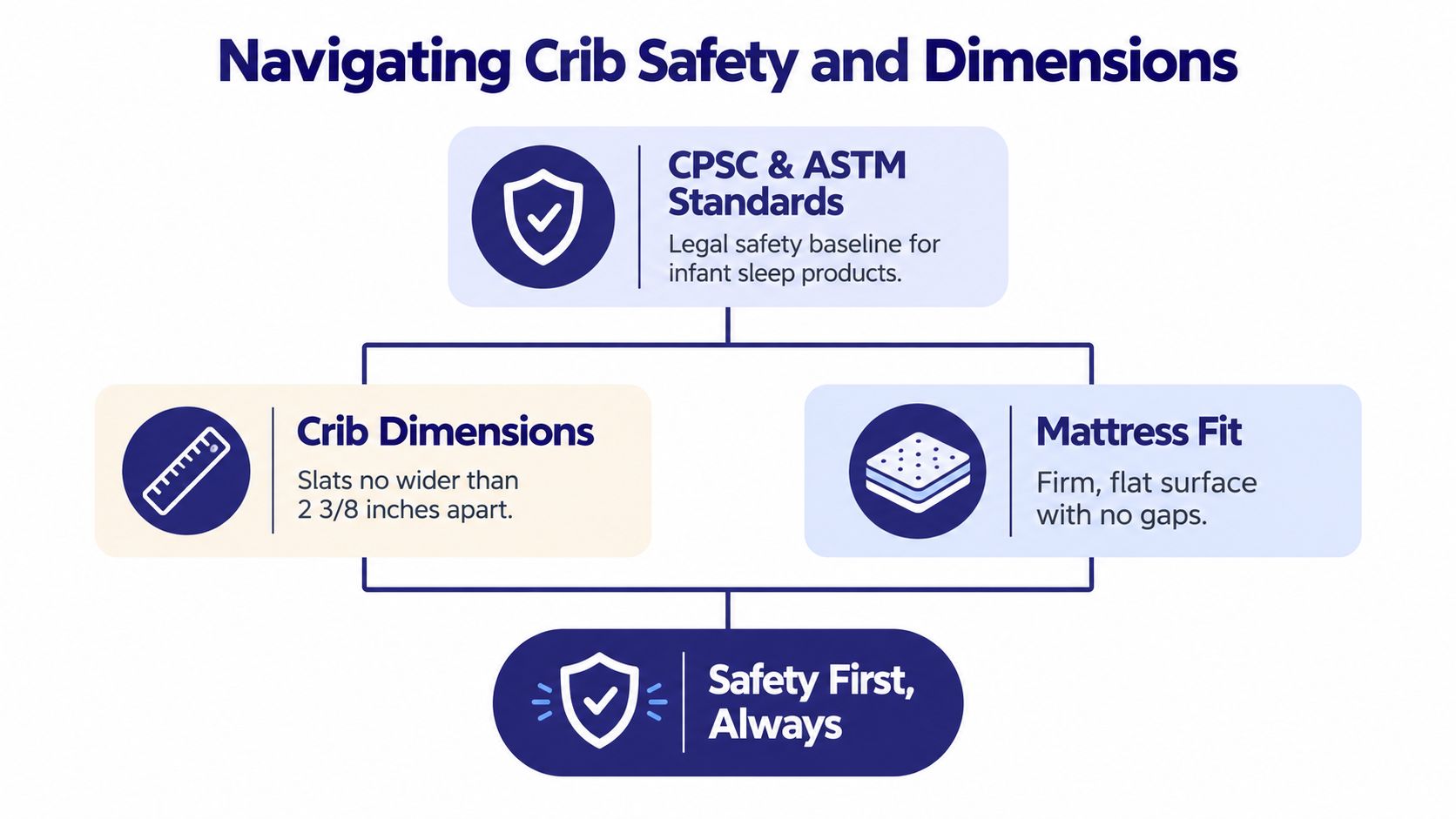
Crib bedding isn't just a smaller version of bedding for an older child. Exact dimensions are a safety requirement, because a mattress, sheet, and crib perimeter must work together without creating dangerous spaces.
The Consumer Product Safety Improvement Act of 2008 directed the Consumer Product Safety Commission to create safety rules for durable infant and toddler products. The CPSC later issued a final crib-mattress rule in the Federal Register at 87 FR 8640 and codified it at 16 C.F.R. Part 1241, incorporating ASTM F2933 with agency modifications. The CPSC crib-mattress guidance explains the applicable requirements.
Match the mattress to the crib
For a full-size crib, the defined interior dimensions are 52 3/8 inches plus or minus 5/8 inch in length and 28 inches plus or minus 5/8 inch in width, approximately 1,330 by 711 millimeters. The associated mattress standard specifies a minimum mattress size of 27 1/4 inches wide and 51 5/8 inches long, about 690 by 1,310 millimeters.
The corner gap between the mattress, sheet, and crib perimeter must not exceed 3.15 inches, or 80 millimeters. That measurement explains why a crib sheet shouldn't be treated as interchangeable with a toddler sheet, twin sheet, or another generic fitted sheet. A product that looks close in size may still leave a hazardous gap.
Before buying, work through these checks:
- Identify the crib category. Confirm whether it's a full-size crib, mini crib, bassinet, portable crib, or play yard.
- Measure the sleep surface. Don't rely only on a product name or a visual comparison.
- Confirm mattress firmness and fit. The mattress should sit flat and securely inside the crib.
- Use the correct fitted sheet. Choose a sheet designed for that exact mattress and check that it stays taut.
- Inspect after laundering. Shrinkage, stretched elastic, or a loose corner can change the fit.
The video below provides another visual explanation of safe crib setup and infant sleep considerations.
A fitted sheet that stays secure is more important than decorative detail. If the mattress or sheet doesn't fit correctly, replace it rather than trying to fill a gap with padding, a topper, or folded fabric.
Infant vs. Toddler Bedding Safety Guidelines
Infant bedding follows a stricter standard than bedding for toddlers and older children. For a baby, the safest configuration is a firm, flat, non-inclined sleep surface with only a properly fitted sheet made for the crib, bassinet, portable crib, or play yard.
The American Academy of Pediatrics advises keeping loose blankets, pillows, quilts, comforters, bumper pads, mattress toppers, stuffed objects, and other soft items out of an infant's sleep space because they can create risks involving airway obstruction, entrapment, suffocation, or strangulation. The American Academy of Pediatrics safe sleep guidance supports making the nursery setup deliberately simple.
The first year
Babies younger than 12 months shouldn't sleep with loose blankets, according to AAP-aligned guidance summarized by the Sleep Foundation's advice on when babies can use blankets. If additional warmth is needed, a properly sized wearable blanket or sleep sack keeps warmth around the body without introducing loose fabric into the crib.
Swaddling also has a limit. Caregivers should stop once the baby shows signs of attempting to roll, commonly around 3 to 4 months, because rolling while swaddled can increase suffocation risk. Follow guidance from the child's healthcare professional when there's uncertainty about swaddling, sleep position, or temperature.
After infancy
As a child grows, the choices can become more flexible, but age alone isn't the only consideration. Look at mobility, the child's ability to move a covering away from the face, the bed design, and the instructions for the product. A toddler may enjoy a small blanket during supervised quiet time, but that doesn't automatically make every comforter or pillow appropriate for overnight sleep.
Parents comparing warmth options for a newborn may find this guide to blankets for newborns useful as a general reference, but product guidance should never override safe-sleep recommendations for the baby's specific age and sleep space.
The distinction is simple: infant bedding prioritizes an empty, firm sleep surface; older-child bedding can add comfort layers when the child and bed are developmentally ready.
Understanding Chemical Safety and Certifications
A soft label or natural-sounding material name doesn't prove that a mattress or sheet is free from every chemical. Parents should separate three questions: what the product is made from, what treatments or finishes were used, and what testing or certification supports the manufacturer's claims.
A 2025 peer-reviewed study of 16 newly purchased children's mattresses detected 21 semivolatile organic compounds, including phthalates, organophosphate esters, benzophenones, and salicylates. The researchers found that emissions increased when they raised the temperature to approximate body heat and applied body weight. One mattress exceeded Canada's 0.1% limit for a regulated phthalate, while several mattresses contained compounds regulated in children's toys but not mattresses. The findings are reported in the study indexed by PubMed.
Look beyond one label
A companion in-home study of 25 children's bedrooms detected 28 compounds in bedroom air, 31 in air immediately above mattresses, and 30 released from mattresses. Some bedding items were likely sources of tris(2-butoxyethyl) phosphate. These studies were small and geographically limited, so they don't establish that every children's mattress presents the same exposure. They do show why transparent product information matters.
Ask manufacturers:
- Which component was tested? A certification for the sheet may not cover the mattress foam, waterproof layer, adhesive, or zipper.
- What does the certification assess? Confirm whether it addresses finished-product emissions, restricted substances, dyes, or another defined category.
- Are treatments disclosed? Ask about flame-retardant treatments, stain resistance, waterproof coatings, and antimicrobial finishes.
- What does “organic” describe? It may refer to a fiber or farming method, not every part of the finished product.
- What should happen after opening? Follow ventilation and care instructions rather than assuming a product is chemical-free.
The Federal Trade Commission's advertising substantiation policy says advertisers need a reasonable basis for objective claims involving performance, safety, effectiveness, or features. For shoppers, that means treating “non-toxic,” “chemical-free,” and “safest” as claims that require specific support, not as automatic benefits of a green color palette or natural fiber name.
Creating the Ideal Sleep Microclimate
A child's comfort depends on more than whether a sheet feels soft in the store. Room temperature, humidity, fabric construction, mattress protectors, and top-layer weight work together to create the sleep microclimate around the body.
Research on children found a curvilinear relationship between nighttime bedroom temperature and sleep. Children sleeping in rooms that were too hot or too cold experienced poorer sleep. A review of bedding and thermoregulation notes that suggested bedroom temperatures range from 17°C to 28°C depending on bedding, with relative humidity around 40% to 60%, while also emphasizing that research on children's thermal comfort in ordinary home settings remains limited. The findings are summarized in this review of children's sleep, bedding, and thermal conditions.
Build adjustable layers
Instead of buying a heavy “winter” set and a thin “summer” set, create a system that can be adjusted. Start with a fitted sheet, add a breathable protector that matches the mattress depth, and use a light top layer before adding warmth. A removable quilt or blanket lets you respond to a warm night without changing the entire bed.
Fabric labels provide clues, but construction matters too. A looser weave may feel airier, while a denser fabric can feel more insulating. Fill weight, quilting, mattress protectors, and the number of layers often affect warmth as much as the fiber itself. Cotton, linen, wool, and rayon made from bamboo can all feel different depending on how they're woven, finished, and layered.
Troubleshoot by observation
A child who wakes sweaty may need fewer layers, a lighter protector, or a more breathable sleepwear combination. A child who kicks off every cover may need a lighter layer that stays comfortable rather than a heavier one that creates a cycle of overheating and removal. Children with eczema, sensory sensitivities, neurodevelopmental differences, or chronic health conditions may need individualized guidance from a qualified clinician.
Use these observations as a practical guide:
- Check the child, not just the thermostat. Sweating, flushed skin, cold hands, damp sleepwear, and repeated uncovering can reveal a mismatch.
- Change one layer at a time. That makes it easier to identify what helped.
- Keep the fit secure. A breathable fabric is not a substitute for a correctly fitted sheet or a safe infant sleep setup.
- Wash after accidents. A system that can be cleaned easily is more useful than one that only feels luxurious when new.
Choosing Durable and Hypoallergenic Materials
Parents often search for “hypoallergenic” bedding as if it were a universal material category. It isn't. The term can describe a manufacturer's intended lower-allergen positioning, but it doesn't guarantee that every child will tolerate the fabric, finish, detergent, dust, or mattress components.
A better choice starts with the child's actual problem. If frequent accidents are the concern, prioritize a washable fitted sheet and a protector that fits without changing the mattress shape. If skin irritation is the concern, look for a smooth, easily laundered fabric and avoid assuming that an organic label alone predicts comfort. If durability is the concern, inspect the weave, seams, elastic, closures, and care instructions.
Compare materials by use
Organic cotton can offer a familiar, washable option, but the finished product still deserves scrutiny for dyes, finishes, and construction. Bamboo-derived rayon may feel smooth and comfortable to some sleepers, while its production process and final treatments vary by product. Bornbir's advice on bamboo sheets can help explain why shoppers should investigate the specific fiber description rather than treating “bamboo” as a complete performance or safety claim.
Microfiber may dry quickly and feel practical for households that launder bedding often, but some children may prefer the feel of natural-fiber sheets. Linen can offer a different texture and airflow profile, though its care requirements and feel may not suit every sleeper. No material is automatically the right choice for every child.
Use a care-first buying test
Before purchasing, check whether the item can handle the household's routine. Look for clear washing instructions, colorfastness guidance, shrinkage information, elastic quality, and mattress-depth compatibility. A product that requires specialty care may be a poor fit for a child who has frequent spills or nighttime accidents.
The FTC cautions that an advertisement can mislead through its overall implication even when individual words are true, as described in its discussion of objective advertising claims and deceptive impressions. Apply that principle while shopping. Ask what “safe,” “clean,” “cooling,” or “durable” means in measurable terms, and look for testing, specifications, or care information that supports the claim.
For families choosing a new sleep setup, Woodstock Furniture & Mattress Outlet offers kids' beds, including twin and full youth beds, bunk beds, loft beds, trundle beds, and daybeds, along with mattresses, protectors, sheets, and other bedroom pieces. Seeing the bed frame and mattress dimensions together can make it easier to plan fitted bedding, clearance, and future changes without relying on a product photo alone.
Visit Woodstock Furniture & Mattress Outlet to compare kids' bedroom configurations, mattresses, protectors, and bedding-related accessories with practical guidance on sizing and room fit. Bring your child's mattress measurements and the problems you're trying to solve, such as overheating, accidents, or limited storage, so the conversation stays focused on a safe, workable sleep environment.
Leave a Reply
You must be logged in to post a comment.