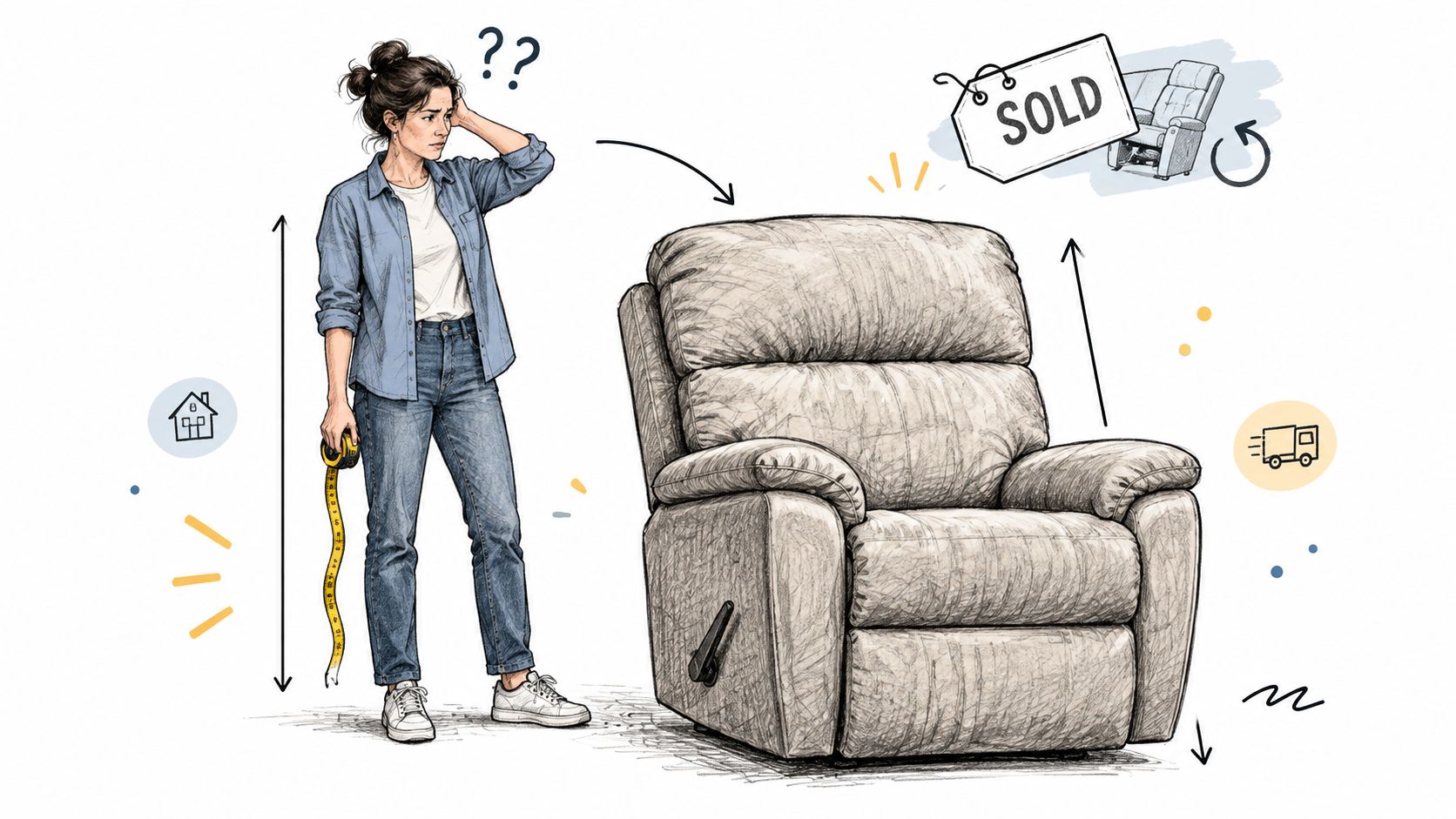
You've found a recliner that looks perfect. The color works with the room, the padding feels wonderfully soft, and the salesperson shows you how smoothly it opens. Then, after it arrives, your feet don't sit flat, the seat feels too deep, or the extended footrest blocks the walkway. A chair can look right in a showroom and still be the wrong chair for your body or home.
The reliable way to choose a recliner chair is to reverse the usual order. Measure the user first, test stability and movement next, plan the room and delivery route, then compare upholstery and style. Appearance matters, but it shouldn't decide the purchase before fit and safe operation do.
Why Most Recliner Shopping Goes Wrong
Many shoppers begin with a visual shortlist. They compare leather with fabric, choose between a rocker and a swivel, and ask how many reclining positions a model offers. Those details affect how the chair looks and operates, but they don't answer the more important question: can the intended user sit down, relax, and stand up without fighting the chair?
A recliner that's too low may make standing difficult, particularly for an older adult or someone with knee or hip limitations. One that's too high can leave the feet unsupported and increase pressure behind the knees. An overly deep seat can separate the lower back from the lumbar support, while a chair that's too narrow may restrict natural movement.
Practical rule: Choose by fit, not by the number of reclining positions or the softness you feel during a brief showroom visit.
I've seen the same mismatch repeatedly. A shopper settles into a large, plush chair and likes the enveloping feel immediately. After sitting longer, they start sliding forward to reach the floor, or they place a cushion behind their back because the seat depth doesn't match their legs. The chair may be comfortable for a taller family member, but awkward for the person who'll use it every evening.
Comfort and transfer ability are connected
A recliner isn't only a place to lounge. Users often shift in it, reach for a remote, transfer from a mobility aid, or use the arms and seat to stand. That makes seat height, base stability, arm placement, and footrest movement practical safety considerations.
The U.S. Consumer Product Safety Commission estimated that product instability or tip-over incidents involving televisions, furniture, and appliances sent an average of 27,100 people to hospital emergency departments each year from 2016 through 2018. The report recorded 556 fatalities between 2000 and 2018, including 170 furniture-related deaths, but it excluded products intended to be sat on or laid upon, including recliners, from its principal tip-over category. These figures aren't recliner injury rates, yet they show why household stability deserves attention when choosing furniture. Read the CPSC tip-over report.
Start with the primary user's body measurements and daily routine. Then ask whether the base remains steady during entry and exit, whether the mechanism moves without sudden shifts, and whether children can reach pinch points under the seat or footrest. A chair that fits the room but makes standing difficult isn't a successful fit.
Measuring for Body Fit and Comfort
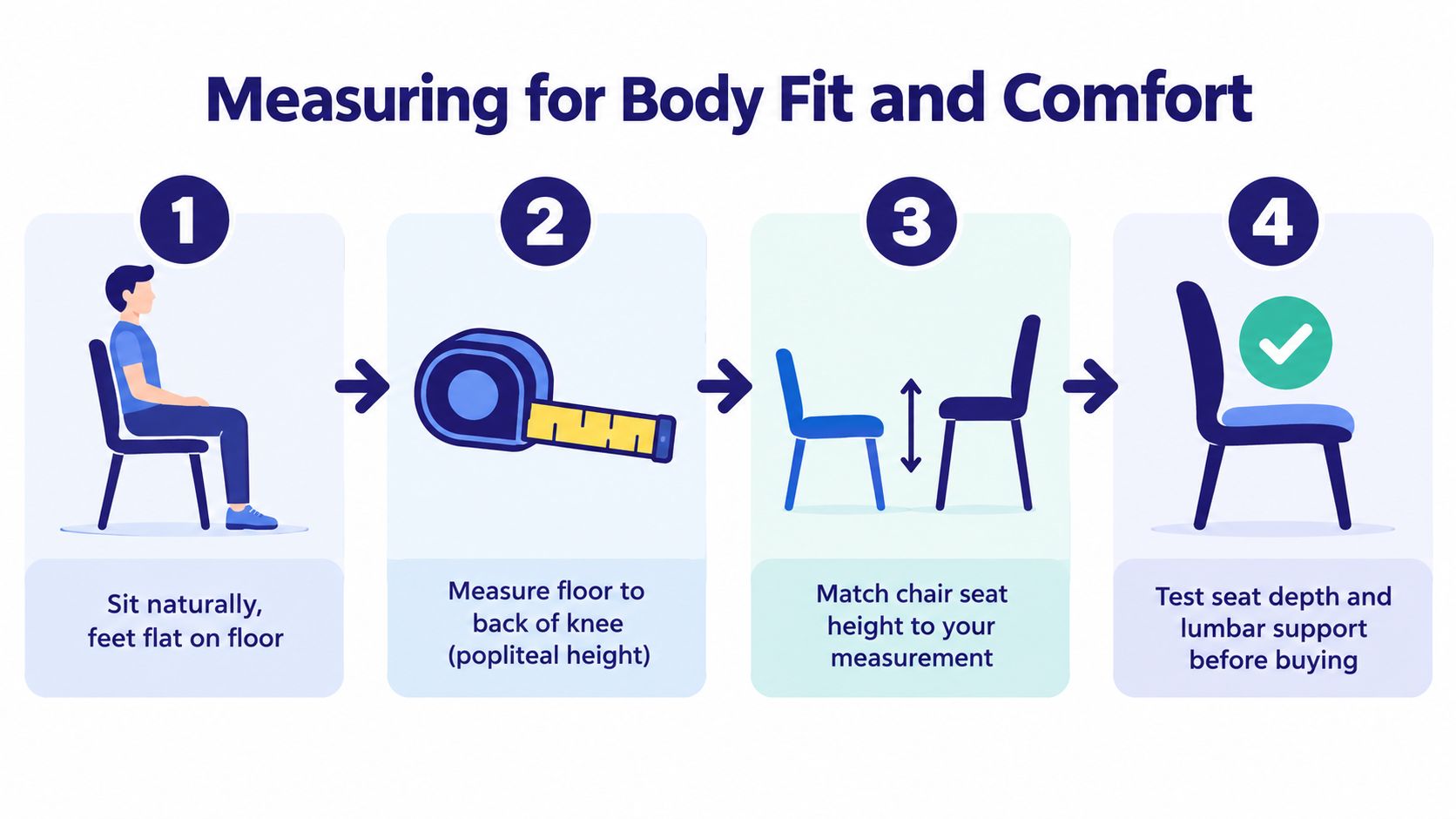
A recliner that looks right in the showroom can still cause returns if the seat height, depth, or back support misses the user's body. Measure the person first, then compare those measurements with the chair in its compressed, occupied position.
Start with popliteal height
Popliteal height is the distance from the floor to the underside of the knee. Measure it while seated naturally, with both feet flat and the knees close to a right angle. Compare it with the recliner's compressed seat height, measured from the floor to the front edge of the cushion while someone is sitting in the chair.
Accessibility guidance commonly places a transfer or seating surface approximately 17 to 19 inches above the floor, with 19 inches also identified as a common wheelchair seat height. Use that as a reference, not a fixed rule. Leg length, hip mobility, footwear, and the user's ability to rise should decide the final fit. Review the accessibility seating reference.
A seating ergonomics analysis places comfortable seat height around 40 to 45 cm for the studied group. Use that range only as a comparison point. Cushion compression and body proportions can change the chair's feel substantially. See the seating ergonomics analysis.
Check depth and lumbar contact
Sit fully back until your pelvis meets the backrest. The cushion edge should clear the backs of your knees, while the lower back stays supported without pushing your pelvis forward. If there is too much unsupported space behind your lumbar region, the seat is probably too deep for you.
Seat-depth research compared 30.4 cm and 38 cm, finding 38 cm long for the population studied and identifying 31 to 33 cm as appropriate for that specific South China group. Do not apply those figures universally. The practical lesson is simpler: judge the chair by your own thigh support and lumbar contact, not by its total outside depth. Read the seat-depth research.
Stay in the chair for 10 to 15 minutes, wearing the shoes normally used at home. Operate the mechanism repeatedly and test both upright and fully reclined positions. Watch for sliding, pressure at the sacrum, shoulder strain, or tightness beneath the thighs. A good fit shifts pressure toward the back as the chair reclines instead of concentrating it in one area. Also test whether you can stand without pulling hard on the arms or rocking the base.
Manual Versus Power Mechanisms Explained
Once the chair fits your body, compare how you'll operate it. A manual recliner uses a handle, bar, or body-weight movement. A power recliner uses an electric motor and controls, and a lift recliner adds a forward-and-up motion intended to assist standing.
| Mechanism | Practical strengths | Trade-offs to check |
|---|---|---|
| Manual | No outlet is required, and the mechanism is mechanically straightforward | The user needs enough arm, shoulder, and core strength to initiate and close the recline |
| Power | Button controls can make gradual positioning easier and may suit users with limited hand or shoulder strength | It needs a nearby power source, and its electronics and motor require separate warranty attention |
| Power lift | The seat rises and tilts forward to support a controlled standing movement | It's a specialized mobility aid, not automatically medical-grade support, and the user still needs to test the movement personally |
Match operation to the user
A manual chair works well when the user can operate the lever or shift body weight comfortably and wants a chair that functions without electricity. It can also make sense in a room where cord placement is awkward. The limitation becomes clear when the user has arthritis, reduced grip strength, shoulder pain, or difficulty leaning back against resistance.
Power controls remove much of that physical demand. They're useful for someone who wants to stop at a chosen position, adjust gradually, or use powered headrest or lumbar functions where available. They also introduce dependence on a motor, controls, wiring, and an outlet. Ask whether a manufacturer-approved battery backup is available, and find out what the chair can and can't do during a power outage.
A power button solves an operating problem. It doesn't solve a sizing problem.
Treat lift chairs separately
A lift recliner can help a user who struggles to rise from a low seat, but it should be assessed as a transfer-support product rather than just a more advanced recliner. Test whether the seat height, arm placement, lift path, and foot positioning let the user stand without twisting or reaching awkwardly.
Record the user's weight and compare it with the manufacturer's rated capacity, allowing a margin for clothing, movement, and occasional load. Check the entire lower-leg support when the footrest is extended, and make sure the controls can be reached without bending across the arm. If a power chair is placed in the middle of a room, route the cord so it doesn't become a trip hazard.
Choosing Durable Upholstery for Your Lifestyle
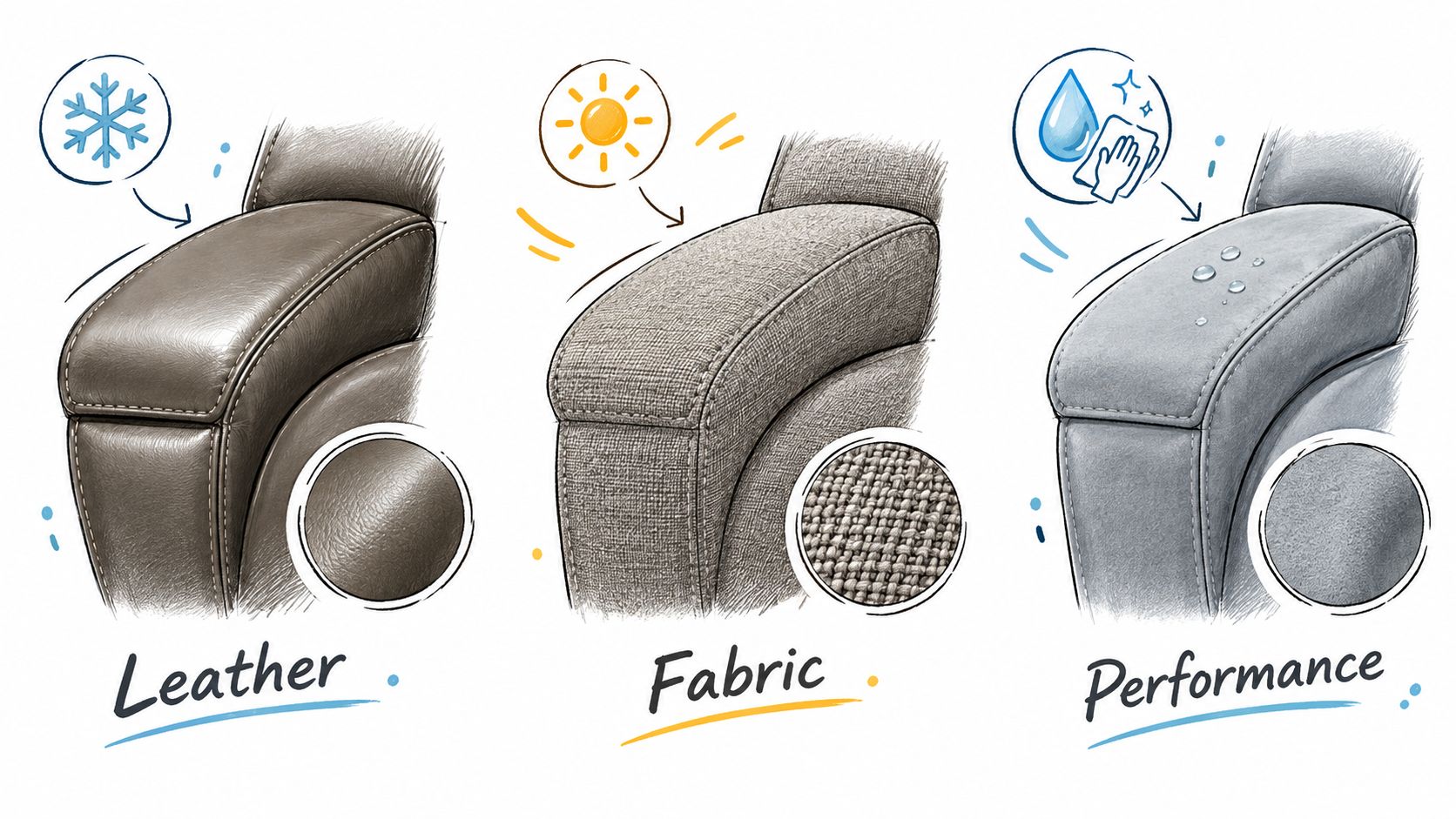
Upholstery should match the way the chair will be used, cleaned, and exposed to light. There isn't one universally superior material. Leather, microfiber, microsuede, canvas-like weaves, and performance fabrics all make different compromises.
Leather is easy to wipe and can develop a changing surface character over time. It may feel cool in winter and can be affected by prolonged direct sunlight. Fabric usually feels warmer and offers more visual variety, but spills and cleaning methods depend heavily on the weave, finish, and manufacturer's care instructions.
Choose for the household, not the showroom light
A tightly woven fabric is generally a more practical starting point for pets because claws are less likely to catch than they are in a loose weave. Families with children may prefer a surface that tolerates regular spot cleaning, while frequent hosts may prioritize a color and texture that conceal ordinary use without making the room feel heavy.
Microfiber and microsuede can feel soft and may handle some everyday spills well, but “spill resistant” doesn't mean stain-proof. Before choosing, ask how the fabric should be cleaned and whether the care code permits water-based cleaning, solvent cleaning, or vacuum-only maintenance. For a plain-language explanation of upholstery care labels, use this guide to cleaning codes for Dublin homes.
Foam quality also deserves a direct question. Don't rely on a vague promise such as “premium cushioning.” Ask what type of foam is used, whether the seat cushion is replaceable, and how the manufacturer handles compression over time. A soft chair can feel inviting at first but may allow you to sink and slide forward if the cushion doesn't provide enough support.
Verify safety labels and coverage
For applicable upholstered furniture made, imported, or reupholstered in the United States after June 25, 2021, federal rules incorporate California Technical Bulletin 117-2013 smolder-resistance test methods. The required evaluation covers the cover fabric, barrier material, resilient filling material, and decking material. A regulated recliner should carry a permanent label stating, “Complies with U.S. CPSC requirements for upholstered furniture flammability.” Check the CPSC upholstered-furniture guidance.
That label confirms compliance with the federal upholstered-furniture requirement. It doesn't prove that a chair is more comfortable, more durable, or better made than another. Read separate warranty terms for upholstery, foam, the frame, the reclining mechanism, motors, and electronics. A long fabric warranty may provide little protection for a failed motor.
Planning Placement and Entry Routes
A recliner can fit the planned wall and still fail before it reaches the room. Measure the delivery route before ordering, including the narrowest doorway, hallway turn, stair landing, and any obstruction between the entrance and its final position.
Map the delivery path
Start at the delivery entrance and record the smallest clear opening. Measure hallways, turns, stair landings, and doorways with each door opened as far as it can swing. Compare those measurements with the manufacturer's packaged delivery dimensions. Many recliners need door openings of about 30 inches, unless removable parts permit a narrower route. Review this recliner dimensions guide.
The listed chair width is only part of the calculation. Packaging may be wider, and the delivery team needs room to turn the chair, not merely move it straight ahead. Remove fragile décor, identify furniture that must be moved temporarily, and check ceiling height on stair turns if the chair will be carried upright.
Calculate the operating footprint
Measure the chair upright, fully reclined, and with the footrest extended. Use removable tape to mark the front edge in each position. This shows whether the footrest will reach a coffee table, narrow a walkway, or interfere with another seat.
A standard recliner needs rear clearance as its back moves. A wall-hugger shifts forward during operation and may need less space behind it, but its required wall distance still varies by mechanism. Follow the manufacturer's specification rather than assuming all wall-hugger models behave alike.
Protect circulation and mobility access
Keep the route around the chair usable for walking and for any mobility aid used in the room. Where a household includes a wheelchair user, plan the clear floor area beside the chair around that person's turning, transfer, and approach needs. The ADA specifies 30 by 48 inches of clear floor space beside certain fixed seating arrangements, so treat that figure as a reference for the applicable setup rather than a universal recliner rule.
Test the chair with the footrest extended and the back reclined. Sit down, stand up, and operate the mechanism while checking for rocking, creeping, or an unstable base. Examine hinges, leg-rest edges, side gaps, and the underside of the seat for pinch points. Keep children away from moving parts, secure climbable furniture nearby, and use only power cords or extension solutions approved by the manufacturer.
Before purchase, request the rated capacity, mechanism warranty, and any available cycle-testing information. Ask whether replacement parts and service remain available after the initial warranty period. Those answers can matter more than a smooth showroom demonstration when a chair receives daily use.
Your Pre-Purchase Recliner Checklist
A useful checklist turns a crowded showroom into a series of decisions you can verify. Bring the primary user whenever possible, because measurements taken on paper can't replace sitting in the actual chair.
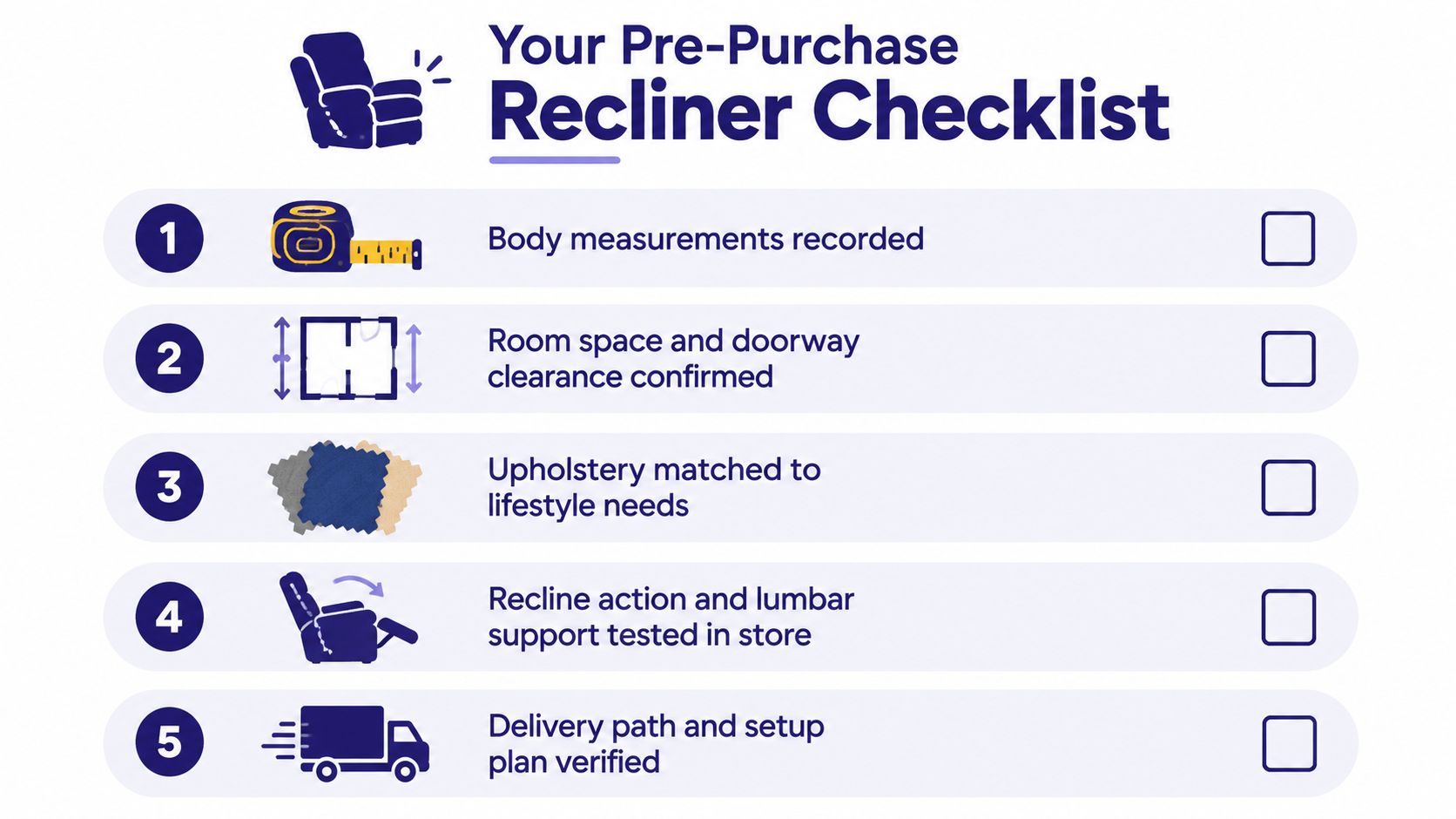
Confirm the body fit
- Record the user's popliteal height: Compare the floor-to-knee measurement with the compressed seat height.
- Check the seat depth: Sit fully back, keep the lumbar area supported, and make sure the edge doesn't press behind the knees.
- Test both positions: Operate the chair upright and fully reclined, then remain seated long enough to notice sliding or concentrated pressure.
- Evaluate the footrest: It should support the lower leg without leaving the feet unsupported or forcing an awkward angle.
Confirm the room and mechanism
- Measure the footprint: Mark the chair's upright and fully open positions, including rear clearance and the front space needed by the footrest.
- Test stability: Sit down, stand up, extend the footrest, and recline while checking for rocking or creeping.
- Match the controls: Choose manual operation only if the user can operate it comfortably. For power models, plan outlet access and ask about approved battery backup options.
- Read the coverage: Separate upholstery, frame, motor, electronics, and mechanism warranties before comparing prices.
Confirm the care plan
Match the upholstery to pets, children, sunlight, and cleaning habits. Keep the manufacturer's care code and instructions with your household records. If you're building a broader maintenance routine, this non-toxic cleaning checklist can help organize cleaning products and tasks, though the recliner manufacturer's care instructions should take priority.
For a home with wheelchair users, check the clear floor space beside the chair and the path needed to transfer. For a family with young children, inspect reachable moving parts and secure nearby climbable furniture. For a user with limited leg strength, prioritize controlled entry and exit over maximum depth or extra-plush padding.
A recliner is ready for purchase when the body fit, movement, stability, upholstery, warranty, room footprint, and delivery route all make sense together. If one of those answers is uncertain, keep comparing rather than letting a color or feature list make the decision for you.
Woodstock Furniture & Mattress Outlet offers recliners in a showroom setting where you can compare sizes, upholstery, and manual or power operation with knowledgeable staff. Visit Woodstock Furniture & Mattress Outlet with the primary user and your room measurements so the conversation starts with fit, stability, and placement rather than appearance alone.
Leave a Reply
You must be logged in to post a comment.