You've just wrestled a new protector onto the bed, smoothed the corners down, and reached for the sheets, only to find one corner has already popped free. Or the fabric pools along one side while the foot of the mattress sits exposed. That's frustrating, and it usually isn't your technique. With a mattress protector California king purchase, the label on the package tells you much less than three measurements from your own bed will. The footprint, the total thickness of your mattress stack, and whether your base moves decide whether a protector stays put. Materials matter, but they come after fit.
Measure Your Bed Before You Compare Protectors
The most common mistake happens before you get home. You see a package marked king, assume all kings are alike, and buy it for a California king bed. Then the fitted corners land in the wrong places. There's too much fabric across the width and not enough along the length, so the protector either bunches at the sides or pulls short at the foot.
The two sizes trade width for length. A California king is also sold as the Western King or Cal King, while the standard version is often called the Eastern King. You'll see all of these names on product labels, so it's worth recognizing them before you shop. The California king measures 72 inches wide by 84 inches long, which is 4 inches narrower and 4 inches longer than a standard king at 76 by 80 inches, according to long-standing California king dimensional guidance.
Why Shape Matters More Than Area
Here's the part that surprises people. The sleeping surfaces are nearly identical. A California king gives you 6,048 square inches, and a standard king gives you 6,080 square inches. That's a difference of only 32 square inches, or about 0.5%. So you aren't choosing a bigger or smaller protector. You're choosing a differently shaped one, and fitted corners can't compromise on shape.
| Mattress | Dimensions (W x L) | Sleeping surface | Protector to buy |
|---|---|---|---|
| California king (Western King, Cal King) | 72 x 84 in | 6,048 sq in | Protector labeled California king |
| Standard king (Eastern King) | 76 x 80 in | 6,080 sq in | Protector labeled standard king; not an exact substitute |
| Split California king (two mattresses) | 36 x 84 in each | Two separate surfaces | Two protectors, each sized 36 x 84 in |
The extra length is the point of the size. If you're tall, those added inches at the foot are likely why you bought the bed. The narrower width can also suit a bedroom that's longer than it is wide. Either way, a standard king protector can't stretch to cover the foot without leaving slack at the sides, and that slack shifts under your sheets.
The Four Measurements to Take
Grab a tape measure and work through these in order. It takes a few minutes and saves a return trip.
- Measure the width twice: Run the tape across the head of the mattress, then across the foot. Note both numbers in case there's any taper.
- Measure the length: Go along the longest edge from head to foot, keeping the tape flat against the side.
- Measure the thickness: Find the deepest point, from where the mattress rests to its highest surface. Leave any topper on while you do this.
- Confirm the layout: Check whether you have one mattress or a split pair that moves in two halves.
Write down three numbers before you compare any product. Width, length, and total thickness. Everything else you read on a package gets checked against those.
That third number is the one people skip, and it's the one that causes most corner pop-offs. A protector has to match the 72-by-84-inch footprint and wrap around the full depth of your bed. The next step is checking whether its pocket is deep enough to do that.
Matching Pocket Depth to Your Mattress Stack
Every listing shows two different numbers, and they're easy to confuse. Surface dimensions describe the top of the protector, the part you sleep on. Pocket depth describes how thick a mattress the skirt and elastic can wrap around. The second number decides whether the protector holds, so compare it first.
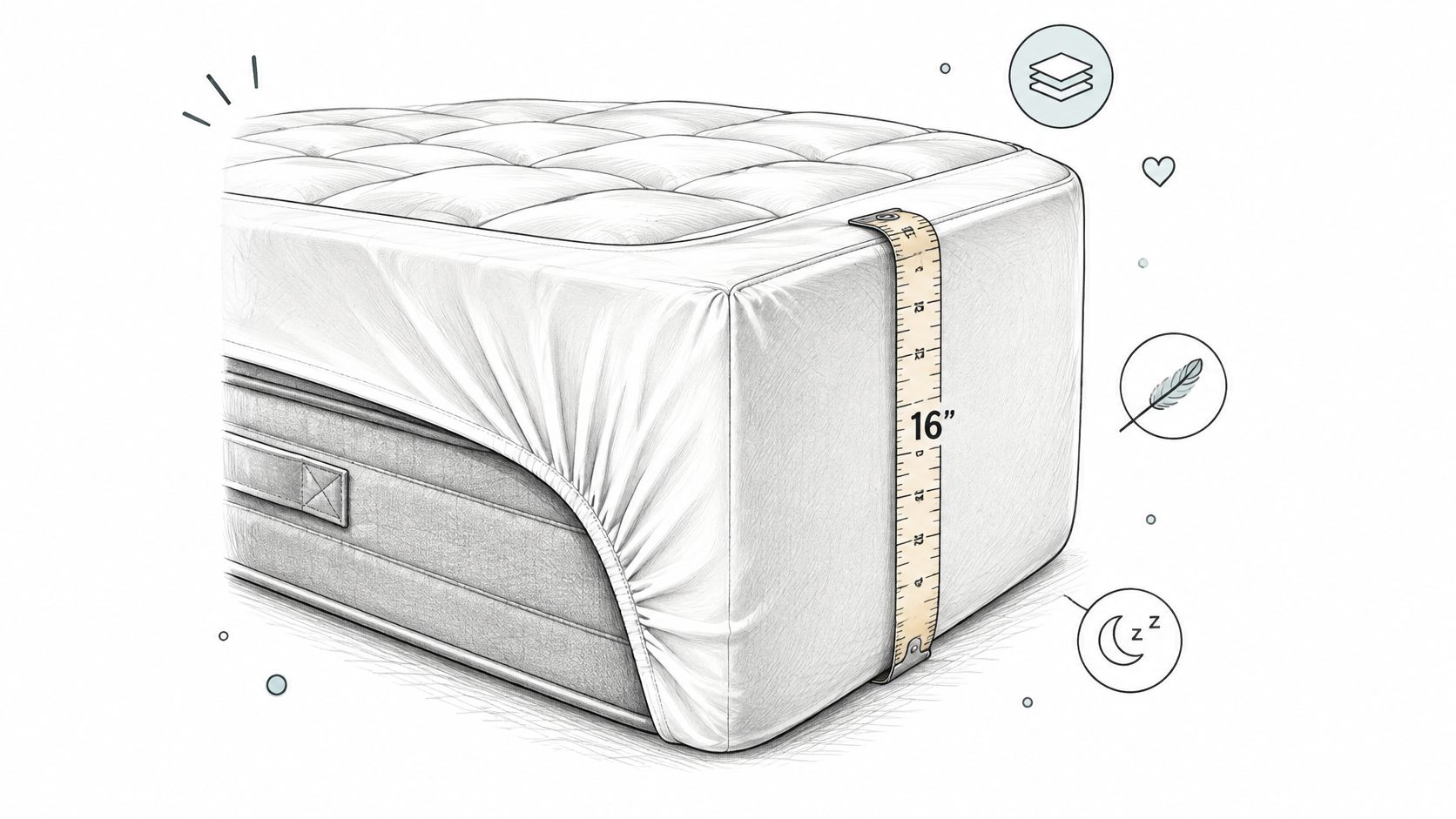
The working rule is simple. Choose a pocket depth 1 to 2 inches greater than your measured thickness, including any pillow top or topper. That extra room lets the elastic skirt tuck underneath the mattress instead of gripping the side, where it can ride up and lift a corner.
Protectors are usually listed as ranges rather than single numbers. You'll see products described as fitting mattresses 8 to 16 or 8 to 20 inches deep, as shown in current California king protector listings with varied depth ranges. Compare your measurement against the top of that range, not the bottom. If your stack sits near the top, the elastic has very little margin left.
| Measured thickness with topper | Pocket depth to look for | Check before buying |
|---|---|---|
| 10 in | 11 to 12 in | Confirm the listed pocket range includes this figure |
| 14 in | 15 to 16 in | Pillow tops and toppers count toward the total |
| 18 in | 19 to 20 in | Look for a range that reaches 20 in or deeper |
| 22 in or more | 23 to 24 in or deeper | Check the exact range; not every line goes this deep |
Three pitfalls come up again and again. People measure the mattress and forget the topper sitting on it. They buy on the California king label alone and never check depth. Or they ignore base movement, then find that raising the head pulls a corner free. Thick hybrid and pillow-top builds are the most common reason a standard depth falls short, so measure with everything in place and treat the label as a starting point rather than proof of fit. The movement check itself comes later, during fitting.
Choosing Waterproof, Breathable or Allergen-Barrier Materials
Shoppers often blur three separate needs into one purchase. You might want protection from spills and accidents. You might want a barrier against allergens. Or you might sleep hot and want something that doesn't make that worse. Those are different jobs, and one protector rarely does all three equally well. Naming your main need first makes the material choice much easier.
| Material type | Best for | Trade-offs | What to verify on the label |
|---|---|---|---|
| Waterproof (polyurethane or TPU laminate) | Spills, accidents and frequent liquid exposure | Can feel crinkly and may trap heat | Laminate type, care label, PVC or PFAS disclosure |
| Breathable membrane or treated cotton | Moisture protection for hot sleepers | Liquid protection level varies by product | Stated breathability, fabric content, fitted depth |
| Tightly woven allergen barrier | Dust mite and allergen concerns | Barrier depends on weave and seams; not automatically waterproof | Weave description, zipper or seam design, liquid claim |
| PFAS-free options (TPU, cotton or wool) | Buyers who want to avoid PFAS | Feel and heat vary by material | PFAS-free statement and any third-party certification |
The Waterproof Trade-off
Waterproof protection sounds like an obvious win, and for a child's bed, a guest room, or anyone managing frequent accidents, it often is. But there's a comfort cost worth knowing about. Independent testing summarized by AARP found that fully waterproof layers can trap heat and create a crinkly, plastic-like feel, while breathable membranes offered moisture protection with less discomfort, as described in AARP's summary of mattress protector testing.
Read that result with one limit in mind. That testing evaluated fit, cooling, material quality, and care on queen-size beds rather than California king models. So treat it as a direction, not a promise about a specific California king product. The construction principle still holds. A continuous barrier that blocks liquid also restricts airflow to some degree, and how noticeable that feels depends on the membrane and the fabric over it.
A plain way to think about it: the more completely a layer seals out liquid, the more you should ask what it does to heat and noise.
Reading Claims and Labels
Waterproof and breathable describe construction, not guarantees. Two products can carry the same word on the front of the package and be built very differently. Look past the headline and check the laminate type, the fabric content, and any specific statement about liquid protection. If a listing won't tell you what's in the barrier layer, that's information too.
Chemical transparency deserves the same check. Recent bedding discussions have raised PFAS concerns, and mattress protectors and waterproof pads are categories where PFAS may occur. If that matters to you, look for PFAS-free alternatives such as TPU, cotton, or wool. On any label, it's reasonable to verify four things where they're provided.
- PVC or vinyl content: Whether the barrier uses these materials or a different laminate.
- PFAS statements: Whether the maker states the product is PFAS-free.
- Flame-retardant disclosures: Whether any treatments are named.
- Third-party certification: Whether an outside body has reviewed the materials.
Allergen barriers work on a different principle again. A tightly woven fabric limits what passes through the weave, so performance depends on the weave itself and on how seams and closures are finished. Don't assume an allergen barrier is waterproof, or that a waterproof layer handles allergens the same way. Check each claim separately.
A useful decision rule is to pick the material that matches the one need that matters most in your home, then accept the trade-off that comes with it. If spills are your real concern, choose the barrier and accept some warmth. If you already wake up hot, prioritize breathability and accept that liquid protection may be lighter. Honest trade-offs beat a product that promises everything.
How to Fit a Protector on an Adjustable Base
An adjustable base changes what a protector has to survive. A flat bed asks the elastic to hold still. A moving base bends the mattress, shifts the corners, and pulls fabric toward the hinge points every time you raise the head to read. So fitting isn't finished when the protector goes on. It's finished when it stays on through the base's full range of motion.
The checklist below lays out the opening steps before you start testing movement.
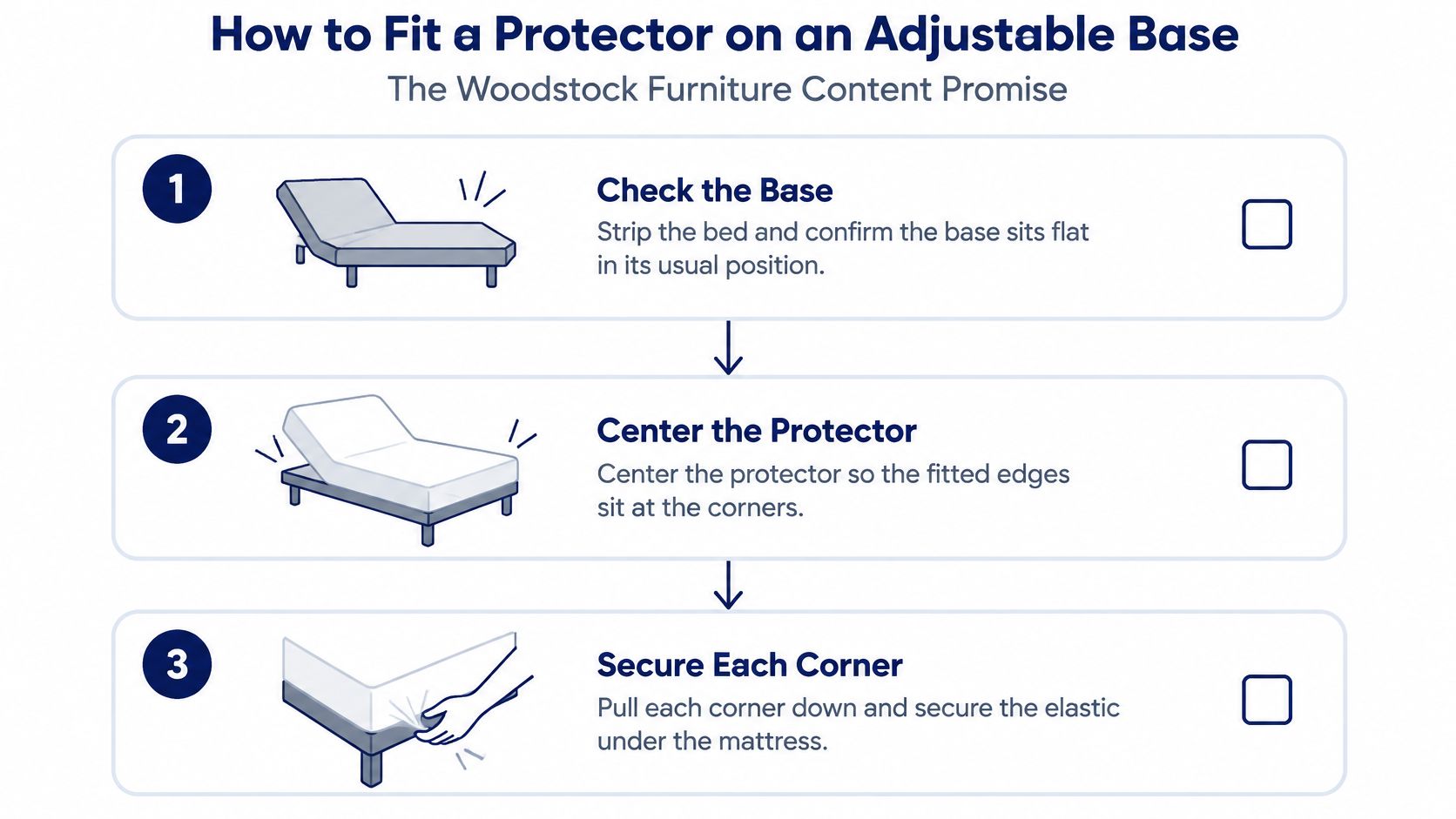
Work through the full routine in order, and don't skip the movement steps even if the fit looks fine while flat.
- Strip the bed and flatten the base: Return the base to its usual flat position so you're fitting against a stable surface, not a raised one.
- Center the protector: Lay it over the mattress with the fitted edges lined up at the corners. Starting centered keeps you from stealing fabric from one side to reach the other.
- Seat each corner under the mattress: Pull each corner down and tuck the elastic fully beneath the mattress. The elastic should grip underneath, not cling to the side wall.
- Smooth without stretching: Run your hands across the surface to remove folds. Don't yank the fabric taut, because stretched material pulls back once the base moves.
- Raise the head and check: Lift the head to a typical reading angle, lower it again, then walk around and inspect every corner.
- Raise the foot through full travel: Run the foot section up and down, then check the whole perimeter a second time.
- Inspect seams and closures: Look along zippers and stitched seams for strain, and check for any patch of exposed mattress fabric.
If a corner lifts during step five or six, the pocket is probably too shallow for your stack, even if it held while flat. That's the movement compatibility problem, and it won't fix itself with use. It's better to learn that now, before washing, while a return or exchange is still simple.
Watching the sequence once can make the corner order and hand placement clearer than reading about it.
Split Beds and the Sheet Layer
A split California king needs two protectors, one per side, each sized for its own mattress. One continuous cover stretched across both halves works against the whole point of a split base. It restricts independent movement and bunches along the center seam where the two mattresses meet. Fit each side separately, run each half through its travel on its own, then check that the center edges sit flat against each other.
Your sheets go on next, and they can undo a good fit. A fitted sheet sits over the protector, so its pockets now have to clear your mattress, your topper, and the protector's added thickness. Choose a deep-pocket sheet with that combined depth in mind. Avoid tucking a flat sheet tightly over the protector, since that tension can drag corners loose when the base articulates.
A successful fit means full perimeter coverage, no corner pop-off, and unobstructed base movement. Anything less is a size match on paper only.
One last habit helps. Protectors can creep after washing or after repeated base movement, so recheck the corners after the first few uses and after the first wash. A quick walk around the bed while you change sheets tells you whether the elastic is still seated where you left it.
Caring for a Waterproof Protector Without Damaging It
A waterproof protector can look intact while its barrier is starting to fail. Beneath the fabric, a thin lining blocks liquid. If that lining cracks, blisters, or peels, spills can reach the mattress. Care matters because heat and bleach may damage the barrier.
For polyurethane-lined covers, Protect-A-Bed's waterproof protector care guidance warns that chlorine bleach, bleach alternatives, and related by-products can harm the lining. It also cautions that overheating can cause blisters, which may split and lead to leaks. A small raised spot can become a weak point under pressure.
The Wash Routine
Check the protector's care label first. Instructions differ by lining and fabric, so the label for your specific product should guide washing and drying. If it permits machine washing, wash the protector separately or with similar items on a gentle, warm, bleach-free cycle. Avoid treating its care as identical to your sheets, which may have different temperature and drying instructions.
- Use a warm wash only if the label allows it: Do not assume one temperature suits every waterproof construction.
- Skip bleach: Avoid chlorine bleach, bleach alternatives, and related by-products for polyurethane linings.
- Follow the label for drying: Heat limits vary, so check the product instructions rather than defaulting to a dryer setting. If the label permits machine drying, use its stated setting and remove the protector when the cycle ends.
- Inspect before refitting: Look over the lining for bubbles, cracks, peeling, or other changes before putting the protector back on the bed.
A TPU laminate, a cotton protector, and a polyurethane-lined cover may have different care requirements. Even protectors sold as a mattress protector California King can vary by construction and warranty. The size label tells you which bed it fits, not how to wash it. The product label is the safer guide than a routine you use for other bedding.
When to Stop Using It
Replace the protector if you find signs that its barrier may no longer work. Check for:
- Blisters or bubbles: Raised areas that may split under pressure.
- Cracks or peeling seams: Visible breaks or separation in the lining.
- Stiff or sticky patches: Spots that feel different from the surrounding material.
- Liquid passing through: Dampness on the mattress side after a spill.
Visible damage means the barrier may have failed. You do not need to wait for a leak to confirm there is a problem.
Keep a photo or record of the care label with your bedding information. That makes it easier to check the instructions later instead of relying on memory. Regularly inspect the protector while changing the bedding, and clean it according to its label when needed.
Before You Buy and Next Steps
Before you buy, run five checks against the listing in front of you. Confirm the label says California king rather than just king. Match the stated dimensions to your measured footprint. Compare the pocket depth range against your total stack thickness. Read the material and barrier details for the one need that matters most to you. For a split bed, confirm you're buying two pieces, not one.
If any check fails, go back to that step instead of comparing more products. Another listing won't fix a measurement you haven't taken, and a different material won't fix a shallow pocket. Fit problems get solved at the measuring stage, not the checkout stage.
Two related questions deserve their own reading. Bed-bug protection is a separate job from spill protection, since an encasement is a zippered cover that surrounds the whole mattress and extension sources advise leaving it in place long term, as explained in University of Minnesota Extension bed bug guidance. Fire safety is separate too, because federal flammability standards under 16 C.F.R. part 1632 and part 1633 apply to mattresses and mattress sets rather than to a protector, as described in Consumer Product Safety Commission mattress flammability information. Neither topic should be settled by a protector label.
Bring your three measurements and your adjustable base model with you when you shop. Knowledgeable, experienced staff can check a protector's pocket depth and footprint against your actual bed, which is far more useful than comparing package claims at home. Visit us to see these options in person.
If your corners keep popping or your protector bunches when the base moves, bring your width, length, and stack thickness to Woodstock Furniture & Mattress Outlet, where staff can help you match pocket depth and material to your California king bed. We carry a great selection of protectors and sleep accessories at great prices, and you're welcome to handle the fabrics in person before you decide.