
You've found a couch that feels comfortable, fits your room, and comes in the brown you wanted. Then you read the tag: top-grain leather, semi-aniline finish, leather-match sides. Across the aisle, another couch says genuine leather. You just wanted seating that would hold up to everyday life. Now you're trying to work out whether those descriptions mean the same thing.
For a North Georgia household, the useful question isn't which leather name sounds most impressive. It's which material will still look acceptable after your family sits, spills, lounges, and lives on it.
Why Leather Couch Names Feel Confusing
Say you ask a showroom associate for a leather couch that won't look worn out after regular use. You hear full grain, top grain, aniline, and pigmented in the same conversation. It's easy to assume these are competing steps on a quality ladder.
They aren't. Some words describe the hide, others describe its surface treatment, and others describe where a manufacturer used leather on the furniture.
Separate the hide from the surface
Grade describes how much of the hide's original surface remains. Finish describes the dye, nap, or protective treatment on that surface. Retail terminology isn't always precise, so those definitions are a starting point for questions, not a substitute for a product specification.
Consider couches both described as top grain. A lightly finished aniline surface may feel especially natural but show absorbed oils and spills. A pigmented surface can look more uniform and provide more protection. The shared grade description doesn't make their everyday behavior identical.
Practical rule: Ask for the hide description and the finish description together. Neither tells the whole story alone.
Judge what you can actually inspect
Store lighting can change your impression of color. Touch the seat, arm, and back rather than relying on the hangtag or a small swatch. You're checking whether the surface feels pleasant where your skin will touch it, not trying to authenticate leather by feel alone.
- Start with the comparison table: Separate hide categories from finish categories before comparing couches.
- Verify the construction: Find out what covers the less-visible panels as well as the seat.
- Read performance information carefully: A rub number and a care sheet answer different questions.
The right choice should make sense both when you first sit down and when you imagine the couch after ordinary household use.
Leather Couch Types by Grade and Finish
Types of leather couches by grade and finish
| Type | What it is | Look and feel | Everyday wear | Often suits |
|---|---|---|---|---|
| Full grain | Grade: original outer surface kept | Natural marks, breathable, develops patina | Scratches and color shifts can stay visible | Owners who accept aging |
| Top grain | Grade: upper hide, sometimes lightly refined | Smooth but still leather-like | Everyday performance follows the finish and construction | Living rooms where the finish matches use |
| Corrected grain | Grade: sanded or buffed, often embossed | Uniform color and grain | Coating does more of the protective work | Shoppers who want a consistent look |
| Split | Grade: fibrous layer under the grain | Often coated or sueded | More vulnerable to tearing and finish failure | Lower-contact areas or a known budget tradeoff |
| Bonded | Reconstituted scraps and binder | Even surface, less like an intact hide | Lower reference abrasion range; surface can peel or crack | Light use when the label is understood |
| Aniline | Finish: dye with little or no pigment coat | Soft, natural, visible color variation | Readily absorbs oils and spills; vulnerable to light | Low-mess rooms and careful owners |
| Semi-aniline | Finish: light protective coat over dye | Soft with some uniformity | Better spill resistance than aniline | Buyers wanting feel plus moderate protection |
| Pigmented or protected | Finish: opaque color and protective film | Consistent color, less visible natural grain | Easier to wipe; can feel less natural | Children, pets, and frequent entertaining |
| Nubuck or suede | Surface treatment: sanded nap | Velvety, matte, shades with touch | Stains, water spots, and nap wear can show | Decorative or low-spill seating |
| Faux or coated synthetic | Not animal hide | Uniform, often easy to wipe | Film can crack, peel, or feel warm against skin | Buyers avoiding animal hide or seeking a uniform budget look |
Read each row across, but don't treat the rows as mutually exclusive. A couch can be corrected-grain leather with a pigmented finish. Leather-match, meanwhile, describes upholstery construction rather than a hide grade.
The Make Bespoke technical guide to furniture leather distinguishes the intact grain structure of full-grain leather from buffed corrected grain and the lower fibrous split. It explains why full grain generally offers greater tear strength and breathability, while split leather is more vulnerable to tearing, stretching, abrasion, and finish failure.
How the combinations work at home
Full-grain aniline makes sense when you want natural character and accept visible change. The intact outer grain provides structural advantages, but the light finish doesn't prevent an absorbed spill. Strong leather and stain-resistant leather aren't the same thing.
Say you're furnishing a quiet sitting room where drinks stay on side tables. You like subtle color variation and won't be upset when the favorite seat develops a different appearance. This combination may fit your expectations, provided you also accept the care requirements.
Semi-aniline top grain offers a middle ground. A light protective treatment can improve resistance to soil and spills while preserving a softer, more natural feel than a heavier finish. It's worth considering when you want leather character but don't want every casual touch to become a concern.
Pigmented corrected grain puts greater emphasis on a consistent appearance and a protected surface. For a family room used for homework, visiting friends, and evening television, that tradeoff may be more useful than preserving every natural marking. Protection still doesn't mean claw-proof, scratch-proof, or immune to finish wear.
The Sofa.info leather sofa guide makes this household distinction useful: lightly finished aniline favors natural feel, while protected or corrected leather can be more practical around children, pets, and frequent entertaining.
Decide how much visible change you welcome
Use a simple tolerance scale rather than a best-to-worst ranking:
- Low tolerance for marks: Begin with pigmented leather and inspect how the coating feels.
- Moderate tolerance: Compare semi-aniline options, particularly on the seat and arm tops.
- High tolerance: Consider aniline or a napped surface if visible aging is part of the appeal.
Nubuck and suede deserve a hands-on comparison. Both have a nap, but nubuck is associated with a refined outer surface, while suede commonly exposes the softer fibrous side. Their changing shades under your hand are part of their appearance, not necessarily a defect.
A familiar comparison helps separate material from finish. Varun Marbles' explanation of honed versus polished quartz worktops offers a parallel: the surface treatment changes how you experience a material without making it an entirely different underlying material. That's a conceptual comparison, not a claim that stone and leather need similar care.
Bonded and faux upholstery need a different conversation. Bonded material contains leather scraps held with a binder; faux is synthetic rather than animal hide. Neither should be judged as though it were an intact hide developing patina.
Price and the word premium don't settle these differences. Ask which hide sits beneath the finish on the seat, then judge whether that combination matches your expectations.
Labels and Where the Leather Actually Sits
Two hangtags can both say leather without describing equivalent upholstery. Genuine leather identifies real leather, not a specific durability grade, as the Leather Furniture buying guide explains. By itself, that label doesn't establish the fiber structure, protective finish, or construction of the couch.
Before comparing prices, ask for a panel-by-panel description. You're not looking for a reason to reject mixed materials. You're trying to understand what you're comparing.
Build a panel map
Use your phone's notes app or a printed specification sheet and record these areas:
- Seat surfaces and cushion fronts: Ask for both the leather category and finish where people sit and slide forward.
- Inside back and arm tops: Identify the surfaces that regularly touch hands, hair, clothing, and skin.
- Outside arms, sides, and back panel: Find out whether these use the same upholstery or a different material.
- Leather-match areas: Ask exactly what the matching material is. Don't assume the term tells you whether it's vinyl, coated split, or another specified upholstery.
The Modern Classics upholstery-leather guide notes that modified split leather may appear on furniture arms, backs, and sides while other areas use higher-grade leather. That arrangement isn't automatically unsuitable, but it matters when comparing price, feel, cleaning needs, and likely wear locations.
Inspect transitions rather than guessing
With permission, gently press and flex the front edge of the seat. Look at how the finish folds and how the seam sits. Don't scratch the upholstery or perform a spill test on a showroom couch.
Compare the arm top with the seat for grain pattern, temperature, and stiffness. Differences can prompt useful questions, but touch alone can't reliably identify every coated material. Written specifications should confirm what you feel.
A mixed-material couch can be a reasonable choice. An unidentified mixed-material couch is harder to compare fairly.
Think about placement, too. If the back will face an open living area, its appearance and feel matter more than they would against a wall. If your household regularly leans over the outside arm, that panel isn't low-contact because a specification treats it as an exterior surface.
Leave with the material names written down for each area. A verbal assurance that it's all leather-like or easy-care doesn't give you enough information to choose a cleaning method later.
Rub Ratings and What They Leave Out
A smooth or expensive-looking surface isn't a wear test. The International Leather Club rub-rating reference lists these approximate material ranges and identifies ASTM D7255 as a leather-upholstery abrasion method using a double-head rotary platform.
Approximate leather rub ranges and their limits
| Material group | Approximate rub range | Method to confirm | What the number misses |
|---|---|---|---|
| Full grain | 15,000–30,000 | Ask the standard; ASTM D7255 is one rotary method | Seams, cushion fronts, and sliding wear |
| Top grain and genuine leather | 12,000–15,000 | Compare only results from the same protocol | Genuine is a broad label, not a grade |
| Bonded leather and suede | 6,000–9,000 | Confirm the endpoint, not just the cycle count | Film failure, nap shading, and peeling need separate consideration |
These are approximate ranges from a reference, not test results for a particular couch. They don't establish how long an individual sofa will last, and grouping genuine leather together doesn't make that broad label more precise.
Ask what the test measured
A cycle count needs a named method and a defined endpoint. Did the tester stop at visible surface change, removal of a finish, or another specified condition? Without that information, numbers that look comparable may describe different outcomes.
The EN ISO upholstery-leather abrasion standard describes a Martindale ball-plate method in which finish breakdown includes removal sufficient to expose leather fibers. Its scope helps explain why an abrasion result can tell you about a protective film without fully describing the structural strength of the hide underneath.
A pigmented or coated surface may resist visible scuffing because the film acts as a barrier. That doesn't transform an underlying split into full-grain leather.
Inspect what repeated rubbing leaves out
People don't use a couch like a flat laboratory sample. They push against arm tops, slide across cushion fronts, and bend upholstery around seams. Those actions introduce concentrated flexing and shear as well as surface rubbing.
- Look at seam placement: Notice whether a seam crosses the area where you naturally slide off the seat.
- Press the cushion front gently: Check the finish and stitching where the upholstery bends.
- Examine accessible cushion undersides: Confirm the construction rather than assuming every surface matches the top.
For a busy household, documented testing paired with an appropriate protected finish is more useful than either a grain label or a rub number alone. A higher count isn't automatically a proportionally longer sofa life, and results from different protocols shouldn't be lined up as one scale.
Ask: Which standard was used, what counted as failure, and was the tested upholstery the same material used on this seat?
Care That Matches the Finish
Skip abrasive cleaners, saddle soap, oils, detergents, furniture polish, and ammonia unless the furniture manufacturer explicitly provides a different approved instruction. The Plymouth Furniture leather-care guide warns against those products and recommends weekly dust removal with an upholstery vacuum attachment or, for suitable leather types, a damp clean cloth.
There's no safe universal household cleaner for every leather couch. A bottle labeled for leather doesn't establish that it's suitable for your particular dye, nap, coating, or binder.
Use this checklist alongside the manufacturer's care sheet.
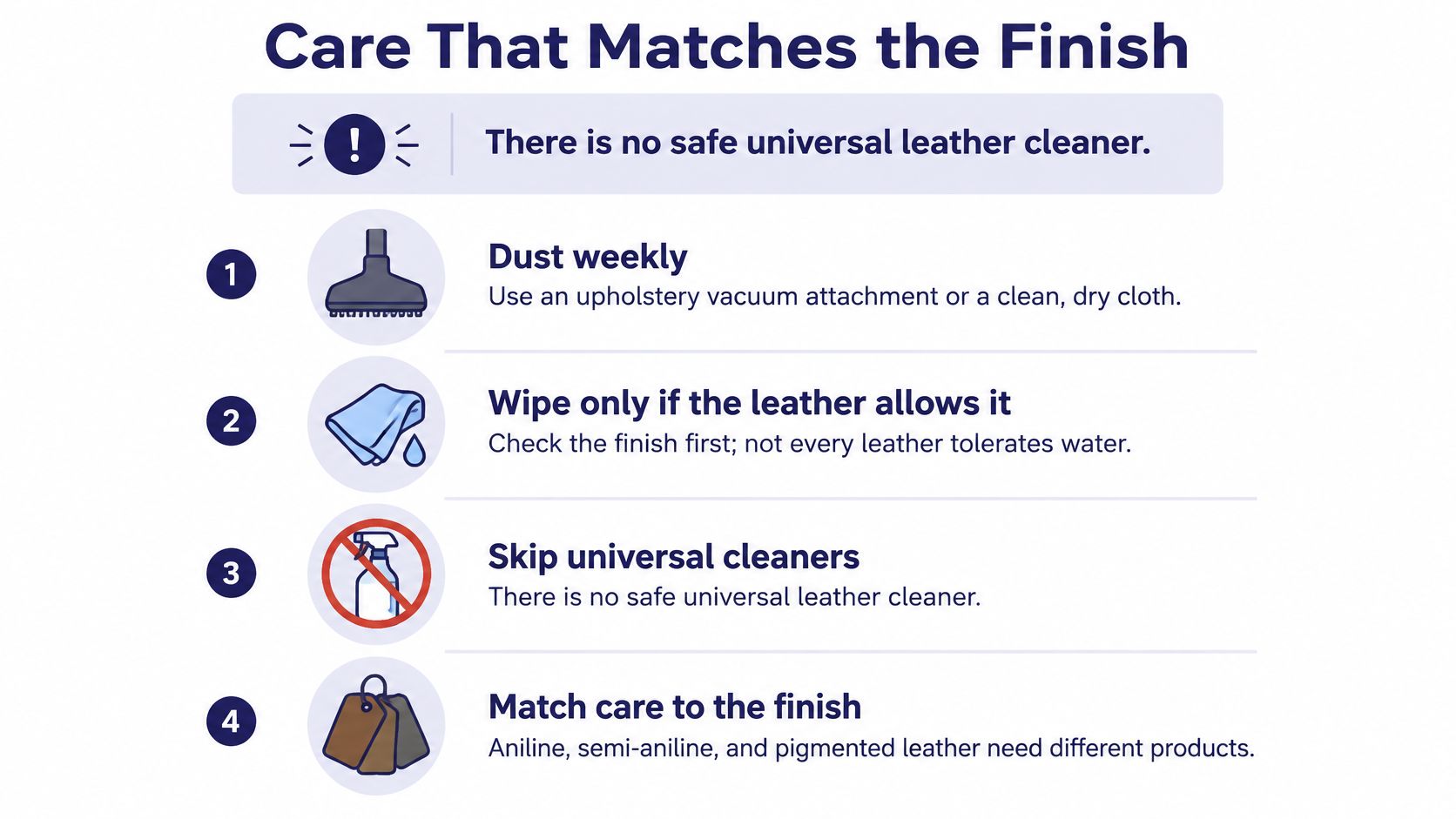
Match the routine to the surface
For pigmented or protected leather, blot a spill promptly with a clean, absorbent cloth. If the care sheet permits wiping, use the specified cleaner and a soft cloth, without saturating seams. Household sprays and solvents can affect the protective film, so don't substitute whatever cleaner is already under the sink.
For aniline, nubuck, and suede, avoid turning a small spot into a larger wet area. Blot rather than scrub, and don't apply water just because it works on another leather couch. Use only the tools and products identified for that finish, and limit strong direct sunlight.
For semi-aniline, use a light hand. If damp cleaning is approved, the cloth should lift soil without soaking the upholstery or leaving moisture around stitching and panel edges.
For bonded or heavily coated materials, don't assume an oil conditioner will nourish the surface. These constructions may rely on a film or binder that wasn't designed for that treatment.
Read the care sheet before choosing
Ask whether the upholstery is protected, unfinished, corrected, split, or bonded, then check that the instructions address the actual material. If the couch has different panel materials, confirm whether they need different care.
- Check the application method: Some products go onto the cloth rather than directly onto the upholstery.
- Check spot-testing instructions: Use a concealed area only as the manufacturer directs.
- Check what to do after a spill: Know when to stop home cleaning rather than repeatedly wetting a mark.
Ownership check: Choose a finish whose care routine you're willing to follow, not one that requires habits your household won't maintain.
Leather can be low-fuss, but it isn't maintenance-free. The specific care sheet matters more than a general promise on a cleaning bottle.
Pick a Type for the Way You Live
Choose for the room you have, not the careful household you hope everyone will become. A family-room couch needs to accommodate its usual traffic; a quieter reading room can support different priorities.
Use this summary to narrow the decision before comparing individual sofas.
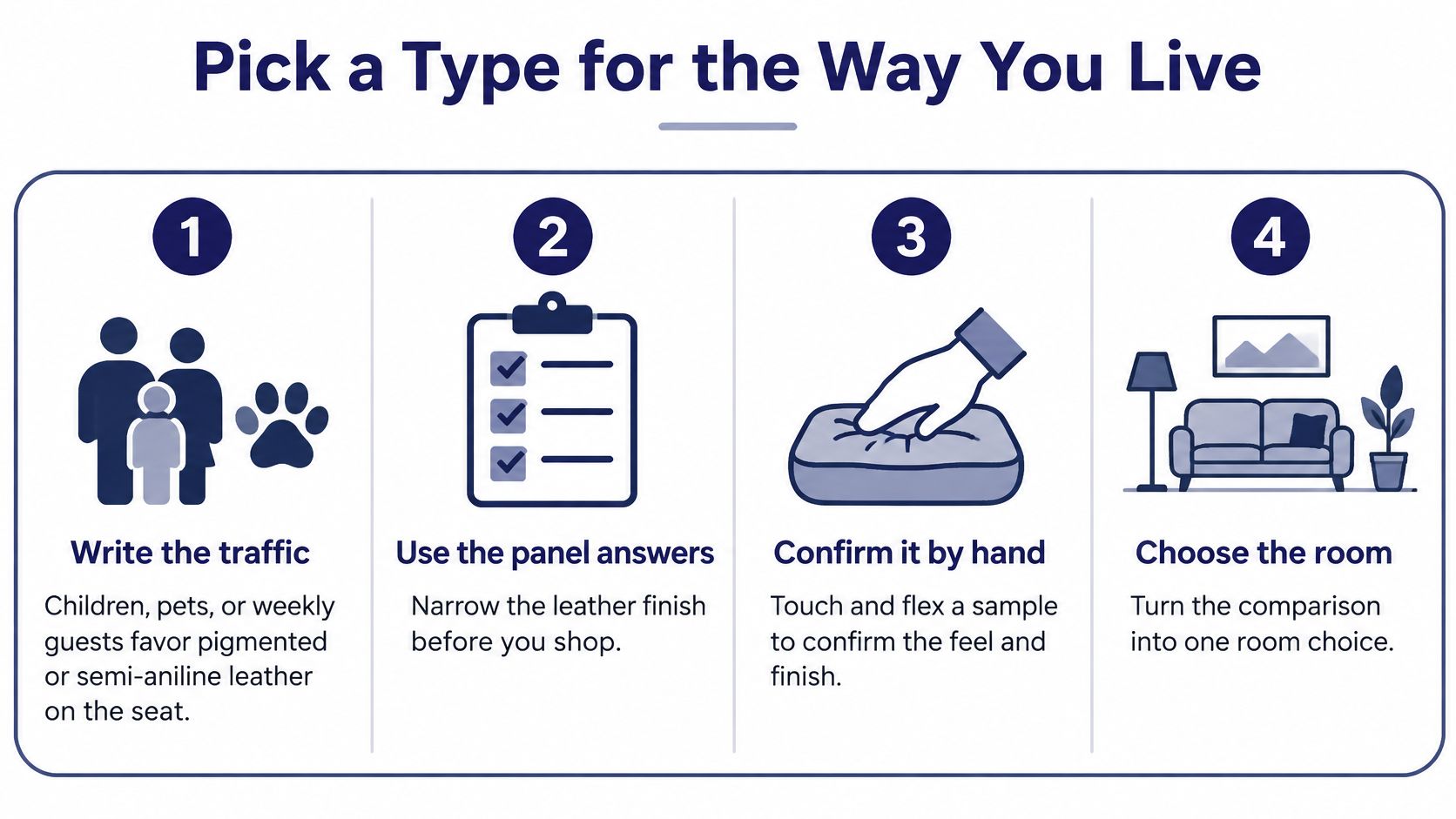
Make a room-specific shortlist
Write down your household's traffic, tolerance for marks, and available light. Be concrete: a dog beside you every evening is different from a pet that never uses the furniture.
- Busy shared seating: Start your comparison with pigmented or semi-aniline seat upholstery, then use the panel map to assess the arms and sides.
- A quieter formal room: Consider aniline or full grain when you want patina and can limit food, spills, and strong sunlight.
- A bright room: Before selecting pale aniline leather, ask about the dye's light sensitivity and whether the planned location is appropriate.
- A bonded, faux, or corrected-grain shortlist: Compare surface construction, hand-feel, and expectations for daily use. Ask about peeling and cracking rather than deciding which label sounds more premium.
Don't assign a promised lifespan from the material name alone. How the surface is finished, where it's used, and how you care for it all matter.
Confirm the choice in person
Sit as you normally would, then slide forward and gently press the cushion front. Check whether the seat feels comfortable against exposed skin and whether the arm height works for your usual posture. Comfort and material suitability are separate decisions, and you need both.
Read the care sheet while you're still comparing options. Ask to view contrasting finishes in daylight and indoor light when possible, then leave with the grade, finish, panel map, and care method recorded.
Use the video as a companion to a hands-on comparison, not a replacement for checking the specific couch.
Bring room measurements and photos, including windows and doorways. Those details help connect the upholstery choice to the layout, lighting, and route into the room.
The useful outcome isn't memorizing every leather term. It's being able to explain why a particular combination fits your home, what changes you'll accept, and how you'll care for it.
At Woodstock Furniture & Mattress Outlet, we offer design services and delivery options to help you connect your leather choice with the room it needs to fit. Bring your measurements, room photos, and upholstery questions when you visit Woodstock Furniture & Mattress Outlet, and compare the feel and finish in person before deciding.