Tag: spinal alignment

  • Mattress Types for Side Sleepers: A Concise Guide to Choosing the Right Mattress

    Mattress Types for Side Sleepers: A Concise Guide to Choosing the Right Mattress

    For many of us, a truly restorative night's sleep can feel elusive. More often than not, we're waking up with nagging shoulder or hip pain. A common reason for this is a mattress that's just not cut out for the way we sleep. Especially for the large majority of people who sleep on their sides, the right mattress isn't a luxury—it's key to waking up feeling refreshed instead of sore.

    Why Your Sleep Position Shapes Your Mattress Needs

    If you're constantly waking up with a sore shoulder or an aching hip, your body is trying to tell you something. Side sleeping might be the most common position, but it introduces a unique set of challenges for your body and your mattress. Understanding these challenges is the first real step toward finding a bed that provides genuine, lasting comfort.

    The core problem boils down to physics. When you lie on your side, your body's weight becomes focused on a couple of small areas—mainly your shoulder and your hip. This creates intense pressure points that can lead to pain, numbness, and a lot of tossing and turning all night.

    The Science of Pressure and Alignment

    Here's a simple way to visualize this: imagine trying to push a bowling ball into a hardwood floor. The floor has no give, so all that force is concentrated on one tiny spot. Now, picture pushing that same bowling ball into a thick, cushy mat. The mat gives way, absorbing the pressure and spreading the weight out more evenly.

    Your body is the bowling ball, and your mattress is the surface.

    • A mattress that’s too firm is like that hardwood floor. It pushes back hard against your shoulder and hip, creating those painful pressure points and knocking your spine out of its natural, straight line.
    • A mattress that’s too soft can be just as problematic. It lets your hips and shoulders sink too deep, causing your spine to sag in the middle.

    The solution is finding a mattress with what we call cradling support. This is that ideal middle ground where the mattress contours to your body's curves to relieve pressure, but at the same time, it’s supportive enough to hold up your waist and keep your spine straight.

    The Importance of Cradling Support

    Side sleeping is, by far, the most common sleep position. Research shows that a significant portion of the population prefers it. When a side sleeper lies down, their body naturally creates major pressure points at the shoulders and hips. A suitable mattress must be able to cushion those sensitive spots while also keeping the spine in proper alignment to prevent pain.

    Mattress experts will often use pressure mapping to see exactly how a mattress performs, measuring how much a person's spine deviates from a straight, neutral line. You can learn more about how mattress testing reveals these support insights from experts at Consumer Reports.

    Figuring out why your sleep position is so important is a huge first step in building a better sleep setup. But it's not just about the mattress. Taking a broader look at how to sleep better at night can make a massive difference in how you feel. When you dial in both your sleep equipment and your habits, you're setting the stage for truly restorative rest.

    Exploring the Most Common Mattress Types

    Once you understand why you need that cradling support, the next step is figuring out which materials deliver it effectively. The mattress world is packed with different technologies, and each one has a distinct feel and its own set of trade-offs. For side sleepers, the choice usually boils down to one question: how well can it contour to my curves while keeping my spine straight?

    When you start shopping, a common fork in the road is choosing between a Spring Mattress vs Foam Mattress. Let's break down the main contenders to see how they stack up for your sleeping style.

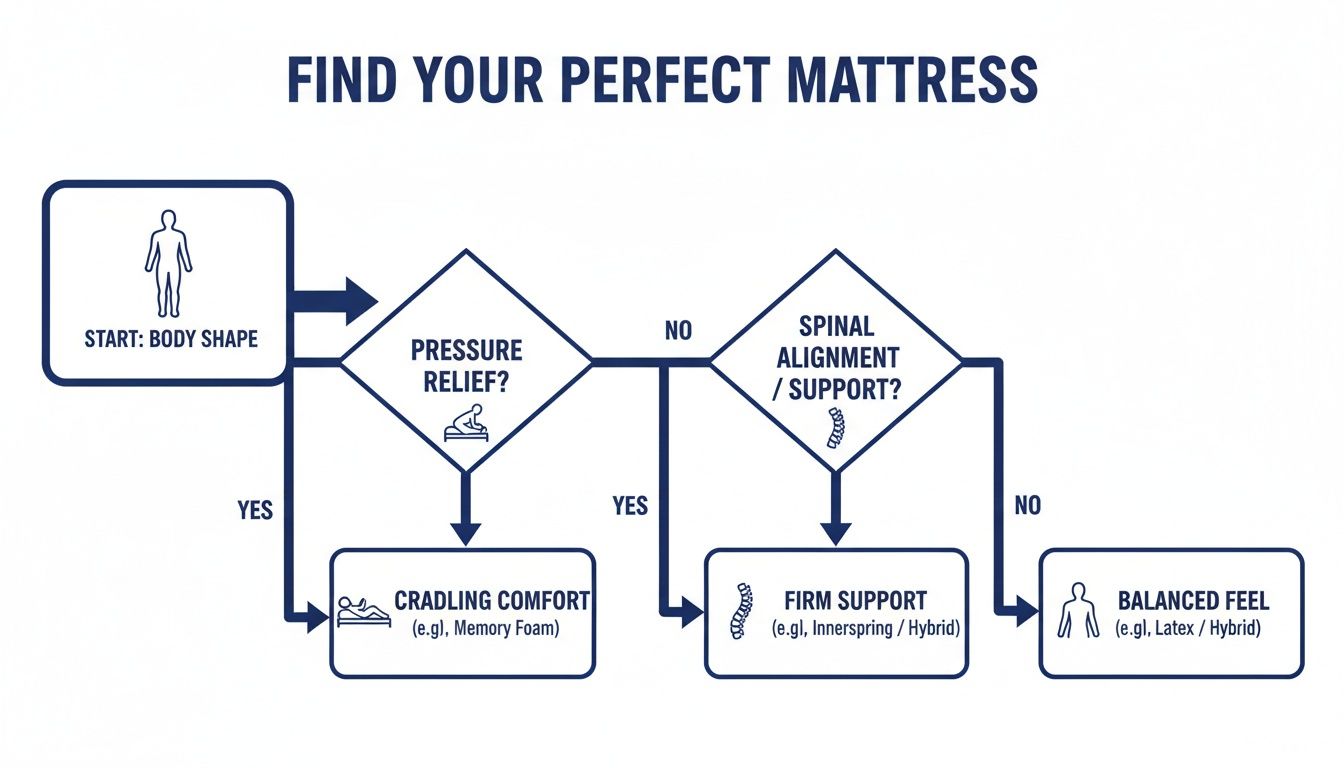
    This simple decision tree can help you see how a side sleeper's needs point toward a specific kind of mattress support.

    Flowchart guiding side sleepers to choose mattress support based on their pain level.

    As the chart shows, if you're waking up with pain, that's your cue. It means your pressure points are signaling the need for a mattress with better contouring and cradling.

    Memory Foam: The Contouring Champion

    Memory foam is famous for its slow-sinking, deep-hugging feeling. It's made from viscoelastic foam that reacts to your body heat and weight, softening and molding around you. This is what creates that signature "hug" that many people find comfortable.

    For side sleepers, this is a significant benefit. The foam gives way exactly where you need it to—at the shoulder and hip—letting those areas sink in just enough. This action is a game-changer for reducing the pressure that causes those morning aches and pains.

    But, like any material, there are a couple of things to keep in mind:

    • Heat Retention: Older memory foam designs had a reputation for trapping body heat. Fortunately, newer models have improved, often using gel infusions, open-cell designs, or other cooling technologies to improve temperature regulation.
    • Slow Response: That deep contouring can sometimes make you feel a bit "stuck." If you're someone who changes positions frequently, the slow-moving nature of memory foam might feel restrictive.

    Latex: The Responsive Cradler

    Latex mattresses offer a different contouring experience. Whether it's made from the sap of rubber trees (natural latex) or from synthetic materials, latex has a more buoyant and responsive feel. The sensation is often described as sleeping on the mattress, not in it.

    It still provides excellent pressure relief, but with an added lift that makes it much easier to move around and switch positions.

    Latex hits that sweet spot between pressure relief and buoyancy. It gently yields to your shoulders and hips without that deep "sinking" feeling of memory foam, which is a great fit for side sleepers who want a more responsive surface.

    On top of that, latex is naturally durable and breathes well. Its open-cell structure allows air to flow, making it one of the more temperature-neutral mattress types available.

    Hybrid: A Combination of Materials

    A hybrid mattress is designed to give you the benefits of different materials all in one bed. The typical construction features a support core of individually wrapped innerspring coils topped with thick comfort layers of memory foam, latex, or other specialty foams.

    This construction is often a great match for side sleepers. You get the deep, contouring pressure relief from the foam on top, paired with the sturdy, responsive support of the coil system below.

    The benefits include:

    • Balanced Feel: Hybrids can provide both the "hug" of foam and the bounce of springs.
    • Enhanced Airflow: The coil layer allows air to circulate much better than an all-foam bed, which helps you sleep cooler.
    • Targeted Support: The pocketed coils adapt to your body's shape, offering zoned support that helps keep your spine in a healthy, neutral alignment.

    Innerspring: The Traditional Foundation

    Traditional innerspring mattresses are built with a core of interconnected steel coils. They're known for offering firm, reliable support and are often available at accessible price points, but they can be tricky for side sleepers.

    The main challenge is their limited ability to contour. A basic innerspring bed usually doesn't have the thick, soft comfort layers needed to properly cushion the shoulders and hips. This can create the very pressure points you’re trying to avoid.

    For an innerspring to work well for a side sleeper, it almost always needs a plush pillow top or Euro top. These extra layers of padding add some much-needed softness, but they still might not provide the same targeted, pressure-relieving qualities you’d get from memory foam, latex, or a well-designed hybrid.

    To help you sort through these options, here's a quick comparison table.

    Mattress Type Comparison for Side Sleepers

    Mattress Type Pressure Relief Potential Spinal Alignment Support Key Considerations
    Memory Foam Excellent Very Good Can sleep hot; slow response time might feel restrictive for some.
    Latex Very Good Excellent Bouncy and responsive; naturally cooler and more durable.
    Hybrid Excellent Excellent Balanced feel, great airflow, strong edge support; often heavier.
    Innerspring Fair to Good Good Very bouncy and affordable; requires a thick comfort layer for pressure relief.

    This table should give you a good starting point, but remember that the right mattress is always a personal choice based on your body and preferences.

    The market has responded to the call for better pressure relief. In fact, foam-based products have grown in popularity, now making up about 45% of the total mattress market share in 2024. This trend is good news for side sleepers, since memory foam and modern latex are adept at providing that cradling support needed to keep pain at bay.

    How Body Weight Affects Firmness and Feel

    So, you've narrowed down the type of mattress you want. The next piece of the puzzle, and it's a critical one, is firmness.

    It’s a common misconception that a "medium-firm" mattress feels the same to everyone. The truth is, how firm a mattress feels is entirely personal and shifts dramatically based on your body weight.

    Here’s an easy way to think about it: imagine dropping a bowling ball and a tennis ball onto the same mattress. They're going to make very different impressions. Your body is the same way. Your weight determines how much you sink into the soft top layers and engage with the supportive core underneath. This is why a mattress that feels like a cloud to a lighter person might feel like a plank of wood to someone heavier.

    Illustration of side sleepers (light, medium, heavy) on a mattress, demonstrating firmness needs via a 1-10 scale.

    To standardize things, the mattress industry uses a 1-10 firmness scale—1 is extremely soft, and 10 is extremely firm. For most side sleepers, the ideal zone is in the medium-soft to medium range, which is about a 4-6 on the scale. This zone usually achieves that balance of pressure-relieving contour and spine-aligning support.

    However, your body weight is the variable that can change everything.

    Finding Your Ideal Firmness Based on Body Weight

    Understanding how your weight interacts with the mattress surface is the secret to avoiding a bed that’s either too soft or too firm. Let's break down the general guidelines.

    • Lighter Sleepers (Under 130 lbs): If you're on the lighter side, you don't place as much pressure on the mattress. A medium or firm bed might not allow you to sink in enough to get the essential cradling for your shoulders and hips. The result? The mattress pushes back too hard, creating pressure points. That's why lighter side sleepers often find a softer mattress (a 3-5 on the scale) provides better pressure relief.

    • Average Weight Sleepers (130-230 lbs): This is the group that most "universal comfort" mattresses are designed for. A medium-soft to medium mattress (a 4-6 on the scale) typically hits the bullseye. It has enough give to cushion the hips and shoulders but also plenty of underlying support to keep the spine straight.

    • Heavier Sleepers (Over 230 lbs): Heavier individuals will naturally sink deeper into a mattress's comfort layers. A bed that's too soft can be a problem; you may sink through the top layers, causing your spine to sag and potentially leading to back pain. A medium-firm to firm mattress (a 6-8 on the scale) provides the robust support needed to prevent over-sinking while still offering sufficient cushion on top.

    Your body weight is the most important factor in translating a mattress's firmness rating into real-world feel. What's "medium" for a 200-pound person might feel "firm" to a 130-pound person sleeping on the exact same bed.

    Why Mattress Thickness Matters for Side Sleepers

    Along with firmness, the mattress's thickness—sometimes called its profile or height—plays a huge role in comfort, especially if you sleep on your side. A thicker mattress isn't just for aesthetics; it's a direct indicator of how deep the comfort system is.

    Think of a mattress as having two main parts: the support core (the strong base of coils or dense foam) and the comfort layers on top (the cushy memory foam, latex, etc.). For side sleepers, those comfort layers do all the heavy lifting by cushioning the shoulders and hips.

    If a mattress is too thin (say, under 10 inches), a side sleeper can easily sink right through those comfort layers and hit the firm support core. This defeats the purpose and can create the exact pressure points you're trying to eliminate.

    For this reason, a mattress that's at least 12 inches thick is often recommended for side sleepers. That extra height usually translates to deeper, more substantial comfort layers, giving your body more room to sink in without bottoming out. This is key to getting consistent pressure relief and durable support that will last.

    Building a Complete Sleep System for Side Sleepers

    Finding the right mattress is a huge step toward a great night's sleep, but it's really the foundation. To truly dial in the comfort and support that side sleepers need, it helps to think in terms of a complete sleep system. This simply means pairing your mattress with the right accessories that all work together for proper alignment and pressure relief from head to toe.

    A fantastic mattress can solve your hip and shoulder pain, but if your head is at an odd angle all night, you might just be trading one problem for another. The goal is to create a seamless, supportive environment for your whole body.

    Diagram of a person lying on an adjustable bed demonstrating proper spinal alignment and airflow.

    The Essential Role of the Right Pillow

    For anyone who sleeps on their side, a pillow isn't just a fluffy accessory—it's a critical tool for spinal health. When you lie on your side, a significant gap opens up between your head and the mattress. If your pillow is too flat, your head will sag down, straining your neck muscles. If it's too thick, it will push your head upward, creating a different kind of misalignment.

    The secret is finding a pillow with the right loft, or thickness, to fill that space correctly.

    • Pillow Loft: Look for a pillow that’s thick enough to keep your head and neck in a straight, neutral line with the rest of your spine. For most side sleepers, this means a mid-to-high loft pillow is the sweet spot.
    • Pillow Firmness: Your pillow also needs to be firm enough to support the weight of your head without going flat overnight. Materials like solid memory foam, latex, and denser down alternatives are often good choices.

    Here’s a helpful tip: tuck a second, thinner pillow between your knees. This simple trick can do wonders for keeping your hips properly aligned and stops your top leg from twisting your lower back out of position.

    Fine-Tuning Comfort with a Mattress Topper

    Have you ever found a mattress that's almost perfect but just a little too firm? Perhaps it felt great in the showroom but is hitting differently at home, or maybe your comfort preferences have just changed over time. This is where a mattress topper can be a useful tool.

    A topper is an extra layer of cushioning, usually 2 to 4 inches thick, that you place on top of your existing mattress. It lets you add that missing layer of pressure relief without having to buy a whole new bed. For side sleepers, a memory foam or latex topper is often an effective solution for adding crucial cradling comfort for your shoulders and hips.

    A mattress topper is a practical solution for fine-tuning your sleep surface. It can add a layer of plush, contouring comfort to a mattress that is supportive but just a little too firm, directly targeting pressure point relief.

    Enhancing Comfort with an Adjustable Base

    An adjustable base is an upgrade for personalizing your sleep. These powered foundations let you raise the head and foot of your bed to find positions that a flat foundation cannot provide.

    While many people think of them for sitting up to read or watch TV, adjustable bases offer real ergonomic benefits for side sleepers. Slightly raising your head can help open up your airways for easier breathing, and lifting your legs can take strain off your lower back and hips. Finding a subtle "zero-gravity" position can help distribute your body weight more evenly, taking even more pressure off your side. It can be a significant investment, but one that adds a new level of customized comfort to your sleep system.

    How to Test a Mattress with Confidence

    Mattress shopping can feel like a chore. While digging through reviews online is a good place to start, there’s simply no substitute for testing a mattress in person. The way a mattress feels is incredibly personal, and the only way to really know if it’s for you is to lie down on it.

    A trip to a mattress showroom lets you feel the real-world difference between all the options we've discussed. It’s your chance to directly compare how different mattress types support your unique body shape and sleep style. This is where theory meets practical experience, connecting what you’ve learned with how your body actually feels.

    A Practical Approach to In-Store Testing

    To get the most out of your visit, it helps to have a game plan. Just sitting on a mattress for thirty seconds won’t tell you much about how you’ll feel after a full night’s sleep. A more deliberate approach is key to uncovering potential issues with pressure points or spinal alignment.

    Here’s a simple process we recommend to our own customers:

    • Wear Comfortable Clothing: You're going to be lying down and rolling over, so wear something that lets you move freely.
    • Lie in Your Side-Sleeping Position: Don't just lie on your back if that's not how you sleep at home. Get into your typical side-sleeping posture and settle in.
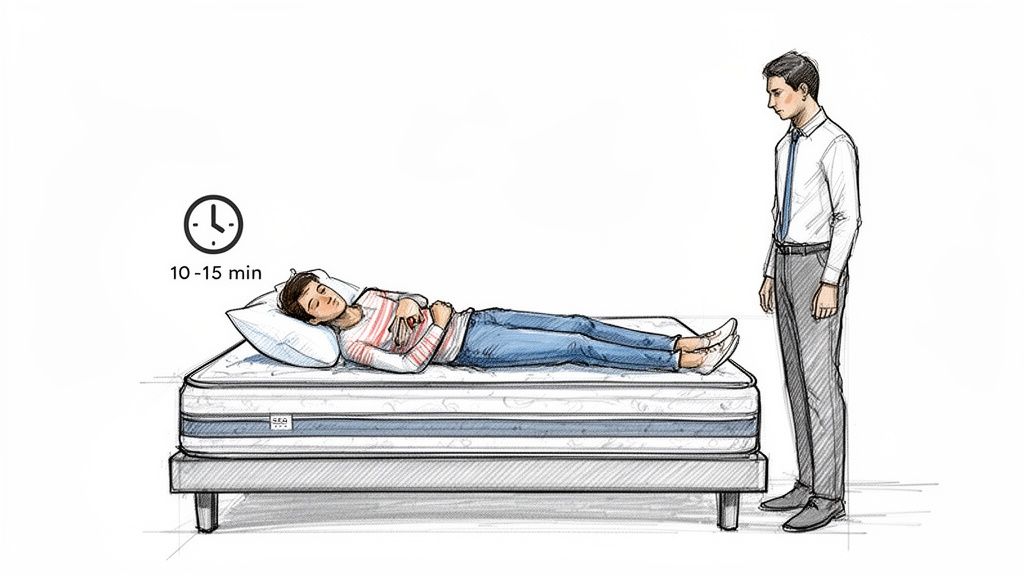
    • Stay for at Least 10-15 Minutes: This is the most important step. Your body needs time to relax and sink into the mattress. Rushing this can easily lead to choosing the wrong bed.
    • Pay Attention to Your Hips and Shoulders: Do you feel any pinching, numbness, or excess pressure? A good mattress for a side sleeper should gently cradle these areas.
    • Check Your Spinal Alignment: This can be tricky to judge on your own. Ask your shopping partner or a knowledgeable sales associate to see if your spine looks straight from your neck to your tailbone. A quick photo on your phone can also give you a clear picture.

    Finding a Low-Pressure Shopping Environment

    The whole point of trying a mattress is to make a smart, informed decision—not to feel pressured. Visiting a store with an experienced, genuinely helpful team can make all the difference.

    Good sleep professionals can walk you through the different mattress types for side sleepers, explain the real functional differences between brands, and help you compare your options without high-pressure tactics.

    The in-store experience should be about discovery and education. Your goal is to gather information about how different mattresses feel so you can make a choice you're confident in for years to come.

    Take your time, ask plenty of questions, and don’t feel awkward about lying on a bed for an extended period. Any true sleep professional will understand and encourage this. They know that a confident, well-informed customer is the goal. A visit to a local showroom, like our own Woodstock Furniture & Mattress Outlet Sleep Centers, gives you the chance to try a wide variety of mattresses in a relaxed, educational setting.

    Common Questions About Mattresses for Side Sleepers

    After digging into all the different mattress types, you might still have a few questions. That's perfectly normal. This section is dedicated to answering the most common questions we hear from side sleepers in our showrooms.

    What Firmness Is Best for Side Sleepers with Hip Pain?

    If you're a side sleeper struggling with hip pain, you'll want to focus on mattresses in the medium-soft to medium range. Think of it as a 4 to 6 on that 10-point firmness scale. This is often the sweet spot for getting both cushioning and support right where you need it.

    A mattress in this range is soft enough to gently cradle your hips, taking the direct pressure off the joint. But, just as importantly, it's supportive enough to keep you from sinking in too far. If you sink too deep, your spine gets thrown out of alignment, which can make the pain worse.

    Memory foam and latex are materials that excel at this because they are designed to distribute body weight evenly instead of letting it all concentrate on your hips. When you're testing mattresses, lie down and pay close attention. If you feel even a hint of strain in your hips or lower back, that's your body telling you it's not the right fit.

    Are Hybrid Mattresses a Good Choice for Side Sleepers?

    Yes, hybrid mattresses are often an excellent choice for side sleepers. They are engineered to give you the standout benefits of two different mattress types in one bed.

    You get a base layer of innerspring coils that provides durable support needed to keep your spine straight. Then, on top, you have thick comfort layers of memory foam or latex that deliver the deep pressure relief your shoulders and hips require.

    This "best of both worlds" approach can give you the contouring hug of foam without the "stuck" feeling some people dislike. The coils also add some bounce, making it easier to roll over or get out of bed.

    As a bonus, the space between the coils allows for better airflow than a solid block of foam, which can be helpful for anyone who tends to sleep hot.

    How Do I Know if My Mattress Is Wrong for Side Sleeping?

    Your body will send you some pretty clear signals if your mattress isn't a good fit. Learning to recognize those signs is the first step to getting a better night's sleep.

    One of the biggest red flags is waking up with numbness or tingling in your arms or hands. This is a classic sign that your mattress is too firm and is pinching nerves or restricting circulation at your shoulder.

    Another common sign is nagging shoulder, hip, or lower back pain. If the pain is most intense first thing in the morning but slowly gets better as you move around, your mattress is a likely culprit. If you find yourself tossing and turning all night, trying to get comfortable, your mattress simply isn't relieving pressure properly.

    Finally, take a look at your mattress. If you can see a permanent dip or sag where you sleep, the support system has likely worn out. It can no longer hold you in proper alignment and should be replaced.

    Where Should My Arms Go When I Sleep on My Side?

    This is a trickier one than people realize. The main goal is to keep your arms and hands below your shoulders. This helps you avoid compressing the nerves in your shoulder joint, which can lead to pain and numbness.

    Many side sleepers are comfortable with their arms down by their sides, or bent slightly in front of their body. Another helpful trick is to hug a body pillow. This not only gives your top arm a comfortable place to rest but also keeps your shoulders from collapsing forward and straining your upper back.

    Whatever you do, try to avoid tucking an arm under your head or pillow. That's a common cause of waking up with that "pins and needles" feeling from restricted circulation.


    Here at Woodstock Furniture & Mattress Outlet, our mission is to help you explore your options in a no-pressure, educational setting. Our experienced team can walk you through the different mattress types for side sleepers, letting you compare models to find a suitable match for your body and your budget. Come visit one of our North Georgia showrooms and feel the difference for yourself.
    Explore our full selection of mattresses online

  • Finding a Suitable Mattress for Side Sleepers

    Finding a Suitable Mattress for Side Sleepers

    Generally speaking, a good mattress for most side sleepers falls somewhere in the medium-soft to medium-firm range. This area usually gives the right mix of cushioning pressure relief for the shoulders and hips, while still being sturdy enough to keep the spine straight and help prevent morning backache.

    Why Your Sleep Position Shapes Your Mattress Needs

    If you’re one of the millions who curls up on their side at night, you may already know the struggle. You might spend half the night trying to find that one spot that doesn't make your shoulder go numb or your hip ache by morning. It’s not in your head—it’s just physics. When you lie on your side, your body's curves create significant pressure points, and a mattress that isn't a good fit can make it worse.

    Think of it like trying to fit a key into a lock. Your body has its own unique shape, especially with the pronounced curves at your shoulders and hips. A mattress that's too firm is like the wrong key; it doesn’t fit your shape, jamming up against those curves and creating painful pressure. On the flip side, a mattress that’s too soft lets you sink in too far, bending your spine out of alignment and causing a different kind of discomfort.

    The Goal: Pressure Relief Meets Support

    A well-suited mattress for a side sleeper is one that fits the body's contours just right, helping to unlock a restful night’s sleep. It needs to be soft enough to cradle your pressure points but supportive enough to hold your spine in a straight, neutral line. For side sleepers, getting this balance right is essential if you want to wake up feeling refreshed and pain-free.

    But finding this balance is about more than just picking a familiar brand name. It's about understanding how a few key factors work together to create the right sleep surface for you. These elements include:

    • Mattress Firmness: This is a major factor. It determines how much "give" the surface has.
    • Mattress Materials: From memory foam to latex to hybrid coils, different materials offer very different feels and benefits.
    • Your Body Type: Your own weight and shape will change how you interact with any mattress.

    At its core, the biggest challenge for a side sleeper is finding a mattress that can spread body weight evenly across the entire surface. If it can’t, the shoulders and hips are left to carry most of the load, which can lead to tossing, turning, and waking up sore.

    This guide is here to walk you through each of these pieces of the puzzle. Our goal is to give you clear, honest information and take the confusion out of the mattress buying process. Once you understand what your body actually needs, you’ll be able to confidently choose a mattress that can give you lasting comfort and truly support the way you sleep.

    Decoding Mattress Firmness for Side Sleepers

    When you're trying to find a suitable mattress for side sleeping, firmness isn't just a matter of personal preference—it's one of the most important keys to a night of pain-free rest. Think of firmness as the amount of "push back" a mattress gives your body. The goal here is to find one that balances this pushback with a gentle, cradling feel.

    Go too firm, and your shoulder and hip will feel like they're jammed against a board, unable to sink in at all. This can force your spine out of alignment and is a classic recipe for waking up with sore joints and a stiff lower back. But swing too far the other way with a mattress that's overly soft, and your heavier hips will sink way too deep, causing your spine to curve downward like a hammock.

    Finding the Right Balance

    For the vast majority of side sleepers, the ideal range is medium-soft to medium-firm. On the typical 1-10 firmness scale you see online, that usually translates to a 4 to 7.

    This range is often a "Goldilocks" solution. It's soft enough to cushion the widest parts of your body (your shoulders and hips), but it’s also firm enough to properly support your waist and lower back. This combination is what helps keep your spine in a straight, neutral line all night long.

    A lot of people think a firmer mattress automatically means better support. That’s a common myth. True support comes from proper alignment, not from sleeping on a rock-hard surface. A mattress that actually adapts to your body's curves is what provides genuine, restorative support.

    This visual guide breaks down the balancing act every side sleeper has to manage: finding a mattress that relieves pressure without sacrificing that essential spinal support.

    Flowchart guiding mattress selection based on body shape, pressure relief, and spinal alignment.

    As the chart shows, you need both cradling pressure relief and straight spinal support. For a side sleeper, these two things are equally critical for real comfort.

    How Body Weight Affects Firmness Needs

    Your body weight is a huge piece of this puzzle because it dictates how much pressure you put on the mattress. A bed is going to feel completely different to someone who weighs 120 pounds versus someone who weighs 220 pounds.

    Lighter folks may need a softer surface to get enough contouring, while heavier sleepers may need a firmer mattress to keep from sinking in too much and losing support. It's simple physics: more weight requires more resistance to get the right amount of sinkage and alignment. Understanding this relationship takes the guesswork out of the equation and helps you find a mattress that feels well-suited for you.

    The key takeaway here is that mattress firmness is not one-size-fits-all. Your body type is a major factor in determining which firmness level will give you the right mix of comfort and support when sleeping on your side.

    This is especially important because side sleeping is a very common position—some studies show that side sleepers make up around 60% of the population. This has pushed mattress companies to innovate, leading to models specifically designed to cradle those pressure points. For instance, testing from the Sleep Foundation has shown that medium-firm hybrid mattresses with zoned support can reduce shoulder sinkage by up to 25% compared to standard models. You can even review more detailed mattress testing results for side sleepers to see just how big of a difference the right construction and firmness can make.

    Firmness Recommendations by Body Weight

    To make this a bit more concrete, we’ve put together a general guide to help you zero in on your ideal firmness level.

    Mattress Firmness Guide for Side Sleepers by Body Weight

    This table should give you a solid starting point for finding a suitable firmness based on your approximate body weight.

    Body Weight Recommended Firmness (1-10 Scale) Why It Works
    Under 130 lbs 4-5 (Medium-Soft) Lighter individuals don't sink as deeply, so a softer mattress is often needed to allow the shoulders and hips to contour properly and relieve pressure.
    130 to 230 lbs 5-7 (Medium to Medium-Firm) This weight range aligns with standard firmness ratings. A medium feel offers a balanced blend of body-hugging comfort and robust spinal support.
    Over 230 lbs 7-8 (Medium-Firm to Firm) Heavier individuals may need a firmer surface to prevent sinking too far into the mattress, which could compromise spinal alignment and support.

    Remember, this is a guideline. Personal preference still plays a role, but this chart can get you much closer to finding a mattress that works well for your body and sleeping style.

    Comparing Mattress Materials for Pressure Relief

    Once you have a general firmness level in mind, the next step is to figure out which materials can deliver that feel. For side sleepers, this decision is all about one thing: pressure relief. You need a surface that can contour to your body's curves and spread your weight out evenly.

    Different materials get the job done in very different ways. Knowing what's inside a mattress gives you a good idea of what to expect in terms of feel, how long it will last, and even how hot or cool it will sleep. The goal here isn't to find a single "best" material, but to find the one that clicks with your own comfort preferences.

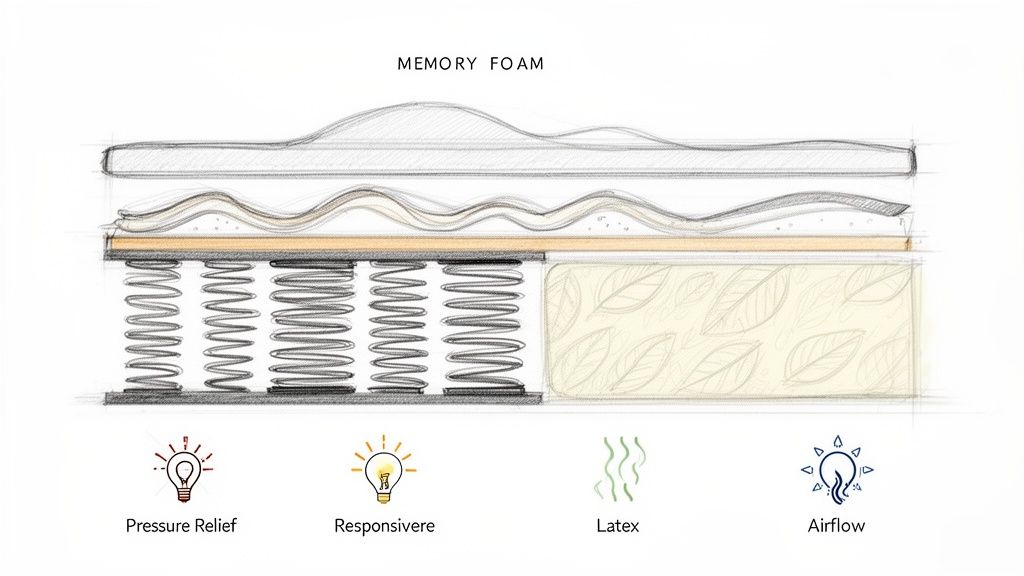
    Detailed diagram of a memory foam mattress cross-section with springs, latex layer, and comfort features.

    Memory Foam Mattresses

    Memory foam is known for its deep, body-hugging feel. When you lie down, it slowly softens in response to your body heat and weight, creating a cradle-like impression. This is incredibly effective at taking the pressure off your shoulders and hips.

    That slow-response sensation is exactly why memory foam is a go-to for side sleepers who complain about sharp pain points. It essentially absorbs pressure instead of pushing back against you.

    • Who it’s for: Side sleepers who want significant pressure relief and like a distinct "sinking in" or "hugged" feeling. It's also a great choice for couples because its dense structure is amazing at absorbing movement and preventing one partner from waking the other.
    • What to consider: A potential drawback of traditional memory foam is that it can trap body heat. However, many modern foams now include cooling technologies like gel infusions or perforated designs to improve airflow.

    Hybrid Mattresses

    Hybrid mattresses are a combination of materials. They typically combine a supportive core of innerspring coils with thick, comfortable layers of foam or latex on top. This construction gives you the benefits of both systems in a single mattress.

    You get the pressure relief and contouring from the top foam layers, but you also get the responsive support, bounce, and breathability from the coil base below. For a lot of side sleepers, this strikes a great balance that isn't too extreme in any one direction.

    A hybrid mattress is often an effective middle ground. It provides the deep cushioning a side sleeper’s joints need, while the coils help prevent that "stuck" feeling some people get from all-foam beds.

    That coil system also promotes much better airflow through the whole mattress, making hybrids a great pick if you tend to sleep warm.

    Innerspring Mattresses

    Traditional innerspring mattresses are built around a core of interconnected steel coils. While they are known for being bouncy, supportive, and often more affordable, they can sometimes cause problems for people who sleep on their side.

    The issue is that their comfort layers are usually quite thin, which means they don't always offer enough padding to properly cushion the hips and shoulders. A firm innerspring can sometimes create pressure points instead of relieving them.

    • Who it’s for: While not always the first choice for dedicated side sleepers, an innerspring might work for combination sleepers who only spend some of the night on their side. They're also an option for anyone who prefers a very firm, bouncy surface.
    • What to consider: If you're considering an innerspring, look for models with pocketed coils (where each spring is wrapped in its own fabric sleeve). They conform to your body much better and reduce motion transfer compared to older, interconnected spring systems.

    Latex Mattresses

    Latex mattresses are made from either natural or synthetic latex foam. They offer a totally different feel from memory foam's slow sink. Latex has a more buoyant and responsive contouring feel—it cradles your pressure points but has a gentle push-back that makes you feel like you're sleeping "on" the mattress, not "in" it.

    This material is also naturally breathable and very durable. For side sleepers who want pressure relief without the deep hug of memory foam, latex is an excellent alternative. It contours to your shape but still makes it easy to roll over and change positions during the night.

    Each of these materials comes with its own set of pros and cons. The only way to really know which one you'll prefer is to try them out. Visiting a showroom lets you compare these very different sensations side-by-side to find what feels best for your body.

    Essential Features for a Side Sleeper's Mattress

    Once you’ve got a handle on mattress firmness and materials, we need to talk about a few key features that can make or break your sleep. For side sleepers, these aren’t just industry buzzwords; they are practical solutions to waking up with a sore shoulder or an aching lower back.

    Knowing what these features are and why they matter will help you cut through the marketing fluff and focus on what’s actually going to give you a great night’s sleep. Each of these elements works together to create a sleep surface that adapts to your body, not the other way around. Let’s dive in.

    The Importance of Pressure Relief

    For a side sleeper, one of the most important jobs a mattress has is to provide excellent pressure relief. Think of it as the mattress’s ability to gently cradle the widest parts of your body—your shoulders and hips—to keep pain and stiffness at bay. When you lie on your side, those two spots bear the brunt of your body weight.

    Without enough pressure relief, all that force gets concentrated on those small areas. The result can be numbness, tingling, and aching joints in the morning. A mattress with good pressure relief spreads your weight out more evenly across the surface, effectively “hugging” your curves and stopping those pressure points from building up.

    This is exactly why materials like memory foam and latex are so popular with side sleepers. They are designed to contour and give way under pressure, providing that critical cushioning right where you need it most.

    The Foundation of Spinal Alignment

    Just as important as pressure relief is spinal alignment. Picture a straight line running from the base of your neck all the way down to your tailbone. A suitable mattress for a side sleeper will keep this line neutral and straight all night long.

    A huge part of what a quality mattress does is help you maintain proper posture while you sleep and keep spinal discs healthy. If a mattress is too firm, it can shove your hips and shoulders upward, causing your spine to bow uncomfortably. On the flip side, if it’s too soft, your midsection will sink way too deep, creating a hammock-like curve. Either way, you’re putting a ton of strain on your back muscles and setting yourself up for pain.

    The ideal mattress has enough support underneath to hold up your waist and lower back, while being soft enough on top to let your shoulders and hips sink in just the right amount.

    Other Important Features

    While pressure relief and alignment are the two pillars of comfort for side sleepers, a few other features can seriously upgrade your sleep experience—especially if you share the bed.

    • Zoned Support: Some mattresses have zoned support systems. This means the mattress is built with different firmness levels in different areas. Usually, it’s firmer in the center third to support the heavier lumbar area and a bit softer at the head and feet to cushion the shoulders and legs. This targeted design is an effective way to address both pressure relief and alignment in a single mattress.

    • Motion Isolation: If you have a partner, motion isolation is important. This is all about the mattress's ability to absorb movement on one side of the bed so it doesn’t travel to the other. Dense materials like memory foam are great at this, making sure your partner’s tossing and turning doesn’t disturb your sleep.

    • Edge Support: Strong edge support simply means the perimeter of the mattress is sturdy and stable. Good edge support is great for couples because it lets you use the entire surface of the bed without that feeling that you might roll off. It also makes getting in and out of bed easier.

    How to Properly Test a Mattress for Comfort

    Reading reviews and looking at specs online is a solid first step. But at the end of the day, there’s no substitute for actually lying on a mattress. Your body is the only true judge of whether a mattress has that just-right blend of soft comfort and firm support.

    Whether you're visiting a showroom or trying a bed in your own home, being intentional about how you test it can save you from a world of hurt. It's not about hopping on a few beds for thirty seconds; it's about giving your body a chance to really feel how the mattress responds. This is where all your research pays off.

    The In-Store Test Drive

    Walking into a showroom is your best chance to compare different materials and firmness levels side-by-side. A mattress that sounds like a dream on paper can feel totally wrong once you lie on it.

    To get the most out of your visit, treat it like you're test-driving a car:

    1. Wear Comfortable Clothes: You can’t get a real feel for a mattress in stiff jeans or a suit. Think sweatpants or athletic wear — something that lets you move and relax without feeling constricted.

    2. Assume Your Position: Don't just sit on the edge. Lie down in the exact same side-sleeping position you use at home. Get comfortable, just like you would if you were turning in for the night.

    3. Stay a While: This is the most important part. Your body needs time to settle in and really feel the mattress. Plan to spend at least 10 to 15 minutes on any mattress you're seriously considering. This is long enough to tell if your shoulder or hip starts to feel pinched or uncomfortable.

    4. Perform a Spine Check: If you're shopping with a partner or friend, have them take a look at your back while you're on your side. Your spine should be in a straight, horizontal line from your neck to your tailbone. If it's sagging or bowing, that mattress isn't giving you the support you need.

    The goal here is simple: see how the mattress feels right now. Does it immediately cradle your shoulder? Can you feel it supporting the curve of your waist? A few minutes of focused testing can tell you everything you need to know.

    Visiting a store with a large selection, like the Sleep Center at Woodstock Furniture & Mattress Outlet, is a huge advantage. You can feel the distinct differences between memory foam, hybrid, and latex beds all in one trip, and our sleep experts can help point you in the right direction.

    The At-Home Sleep Trial

    Even the best showroom test can't fully predict how you'll feel after eight hours of sleep. That's where at-home sleep trials come in. Many brands will give you several weeks—or even months—to sleep on their mattress in your own bedroom, often with a return or exchange option.

    This trial period is absolutely critical because every new mattress comes with an adjustment period. Your body has spent years getting used to your old bed, and it can take a couple of weeks to fully adapt to a new feel, even one that’s much healthier for you.

    Before you commit, always read the fine print on the sleep trial. Look for any fees for returns or exchanges. Think of the trial as the final step in your research—a no-pressure way to confirm you’ve made a good choice for years of comfortable sleep.

    Building Your Complete Sleep System

    A great mattress is the heart of a good night's sleep, but it’s really only one piece of the puzzle. If you want to get the most out of your new mattress, you need to think bigger and build a complete sleep system where everything works together in harmony. For side sleepers, the right pillow and foundation are just as critical as the mattress itself for waking up pain-free.

    The key is to start thinking about your mattress, pillow, and foundation as a single, cohesive unit. Why? Because each part directly impacts how the others feel and perform.

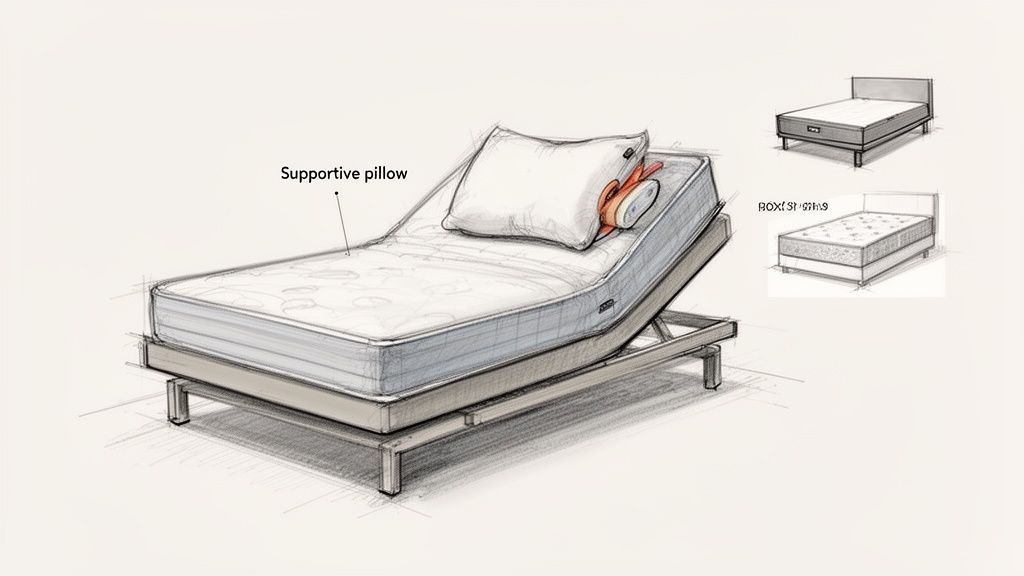
    A detailed sketch of an adjustable bed with a mattress and a supportive pillow, highlighting its design.

    The Role of the Right Pillow

    When you lie on your side, a pretty significant gap opens up between your head and the mattress. Your pillow’s job is to fill that space perfectly, keeping your head and neck in a straight line with the rest of your spine. If your pillow is too thin, your head will sag down. Too thick, and it’ll be pushed up at an awkward angle.

    For side sleepers, a thicker, more supportive pillow is almost always necessary. The goal is to create a straight, horizontal line from your head to your tailbone, and the pillow is the final piece of that alignment puzzle.

    Look for materials like memory foam, latex, or other dense fills that won’t flatten out under the weight of your head during the night. The ideal pillow should feel substantial and hold its shape while still contouring to your neck just right.

    Choosing the Right Foundation

    The foundation under your mattress does more than just get it off the floor. It provides crucial support that changes how the mattress feels and how long it lasts. In fact, using the wrong base can even void your mattress warranty.

    Here are the most common options you'll run into:

    • Platform Beds: These have a solid or slatted surface, giving your mattress firm, even support. They work great with most modern mattresses, especially memory foam and hybrid models.
    • Box Springs: These are designed for traditional innerspring mattresses. A box spring has its own set of coils inside to absorb shock. They are not recommended for foam or hybrid mattresses because they don't provide a solid enough surface.
    • Adjustable Bases: An adjustable base gives you ultimate control. For side sleepers, you can slightly raise your head and feet, which can help with things like acid reflux or snoring without forcing you onto your back.

    To build a truly complete sleep system, it's crucial to understand how all these pieces fit together. For a deeper dive, check out this guide to selecting your ideal mattress. By pairing your perfect mattress with the right pillow and a supportive foundation, you create a personalized sleep sanctuary that sets you up for deeper, more restorative rest.

    Common Questions from Side Sleepers

    Even after you've learned the ropes on firmness, materials, and support, you might still have a few nagging questions. That’s totally normal. Finding the right mattress is a big deal, and it’s smart to cover all your bases before making a decision.

    Below, we’ve tackled some of the most common questions our mattress experts hear from side sleepers every day. These straightforward answers may help you feel more confident in your search.

    I Am a Combination Sleeper but Favor My Side What Should I Look For?

    This is a really common scenario. For combination sleepers who find themselves on their side most of the night, a medium-firm hybrid mattress is usually a fantastic place to start. It gives you that critical pressure relief for your hips and shoulders when you're on your side.

    Just as importantly, the responsive coils make it much easier to roll over and change positions without feeling like you’re fighting your way out of quicksand. You’re looking for that sweet spot—a mattress that offers both contouring comfort and a lively, buoyant feel.

    Can a Mattress Topper Fix My Too-Firm Mattress?

    Yes, sometimes a topper can be an effective and budget-friendly solution. If your mattress is still in good shape and offers solid support but just feels too firm, adding a 2-3 inch memory foam or latex topper can introduce that crucial layer of cushioning your pressure points are craving.

    However, it's key to remember that a topper is just a band-aid, not a cure. It can change the feel of your mattress, but it absolutely cannot fix an old, sagging bed that has lost its core support.

    Think of a mattress topper as a comfort adjustment, not a structural repair. It adds softness to a supportive base but won't bring a worn-out mattress back to life.

    How Can I Tell if My Spine Is Aligned Correctly?

    There's actually a pretty easy way to check your alignment, whether you're testing mattresses in a store or on your bed at home. Lie down in your usual side-sleeping position and have a partner or friend take a look at your back.

    Your spine, from the base of your neck all the way down to your tailbone, should form a straight, horizontal line. If your hips sink in too far, your spine will sag downwards into a hammock shape. If the mattress is too firm, your spine will bow upwards. You should feel comfortably "held" without any weird strain.

    What if My Partner and I Have Very Different Body Weights?

    This is a common challenge for couples. Oftentimes, a medium-firm mattress can be a good compromise, as it can comfortably accommodate a wider range of body types and sleep styles.

    When you have different needs, it’s also critical to look for a mattress with excellent motion isolation. Materials like memory foam or a well-made hybrid with high-quality pocketed coils are champs at absorbing movement, so you won’t feel every toss and turn from your partner. For couples with drastically different needs, some brands offer split king mattresses, which allow each of you to have your own ideal firmness on your side of the bed.


    Finding a suitable mattress comes down to understanding your own unique needs and knowing what to look for. At Woodstock Furniture & Mattress Outlet, our sleep experts are here to guide you through the process, letting you test and compare dozens of options from well-regarded brands in our Sleep Center. Visit us to find the supportive, comfortable mattress you deserve.

  • A Guide to Finding a Mattress for Back Pain Relief

    A Guide to Finding a Mattress for Back Pain Relief

    Waking up with a sore back is an awful way to start the day. More often than not, the mattress you’re sleeping on is the real culprit. It’s tempting to search for a single mattress brand for back pain, but the truth is: the right mattress isn’t about a brand name—it's about matching specific support and comfort features to your body and sleep style.

    Why Your Mattress Is the Foundation of a Healthy Back

    Think of your mattress as the foundation of a house. If that foundation is cracked, unstable, or uneven, the whole structure on top of it—your body—is going to have problems. Starting your day with stiffness, aches, and soreness is a clear sign that your mattress isn't doing its job anymore. This usually boils down to a few common issues.

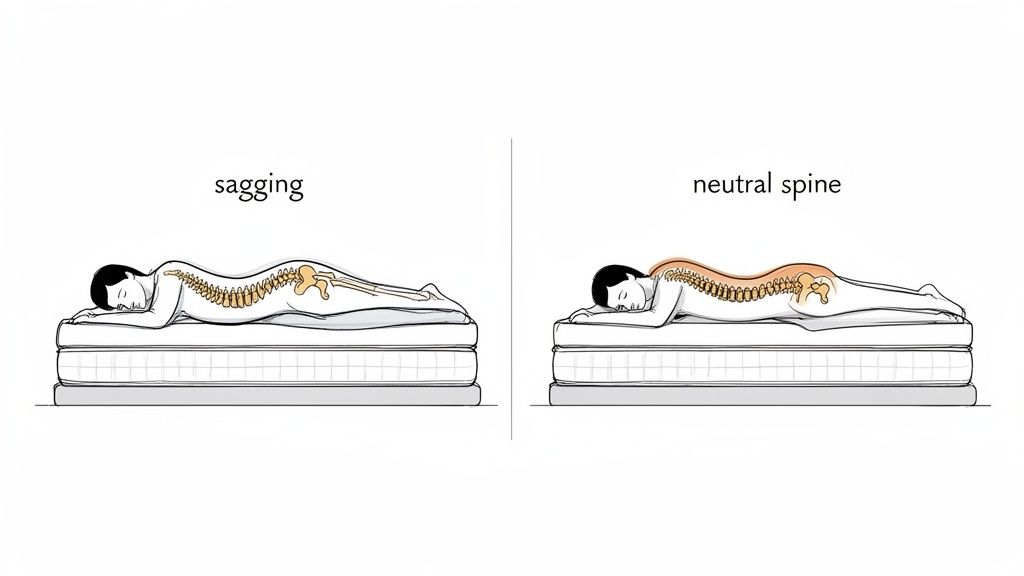
    Illustrations comparing a person's spine on a sagging mattress versus a supportive mattress for neutral alignment.

    Over time, mattresses wear out. The foams and springs that once held you up can soften and break down, creating a hammock-like dip right in the middle. When that happens, your spine is forced into an unnatural curve, straining muscles and ligaments all night long.

    Identifying the Root of the Problem

    Figuring out why your current mattress is causing you pain is the first step toward finding a real solution. Is it too soft, letting your hips sink way too far and throwing your spine out of whack? Or is it too firm, creating painful pressure points on your shoulders and hips while leaving your lower back totally unsupported?

    Here are a few tell-tale signs that your mattress is the source of your back pain:

    • Visible Sagging or Body Indentations: This is a clear indicator that the support system has failed.
    • Waking Up Stiffer Than When You Went to Bed: This means your body isn't being held in a neutral, relaxed position while you sleep.
    • Tossing and Turning to Find a Comfortable Spot: Your body is instinctively trying to get away from bad alignment and pressure points.

    The goal isn't just to buy a new mattress; it's to find the right mattress that solves these specific problems. When you focus on fundamentals like spinal alignment and personalized support, you can cut through the marketing noise and find genuine, lasting relief.

    This guide will walk you through exactly what makes a mattress supportive, helping you understand what to look for based on your own needs. Making a smart choice starts with knowing what you’re looking for, and trying different options firsthand is an important part of the process. At Woodstock Furniture & Mattress Outlet, our knowledgeable team is ready to help you explore these solutions in person, ensuring you find a mattress that will truly support a healthier back for years to come.

    The Science of Support and Spinal Alignment

    To get to the bottom of your back pain, you have to look past marketing slogans and understand what a mattress is really supposed to do. Think of your spine as a gently curving bridge—it needs consistent support from end to end. The number one job of your mattress is to provide that support, helping you maintain what sleep experts call neutral spinal alignment all night long.

    When your spine is neutral, it holds its natural S-curve without being pushed or pulled into an awkward position. This allows the muscles, ligaments, and discs in your back to finally relax and recover while you sleep. A mattress that can’t keep you aligned is often the direct cause of that dreaded morning stiffness and pain.

    Support vs. Firmness: What Is the Difference?

    This is easily one of the biggest points of confusion for mattress shoppers. People use the terms "support" and "firmness" interchangeably, but they are two very different things. Getting this right is critical for finding real back pain relief.

    • Support is the mattress's ability to push back against your body, keeping your spine in that ideal neutral alignment. This comes from the inner workings, like the coil system or high-density foam core. A properly supportive mattress keeps your heavier parts, like your hips and shoulders, from sinking in too far.
    • Firmness is simply how hard or soft the mattress feels right on the surface. It's that immediate impression you get when you lie down. This is all about the top comfort layers—things like memory foam, latex, or soft pillow tops.

    Here's the key takeaway: you can have a very soft mattress that is incredibly supportive, or you can have a rock-hard mattress that offers almost no support at all. The goal is to find a mattress with a strong, supportive core and then pick a firmness level that feels comfortable for your body and the way you sleep.

    The Myth of the Extra-Firm Mattress

    For decades, the common advice for back pain was to sleep on the hardest mattress you could find. We now know that's not good advice for everyone. Modern sleep science and real-world feedback tell us that a mattress that’s too firm can be just as bad as one that's too soft.

    If a mattress is too firm, it won't let your shoulders and hips sink in even a little bit. This can push your spine into an unnatural, flat line and create painful pressure points. Your lower back may end up getting no support, and you can wake up feeling just as sore and stiff as you would on an old, sagging mattress.

    Finding Your Ideal Firmness Level

    So, what’s the right firmness for you? It's all about finding a balance that’s tailored to your body and your sleep habits, not a one-size-fits-all solution. There are two main factors that will point you in the right direction:

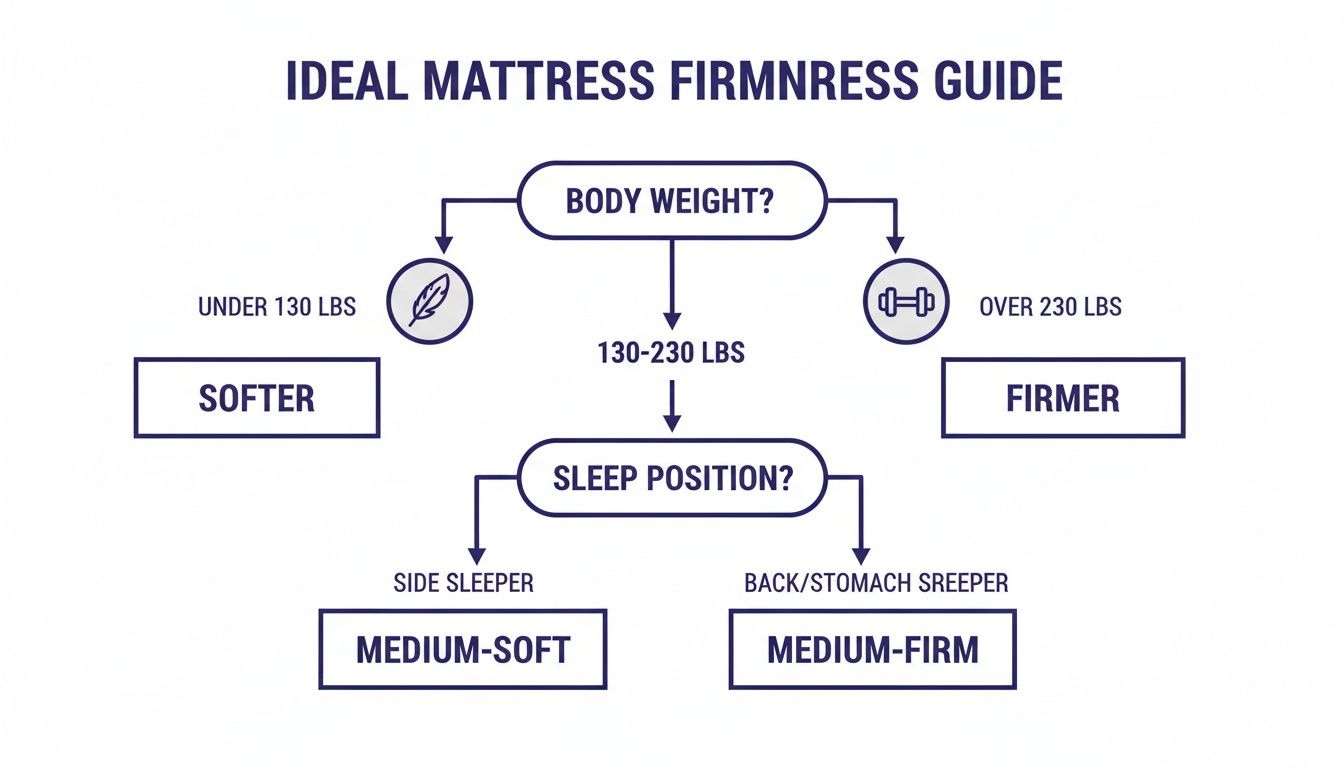
    1. Your Body Weight: Sleepers with a lighter frame (under 130 lbs) often do better on a slightly softer mattress. They need that extra give to get proper contouring and pressure relief. On the flip side, individuals with a heavier frame (over 230 lbs) typically need a firmer, more substantial mattress to prevent sinking too deep and to ensure their spine stays supported.
    2. Your Primary Sleep Position: The position you sleep in most of the night drastically changes how your weight is distributed across the mattress. A side sleeper needs a lot more cushioning for their hips and shoulders, while back and stomach sleepers generally need a firmer surface to keep their spine from dipping.

    Of course, a good mattress is just one piece of the puzzle. Adding some core stability exercises for a stronger back can build up the muscles that support your spine, making you more resilient to pain. When you combine a supportive sleep surface with a stronger core, you’ve got a powerful strategy for long-term relief.

    Armed with this knowledge, you can now look at mattresses with a more critical eye. You're no longer just shopping for a mattress; you're looking for a real solution for your back.

    Comparing Mattress Types for Back Pain Sufferers

    Once you’ve got a handle on support vs. firmness, you can start digging into the different kinds of mattresses out there. It’s easy to get lost in brand names, but it’s more helpful to look at how a mattress is actually built. Each type—from memory foam to hybrid—has its own unique feel and support system, and that’s what makes one better than another for you.

    The mission is simple: find a mattress construction that keeps your spine in a neutral line while also feeling comfortable enough to sleep on. There’s no single "best" type for everyone with back pain. The right choice is all about your body, how you sleep, and what feels right when you lie down. Let’s break down the main categories so you know what you’re getting into.

    Memory Foam Mattresses: Who They Are For

    Memory foam is famous for that deep, body-hugging sensation. It uses your own body heat to soften and mold to your shape, creating a cradle that’s amazing for relieving pressure. This makes it a go-to for anyone who needs serious cushioning around their joints.

    This type can be a great match for:

    • Dedicated Side Sleepers: The way it contours allows your shoulders and hips to sink in just enough, which is key to keeping your spine straight when you’re on your side.
    • Individuals with Sharp Pressure Points: If you’re constantly waking up with sore hips or shoulders, the way memory foam absorbs that pressure can be a game-changer.
    • Couples Concerned with Motion Transfer: Memory foam is incredible at isolating movement. Your partner can toss and turn all night, and you’re much less likely to feel a thing.

    Latex Mattresses: Who They Are For

    Latex mattresses offer a really unique feel that’s both contouring and responsive. Instead of the slow-sinking feeling of memory foam, latex gives you a more buoyant, lifting support. It feels more like you’re sleeping on the mattress rather than in it. It still molds to your curves, but it bounces back into shape almost instantly.

    You might want to consider a latex mattress if you are:

    • A Combination Sleeper: The springy, responsive nature of latex makes it super easy to switch positions during the night without feeling like you’re stuck in quicksand.
    • Someone Who Sleeps Hot: Natural latex is naturally breathable and doesn't hold onto heat the way some traditional memory foams are known to do.
    • Looking for Exceptional Durability: High-quality latex is one of the toughest, most durable mattress materials you can find. It’s fantastic at resisting sagging and body impressions for years to come.

    This visual guide is a helpful starting point for connecting your body weight and sleep style to the right firmness level, which is a huge part of picking the right mattress type.

    Flowchart guiding ideal mattress firmness by body weight and sleep position for different comfort levels.

    As the chart shows, lighter sleepers generally get better pressure relief from a softer mattress, while heavier sleepers usually need a firmer surface to get the spinal support they need.

    Innerspring Mattresses: Who They Are For

    Traditional innerspring mattresses are the kind most of us grew up sleeping on. The core is built from interconnected steel coils, which gives them a firm, bouncy feel and allows for tons of airflow. While they don’t offer the same deep contouring as foam beds, modern innerspring designs are much more comfortable than they used to be.

    An innerspring mattress could be the right fit for:

    • Strict Stomach and Back Sleepers: These positions really benefit from a firm, even surface that keeps the hips from sinking and throwing the spine out of alignment.
    • Shoppers Prioritizing Airflow: The wide-open structure of a coil system lets air move freely, making innerspring mattresses one of the coolest options you can buy.
    • Those Who Prefer a Bouncy Feel: If you like a responsive surface that makes getting in and out of bed easy, you can’t beat the classic bounce of an innerspring.

    Hybrid Mattresses: Who They Are For

    Just like the name says, hybrid mattresses aim to combine the features of other mattress types. They start with a support core of individually pocketed coils (like an innerspring) but top it with thick comfort layers made of memory foam, latex, or other materials. The goal is to deliver both robust support and pinpoint pressure relief.

    A hybrid mattress is often a go-to recommendation for back pain because it balances robust support from the coils with the conforming comfort of foam or latex, providing a solution that works for a wide range of sleepers.

    This do-it-all option can be excellent for:

    • Sleepers Needing a Balance of Support and Cushioning: This is where hybrids shine. The coils provide the foundational support your spine craves, while the foam layers cushion your joints.
    • Couples with Different Preferences: The blend of features often makes both partners happy, even if one prefers foam and the other prefers springs.
    • Anyone Unsure Where to Start: Because they offer such a balanced feel, hybrids are a fantastic starting point for people who are just beginning their search for a mattress to help with back pain.

    To help you compare these options at a glance, we've put together a simple chart outlining the key characteristics of each mattress type for those dealing with back pain.

    Mattress Type Characteristics for Back Pain Sufferers

    Mattress Type Primary Support Mechanism Pressure Relief Level Ideal For Sleep Position Typical Feel
    Memory Foam High-density foam core High Side sleepers Deep contouring, slow response
    Latex Latex foam core Medium to High Combination sleepers Buoyant, responsive
    Innerspring Interconnected steel coils Low Stomach & back sleepers Bouncy, firm
    Hybrid Pocketed coils & foam layers High All positions Balanced, supportive

    Ultimately, this table is just a guide. The best way to know for sure is to try them out yourself, but this should give you a much clearer idea of what to expect from each construction.

    How Your Sleep Position Determines Your Mattress Needs

    Even if we’ve picked the perfect materials and construction, there's one more piece to the puzzle that trumps just about everything else: your favorite sleep position. This is probably the single most critical factor in finding relief from back pain.

    The way you sleep every night determines where your body puts the most pressure on the mattress and exactly what kind of support you’ll need to keep your spine in that happy, neutral alignment. A mattress that feels like heaven to a side sleeper could be a total nightmare for someone who sleeps on their back. It’s all about finding the mattress that’s perfectly matched to you.

    Needs of the Side Sleeper

    Side sleeping is incredibly common, but it also creates a unique challenge for keeping your spine straight. When you’re on your side, your body's widest points—the shoulders and hips—dig into the mattress more than anything else.

    If the mattress is too firm, it’ll just push back against those pressure points, forcing your spine to curve uncomfortably. This is a fast track to waking up with sore shoulders, hips, and a strained lower back. On the flip side, a mattress that’s too soft will let you sink in too deep, causing your spine to sag into a hammock-like position. Not good.

    For side sleepers, the sweet spot is a mattress with enough give in the top layers to cushion the shoulders and hips. You want them to sink in just enough to let your spine stay perfectly straight from your neck all the way down. This is usually found in medium-soft to medium-firm mattresses, particularly hybrids or memory foam models.

    Needs of the Back Sleeper

    Sleeping on your back is generally considered one of the best positions for spinal health, but there's a huge catch: your mattress must provide solid support to your lower back, or lumbar region.

    The biggest pitfall for back sleepers is a mattress that allows the lower back to sink down, creating a gap. When your lumbar spine isn't supported, your muscles have to work overtime all night to hold you in place, which is why you might wake up stiff and sore.

    A mattress that’s too soft will let you sag, and one that's too firm can also create a gap because it doesn't conform to your body's natural curve. The goal is to find a surface that perfectly fills in and supports the small of your back. This is why a medium-firm feel often hits the mark, giving you that ideal balance of contouring and deep-down support.

    Needs of the Stomach Sleeper

    Of all the positions, stomach sleeping is easily the riskiest for your back and neck. Lying on your stomach puts a ton of stress on your spine. Since most of us carry our weight in our midsection, that area tends to sink deepest into the mattress.

    When your hips dip lower than your shoulders, it forces your lower back into a dramatic, unnatural arch. Holding that posture for hours is a recipe for chronic pain. For this very reason, stomach sleepers almost always need a firmer mattress.

    A firm or even extra-firm surface keeps the hips from sinking, which helps keep the spine on a more level plane. You still want a little cushioning for comfort, but preventing that spinal curve has to be the top priority. Innerspring and firm hybrid mattresses are often great choices here.

    Recent analysis confirms just how critical finding this balance is. Some studies show that a medium-firm feel helps maintain the spine's natural curve, and that proper spinal alignment is a key priority for shoppers with back pain. You can read the full analysis of mattress features for back pain to better understand these connections.

    Why You Should Always Test a Mattress In Person

    A woman lies on a mattress, while a man in a suit observes, with a '10-15 min' timer icon.

    Reading online reviews and comparing specs is a great way to start your mattress search. It helps you narrow down the field. But here’s the thing: no amount of research can tell you how a mattress will actually feel when you lie on it. That’s why there’s no substitute for testing a mattress in person.

    Think about it. Words like "medium-firm" or "plush" are completely subjective. What feels like a cloud to one person might feel like a rock to another. The only way to truly know if a mattress gives your back the support it needs is to lie down and let your body decide.

    How to Properly Test a Mattress in a Showroom

    Walking into a showroom is the final, most important step of your research. To get the most out of your visit, don’t just pop in for a quick look. Treat it like a proper test drive.

    • Wear Comfortable Clothes: You wouldn't test drive a car in a tuxedo, right? Wear something loose and comfy, like what you’d lounge around the house in.
    • Assume Your Position: Don’t just sit on the edge. Lie down in the exact position you normally sleep in, whether you’re a side, back, or stomach sleeper. This is the real test.
    • Stay for a While: This one’s key. Don’t just lie down for 30 seconds and hop off. Plan to spend at least 10-15 minutes on any mattress you’re seriously considering. This gives your body time to settle and really feel how the mattress contours and supports you.
    • Focus on Key Areas: Pay close attention to your lower back, hips, and shoulders. Do you feel any uncomfortable pressure? Critically, is there a gap between your lower back and the mattress, or does it feel properly supported?

    The goal of an in-store visit isn't to be sold, but to be educated. Our team is here to offer guidance and give you the space you need to make a confident, unhurried decision.

    This hands-on experience is where you can truly feel the difference between different mattress technologies. For instance, you can read about a hybrid mattress with a zoned coil system, but you can’t understand how that targeted lumbar support feels until you try it. Some designs focus on this kind of targeted support, which may help reduce lower back and hip pain compared to a standard innerspring for some individuals.

    Ultimately, reading about mattress tests is helpful, but feeling the support for yourself is what makes all the difference. To dig deeper into how mattress construction can impact your sleep quality, you can explore the findings of comprehensive mattress tests from industry experts. A little time spent in a showroom is a great way to ensure you find a long-term solution you’ll love for years to come.

    Finding Your Long-Term Back Pain Solution

    Ultimately, the journey to finding a mattress that actually helps your back pain isn’t about chasing a specific brand. It's about finding the one that gives you personalized support and neutral spinal alignment for your own unique body and the way you sleep. The real solution is understanding what you need, whether that’s a side sleeper needing pressure relief or a back sleeper who requires solid lumbar support.

    Making the right choice means you’ve got to shift your focus from marketing claims to the core principles we’ve talked about. A mattress that truly works for you is a long-term investment in your health, setting you up for restorative sleep night after night.

    Enhancing Your Sleep System

    To really dial in your comfort, don’t forget how other pieces can help with pain relief. An adjustable base, for example, can be a total game-changer. It lets you raise your head or feet, helping you find those perfect angles that take a ton of pressure off your lower back.

    A whole-body approach usually gets the best results. Lasting relief from back pain often involves more than just a great mattress. For instance, you might find it helpful to look into additional strategies for back and shoulder pain relief to better support your body during the daytime too.

    Building long-term trust through honest education is how we help our customers. We believe an empowered shopper makes the best decision for their health and home.

    At Woodstock Furniture & Mattress Outlet, that customer-first mindset is behind everything we do. Our team is experienced and knowledgeable, and we’re here not just to sell you a mattress, but to help you find a lasting fix for better sleep and a healthier back.

    We invite you to come visit one of our North Georgia showrooms and try these options out for yourself. Feel the difference, ask us all your questions, and let us help you find the right foundation for a pain-free night's sleep.

    Frequently Asked Questions About Mattresses for Back Pain

    Shopping for a mattress can bring up a ton of questions, especially when you're trying to solve a real problem like nagging back pain. Here are answers to a few common questions our furniture experts get from shoppers every day, designed to give you clear, straightforward info to help you make your decision with confidence.

    How Long Should I Try a New Mattress for My Back Pain?

    Most sleep experts say you need to give a new mattress a minimum of 30 nights to really know if it’s working for you. This gives your body time to adjust to the new support system and also allows the mattress materials to fully break-in and settle.

    Don't be surprised if you feel a little different or even slightly sore for the first few nights. That's your spine learning to hold a new, healthier alignment! This is exactly why many mattress brands and retailers offer trial periods—it gives you plenty of time to be sure the mattress is truly helping your back pain without feeling rushed.

    Is a Firm or Soft Mattress Better for Lower Back Pain?

    There’s an old myth that a rock-hard mattress is the only way to fix back pain. However, sleep science consistently shows that a medium-firm mattress is the sweet spot for many people. Why? It offers a great combination of robust support and gentle, pressure-relieving comfort.

    A mattress that's too firm will create painful pressure points on your hips and shoulders and can actually leave your lower back hanging without support. On the flip side, if it’s too soft, your hips will sink in too far, knocking your spine right out of alignment. The goal is to find that perfect balance where your body is held in place and cushioned at the same time.

    Can an Adjustable Base Help With My Back Pain?

    For those dealing with chronic back pain, an adjustable base can be a game-changer. By letting you raise your head and feet, it helps you find what sleep pros often call a “zero-gravity” position. This can take a huge amount of pressure off your spine.

    For instance, slightly elevating your upper body can relieve discomfort from certain conditions, while lifting your legs can ease the strain on your lower back. When you pair an adjustable base with a compatible mattress, you’re creating a custom sleep system built specifically to manage your pain and boost your overall sleep quality.


    Here at Woodstock Furniture & Mattress Outlet, our whole goal is to give you the knowledge and the hands-on experience you need to find lasting relief. Come on down to the showroom to explore these options for yourself and let us help you find the right sleep solution for a healthier, happier back. Find out more at https://woodstockoutlet.com.