Tag: small space dining

  • 8 Dining Table Ideas for Real Homes and Room Layouts

    8 Dining Table Ideas for Real Homes and Room Layouts

    Your table probably has to do three jobs before lunch. Someone eats cereal at one end, a laptop opens at the other, and homework, mail, and a grocery bag all compete for the middle. Then the holidays arrive and that same surface needs to seat people who don't fit on a normal Tuesday.

    That's why the most useful dining table ideas start with a problem, not a style label. Ask what isn't working now. Is the room too tight, the guest list too long, or the dining area no longer a separate room at all?

    Most eating still happens at home, so this isn't an occasional piece of furniture. In 2023, Americans aged 15 and older spent an average of 82.5 total minutes per day eating and drinking, and 76.3% of primary eating and drinking occurred at the home or yard, according to the U.S. Department of Agriculture Economic Research Service Eating and Health Module summary. A table that handles daily use comfortably matters more than one that only photographs well for guests.

    How to Use This List

    Match each idea below to the problem you recognize first. Then check the measurements and the trade-off before you fall for a finish or a shape. If farmhouse styling is your starting point, the current direction in modern farmhouse dining table trends for 2026 is useful context, but size and layout should still drive your shortlist.

    1. Extendable Dining Table with Leaf Inserts

    Say your household is four people most nights and ten people three times a year. An extendable table solves that gap without forcing you to walk around an oversized top every day. You keep a compact footprint for weeknight meals and add leaves, or slide the top apart, when guests come.

    This isn't a new trick. A Shaker dining table dated 1825 to 1850 in the collection documented by the Metropolitan Museum of Art was built around squares seating four people, and a 10-foot table could serve three squares, or 12 people. Matching capacity to the group has always shaped table design.

    What to Check Before You Buy

    Measure at full extension, not at the everyday size. Add chair pull-back space and a walking route on every side people need to pass. A table that fits on paper can still trap the person seated against the wall.

    • Leaf storage: Confirm where the leaves live. Self-storing leaves are convenient, but separate leaves need a flat, dry spot where they won't get dinged.
    • Mechanism: Open and close it yourself in the store. You should be able to operate it without wrestling the top or asking a second person every time.
    • Seating claims: Tie any seats-six or seats-eight claim to the extended dimensions, not the compact ones.

    Watch how a typical extension mechanism moves before you shop, so you know what questions to ask in person.

    The trade-off is simple. You gain flexibility, and you accept a seam in the top, moving parts that need care, and leaves that need storage. For occasional hosts, I think that's usually a fair exchange.

    2. Round Pedestal Table for Smaller Rooms

    Corners are often the problem in a small room. A rectangular table wastes floor space at each corner and puts a leg exactly where someone's knee wants to go. A round pedestal table removes both issues with one central base.

    Here's a sketch of how that open base changes chair placement in a tight dining area.
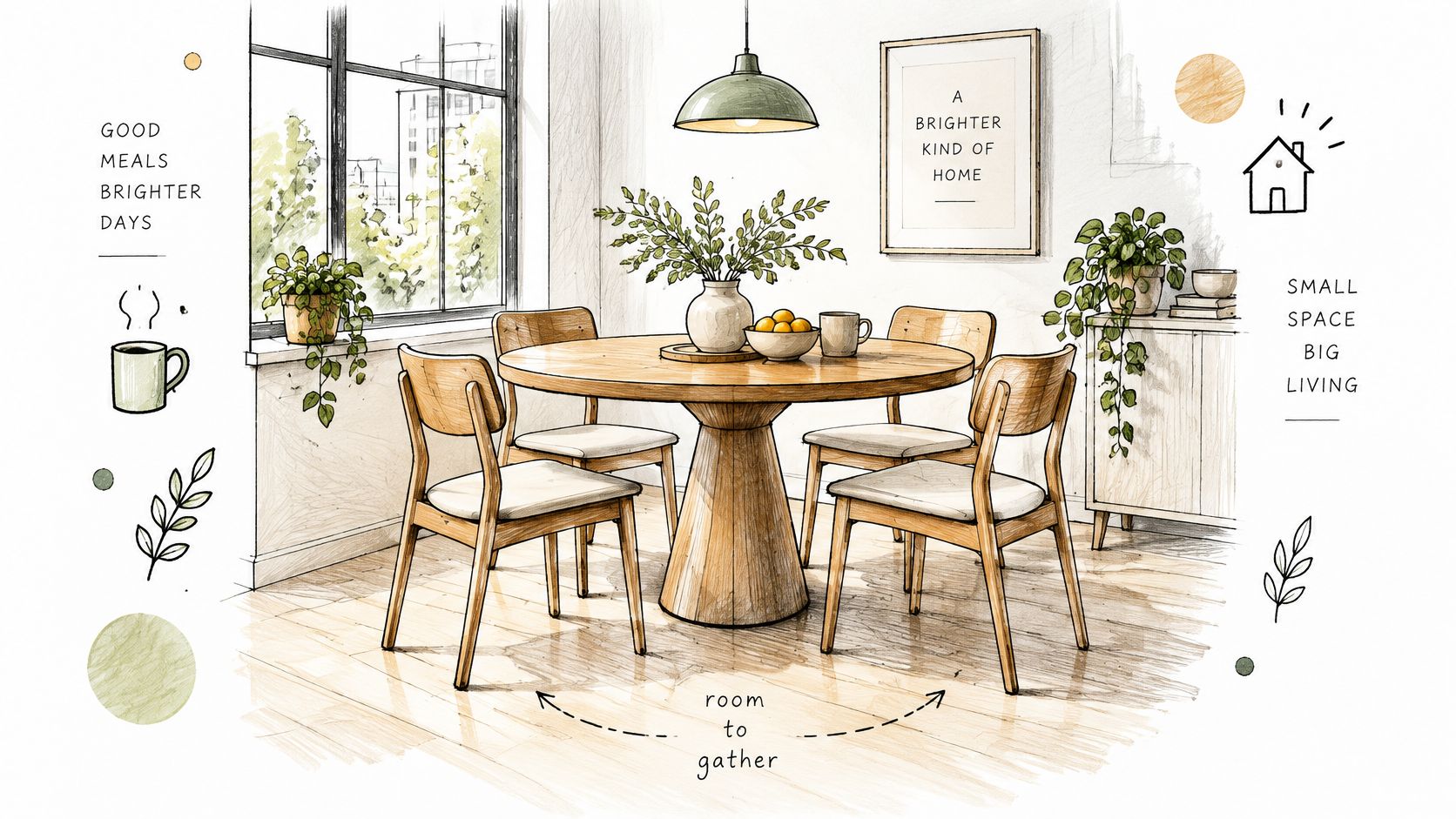
    A cozy, hand-drawn sketch illustration of a modern dining room featuring a round wooden table and four chairs.

    Say you have a kitchen nook in an apartment where a rectangle would block the path to a door. A round top lets people slide in from any angle and keeps traffic moving around the edge. Conversation also feels easier because nobody sits at a far end.

    Sizing a Round Top Honestly

    Allow about 24 inches of width per seat when you estimate capacity, and be skeptical of a diameter that's marketed for more people than that math supports. Then sit down at the table in person. Some pedestal bases have a wide foot that looks stable but blocks chair legs or feet at certain seats.

    Practical rule: Pull up the exact number of chairs you plan to use, sit in each one, and check your feet against the base before you decide.

    The trade-off is surface area. A round table gives you less room for serving dishes, laptops, and centerpieces than a rectangle with a similar footprint. If you host large family-style meals often, that lost middle space will bother you. If you mostly eat in pairs or fours, it rarely will.

    3. Dining Table with a Bench or Banquette

    Chairs need room to slide back. In a narrow dining area, that slide-back space is often what you don't have. A bench or banquette along a wall removes the problem on one side, because the seat stays put and people slide along it instead.

    This drawing shows the typical corner arrangement in a breakfast nook.
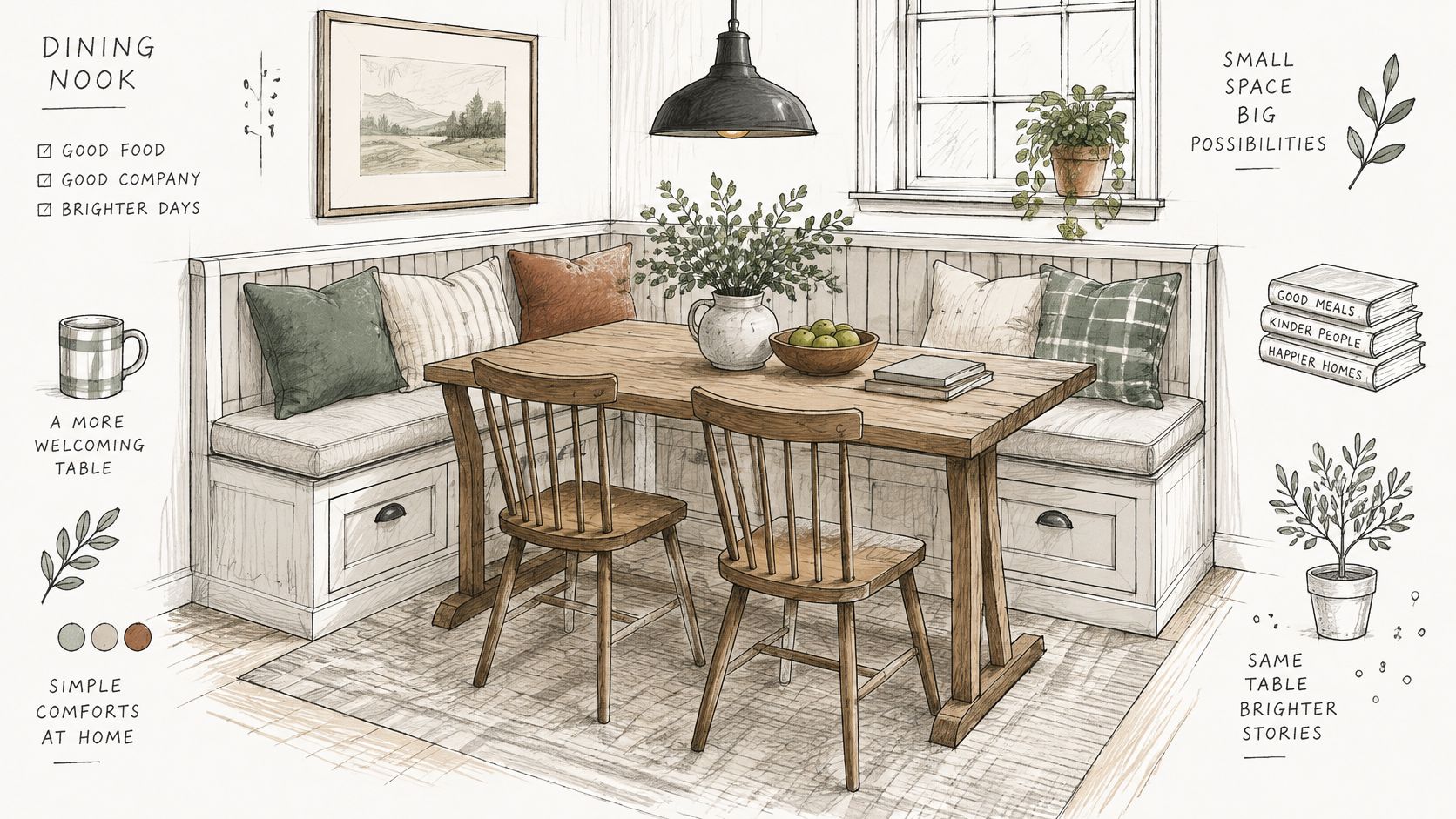
    A hand-drawn sketch of a cozy dining nook featuring a wooden table, bench seating, and decorative pillows.

    A common setup is a bench on the wall side of a rectangular table and chairs on the open side. Kids often prefer the bench, and you can seat an extra person without hunting for another chair. Plan roughly 18 to 20 inches of bench seat per person so shoulders aren't pressed together.

    Freestanding Bench or Built-In Banquette

    Renters and anyone who might move the table should start with a freestanding bench. It's reversible, it travels to the next home, and you can test the arrangement before committing. Homeowners who are settled can consider a built-in banquette with storage under the seat, which uses the corner more completely.

    Test the heights together. A bench that's too low makes the tabletop feel chest-high, and one that's too deep leaves shorter diners perched on the edge. The honest downside is access. The person in the middle of a banquette can't get up without everyone else shifting, so seat the most mobile people there.

    4. Counter-Height or Bar-Height Dining Table

    Open-plan homes blur the line between cooking, eating, and gathering. A counter-height table, typically around 36 inches high, or a bar-height table around 42 inches, bridges the kitchen and living area at the same level as an island or peninsula. People can stand and talk to seated guests at eye level, which suits casual hosting.

    That layout pressure is real, because many homes no longer have a separate dining room to fall back on. The 2025 Houzz U.S. Kitchen Trends Study found that 29% of kitchen expansions take space from dining rooms. When the dining zone moves into the kitchen, table height becomes a layout decision, not just a style one.

    Match the Stool to the Table

    Use 10 to 12 inches between the seat and the tabletop as your guideline, and confirm the stools push fully under the table so walkways stay clear. If you're coordinating with an island, the same math applies to counter sizing with R E and Sons.

    • Sit for a while: Test seating for at least 20 minutes. A stool that feels fine for two minutes can ache by dessert.
    • Check foot support: Your feet need a rail or rung. Dangling legs get uncomfortable fast, especially for kids.
    • Think about who visits: Older relatives and small children often struggle with tall stools and climbing up.

    I recommend counter height over bar height for most families. It's easier to get in and out of, and it works as extra prep space. Bar height reads more dramatic, but everyday comfort usually wins.

    5. Dining Table That Doubles as a Home Office

    No spare room doesn't have to mean working from the couch. A dining table can serve as a weekday desk if you solve the reset problem, which is clearing work away fast enough that dinner doesn't feel like a second job.

    This illustration shows a simple version of that shared setup.
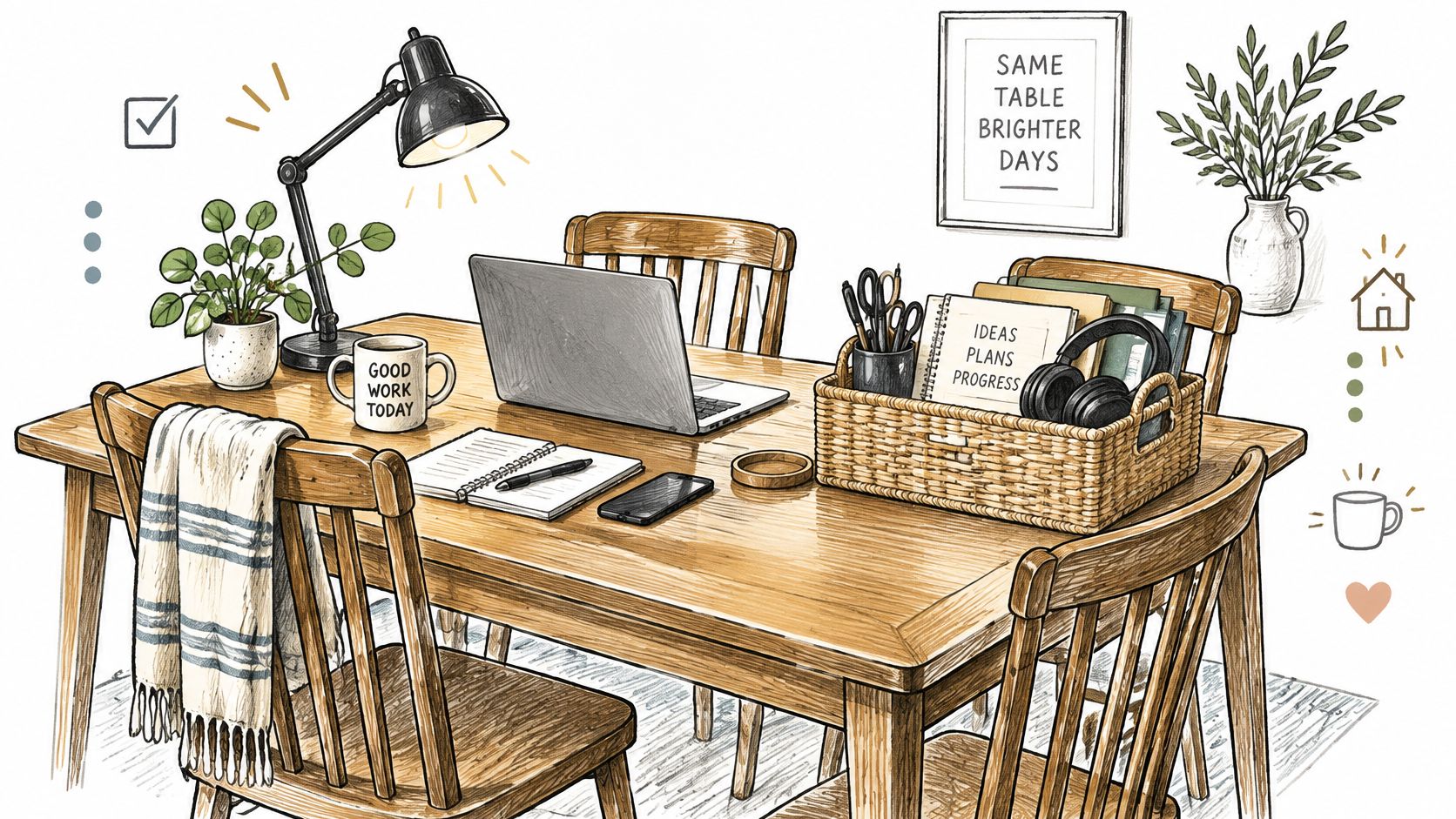
    A cozy, hand-drawn illustration of a dining table used as a home office workspace with a laptop.

    Say you work from home three days a week in a smaller house. Keep a rolling storage unit or a single basket beside the table for your laptop, charger, notebook, and headset. By day's end, everything goes in one container and the table is a table again.

    Make the Posture Work for Both Jobs

    Dining chairs aren't office chairs, so don't pretend otherwise. Add a cushion for seat support, and use a laptop stand or monitor riser so the screen sits closer to eye level. If you work full days, consider one supportive chair that lives at your work end and blends with the dining set.

    Clear the table completely at least once a day. A workspace you never put away turns every meal into a reminder of unfinished tasks.

    Choose a finish that tolerates both lives. You'll slide mugs, laptops, and plates across it daily, so ask how the surface handles heat rings and whether it can be touched up or refinished later. A table pad during work hours is a cheap compromise that saves arguments.

    6. Mixed-Material and Contrasting Chair Styling

    Sometimes the table is fine and the room just feels flat. Mixing chair materials or finishes changes the whole setting without replacing the biggest, most expensive piece. A heavy wood table reads lighter with upholstered chairs, and a plain table gains character from two contrasting host chairs at the ends.

    This sketch shows a wood table softened with linen, candles, and natural accents.
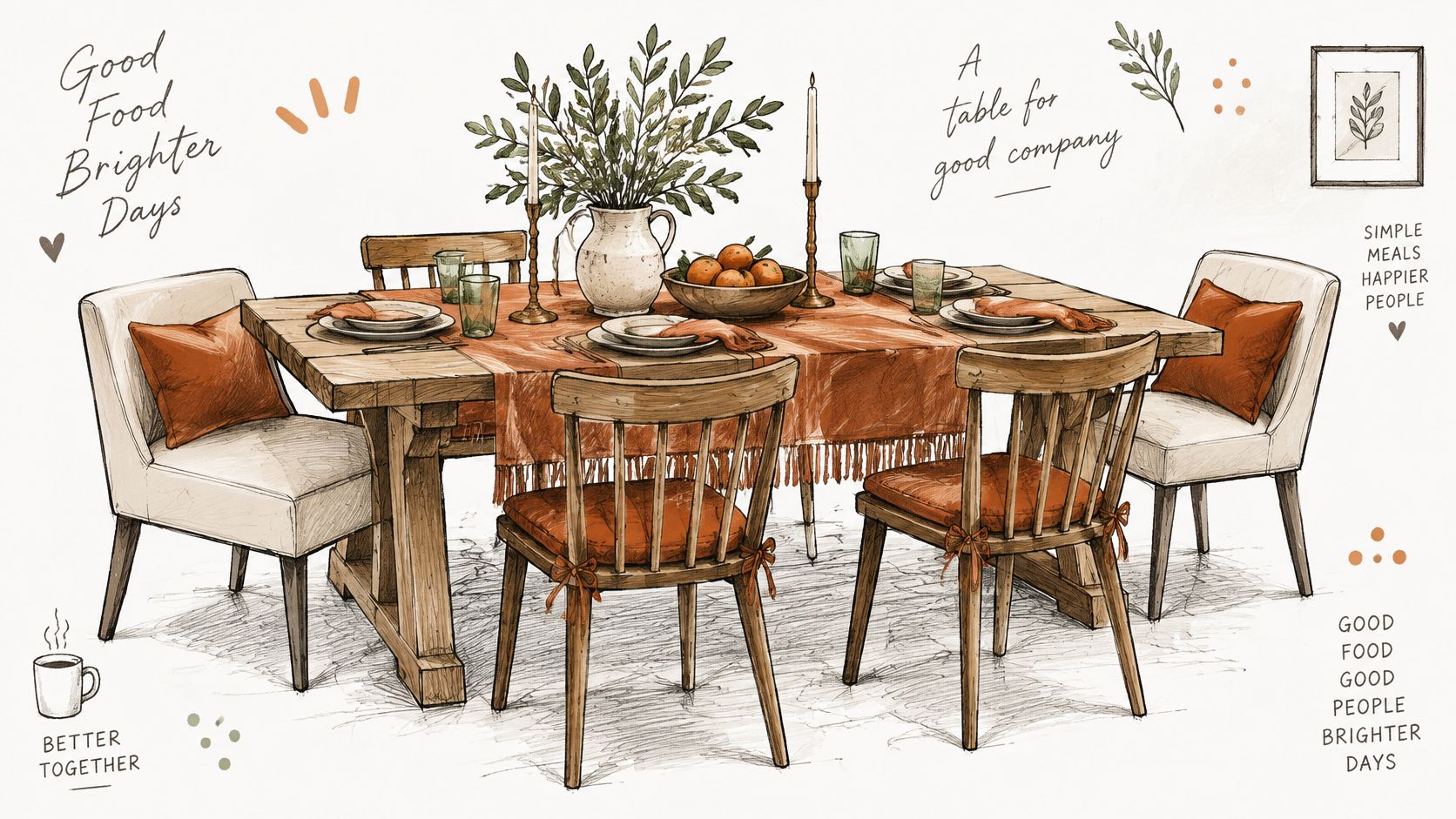
    A cozy, hand-drawn illustration of a rustic wooden dining table decorated with oranges, candles, and linen fabric.

    Before you mix anything, check the construction claims behind the pieces you're keeping or adding. In a YouGov survey commissioned by imm cologne and reported in its article on durable design and transparent supply chains, 95.5% of European consumers consider durability important or very important when purchasing furniture. Ask whether a chair is solid wood, veneer, or composite, and whether parts can be repaired or replaced.

    Rules That Keep Mixed Seating Coherent

    Keep seat heights consistent across every chair, even when styles differ. Repeat one color or material somewhere else in the room, such as the rug, a sideboard finish, or a light fixture. Limit yourself to two or three distinct styles so the grouping reads as a decision, not a clearance aisle.

    Upholstery adds comfort for long meals and adds cleaning work after them. If kids or pets eat there daily, put upholstery at the heads of the table and wipeable chairs along the sides. You'll get the look where it's most visible and the practicality where spills happen.

    7. Outdoor Dining Table for Patios and Covered Spaces

    An outdoor table fails for a predictable reason. Someone buys a table rated for a covered porch and leaves it in full sun and rain. Start by naming your exposure, because a pergola in North Georgia still lets in wind-driven rain and summer humidity.

    Many homeowners place the table under a covered porch to cut direct sun, then build the eating zone around it. If you're planning the surface underneath at the same time, you can browse decorative concrete patio photos to see how the footprint reads against different patio finishes. Whatever the surface, plan a clear zone of at least 36 inches around the table for chairs and walkways.

    Match the Material to the Exposure

    Ask a direct question in the store. Is this material designed for full outdoor exposure or covered areas only? Then ask what care that answer requires, such as sealing, covering, or storing cushions indoors during severe weather.

    • Metal frames: Check how joints and feet are finished, since trapped water collects there first.
    • Wood looks: Ask what the material is and how it handles standing water on the top.
    • Weight: A table that's too light shifts in wind. One that's too heavy won't get moved for cleaning.

    The trade-off is maintenance against appearance. Materials that need the least care don't always look like the indoor furniture you love. I'd rather see you choose the finish you'll keep up with than the one that looks best in April and tired by August.

    8. Trestle or Pedestal Base Table for Open Seating

    Four corner legs dictate where chairs can go. A trestle base, with supports near each end connected by a beam, opens the long sides completely. You can slide a bench in, add a chair at a corner, or squeeze in one more place setting without a leg in someone's shin.

    That openness suits the larger tables many open-plan homes now use. A market report from Dataintelo on the global dining furniture market notes average recent purchases increased from approximately 36 by 60 inches to 40 by 72 inches. At that size, leg placement decides whether six people sit comfortably or just technically fit.

    Measure Between the Supports

    The number that matters is the distance between the end supports, not the full length of the top. That gap determines how many chairs fit along each side and whether end chairs clear the trestle feet. Bring your chair width with you and do the arithmetic in the store.

    Before you commit: Sit at the end seat and at a corner. Those are the two spots where a trestle base either proves itself or gets in the way.

    If the top is solid wood, ask how it's attached to the base. The connection should allow seasonal wood movement, since a wide top expands and contracts across its width through the year. A rigid attachment can stress the top over time. Farmhouse and traditional rooms suit this base naturally, but the main reason to choose it is legroom, not looks.

    How the 8 Dining Table Ideas Compare at a Glance

    Pick the row whose everyday setup already works, then use the maximum only as a stress test.

    Item Typical Seating Space Needs Best For
    Extendable Dining Table with Leaf Inserts About 4 closed; 6-8 with leaves Measure fully extended; allow 36 inches around Occasional hosting and everyday use
    Round Pedestal Table for Smaller Rooms Often 4 people Compact footprint; allow about 24 inches per seat Small rooms, apartments, and breakfast nooks
    Dining Table with a Bench or Banquette Usually 3-4 per bench at 18-20 inches each, plus end chairs Fits close to a wall or in a corner Narrow dining areas and space-saving seating
    Counter-Height or Bar-Height Dining Table Commonly 4 stools; longer tops can take 6 Allow room to pull stools out and keep walkways clear Casual meals and open-plan homes
    Dining Table That Doubles as a Home Office 1 work seat by day; about 4-6 for meals when cleared Needs clear work surface and nearby storage Remote work in homes without a dedicated office
    Mixed-Material and Contrasting Chair Styling Set by the base table, commonly 4-6 No special space needs beyond the dining setup Personalizing a dining area without replacing the table
    Outdoor Dining Table for Patios and Covered Spaces Bistro tables usually seat 2-4 Allow at least 36 inches around Outdoor meals and gatherings
    Trestle or Pedestal Base Table for Open Seating Often 6-8 when end seats clear the supports Check support placement and room for chairs Frequent gatherings and open legroom

    Choose the Table That Fits How You Live

    Start with the problem that's bothering you. Occasional hosts need extension, not a permanently huge table. Small rooms need open bases and wall-side benches. Open layouts need a height and footprint that protect the walking routes between kitchen, table, and living area.

    Then measure like a skeptic. Tape the footprint on your floor at the largest size you'll use, pull chairs out to sitting position, and walk every route around it, including the path carrying a hot dish from the oven. Keep walkways clear at full extension, not just in the compact setup you see in the showroom.

    Check Claims the Way You Check Dimensions

    Treat words like solid wood, seats eight, and durable as claims that need a basis you can verify. The Federal Trade Commission states that advertising claims must be truthful, non-deceptive, and supported by evidence, and that standard is a good shopping habit too. Ask for the documented dimensions, the listed materials, and the care guidance, then decide whether the description matches.

    Sustainability claims deserve the same treatment. U.S. survey data reported by Home Accents Today found 57% of respondents said they would be likely to buy furniture labeled sustainable, but price was the leading barrier at 55%. A repairable table you keep for years can be a more responsible choice than a vaguely labeled one you'll replace, so ask about refinishing, replacement parts, and expected service life.

    Sometimes the right answer is a product we don't carry, a smaller table than you planned, or keeping your current table and changing only the chairs. That's a good outcome if it fits your room and your budget.

    An honest no now beats an expensive return later.

    If you want a second set of eyes on your room layout, our knowledgeable, experienced staff can talk it through with you. We offer design services and delivery options, which helps with larger pieces. When you come in, sit in the chairs, try the moving parts, and check your knees against the base.


    Visit Woodstock Furniture & Mattress Outlet to see dining tables and chairs in person and compare sizes, heights, and materials side by side. Bring your room measurements and a photo of the space, and we can help you narrow eight ideas down to the one or two that best fit how you live.

  • Folding Wooden Table and Chairs: A Practical Buyer Guide

    Folding Wooden Table and Chairs: A Practical Buyer Guide

    You're trying to host dinner in a room that also serves as an office, or keep a small patio usable after guests leave. The table needs to seat people comfortably, but it can't occupy the room permanently. A folding wooden table and chairs set can solve that problem, provided you choose it as a piece of working furniture rather than as a temporary convenience.

    The important questions go beyond appearance. Weight, hardware, finish, wood construction, and storage conditions determine whether the set suits your home. Size and style still matter, but they should come after you understand how often you'll move the furniture, where it will live, and what kind of use it must handle.

    What Folding Wooden Table and Chairs Actually Are

    A folding wooden set sits between a conventional dining group and portable event furniture. The table usually has a hinged top that drops flat or folds in half. The chairs collapse through a center pivot or fold into a narrower profile, allowing the whole group to move into a closet, storage room, guest room, or protected outdoor area.

    The defining material is wood, or an engineered wood component, rather than metal tubing or molded plastic. That distinction affects the furniture's feel, weight, maintenance, and appearance. A solid dining table with removable legs may be portable, but it isn't usually considered folding furniture. Likewise, a metal folding frame with a wood-look surface belongs to a different construction category.

    Start with the way you'll use it

    Think about the room after the table disappears. If you need a breakfast surface that stays open most of the time, a compact folding set may provide flexibility without replacing a standard dining table. If you need seating only for holidays, a set that stores against a wall may be more practical than keeping a large dining group in daily use.

    Folding furniture has a long portability tradition. Furniture makers in medieval Europe built tables and chairs that could be disassembled and carried for travel, while folding chairs became associated with the aristocracy. A historical interpretation places the core characteristics of modern folding tables and chairs in the medieval period from 476 AD to 1453 AD, so the basic idea is much older than mass-produced contemporary furniture. This history of folding tables and chairs provides useful background on that development.

    Practical rule: If the furniture must disappear often, evaluate the folded profile and hardware before choosing a stain color.

    Know the product family

    Common forms include:

    • Folding dining sets: A table and matching chairs intended for regular meals in a compact home.
    • Bistro sets: Smaller tables paired with fewer chairs, often useful in breakfast corners or balconies.
    • Banquet-style tables: Larger, sturdier surfaces designed for gatherings, community rooms, or event use.
    • Individual folding chairs: Helpful when you already own a table and need flexible extra seating.

    This category makes sense when your primary problem is space that must perform more than one job. It may not be the right fit if you need a heavy everyday dining table that never moves, or if the furniture will remain exposed to severe weather. Folding capability creates convenience, but it also introduces pivots, locks, and moving joints that deserve careful inspection.

    How the Construction and Hardware Really Work

    A folding table may look straightforward across a showroom, but its dependability comes from several parts working together. The tabletop must remain level when open, the legs must resist sideways movement, and the locks must hold the frame without making setup awkward. For a long-term purchase, inspect these working parts before giving finish or style much weight.

    Wood sets the starting point. Hardwoods usually feel dense and substantial, and they can often be sanded or refinished after surface wear appears. Softwoods may reduce carrying weight and are easier to work, but they can dent more readily. Engineered wood can suit a tabletop because its layered construction may form a broad, stable panel, particularly when combined with solid or reinforced framing.

    Inspect the moving points

    Examine these areas in the showroom:

    • Tabletop pivots: Open and close the top slowly. Movement should feel controlled, without looseness or sudden catches.
    • Leg hinges: Confirm that the legs align cleanly when extended. Lateral movement in one leg can make the whole table feel unstable.
    • Locks and braces: The lock should engage fully and release deliberately. Metal cross-braces can support the frame while the table is open.
    • Chair joints: Sit carefully and check the center pivot, side rails, and rear legs for unwanted movement.
    • Fasteners: Screws, bolts, and pivot pins should sit firmly, with no visible gaps or excessive play.

    A weak hinge works like a door that never quite latches. The door still moves, but each opening puts extra stress on the surrounding frame. A well-fitted lock feels deliberate, reaching its position and staying there without repeated adjustment.

    The formal requirements for wooden folding chairs show why workmanship matters. Indian Standard IS 6632:1988 covers materials, dimensions, manufacture, and finish for wooden folding chairs, addressing construction as well as appearance. Its focus includes the joints, pivots, and finish-dependent wear points where folding furniture commonly develops trouble. The archived IS 6632:1988 specification offers a technical reference for shoppers assessing build quality.

    A detailed technical drawing of a folding wooden table mechanism highlighting joinery and structural hinges.

    You do not need to become a hardware engineer. You do need to recognize smooth movement, firm locks, and joints that stay aligned. General deck hardware guidance can clarify how fasteners, brackets, and corrosion-resistant components function around outdoor-adjacent furniture, though a folding dining set still needs hardware chosen for its own design and storage conditions.

    Where Folding Wooden Sets Make the Most Sense

    The strongest use case is a room with competing demands. A folding wooden table and chairs set can give an apartment dining nook a defined eating area without permanently consuming the available floor. It can also let a home office become a guest room or gathering space after work hours, provided you have somewhere dry and accessible to store the pieces.

    Match the setting to the workload

    Indoor dining nooks favor compact sets that open easily and remain attractive between uses. A small two-chair bistro arrangement may work well for breakfast or coffee, but it won't replace a larger dining surface when family or friends visit.

    Covered patios and porches offer more flexibility, but “covered” doesn't mean weatherproof. Shade reduces direct exposure, while wind-driven rain, humidity, and temperature changes can still affect wood. Readers planning a broader patio arrangement may find ideas in this outdoor living tag archive, then apply the same storage and finish questions to a folding set.

    Multipurpose rooms benefit from furniture that folds into a slim profile. A guest room, craft area, or home office can remain usable when the table is closed and stored vertically. In this situation, carrying weight and folded dimensions may matter more than the number of seats.

    Occasional events require a different standard. If the set will support holiday meals or extended-family visits, look for a reinforced table, stable leg bracing, and chairs that can be moved without scraping floors. If you host often, opening and closing effort becomes a daily design issue rather than a minor detail.

    A folding set is most useful when storage is planned before purchase. If you don't know where the closed table and chairs will go, the furniture may simply migrate from one inconvenient corner to another.

    Frequency should guide your choice. Occasional setup allows you to accept a heavier table if it offers a steadier surface. Frequent movement favors manageable weight, smooth locks, and a folded shape that one person can handle safely. When neither profile fits, a conventional dining table or lighter non-wood folding set may be the more sensible choice.

    Sizes, Footprints, and What the Numbers Mean

    Choose a folding wooden table by its full life cycle, not only by the space available during dinner. Measure it in three states: open, folded, and stored in its final position. A table may fit the dining area yet fail at the doorway, stair turn, or closet where you plan to keep it.

    One documented folding wooden dining set measures 120 x 70 x 75 cm when open and 70 x 14 x 75 cm when folded. The product dimensions make the mechanism easy to understand. The table becomes much shallower, while its height remains unchanged in that example. Those dimensions also give you a practical comparison point when checking your own storage space.

    Understanding load ratings

    A static load rating applies to a stationary table that is fully opened and correctly supported. It does not cover dropping a heavy object onto the top, leaning hard on one corner, or moving the table while it is loaded. Published banquet specifications list a 485 lb static capacity for a 4-foot square wood folding table and up to 680 lb for an 8-foot rectangular wood folding table, as reported in the same product reference.

    Capacity reflects more than tabletop size. Frame geometry, leg bracing, tabletop thickness, hinge design, wood species, and overall construction all affect how the table behaves. A compact table with well-supported legs may carry substantial stationary weight, while a lighter dining model may be intended for plates and serving dishes rather than event service.

    Set Type Typical Open Footprint Typical Folded Footprint Typical Static Load
    Documented folding dining set 120 x 70 x 75 cm 70 x 14 x 75 cm Not stated
    4-foot square banquet table 4-foot square Product-specific About 485 lb
    8-foot rectangular banquet table 8-foot rectangular Product-specific Up to 680 lb

    The table uses the documented dimensions and published capacities from the folding wooden table reference. These figures are not interchangeable with a household set. Check the manufacturer's rating for the exact model, and treat load capacity as one filter alongside weight, finish, wood species, and the conditions of your storage area.

    Seating capacity follows the room's circulation

    A table can fit within its measured footprint and still feel cramped once plates, serving dishes, and elbows appear. Count the people you seat routinely, then check whether chairs can remain pulled out without blocking a walkway. A smaller set may suit daily meals but become frustrating for regular larger gatherings.

    Measure the folded chairs as well. Their narrow profile may fit behind a door, while the combined stack becomes awkward to lift or carry. Test whether one person can open and close the set safely without dragging it across the floor. If the furniture is heavy or the storage route is tight, a different size, lighter construction, or non-folding arrangement may fit your routine better.

    Wood Compared to Metal and Plastic Folding Furniture

    A folding wooden table and chairs set is a long-term purchase, so compare more than the appearance. Weight, finish, wood species, and storage environment should come before size or style. Wood offers a warm surface, visible grain, and a closer connection to a dining room. Depending on its construction and finish, it can also be sanded or refinished, making some repairs practical. The tradeoff is more maintenance, greater sensitivity to moisture, and often more lifting effort.

    Metal folding furniture generally prioritizes portability and structural efficiency. Tubular frames can be easier to carry and may handle outdoor conditions more readily when properly finished. Dents, scratches, welds, and fasteners still need inspection, and its utilitarian appearance may not suit every dining room.

    Plastic and resin sets simplify cleanup and can be more forgiving around spills or weather exposure. Their surfaces are usually easy to wipe, though some designs may flex, creak, or show wear. Molded parts are also harder to refinish or replace than a wooden panel or mechanical fastener.

    A comparison chart outlining the durability, weather resistance, repairability, weight, and eco-impact of hardwood, metal, and plastic furniture.

    Choose according to the environment

    For an indoor dining room, the tactile warmth and repair potential of folding wooden table and chairs may justify their care requirements. A semi-outdoor area may suit metal or plastic better if you cannot bring the furniture inside promptly after damp conditions. An event business also needs to match the material to repeated handling and cleaning, rather than assuming a residential wooden finish will tolerate that workload.

    Sustainability depends on how the furniture is sourced, finished, used, and replaced. Recent market coverage places the global wood folding furniture market at USD 1.52 billion in 2024 and projects it to reach USD 2.16 billion by 2034. It also describes broader interest in FSC-certified wood, reclaimed wood, and water-based finishes. The wood folding furniture market coverage provides context for questions about material sourcing and finish chemistry.

    Those features may improve a set's environmental profile, but wood is not automatically the sustainable choice. A well-made wooden set that is repaired and used for years can support a long-term purchase. A wooden set repeatedly damaged by rain and replaced early may be less practical than a weather-tolerant alternative.

    Living With the Set Season After Season

    Wood furniture needs a stable environment. It isn't naturally water-resistant, and moisture can enter through unfinished edges, joints, scratches, or worn surfaces. Prolonged rain, snow, strong sunlight, and nearby heat sources can contribute to warping, cracks, fading, or finish breakdown.

    Indoor humidity deserves attention because wood responds to seasonal changes. Wood-furniture care guidance recommends aiming for about 50% relative humidity indoors and using a humidifier when conditions fall below 45%. This wood-furniture care guidance also recommends checking surfaces for warping, cracks, and finish wear.

    Build a small care routine

    Use a repeatable inspection rather than waiting for a problem:

    • After spills: Wipe moisture promptly, including around hinges and chair pivots.
    • During storage: Keep the furniture dry, raised off damp floors, and away from direct heat.
    • During inspections: Look for loose fasteners, rough edges, cracks, uneven legs, and finish loss.
    • When the finish wears: Follow the manufacturer's guidance for oiling, sealing, or refinishing.

    Annual oiling or resealing may be appropriate for some hardwood folding pieces when the finish calls for it, but don't apply a random product over an incompatible coating. An oil intended for unfinished wood may not behave correctly on lacquer, varnish, paint, or a factory-applied water-based finish.

    Decide whether outdoor storage is realistic

    A covered porch can work for a properly finished set if the furniture stays protected from standing water and is brought inside during harsh conditions. A garage may offer better shelter, although temperature and humidity can still fluctuate. An outdoor shed is suitable only when it stays dry and doesn't expose the furniture to condensation or roof leaks.

    Species alone doesn't answer the outdoor question. Finish, ventilation, direct exposure, and your willingness to inspect the furniture matter just as much. If you want furniture that can remain outside with minimal attention, folding wood may not be the right material choice.

    A Pre-Purchase Checklist and Quick Answers

    Take this checklist with you when viewing a set or reading a product page:

    • Test the hinge: Open and close the table slowly. Look for smooth action, secure stops, and minimal side play.
    • Check leg bracing: Unfold the table fully and test for wobble without leaning your full weight on it.
    • Inspect the finish: Look for even coverage, sealed edges, rough areas, cracks, and exposed end grain.
    • Measure storage space: Confirm the folded table and chair stack fit through doors and inside the planned storage area.
    • Assess handling weight: Make sure you can lift, carry, and position the furniture without unsafe straining.
    • Read the support terms: Ask about warranty coverage, replacement hardware, finish limitations, and service procedures.

    A checklist infographic titled Your Folding Furniture Checklist with five essential steps for inspecting folding furniture quality.

    Quick answers for practical concerns

    How often can I fold and unfold the set?
    That depends on the hinge design, materials, loading, and handling technique. Frequent cycles make smooth hardware, sturdy fasteners, and easy alignment more important. Never force a lock that isn't lining up.

    Can I replace hinges or pivot hardware?
    Sometimes, but replacement availability varies by manufacturer and model. Ask before purchase whether the brand identifies hardware parts or provides service support.

    What floor protection works under a moving wooden table?
    Use felt pads or other floor-safe furniture glides selected for your flooring type. Check them regularly for grit, compression, or adhesive failure, since a damaged pad can scratch floors while the table moves.

    Should I choose folding wood at all?
    Choose it when you value a warm appearance, repair potential, and compact storage enough to accept regular care. Choose another material when severe weather, very frequent commercial handling, or minimal maintenance matters more.


    Woodstock Furniture & Mattress Outlet offers dining tables, chairs, and complete dining sets for shoppers comparing flexible room solutions, with knowledgeable staff available to discuss fit, storage, and everyday use. Visit Woodstock Furniture & Mattress Outlet to see dining options in person and get practical help deciding whether folding wood furniture suits your home.