
Standing in a dining room with a tape measure in one hand and a floor plan in the other, you might expect the choice between a round and rectangular dining table to be simple. Then you account for chairs, walkways, family meals, homework, guests, and the furniture already surrounding the space. Suddenly, the table shape affects much more than appearance.
A round table can make conversation feel natural and soften a compact room. A rectangular table can offer more predictable seating, align with a wall, and adapt to larger gatherings. Neither shape works universally, so the useful question is not which table is better. It's which one supports the way your household moves, eats, works, and hosts.
| Decision factor | Round dining table | Rectangular dining table |
|---|---|---|
| Everyday conversation | Places diners around a shared center, without formal head seats (historical comparison) | Creates defined side and end positions, which can feel more structured (historical comparison) |
| Common capacity examples | A 48-inch table seats about 4 to 5, while a 60-inch table seats roughly 6 to 7 (planning guidance) | A 60-inch table typically seats 6, a 72-inch table accommodates 6 to 8, and a 96-inch table seats approximately 8 to 10 (planning guidance) |
| Floor planning | Works naturally in square rooms, but the surrounding clearance forms a wider circle | Fits long rooms and can align with walls, islands, or banquettes |
| Flexibility | Flexible seating around the perimeter, though a larger diameter increases reach and circulation needs | Capacity grows more predictably as length increases |
| Base considerations | A pedestal can improve legroom, while perimeter legs may obstruct approach | A well-designed pedestal or trestle base can leave useful approach zones |
The Challenge of Choosing a Dining Table Shape
A round table can look like the natural choice for a compact room, while a rectangular table may seem better suited to family meals or formal dining. Those shortcuts help narrow the options, but they do not show how the table will work once chairs, people, and daily activities enter the room.
Start with the route through the space. If someone walks from the kitchen to a patio door through the dining area, pulled-out chairs and table corners may matter more than the room's empty dimensions. An open-plan home may also use the table for homework, laptop work, crafts, or serving food. A shape that suits occasional meals may feel restrictive during a busy weekday.
Practical rule: Choose the table around real movement and routines, not around the empty room before chairs are added.
The tabletop shape also influences the room's social character. A round table removes a formal head position, placing diners around a shared center. A rectangular table creates two long sides and end positions, a structure historically associated with formal dining and visible seating hierarchy in Georgian and Victorian interiors (historical context). That structure does not automatically make conversation colder or more formal. It gives the room a different starting arrangement.
Accessibility depends on the base as well as the outline. A central pedestal can leave more approach space for knees, mobility aids, or chairs from different angles. Legs placed near the corners may interrupt those approaches, even when the tabletop itself appears roomy. The same principle applies to rectangular tables with trestle or pedestal bases.
Furniture dimensions are only one part of hosting. If you are visiting friends or relatives for a meal, a practical scented candle hostess gift can contribute to the occasion without altering the dining layout.
The useful comparison therefore includes circulation, multi-use behavior, base design, and the difference between advertised and genuinely usable space. Once those needs are clear, style becomes easier to judge.
How Seating Capacity Works by Shape
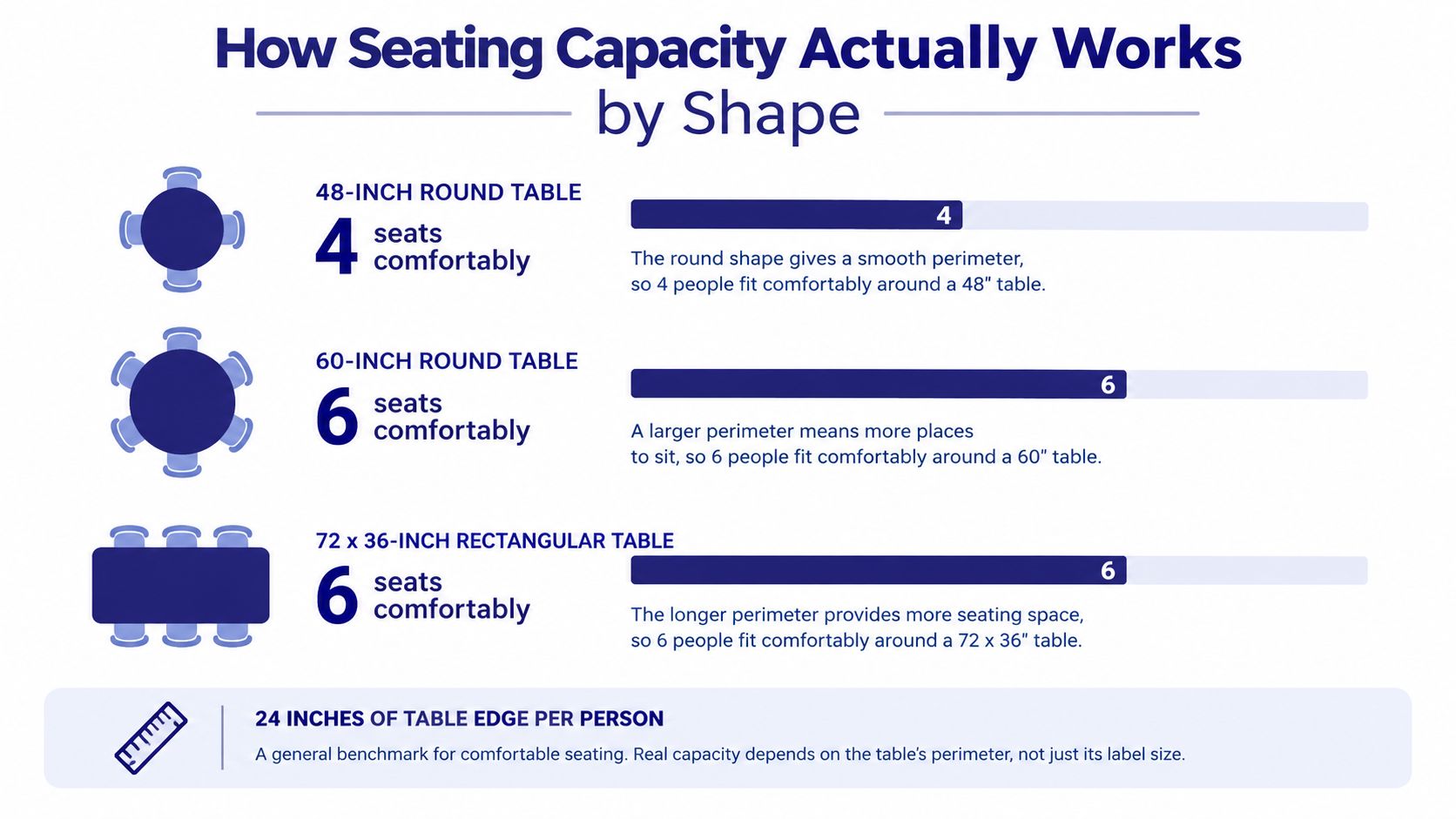
A label such as “seats six” describes a maximum arrangement, not a guaranteed experience. Usable seating depends on table edge, chair width, leg placement, and the space needed for arms, plates, and serving dishes. A practical benchmark allows approximately 24 inches of table edge per adult diner, while about 28 inches provides more comfortable elbow room for everyday meals (seating guidance).
For a rectangular table, capacity is easier to estimate. Diners sit along the two long sides, with the ends available when the table width and base permit it. A 60-inch rectangular table generally accommodates six people, a 72-inch table generally accommodates six to eight, and a 96-inch table approximately accommodates eight to ten (dining table dimensions). Its length creates a predictable way to add places without greatly increasing the distance across the table.
Why diameter changes the calculation
Round tables spread diners around a continuous perimeter. A 48-inch round table commonly seats about four to five people, while a 60-inch round table seats roughly six to seven (round table planning). This supports face-to-face conversation, but a larger diameter also increases the distance across the center and the floor area required for chairs.
A 60-inch round table may seat a similar number of people as a 60-inch rectangular table, yet the usable experience differs. Each diner receives a curved section of edge and reaches toward a shared center. At a rectangle, diners can use long straight sides, while the ends may add places without expanding the table's footprint in every direction.
Test the seating claim in your home
Start with the people who eat there most often, rather than an occasional large gathering. Check the table with your chairs, including arms, wide backs, and legs that could meet the base. In an open-plan home, also consider whether the table serves as a homework desk, work surface, craft area, or route between the kitchen and living room.
A 48-inch round table can suit four diners seeking a compact, conversational setup. A 60 to 72-inch rectangle gives a six-person household a more scalable daily arrangement, especially when serving dishes are common. These are planning benchmarks, not guarantees. A pedestal may leave more approach space than corner legs, while a trestle, four-leg base, bench, or armless chair changes the usable seating envelope. For further round table planning, compare the tabletop with the base and the room's daily paths, not the capacity label alone.
Room Dimensions and Real Circulation Needs
A table that fits on paper may still make the room difficult to use. The problem appears after chairs are pulled back, someone carries a dish from the kitchen, or a child needs to move between the table and the living room. The furniture needs space for people, not just space for the tabletop.
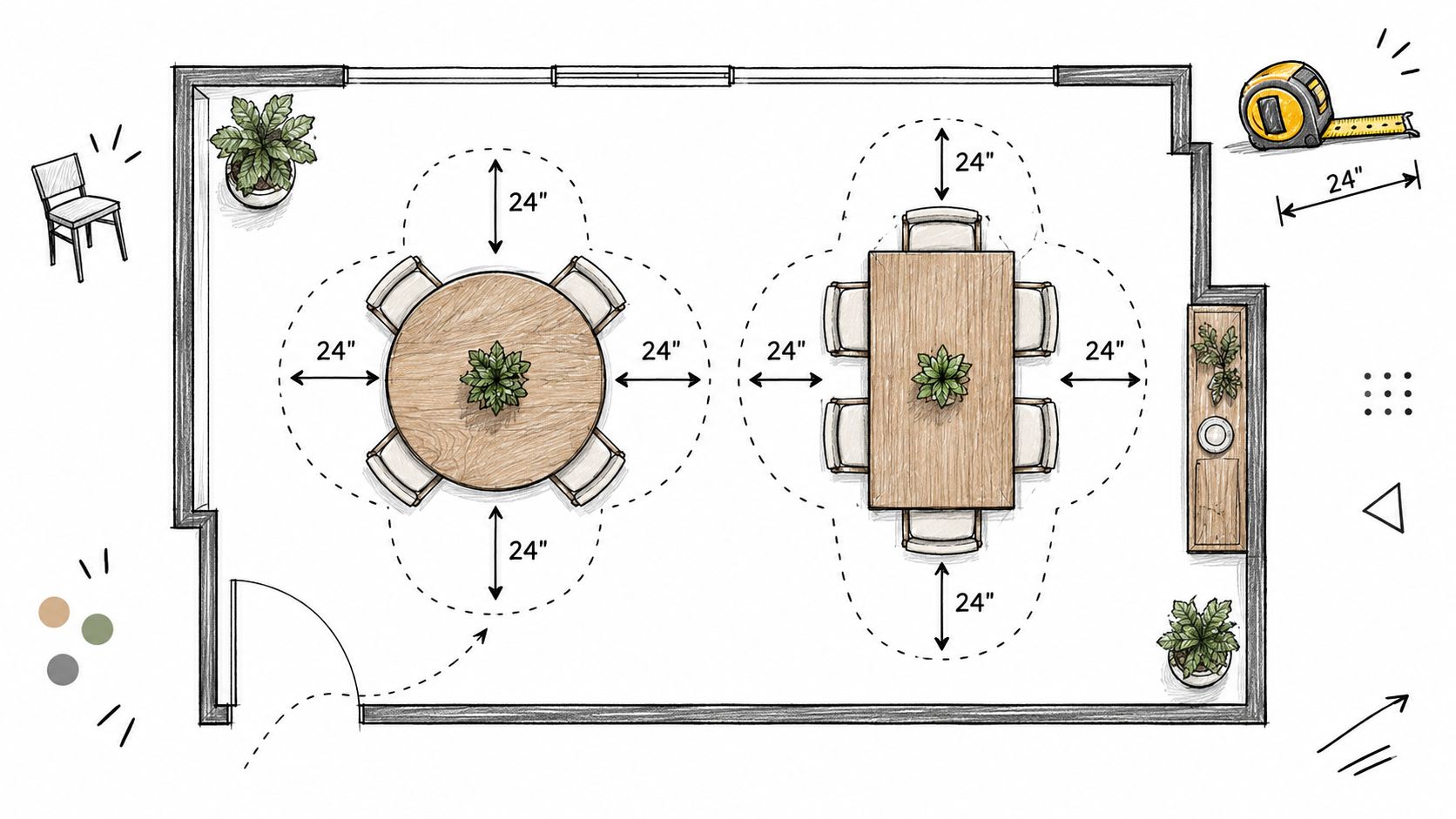
A round table has no corners, which can make its edges easier to move around in a compact room. That benefit doesn't automatically make it the more space-efficient choice. One current design comparison states that a 36-inch round table needs an approximately 9.5-foot clearance circle for chair movement and passage, while rectangular planning is commonly based on the table's length plus clearance along each side (circulation comparison).
Measure the paths, not only the walls
Begin with the narrowest route around the proposed table. Mark the kitchen-to-table path, the passage to a patio or balcony, and any route to a home office, hallway, or living area. Then account for chairs pulled out at the places people use most often.
A rectangle can work well in a long room because its edges follow the room's proportions. It may also sit closer to a wall on ordinary days, then move outward when more people gather. A round table can create a clear central meeting point in a square room, but it may leave awkward strips of unused floor in a long, narrow room.
Open-plan homes make this test more important. The dining table may serve as a homework station, laptop desk, craft surface, and dining area in the same day. A rectangular top can provide a longer work edge and a clear orientation toward a kitchen island or wall. A round top can make movement between zones feel less rigid, but it may occupy more usable circulation area than its footprint suggests.
Test the room in its busiest arrangement
Measure the space with the table centered, then consider the table shifted toward a wall or other boundary. Use temporary markers on the floor to represent the tabletop and chairs. Walk through the room while carrying a plate or opening a nearby door. If people must turn sideways whenever someone is seated, the layout isn't functioning comfortably, even if the tabletop technically fits.
The useful question is not whether a shape saves space in the abstract. It's whether the complete arrangement, including chairs and traffic, leaves the room usable during an ordinary busy evening.
Accessibility and Base Design Decisions
Table shape alone doesn't determine accessibility. Leg placement, pedestal width, knee clearance, and approach space can matter just as much as whether the top is round or rectangular. A round tabletop may appear easier to maneuver around, but a central or perimeter support can obstruct a wheelchair, walker, high chair, or dining chair.
The U.S. Access Board's accessibility guidance calls for 30 by 48 inches of clear floor space for a wheelchair user and a table surface approximately 28 to 34 inches high (accessibility and table sizing guidance). Those figures can inform residential planning, even though public-accommodation requirements and best practices for a private home aren't identical.
Look beneath the tabletop
A four-leg round table may place supports where a user needs to approach or position their knees. A pedestal table can leave more open space around the perimeter, but a pedestal that is too wide can create its own obstacle. Rectangular tables with legs near the corners may restrict some seating positions, while a pedestal or carefully designed trestle can create a more useful approach zone.
This is why a pedestal-based rectangular table can sometimes be more practical than a four-leg round table. The rectangular shape may offer a clearer side approach and a longer edge for positioning, while the base keeps the relevant knee area open.
For aging-in-place households, multigenerational homes, and families with mobility needs, inspect the table from the seated user's point of view. Can the chair or wheelchair approach without hitting a leg? Is there room for knees beneath the surface? Can another person pass behind the seated user without forcing them to move?
The inclusive choice is the table with the clearest approach and knee zones, not automatically the table with the fewest corners.
Try every intended seating position before deciding. A table can meet a nominal height or clearance guideline and still be awkward because of chair arms, a bulky pedestal, or a nearby wall. Residential needs vary, so treat accessibility measurements as planning guidance and assess the complete furniture arrangement.
Materials, Style, and Long-Term Use
Once the table fits the room and supports the household, material and style become meaningful selection factors. A shape can look right in a photograph but feel wrong when the surface must handle plates, laptops, schoolwork, and everyday spills. The material, finish, edge profile, and base all influence that experience.
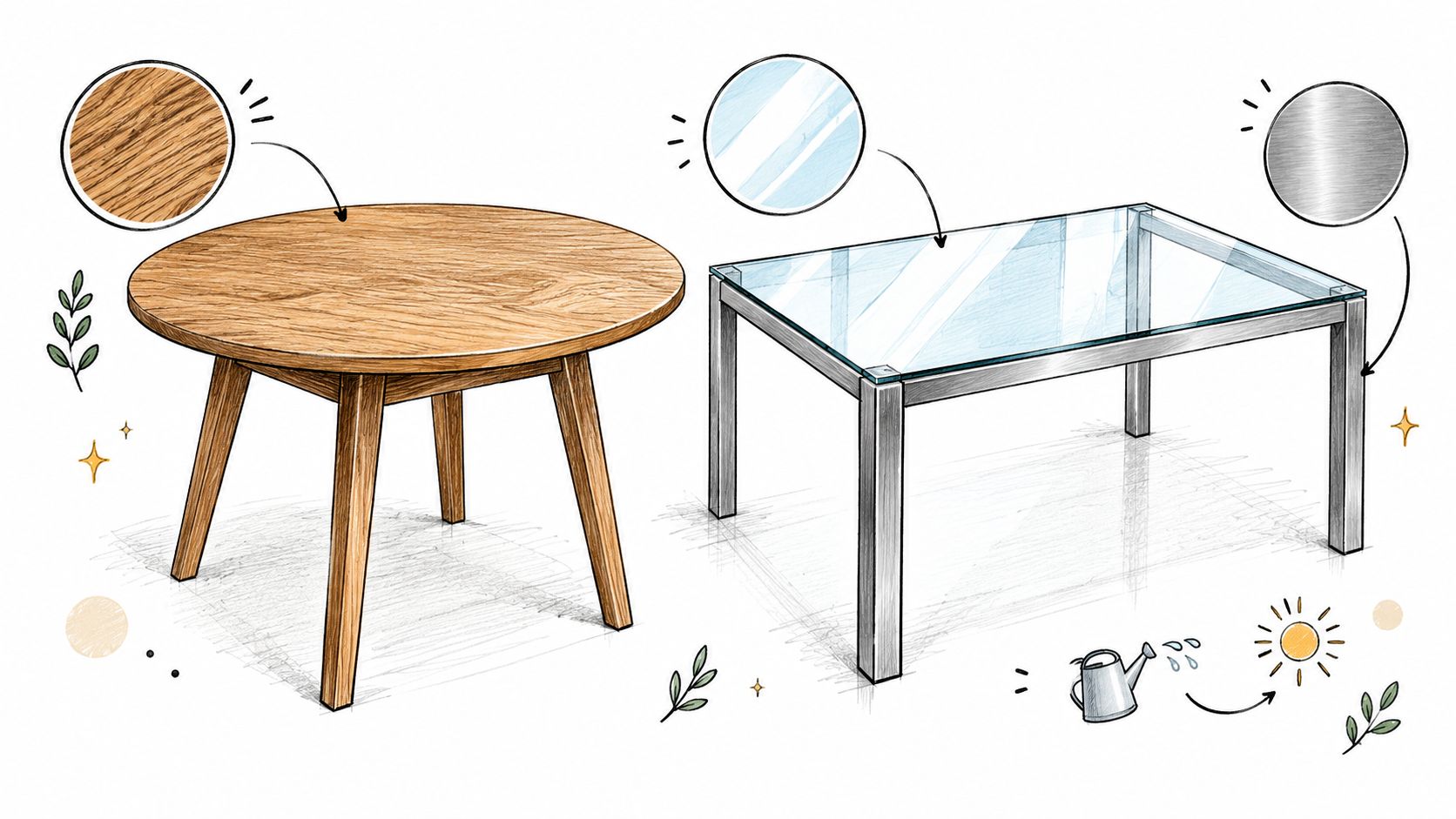
Round tables often draw attention to the center pedestal and curved edge. A wood top can make the shape feel warm and grounded, while glass can keep the visual center lighter. Rectangular tables emphasize length, which can support a runner, separated place settings, serving dishes, or a row of work materials. Metal bases and glass tops can create a more open appearance, while wood and composite surfaces may establish a heavier visual anchor.
Match the surface to the routine
A family that serves meals in shared dishes may prefer a shape that leaves a reachable central area without forcing diners to stretch. A household that works at the table may value a longer rectangular surface for notebooks, monitors, or parallel activities. A round table can focus attention toward a central game, conversation, or project, but the usable work edge changes as people sit around the curve.
Maintenance also deserves a practical look. Sealed wood, glass, metal, and composite materials each respond differently to fingerprints, spills, heat, and scratches. The right question isn't which material is universally easiest. Ask what maintenance your household will consistently perform and whether the finish suits the table's daily workload.
Let the base support the style
The base affects both appearance and comfort. Four legs can provide a familiar, stable visual structure, but they may interfere with chairs. A pedestal can create cleaner legroom, although its footprint must remain compatible with wheelchairs, high chairs, and the positions people use.
Rectangular tables can feel formal with straight lines and traditional legs, or relaxed with a softer finish and bench seating. Round tables can feel casual and social, but the same shape can appear refined when paired with a carefully proportioned top and sculptural base. Style works best when it follows the room's needs instead of attempting to hide a layout that doesn't function.
Real Household Scenarios and Room Types
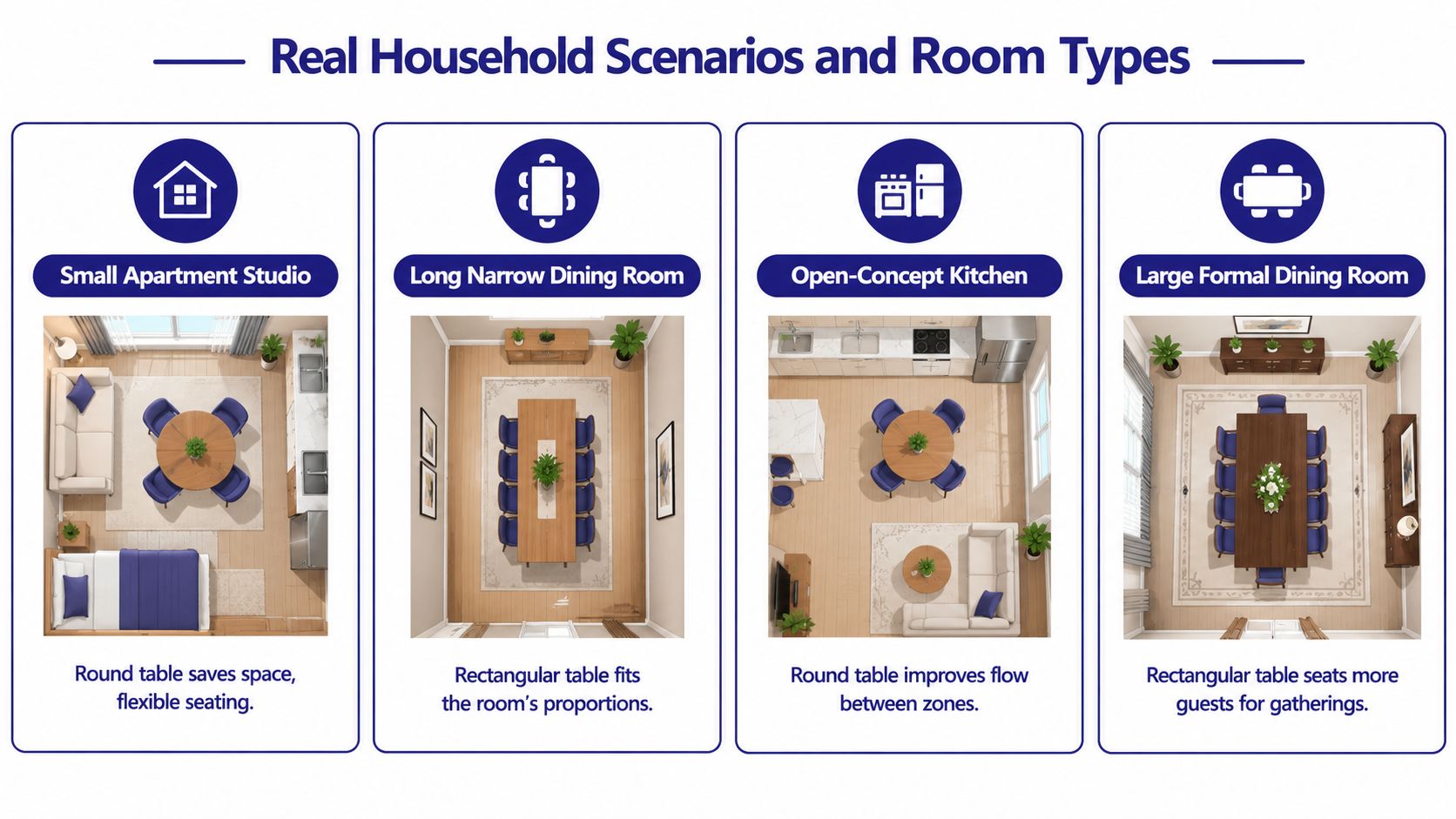
A small apartment studio often needs a table to perform several jobs without becoming a permanent barrier. A round table can create a softer center for meals, conversation, or a small project area, particularly when the room is fairly square. A compact rectangular table may be more useful if it can sit near a wall and leave a longer passage open.
Match the table to the room's behavior
In a long, narrow dining room, a rectangular table usually follows the room's proportions more naturally. Its straight sides can align with a rug, wall, or built-in seating, and its length can support a larger household without forcing the entire arrangement to widen.
An open-concept kitchen presents a different test. A round table can define a social zone between the kitchen and living area without adding another strong straight line. A rectangular table may align more naturally with a kitchen island and provide a clear axis through the room. Neither choice succeeds if it blocks the main route between cooking, seating, and exterior doors.
A larger formal dining room gives a rectangular table more opportunity to show its strengths. Defined end positions, longer sides, and scalable length can support hosting, while the shape also suits traditional room proportions. A round table can still work if the household values equal positioning and conversation over a long linear arrangement.
Consider the people who use the table most
For a household of four in a compact room, a round table may improve flow and keep everyone engaged in the conversation. For a household that regularly hosts larger gatherings, a rectangular table usually offers more predictable expansion through added length.
A multi-use room needs closer attention. If children complete homework while an adult uses a laptop and the table later holds dinner, surface organization matters as much as seating. The best shape is the one that leaves enough working area without forcing chairs into the main circulation path.
Look at the room during its busiest routine, not only when it's neatly arranged. A table that seems ideal for dinner may create a daily obstacle when books, bags, chairs, and people all share the same floor area.
Making Your Decision with Confidence
Start with the household, not the showroom. Record how many people use the table on a normal day, then note how often guests join. A six-person household seeking future flexibility may find a 60 to 72-inch rectangular table easier to extend. Four to six diners who value face-to-face conversation may prefer a 48 to 60-inch round table. See a guide to matching table size to diner count for a useful sizing reference.
Test the choice in the room itself:
- Measure the tabletop area. Mark the proposed table, chairs, and the space needed to pull each chair out.
- Trace the busiest paths. Include routes to the kitchen, living room, doors, hallways, and any work area.
- Check the base. Assess knee clearance, chair positions, and approach space. A pedestal can leave more usable seating room than legs at the corners, regardless of the tabletop shape.
- Test multi-use needs. Decide whether the surface must hold homework, laptops, crafts, serving dishes, or meals alone.
- Review the long-term household. Account for young children, aging relatives, mobility needs, and possible changes in hosting habits.
A confident choice survives the chair test. Sit in every intended position, pull each chair back, and check whether another person can still pass comfortably.
Choose round when a compact or square room needs a social center and movement around a central surface. Choose rectangular when the room is long, seating needs are more predictable, or the table must align with a wall, island, or work zone. If both shapes fit, let the base, chair clearance, and multi-use behavior decide.
Visit a showroom after measuring. Sit down, move your knees, pull out chairs, and test how the table feels for the people in your home. A hands-on comparison reveals practical problems that a shape label or floor plan can miss.
Woodstock Furniture & Mattress Outlet offers rectangular, round, and oval dining tables, plus room-planning resources and in-person guidance on size, base design, and seating. Visit Woodstock Furniture & Mattress Outlet to compare options and discuss an arrangement for your North Georgia home.