
Tag: round dining table

  • Round vs Rectangular Dining Table: The Honest Comparison

    Round vs Rectangular Dining Table: The Honest Comparison

    Standing in a dining room with a tape measure in one hand and a floor plan in the other, you might expect the choice between a round and rectangular dining table to be simple. Then you account for chairs, walkways, family meals, homework, guests, and the furniture already surrounding the space. Suddenly, the table shape affects much more than appearance.

    A round table can make conversation feel natural and soften a compact room. A rectangular table can offer more predictable seating, align with a wall, and adapt to larger gatherings. Neither shape works universally, so the useful question is not which table is better. It's which one supports the way your household moves, eats, works, and hosts.

    Decision factor Round dining table Rectangular dining table
    Everyday conversation Places diners around a shared center, without formal head seats (historical comparison) Creates defined side and end positions, which can feel more structured (historical comparison)
    Common capacity examples A 48-inch table seats about 4 to 5, while a 60-inch table seats roughly 6 to 7 (planning guidance) A 60-inch table typically seats 6, a 72-inch table accommodates 6 to 8, and a 96-inch table seats approximately 8 to 10 (planning guidance)
    Floor planning Works naturally in square rooms, but the surrounding clearance forms a wider circle Fits long rooms and can align with walls, islands, or banquettes
    Flexibility Flexible seating around the perimeter, though a larger diameter increases reach and circulation needs Capacity grows more predictably as length increases
    Base considerations A pedestal can improve legroom, while perimeter legs may obstruct approach A well-designed pedestal or trestle base can leave useful approach zones

    The Challenge of Choosing a Dining Table Shape

    A round table can look like the natural choice for a compact room, while a rectangular table may seem better suited to family meals or formal dining. Those shortcuts help narrow the options, but they do not show how the table will work once chairs, people, and daily activities enter the room.

    Start with the route through the space. If someone walks from the kitchen to a patio door through the dining area, pulled-out chairs and table corners may matter more than the room's empty dimensions. An open-plan home may also use the table for homework, laptop work, crafts, or serving food. A shape that suits occasional meals may feel restrictive during a busy weekday.

    Practical rule: Choose the table around real movement and routines, not around the empty room before chairs are added.

    The tabletop shape also influences the room's social character. A round table removes a formal head position, placing diners around a shared center. A rectangular table creates two long sides and end positions, a structure historically associated with formal dining and visible seating hierarchy in Georgian and Victorian interiors (historical context). That structure does not automatically make conversation colder or more formal. It gives the room a different starting arrangement.

    Accessibility depends on the base as well as the outline. A central pedestal can leave more approach space for knees, mobility aids, or chairs from different angles. Legs placed near the corners may interrupt those approaches, even when the tabletop itself appears roomy. The same principle applies to rectangular tables with trestle or pedestal bases.

    Furniture dimensions are only one part of hosting. If you are visiting friends or relatives for a meal, a practical scented candle hostess gift can contribute to the occasion without altering the dining layout.

    The useful comparison therefore includes circulation, multi-use behavior, base design, and the difference between advertised and genuinely usable space. Once those needs are clear, style becomes easier to judge.

    How Seating Capacity Works by Shape

    A label such as “seats six” describes a maximum arrangement, not a guaranteed experience. Usable seating depends on table edge, chair width, leg placement, and the space needed for arms, plates, and serving dishes. A practical benchmark allows approximately 24 inches of table edge per adult diner, while about 28 inches provides more comfortable elbow room for everyday meals (seating guidance).

    For a rectangular table, capacity is easier to estimate. Diners sit along the two long sides, with the ends available when the table width and base permit it. A 60-inch rectangular table generally accommodates six people, a 72-inch table generally accommodates six to eight, and a 96-inch table approximately accommodates eight to ten (dining table dimensions). Its length creates a predictable way to add places without greatly increasing the distance across the table.
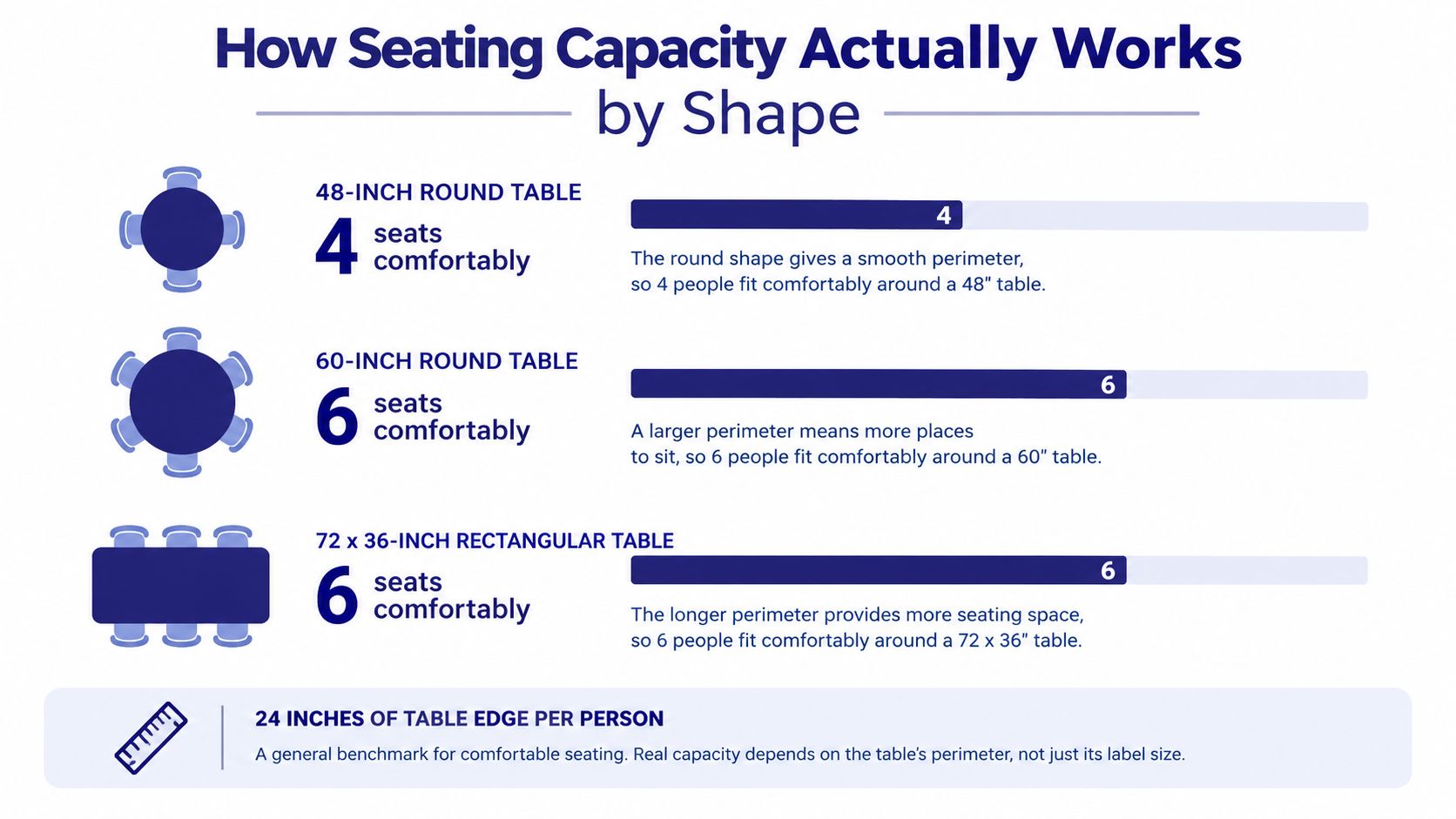
    A chart illustrating comfortable seating capacity for round and rectangular dining tables based on table size.

    Why diameter changes the calculation

    Round tables spread diners around a continuous perimeter. A 48-inch round table commonly seats about four to five people, while a 60-inch round table seats roughly six to seven (round table planning). This supports face-to-face conversation, but a larger diameter also increases the distance across the center and the floor area required for chairs.

    A 60-inch round table may seat a similar number of people as a 60-inch rectangular table, yet the usable experience differs. Each diner receives a curved section of edge and reaches toward a shared center. At a rectangle, diners can use long straight sides, while the ends may add places without expanding the table's footprint in every direction.

    Test the seating claim in your home

    Start with the people who eat there most often, rather than an occasional large gathering. Check the table with your chairs, including arms, wide backs, and legs that could meet the base. In an open-plan home, also consider whether the table serves as a homework desk, work surface, craft area, or route between the kitchen and living room.

    A 48-inch round table can suit four diners seeking a compact, conversational setup. A 60 to 72-inch rectangle gives a six-person household a more scalable daily arrangement, especially when serving dishes are common. These are planning benchmarks, not guarantees. A pedestal may leave more approach space than corner legs, while a trestle, four-leg base, bench, or armless chair changes the usable seating envelope. For further round table planning, compare the tabletop with the base and the room's daily paths, not the capacity label alone.

    Room Dimensions and Real Circulation Needs

    A table that fits on paper may still make the room difficult to use. The problem appears after chairs are pulled back, someone carries a dish from the kitchen, or a child needs to move between the table and the living room. The furniture needs space for people, not just space for the tabletop.

    A round table has no corners, which can make its edges easier to move around in a compact room. That benefit doesn't automatically make it the more space-efficient choice. One current design comparison states that a 36-inch round table needs an approximately 9.5-foot clearance circle for chair movement and passage, while rectangular planning is commonly based on the table's length plus clearance along each side (circulation comparison).
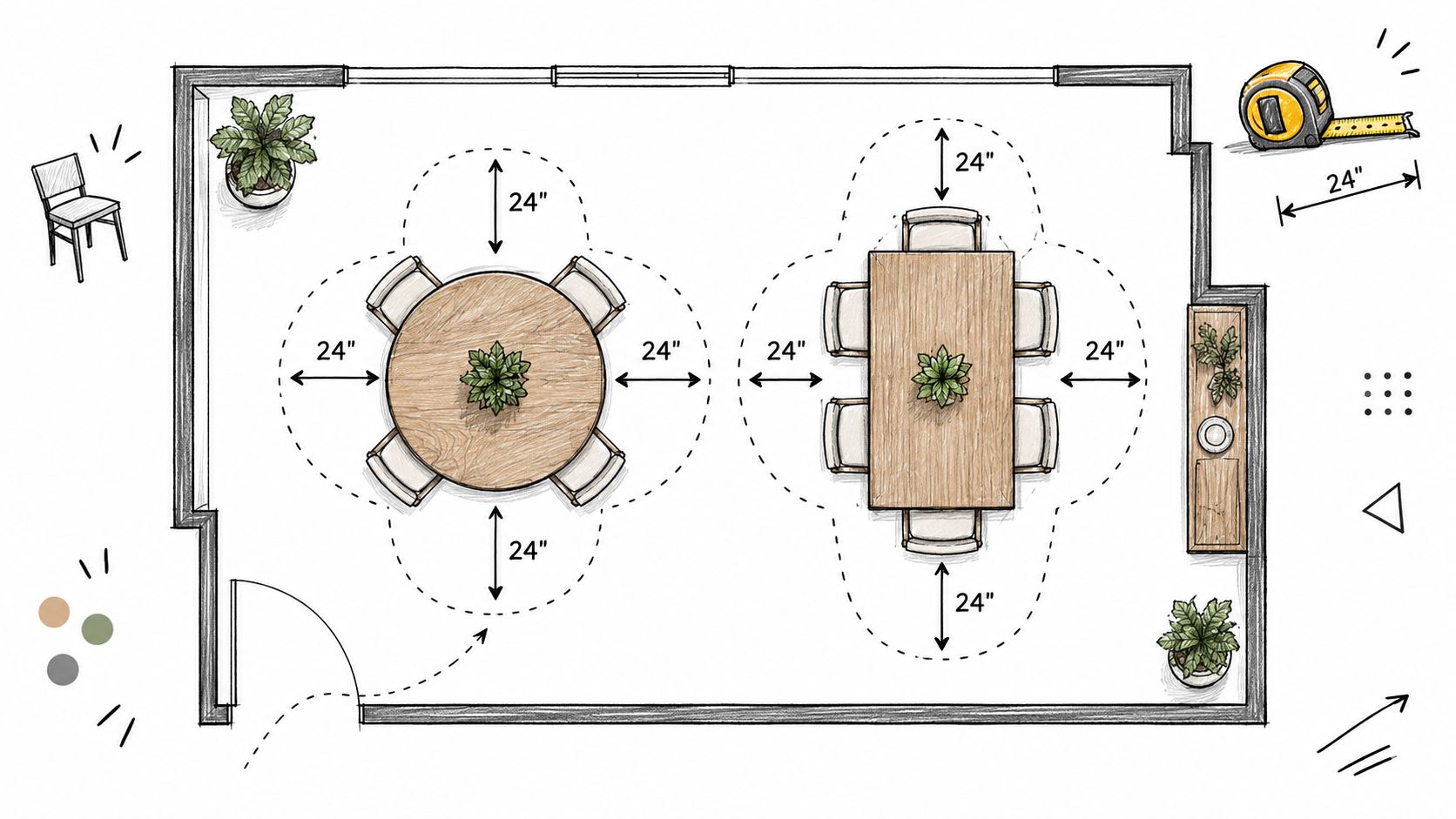
    A top-down floor plan comparison showing spacing requirements for a round dining table and a rectangular table.

    Measure the paths, not only the walls

    Begin with the narrowest route around the proposed table. Mark the kitchen-to-table path, the passage to a patio or balcony, and any route to a home office, hallway, or living area. Then account for chairs pulled out at the places people use most often.

    A rectangle can work well in a long room because its edges follow the room's proportions. It may also sit closer to a wall on ordinary days, then move outward when more people gather. A round table can create a clear central meeting point in a square room, but it may leave awkward strips of unused floor in a long, narrow room.

    Open-plan homes make this test more important. The dining table may serve as a homework station, laptop desk, craft surface, and dining area in the same day. A rectangular top can provide a longer work edge and a clear orientation toward a kitchen island or wall. A round top can make movement between zones feel less rigid, but it may occupy more usable circulation area than its footprint suggests.

    Test the room in its busiest arrangement

    Measure the space with the table centered, then consider the table shifted toward a wall or other boundary. Use temporary markers on the floor to represent the tabletop and chairs. Walk through the room while carrying a plate or opening a nearby door. If people must turn sideways whenever someone is seated, the layout isn't functioning comfortably, even if the tabletop technically fits.

    The useful question is not whether a shape saves space in the abstract. It's whether the complete arrangement, including chairs and traffic, leaves the room usable during an ordinary busy evening.

    Accessibility and Base Design Decisions

    Table shape alone doesn't determine accessibility. Leg placement, pedestal width, knee clearance, and approach space can matter just as much as whether the top is round or rectangular. A round tabletop may appear easier to maneuver around, but a central or perimeter support can obstruct a wheelchair, walker, high chair, or dining chair.

    The U.S. Access Board's accessibility guidance calls for 30 by 48 inches of clear floor space for a wheelchair user and a table surface approximately 28 to 34 inches high (accessibility and table sizing guidance). Those figures can inform residential planning, even though public-accommodation requirements and best practices for a private home aren't identical.

    Look beneath the tabletop

    A four-leg round table may place supports where a user needs to approach or position their knees. A pedestal table can leave more open space around the perimeter, but a pedestal that is too wide can create its own obstacle. Rectangular tables with legs near the corners may restrict some seating positions, while a pedestal or carefully designed trestle can create a more useful approach zone.

    This is why a pedestal-based rectangular table can sometimes be more practical than a four-leg round table. The rectangular shape may offer a clearer side approach and a longer edge for positioning, while the base keeps the relevant knee area open.

    For aging-in-place households, multigenerational homes, and families with mobility needs, inspect the table from the seated user's point of view. Can the chair or wheelchair approach without hitting a leg? Is there room for knees beneath the surface? Can another person pass behind the seated user without forcing them to move?

    The inclusive choice is the table with the clearest approach and knee zones, not automatically the table with the fewest corners.

    Try every intended seating position before deciding. A table can meet a nominal height or clearance guideline and still be awkward because of chair arms, a bulky pedestal, or a nearby wall. Residential needs vary, so treat accessibility measurements as planning guidance and assess the complete furniture arrangement.

    Materials, Style, and Long-Term Use

    Once the table fits the room and supports the household, material and style become meaningful selection factors. A shape can look right in a photograph but feel wrong when the surface must handle plates, laptops, schoolwork, and everyday spills. The material, finish, edge profile, and base all influence that experience.

    Round tables often draw attention to the center pedestal and curved edge. A wood top can make the shape feel warm and grounded, while glass can keep the visual center lighter. Rectangular tables emphasize length, which can support a runner, separated place settings, serving dishes, or a row of work materials. Metal bases and glass tops can create a more open appearance, while wood and composite surfaces may establish a heavier visual anchor.
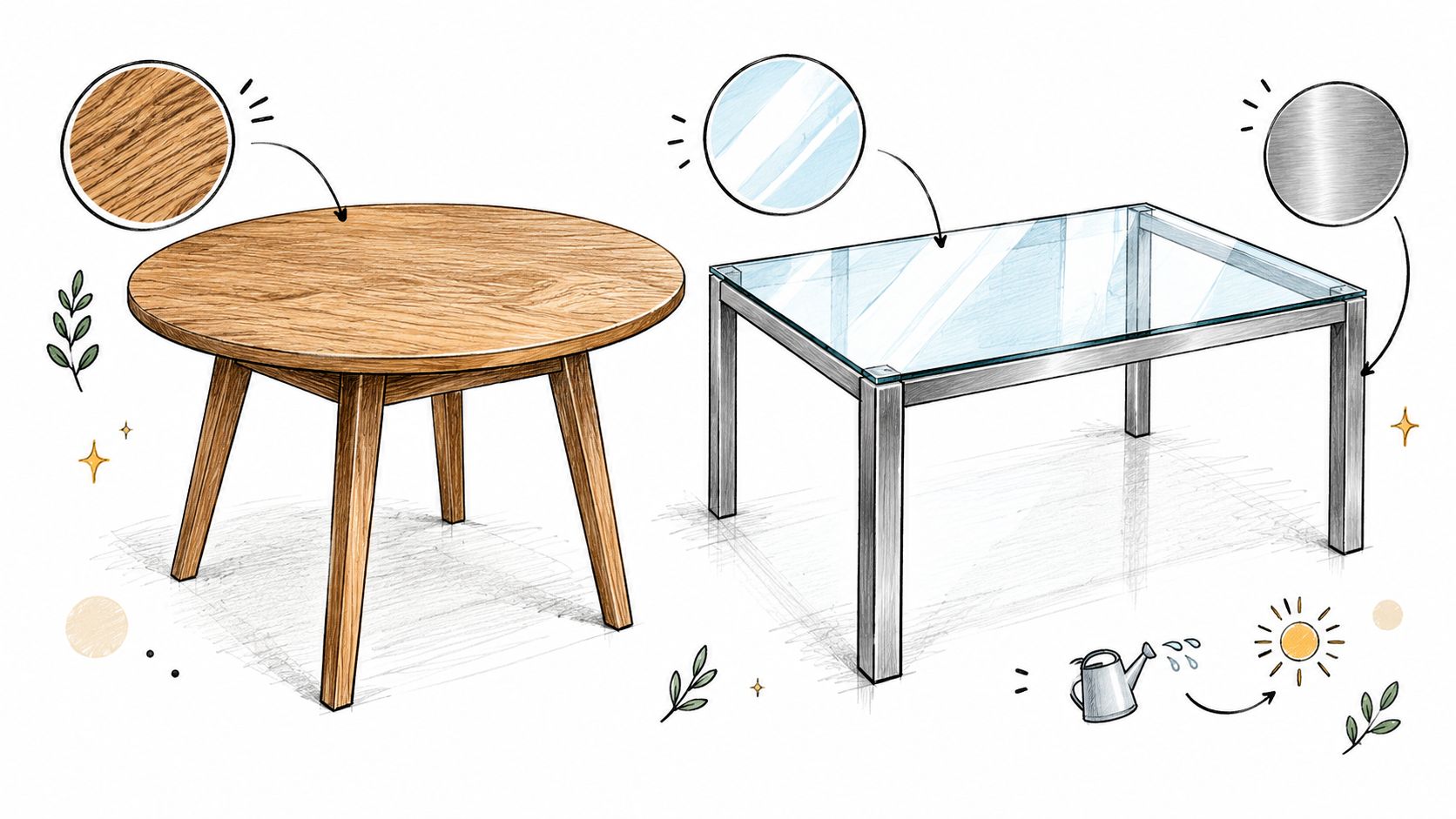
    A hand-drawn illustration comparing a round wooden dining table and a rectangular glass and metal dining table.

    Match the surface to the routine

    A family that serves meals in shared dishes may prefer a shape that leaves a reachable central area without forcing diners to stretch. A household that works at the table may value a longer rectangular surface for notebooks, monitors, or parallel activities. A round table can focus attention toward a central game, conversation, or project, but the usable work edge changes as people sit around the curve.

    Maintenance also deserves a practical look. Sealed wood, glass, metal, and composite materials each respond differently to fingerprints, spills, heat, and scratches. The right question isn't which material is universally easiest. Ask what maintenance your household will consistently perform and whether the finish suits the table's daily workload.

    Let the base support the style

    The base affects both appearance and comfort. Four legs can provide a familiar, stable visual structure, but they may interfere with chairs. A pedestal can create cleaner legroom, although its footprint must remain compatible with wheelchairs, high chairs, and the positions people use.

    Rectangular tables can feel formal with straight lines and traditional legs, or relaxed with a softer finish and bench seating. Round tables can feel casual and social, but the same shape can appear refined when paired with a carefully proportioned top and sculptural base. Style works best when it follows the room's needs instead of attempting to hide a layout that doesn't function.

    Real Household Scenarios and Room Types

    A small apartment studio often needs a table to perform several jobs without becoming a permanent barrier. A round table can create a softer center for meals, conversation, or a small project area, particularly when the room is fairly square. A compact rectangular table may be more useful if it can sit near a wall and leave a longer passage open.
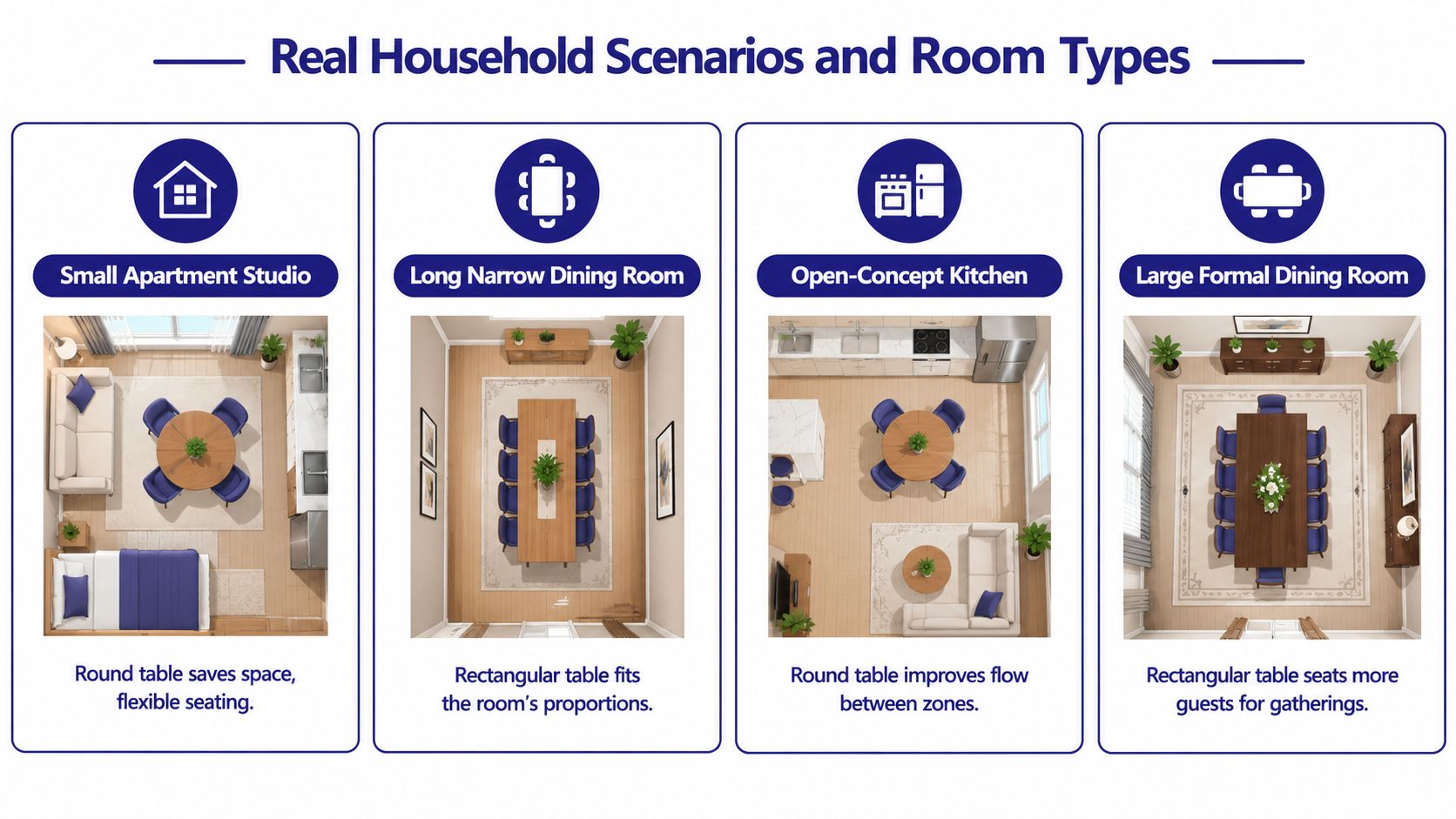
    A comparison chart showing round versus rectangular dining tables in various household room types and layouts.

    Match the table to the room's behavior

    In a long, narrow dining room, a rectangular table usually follows the room's proportions more naturally. Its straight sides can align with a rug, wall, or built-in seating, and its length can support a larger household without forcing the entire arrangement to widen.

    An open-concept kitchen presents a different test. A round table can define a social zone between the kitchen and living area without adding another strong straight line. A rectangular table may align more naturally with a kitchen island and provide a clear axis through the room. Neither choice succeeds if it blocks the main route between cooking, seating, and exterior doors.

    A larger formal dining room gives a rectangular table more opportunity to show its strengths. Defined end positions, longer sides, and scalable length can support hosting, while the shape also suits traditional room proportions. A round table can still work if the household values equal positioning and conversation over a long linear arrangement.

    Consider the people who use the table most

    For a household of four in a compact room, a round table may improve flow and keep everyone engaged in the conversation. For a household that regularly hosts larger gatherings, a rectangular table usually offers more predictable expansion through added length.

    A multi-use room needs closer attention. If children complete homework while an adult uses a laptop and the table later holds dinner, surface organization matters as much as seating. The best shape is the one that leaves enough working area without forcing chairs into the main circulation path.

    Look at the room during its busiest routine, not only when it's neatly arranged. A table that seems ideal for dinner may create a daily obstacle when books, bags, chairs, and people all share the same floor area.

    Making Your Decision with Confidence

    Start with the household, not the showroom. Record how many people use the table on a normal day, then note how often guests join. A six-person household seeking future flexibility may find a 60 to 72-inch rectangular table easier to extend. Four to six diners who value face-to-face conversation may prefer a 48 to 60-inch round table. See a guide to matching table size to diner count for a useful sizing reference.

    Test the choice in the room itself:

    1. Measure the tabletop area. Mark the proposed table, chairs, and the space needed to pull each chair out.
    2. Trace the busiest paths. Include routes to the kitchen, living room, doors, hallways, and any work area.
    3. Check the base. Assess knee clearance, chair positions, and approach space. A pedestal can leave more usable seating room than legs at the corners, regardless of the tabletop shape.
    4. Test multi-use needs. Decide whether the surface must hold homework, laptops, crafts, serving dishes, or meals alone.
    5. Review the long-term household. Account for young children, aging relatives, mobility needs, and possible changes in hosting habits.

    A confident choice survives the chair test. Sit in every intended position, pull each chair back, and check whether another person can still pass comfortably.

    Choose round when a compact or square room needs a social center and movement around a central surface. Choose rectangular when the room is long, seating needs are more predictable, or the table must align with a wall, island, or work zone. If both shapes fit, let the base, chair clearance, and multi-use behavior decide.

    Visit a showroom after measuring. Sit down, move your knees, pull out chairs, and test how the table feels for the people in your home. A hands-on comparison reveals practical problems that a shape label or floor plan can miss.

    Woodstock Furniture & Mattress Outlet offers rectangular, round, and oval dining tables, plus room-planning resources and in-person guidance on size, base design, and seating. Visit Woodstock Furniture & Mattress Outlet to compare options and discuss an arrangement for your North Georgia home.

  • Your Guide to a 7 Piece Round Dining Set

    Your Guide to a 7 Piece Round Dining Set

    You're probably here because you've found a dining set you like, then hit the same question many homeowners face. Will a 7 piece round dining set work in my home, or will it look good online and feel crowded in real life?

    That's a smart question.

    In North Georgia homes, dining spaces often do more than one job. They connect to the kitchen, open into the living room, or double as homework space, game night space, and holiday overflow. A table can't just fit on paper. It has to let people move around it comfortably, pull chairs out without banging a wall, and still feel right for everyday life.

    A round set can solve a lot of those problems. It can also create a few if you choose the wrong size, base, or material. The good news is that once you understand the basics, the decision gets much easier.

    What Is a 7 Piece Round Dining Set

    A 7 piece round dining set is simple in structure. It includes one round dining table and six chairs.

    That sounds straightforward, but the layout changes how the room feels. A round table has no head of the table, so everyone faces inward more evenly. For many families, that means easier conversation, better eye contact, and a setup that feels more relaxed than a long rectangular table.

    Round dining has also become more common in recent years. Round dining configurations account for approximately 22% of all dining table sales, according to 2024 AHFA data referenced here. That doesn't mean round is right for every room, but it does show that more shoppers are choosing this shape for everyday homes.

    Why people choose this layout

    Most buyers aren't choosing a 7 piece round dining set just because it looks nice in a showroom photo. They're usually trying to solve one of these real problems:

    • The room feels tight: A round shape can soften traffic flow because there are no hard corners sticking into walkways.
    • The table needs to seat a group regularly: Six chairs gives you everyday capacity for family meals without jumping to a much larger formal table.
    • The room needs to feel welcoming: A round table naturally centers people around each other.

    A good dining set shouldn't make you plan your whole room around it. It should support the way you already live.

    What the term doesn't tell you

    “7 piece” only tells you the count, not the fit.

    Two different 7 piece round dining sets can behave very differently in a home. One may have a compact pedestal base and armless chairs that slide in neatly. Another may have bulky chairs, a heavier base, and a much larger visual footprint. That's why measuring and material choices matter just as much as the piece count.

    Will It Fit Sizing Your Space Correctly

    Most mistakes happen at this stage.

    A shopper measures the tabletop, sees that it technically fits the room, and assumes everything is fine. Then the chairs arrive, people pull them out, and the whole space feels cramped. The table wasn't the only thing that needed room. The people using it did too.

    An infographic titled Dining Set Sizing Guide illustrating measurements for a 7-piece round dining set.

    Start with the clearance, not the table

    The most useful rule is this one. Proper layout requires 36 to 42 inches of clearance from the table edge to walls or other furniture, based on NKBA guidance referenced here.

    That clearance is what lets someone sit down, push their chair back, and let another person walk behind them without turning the meal into a traffic jam.

    If you remember only one measurement principle, remember that one.

    A simple way to measure your room

    Before you shop, do this with a tape measure and painter's tape:

    1. Measure the full room width and length.
    2. Subtract the needed clearance on all sides.
    3. Use tape on the floor to mark the table area.
    4. Add chair space mentally beyond the table edge.
    5. Walk around the taped outline like you're carrying plates or groceries.

    That last step matters more than people think. A room can look fine on paper and still feel awkward when you move through it.

    What often trips people up in North Georgia homes

    A lot of homes around here don't have a perfectly separate dining room. They have breakfast areas, open dining corners, or a dining zone that shares space with an island, hallway, or back door. In those rooms, traffic flow matters as much as table diameter.

    Here are the usual trouble spots:

    • Kitchen crossover paths: If people pass behind seated diners to get to the fridge, patio, or pantry, you need the wider end of the clearance range.
    • Rugs that are too small: Chairs catch on the rug edge when they slide back.
    • Oversized chairs: Upholstered or curved-back chairs can take up more room than buyers expect.
    • Nearby buffets or islands: These fixed pieces reduce usable clearance fast.

    Practical rule: Measure from the table edge, not the center of the room. Clearance is what determines comfort.

    A quick fit check table

    Room situation What to pay attention to
    Dedicated dining room Wall clearance and chandelier placement
    Open kitchen-dining area Walking paths behind chairs
    Apartment or condo dining nook Chair pull-out space and visual bulk
    Multi-use family dining area Whether the table blocks homework, crafts, or daily circulation

    Don't forget the room above the table

    Once the footprint works, look upward. Lighting changes how a dining set feels. In rooms where you're trying to keep a round table feeling open and balanced, it helps to browse design-forward fixtures for kitchens and baths so you can compare fixture shapes that complement a round layout rather than fighting it.

    A heavy rectangular light over a small round table can feel off. A fixture with a softer silhouette often feels more natural.

    When a round set may not be your best choice

    Sometimes the honest answer is that a fixed round table isn't the best fit. If your dining area has to stay compact most of the week, but expand when guests come over, an extendable hybrid can make more sense. Some buyers are better served by a square-to-round design because it gives them more flexibility in a multi-use room.

    That's not a compromise. It's just better planning.

    Comparing Materials and Styles

    Once you know a 7 piece round dining set will fit, the next question is what it should be made of. This choice affects maintenance, comfort, and how forgiving the set will be during real daily use.

    A dining set can look perfect in a photo and still be wrong for your household. The family with young kids, the empty nesters who host often, and the renter furnishing a first condo may all need different materials even if they like the same style.

    A diagram comparing solid wood with uniform grain to wood veneer with a composite core base.

    Wood feels warm and forgiving

    Wood remains the default choice for many dining rooms because it feels grounded and lived-in. It works in farmhouse, traditional, transitional, and many modern spaces depending on the finish and silhouette.

    Solid wood usually appeals to buyers who want substance and repairability. Veneers can also be a smart choice when they're well made, especially if you want a consistent finish and easier upkeep.

    A few style notes help here:

    • Rustic finishes hide small scratches and daily wear better than slick dark finishes.
    • Smooth formal finishes look polished, but they may show dust, fingerprints, and surface marks faster.
    • Textured or wire-brushed looks tend to be friendlier for busy households.

    Glass changes the feel of the room

    A glass top can make a dining area feel lighter. In smaller spaces, that visual openness can matter.

    It's also worth knowing what kind of glass you're looking at. Tempered glass tops on seven-piece round dining sets can be 5 to 10 times stronger than standard glass and break into small, relatively harmless granules if broken, which is why many buyers prefer them for safety-sensitive homes, as described in this tempered glass product reference.

    That doesn't mean glass is maintenance-free. It usually shows fingerprints, smudges, and crumbs quickly. If that bothers you, wood may be the easier everyday choice.

    Glass often looks cleaner from across the room than it does up close. If you mind streaks, keep that in mind before you commit.

    Metal and mixed materials

    Metal shows up most often in the base, chair frames, or trim details rather than the full tabletop in indoor dining. It can lean industrial, modern, or casual depending on the finish.

    Mixed-material sets, such as wood with metal accents or glass with upholstered chairs, can be useful if you want a room to feel less heavy. They can also help bridge styles if your kitchen and living room already mix finishes.

    Match the material to your lifestyle

    Here's a plain-language comparison:

    Material Best for Keep in mind
    Solid wood Long-term use, warmer look Weight and natural variation
    Wood veneer Style flexibility, easier finish consistency Quality varies by construction
    Tempered glass Light visual feel, easy wipe-downs Shows fingerprints faster
    Metal accents Modern or industrial looks Can feel cooler visually

    If you like minimalist or globally influenced interiors, it can help to study how other traditions use shape and material. This guide to Japanese table materials and styles is useful because it shows how wood tone, edge profile, and table form change the overall mood without relying on ornate detailing.

    Chairs matter as much as the tabletop

    People often focus on the table and rush the chair choice. That's backwards.

    The chairs affect how long people want to sit there. Upholstered seats feel softer and more inviting for long meals. Wood seats can be easier to clean. Curved backs feel supportive, but bulkier chair frames can affect fit in tighter rooms. A beautiful chair that's hard to pull in and out will get old fast.

    Pedestal Bases vs Traditional Legs

    Base style isn't just a visual preference. It changes legroom, movement, and how the table handles daily use.

    For a round dining table, this decision matters more than many shoppers expect because all six seats share the same perimeter.

    A diagram comparing a pedestal base table and a traditional four-legged table regarding seating movement accessibility.

    Why pedestal bases are so popular

    A pedestal base supports the tabletop from a central column instead of four outer legs. That opens up the seating area and usually makes chair placement easier.

    Pedestal bases on 7-piece sets distribute the load through a single central column and require high-grade wood construction and reinforced joinery for wobble resistance. Solid wood pedestal construction can extend functional lifespan by 5 to 7 years, according to this pedestal construction reference.

    That tells you something important. A pedestal table can be very practical, but it depends heavily on build quality.

    Everyday tradeoffs

    Here's the side-by-side view:

    • Pedestal base

      • Easier to slide chairs around
      • Better knee and foot room
      • Cleaner look in many rooms
      • More sensitive to poor construction
    • Traditional four legs

      • Familiar structure
      • Can feel visually sturdy
      • Legs may interfere with chair placement
      • Less flexible if you need to shift seating positions

    If you expect kids to lean on the table, guests to linger, or chairs to move constantly, inspect the base construction as closely as the finish.

    A short visual can help you notice the difference in seating movement and support design before you shop in person.

    What to look for in person

    When you test a pedestal table, don't just tap it lightly. Sit down, rest your forearms on the edge, and gently shift weight the way people do during a real meal. If there's movement, ask about the construction details.

    Check for these signs:

    • Solid connection points: The joinery where the column meets the base and top should feel firm.
    • Weight in the base: A better pedestal usually feels anchored.
    • Even floor contact: Older homes sometimes have slightly uneven flooring, so stability matters.
    • Chair sweep: Make sure chairs can rotate in and out without catching the base.

    A pedestal done well is one of the most user-friendly choices for a 7 piece round dining set. A pedestal done poorly is one of the most frustrating.

    Your Pre-Purchase Checklist

    Before you order anything, pause and run through a short checklist. This catches most regrets before they happen.

    The room check

    Ask yourself these first:

    • Did I measure wall-to-wall space clearly?
    • Did I account for clearance around the table, not just the tabletop itself?
    • Will doors, walkways, or kitchen paths cross behind seated people?

    If any answer is uncertain, remeasure. Guessing is expensive.

    The lifestyle check

    Your dining set should match the way your home functions.

    • Do I need easy cleanup every day? If yes, think carefully about finish texture, upholstery, and whether glass streaks will annoy you.
    • Will people sit here for long meals? Chair comfort becomes more important than a dramatic table design.
    • Do kids use this table for homework or crafts? A fussy surface may not stay looking the way you want.

    The construction check

    Buyers often rush at this stage.

    Question Why it matters
    Is the base stable? Daily use exposes weak construction quickly
    Do the chairs feel supportive? Comfort affects how often the space gets used
    Does the finish fit your tolerance for upkeep? Some surfaces show every mark
    Can the set work with your existing room style? A dining set shouldn't feel borrowed from another house

    Bring your room measurements, a few phone photos, and the dimensions of any nearby furniture. That combination answers more questions than memory ever will.

    The style check

    Finally, look at the whole room. Not just the table.

    A round set can soften a room full of straight cabinet lines and rectangular counters. It can also feel out of place if every other element is sharp, formal, and highly symmetrical. Think about your floors, lighting, nearby bar stools, wall color, and whether you want the set to blend in or become the visual center of the room.

    Caring for Your New Dining Set

    Once your dining set is in place, a few habits will help it stay looking good longer. Most care problems start with good intentions and the wrong cleaning method.

    Wood surfaces

    Use a soft cloth for routine dusting. Clean spills promptly, especially if they involve heat, grease, or moisture. Avoid harsh cleaners that can dull or damage the finish over time.

    If your table has a textured or rustic finish, crumbs may settle into the grain more easily. A soft brush attachment or slightly damp cloth usually works better than over-saturating the surface.

    Glass tops

    Glass is easy to wipe clean, but it shows residue fast. Use a microfiber cloth and a glass-safe cleaner sparingly rather than soaking the surface.

    If streaks keep showing up, the issue is often too much product rather than too little. A dry final wipe usually helps.

    Upholstered chairs

    Vacuum upholstered seats regularly so grit doesn't wear into the fabric. Blot spills instead of rubbing them. Rubbing can spread the stain and push it deeper into the fibers.

    If you have performance fabric, follow the care tag first. If you don't know the fabric type, test any cleaner on a hidden area before using it more broadly.

    A few habits that help any set

    • Use placemats or trivets: They reduce wear from dishes and heat.
    • Lift chairs when possible: Dragging strains joints and scuffs floors.
    • Tighten hardware occasionally: Chairs and bases naturally loosen with daily use.
    • Watch direct sunlight: Strong light can change how finishes and fabrics age.

    A dining set ages best when small maintenance stays small. Waiting until something feels loose, scratched, or stained usually means more work later.

    Finding Your Set in North Georgia

    Shopping online is useful for narrowing options. It's not always enough for making the final call.

    A 7 piece round dining set is one of those purchases that benefits from seeing it in person. Chair comfort is hard to judge from a product photo. So is finish texture, table edge thickness, base stability, and whether the set feels too heavy or too small for the kind of room you have.

    A sketched illustration of a seven piece round dining room set featuring upholstered chairs in a modern room.

    In North Georgia, this category makes sense for how many families live and gather. North Georgia homes average 2,100 square feet, and 65% of dining set purchases involve 6 to 8 seating capacity, which is why this format fits so many local households, as noted in the earlier market data from the cited AHFA-related source.

    What to test before you decide

    When you shop in person, do more than look.

    • Sit in every chair style you're considering: Some backs look supportive but hit the shoulders awkwardly.
    • Pull the chair in and out: This tells you how the base and chair shape work together.
    • Touch the finish: A photo can't tell you whether a surface feels slick, textured, dry, or overly distressed.
    • Check the visual scale: A table may fit dimensionally and still feel too heavy for your room.

    Why local guidance helps

    Regional stores are useful in this regard. Staff who regularly help customers furnish North Georgia homes tend to understand the layouts people are dealing with, including breakfast rooms, open kitchen plans, and smaller combined living-dining spaces.

    If you want to compare options in person, Woodstock Furniture & Mattress Outlet is one local place where shoppers can look at dining sets, sit in the chairs, and talk through layout questions with someone who sees these room challenges every day.

    The right outcome

    Sometimes the right set is the one you expected to buy. Sometimes it isn't.

    You might walk in thinking you want a large rustic pedestal table and leave realizing a lighter mixed-material set fits your room better. Or you may confirm that the round table you loved online really does work beautifully in person. Either way, that's a better result than forcing a dining set into a space that was never suited for it.


    If you're trying to choose a 7 piece round dining set and want help thinking through size, comfort, and layout, visit Woodstock Furniture & Mattress Outlet to explore options in person and get practical guidance for your North Georgia home.