You've found a recliner that feels comfortable, but you'd also like to turn toward the television, join a conversation, or face a side table without dragging the chair across the floor. A swivel sounds like the answer. Then you sit down, turn, and wonder whether the movement you feel is normal rotation or unwanted looseness.
A recliner swivel base is more than a convenience feature. It carries weight while the chair changes direction, and it must work with the reclining mechanism and any gliding or lifting functions. Choosing one means checking not just whether it turns, but how it behaves while you're seated, reclining, and getting up.
What a Recliner Swivel Base Is
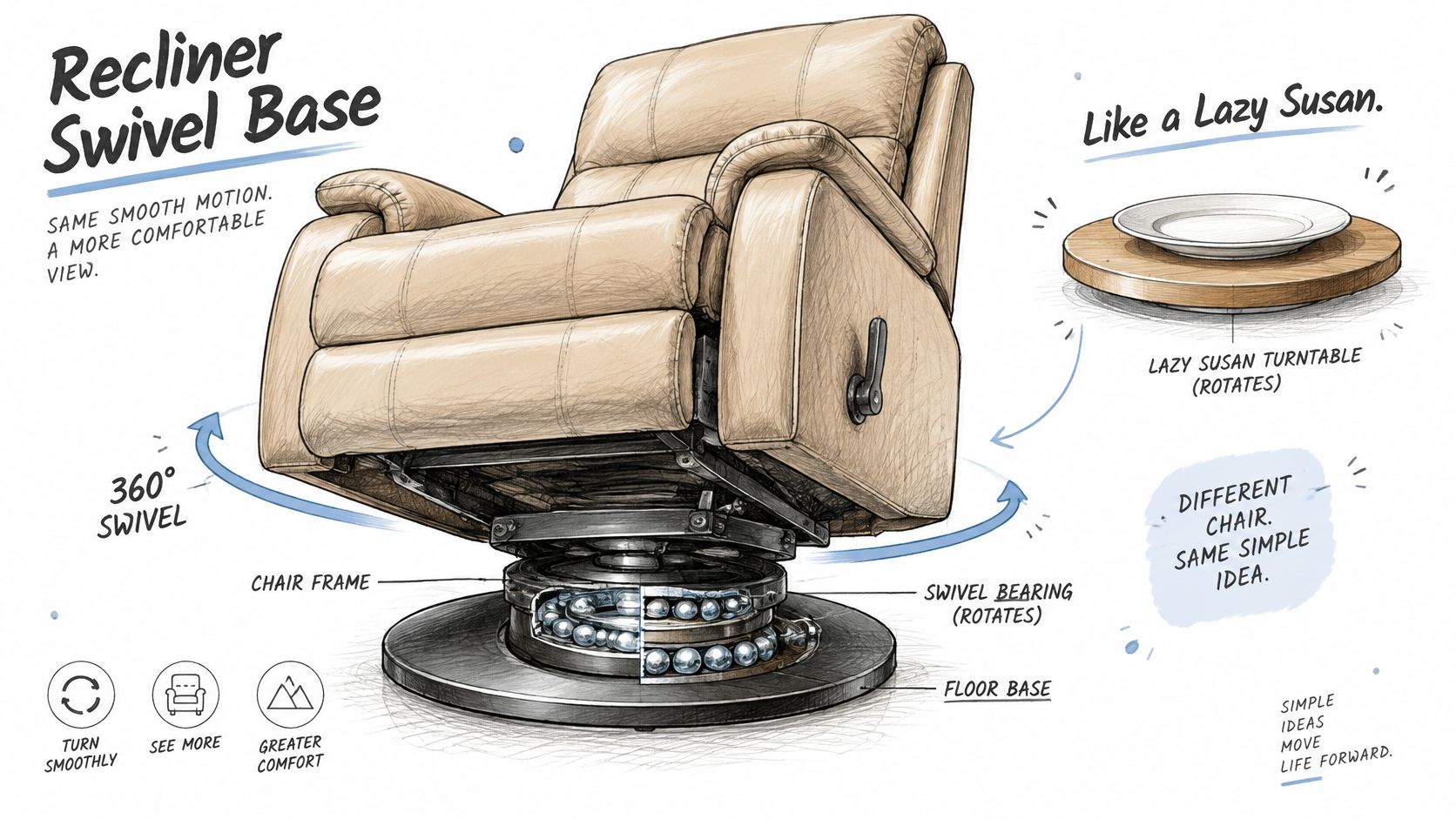
A recliner swivel base is the rotating connection between the chair's frame or pedestal and its floor-contact support. It carries the chair and seated person while allowing the seat assembly to turn. Think of a lazy Susan engineered to support a person, with a rotating bearing or sliding surface between stationary and moving parts.
The construction commonly includes a floor-contact pedestal or base plate, a bearing or sliding race, and a mounting plate attached to the chair frame. Some of these parts may be hidden by upholstery or a protective cover.
This diagram shows the basic relationship between the support and rotating assembly.
How to Identify a Swivel Base
Many recliners don't swivel at all. Before comparing mechanisms, make a simple identification check:
- Turn the seat gently. Look from outside the mechanism for a round plate, pedestal, or bearing ring. Don't reach beneath an occupied or moving chair.
- Find the frame connection. A visible seam or bolt pattern can identify where the base attaches. A detachable base has its own assembly requirements.
- Read the specification sheet. Look for swivel or rotating. Glider describes another movement and doesn't, by itself, confirm rotation.
The technology has a long engineering history: the swivel-chair patent record cites revolving-chair-base work filed in 1950, before the modern recliner became common living-room furniture. That history helps explain why the base deserves attention as structural hardware, not decorative trim.
Practical distinction: Swiveling changes where you face. Reclining changes your seated position. A chair may offer either movement without the other.
The control method is a separate choice, too. Tip Top Furniture & Mattresses offers a resource to compare power and manual recliners when you're deciding how you want to operate the back and footrest.
Swivel Base Types Compared Side by Side
| Base type | Movements it adds | Typical use | What to confirm |
|---|---|---|---|
| Basic rotating base | Rotation only | Turning to talk or reach a side table | Stated swivel range and any locking feature |
| Swivel-and-tilt platform | Rotation plus tilt | Turning while the back reclines | Stability evidence in reclined and rotated positions |
| Lift-recliner with swivel | Rotation, powered lift and recline | Sit-to-stand assistance and turning left or right | Lift-capacity rating, tested transfer stability and cord clearance |
These are useful construction categories, not interchangeable labels. The word swivel tells you that rotation is available, but it doesn't tell you which other movements the support system accommodates.
A basic rotating base adds turning at the base connection. The chair above it may still have a separate reclining mechanism, but the rotating base itself doesn't provide tilt or lift. This can suit someone who mainly wants to turn between a television and a conversation area.
A swivel-and-tilt platform combines rotation with a tilting support arrangement. Tilt and recline aren't identical: tilt changes the angle of the supported chair assembly, while a reclining mechanism changes the seat and back positions relative to the frame. Ask the salesperson to demonstrate each motion separately so you know what you're feeling.
When Lift Assistance Changes the Decision
A lift-recliner with swivel combines positioning with powered assistance between sitting and standing. The patent for an all-purpose rocking, swiveling, reclining, and lifting chair documents this integrated approach, treating the swivel base as part of a support system with several movements.
For this category, easy turning isn't enough. You need to understand whether rotation locks, resists movement, or is restricted during lifting, and whether the intended user can operate the controls comfortably.
The table's final column is your action list:
- For basic rotation, establish the permitted range and whether you can hold a chosen direction.
- For combined tilt and rotation, ask about testing in the positions you'll use.
- For powered lifting, evaluate the complete transfer sequence, not just the chair's ability to rise.
Fit and upholstery remain separate considerations. Willis Furniture & Mattress's guide to swivel recliner fit and materials can help you consider those alongside the mechanism.
More movement isn't automatically more useful. Choose the movements that solve your daily seating problem without making operation harder.
How the Rotating Mechanism Works Under Load
Sit down in a swivel recliner that spun freely when it was empty, and it may suddenly feel stiff. That change is load at work, not necessarily a fault. Your body weight presses the rotating parts together, and the mechanism now has to carry you while it turns.
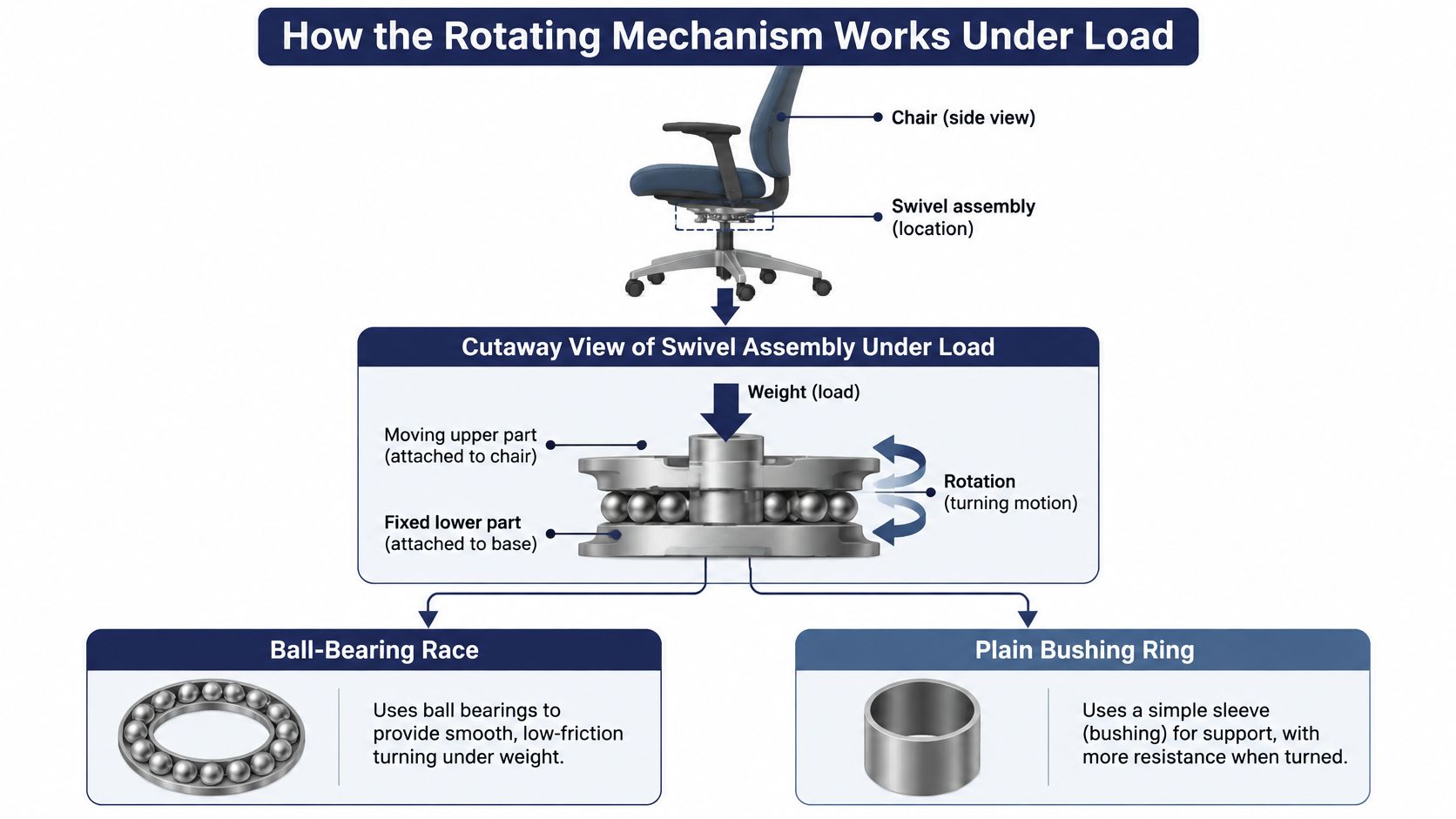
The swivel base works like the chair's ankle joint: it bears your full weight while allowing controlled rotation. Inside the assembly, a race guides movement between a fixed lower ring and a moving upper ring. A steel ball-bearing race uses rolling elements, so the surfaces glide over tiny spheres rather than scraping past each other. A nylon or polymer sliding race supports the same movement through sliding contact instead. Ball-bearing designs generally need less starting effort, although the complete chair's construction and condition still matter.
The cutaway below shows how that load travels through a bearing assembly. Its chair shape is illustrative, not a specification for every recliner.
Starting Effort and Weight Ratings
Veito Hardware's swivel-plate technical guide gives the following approximate starting-torque ranges, which describe its technical comparison rather than guaranteed performance for a particular recliner.
| Race type | Unloaded starting torque | Starting torque at rated load | Rotation feel |
|---|---|---|---|
| Steel ball-bearing race | 0.3–1.2 N·m | 0.8–2.5 N·m | Generally smoother and more consistent |
| Nylon or polymer glider ring | 1.5–4.0 N·m | 3.0–8.0 N·m | Greater starting effort; can feel less smooth as wear increases |
Starting torque means the twisting effort needed to begin rotation. You don't need to calculate it in a showroom. The useful takeaway is that starting a loaded chair can take more effort than keeping an empty one moving, and the table shows why: under rated load, each race type demands roughly two to three times the effort.
Two ratings get confused here. Static capacity is the weight the base supports while sitting still. Dynamic capacity is support during movement, when friction, off-center loading, and a shifting center of gravity act together. A user-weight rating on the label speaks to the first. It tells you nothing about how easily the chair will turn with you in it, which is the second.
Watch for these changes in an existing chair:
- Increasing resistance or grinding can indicate contamination, lubricant loss, or damage.
- Lateral play means unwanted sideways looseness, rather than the intended turning movement.
Don't apply lubricant or tighten unfamiliar mechanism parts without model-specific guidance. A noise alone won't identify the repair.
One naming trap worth clearing up: a glider ring inside a rotating assembly isn't the same thing as a chair's gliding motion. Miller Waldrop Furniture & Decor's resource on swivel glider recliners for living rooms provides context for that combined seating category.
For a useful feel test, sit centered and turn slowly in both directions. Notice whether rotation starts without a catch and continues evenly, rather than judging only how freely the empty chair spins. A base that carries weight smoothly while rotating is doing its real job.
Stability When Reclining, Rotating and Standing
A chair can feel steady upright yet shift when you extend the footrest and turn toward someone beside you. That's why a stationary comfort test can't answer every stability question.
Stability depends on the combined center of mass, base footprint, reclined geometry, and swivel orientation. Reclining can move weight rearward and increase the risk of tipping. Turning can place the seat assembly in a less favorable relationship to its supporting footprint.
The test logic reflects this: ISO 7174-1 requires swivel-base chairs to be evaluated with the base in the position most likely to cause over-balancing, and reclining or tilting chairs with the back assembly inclined rearward.
What Testing Can and Can't Tell You
A broad base can help resist tipping, but weight alone doesn't establish stability. The location of the load and the support geometry matter. At home, an uneven floor, compressible rug, or sideways lean can reduce the margin against tipping.
The scope of a standard matters as much as its name. EN 1022:2023 covers reclining and multi-position seating, including sideways stability involving swiveling components; the standards overview also identifies EN 12520:2024 domestic-seating requirements addressing durability, entrapment-related hazards, and stability after testing.
That doesn't make a general statement such as tested for safety a complete answer. Ask:
- Which standard applies? Request the actual designation and the chair model covered.
- What was evaluated? Separate stability, strength, durability, and pinch-point testing.
- Which configurations were included? Ask about reclined, rotated, and raised positions where applicable.
The U.S. Consumer Product Safety Commission's staff letter on recliner entrapment states that no published consensus standard specifically addresses recliner entrapment and identifies related provisions in UL 962 and ANSI/BIFMA X5.4-2020. Those provisions address relevant characteristics, but a general compliance claim shouldn't be treated as proof that every entrapment hazard has been eliminated.
For caregivers: Easy positioning and secure transfer stability are different requirements. A chair that turns toward a walker isn't necessarily safe to lean on while standing.
For someone with mobility limitations, evaluate the person, chair, and assistance routine together. Don't deliberately lean to the tipping point or attempt a showroom stability test yourself. Ask for documentation and a controlled demonstration, and involve an appropriate mobility professional when transfers are uncertain.
How to Test a Swivel Recliner Before You Buy
Use a deliberate routine rather than repeatedly spinning an empty chair. Bring the intended user when possible, wear the footwear they normally use indoors, and ask for help before operating an unfamiliar lift or reclining control.
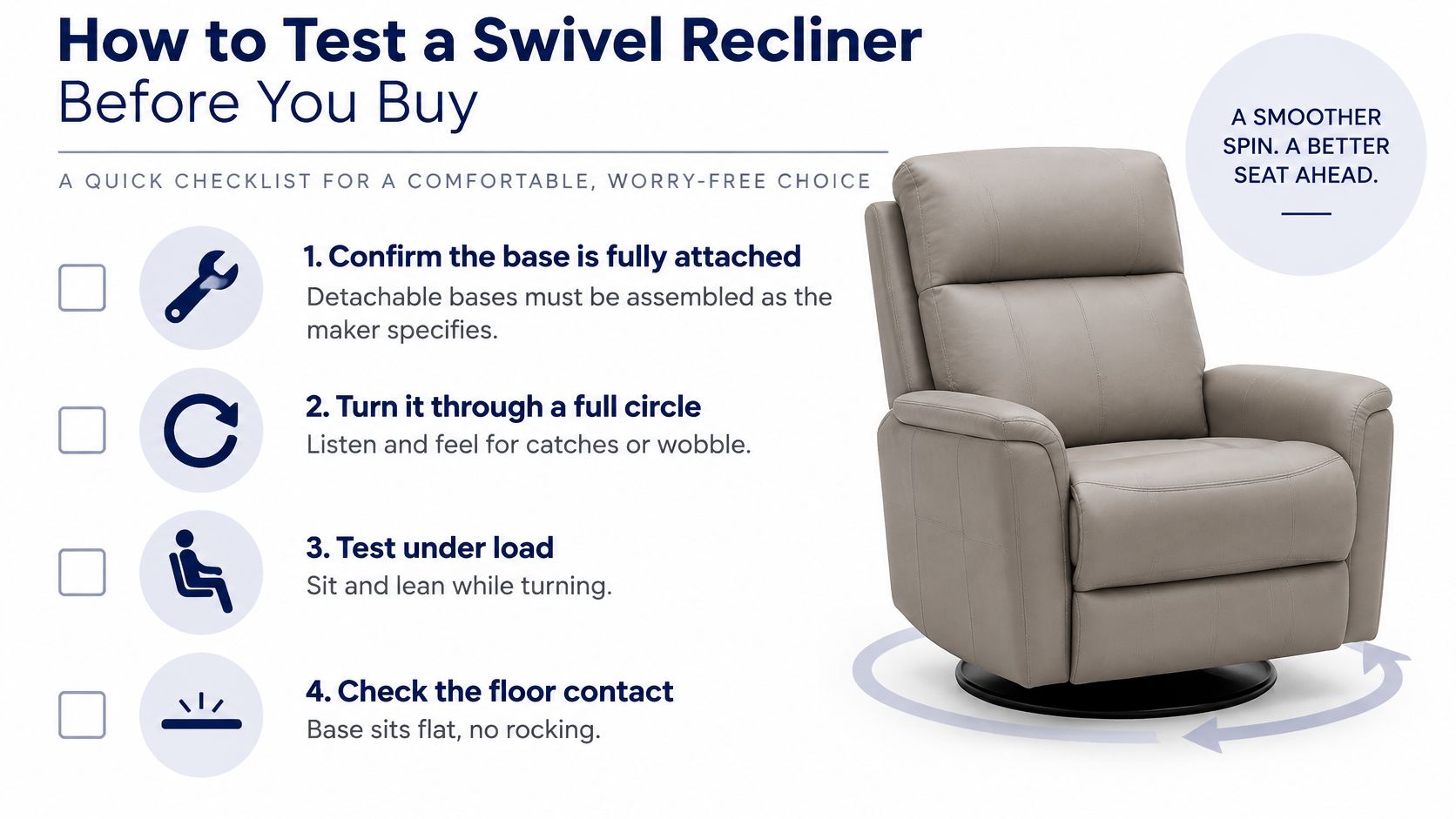
This visual is a quick reminder of the physical checks. Follow the model's rotation limit rather than assuming a full circle is permitted.
A Shopper's Inspection Routine
Confirm the base is fully attached. The manufacturer's swivel and gliding recliner safety instructions warn that improper installation of a detachable base can cause tipping. Ask staff to inspect unexplained gaps, loose joints, or movement where the base attaches before you sit.
Check floor contact. The base should sit level without unintended rocking or an edge lifting. At home, repeat this check on the actual flooring and rug arrangement, since the showroom surface may be different.
Try rotation with the footrest closed, then open. Only combine movements the manufacturer permits. Move slowly and stop if you notice wobbling, catching, or a sudden shift; don't force the seat through resistance.
Verify the swivel limit and cord path. One powered swivel-furniture instruction sheet warns against rotation beyond 270 degrees to protect the power cord, but that limit isn't universal. For the chair you're considering, check that the cord neither catches under the base nor pulls tight anywhere within its permitted range.
Practice the actual transfer. Close the footrest and use the specified entry and exit position. Check whether the chair stays predictable as you sit and stand, without depending on a moving or partially turned seat for support; stop if you lose balance or need to grab nearby furniture.
Inspect accessible moving gaps. An account of the CPSC's recliner-entrapment concerns identifies hazards beneath the foot-support lift mechanism and near the upper leg rest, where a child can slip between it and the seat cushion. Look without placing fingers in moving parts, keep children away during operation, and follow the model's supervision instructions.
Clarify the weight ratings. Confirm the chair's tested user-weight limit. If you're reviewing a separate base component, establish whether its total-load rating includes the chair itself; don't confuse that figure with occupant capacity.
Request the testing details. Ask which standard the manufacturer cites and which characteristics it covers. A vague assurance without model-specific documentation leaves important questions unanswered.
Watch the Complete Movement
Use a demonstration to observe how the chair operates, then have staff explain any differences in the model you're testing.
This checklist supports your judgment; it doesn't replace the manufacturer's instructions or professional transfer advice. If a chair feels unpredictable, pause the test instead of trying to get used to the movement.
Choosing the Right Swivel Recliner for Your Room
Choose the base around the task you want the chair to perform. A swivel base is load-bearing hardware, so judge it across every movement you expect: turning upright, rotating while reclined, and rising from the seat. A complicated mechanism adds little if you only need a simple turn toward the conversation.
For occasional turning in a family room, start with a basic rotating base. Check that you can face your usual destinations without moving the entire chair, and that the swivel range and locking behavior suit how you will use it. Turn through the positions you expect at home rather than stopping after one smooth rotation.
The illustration shows how rotation can change a chair's relationship to nearby furniture. It does not guarantee that every model permits unrestricted turning.
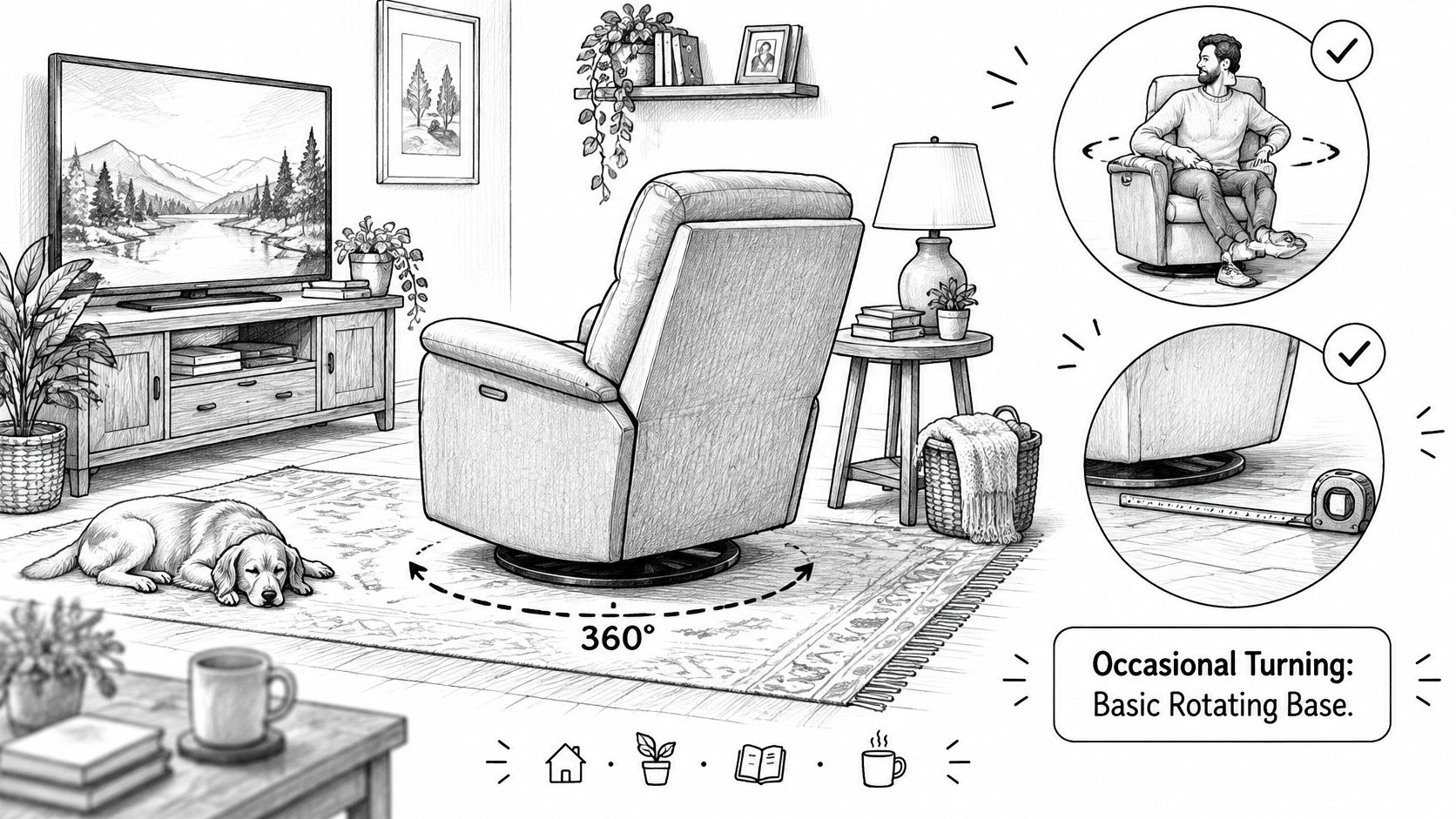
Match the Movement to the Space
For frequent turning while reclining, consider a swivel-and-tilt platform with documentation appropriate to those combined positions. Measure the chair's moving envelope as well as its upright width: the back, arms, and extended footrest need unobstructed space throughout the permitted movement.
For sit-to-stand assistance or caregiver access, evaluate a swivel lift-recliner as a transfer aid that needs individual testing. A powered lift function does not make the arms or moving seat a dependable standing support, so assess stability during the full rise and return.
Before visiting a showroom, prepare:
- A room sketch showing walls, side tables, walkways, and electrical outlets.
- Your main use case, such as turning between television viewing and conversation.
- Your testing questions, including rotation effort, transfer behavior, and the maker's specification sheet.
At Woodstock Furniture & Mattress Outlet, staff can walk through a chair's specifications, demonstrate rotation, and discuss placement questions. An in-person visit lets you feel the movement under your own weight and decide whether the chair fits your routine instead of relying on the swivel label alone.
Woodstock Furniture & Mattress Outlet sells furniture, mattresses, and home decor, and offers design services and delivery options to help you plan your room. Bring your room sketch and testing checklist to any location in Woodstock/Acworth, Canton, Dallas/Hiram, Rome, Covington, or Douglasville to explore how a swivel recliner could work in your space.