A standard non-adjustable queen box spring or foundation typically costs about $200 to $400 in the U.S. A practical baseline is near $300 before tax, delivery, and a frame.
Why, then, can two queen bases that look the same size online differ by a few hundred dollars, and why does the cheaper one sometimes stop looking cheaper once it's in your bedroom? That's the gap most price lists leave out, and it's the one that decides whether you're comfortable with what you spent.
The queen label tells you the footprint your mattress needs. It doesn't tell you how the piece is built, how tall your finished bed will sit, whether your frame can hold it, or what it'll cost to get it up a narrow stairway. Work through those questions in order and the pricing starts to make sense without any pressure to chase a particular brand or tier.
Queen Box Spring Prices and What Drives Them
How much is a queen-size box spring once you account for more than the sticker price? A standard, non-adjustable queen box spring or foundation typically costs about $200 to $400. Current prices on Mattress Firm's queen foundation listings start around $219.99 for basic models, with mainstream options commonly around $275 to $325 and higher-end models starting near $400.
For the foundation itself, a practical budget is roughly $250 to $400 before sales tax, delivery, setup, or a compatible bed frame. About $300 is a useful baseline for a conventional model. The final cost depends on what the price buys and what else your bed needs.
How the Price Bands Break Down
The available Mattress Firm prices show why two foundations with the same queen label can have different prices. Basic models start around $219.99, mainstream options commonly fall around $275 to $325, and higher-end models start near $400. The table summarizes those typical ranges once, as a guide rather than a ranking.
| Price band | Typical queen price | What the price usually covers |
|---|---|---|
| Basic | About $220 to $275 | Entry-level foundation |
| Mainstream | About $275 to $325 | Standard non-adjustable foundation |
| Higher-end | About $400 and up | Higher-priced foundation |
Prices can reflect construction, reinforced support, upholstery, warranty terms, or compatibility with particular mattresses. A standard-height and low-profile model may also differ in price, even though both fit the same mattress. The queen size describes the footprint; it doesn't, by itself, tell you what support the foundation provides.
A higher price isn't automatically a better fit. Compare what each model includes and whether it suits your mattress, rather than treating price as a quality ranking. For a plain-language introduction to understanding box spring benefits, consider how the support layer contributes to the bed as a whole.
What Warranty Length Does and Does Not Tell You
Warranty length describes how long the maker covers defects under its terms. It doesn't promise how long the foundation will feel new, and coverage can depend on using it with an approved mattress and frame.
Practical rule: Compare warranties only between foundations your mattress maker allows. A long warranty on incompatible support won't make that support a suitable choice.
Two foundations at the same price can still be different values. If your mattress specifications call for a rigid, flat foundation, a lower-priced flexible spring unit may not meet that requirement. A shopper whose mattress allows a spring unit can compare it on different terms.
Compare Like With Like Before You Compare Prices
Keep the comparison focused on the same profile, construction, mattress approval, and included pieces. A foundation price may not include the frame needed to raise it off the floor.
- Same profile: Compare standard-height models with standard-height models, and low-profile models with low-profile models.
- Same build type: Rigid foundations and flexible coil units provide different kinds of support.
- Same approval: Check that each option is allowed by your mattress maker.
- Same inclusions: Confirm whether the quote covers just the foundation or a metal frame too.
Once those details match, the lower price is easier to assess fairly. Add tax, delivery, setup, and any frame cost to compare the full amount you'll pay.
What the Queen Price Is Actually Buying
Say you're standing in front of two queen foundations. Both boxes say queen, both look like upholstered rectangles, and one costs noticeably more. The size label is doing less work than you might think.
The diagram below shows the idea to carry with you while you shop.
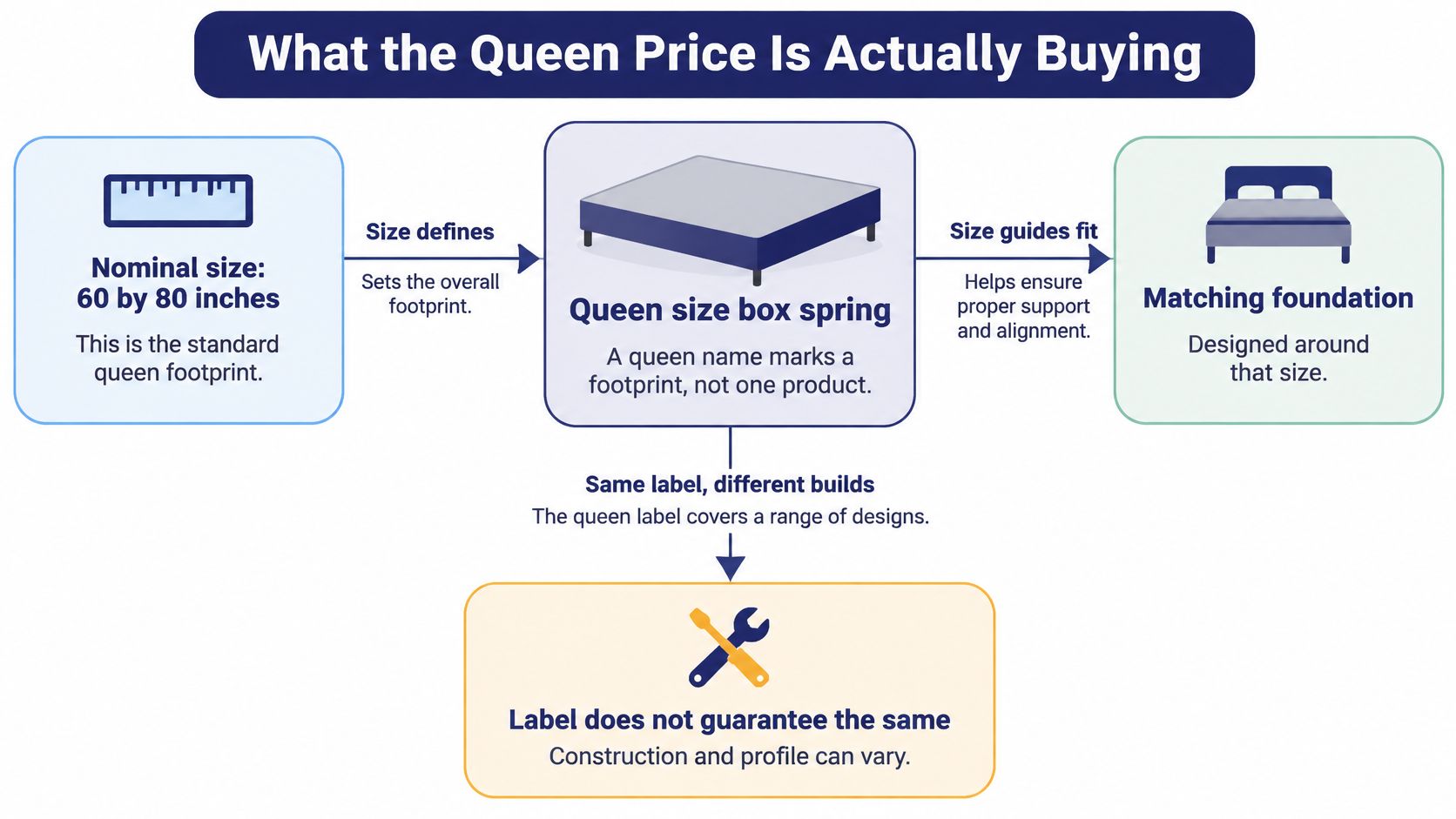
Think of queen as a clothing size. Size tells you the garment should fit a certain range, while fabric tells you how it behaves. A queen foundation is designed around a nominal 60 by 80 inch mattress footprint, but that label doesn't guarantee the same build, the same feel under your mattress, or the same approval from your mattress maker.
Flexible Springs and Rigid Foundations Are Not Interchangeable
Traditional box springs use flexible coil support and were designed for use with some innerspring mattresses, whereas many modern foam and hybrid mattresses require a rigid foundation or another specifically approved support surface, as Sealy's flat foundation warranty information explains. Compatibility is determined by the mattress manufacturer's requirements rather than by the queen size alone. Using an incompatible support can affect stability and may create warranty problems, even when the dimensions appear correct.
That distinction explains a common confusion. A shopper replaces a worn innerspring mattress with a foam or hybrid model, keeps the old spring unit because it's queen sized, and then feels the new mattress dip or move in a way the old one didn't. The footprint matched. The support type didn't.
Before you price anything, identify which of these your mattress allows:
- Traditional spring unit: A flexible coil base, mainly for mattresses designed for it.
- Rigid foundation: A firm wood or metal structure with little give.
- Platform bed: Slats or a solid deck built into the frame itself.
- Adjustable base: A moving base that replaces a foundation entirely.
For a neutral explanation of how these choices connect to coverage, mattress base requirements for warranty coverage walks through foundation versus box spring differences without pushing one brand. It's a useful cross-check against your own warranty card.
Price differences follow from those builds. Materials, coil or rigid construction, upholstery, height, and whether a piece is built for a named mattress line all change cost. A foundation also doesn't automatically include legs or a metal frame to lift the bed off the floor, so don't assume the piece in the photo is a complete setup.
Check your mattress warranty or spec sheet for the allowed support first. Once you know the type you're allowed to buy, comparing two prices becomes an honest comparison instead of a guess.
Height Fit and Weight Before You Order
A foundation can be the right type and still be the wrong fit. Start with the tape measure, because published queen sizes aren't always identical.
The illustration below shows where to measure before you order.
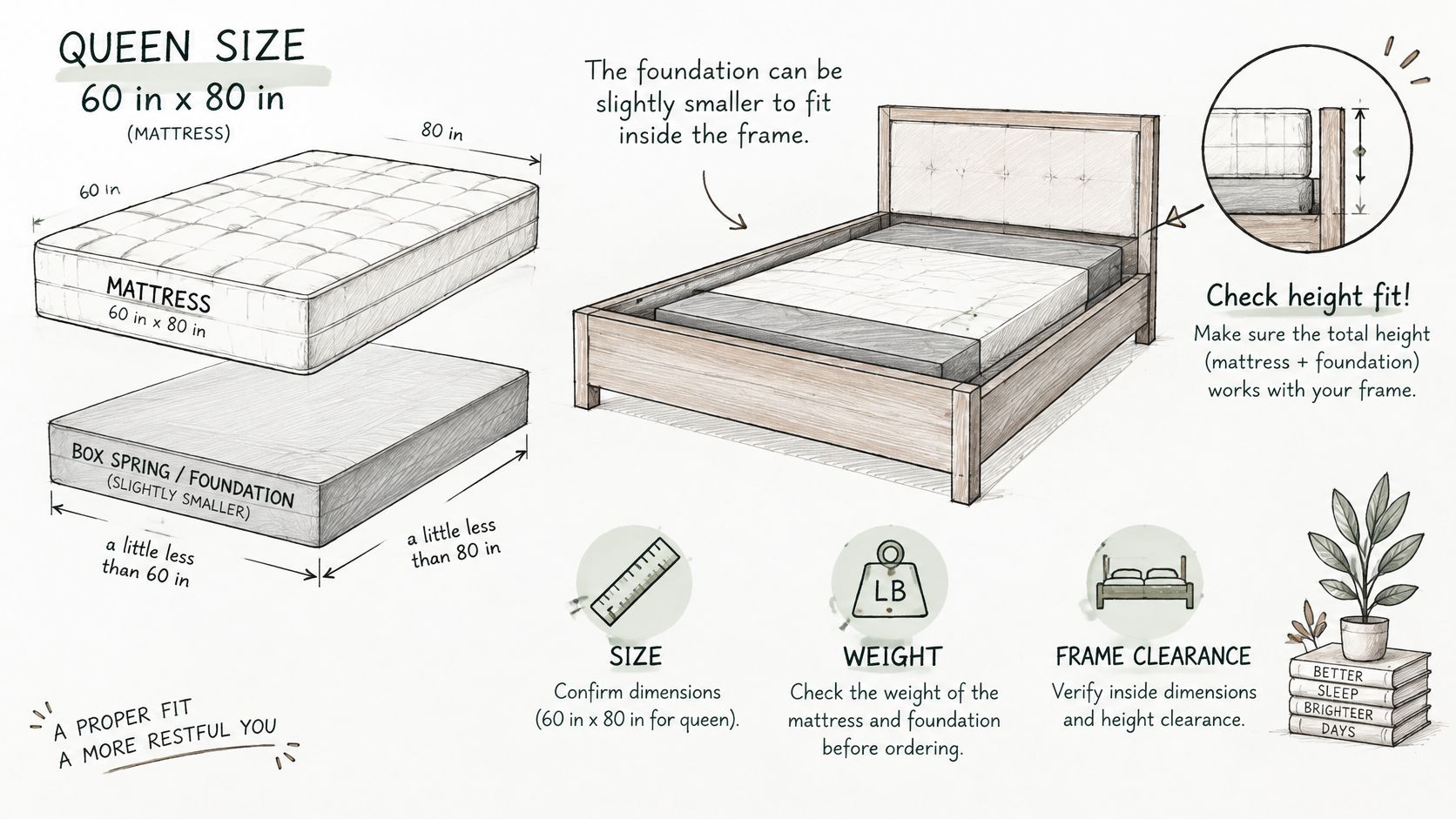
Standard queen mattress dimensions are approximately 60 by 80 inches, but finished foundations can vary slightly, with one major specification listing a queen foundation at 60 by 80 inches and another at approximately 59.5 by 79 inches, according to Living Spaces' guide to types of mattress bases. Low-profile foundations there are commonly around 5 to 5.5 inches high, while standard versions are often about 9 inches. A slightly smaller made size often helps a foundation sit inside frame rails, but you won't know until you measure.
One documented queen foundation measures 79.6 inches long by 57.6 inches wide and 9 inches high, as listed in KitchPrep's queen box spring size guide. That example is narrower than the nominal width, which is exactly why the word queen shouldn't replace the product's published dimensions. Check the exact model you're considering, not a similar one.
Measure the Inside of the Frame
Measure the inside of your frame from rail to rail and head to foot, not just the outside edges. Then verify clearance, center rails, support legs, and permitted slat spacing for your mattress. A queen setup needs center support that reaches the floor on many frames, and missing legs can let the middle sag even when the foundation itself is sound.
| What to check | Common figure | Why it matters |
|---|---|---|
| Nominal queen footprint | 60 by 80 inches | Matches a standard queen mattress |
| Slightly smaller made size | About 59.5 by 79 inches, or 79.6 by 57.6 inches in one example | Must fit inside the frame |
| Standard profile | About 8 to 9 inches | Sets a typical finished bed height |
| Low profile | About 5 to 5.5 inches | Lowers a thick mattress |
| Split queen | Two pieces near 30 by 80 inches | Easier through stairs and narrow doors |
| Example shipping weight | 61 pounds (2024 Costco listing) | Affects carrying and delivery |
Height is where a few inches change daily life. A standard profile under a thick mattress can put the sleep surface high enough that sitting on the edge feels awkward and nightstands sit oddly low by comparison. A low-profile foundation lowers that same mattress, which can help shorter sleepers, anyone with mobility concerns, and rooms where a tall bed overwhelms the space.
The short video below is worth watching before you finalize a height, then do your own arithmetic with your frame and mattress thickness.
Add frame height, foundation height, and mattress thickness together. Sit on a surface at that finished height if you can, or stack items to approximate it. You're testing whether your feet rest comfortably and whether getting in and out feels easy, not whether the number looks standard on paper.
Split Queens and Carrying Weight
A split queen divides the foundation into two narrower sections while keeping the same overall sleeping surface. That helps with stairways, hallways, tight doorways, and older homes where a one-piece queen base won't turn a corner. It can cost more than a one-piece equivalent, but it's cheaper than ordering a base that can't reach the bedroom.
Weight matters for the same reason. In 2024, Costco's listing for the Beautyrest Silver BRS900 queen box spring showed 79.5 inches long by 60 inches wide by 9 inches high, with a weight of 61 pounds. That's manageable for two people on a straight path and a different task on a tight staircase. Plan the carry before you choose pickup over delivery.
Don't rely on a generic weight capacity. Add the combined weight of the mattress, sleepers, and bedding, then compare that total with the maker's stated rating for the exact model.
Heavier couples and dense hybrid mattresses can outgrow a light foundation even when the price looked right. If the maker doesn't publish a rating you can find, ask for it in writing. "Queen size" alone doesn't answer the load question.
Add Delivery Frame and Setup to the Budget
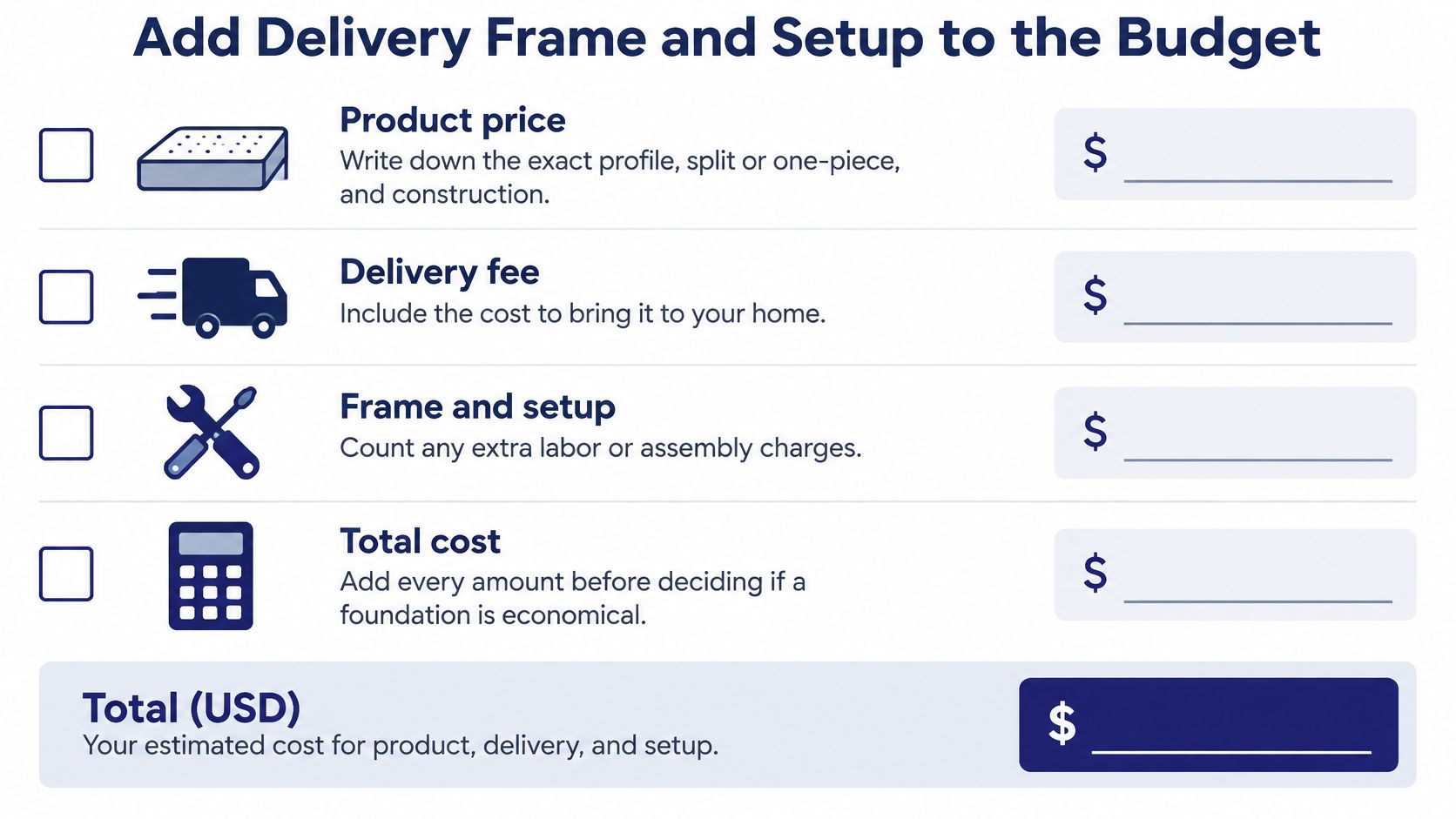
A product price is a starting point, not a finished bed. Work through this checklist on paper before you decide a foundation is the economical choice.
The worksheet below mirrors the order to use.
Seven Lines to Total Before You Decide
- Product price: Write down the price for the exact profile, split or one-piece design, and construction your mattress allows.
- Sales tax: Add tax so you're comparing totals, not shelf tags.
- Frame inclusion: Ask whether the quote includes a metal frame or only the foundation.
- Center support: Price center rails or legs if your existing frame needs them to reach the floor.
- Pickup versus delivery: Separate store pickup from delivery and in-home setup, including stairs or a long carry.
- Old foundation removal: Ask about removal if you won't reuse or dispose of the old piece yourself.
- Final fit check: Recheck the inside frame measurement and finished height with the mattress on top.
Each line answers a different failure mode. Skipping the frame question can leave a new foundation sitting on the floor. Skipping the carry question can leave it in a hallway. Skipping removal can leave you storing a bulky old base you have no way to move.
Delivery and setup pricing varies by retailer and by how far the delivery travels, so there's no single local fee to quote here. Ask each store to itemize its own charges. Itemized quotes are also easier to compare than a single bundled number, because you can see whether you're paying for distance, stairs, setup labor, or haul-away.
When the Cheaper Foundation Isn't the Cheaper Bed
Consider a hypothetical example. A lower-priced foundation looks like the clear saving until you add a new metal frame, center support hardware, delivery up a staircase, and removal of the old base. The total can pass the cost of a simpler platform setup that needed fewer separate pieces.
Now reverse it. A higher-priced foundation can be the smaller spend when your existing frame is sound, already has proper center support, and your mattress requires that specific type of rigid foundation. You aren't paying extra for a label. You're avoiding a second purchase later.
Compare complete totals for the same outcome, a stable queen bed at a comfortable height, delivered into the room where it'll be used.
That framing also helps renters. If you'll move in a year or two, a split foundation that's easier to carry may be worth more to you than a one-piece model at a lower product price, because you'll pay the moving difficulty twice. Write your own situation into the checklist rather than copying someone else's priorities.
Platform Beds and Adjustable Bases Instead
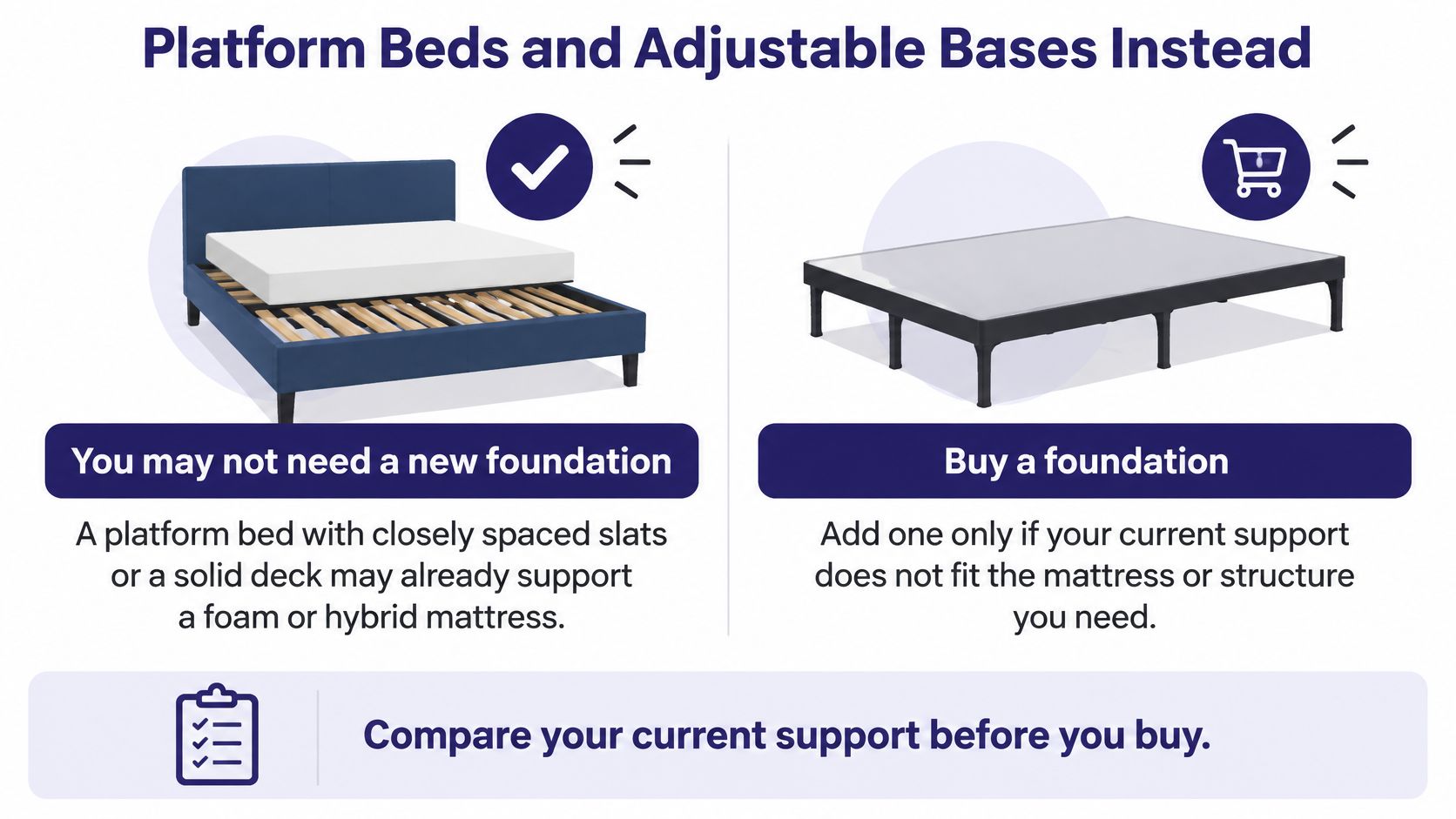
Could another base solve the problem without buying a queen box spring? A platform bed may support a mattress on its own, while an adjustable base replaces a traditional foundation with a movable surface.
Prices depend on the type and construction of the base. Metal foundations listed by Mattress Firm include premium branded models priced around $315 to $400. Wood and flat foundations have different designs and price points, so compare them separately rather than treating them as metal-foundation alternatives.
Match the Support to the Problem
A platform bed with closely spaced slats or a solid deck may already support a foam or hybrid mattress, provided the mattress maker approves the surface and slat spacing. Adding a foundation on top can raise the bed without adding needed support. Check the manufacturer's spacing requirements instead of judging the gaps by eye.
A conventional metal frame generally needs a foundation and center support legs that reach the floor. The frame rails alone do not create a sleep surface. If the frame is sound and the mattress requires a rigid foundation, that foundation may be the straightforward option.
An adjustable base is a separate alternative. It replaces the foundation, needs room to move and access to power, and costs more than a standard box spring. It suits shoppers who want to raise the head or foot of the bed, as long as their mattress is approved for adjustable use.
- Rigid foundation: A fit when the mattress requires one and the existing frame is sound.
- Platform bed: A fit when replacing the frame and base, with fewer separate pieces to manage.
- Adjustable base: A fit when you want a movable surface and your mattress allows it.
When Reusing Your Old Box Spring Makes Sense
Reuse can save money if the box spring is compatible with the new mattress, remains firm and quiet under load, and fits the frame with proper center support. Press across the surface and check for dips, broken slats, or a frame that rocks.
Memory-foam, latex, and hybrid mattresses may require a firm, flat surface or particular slat spacing. If the old box spring is flexible but the mattress calls for rigid support, it is a mismatch, not a bargain. The support type, construction, and fit determine whether reusing the base makes sense.
Confirm the Fit at a Local Sleep Center
A queen foundation's price makes more sense once you know what it must support and how it will fit your room. Bring your mattress's required support type, the inside measurements of your frame, and your target finished bed height. Those details make it easier to compare a foundation with other options on equal terms.
What to Bring and What to Ask
- Mattress brand and model: Bring the name or a photo of the law tag and warranty card.
- Frame measurements: Note the inside width and length, plus whether the frame has center support legs.
- Access limits: Measure stairs, hallways, and doorways that could affect moving in a one-piece base.
- Height target: Note your frame height and mattress thickness to estimate the finished bed height.
Ask whether each quote covers only the foundation or includes a frame. Also ask what delivery options are available and whether the quoted cost includes bringing the foundation into the room. A bulky piece may need to turn corners or go up stairs, so access details can affect the total.
Seeing foundations in person can clarify differences that are hard to judge in photos. Compare a standard profile with a low-profile model, then check how each changes the bed's finished height. Woodstock Furniture & Mattress Outlet sells furniture, mattresses, and home decor, and offers design services for shoppers planning how a new bed will fit into a room.
A store visit can also confirm that your existing setup is still suitable. If your platform already meets your mattress maker's requirements, replacing it may not be necessary. Choosing by sticker price alone can cost more if the foundation does not fit and has to be returned or delivered again.
Bring your measurements, ask for an itemized total, and choose support your mattress allows at a height that feels comfortable to use.
Visit Woodstock Furniture & Mattress Outlet to compare foundations, platforms, and mattresses in person. Staff can help you consider mattress requirements, frame measurements, and delivery options, while keeping your existing setup in the conversation if it fits. Start planning your visit to Woodstock Furniture & Mattress Outlet today.