Tag: queen bed dimensions

  • Unlock Exact Dimensions of Queen Size Bed Frame

    Unlock Exact Dimensions of Queen Size Bed Frame

    You chose a queen mattress, measured the sleeping surface, and felt like the hard part was done.

    Then you started looking at frames.

    One says queen and looks compact. Another also says queen, but the footprint looks much larger. One product page lists width and depth. Another lists inside dimensions. A third has a headboard that changes the total length. Many shoppers get stuck at this point.

    The confusion is understandable. A queen mattress size is standardized, but the dimensions of queen size bed frame can vary based on style, materials, support system, and storage features. A simple metal frame and a storage bed can both hold the same mattress while taking up very different amounts of room.

    That difference matters in real homes. It affects whether you can open your closet door fully, whether your nightstands fit without crowding the walkway, and whether your mattress sits securely inside the frame instead of shifting around.

    This guide is for the shopper who wants clear answers, not furniture jargon. If you are planning a bedroom in North Georgia, moving into a new home, or replacing an older bed that never quite fit right, the goal is simple. Help you understand the numbers, avoid common fit mistakes, and walk into a showroom with confidence.

    So You've Picked a Queen Mattress Now for the Frame

    A situation we see often goes like this. Someone has already settled on a queen mattress because it feels like the practical middle ground. It gives enough room for one person to spread out, and it can still work well for two sleepers.

    Then they start shopping for the frame and notice something frustrating. Every option says “queen,” but the outside measurements are not the same.

    A low-profile platform bed may look neat and space-conscious. A panel bed with a thicker headboard may add noticeable length. A storage bed can push farther into the room because drawers need extra structure. Suddenly, “queen” stops feeling like one size.

    Where the confusion usually starts

    Shoppers often compare two different things without realizing it:

    • Mattress dimensions are the sleep surface.
    • Frame dimensions are the full outside footprint of the bed.
    • Support system details affect whether the mattress sits flush, recessed, or slightly raised.
    • Style features such as a footboard or storage base can change how much floor space the bed uses.

    If your current room feels tight, those details matter more than the label on the tag.

    A queen frame is not just about holding a queen mattress. It also has to fit your room, your mattress profile, and the way you move around the bedroom every day.

    That is why smart bed shopping starts with the physical footprint, not just the mattress name.

    Standard Queen Bed Frame Dimensions The Official Numbers

    Start with the one measurement that does not change. A standard queen mattress measures 60 inches wide by 80 inches long, according to Purple’s queen bed frame dimensions guide.

    The frame is the part that varies. In many cases, a standard queen bed frame footprint lands around 62 to 65 inches wide and 82 to 85 inches long. Those extra inches come from the parts that surround and support the mattress.

    The numbers that matter first

    If you want a quick baseline, use this table:

    Item Standard Size
    Queen mattress 60 inches x 80 inches
    Typical queen frame footprint 62 to 65 inches x 82 to 85 inches

    That second line is usually the number shoppers need for room planning.

    A helpful way to understand it is to compare a mattress to the cushion on a sofa and the frame to the full sofa itself. The seat size tells you where you sit. The outside dimensions tell you how much space the furniture takes up in the room. Beds work the same way.

    Why the frame almost always runs larger

    A queen frame needs enough structure to support a 60 by 80 mattress safely and keep it positioned correctly. Depending on the design, the added size often comes from:

    • Side rails along the mattress edges
    • A headboard that extends past the sleep surface
    • A footboard at the end of the bed
    • Platform borders around the mattress
    • Built-in support pieces under the mattress

    Even a small difference matters in a real bedroom. An extra 3 inches on each side can affect whether you have comfortable walking space next to the bed or whether a nightstand feels squeezed in.

    What shoppers often misunderstand

    Many people hear “queen” and assume every queen bed has the same outside dimensions. The mattress size is standardized. The full bed is not.

    That is why two beds on a showroom floor can both fit a queen mattress and still occupy different amounts of floor space at home. One may sit close to the mattress dimensions, while another adds several inches in width or length because of its construction.

    The most practical way to read a product tag

    Check every queen bed with two questions in mind:

    1. Does it fit a standard 60 x 80 queen mattress?
    2. What is the full assembled footprint of the frame?

    That second question is the one that helps North Georgia shoppers avoid surprises after delivery. At Woodstock Furniture, we often remind customers to write down the outside width and length, not just the mattress size, because those are the numbers that decide how the bed will live in the room.

    Keep this baseline in mind: queen mattress equals 60 x 80. The frame usually adds a few more inches in both directions.

    How Frame Style Affects Overall Size

    Two queen beds can hold the same mattress and still look very different in a room. That is because style changes the outside footprint.

    A basic metal frame usually stays close to the mattress size. A wood platform bed adds more visual mass. A bed with a large headboard or storage drawers can claim noticeably more floor space, even though the sleep surface stays exactly the same.

    Three different styles of beds including platform, sleigh, and storage beds all featuring a standard queen size mattress.

    Minimal frames and platform beds

    If your room is on the smaller side, these are often the first styles worth considering.

    A minimal metal frame tends to keep the bed close to the standard queen footprint. Platform beds can still be compact, but they often add a visible border around the mattress. That border can make the bed look more substantial, which some shoppers like, but it also increases the total size of the frame.

    These styles often work well for people who want a cleaner look and do not need a tall footboard.

    Panel beds and beds with footboards

    Panel beds can change the room feel quickly.

    The headboard may be wide, thick, or upholstered. A footboard can make the bed look finished and furniture-like, but it also extends the footprint and changes how the room moves around the bed. In a tighter bedroom, that extra structure at the foot can make the walkway feel narrower even if the measurements still fit on paper.

    Consequently, shoppers sometimes say, “It fit in the room, but it feels bigger than I expected.”

    Storage beds and statement styles

    Storage beds solve one problem and sometimes create another. They can help with organization, especially if closet space is limited, but the base often becomes bulkier. Drawers, drawer hardware, and reinforced side panels all add presence.

    Some statement styles also project farther outward because of their shape. Curved profiles, thicker rails, and oversized headboards can make the bed dominate the room visually.

    Frame Style How It Usually Affects Size Best Fit For
    Minimal metal frame Stays closest to mattress footprint Smaller rooms, simple setups
    Platform bed Adds a border around mattress Modern bedrooms, no box spring setups
    Panel bed Adds structure at head and sometimes foot Traditional or transitional rooms
    Storage bed Adds bulk at base Rooms that need hidden storage

    The label “queen” tells you mattress compatibility. It does not tell you how much walking space you will have around the bed.

    The practical takeaway

    If you are comparing multiple beds, do not stop at the mattress size label. Compare the full outside dimensions and think about how those extra inches affect:

    • Walkways
    • Nightstand placement
    • Closet and bathroom door swings
    • Whether the foot of the bed feels open or blocked

    A frame style should fit your taste, but it also needs to fit your floor plan.

    A Quick Guide to Queen Size Variations

    A queen mattress label can sound simple until you are trying to match an older frame, outfit an RV, or replace bedding for a guest room. That is where shoppers get tripped up. "Queen" is a family of sizes, not always one exact footprint.

    The practical question is this. Do you have a standard queen, or a specialty queen that needs its own frame and accessories?

    Infographic

    Queen Bed Size Variations At a Glance

    | Queen Type | Mattress Dimensions (Width x Length) | Best For |
    |—|—|
    | Standard Queen | 60 inches x 80 inches | Most bedrooms and most shoppers |
    | Olympic Queen | 66 inches x 80 inches | Couples who want more width |
    | California Queen | 60 inches x 84 inches | Taller sleepers who want more length |
    | Short Queen | 60 inches x 53 inches | RV and compact specialty spaces |

    Standard queen

    Standard queen is the version most North Georgia shoppers mean when they say "queen bed." It is the easiest size to shop for because frame choices, sheet sets, and bedroom displays are usually built around it.

    If you want the smoothest buying process, this is usually the least complicated option.

    Olympic queen

    An Olympic queen measures 66 inches by 80 inches. Those extra 6 inches of width can make a real difference for couples who feel crowded on a standard queen, much like choosing a slightly wider sofa gives each person a little more elbow room.

    The tradeoff is availability. Olympic queen products are harder to find, so frame options, protectors, and sheet sets may require more planning instead of a same-day purchase.

    California queen and short queen

    A California queen measures 60 inches by 84 inches. It keeps the standard queen width but adds length, which can help taller sleepers avoid that feet-near-the-edge feeling.

    A short queen goes the other direction. It trims length for compact spaces and is often used in RVs or specialty setups. That makes it useful in the right setting, but it also means standard queen frames and bedding may not work.

    For a room that needs to do more than one job, such as a guest room that also serves as an office or den, flexible alternatives can be worth a look. Options like queen size futon frames can make sense when floor space has to work harder.

    Before you buy a frame, check the mattress tag or measure the mattress yourself. A few inches in width or length can turn a simple setup into a frustrating return.

    Mattress Size vs Frame Size Ensuring a Perfect Fit

    Buying a queen frame without checking the inside dimensions is a lot like buying a parking space by the label alone. "Standard" gets you close, but the final fit depends on the actual opening, the support system, and the shape of the mattress itself.

    A mattress and frame should work together with just enough tolerance. Too much extra room, and the mattress can slide or leave visible gaps at the sides. Too little room, and you can end up wrestling the mattress into place, pressing the corners against the rails, or creating side pressure that makes the bed look crooked.

    Height matters too.

    A queen mattress may match the frame in width and length but still feel wrong once it is set up. A thick pillow-top mattress can sit lower inside a frame with deep side rails. A thinner foam mattress on a shallow platform can appear more exposed and may feel different when you sit on the edge. Max and Lily notes that queen frames are commonly built for mattresses in the 8 to 14 inch range, and that a modest frame lip can help contain hybrid and pillow-top models inside the frame opening (Max and Lily’s guide to queen bed dimensions).

    This is one of the most common points of confusion we hear in-store at Woodstock Furniture. Shoppers often measure the mattress and stop there, but the smarter check is to measure three things: the mattress, the frame's inside opening, and the height from the floor to the top of the sleep surface once everything is assembled.

    A simple fit checklist

    Use this checklist before you commit:

    • Confirm the mattress type. Check that it is a standard queen and not an Olympic, California, or short queen.
    • Measure the mattress itself. Tags help, but a quick tape measure check can catch surprises.
    • Ask for the frame's inside dimensions. The outer size of the headboard or rails does not tell you how tightly the mattress will fit.
    • Check how the mattress is supported. Some frames hold the mattress down inside side rails. Others support it on top of slats or a platform.
    • Look at edge containment. A small lip can help keep the mattress from shifting, especially with slick mattress covers.
    • Test the finished bed height. That affects how easy the bed is to get into, how nightstands line up, and how the room will feel day to day.

    A good fit should look clean, feel stable, and support the mattress the way the manufacturer intended. That is the difference between a bed that merely fits on paper and one that works well in a real North Georgia bedroom.

    How to Measure Your Room for a Queen Bed Frame

    You get the queen bed home, set the frame in place, and suddenly the closet door clips the corner, the nightstand has nowhere to go, and making the bed feels like squeezing past a parked SUV in a one-car garage. That is why room measuring needs to cover daily use, not just whether the bed can physically fit inside four walls.

    Start with the room’s full length and width. Then measure the parts that affect how you live in the space: door swing, closet access, window placement, floor vents, and any trim or low sills that limit where a headboard can sit.

    An illustration showing three steps for bedroom planning: measuring walls, marking door and window openings, and bed placement.

    Start with a simple sketch

    A hand-drawn rectangle on paper works fine. Write in each wall measurement first, then add the fixed features:

    • Bedroom door and door swing
    • Closet doors
    • Bathroom door if it opens into the room
    • Windows
    • Floor vents
    • Baseboards, trim, or low windows that affect bed placement

    This sketch becomes your roadmap in the store. At Woodstock Furniture, it often helps North Georgia shoppers narrow down frame styles faster because they can compare a tall wingback headboard, a storage bed, and a simpler platform frame against the same room drawing.

    Measure for clearance, not only footprint

    The frame’s outside dimensions matter, but the open space around it matters just as much. A queen bed works like the refrigerator in a kitchen. The appliance may fit the wall, but if the door cannot open fully, the setup does not work well.

    Check these zones carefully:

    1. The walking path on each side you will use
    2. Space for one or two nightstands
    3. Clearance for dresser or chest drawers
    4. Door swing into the bedroom or closet
    5. Room at the foot of the bed so it does not feel blocked

    If your bedroom is on the smaller side, these clever UK design tricks for making small rooms look bigger can also help you think through visual openness after you confirm the bed will fit physically.

    Here is a quick visual if you want a simple room-planning walk-through:

    Use painter’s tape to test the true footprint

    Painter’s tape is one of the best planning tools you can use at home.

    Tape out the full outside dimensions of the frame, not the mattress size. Include extra depth for a headboard with shelves or a footboard that sticks out farther than expected. Then walk the room as if the bed is already there. Open the closet. Step around the taped corners. Stand where your nightstand would sit and check whether a drawer or cabinet door still has room to open.

    If the taped layout already feels tight, the finished room will feel tighter once bedding, pillows, and other furniture are in place.

    A practical measuring habit that prevents mistakes

    Bring three numbers with you when you shop:

    • Room size
    • Doorway width for delivery
    • Maximum bed footprint that still leaves comfortable walking space

    That last number is the one people skip. It is also the one that prevents regrets. A queen frame can fit your mattress and still be too bulky for your room if the headboard, side rails, or storage drawers add more size than you expected.

    Planning Your Bedroom Layout Around a Queen Bed

    Once you know the frame footprint, the next question is placement. At this point, the dimensions of a queen size bed frame become tangible. A bed is not a number on a spec sheet anymore. It is the largest piece in the room, and everything else has to work around it.

    Three different interior design floor plans illustrating various ways to arrange a queen size bed in a bedroom.

    In a tighter bedroom

    In a more compact room, centering the bed on the main wall often creates the cleanest layout. It gives the room a natural focal point and usually leaves the best chance for balanced nightstands.

    If the room has multiple doors or an offset closet, you may need to break symmetry and use one smaller nightstand or skip one entirely. That is not bad design. It is often the right tradeoff for better movement.

    In a more open room

    A room with more breathing room gives you flexibility. You might center the bed and still have space for matching nightstands and a dresser. You may also have enough room to choose a frame with a more substantial headboard or footboard without making the room feel cramped.

    Here, style and function can work together more easily.

    Common layout decisions that help

    Layout Choice Why It Helps
    Centering the bed on the main wall Creates visual balance
    Keeping the foot of the bed open Improves flow when entering the room
    Using smaller nightstands Preserves side clearance
    Avoiding bulky footboards in tight rooms Reduces visual and physical crowding

    If you are trying to make a small bedroom feel lighter and more open, some of the visual principles in these clever UK design tricks for making small rooms look bigger can be useful alongside your furniture planning.

    A successful layout is not just about what fits. It is about whether the room feels calm, usable, and easy to move through every day.

    A final tip from the showroom side of things. Bring photos of the room from the doorway and from each corner. Those images often reveal layout conflicts faster than measurements alone.

    Frame Compatibility with Box Springs Slats and Adjustable Bases

    A queen frame only works well if the support underneath matches the mattress and the frame design. This is the point where many shoppers get tripped up. The mattress is queen size, the frame is queen size, but the support system still does not line up.

    A simple way to look at it is this: the mattress is the top layer, and the frame and support below it are the structure holding everything steady. If one layer is wrong, the whole bed can feel too high, too low, too flexible, or not properly supported.

    Box springs and foundations

    Some queen bed frames are built for a box spring or foundation. In that setup, the frame holds the foundation, and the foundation holds the mattress.

    This is common with more traditional bed styles. It can also help if you want a taller bed height for easier sitting and standing. But if you place a foundation on a frame that already has enough built-in support, the bed can end up taller than expected. In a showroom, that extra height may seem fine. At home, it can make the headboard look short and the bed feel oversized for the room.

    Slatted support

    Other queen frames support the mattress with slats. Platform beds often work this way.

    Slats act like the crosspieces in a shelf. They spread weight across the frame so the mattress does not sag between open spaces. The detail that matters is not just whether slats are included, but whether they are spaced appropriately for your mattress type and whether the frame has a center support for a queen. Foam and hybrid mattresses, in particular, usually need steady, even support.

    If you already own a box spring or foundation, ask whether you should keep using it. With many slatted frames, adding one is unnecessary and can throw off the final bed height.

    Adjustable bases

    Adjustable bases need more careful checking. A decorative queen bed may fit around one nicely, or it may conflict with it.

    The key question is whether the bed frame is mostly decorative on the outside, with enough interior clearance for the adjustable base to sit inside, or whether the frame’s own slats, platform, drawers, or center structure block that setup. Storage beds are a common place where shoppers need to pause and ask more questions. A frame can look like a standard queen bed from the front and still have a base design that does not work with adjustability.

    This matters in real bedrooms, not just on paper. North Georgia shoppers often come into Woodstock Furniture with an existing mattress or base they want to keep, and that is smart. Compatibility is easier to confirm before delivery than after the bed is in the room.

    What to ask before you buy

    • Does this frame need a box spring, foundation, or nothing extra?
    • Are the slats included, and are they suitable for my mattress type?
    • Does the queen frame have center support?
    • Will my adjustable base fit inside this bed, or under it?
    • Do any slats or support rails need to be removed for adjustable-base use?
    • What will the final bed height be with my mattress setup?

    A good-looking frame is only part of the job. The full setup should work together in a way that supports the mattress correctly, fits your room, and feels right every night.

    Your In-Store Shopping and Measurement Checklist

    The easiest way to shop confidently is to walk in with the right information. Not a vague estimate. Actual notes.

    You do not need a complicated spreadsheet. A simple checklist on your phone works fine.

    Bring these measurements with you

    • Room dimensions. Wall-to-wall length and width.
    • Target bed wall. Note where you want the headboard to go.
    • Doorway width. Bedroom doors, entry doors, and any tight interior turns.
    • Stair or hallway notes. Especially if you are moving the bed upstairs.
    • Existing furniture sizes. Nightstands, dressers, benches, or chests that will stay in the room.

    Bring these photos too

    • The full room from the doorway
    • Each corner of the bedroom
    • Closet and bathroom door locations
    • Any windows or low trim on the bed wall

    Photos often catch issues that numbers alone miss.

    Ask these questions in the store

    • Will this frame fit a standard queen mattress securely?
    • Is this style better with or without a box spring?
    • Will this frame work with an adjustable base?
    • How high will the bed sit with my mattress profile?
    • Does the footboard or storage base affect clearance in a smaller room?

    The best shopping tool is not a sales pitch. It is a short list of your real measurements, real constraints, and real priorities.

    That turns bed shopping into a planning decision instead of a guessing game.

    Common Queen Bed Frame Questions Answered

    Can I use a queen mattress on a full size frame

    No. A queen mattress is wider and longer than a full-size setup is designed for, so it will not sit safely or correctly.

    Do all queen headboards fit all queen frames

    Not always. “Queen” helps, but hardware patterns, rail connections, and attachment systems can differ by manufacturer and design. Always confirm compatibility before assuming parts will mix.

    Does every queen frame need a box spring

    No. Some do, some do not. Platform and slatted designs often support the mattress directly, while other frames expect a foundation or box spring.

    Why does one queen bed look much larger than another

    Because the mattress size is standardized, but the outer frame dimensions change with the style. Headboards, footboards, thicker rails, and storage bases all affect the full footprint.

    Is a queen a good choice for a smaller primary bedroom

    Often, yes. It is the middle ground that gives usable sleeping space without taking over the room the way a larger bed can.

    What should I bring before shopping for a frame

    Bring room measurements, doorway measurements, photos of the room, and the details of your mattress type and height. That makes it much easier to judge fit and compatibility accurately.


    If you want help comparing frame footprints, checking mattress compatibility, or thinking through a real bedroom layout, visit Woodstock Furniture & Mattress Outlet. A knowledgeable team can help you look at the measurements, the room constraints, and the support system together so you can choose a queen bed setup that fits your space with confidence.
  • What Is the Width of a Queen Bed? A Complete Guide

    What Is the Width of a Queen Bed? A Complete Guide

    If you're trying to figure out the width of a queen bed, the simple answer is 60 inches. This has become a very popular mattress size across the country, and for good reason. It’s a comfortable upgrade from a full bed without taking up the massive footprint of a king.

    The Official Width of a Queen Bed

    A standard queen mattress measures 60 inches wide by 80 inches long. These dimensions became more common after World War II as homes grew larger and people sought more room to stretch out. Today, it’s a leading choice, making up a significant portion of mattress sales in North America. If you're curious about the history, you can learn more about how mattress standards have evolved over time.

    To really get a feel for what that 60-inch width means, it helps to see how it stacks up against other common sizes you might have slept on.

    How Queen Width Compares to Other Sizes

    Moving up from a full-size bed (sometimes called a double) to a queen gets you an extra six inches of width. That might not seem like a huge number on paper, but it can make a real difference in sleep quality—especially for couples. Those extra inches mean more personal space and can reduce accidental wake-up calls from a partner who likes to toss and turn.

    For couples, a queen mattress provides 30 inches of personal space for each person. Many people find this is a comfortable amount of space for two adults to sleep without feeling like they're on top of each other. It's a noticeable upgrade from the 27 inches per person a full bed offers.

    Sometimes it helps to have a quick reference when you're trying to visualize these differences.

    Standard Mattress Widths at a Glance

    Mattress Size Standard Width (Inches) Width Per Person (For Couples)
    Full 54 inches 27 inches
    Queen 60 inches 30 inches
    King 76 inches 38 inches

    As you can see, the queen occupies a middle ground between the cozier full and the expansive king.

    This chart below gives you a clear visual of how these mattress widths compare side-by-side.

    Bar chart comparing full, queen, and king mattress widths in inches. Full and queen are 80 inches, king is 60 inches.

    It’s understandable why the queen has become a frequent choice for master bedrooms. It offers ample room for most single sleepers and couples, all while fitting comfortably into many average-sized rooms.

    Why 60 Inches Became a Popular Choice for Sleep

    The queen bed didn’t become a leading mattress size by chance. It effectively solved a common problem that couples had experienced for years: the "double" or full-size bed often felt too small.

    While a full bed was a step up from a twin, it only gave each person 27 inches of space. To put that in perspective, that’s about the same width as a baby’s crib. For many couples, this was a recipe for a restless night filled with tossing, turning, and bumping into a partner.

    Comparison of Full (54 in), Queen (60 in), and King (76 in) bed widths, with a person for scale.

    A Balance of Comfort and Space

    This is where the queen bed’s 60-inch width provides a solution. Those extra six inches compared to a full bed were a significant change. Suddenly, each partner had a more comfortable 30 inches of personal space, which helped cut down on nighttime disturbances and led to better sleep for many. It’s no wonder this specific width is a main reason for the queen's popularity.

    Over the decades, the queen bed's market share has grown, now accounting for a majority of mattress sales. This is largely driven by couples, as studies suggest that a queen can improve sleep satisfaction and reduce disruptions from a bed-sharing partner. You can explore the full data and research on how bed size impacts sleep quality.

    This trend also went hand-in-hand with changes in home construction. As master bedrooms in new homes started getting bigger in the second half of the 20th century, people had room for something larger than a full-size bed without making the space feel cramped.

    The queen mattress offered a practical compromise: more personal space than a full, but without the room-dominating footprint of a 76-inch king. It became a go-to choice for millions of American homes.

    The “Just Right” Solution for Modern Bedrooms

    Ultimately, the 60-inch width became an industry standard because it’s a practical solution for a wide range of sleepers and homes. It’s a versatile size that works well in many situations.

    Consider its uses. A queen is suitable for:

    • Couples who need enough personal space to sleep without waking each other up.
    • Single sleepers who enjoy having plenty of room to stretch out.
    • Guest rooms, providing a comfortable stay for either single guests or couples.
    • Most master bedrooms, because it fits comfortably without overwhelming the layout.

    This combination of comfort, practicality, and versatile sizing is why the 60-inch queen bed is more than just a mattress—it's the foundation of a good night's sleep in many homes today.

    Understanding Variations of the Queen Size

    While the standard queen mattress is a solid 60 inches wide, it’s not the only queen size available. The mattress world has a couple of specialized variations built to solve specific problems. Think of these not as replacements for the standard queen, but as custom solutions for sleepers who need a bit more room in one direction or another.

    Knowing about these less-common sizes can help you make a more informed decision and avoid the frustration of buying a bed that almost works. They offer some unique benefits, but they also have a few practical trade-offs you should know about before making a choice.

    Olympic Queen

    The Olympic Queen, sometimes called an Expanded Queen, is the most common queen variation you're likely to find. It addresses the desire for a little more elbow room.

    • Dimensions: An Olympic Queen mattress measures 66 inches wide by 80 inches long.
    • Best For: This can be a great option for couples who feel just a tad cramped in a standard queen. Those extra six inches of width give each sleeper three more inches of personal space, which can make a real difference if one or both of you tend to toss and turn.

    It’s a middle ground for folks who don’t quite have the floor space for a king but still crave more room to themselves.

    The biggest hurdle with an Olympic Queen is finding accessories that fit. Since it's a non-standard size, you'll have a more difficult time finding bed frames, sheets, and mattress protectors designed for its unique 66-inch width.

    California Queen

    Another specialty size you might see is the California Queen. Unlike its Olympic cousin, this one isn’t about adding width; it’s all about adding length for taller sleepers.

    • Dimensions: A California Queen mattress comes in at 60 inches wide by 84 inches long.
    • Best For: This bed was made for anyone over six feet tall who is tired of their feet dangling off the edge of a typical 80-inch mattress. It gives you the same four inches of extra legroom you'd find in a California King, but keeps the more manageable 60-inch width of a standard queen.

    Ultimately, variations like the Olympic and California Queen serve a specific slice of the market. While these specialty sizes have their place, the 60×80-inch standard queen remains the most practical choice for the vast majority of bedrooms. It simply fits better in most rooms and is a top seller for a reason. If you're curious about the market dynamics, you can learn more about how different bed sizes compare in sales and bedroom fit.

    How to Know if a Queen Bed Will Fit Your Room

    Knowing a queen mattress is 60 inches wide is one thing, but making sure it actually fits and feels right in your bedroom is another. It's a common experience where a bed can technically squeeze into a space but leave the room feeling cramped and unusable.

    The secret isn't just about fitting the bed itself. The real key is to plan for comfortable movement around the bed.

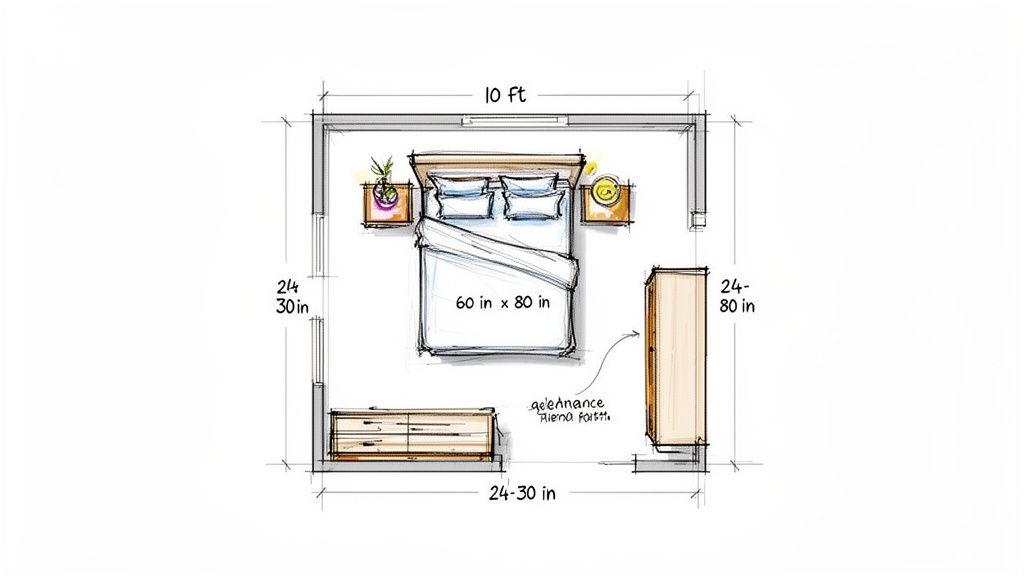
    A good rule of thumb is to leave at least 24 to 30 inches of walking space on the three open sides of the bed (the left, right, and foot). This clearance gives you enough room to walk without turning sideways, make the bed without scraping your knuckles, and fully open dresser drawers or closet doors without them bumping into the frame.

    For a queen bed, this means your room should ideally be at least 10 feet by 10 feet. This size gives you just enough space for the 60-inch-wide bed, two average nightstands (around 20-24 inches each), and still keeps that critical walking path clear.

    While a 10×10 room is a great starting point, many people find a slightly larger space, like 12 feet by 12 feet, to be ideal. That little bit of extra square footage offers more breathing room and flexibility for other furniture, like a dresser, a bench at the foot of the bed, or a cozy reading chair.

    Measure Your Room Like a Pro

    Before you decide on a new bed set, it's time to grab a tape measure and get the true lay of the land. And don't just measure from wall to wall; you need to map out all the real-world obstacles that can affect your layout plans.

    Here’s a simple checklist our experienced team recommends:

    • Measure Wall to Wall: First, get the total length and width of the room. This gives you your maximum canvas to work with.
    • Map Out Obstacles: Take note of where your windows (especially low ones), radiators, air vents, and electrical outlets are. You don’t want your headboard blocking your only usable outlet or sitting awkwardly in front of a window.
    • Check Door Swings: This is a big one people forget! Measure how far your bedroom and closet doors swing into the room. A new bed won't feel so great if it keeps a door from opening all the way.
    • Account for Other Furniture: Finally, measure the depth and width of your existing dressers, nightstands, and any other pieces you plan on keeping in the room.

    Once you have these numbers jotted down, you can sketch out a quick floor plan. For a helpful visual, use painter's tape to mark out the 60-inch by 80-inch footprint of a queen mattress right on your floor. This simple trick lets you see and feel exactly how much space the bed will take up and how your walking paths will be affected. This small step can save you from the headache of buying a bed that’s just too big for your space.

    Accounting for Your Bed Frame's Total Width

    A detailed floor plan showing a queen-size bed, nightstands, and furniture layout in a bedroom with dimensions and recommended clearances.

    It’s one of the most common things shoppers can overlook. They focus so much on the mattress itself that they forget a bed is more than just a mattress. While a standard queen mattress has a firm width of 60 inches, the bed frame you put it on can add anywhere from a couple of inches to a foot or more to the bed's total footprint.

    This is a critical detail, because it directly impacts how the bed will actually fit in your room. If you only plan for the mattress, you might end up with a bed that overwhelms your space, blocks walkways, or even keeps you from opening your dresser drawers. The style of the frame is the single biggest factor here.

    How Frame Style Impacts Total Bed Width

    Different bed frame designs have widely different profiles. For instance, a sleek, modern platform bed is built for minimalism and might only add 2 to 3 inches to the total width. These are good choices for smaller bedrooms where every inch of floor space is precious.

    On the flip side, a substantial sleigh bed with wide, curved side rails or a bed with a bulky, decorative headboard could easily add 8 to 12 inches — or even more! These are beautiful statement pieces, but they demand a more spacious room to avoid feeling cramped.

    Always check the product specifications for the bed frame's exact dimensions, not just the mattress size it’s made for. This ensures you're planning your room layout with the bed's true, fully-assembled footprint in mind.

    To give you a better idea of what we mean, here’s a quick look at how different frame styles can change the final width of your new queen bed.

    Estimated Total Bed Width by Frame Style

    The table below breaks down some common bed frame styles and how much width they typically add to a standard 60-inch queen mattress.

    Bed Frame Style Estimated Added Width (Inches) Total Estimated Bed Width (Inches)
    Metal Frame 1 to 2 inches 61 to 62 inches
    Platform Bed 2 to 4 inches 62 to 64 inches
    Upholstered Bed 4 to 8 inches 64 to 68 inches
    Sleigh Bed 8 to 12+ inches 68 to 72+ inches

    While these numbers are a helpful guide, seeing these options in person can help you understand their scale. Visiting a showroom lets you compare how a simple platform frame feels in a space versus a more commanding sleigh bed. This hands-on experience can help you confidently choose a style that complements your room's layout without overpowering it.

    Choosing the Right Bedding for a 60-Inch Bed

    Three illustrations compare the width of a 60-inch mattress, a platform bed adding 2-3 inches, and a sleigh bed adding 10 inches.

    You’ve picked out the perfect queen bed and frame. Now for the fun part — dressing it up! Since the standard queen mattress’s 60-inch width is the most popular size in the country, finding bedding is usually a breeze. Sheets, comforters, and duvets labeled "queen" are all made to fit that classic 60×80 inch mattress surface.

    Most of the time, that is. While standard queen bedding works great for most people, there are a couple of common situations where you might need to think about a different approach. A few simple adjustments can make a real difference between a bed that just looks good and one that gives you a truly comfortable night’s sleep.

    Practical Tips for a Polished Look

    Ever found yourself in a nightly tug-of-war over the blankets? It's one of the most common complaints we hear from couples. If you or your partner tend to pull the covers, or if you have a pillow-top or extra-deep mattress (anything over 14 inches tall), here's a helpful tip: consider sizing up to a king-sized comforter or duvet.

    That extra fabric provides more overhang on both sides of the bed, ending the midnight cover-stealing and keeping everyone cozy. For more on getting the dimensions just right, it can be helpful to check out a guide on what size is a queen flat sheet.

    Just remember that while a bigger blanket is a great fix, you must stick with a queen fitted sheet. A king fitted sheet will be far too big for a 60-inch mattress, leaving you with a bunched-up, uncomfortable mess.

    Finally, let’s talk pillows. The 60-inch width of a queen bed is the ideal canvas for two standard or queen-sized pillows. They’ll sit perfectly side-by-side without looking cramped or leaving a large gap in the middle. This simple setup creates a sleep space that’s as inviting and comfortable as it is visually pleasing. With these little tricks up your sleeve, your new bed will be well-outfitted for years of great sleep.

    Got a Few More Questions About Queen Bed Width?

    We've covered the main specs, but you probably still have a few "what if" questions. That's completely normal. When you're making a decision like buying a new bed, the details matter. Our knowledgeable staff gets these kinds of questions all the time, so let's clear up a few of the most common ones.

    Is a Double Bed the Same Width as a Queen Bed?

    No, they are two different sizes. A "double bed" is just another name for a full-size mattress, which comes in at 54 inches wide. A standard queen, on the other hand, is 60 inches wide.

    Those extra six inches can make a significant difference, especially for couples. That bit of extra elbow room means less bumping into your partner and can lead to a more restful night's sleep.

    Can I Use Queen Sheets on a Full Mattress?

    You might be tempted to make it work, but we would advise against it—at least for the fitted sheet. While you could probably get away with using a queen flat sheet or comforter on a full bed, the fitted sheet is another story.

    A queen fitted sheet is built for a 60 x 80-inch mattress. Trying to put it on a 54 x 75-inch full mattress will leave you with loose, baggy fabric that's likely to slip off the corners. For that snug, crisp feeling, you should always match your bedding to your exact mattress size.

    Speaking of bedding, figuring out the right blanket or comforter size is key to getting that perfectly draped look. For a detailed guide on exactly what size blanket for a queen bed, this is a helpful resource to check out.

    How Wide Does My Doorway Need to Be for a Queen Mattress?

    Here's some good news. Most modern queen mattresses are flexible and can be squeezed, angled, or gently bent to get through standard doorways, which are usually about 30 to 32 inches wide. The real challenge often isn't the doorway itself, but navigating tight hallways, sharp corners, and tricky stairwells.

    If you're worried about getting a solid, rigid box spring through a difficult delivery path, a split queen box spring is an excellent solution. It’s delivered in two smaller, more manageable pieces, making it much easier to get into just about any room.

    Is the Queen Bed Width the Same in Other Countries?

    Not always, and this is a great question if you're shopping for international brands. While the standard queen in the US is 60 inches wide (or about 152 cm), the sizes and names can vary once you go abroad.

    • United Kingdom: What they call a "King" is 150 cm wide, which is almost identical to a US Queen.
    • Australia: An Aussie "Queen" is also 152 cm wide, matching the US standard perfectly.

    Because of these regional quirks, it’s always a smart move to double-check the exact measurements in both inches and centimeters before buying a bed frame or bedding from an overseas company. It saves a lot of headaches and ensures a proper fit.


    At Woodstock Furniture & Mattress Outlet, our team is passionate about this stuff. We're here to answer your questions and help guide you to the right sleep setup for your home. Come visit one of our North Georgia locations to see our great selection of mattresses and bed frames for yourself. You can find us online at https://woodstockoutlet.com.

  • How Big is a Queen Size Bed? A Guide to Dimensions and Room Fit

    How Big is a Queen Size Bed? A Guide to Dimensions and Room Fit

    If you're wondering, "how big is a queen size bed?", the standard queen mattress measures 60 inches wide by 80 inches long. It’s the most popular mattress size in the United States, offering a good balance between spacious comfort and a manageable footprint that fits well in most bedrooms.

    The Standard Queen Bed Dimensions Explained

    Understanding the exact measurements of a queen bed is the first step in making sure it’s the right fit for your room and your lifestyle. For couples, singles who enjoy spreading out, or guest rooms, the queen has become a go-to choice because it offers ample space without making smaller rooms feel cramped.

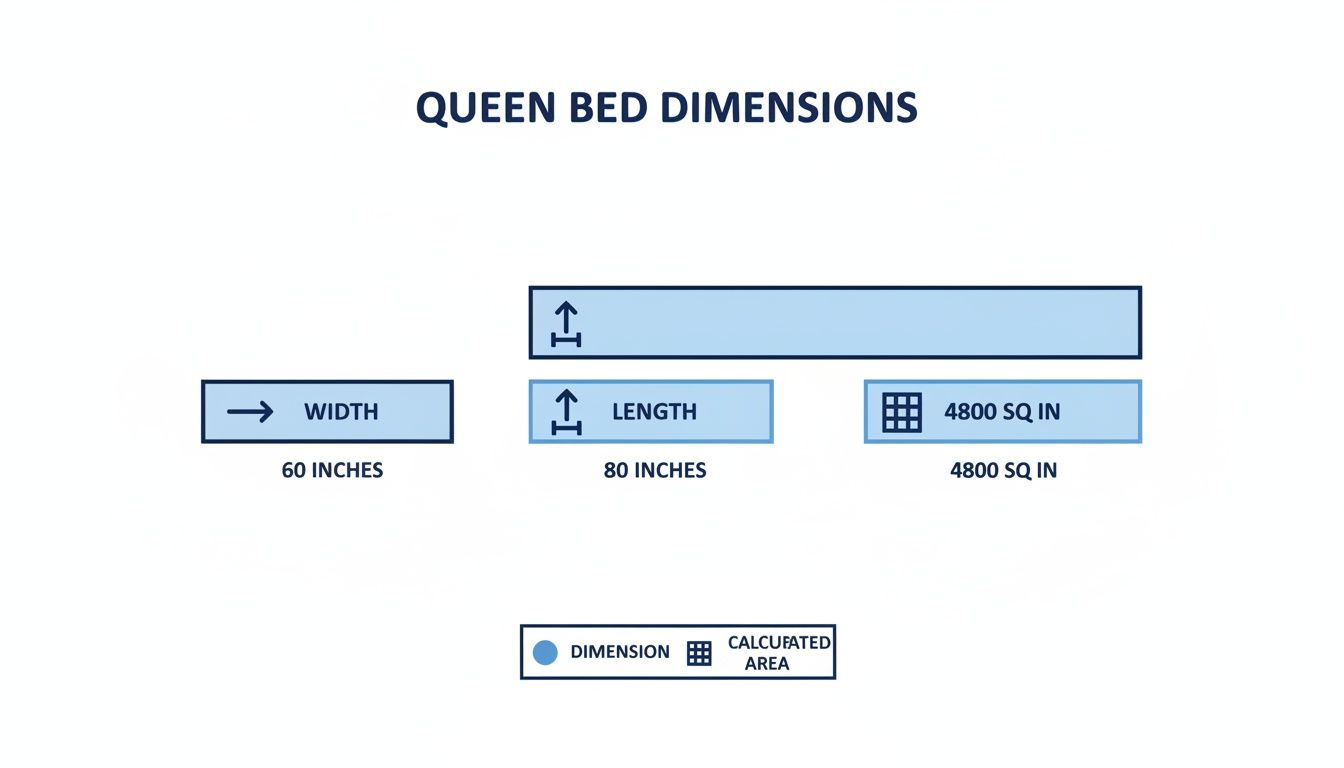
    Introduced in the 1950s, the queen bed offered a welcome upgrade from the full size bed, which was the standard at the time. A queen mattress has a total surface area of 4,800 square inches. For couples, that provides about 30 inches of personal space for each person — a noticeable improvement over the 27 inches per person available on a full mattress.

    For those who need to see the numbers laid out, here's a quick reference table to make your bedroom planning a bit easier.

    Queen Bed Dimensions at a Glance

    This table breaks down the standard queen bed dimensions in both inches and centimeters, providing a clear reference for your planning.

    Measurement Inches Centimeters Total Surface Area
    Width 60 in. 152 cm
    Length 80 in. 203 cm
    Surface Area 4,800 sq. in. (3.09 sq. m.)

    With these exact numbers in hand, you can start measuring your space and determining how a new queen bed will fit with your other bedroom furniture.

    Comparing the Queen Bed to Other Mattress Sizes

    Knowing the exact dimensions of a queen bed is a great start, but those numbers can feel a bit abstract. To get a better feel for its scale, it helps to see how it compares to other common mattress sizes. This isn't about finding a "winner," but about helping you visualize the real-world trade-offs in space and comfort.

    This quick visual gives a clear breakdown of a standard queen bed’s width, length, and total sleeping surface.

    Infographic detailing queen bed dimensions, showing 60 inches width, 80 inches length, and 4800 square inches.

    Seeing the 60-inch width and 80-inch length helps put its 4,800 square inches of sleeping surface into perspective.

    Queen vs Full Bed

    One of the most common decisions shoppers face is choosing between a queen and a full size bed. A full mattress, also known as a double, measures 54 inches wide by 75 inches long. While a six-inch difference in width and five-inch difference in length might not sound like much, that extra space can be significant in practice.

    A full bed can feel comfortable for a single sleeper. For couples, however, those missing inches mean each person only gets 27 inches of personal space, which is the same width as a crib mattress. The queen’s slightly wider frame gives each person 30 inches, which can contribute to a more comfortable night's sleep without bumping elbows.

    A queen bed is 6 inches wider and 5 inches longer than a full bed. This extra space makes a considerable difference for couples or taller individuals seeking more room to stretch out without feeling cramped.

    Queen vs King Bed

    Going up in size, a standard king bed measures 76 inches wide by 80 inches long. It offers the same length as a queen but provides an additional 16 inches of width.

    A king is a suitable choice for couples who value personal space, often share their bed with children or pets, or simply prefer a more luxurious, sprawling feel. Each person gets 38 inches of width—the same as a twin mattress. The main trade-off is bedroom real estate. Choosing a king often means sacrificing floor space that could be used for a dresser, a chair, or walking room.

    Why the Queen Bed Became a Household Staple

    Have you ever wondered why the queen bed is so common in homes across America? The story behind it reflects major changes in how we live. Before the 1950s, the much smaller full bed was the primary choice for couples — a size that can feel quite snug by today’s standards.

    This began to change after World War II as American homes started getting larger. With more space available, people began to place a higher value on personal comfort and a good night's sleep. The queen bed emerged as an ideal solution, offering a significant upgrade in sleeping room without needing the massive footprint of a king mattress. It filled a gap in the market, giving couples more breathing room.

    A Shift in American Lifestyles

    This move toward more spacious living is a huge piece of the puzzle. It wasn't just about the dimensions; it was about the idea of a more comfortable life. Mattress marketers in the 1950s and 60s tapped into this by using regal names like "queen" and "king" to associate these larger beds with luxury and status.

    This marketing approach was effective. By 1999, the once-dominant full size bed saw its popularity decline, while the queen bed became the new standard for couples. Today, it remains the top-selling mattress size, making up a large portion of all mattress sales in North America. It’s a testament to its blend of comfort and practicality. You can get more information on the history of mattress sizes at The Bedding Mart.

    The queen bed solved a real problem for millions of people: it offered a more comfortable sleep experience for two without requiring an oversized master bedroom. Its rise in popularity mirrors the country's growing focus on personal wellness and comfort at home.

    Ultimately, understanding how big a queen size bed is goes beyond just its measurements. It’s about recognizing its role as a practical, comfortable centerpiece that fits the way many people live today.

    Planning Your Room Layout Around a Queen Bed

    Knowing the measurements of a queen bed is a good start, but the real test comes when you place it within your bedroom. A bed’s dimensions on paper can feel very different once it’s actually in the room. Thoughtful planning can help create a space that feels open and functional.

    Bedroom layout sketch with queen size bed, nightstands, dresser, wardrobe, and dimensions.

    Before committing to a bed frame or bedroom set, it’s always a good idea to use a tape measure. Once you have your queen bed’s dimensions, the next step is to figure out how to arrange your bedroom furniture for a space that feels both balanced and functional. This planning stage can help you avoid the common issue of buying furniture that is too large for your home.

    The Minimum Room Size for a Queen Bed

    So, how big of a room do you need? While every layout is different, a general guideline is that a queen bed fits most comfortably in a room that's at least 10 feet by 10 feet. This size provides enough space for the bed while leaving room for other essential pieces and for you to move around.

    For a room to feel comfortable, you need clear pathways. It is recommended to leave at least 24 to 30 inches of open space on two or three sides of the bed. This clearance allows you to walk around without difficulty, make the bed, and access your closet or dresser.

    Leaving at least two feet of clearance around your bed is more than just a design tip—it's a practical necessity. This space ensures you can navigate your room comfortably and prevents the layout from feeling crowded and stressful.

    Arranging Furniture for a Balanced Feel

    Smart furniture placement is key to a well-balanced bedroom. Placing the queen bed against the longest, uninterrupted wall usually creates a natural focal point and makes the entire room feel more spacious. This placement typically leaves enough room on either side for nightstands.

    When you start adding in other pieces, think about their function and footprint:

    • Nightstands: Try to find nightstands that are about the same height as the top of your mattress. This makes them easier and more comfortable to reach from bed.
    • Dressers: If you have the space, place your dresser on the wall opposite the bed. Be sure to account for the clearance needed to fully open all its drawers.
    • Walkways: Before you finalize the layout, do one last check. Is your main path—from the door to the bed and over to the closet—clear and easy to walk?

    By thinking through these layout details ahead of time, you can ensure your new queen bed not only fits but also enhances your bedroom’s overall comfort and style.

    Exploring Queen Bed Variations You Should Know

    While the standard 60-inch by 80-inch queen is the most common mattress size, it's not the only option. A few less-common variations were created to solve specific problems, such as needing more width or preventing feet from hanging off the end. Knowing about these alternatives can help you find the right mattress for your home.

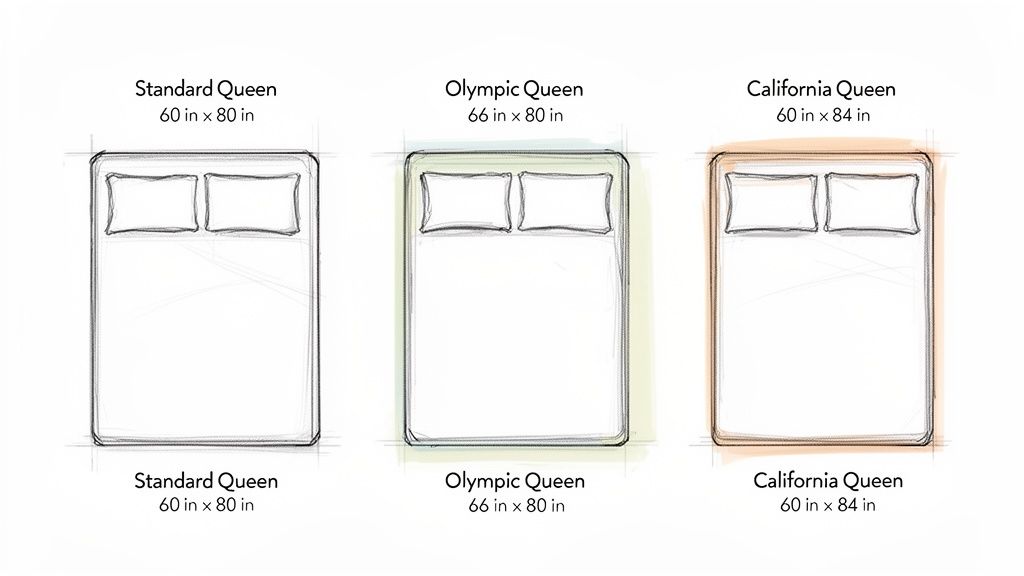
    Illustration comparing standard, Olympic, and California queen bed sizes with their dimensions.

    The standard queen remains a versatile choice, fitting a wide range of accessories and accounting for a significant portion of mattress purchases in the U.S. You can learn more about how mattress sizes became standardized in this article on the evolution of mattress sizes on gottasleep.com. But if the standard queen doesn't quite meet your needs, one of these unique sizes might be a better fit.

    Olympic Queen

    The Olympic Queen mattress adds six inches of width to the standard queen, measuring 66 inches wide by 80 inches long. For couples who feel a bit cramped on a regular queen but don’t have space for a king, that extra space can be a useful alternative.

    It’s an interesting "in-between" solution, but be aware that finding sheets and bed frames that fit this non-standard size can be more challenging.

    California Queen

    If you or your partner are tall and find your feet dangling off the end of the bed, the California Queen might be a solution. It keeps the standard 60-inch width but adds four inches of length, making it 60 inches by 84 inches. For taller sleepers, those extra inches can make a significant difference.

    Much like its more famous counterpart, the California King, the California Queen is built with one thing in mind: extra length for a more comfortable night's sleep for taller individuals.

    Split Queen

    A Split Queen is a unique setup. Instead of one mattress, it consists of two separate mattresses, each measuring 30 inches by 80 inches. When placed side-by-side on a bed frame, they have the exact footprint of a standard queen.

    This design is often used with an adjustable bed base. It allows each person to raise or lower their head and feet independently, accommodating different sleeping preferences.

    Choosing the Right Frame for Your Queen Mattress

    The mattress is only half of the equation. The bed frame you choose sets the style and determines the final footprint of your bed in the room. While a queen mattress will always be 60 inches wide by 80 inches long, the frame can add anywhere from a couple of inches to over a foot in both directions.

    This is a detail that is often overlooked when planning a room layout. A simple metal frame or a sleek, modern platform bed will keep the overall size close to the mattress dimensions, making them a good fit for smaller spaces. On the other hand, a large sleigh bed or a frame with a thick, upholstered headboard can dramatically increase how much floor space the bed occupies.

    Measuring for Your New Bed Frame

    When browsing different styles, it's important to think beyond the mattress size. Always ask for the frame's total dimensions—including the headboard and footboard—to ensure it won’t overwhelm your bedroom or block walkways.

    Always measure the full dimensions of the bed frame—not just the mattress. A larger frame with a decorative headboard can easily add several inches to the length and width, impacting your room's available space and layout.

    Don't forget to consider vertical height. If you’re pairing a thick mattress with a new, taller frame, your bedding might suddenly look too short. For instance, a king-size comforter often drapes better and looks more balanced on a high-profile queen bed than a standard queen comforter would. Keeping these details in mind helps ensure your entire setup looks cohesive and functions well in your room.

    Common Questions About Queen Size Beds

    Choosing a new bed is a significant decision, and it’s natural to have questions. Here are answers to some of the most common questions we hear from shoppers.

    Can Two Adults Sleep Comfortably on a Queen Bed?

    Yes, a standard queen bed was designed to accommodate two adults. It provides each sleeper with 30 inches of personal space, which is enough room for most couples to sleep soundly without feeling cramped. This balance of individual space and a manageable footprint is why the queen is the most popular mattress size in America for couples.

    What Is the Real Difference Between a Full and Queen Bed?

    A queen bed is 6 inches wider and 5 inches longer than a full-size bed. A queen measures 60” x 80”, while a full is 54” x 75”. While those numbers might not seem like a huge jump, the difference is often noticeable. That extra room is beneficial for couples who want more personal space or for taller individuals who find their feet hang off the end of a full bed.

    Do I Need Special Sheets for a Thick Queen Mattress?

    It is very likely. If your new queen mattress is particularly thick—especially if it’s over 14 inches tall—you will likely need to buy deep-pocket sheets. Standard sheets may not have enough fabric to wrap all the way around and under, which can cause the corners to pop off during the night.

    Before shopping for new bedding, measure your mattress’s height. Then, check the sheet packaging for its "pocket depth" to ensure it can accommodate your mattress.

    Quick tip: Don't forget to include your mattress topper when you measure! A plush topper can easily add another 2 to 4 inches, making deep-pocket sheets a necessity for a snug, secure fit.

    Is an Olympic Queen the Same as a Standard Queen?

    No, they are two different sizes. An Olympic Queen is a non-standard mattress that measures 66" x 80", making it 6 inches wider than a standard queen. While that extra width can be nice, be prepared for a challenge when it comes to finding frames and bedding that fit correctly, as they may need to be special-ordered.


    Still have questions? The team at Woodstock Furniture & Mattress Outlet has extensive experience and is here to help you find the right mattress and bedroom furniture for your home. Visit us in person to explore our great selection and see these options for yourself!