Tag: pressure relief

  • Mattress Types for Side Sleepers: A Concise Guide to Choosing the Right Mattress

    Mattress Types for Side Sleepers: A Concise Guide to Choosing the Right Mattress

    For many of us, a truly restorative night's sleep can feel elusive. More often than not, we're waking up with nagging shoulder or hip pain. A common reason for this is a mattress that's just not cut out for the way we sleep. Especially for the large majority of people who sleep on their sides, the right mattress isn't a luxury—it's key to waking up feeling refreshed instead of sore.

    Why Your Sleep Position Shapes Your Mattress Needs

    If you're constantly waking up with a sore shoulder or an aching hip, your body is trying to tell you something. Side sleeping might be the most common position, but it introduces a unique set of challenges for your body and your mattress. Understanding these challenges is the first real step toward finding a bed that provides genuine, lasting comfort.

    The core problem boils down to physics. When you lie on your side, your body's weight becomes focused on a couple of small areas—mainly your shoulder and your hip. This creates intense pressure points that can lead to pain, numbness, and a lot of tossing and turning all night.

    The Science of Pressure and Alignment

    Here's a simple way to visualize this: imagine trying to push a bowling ball into a hardwood floor. The floor has no give, so all that force is concentrated on one tiny spot. Now, picture pushing that same bowling ball into a thick, cushy mat. The mat gives way, absorbing the pressure and spreading the weight out more evenly.

    Your body is the bowling ball, and your mattress is the surface.

    • A mattress that’s too firm is like that hardwood floor. It pushes back hard against your shoulder and hip, creating those painful pressure points and knocking your spine out of its natural, straight line.
    • A mattress that’s too soft can be just as problematic. It lets your hips and shoulders sink too deep, causing your spine to sag in the middle.

    The solution is finding a mattress with what we call cradling support. This is that ideal middle ground where the mattress contours to your body's curves to relieve pressure, but at the same time, it’s supportive enough to hold up your waist and keep your spine straight.

    The Importance of Cradling Support

    Side sleeping is, by far, the most common sleep position. Research shows that a significant portion of the population prefers it. When a side sleeper lies down, their body naturally creates major pressure points at the shoulders and hips. A suitable mattress must be able to cushion those sensitive spots while also keeping the spine in proper alignment to prevent pain.

    Mattress experts will often use pressure mapping to see exactly how a mattress performs, measuring how much a person's spine deviates from a straight, neutral line. You can learn more about how mattress testing reveals these support insights from experts at Consumer Reports.

    Figuring out why your sleep position is so important is a huge first step in building a better sleep setup. But it's not just about the mattress. Taking a broader look at how to sleep better at night can make a massive difference in how you feel. When you dial in both your sleep equipment and your habits, you're setting the stage for truly restorative rest.

    Exploring the Most Common Mattress Types

    Once you understand why you need that cradling support, the next step is figuring out which materials deliver it effectively. The mattress world is packed with different technologies, and each one has a distinct feel and its own set of trade-offs. For side sleepers, the choice usually boils down to one question: how well can it contour to my curves while keeping my spine straight?

    When you start shopping, a common fork in the road is choosing between a Spring Mattress vs Foam Mattress. Let's break down the main contenders to see how they stack up for your sleeping style.

    This simple decision tree can help you see how a side sleeper's needs point toward a specific kind of mattress support.

    Flowchart guiding side sleepers to choose mattress support based on their pain level.

    As the chart shows, if you're waking up with pain, that's your cue. It means your pressure points are signaling the need for a mattress with better contouring and cradling.

    Memory Foam: The Contouring Champion

    Memory foam is famous for its slow-sinking, deep-hugging feeling. It's made from viscoelastic foam that reacts to your body heat and weight, softening and molding around you. This is what creates that signature "hug" that many people find comfortable.

    For side sleepers, this is a significant benefit. The foam gives way exactly where you need it to—at the shoulder and hip—letting those areas sink in just enough. This action is a game-changer for reducing the pressure that causes those morning aches and pains.

    But, like any material, there are a couple of things to keep in mind:

    • Heat Retention: Older memory foam designs had a reputation for trapping body heat. Fortunately, newer models have improved, often using gel infusions, open-cell designs, or other cooling technologies to improve temperature regulation.
    • Slow Response: That deep contouring can sometimes make you feel a bit "stuck." If you're someone who changes positions frequently, the slow-moving nature of memory foam might feel restrictive.

    Latex: The Responsive Cradler

    Latex mattresses offer a different contouring experience. Whether it's made from the sap of rubber trees (natural latex) or from synthetic materials, latex has a more buoyant and responsive feel. The sensation is often described as sleeping on the mattress, not in it.

    It still provides excellent pressure relief, but with an added lift that makes it much easier to move around and switch positions.

    Latex hits that sweet spot between pressure relief and buoyancy. It gently yields to your shoulders and hips without that deep "sinking" feeling of memory foam, which is a great fit for side sleepers who want a more responsive surface.

    On top of that, latex is naturally durable and breathes well. Its open-cell structure allows air to flow, making it one of the more temperature-neutral mattress types available.

    Hybrid: A Combination of Materials

    A hybrid mattress is designed to give you the benefits of different materials all in one bed. The typical construction features a support core of individually wrapped innerspring coils topped with thick comfort layers of memory foam, latex, or other specialty foams.

    This construction is often a great match for side sleepers. You get the deep, contouring pressure relief from the foam on top, paired with the sturdy, responsive support of the coil system below.

    The benefits include:

    • Balanced Feel: Hybrids can provide both the "hug" of foam and the bounce of springs.
    • Enhanced Airflow: The coil layer allows air to circulate much better than an all-foam bed, which helps you sleep cooler.
    • Targeted Support: The pocketed coils adapt to your body's shape, offering zoned support that helps keep your spine in a healthy, neutral alignment.

    Innerspring: The Traditional Foundation

    Traditional innerspring mattresses are built with a core of interconnected steel coils. They're known for offering firm, reliable support and are often available at accessible price points, but they can be tricky for side sleepers.

    The main challenge is their limited ability to contour. A basic innerspring bed usually doesn't have the thick, soft comfort layers needed to properly cushion the shoulders and hips. This can create the very pressure points you’re trying to avoid.

    For an innerspring to work well for a side sleeper, it almost always needs a plush pillow top or Euro top. These extra layers of padding add some much-needed softness, but they still might not provide the same targeted, pressure-relieving qualities you’d get from memory foam, latex, or a well-designed hybrid.

    To help you sort through these options, here's a quick comparison table.

    Mattress Type Comparison for Side Sleepers

    Mattress Type Pressure Relief Potential Spinal Alignment Support Key Considerations
    Memory Foam Excellent Very Good Can sleep hot; slow response time might feel restrictive for some.
    Latex Very Good Excellent Bouncy and responsive; naturally cooler and more durable.
    Hybrid Excellent Excellent Balanced feel, great airflow, strong edge support; often heavier.
    Innerspring Fair to Good Good Very bouncy and affordable; requires a thick comfort layer for pressure relief.

    This table should give you a good starting point, but remember that the right mattress is always a personal choice based on your body and preferences.

    The market has responded to the call for better pressure relief. In fact, foam-based products have grown in popularity, now making up about 45% of the total mattress market share in 2024. This trend is good news for side sleepers, since memory foam and modern latex are adept at providing that cradling support needed to keep pain at bay.

    How Body Weight Affects Firmness and Feel

    So, you've narrowed down the type of mattress you want. The next piece of the puzzle, and it's a critical one, is firmness.

    It’s a common misconception that a "medium-firm" mattress feels the same to everyone. The truth is, how firm a mattress feels is entirely personal and shifts dramatically based on your body weight.

    Here’s an easy way to think about it: imagine dropping a bowling ball and a tennis ball onto the same mattress. They're going to make very different impressions. Your body is the same way. Your weight determines how much you sink into the soft top layers and engage with the supportive core underneath. This is why a mattress that feels like a cloud to a lighter person might feel like a plank of wood to someone heavier.

    Illustration of side sleepers (light, medium, heavy) on a mattress, demonstrating firmness needs via a 1-10 scale.

    To standardize things, the mattress industry uses a 1-10 firmness scale—1 is extremely soft, and 10 is extremely firm. For most side sleepers, the ideal zone is in the medium-soft to medium range, which is about a 4-6 on the scale. This zone usually achieves that balance of pressure-relieving contour and spine-aligning support.

    However, your body weight is the variable that can change everything.

    Finding Your Ideal Firmness Based on Body Weight

    Understanding how your weight interacts with the mattress surface is the secret to avoiding a bed that’s either too soft or too firm. Let's break down the general guidelines.

    • Lighter Sleepers (Under 130 lbs): If you're on the lighter side, you don't place as much pressure on the mattress. A medium or firm bed might not allow you to sink in enough to get the essential cradling for your shoulders and hips. The result? The mattress pushes back too hard, creating pressure points. That's why lighter side sleepers often find a softer mattress (a 3-5 on the scale) provides better pressure relief.

    • Average Weight Sleepers (130-230 lbs): This is the group that most "universal comfort" mattresses are designed for. A medium-soft to medium mattress (a 4-6 on the scale) typically hits the bullseye. It has enough give to cushion the hips and shoulders but also plenty of underlying support to keep the spine straight.

    • Heavier Sleepers (Over 230 lbs): Heavier individuals will naturally sink deeper into a mattress's comfort layers. A bed that's too soft can be a problem; you may sink through the top layers, causing your spine to sag and potentially leading to back pain. A medium-firm to firm mattress (a 6-8 on the scale) provides the robust support needed to prevent over-sinking while still offering sufficient cushion on top.

    Your body weight is the most important factor in translating a mattress's firmness rating into real-world feel. What's "medium" for a 200-pound person might feel "firm" to a 130-pound person sleeping on the exact same bed.

    Why Mattress Thickness Matters for Side Sleepers

    Along with firmness, the mattress's thickness—sometimes called its profile or height—plays a huge role in comfort, especially if you sleep on your side. A thicker mattress isn't just for aesthetics; it's a direct indicator of how deep the comfort system is.

    Think of a mattress as having two main parts: the support core (the strong base of coils or dense foam) and the comfort layers on top (the cushy memory foam, latex, etc.). For side sleepers, those comfort layers do all the heavy lifting by cushioning the shoulders and hips.

    If a mattress is too thin (say, under 10 inches), a side sleeper can easily sink right through those comfort layers and hit the firm support core. This defeats the purpose and can create the exact pressure points you're trying to eliminate.

    For this reason, a mattress that's at least 12 inches thick is often recommended for side sleepers. That extra height usually translates to deeper, more substantial comfort layers, giving your body more room to sink in without bottoming out. This is key to getting consistent pressure relief and durable support that will last.

    Building a Complete Sleep System for Side Sleepers

    Finding the right mattress is a huge step toward a great night's sleep, but it's really the foundation. To truly dial in the comfort and support that side sleepers need, it helps to think in terms of a complete sleep system. This simply means pairing your mattress with the right accessories that all work together for proper alignment and pressure relief from head to toe.

    A fantastic mattress can solve your hip and shoulder pain, but if your head is at an odd angle all night, you might just be trading one problem for another. The goal is to create a seamless, supportive environment for your whole body.

    Diagram of a person lying on an adjustable bed demonstrating proper spinal alignment and airflow.

    The Essential Role of the Right Pillow

    For anyone who sleeps on their side, a pillow isn't just a fluffy accessory—it's a critical tool for spinal health. When you lie on your side, a significant gap opens up between your head and the mattress. If your pillow is too flat, your head will sag down, straining your neck muscles. If it's too thick, it will push your head upward, creating a different kind of misalignment.

    The secret is finding a pillow with the right loft, or thickness, to fill that space correctly.

    • Pillow Loft: Look for a pillow that’s thick enough to keep your head and neck in a straight, neutral line with the rest of your spine. For most side sleepers, this means a mid-to-high loft pillow is the sweet spot.
    • Pillow Firmness: Your pillow also needs to be firm enough to support the weight of your head without going flat overnight. Materials like solid memory foam, latex, and denser down alternatives are often good choices.

    Here’s a helpful tip: tuck a second, thinner pillow between your knees. This simple trick can do wonders for keeping your hips properly aligned and stops your top leg from twisting your lower back out of position.

    Fine-Tuning Comfort with a Mattress Topper

    Have you ever found a mattress that's almost perfect but just a little too firm? Perhaps it felt great in the showroom but is hitting differently at home, or maybe your comfort preferences have just changed over time. This is where a mattress topper can be a useful tool.

    A topper is an extra layer of cushioning, usually 2 to 4 inches thick, that you place on top of your existing mattress. It lets you add that missing layer of pressure relief without having to buy a whole new bed. For side sleepers, a memory foam or latex topper is often an effective solution for adding crucial cradling comfort for your shoulders and hips.

    A mattress topper is a practical solution for fine-tuning your sleep surface. It can add a layer of plush, contouring comfort to a mattress that is supportive but just a little too firm, directly targeting pressure point relief.

    Enhancing Comfort with an Adjustable Base

    An adjustable base is an upgrade for personalizing your sleep. These powered foundations let you raise the head and foot of your bed to find positions that a flat foundation cannot provide.

    While many people think of them for sitting up to read or watch TV, adjustable bases offer real ergonomic benefits for side sleepers. Slightly raising your head can help open up your airways for easier breathing, and lifting your legs can take strain off your lower back and hips. Finding a subtle "zero-gravity" position can help distribute your body weight more evenly, taking even more pressure off your side. It can be a significant investment, but one that adds a new level of customized comfort to your sleep system.

    How to Test a Mattress with Confidence

    Mattress shopping can feel like a chore. While digging through reviews online is a good place to start, there’s simply no substitute for testing a mattress in person. The way a mattress feels is incredibly personal, and the only way to really know if it’s for you is to lie down on it.

    A trip to a mattress showroom lets you feel the real-world difference between all the options we've discussed. It’s your chance to directly compare how different mattress types support your unique body shape and sleep style. This is where theory meets practical experience, connecting what you’ve learned with how your body actually feels.

    A Practical Approach to In-Store Testing

    To get the most out of your visit, it helps to have a game plan. Just sitting on a mattress for thirty seconds won’t tell you much about how you’ll feel after a full night’s sleep. A more deliberate approach is key to uncovering potential issues with pressure points or spinal alignment.

    Here’s a simple process we recommend to our own customers:

    • Wear Comfortable Clothing: You're going to be lying down and rolling over, so wear something that lets you move freely.
    • Lie in Your Side-Sleeping Position: Don't just lie on your back if that's not how you sleep at home. Get into your typical side-sleeping posture and settle in.
    • Stay for at Least 10-15 Minutes: This is the most important step. Your body needs time to relax and sink into the mattress. Rushing this can easily lead to choosing the wrong bed.
    • Pay Attention to Your Hips and Shoulders: Do you feel any pinching, numbness, or excess pressure? A good mattress for a side sleeper should gently cradle these areas.
    • Check Your Spinal Alignment: This can be tricky to judge on your own. Ask your shopping partner or a knowledgeable sales associate to see if your spine looks straight from your neck to your tailbone. A quick photo on your phone can also give you a clear picture.

    Finding a Low-Pressure Shopping Environment

    The whole point of trying a mattress is to make a smart, informed decision—not to feel pressured. Visiting a store with an experienced, genuinely helpful team can make all the difference.

    Good sleep professionals can walk you through the different mattress types for side sleepers, explain the real functional differences between brands, and help you compare your options without high-pressure tactics.

    The in-store experience should be about discovery and education. Your goal is to gather information about how different mattresses feel so you can make a choice you're confident in for years to come.

    Take your time, ask plenty of questions, and don’t feel awkward about lying on a bed for an extended period. Any true sleep professional will understand and encourage this. They know that a confident, well-informed customer is the goal. A visit to a local showroom, like our own Woodstock Furniture & Mattress Outlet Sleep Centers, gives you the chance to try a wide variety of mattresses in a relaxed, educational setting.

    Common Questions About Mattresses for Side Sleepers

    After digging into all the different mattress types, you might still have a few questions. That's perfectly normal. This section is dedicated to answering the most common questions we hear from side sleepers in our showrooms.

    What Firmness Is Best for Side Sleepers with Hip Pain?

    If you're a side sleeper struggling with hip pain, you'll want to focus on mattresses in the medium-soft to medium range. Think of it as a 4 to 6 on that 10-point firmness scale. This is often the sweet spot for getting both cushioning and support right where you need it.

    A mattress in this range is soft enough to gently cradle your hips, taking the direct pressure off the joint. But, just as importantly, it's supportive enough to keep you from sinking in too far. If you sink too deep, your spine gets thrown out of alignment, which can make the pain worse.

    Memory foam and latex are materials that excel at this because they are designed to distribute body weight evenly instead of letting it all concentrate on your hips. When you're testing mattresses, lie down and pay close attention. If you feel even a hint of strain in your hips or lower back, that's your body telling you it's not the right fit.

    Are Hybrid Mattresses a Good Choice for Side Sleepers?

    Yes, hybrid mattresses are often an excellent choice for side sleepers. They are engineered to give you the standout benefits of two different mattress types in one bed.

    You get a base layer of innerspring coils that provides durable support needed to keep your spine straight. Then, on top, you have thick comfort layers of memory foam or latex that deliver the deep pressure relief your shoulders and hips require.

    This "best of both worlds" approach can give you the contouring hug of foam without the "stuck" feeling some people dislike. The coils also add some bounce, making it easier to roll over or get out of bed.

    As a bonus, the space between the coils allows for better airflow than a solid block of foam, which can be helpful for anyone who tends to sleep hot.

    How Do I Know if My Mattress Is Wrong for Side Sleeping?

    Your body will send you some pretty clear signals if your mattress isn't a good fit. Learning to recognize those signs is the first step to getting a better night's sleep.

    One of the biggest red flags is waking up with numbness or tingling in your arms or hands. This is a classic sign that your mattress is too firm and is pinching nerves or restricting circulation at your shoulder.

    Another common sign is nagging shoulder, hip, or lower back pain. If the pain is most intense first thing in the morning but slowly gets better as you move around, your mattress is a likely culprit. If you find yourself tossing and turning all night, trying to get comfortable, your mattress simply isn't relieving pressure properly.

    Finally, take a look at your mattress. If you can see a permanent dip or sag where you sleep, the support system has likely worn out. It can no longer hold you in proper alignment and should be replaced.

    Where Should My Arms Go When I Sleep on My Side?

    This is a trickier one than people realize. The main goal is to keep your arms and hands below your shoulders. This helps you avoid compressing the nerves in your shoulder joint, which can lead to pain and numbness.

    Many side sleepers are comfortable with their arms down by their sides, or bent slightly in front of their body. Another helpful trick is to hug a body pillow. This not only gives your top arm a comfortable place to rest but also keeps your shoulders from collapsing forward and straining your upper back.

    Whatever you do, try to avoid tucking an arm under your head or pillow. That's a common cause of waking up with that "pins and needles" feeling from restricted circulation.


    Here at Woodstock Furniture & Mattress Outlet, our mission is to help you explore your options in a no-pressure, educational setting. Our experienced team can walk you through the different mattress types for side sleepers, letting you compare models to find a suitable match for your body and your budget. Come visit one of our North Georgia showrooms and feel the difference for yourself.
    Explore our full selection of mattresses online

  • What Is a Memory Foam Mattress and How Does It Work?

    What Is a Memory Foam Mattress and How Does It Work?

    So, what exactly is a memory foam mattress? At its core, it’s a mattress made from a material called viscoelastic foam. This unique foam reacts to your body's heat and pressure, softening and contouring to cradle your unique shape. It's well-known for delivering pressure relief and absorbing movement, making it a popular choice for anyone looking for personalized comfort.

    From NASA Technology to Your Bedroom

    The journey of memory foam didn't start in a mattress factory. It began with NASA back in the 1960s. The goal wasn't a good night's sleep, but to improve the safety and comfort of aircraft cushions for astronauts during takeoff. They needed a material that could absorb significant shock while still providing customized support.

    Decades later, that same technology was refined for consumer use, eventually making its way into the mattresses we see in showrooms today.

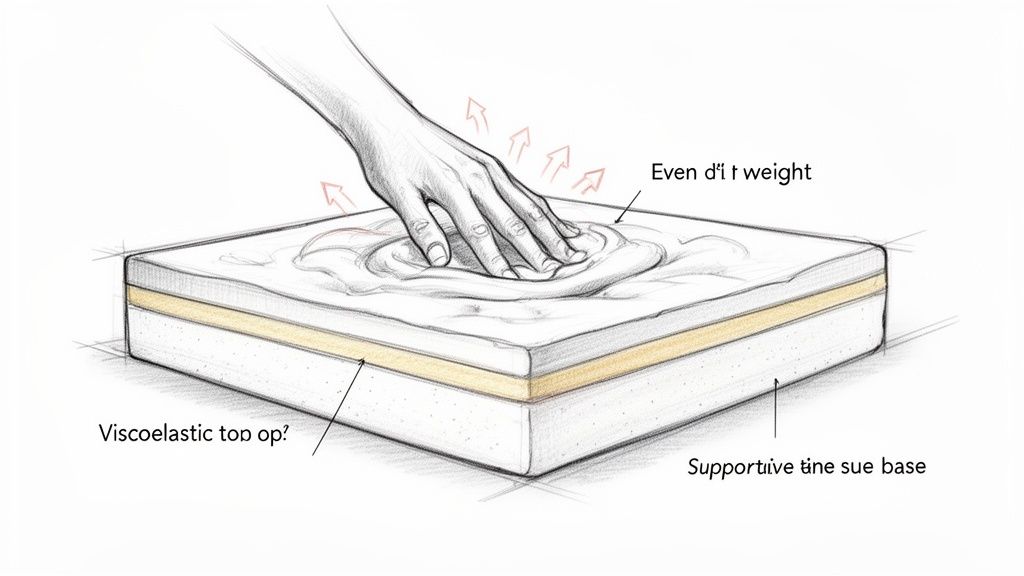
    Think of it like pressing your hand into a piece of soft dough. You see how it holds the impression for a few seconds before slowly bouncing back? That's the basic idea behind memory foam. When you lie down, your body heat softens the foam, allowing it to gently mold around your shoulders, hips, and back. This contouring action spreads your weight evenly across the entire surface, which is the secret behind its most popular benefits.

    Illustration of a hand pressing into a memory foam mattress, demonstrating viscoelastic conformity and even weight distribution.

    Core Benefits of Memory Foam

    Once you understand where it came from, it’s easy to see why so many people have found it beneficial.

    • Exceptional Pressure Relief: By conforming so closely to your body, memory foam helps eliminate painful pressure points. This can be a significant benefit for side sleepers and may lead to less tossing and turning.
    • Motion Isolation: The foam is brilliant at absorbing energy. If you share a bed with a restless partner (or a pet that jumps on and off all night), you’re far less likely to feel their movements.

    This unique combination of contouring support and motion absorption is why memory foam has become a go-to solution for sleepers looking to minimize disturbances and alleviate discomfort. It provides a quiet, still, and deeply supportive sleep environment.

    In the end, it’s all about creating personalized comfort that adapts to you, not the other way around. Understanding what a memory foam mattress is and how it works is a huge step in the pursuit of a perfect night's sleep. Once you demystify the material, you can decide if that signature "hugging" sensation is the right match for you.

    The Science Behind That 'Hugging' Sensation

    That signature "hugging" feeling you get from a memory foam mattress isn’t magic — it’s material science. The unique feel all comes down to two key properties working together: viscosity and elasticity. Once you understand how these two things react to your body, you’ll know if memory foam is the right choice for you.

    At a microscopic level, memory foam has what’s called an open-cell structure. An easy way to picture this is to think of a sponge full of millions of tiny, interconnected air bubbles. When you lie down, your body weight and pressure push the air out of the cells directly beneath you and into the neighboring cells all around. This slow, controlled transfer of air is what creates that gradual, adaptive response. The foam doesn’t just squish down; it gently yields and molds to your exact shape.

    This is very different from a traditional innerspring mattress, which relies on the instant pushback from metal coils. With memory foam, the mattress adapts to you, not the other way around.

    The Role of Body Heat

    There's another crucial ingredient in the mix: your own body heat. Viscoelastic foam is temperature-sensitive, which means it gets softer and more flexible as it warms up.

    As you get comfortable in bed, the foam directly touching your body starts to warm. This softening allows the mattress to contour even more closely to your individual curves, especially around pressure points like your shoulders and hips. Meanwhile, the foam that isn't in direct contact with you stays a bit firmer, providing consistent support. It's this temperature-driven contouring that creates that custom-fit, cradled feeling that many people enjoy.

    Viscosity and Elasticity Explained

    To really understand what’s going on, let's break down those two terms. Think of them as two sides of the same coin, working in harmony to give memory foam its unique feel.

    • Viscosity is about the foam's ability to resist flow and absorb energy. A good real-world example is honey. If you drop a spoon into a jar of honey, it sinks in slowly because the honey absorbs the impact. In a mattress, this high viscosity is what gives memory foam its excellent motion isolation. It deadens movement, so when your partner tosses and turns, that motion is absorbed by the foam instead of being transferred across the bed to you.

    • Elasticity is the foam's ability to bounce back to its original shape after you get up. While the "visco" part lets the foam mold to your body, the "elastic" part makes sure it doesn't just stay flat. This slow, gentle return to form provides continuous support all night long without creating the hard "push-back" or bounciness you'd get from springs.

    In a nutshell, viscosity lets the mattress absorb your weight and movement, while elasticity ensures it keeps supporting you by slowly recovering its shape. This scientific dance is what creates a sleep surface that is both deeply contouring and reliably supportive.

    By understanding this interplay between the foam's open-cell structure, its reaction to temperature, its viscosity, and its elasticity, it’s easy to see how a memory foam mattress delivers such a unique and personalized night's sleep. It’s a material designed from the ground up to adapt, absorb, and support.

    Understanding the Different Types of Memory Foam

    Just as cars have evolved into sedans, trucks, and hybrids, memory foam has also evolved from its original design. Not all memory foam is the same, and knowing the key differences can help you find a mattress that actually solves your sleep problems — whether that’s sleeping hot or feeling “stuck.”

    Innovations in foam technology have led to several distinct types, each bringing its own unique properties to the table. Understanding what makes them different is your first step toward picking a mattress that truly fits your comfort needs.

    This graphic breaks down the basic science behind memory foam — how your body heat influences the foam's viscosity (its ability to flow and contour) and its elasticity (its ability to bounce back).

    Foam science concept map illustrating how body heat increases viscosity, influencing elasticity.

    As you can see, body heat is the catalyst that softens the foam, which is what gives it that signature deep contouring and pressure relief.

    Traditional Memory Foam

    This is the original viscoelastic foam that started it all. It’s known for that slow-moving, deep-sinking feel that provides notable pressure relief. When people talk about getting that classic "hugging" sensation from their mattress, this is usually what they're referring to.

    It’s excellent at absorbing motion and contouring closely to your body, making it a solid choice if pressure point relief is your top priority. The one common critique is that its dense structure can sometimes trap body heat, which is a problem that newer foam types were specifically invented to solve.

    Gel-Infused Memory Foam

    One of the most popular solutions to the heat problem is gel-infused memory foam. This type of foam has tiny gel beads or swirls of liquid gel mixed into the foam during the manufacturing process.

    These gel particles are designed to absorb and pull heat away from your body, helping you maintain a more comfortable, neutral sleeping temperature. This was a significant step forward, making it possible to enjoy the deep pressure relief of memory foam without overheating, as could sometimes happen on older models. It's a very popular choice for sleepers who love the contouring feel but tend to sleep warm.

    Plant-Based Memory Foam

    For those looking for a more responsive and breathable option, plant-based memory foam is a compelling alternative. In this version, mattress makers replace a portion of the usual petroleum-based ingredients with plant-derived oils, like soy or castor oil.

    This change in the composition has two main effects:

    1. It’s More Breathable: Plant-based foams usually have a more open-cell structure, which lets air flow more freely and helps move heat away from you more effectively than many traditional foams.
    2. It Responds Faster: These foams tend to bounce back to their original shape more quickly. This reduces that "stuck" feeling some people experience, making it much easier to change positions during the night.

    Plant-based memory foam gives you a slightly bouncier and cooler sleep experience while still delivering the pressure-relieving benefits that memory foam is known for.

    Open-Cell Memory Foam

    Here's another clever engineering fix for sleeping hot: open-cell memory foam. While technically all memory foam has an open-cell structure, these newer versions feature much larger, more interconnected cells.

    Imagine the difference between a dense pound cake and a light, airy sponge cake. The sponge's more open structure lets air pass through it easily. It's the same idea here. The enhanced internal structure of open-cell foam creates small airways that improve ventilation and allow heat and moisture to escape. This design tackles heat buildup by promoting constant airflow all night, offering a cooler sleep without giving up that contouring support.

    The Real-World Pros and Cons of Memory Foam

    Every mattress material has its pluses and minuses, and memory foam is no different. Knowing both sides of the coin is key to making a good decision. Let's take a balanced look at the pros and cons to see if a memory foam mattress is the right fit for you.

    The growth in popularity of memory foam comes from real benefits that solve some of the most common sleep issues people face. The foam mattress segment has become a major part of the global market, accounting for 45.2% of the total share in a recent analysis. This indicates that many people find that foam meets their needs. For a deeper dive into these numbers, you can review market analyses on the subject.

    The Clear Advantages of Memory Foam

    When memory foam is a good match for a sleeper, it can be an excellent one. Here are the main reasons people find it so beneficial.

    • Exceptional Pressure Relief: This is a key strength of memory foam. The way it molds perfectly to your body’s unique shape—especially around hotspots like shoulders, hips, and your lower back—spreads your weight out evenly. This takes a ton of pressure off sensitive joints, which means less tossing and turning and fewer aches when you wake up.

    • Superior Motion Isolation: If you share a bed with someone who tosses and turns (or a pet that jumps on and off the bed), memory foam can be a great solution. Its dense, absorbent nature stops movement in its tracks. When your partner rolls over, the energy gets soaked up by the foam instead of rippling across to your side, leading to a much more peaceful, undisturbed night.

    • Durable and Long-Lasting Support: High-quality memory foam is very resilient. It doesn’t have springs that can wear out or sag over time. This means you get consistent, reliable support for years. With proper care, it'll keep its supportive, contouring feel for its entire lifespan.

    And it’s not just mattresses! The unique feel of memory foam is great for other sleep accessories too. For example, exploring the memory foam pillow benefits for better sleep can show you how to get that same contouring comfort for your head and neck.

    Potential Drawbacks and Honest Considerations

    Of course, no mattress is perfect for everybody. It’s just as important to get familiar with the potential downsides so you can make a truly informed choice.

    Understanding the potential cons isn’t about finding fault; it’s about managing expectations. Modern memory foams have addressed many of these concerns, but knowing what to look for is crucial.

    • Heat Retention Concerns: This is the oldest complaint about memory foam. Early, traditional versions of the foam had a dense structure that could trap body heat. The good news is that modern mattress makers have largely solved this with innovations like gel infusions, copper particles, and open-cell designs. These technologies are designed to improve airflow and actively pull heat away from you.

    • The "New Foam" Smell (Off-Gassing): When you first unwrap a new memory foam mattress, you might notice a distinct smell. This is called off-gassing, and it’s just the release of harmless volatile organic compounds (VOCs) left over from the manufacturing process. While the name sounds a bit scary, it’s not considered harmful and almost always airs out and disappears completely within a few hours to a couple of days. Be sure to let it breathe in a well-ventilated room.

    • A Slower Response Time: That slow-sinking, deep-hugging feeling is a huge plus for many people, but it can be a deal-breaker for some. If you’re an active sleeper who changes positions a lot, you might feel a slight delay as the foam recovers and adjusts to your new shape. For those who prefer a quick, bouncy feel, an innerspring or hybrid mattress might be a better fit.

    Who Is a Memory Foam Mattress Really For?

    Now for the big question: we've talked about what a memory foam mattress is, but is it the right mattress for you? Knowing how it works is one thing, but figuring out if it’ll solve your specific sleep problems is what really counts. Memory foam is an excellent choice for some sleepers, but for others, it’s just not the right fit.

    The goal here isn't to say one mattress type is better than another, but to help you figure out if memory foam’s unique feel lines up with what you need to get a great night's sleep.

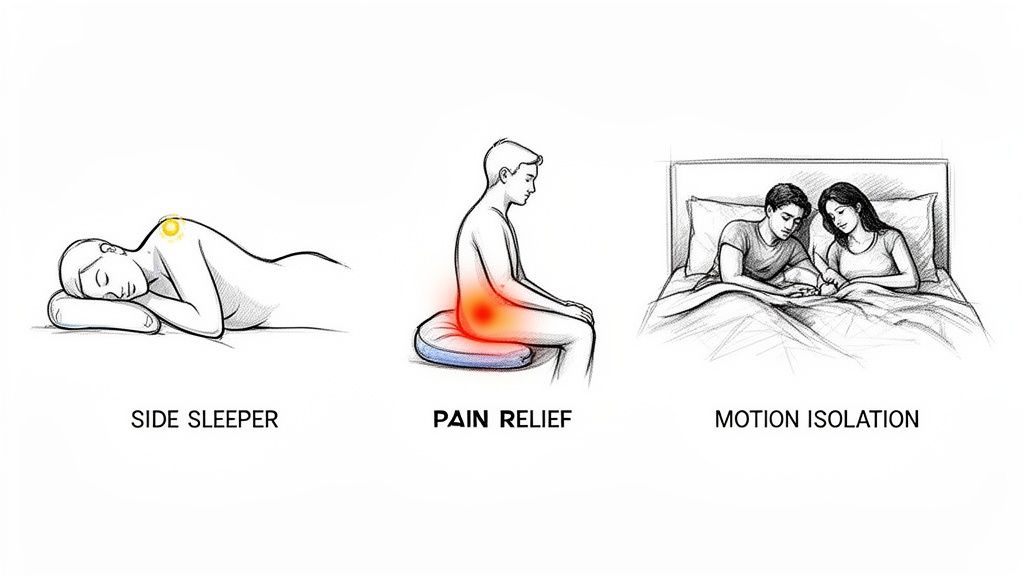
    Three illustrations depict comfort benefits: side sleeping support, seated pain relief, and couples experiencing motion isolation in bed.

    Side Sleepers Seeking Pressure Relief

    If you spend most of the night on your side, a memory foam mattress should definitely be on your short list. When you sleep on your side, you put a ton of weight on your shoulders and hips, creating major pressure points. Memory foam’s signature contouring lets those areas sink in just enough to keep your spine properly aligned, which helps you avoid that next-day soreness from a mattress that’s too firm.

    By cradling your body's curves, memory foam distributes weight away from sensitive joints. This provides targeted support that helps prevent you from waking up to numb arms or aching hips.

    Individuals with Chronic Pain or Soreness

    For folks dealing with chronic pain from conditions like arthritis or fibromyalgia, the gentle, pressure-relieving qualities of memory foam can be a huge help. The foam’s conforming nature doesn't put any extra stress on already tender parts of the body.

    This even weight distribution can mean waking up with much less pain and stiffness. The mattress essentially creates a custom-fit cradle that supports you without pushing back, which can make a world of difference in your comfort level.

    Couples and Light Sleepers

    The motion isolation you get from memory foam is a game-changer for anyone who shares a bed. Since the foam absorbs movement instead of transferring it across the mattress, you're way less likely to be woken up by a partner who tosses and turns, gets up for a midnight snack, or is on a completely different sleep schedule. It makes for a calmer, more stable sleep surface for both of you.

    Who Might Want to Consider Other Options

    Let's be honest, memory foam isn't the perfect mattress for everyone. Knowing who it doesn't work for is just as important as knowing who it helps.

    • Stomach Sleepers: This sleeping position really needs a firm, supportive surface to keep the hips from sinking in too much and knocking the spine out of alignment. The deep hug of memory foam can sometimes make this problem worse.
    • Those Who Prefer a Bouncy Feel: If you love that springy, responsive feel of a traditional innerspring bed, the slow-sinking sensation of memory foam might feel a bit like quicksand to you.
    • Combination Sleepers Who Move Frequently: While today's memory foams are much more responsive than they used to be, some active sleepers might find it a little harder to change positions on a bed that contours so deeply.

    Ultimately, finding the right mattress comes down to your body, how you sleep, and what feels most comfortable to you.

    How to Care for Your Mattress to Maximize Its Lifespan

    A quality mattress is an important investment in your well-being. It makes sense that you'd want it to last as long as possible, and a little routine care can make a massive difference. With the right maintenance, a well-made memory foam mattress can typically last anywhere from 7 to 10 years, sometimes even longer depending on the foam density and how it’s treated.

    Protecting this investment is actually pretty straightforward and doesn't require much effort. All it really takes are a few simple, consistent habits to keep your mattress feeling supportive and clean for years to come.

    Simple Steps for Long-Lasting Comfort

    The popularity of memory foam continues to grow, and its market share shows a strong consumer preference for its unique feel and benefits. The global memory foam mattress market is projected to reach over $29 billion by 2035 — a testament to its staying power. To get the most from this popular mattress choice, a few key practices are essential. Discover more insights about this growing market and its future trends.

    To help you protect your purchase, here are a few simple, actionable tips to make it last:

    • Use a High-Quality Mattress Protector: This is one of the most important things you can do. A waterproof, breathable protector guards your mattress against spills, sweat, allergens, and dust mites, all of which can break down foam over time. It’s an easy way to protect your mattress.

    • Provide a Supportive Foundation: Memory foam needs a solid, flat base to perform its best. A weak or sagging foundation can cause the mattress to break down unevenly. Make sure you’re using a proper bed frame, box spring, platform bed, or adjustable base that offers consistent support across the entire mattress.

    Maintaining Even Wear and Tear

    Unlike many old-school innerspring mattresses, you’re not supposed to flip a memory foam mattress over. Most are built with very specific layers — a dense support core on the bottom and softer comfort layers on the top.

    However, rotating your mattress is highly recommended. This simple action prevents body impressions from forming in one spot and ensures the foam wears down evenly over time, preserving its supportive feel.

    A good rule of thumb is to rotate your mattress 180 degrees (from head to foot) every 3 to 6 months. This easy habit helps maintain a consistent feel across the whole sleep surface and can significantly extend the life of your mattress. Follow these simple guidelines, and your mattress will give you restorative sleep for many years.

    Common Questions About Memory Foam Mattresses


    When you’re looking into a new mattress, especially one made from a material as unique as memory foam, you’re bound to have a few questions. That’s perfectly normal. Getting straight answers can clear up any doubts and help you feel confident in your choice.

    Let's dive in and tackle some of the most common questions shoppers have when they start exploring the world of memory foam.

    Can I Use a Memory Foam Mattress with an Adjustable Base?

    Yes, absolutely. In fact, memory foam mattresses and adjustable bases are an excellent combination.

    Because they’re built entirely from foam layers and don't have a rigid innerspring core, they are incredibly flexible. This lets them bend and move effortlessly with the base as you lift your head or feet. This pairing means you can enjoy all the comfort and health benefits of an adjustable base—like reducing snoring or easing acid reflux—without worrying about damaging your mattress.

    Will a Memory Foam Mattress Make Me Sleep Hot?

    This is probably the number one concern we hear from customers, and it’s a fair question based on the memory foams of yesterday. The earliest models had a very dense structure that could trap body heat, which sometimes made for a warm, uncomfortable night.

    However, the mattress world has come a long way since then. Modern memory foam has largely solved this problem. Today’s mattresses are packed with advanced cooling features designed specifically to keep you from overheating.

    Some of these solutions include:

    • Gel-Infused Foam: Tiny gel beads or swirls are mixed right into the foam to actively pull heat away from your body.
    • Copper-Infused Foam: Copper is a natural conductor, and it does a fantastic job of drawing heat away from the sleeping surface.
    • Open-Cell Designs: This is a big one. This type of foam has a more breathable internal structure with larger, connected cells that let air flow freely, allowing heat to escape instead of building up.

    So, while the concern is understandable based on old technology, today's memory foam mattresses are engineered for a much cooler, more comfortable sleep.

    What Is Off-Gassing and Is It Harmful?

    When you first unbox a new memory foam mattress, you might notice a slight smell, kind of like a "new car" scent. This is totally normal and it's called off-gassing.

    It’s simply the release of volatile organic compounds (VOCs), which are a byproduct of the mattress manufacturing process. While the name "VOCs" sounds a bit scary, the off-gassing from mattresses made by reputable brands is not considered harmful. Certifications like CertiPUR-US® are your guarantee that the foam is made without certain harsh chemicals and has very low VOC emissions.

    The smell is temporary and usually disappears within a few hours to a couple of days. A simple trick to speed things up is to put the new mattress in a well-ventilated room and let it air out for a bit before you make the bed.

    Getting these questions answered helps pull back the curtain on memory foam, letting you focus on the most important thing—finding a mattress that gives you the comfort and support you deserve.


    Ultimately, the best way to know if a memory foam mattress is the right fit for you is to try one out for yourself. Here at Woodstock Furniture & Mattress Outlet, our knowledgeable team can walk you through all the different types and technologies, helping you find a great match without any pressure. Come visit one of our North Georgia showrooms to feel the difference firsthand. Find out more at woodstockoutlet.com.

    Article created using Outrank