You've found the right patio corner, chosen a color that works with the house, and started picturing long afternoons with a book and a cold drink. Then the practical questions arrive: Will the frame handle humid weather? Will the cushions stay comfortable after repeated rain? Can the daybed fit without turning the patio into an obstacle course?
An outdoor patio furniture daybed is more than an oversized lounge cushion. It has to balance comfort, structure, drainage, sun exposure, and available space. The category is also becoming more substantial, with one report estimating the global outdoor daybed market at USD 2.1 billion in 2025, projected to reach USD 3.2 billion by 2034 at a 5.8% CAGR (global outdoor daybed market analysis). That growth gives shoppers more choices, but it also makes it easier to choose based on appearance alone.
What Makes an Outdoor Daybed Different
A shopper may walk into a showroom with a simple image in mind: a deep cushion, a clean frame, perhaps a canopy, and enough room to stretch out. That picture is useful, but it doesn't tell you whether the piece is designed to live outside.
Indoor daybeds assume a relatively controlled environment. Their fabrics, foam, fasteners, and finishes aren't expected to deal continuously with direct sunlight, rain, humidity, airborne salt, or abrupt temperature changes. An outdoor model needs construction that anticipates those pressures from the start.
Look beyond the silhouette
The first test is the frame. Check whether it feels stable when you apply gentle pressure to the arms or back. Look closely at joints, welds, hardware, woven panels, and the points where the cushion rests. A stylish profile can't compensate for movement, exposed hardware, poor drainage, or a finish that begins to break down under regular weather exposure.
Outdoor daybeds commonly use powder-coated aluminum, teak, all-weather wicker, PE rattan, and treated hardwoods because these materials are selected for resistance to sun, rain, humidity, fading, mold, and mildew (outdoor daybed material guidance). Each material still has limits, and the local climate determines how quickly those limits matter.
Practical rule: Treat the cushion, frame, and drainage system as one product. A strong frame won't make a daybed comfortable if the cushion stays wet, and a premium cushion won't rescue a frame that shifts or corrodes.
Think about how you'll use the piece. A covered porch offers more protection than an exposed pool deck. A daybed used occasionally may tolerate a different maintenance routine than one used every afternoon. The right purchase starts with those conditions, not with the photograph.
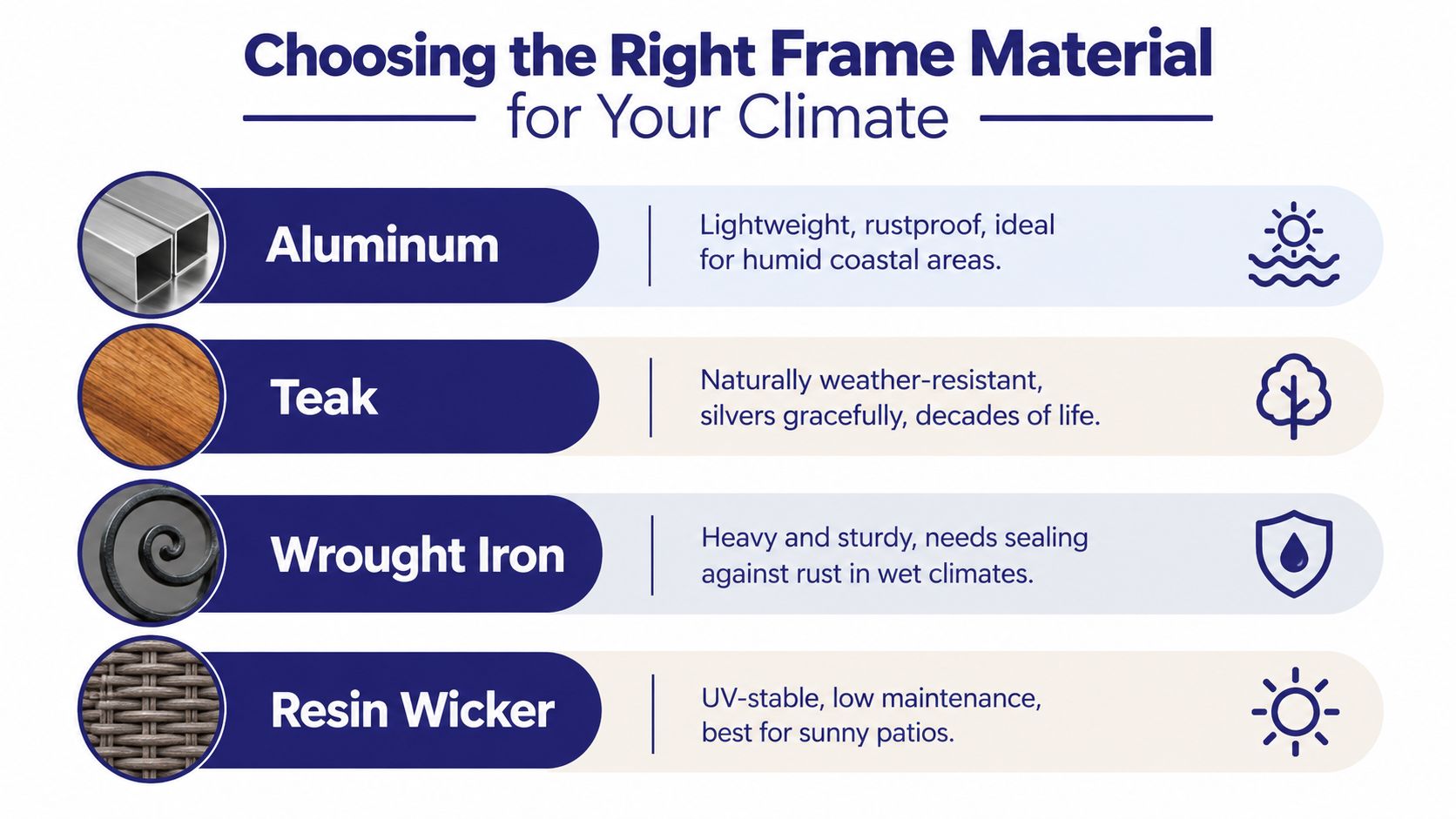
Choosing the Right Frame Material for Your Climate
Frame material should follow the weather pattern around your home, not the color palette of your patio. A dry, sunny setting puts sustained pressure on finishes and woven materials. A rainy region makes drainage and moisture management more urgent. Coastal and humid locations add salt and persistent dampness to the equation.
Powder-coated aluminum
For many climates, powder-coated aluminum is the most technically durable choice. Aluminum itself doesn't rust, while the powder coat creates a bonded protective layer that helps resist chipping, corrosion, and UV-related finish breakdown. Independent outdoor-furniture guidance identifies accelerated UV testing, including ASTM G154, as useful for comparing materials, while cautioning that test results don't translate directly into a specific number of outdoor years. With proper maintenance of the coating and hardware, practical service expectations commonly fall in the 15 to 25-plus year range (weatherproof patio furniture guidance).
Aluminum is relatively easy to move and doesn't require the same ongoing sealing routine as many wood frames. The trade-off is that lighter construction can feel less planted in strong wind, so stability, base design, and placement still matter.
Wood, iron, and synthetic weave
Teak has natural weather resistance and develops a silver-gray appearance as it ages. That change is attractive to some homeowners and undesirable to others. If you want the original wood tone, expect more upkeep. Treated hardwoods can bring warmth and substantial visual presence, but their finish requires attention as weather exposure increases.
Wrought iron feels heavy and sturdy, which can be useful in windy settings. It needs effective rust protection, especially where rain and humidity are frequent. Resin wicker or PE rattan can offer a softer, woven appearance with relatively low maintenance, but look for UV-stable material and a frame beneath the weave that suits your climate.
The most sensible choice is the material whose maintenance requirements match your habits. A beautiful wood daybed that you won't reseal may age less gracefully than an aluminum model you can clean and inspect easily.
Sizing and Layout – Finding the Right Fit
A daybed can look compact in a large showroom and surprisingly dominant on a real patio. Measure before you shop, and measure the route the furniture must take to reach its final position.
Start with the usable footprint
Clear the area of temporary items, then measure the width and depth available for the daybed itself. Account for steps, columns, railings, doors, grill access, and the swing path of nearby doors. If the daybed includes a canopy, chaise extension, or adjustable back, measure the space in its most extended position.
One major retailer groups outdoor daybeds into four width bands: small, under 70 inches; standard, 71 to 86 inches; long, 87 to 100 inches; and extra-long, over 100 inches (outdoor daybed size categories). These categories can help narrow the search, but width alone doesn't tell you how comfortable the surrounding layout will be.
Protect circulation
Leave at least 18 inches of clearance around walkways, with two feet preferred for more comfortable movement (outdoor daybed layout guidance). Mark the proposed footprint with painter's tape or flattened cardboard. Walk around it while carrying a tray, opening the patio door, and accessing other seating. That quick exercise often reveals a problem that a product page won't show.
Small patio: Position the daybed against a wall or railing and keep the remaining furniture visually light.
Covered porch: Use the daybed as an anchor, but preserve a clear route from the entry to the yard.
Large deck: Create a relaxation zone with a side table, while keeping dining and cooking areas separate.
Don't assume a larger daybed automatically delivers better value. If it blocks circulation or forces other furniture into awkward positions, a smaller model may provide more usable comfort.
Understanding Cushions and Weatherproofing
Many daybed problems begin with the cushion rather than the frame. A frame can remain stable while the cushion cover fades, the filling compresses, or trapped moisture creates an unpleasant sitting surface.
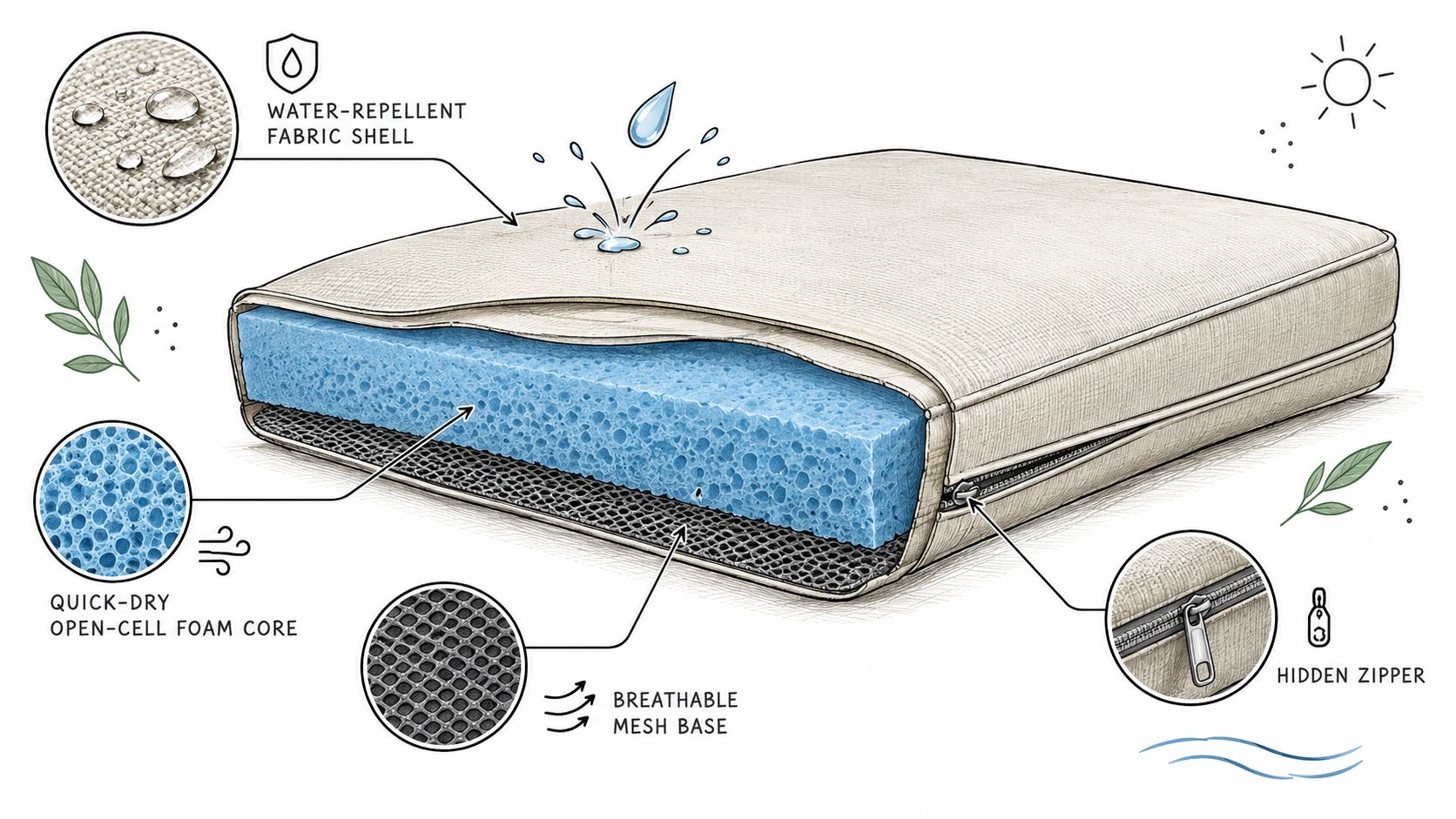
Outdoor covers commonly use weather-resistant polyester, olefin, or solution-dyed acrylic because these textiles resist water absorption, fading, and mildew better than standard indoor fabrics. Foam and foam blends provide support, but they can retain moisture if the cushion lacks quick-drying covers, airflow, and a drainage-friendly base (outdoor cushion and patio seating guidance).
Comfort needs airflow
A very soft cushion may feel inviting during the first sitting, but support matters when you stay on the daybed for a long afternoon. Ask how the cushion holds its shape, whether the cover can be removed, and whether the underside allows water to escape. A zipper is useful for cleaning and replacement, but it isn't a substitute for proper drainage.
Sun and rain affect different parts of the cushion system. UV exposure attacks color and fibers, while moisture affects foam, seams, and the base beneath the cushion. A covered porch reduces exposure but doesn't eliminate it, especially when wind-driven rain reaches the furniture.
Covers help, but they aren't magic
Use a breathable, well-fitted cover when the daybed won't be used for an extended period, and remove it when conditions allow the furniture to air out. Avoid trapping damp cushions beneath a cover. If rain has reached the foam, give the cushion time to dry fully rather than stacking or covering it immediately.
The practical buying question isn't just, “Is this cushion weatherproof?” Ask instead how the complete system manages sunlight, water, airflow, cleaning, and replacement.
Styles and Configurations for Different Needs
A daybed's configuration should reflect the job you expect it to perform. A simple bench-style design can be ideal for reading and casual lounging, while a larger piece with a chaise extension may make more sense when you regularly stretch out or host overnight guests.
Match the shape to the routine
Bench-style daybeds have a straightforward footprint and often work well against a wall or beneath a covered porch. They're easier to arrange around existing furniture, but they may offer less room for two people to recline fully.
Round or island-style daybeds create a relaxed, social feel and can work beside a pool or in the center of a large patio. Their curved footprint is less efficient in compact spaces, and they usually need room around every side.
Chaise-style designs give one or more users a defined lounging position. They suit homeowners who prioritize reading, napping, or sunbathing, but the extended shape requires careful measurement.
Canopy daybeds add shade and a stronger sense of enclosure. They're useful on open decks and sunny patios, although the canopy can catch wind and may need to be folded, secured, or removed during severe weather.
Be honest about overnight use
A daybed may provide occasional guest overflow, particularly on a covered porch, but outdoor models aren't automatically substitutes for a dedicated bed. Recent daybed coverage commonly treats overnight use as secondary and positions these pieces more naturally for short naps (daybed market and use-case coverage).
Consider three realistic scenarios:
Resort-style lounging: Prioritize depth, shade, durable upholstery, and a side surface for drinks.
Guest overflow: Check the usable sleeping length, support across the full surface, and weather protection.
Poolside relaxation: Favor easy-clean fabrics, drainage, and materials suited to moisture and sun.
Storage-integrated designs can keep throws and cushions close at hand, but inspect the compartment for ventilation and water management. More features aren't automatically more useful. Choose the configuration that supports your routine without creating maintenance you won't keep up with.
Simple Maintenance Tips for Long-Lasting Enjoyment
Outdoor furniture lasts more comfortably when care becomes a small routine rather than a rescue project. The goal isn't to keep the daybed untouched. It's to remove dirt, moisture, and early signs of wear before they create larger problems.
Use a simple care cycle
Brush away loose debris. Clear leaves, grit, pollen, and sand from the frame, weave, seams, and cushion surfaces before they become embedded.
Clean with mild soap and water. Use a soft cloth or brush appropriate to the material, then rinse thoroughly so residue doesn't remain on the finish or fabric.
Dry every component. Stand cushions on edge when practical and allow air to reach both sides. Don't put damp cushions into storage.
Inspect the structure. Check fasteners, welds, feet, moving parts, and canopy attachments. Tighten or replace hardware according to the product's care guidance.
Cover selectively. Use a breathable cover during prolonged exposure or severe weather, but allow the furniture to dry before covering it.
Cushions deserve their own check. Look for fading, persistent dampness, flattened support, open seams, and damage around zippers. If the frame remains sound, replacing a cushion or cover may be more sensible than replacing the entire daybed.
A useful habit: Clean after periods of heavy pollen, storms, or pool use. Small deposits are easier to remove before they combine with moisture and heat.
Climate should also determine the routine. Sunny areas call for closer attention to UV exposure, rainy regions need dependable drying, and coastal homes should inspect metal components and fasteners for signs of corrosion. Store removable cushions in a dry, ventilated place when the daybed won't be used for a while, and follow the manufacturer's specific cleaning instructions before applying any treatment.
A thoughtful purchase includes a realistic care plan. If you won't move a heavy frame, select a stable location. If cushions won't be stored regularly, prioritize quick drying and breathable construction. The daybed that looks good after years outdoors is usually the one whose materials and maintenance demands fit the way its owner lives.
At Woodstock Furniture & Mattress Outlet, you can explore outdoor furniture options such as sectionals, fire pits, patio umbrellas, and porch swings while comparing how each piece fits your space and climate. Visit Woodstock Furniture & Mattress Outlet to see available options in person and speak with a knowledgeable team about measurements, materials, cushion care, and practical patio layouts.
A fire pit usually disappoints in the same way. The flame looks inviting, everyone heads outside, and within ten minutes one person is too hot, another is too far back to feel the heat, and someone has to stand up so others can squeeze through.
Good seating solves that before you buy a single chair. The key is balancing comfort, circulation, and safe spacing so the area works for conversation instead of fighting it. That matters even more on patios that are narrow, off-center, or shared with a grill, steps, or a pool.
Most homeowners are not choosing between chair styles in a vacuum. They are solving a specific problem. A small patio may need compact seats with open sightlines. A larger family setup may need flexible pieces that can handle extra guests without turning the fire pit into a crowded ring. In Georgia, material choice matters too. Humidity, pollen, and long warm seasons can make high-maintenance wood finishes and thick cushions harder to live with than they look in photos.
Start with layout geometry. Round fire pits tend to work best with individual seats that can arc around the flame. Square and rectangular pits often pair better with benches, loveseats, or modular pieces that follow the lines of the patio. Keep enough room between the fire feature and the seating for comfort, and enough space behind the chairs for people to pass without brushing heat or backing into furniture.
The sections that follow look at eight seating ideas through that practical lens. Not just what each piece looks like, but which problem it solves, where it falls short, and how to choose materials and spacing that hold up in real backyard use.
1. Adirondack Chairs
If you want a setup that almost always works, start here. Adirondack chairs have earned their place around fire pits because they solve several problems at once. They’re individual seats, so people can shift position without disturbing anyone else, and the wide arms give guests a natural place for a drink, plate, or blanket.
They also make layout planning simpler. Around a fire pit, individual chairs are forgiving. If your patio isn’t perfectly round or your pavers don’t line up evenly, Adirondacks still look intentional.
Why they work so often
The shape helps. A sloped seat and angled back encourage relaxed posture, which suits an evening fire better than a rigid upright dining chair. Materials matter too. In Georgia’s humidity, poly lumber versions are easier to live with than natural wood if you don’t want seasonal sealing.
Real examples span several price points and looks. Polywood is a familiar option for low-maintenance composite construction. Teak District leans more natural and classic. Coastal homes often use painted wood versions, while many everyday patios mix neutral composite chairs with outdoor cushions to soften the look.
Practical rule: Adirondacks work best when every seat has a clear view of the flame and an easy path in and out. Don’t pack the circle too tightly just because the chairs technically fit.
Where they fall short
They’re not the easiest chairs to get in and out of. That’s fine for some households, but less ideal for older guests or anyone who prefers a higher, more upright seat. They also take up more visual space than people think because of the wide arms and sloped profile.
A few ways to make them work better:
Choose the right material: Composite or poly styles usually handle moisture with less upkeep than unfinished wood.
Think in mixed seating: Pair Adirondacks with one bench or two upright side chairs if you want more flexibility.
Plan storage early: If you won’t leave them out year-round, stackable or lighter-weight versions are easier to manage.
For classic, low-fuss outdoor fire pit seating ideas, Adirondacks are still one of the safest bets.
2. Outdoor Sectional Sofas
A sectional suits the fire pit area that gets used like a real outdoor room. One person stretches out after dinner, two kids pile into the corner, and a few guests stay longer than planned because nobody is balancing on a stiff chair.
The main advantage is social. People sit closer together, conversation flows across one continuous piece, and the fire pit reads as part of a lounge setup instead of a ring of separate chairs.
Modular sectionals are usually the smartest version to buy. They let you adjust the footprint if you change the fire feature later, add a side table, or need to open up more walking space for parties. Brands like Room & Board and West Elm have popular modular options, but the brand matters less than the proportions. Check corner depth, arm width, and overall seat height before getting attached to a look.
For Georgia patios, cushion fabric and frame material deserve extra attention. Aluminum frames handle humidity well and are easier to move than steel. Performance fabrics with quick-dry foam hold up better through summer storms, pollen, and long stretches of heat. Natural teak frames can look great, but they ask for more upkeep and usually come with a higher price.
What people get wrong
The biggest mistake is scale. A sectional that looks comfortable in a showroom can overwhelm a modest patio once you account for fire pit clearance, legroom, and the path people need to walk around the back.
Layout geometry matters here. L-shaped sectionals work better in corners or along the edge of a patio where they can anchor the space without boxing it in. U-shaped sectionals fit bigger pads and larger groups, but they need careful spacing so people on the ends do not feel too far from the flame. If the seat depth is very generous, the fire pit may need to be slightly larger or closer than you first planned, while still staying within the manufacturer's safety guidance.
A sectional should frame the fire, not crowd it.
There is also a comfort trade-off. Sectionals are excellent for lingering, but they are less flexible than separate chairs when you want every guest facing the flame equally or when older family members prefer a firmer, higher seat. If you like the sofa look but want better mobility, use a smaller sectional as the anchor and add one or two movable chairs to round out the layout.
3. Outdoor Lounge Chairs and Recliners
A fire pit setup changes fast once someone wants to stay out for two hours instead of twenty minutes. Standard patio chairs can handle a quick drink. Lounge chairs and recliners are better for the person who reads outside, stretches out after dinner, or wants neck and back support that upright seating does not give.
They solve a specific problem. Some patios need seating for longer stays, not the highest headcount.
That shift affects layout. Lounge seating usually works best in smaller groupings of two to four seats, where comfort matters more than packing in extra guests. On a large patio, they can anchor one side of the fire pit while simpler chairs handle overflow. On a tight patio, a full ring of recliners often eats up too much clearance and makes the space feel crowded before anyone even sits down.
Best for relaxed, longer stays
The main advantage is posture flexibility. A good lounge chair supports a more natural sitting angle, and a recliner lets each person adjust based on height, mobility, or how close they want to feel to the heat. That matters in real use. People who are happy in a dining-height chair for half an hour may start shifting constantly later in the evening.
There is a trade-off, though. The deeper the seat and the farther the chair reclines, the more distance you may need between the seat front and the fire pit to keep legroom comfortable and traffic paths open. In Georgia, where outdoor spaces often stay in use well into warm evenings, that extra space matters even more because people tend to spread out, move around, and stay outside longer.
Material choice matters here too. Aluminum frames are the practical pick if you expect humidity, summer storms, and frequent furniture moves. Sling loungers dry faster and need less cushion storage, but they usually feel less plush. Cushioned lounge chairs are more inviting for long evenings, but the cushions need quick-dry fills and fabrics that can handle moisture, pollen, and strong sun without getting musty or faded.
Where they work best
Lounge chairs fit naturally in a few common situations:
Couples' setups: Two lounge chairs across from each other or slightly angled toward a round pit create a quiet, easy layout.
Mixed-seating patios: Use two loungers as the comfort seats, then add more upright chairs for guests who prefer easier entry and exit.
Poolsides or deep patios: Recliners need room behind and in front, so they make more sense where the footprint is generous.
Angle matters more than people expect. Chairs pointed straight at the flame can feel formal and rigid. Turn them slightly inward and conversation gets easier without losing the view of the fire.
What people get wrong
The common mistake is treating recliners like standard club chairs. They are not. Once the back tilts or the footrest comes out, the chair claims more space and can block the walking path behind it. I usually recommend testing the fully open position on paper or with painter's tape before buying anything bulky.
Seat height matters too. Very low loungers look great in photos, but they are not ideal for every household. Older adults, anyone with knee issues, and guests who like to sit upright by the fire often do better with a lounge chair that has a slightly higher seat and firmer cushion.
Lounge seating should make the fire pit area more restful, not harder to move through.
For a lot of backyards, the best answer is restraint. Two well-made lounge chairs or recliners can add comfort without turning the whole fire pit area into a row of oversized furniture. That gives you a softer, more relaxed zone while keeping the layout functional.
4. Wooden Benches and Picnic Seating
A fire pit area usually starts to feel cramped when every guest needs a full chair footprint. Benches solve that problem fast. They let you seat more people along the edge of a patio, and they keep the layout from looking overfurnished.
They also work well for households that host in different group sizes. On a quiet weeknight, one bench and two chairs may be enough. When friends come over, the bench absorbs extra people without forcing a full furniture reset.
Best for compact footprints and larger groups
Wooden benches make sense when the main problem is capacity, not all-night lounging. A curved bench can follow the shape of a round fire pit and keep conversation angles more natural. A straight bench fits better along a hard boundary such as a retaining wall, deck rail, or fence line.
Picnic-style seating has a place too, especially in backyards where the fire pit doubles as a casual hangout spot for kids, snacks, or board games. The trade-off is legroom. Fixed picnic benches can make entry and exit awkward, so they are usually better in open yards than on tight patios where people need to pass behind the seats.
One practical layout I like for small patios is a built-in or freestanding bench on one side of the pit, then lighter chairs opposite it. That gives you efficient seating on the tight side and easier pull-up access on the open side. It also avoids the common problem of two long benches facing each other while everyone twists sideways to see the fire.
Bench seating saves space well, but comfort depends on back support, seat depth, and cushion quality.
Material choices that hold up outdoors
Wood changes the feel of the space more than metal or resin does. A chunky, rustic bench feels relaxed and informal. A cleaner teak or eucalyptus bench reads a little sharper and works better on patios that already have a more refined look.
In Georgia, moisture and heat matter as much as appearance. Untreated wood can swell, check, or mildew faster than homeowners expect, especially after humid stretches and afternoon storms. Sealed hardwoods and naturally rot-resistant species are easier to live with. They still need maintenance, but they usually age better than softwoods left exposed.
Cushions help a lot here. They make a bench more usable for longer conversations, but they also add one more thing to manage when the weather turns. If storms roll in often at your house, use quick-dry inserts or choose bench seating that still feels acceptable without thick cushions.
What people get wrong
The biggest mistake is treating a bench like a universal replacement for chairs. It is not. Benches are efficient, but they do not suit every guest equally well. Older adults often prefer arms and a defined seat edge. Anyone staying out for a long evening may want more back support than a simple backless bench gives.
The second mistake is ignoring clearance. A bench may look slimmer than a set of chairs, but people still need room to slide in, stand up, and walk around the fire pit safely. Leave enough distance so knees are not pushed too close to the heat, and keep a clear path behind the seating if the bench sits near a wall or planter.
For many patios, the best answer is mixed seating. Use a bench where you need efficiency, then add a couple of chairs where you need comfort and easy access. That usually gives the fire pit area a more natural feel and handles real-life use better than an all-bench setup.
5. Swivel and Rocking Chairs
This is the category people don’t always think they need until they sit in one. Swivel and rocking chairs add movement, which changes how the whole seating area feels.
They’re especially useful on patios where the fire pit isn’t the only view. Maybe you also face a pool, a tree line, or the rest of the yard where kids are playing. A swivel chair lets someone stay part of the conversation without staying locked in one direction.
Why movement matters
With fixed seating, every chair asks the user to commit to one angle. Swivel chairs are more forgiving. That makes them useful in multipurpose outdoor spaces where people shift between talking, watching the fire, and checking on what’s happening elsewhere.
Rockers bring a different feel. They’re slower and more nostalgic. For some households, that gentle motion is exactly what makes the patio relaxing. For others, it’s less practical because rocking chairs need room behind them and can feel less stable on uneven surfaces.
A few practical buying notes help here:
Look for rust resistance: Powder-coated finishes hold up better in humid conditions.
Test the motion: A stiff swivel or jerky rocker gets old fast.
Leave room behind the chair: Rockers need space to move without clipping another seat or a wall.
Where they fit best
Swivel chairs usually shine as part of a mixed layout rather than a full matching set. Two swivel chairs opposite a loveseat or bench can make the arrangement feel more dynamic without turning the whole space into a furniture showroom experiment.
Rockers tend to work better on covered patios or more traditional settings where the motion matches the style. If the fire pit area is very modern and low-profile, a rocker can sometimes look visually out of place even if it feels comfortable.
The bottom line is simple. If your patio serves more than one purpose, a little movement in the seating can make the whole area easier to use.
6. Metal Fire Pit Seating and Conversation Sets
Sometimes the easiest decision is to buy the group, not build the group one piece at a time. That’s the appeal of outdoor conversation sets.
They’re a good solution for homeowners who want a coordinated look and don’t want to spend weeks figuring out whether one chair is too low, another is too deep, and the coffee table blocks the fire pit. A metal-frame set can simplify that process, especially if the pieces were designed to live together from the start.
Best for a polished, matched layout
Aluminum is usually the most practical metal here because it’s lighter and easier to move than steel. Cushioned conversation sets also bridge the gap between upright dining-style chairs and deep lounge furniture. They often feel balanced for guests because they’re comfortable but not hard to exit.
Symmetry matters more than people realize with these sets. Outland Living notes that symmetry-matched seating layouts such as circular sofas around round pits or U-shaped seating around rectangular pits correlate with 85% user satisfaction in outdoor living surveys. That matches what many people notice in real patios. When the furniture shape fits the fire feature shape, the whole area feels calmer and easier to use.
The real trade-off
Metal can get hot in direct sun and feel hard-edged if the cushions are thin or cheap. That doesn’t make metal a bad choice. It just means you should pay attention to cushion quality and frame finish instead of assuming all conversation sets are basically the same.
What tends to work well:
Aluminum frames: Easier to shift when you need to clean or reconfigure.
Removable cushion covers: More practical for pollen, spills, and damp weather.
Built-in coordination: Matching seat height and depth usually creates better sightlines around the pit.
What tends not to work well is choosing a set solely by appearance, then realizing the seats are so low that everyone feels swallowed by the cushions. If you can, test seat height and arm height before deciding.
7. Ottoman Cubes and Poufs with Storage
Not every fire pit layout needs more full-size chairs. Sometimes it needs flexibility. Ottoman cubes and poufs are useful when the guest list changes often, the patio is tight, or you want seating that can shift between footrest, side table, and extra perch.
They’re especially smart for renters or anyone who doesn’t want to commit every square foot of the patio to large furniture. If your normal setup is four main seats but you occasionally host more people, poufs can handle the overflow without making the patio look overfurnished on ordinary nights.
Best for flexible seating
Storage ottomans do more than add seats. They also help with the stuff that accumulates around a fire pit, like blankets, roasting tools, or extra outdoor pillows. That kind of hidden function makes a patio easier to maintain because the setup feels ready without staying cluttered.
This is one of the few categories where visual lightness really matters. Cubes and poufs can tuck under a console, slide beside a chair, or move to the perimeter when not needed. That makes them useful around both compact pits and larger conversation areas.
Their limitations
Most poufs aren’t ideal as primary seating for an entire evening. They’re lower, softer, and often harder for some guests to get up from. Storage ottomans can be sturdier, but they still work best as support players rather than the whole cast.
Extra seating is only helpful if guests can use it comfortably. Keep poufs for casual overflow, not as the only seat you offer older relatives or anyone who needs firmer support.
A good setup might use two lounge chairs, a loveseat, and a pair of movable ottomans that can become extra seats when needed. Neutral colors usually age better visually, especially if you already have patterned cushions elsewhere in the space.
8. Hanging and Suspended Seating
Hanging seating gets attention fast. Egg chairs, suspended pods, and hammock-style seats add personality that standard patio chairs usually don’t. They can be comfortable, but they’re rarely the best choice for every seat around a fire pit.
That’s why I usually think of them as accent seating. One or two suspended seats can make the area feel more layered and interesting. Building the whole fire pit layout around them often creates more problems than it solves.
A look at varied layouts helps make that point clearer.
Best as a feature, not the whole plan
Suspended seating works best when the fire pit zone is part of a larger outdoor room. Maybe the hanging chair sits just off the main circle, giving one person a cozy perch while the main seating stays grounded and social. That arrangement feels intentional. It also avoids the issue of everyone swinging at slightly different angles while trying to talk.
There’s also a practical code and compliance side to built-in or unusual seating forms. For low-profile or more customized fire pit setups, permit checks and local rules matter more than many homeowners expect. The Unilock article highlights the gap around local rule awareness and notes projected permitting and HOA friction concerns tied to fire features and code-compliant alternatives such as modular seating in some areas in this fire pit seating discussion. If you’re considering anything recessed, attached to a structure, or heavily customized, it’s worth checking local requirements before buying furniture around the idea.
Installation matters more than style
A hanging chair is only as good as its support. Freestanding frames are simpler. Ceiling-mounted or pergola-mounted versions need real structural confidence, not guesswork. Even when the chair itself is weather-friendly, the hardware and anchor points have to be suitable for outdoor use.
This video gives a helpful visual sense of how suspended seating changes an outdoor setup:
What usually works best is balance. Pair one hanging chair with grounded seating that’s easier for everyday use. That way you get the visual appeal without making the fire pit area harder to move through or less welcoming for guests who prefer stable seating.
A fire pit setup usually looks great on day one. The test comes on a cool Friday night when six people show up, someone needs to pass behind a chair with a drink, and the seat closest to the flame feels too hot. That is when layout decisions either work or start causing friction.
The strongest outdoor fire pit seating ideas solve a specific problem. A sectional helps if you host often and want a clear social zone. A bench-and-chair mix makes better use of a tight patio where every inch matters. Two Adirondacks can be the right answer for a quiet corner, especially if you want simple maintenance and a clear view of the fire without filling the whole space.
Start with geometry before style. Round fire pits usually pair best with chairs spaced in an arc or full circle, because everyone gets a similar sightline and conversation feels balanced. Rectangular pits often work better with a U-shape or parallel seating, especially in long, narrow patios. The trade-off is circulation. If you crowd the perimeter to add one more seat, people end up turning sideways to pass, and the area feels smaller than it is.
Clearance matters just as much as comfort. Seats need enough distance from the fire to feel warm, not harsh, and people need a walking path that stays usable even when chairs are pulled out. In practice, I tell homeowners to picture the space in use, not just from above on a sketch. Reclined backs, side tables, and foot traffic all take more room than expected.
Georgia weather changes the material conversation. Humidity, pollen, strong summer sun, and surprise rain punish high-maintenance furniture fast. Composite, powder-coated aluminum, and outdoor fabrics with removable covers are often easier to live with through a full season. Natural wood still has a place, especially if you like the look of teak or acacia, but it asks for regular care and usually makes more sense when you are willing to stay on top of cleaning and sealing.
A simple filter helps narrow the field: How many people do you seat on a normal night? How much upkeep will you do in July? Do you want the area to feel conversational, loungy, or flexible enough to rearrange for guests?
Answer those truthfully, and the right seating style usually becomes clear.
If you want to compare materials, seat heights, and footprint in person, a showroom visit can save a lot of trial and error. Woodstock Furniture & Mattress Outlet is one regional option with outdoor furniture and fire pit seating setups that let you check comfort and scale before making a patio decision. You can also explore more planning inspiration through these fire pit installation ideas if you are still shaping the overall space.
If you want help comparing patio seating styles in person, Woodstock Furniture & Mattress Outlet is a practical place to start. You can look at outdoor chairs, sectionals, and coordinated sets side by side, check comfort before you commit, and get guidance on what may fit your space and how you plan to use it.
You’re probably starting where most North Georgia homeowners start. You step outside, look at a bare slab or an aging set that’s seen too many pollen seasons, and think, “I want this to feel like part of the house.” Then the questions pile up.
Do you need dining furniture or lounge seating first? Will wood hold up through humid summers? Will cushions stay damp after rain? Will a compact set look neat but feel cramped once real people sit in it?
That’s the key challenge in how to choose patio furniture. It isn’t just about style. It’s about matching your weather, your habits, your space, and your comfort needs so the furniture still feels right after the first month of excitement wears off.
North Georgia makes this more interesting. A patio here might get blazing afternoon sun, heavy moisture in the air, sudden rain, pollen, and a cool snap later in the year. A set that looks beautiful in a product photo may not make sense on your actual back porch. The right choice usually comes from slowing down and making a few practical decisions in the right order.
Understand Your Patio Furniture Goals
A lot of people shop backward. They start with color or a trending look, then try to force that set into their routine.
It usually works better to start with a simple question. What do you want your patio to do for you on a normal week?
One homeowner might need a place for family dinners and weekend grilling. Another wants two deep chairs for coffee in the morning. Someone else needs flexible seating for friends around a fire pit, with furniture that can handle weather swings without constant maintenance.
Start with the life you actually live
Think about your outdoor space the same way you’d think about a kitchen remodel. A kitchen for a serious cook looks different from a kitchen for takeout and occasional baking. Patios work the same way.
Ask yourself:
Daily use: Will you sit outside most mornings, or only when company comes over?
Main activity: Are you eating, lounging, reading, watching kids play, or hosting?
Weather exposure: Does your furniture sit under a covered porch, a pergola, or full open sky?
Comfort level: Do you want upright support for dining, or sink-in seating for long evenings?
Maintenance tolerance: Are you happy to care for natural materials, or do you want something low effort?
Those answers narrow the field quickly.
Separate your must-haves from your nice-to-haves
This part saves people from expensive indecision.
A must-have is something tied to regular use. If you host cookouts, enough seating matters. If your patio gets full afternoon sun, heat-friendly materials matter. If your family lingers outside, comfort matters more than a formal look.
Nice-to-haves are things like a matching coffee table, decorative accents, or a very specific finish.
Practical rule: If a feature changes how often you’ll use the patio, treat it as essential. If it only changes the photo, treat it as optional.
That mindset keeps your budget focused on the pieces that carry the most daily value.
Assess Your Outdoor Space and Usage
Before you compare frames, fabrics, or finishes, look at how your outdoor area functions hour by hour. A patio isn’t one generic zone. It’s usually a mix of movement, weather exposure, and activities that compete for the same square footage.
Identify your primary use
Pick one use that matters most. Not three. One.
If your family eats outside often, build around dining. If your patio is where you unwind after work, prioritize lounge seating. If you entertain in waves, think in clusters instead of one large formal set.
Here’s a practical way to sort it out:
List your most common outdoor activity. This is the anchor for your furniture plan.
Name the second most common use. That tells you what supporting pieces to add.
Ignore rare scenarios at first. Don’t let one annual gathering dictate the whole layout.
A patio that mainly hosts casual conversation often works better with a sofa, swivel chairs, and a coffee table than a large dining set that feels empty most of the year.
Watch how people move through the area
Many buying mistakes happen because shoppers think only about where furniture sits, not how people walk.
Look for paths from the back door to the grill, steps, yard, or pool. If a chair has to be dragged every time someone carries food outside, the layout is fighting the space. If a sectional blocks the natural route to a fire pit, it’ll feel awkward every day.
Pay attention to these friction points:
Doorways: Furniture shouldn’t crowd the entry or make screen doors feel cramped.
Cooking zones: Grills need breathing room and a clear working path.
Kid and pet traffic: Open lanes matter more than symmetrical placement.
Storage access: Cushion boxes and side tables should be easy to reach, not tucked into dead corners.
Match furniture type to activity
Some patios fail because the furniture sends the wrong message.
A stiff dining chair doesn’t invite someone to settle in with a book. A very deep lounge sectional can make quick meals feel inconvenient. If your patio has to handle several uses, assign each area a job.
Common pairings work like this:
Family meals: Dining-height table, supportive chairs, surfaces for serving.
Quiet corner: Two lounge chairs, a side table, and shade.
Poolside pause: Easy-dry seating with breathable surfaces.
Fire pit setup: Chairs that are easy to move and angle toward conversation.
Flexible entertaining: Modular seating, stools, or ottomans that can shift around.
If you’re also shaping the surroundings, these back patio landscaping ideas can help you think through shade, planting, privacy, and flow before the furniture is locked in.
Check sun, shade, and moisture patterns
The same patio can feel different at 9 a.m. and 4 p.m. A reading chair that seems perfect in the store may become a hot seat in direct afternoon sun.
Walk the area at different times and notice:
Where the strongest sun lands
Which sections stay shaded longest
Where water tends to collect after rain
Whether cushions sit in still, humid air or get cross-breeze
This is especially important in North Georgia, where humid conditions can make certain cushion and material choices feel very different in real life than they do indoors.
Don’t furnish the entire patio as if every inch behaves the same. One side may need quick-dry, low-maintenance materials, while a covered area can handle softer finishes and fuller cushions.
Plan for storage before you need it
Outdoor living gets messy when there’s no place for the extras.
Cushions, throws, side tables, lanterns, and serving pieces all need a home. If your setup requires frequent moving before every storm, simplify the plan. The easiest patio to maintain is usually the one people keep using.
A good outdoor setup shouldn’t feel like stage furniture. It should support the way your household spends time outside.
Measure Your Patio Space and Plan Layout
Good patio furniture can still be a bad fit. Most layout problems aren’t style problems. They’re measurement problems.
Start with the hard edges of the space, not the furniture you hope will fit.
Measure the real footprint
Take a tape measure outside and write down the full length and width of the usable area. Then subtract anything that gets in the way.
That includes:
Door swing area
Steps and railings
Columns and posts
Planters that won’t move
Grill zones
Low overhangs or sloped edges
A patio may be large on paper but much smaller in practice once those limits are marked.
Sketch a simple floor plan
You don’t need drafting software. A basic hand sketch works.
Draw the shape of the patio. Mark fixed obstacles. Add the door locations and note how people enter and exit. Then block out your major furniture pieces as rectangles or circles.
This simple exercise often reveals the problem immediately. Maybe the dining set fits, but no one can pull chairs back comfortably. Maybe the sectional looks great, but it cuts off the route to the stairs.
Think in zones, not just pieces
One reason patios feel crowded is that people shop item by item. A better method is to divide the space into zones.
For example:
Dining zone: Table, chairs, serving clearance
Conversation zone: Sofa or chairs facing inward
Transition zone: Open area for walking
Utility zone: Grill, storage, or planter edge
That approach keeps the whole layout balanced.
Zone
Best Use
What to Watch
Dining
Meals and hosting
Chair pull-out space
Lounge
Reading or conversation
Deep seating can sprawl
Walkway
Daily movement
Keep it clear and obvious
Utility
Grill or storage
Avoid crowding nearby seating
Test with painter’s tape or boxes
If you want a low-tech reality check, mark furniture footprints on the patio with tape or use boxes to represent tables and chairs.
This helps answer questions that dimensions alone can’t. Can someone walk behind the chairs? Does the sofa feel too close to the railing? Does the coffee table leave enough leg room?
A layout should feel usable before it looks polished.
Layout shortcut: If you keep bumping into the taped outline during your test walk, the finished furniture will feel even tighter once cushions and side tables are added.
Use a visual planning tool before you buy
Some people can picture scale easily. Others can’t. There’s nothing wrong with that. Outdoor furniture is large, and mistakes are annoying.
A room-planning tool can help you test different arrangements before delivery day. If you prefer seeing a space built out more visually, this walkthrough may help you think through placement and proportion:
Plan for the furniture in use, not at rest
A chair occupies more space when someone sits in it. A dining setup expands when guests pull back seats. A chaise lounge needs room at the foot. A swivel chair needs turning space.
That’s the part many shoppers miss.
A patio shouldn’t be planned like a showroom. It should be planned like a lived-in room, with movement, mess, and real bodies in it. When you measure that way, your final setup feels calmer and more natural.
Select Patio Furniture Materials and Finishes for North Georgia
Material choice decides how your patio furniture ages. In North Georgia, that matters. Heat, humidity, rain, pollen, and changing seasons all test a finish in different ways.
A material that works beautifully on a covered porch may struggle in full exposure. Another may hold up well structurally but feel too hot to touch in summer sun. The goal isn’t to find one perfect material. It’s to match the material to the conditions on your patio.
Start with climate exposure
The biggest mistake is treating all outdoor conditions the same.
Look at where the furniture will live:
Covered porch: More flexibility with cushions and natural textures
Open patio: Greater need for moisture resistance and sun stability
Poolside or splash zone: Fast-drying surfaces matter more
Humid corner with little airflow: Mold and mildew resistance become more important
The Lowe’s patio furniture buying guide notes that teak can reach a benchmark durability of 20+ years, that powder-coated cast aluminum is rust-proof and lighter than steel, and that galvanized or stainless steel can last 20+ years in severe weather when chosen well and protected appropriately. The same guide also says budget cuts on quality materials lead to 70% of patio furniture being replaced within 5 years, while premium options achieve a 90% longevity success rate (Lowe’s patio furniture buying guide).
That doesn’t mean everyone needs premium wood or metal. It means material shortcuts often become replacement problems.
Compare common patio materials
Here’s a simple side-by-side view.
Durability and Maintenance of Patio Furniture Materials
Material
Expected Lifespan
Maintenance Level
Pros and Cons
Teak
20+ years
Moderate
Naturally oily wood that resists water, insects, and rot. Great for exposed settings. Needs care if you want to preserve a more uniform appearance.
Powder-coated cast aluminum
Qualitatively long-lasting
Low
Rust-proof and lighter to move. Good for humid weather. Can feel less substantial in very windy placements unless the design is sturdy.
Galvanized or stainless steel
20+ years in severe weather
Moderate
Strong and durable when properly protected. Heavier feel. Quality of coating and hardware matters.
Synthetic weave or polymer-based materials
Qualitatively durable
Low to moderate
Handles moisture well and works for casual comfort. Quality varies widely, so construction matters.
Cheap plastic or untreated metal
Shorter-lived qualitatively
Low at first, high over time
Lower upfront commitment, but more likely to warp, crack, or rust with seasonal stress.
What each material feels like in real life
Teak suits homeowners who want a natural look and are comfortable with a material that changes over time. It’s the outdoor equivalent of a hardwood floor. Strong, attractive, and worth caring for if you like character.
Powder-coated aluminum is often the easiest recommendation for humid areas. It’s practical, easier to move, and less stressful for people who don’t want to monitor rust.
Steel works best when you want a more anchored feel. Just pay close attention to protective finishes and hardware quality.
Synthetic wicker or polymer-based options fit households that want softness in appearance without the upkeep of natural woven materials. Construction quality matters a lot here. Two pieces may look similar from a distance and perform very differently over time.
Don’t overlook cushion materials
Frames get the attention. Cushions often decide whether the furniture stays comfortable and usable.
The same Lowe’s guide recommends high-density foam in the 2.5 to 3 lb/ft³ range and solution-dyed acrylic or polyolefin fabrics with UV fade resistance above 1,000 hours in QUV testing. Those details matter because humid air and strong sunlight tend to expose weak cushion materials quickly.
If your patio gets frequent moisture, look for quick-drying fills and fabrics designed for outdoor use. If the seating area gets trapped heat in the afternoon, breathable sling styles or lighter upholstery choices may feel better than thick, heat-holding cushions.
Materials should match your climate first and your style second. If you reverse that order, maintenance starts choosing for you.
Finishes and protection still matter
Even durable materials benefit from protection. Covers help. Placement helps. Airflow helps.
The Lowe’s guide states that using covers can reduce degradation by 60%. That’s a useful reminder that durability doesn’t come only from the frame itself. It comes from the full setup, including how you protect it between uses and seasons.
When you’re comparing furniture in person, ask to see finish samples, fabric swatches, and any material certifications available. On a Georgia patio, those details often matter more than the name of the collection.
Choose Patio Furniture Styles Sizes and Comfort Features
A patio can look coordinated and still feel wrong the moment people sit down. That’s why style should never be separated from comfort.
The right furniture has to fit your house visually, but it also has to fit the bodies using it. That second part gets overlooked all the time.
Choose a style that belongs with your home
Your outdoor space usually feels best when it echoes the architecture and mood of the house instead of fighting it.
A few common matches:
Traditional homes: Wood tones, classic silhouettes, woven textures
Clean-lined newer homes: Aluminum frames, slimmer profiles, simpler color palettes
Relaxed family patios: Mixed materials, modular pieces, durable finishes that don’t feel formal
Covered porches with a cozy feel: Deep seats, layered cushions, softer shapes
You don’t need a perfectly matched set for everything. Often, the most natural-looking patios mix a main seating group with a different accent chair or side table material. The key is consistency in mood, not strict uniformity.
Pay attention to seat size, not just overall dimensions
A chair can look generous and still feel shallow. A sofa can appear sleek and still push people too upright.
The overlooked issue is body fit. The guidance in the big-and-tall outdoor seating discussion from Chair King points out that many standard guides stop at general seat dimensions, while real comfort varies significantly by body type. That matters because U.S. adult obesity rates reached 42% in 2023, which has increased demand for deeper seats in the 23 to 26 inch range and reinforced frames (Chair King guide on outdoor seating fit).
That doesn’t mean everyone needs oversized furniture. It means average sizing isn’t automatically comfortable.
Fit different body types honestly
Here’s where people get frustrated in stores. They sit quickly, think “that’s nice,” and move on. A better test is to sit the way you’ll use it.
Check for:
Thigh support: Does the seat support your legs without cutting in?
Back angle: Can you relax, or are you constantly correcting posture?
Seat depth: Can shorter users sit back comfortably, or do their feet dangle awkwardly?
Frame confidence: Does the piece feel sturdy and stable when shifting weight?
Arm placement: Are the arms usable, or too high, too low, or too narrow?
For taller or broader users, roomier chairs often feel more welcoming over long evenings. For petite users, very deep lounge seating can become tiring because it pushes the lower back away from support.
A patio chair shouldn’t only “fit the space.” It should fit the person for more than five minutes.
Comfort details that matter more than shoppers expect
Some features sound minor until you use the furniture weekly.
Look closely at:
Waterfall seat edges: These can feel gentler under the legs than a sharp front rail.
Cushion firmness: Too soft can feel unsupportive outdoors. Too hard can feel short-stay only.
Seat height: Dining and lounge seating should match the activity.
Modular flexibility: Helpful if your guest count changes often.
Breathable surfaces: Especially useful on hot Georgia afternoons.
If several people in your household will use the furniture regularly, bring them into the decision if possible. Patio comfort is rarely one-size-fits-all. The best setup usually feels welcoming to the person who uses it most, not just attractive in a wide-angle photo.
Factor Maintenance Budget and Warranty in Patio Furniture
A patio set isn’t a one-time decision the moment it arrives. You’re also choosing how much attention it’ll need over time.
That’s why maintenance and warranty should be part of the buying decision, not an afterthought. A lower-effort material can be a smarter value than a beautiful one that asks more care than you’ll realistically give it.
Match upkeep to your habits
Ask yourself a plain question. Are you the kind of homeowner who enjoys seasonal maintenance, or do you want furniture that mostly asks for cleaning and basic protection?
There’s no right answer. There’s only a right fit.
Some people are happy to maintain wood and keep it looking well-maintained. Others know they want to wipe things down, use covers, and move on. Being honest here saves frustration.
Consider this simple approach:
Low-maintenance preference: Aluminum, many polymer-based pieces, simpler sling styles
Moderate-maintenance comfort: Better synthetics with cushions and covers
Higher-maintenance acceptance: Natural woods and more finish-sensitive materials
Budget for care, not just purchase
Patio furniture ownership includes more than the frame and cushions.
Your long-term costs may include:
Covers for weather and off-season protection
Cleaners suited to the frame or fabric
Storage for cushions or accessories
Touch-up products for finish preservation
Professional help if assembly or seasonal handling is substantial
If you want to understand the kinds of surface products people use for outdoor care, browsing examples of protective coatings can help you see the category, even if your final choice depends on the material and manufacturer guidance for your furniture.
Read the warranty like a realist
A warranty can tell you something useful, but only if you read the details.
Look for answers to these questions:
What part is covered? Frame, finish, fabric, or cushions may all differ.
What counts as a defect? That’s not the same as fading, wear, or neglect.
What maintenance is required? Some coverage assumes reasonable care.
Who handles claims? The store, the brand, or a service partner?
What proof is needed? Keep paperwork and delivery records.
A longer warranty isn’t a promise of perfection. It’s just one clue about how the manufacturer stands behind the construction.
Trends can reveal what buyers are reacting to
Recent buying patterns also say something about what homeowners are dealing with. Post-2025 data shows sales of UV-resistant polymer/teak hybrid furniture rose 35% as homeowners sought quick-dry cushions amid wetter springs and higher humidity (Pangaea Patio guide).
That’s useful because it reflects a practical shift. People are paying more attention to moisture management, drying speed, and mixed-material durability.
The cheapest option can become the most expensive to live with
This isn’t about telling everyone to buy the most expensive set in the room. It’s about understanding the hidden cost of replacing weak furniture, struggling with fussy upkeep, or living with cushions that never quite recover after damp weather.
A good patio purchase usually balances four things at once:
The look you want
The comfort you need
The maintenance you’ll do
The protection the warranty provides
When those four line up, the furniture tends to stay satisfying long after the first season.
Plan Shopping and Delivery with a Printable Checklist
By the time you’re ready to shop, most of the important decisions should already be made. That’s a good thing. It means you’re choosing from clarity instead of reacting to whatever looks appealing on the sales floor.
Bring your plan with you. A patio purchase goes more smoothly when you have measurements, photos, finish preferences, and notes about how the space will be used.
Use this checklist before you finalize anything
Bring measurements: Include the full patio size, obstacles, door swings, and any tight access points.
Carry photos: Daylight photos help with material, finish, and scale decisions.
List your priorities: Dining, lounging, flexible seating, weather resistance, or low maintenance.
Test comfort: Sit long enough to notice posture, depth, and support.
Review delivery access: Gates, stairs, porches, and assembly areas matter.
Inspect on arrival: Check frames, finishes, cushions, and hardware before the packaging disappears.
This is also the stage where planning tools can help. A design consultation or room-planning tool can make it easier to test whether a sectional, dining set, or mixed seating plan suits the space before anything is scheduled for delivery.
Keep the last step simple
Good patio shopping doesn’t feel rushed. It feels organized.
If you’ve already defined the purpose of the space, measured the layout, chosen materials that make sense for North Georgia, and tested for real comfort, the final purchase becomes much easier. You’re not just buying furniture. You’re building an outdoor room that should work in daily life.
If you’d like help turning your measurements and ideas into a practical outdoor setup, Woodstock Furniture & Mattress Outlet offers design support, planning tools, and in-store guidance from knowledgeable staff. It’s a useful place to compare materials, test comfort in person, and make sure your patio furniture fits both your space and your routine.
Your deck is more than just an extension of your home; it’s a canvas for creating an outdoor sanctuary for relaxation, entertainment, and making memories. A well-decorated deck becomes a functional living area, extending your usable space and enhancing your quality of life, especially in Georgia's pleasant climate. The challenge often lies in knowing where to start. Many homeowners struggle with arranging furniture, choosing the right materials that withstand the elements, and creating a cohesive look that feels both personal and practical.
This guide breaks down ten actionable deck decorating ideas to help you solve these common problems. We'll explore how to define functional zones, layer lighting for ambiance, select durable furniture, and add personal touches that turn a simple wooden platform into a purposeful, inviting retreat. Embracing the potential of your deck starts with inspiring seasonal outdoor deck design ideas that cater to various seasons and styles, ensuring your space is enjoyable year-round.
From establishing a comfortable conversation pit with a sectional to integrating shade solutions and creating privacy with planters, each idea is designed to be practical and adaptable. You will learn how to maximize your layout, whether you have a small balcony or an expansive multilevel deck. Our goal is to provide clear, straightforward solutions that empower you to transform your outdoor space into an area you'll love using for years to come.
1. Outdoor Sectional Seating Arrangements
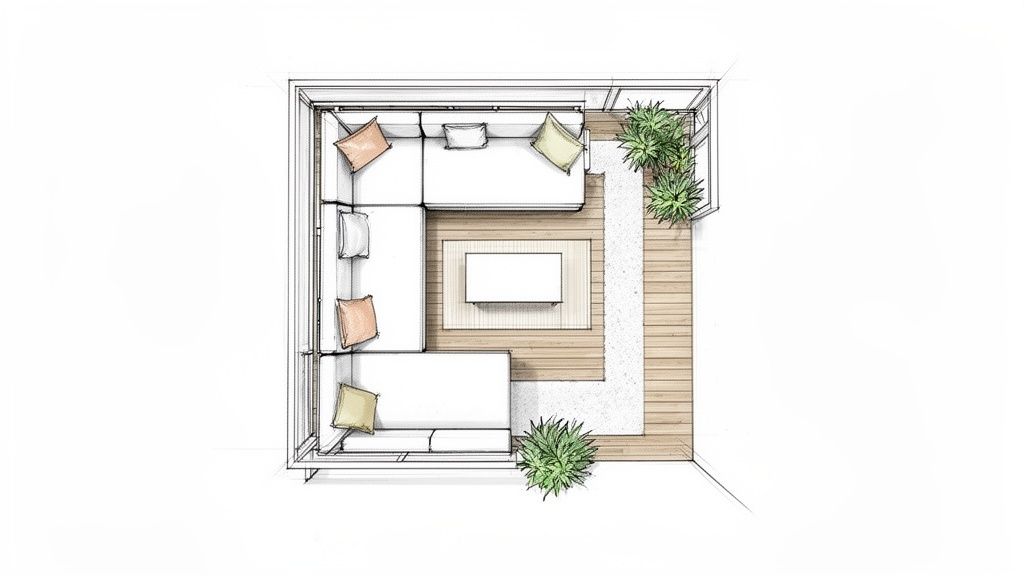
One of the most effective deck decorating ideas for creating a functional and inviting outdoor living room is to anchor the space with a sectional sofa. Unlike some patio sets with separate chairs, a sectional's modular design offers great versatility. It allows you to define specific zones for conversation, lounging, or entertaining, transforming a simple wooden platform into a true extension of your home.
The key benefit is maximizing seating in a consolidated footprint, which helps prevent the cluttered look that can happen with too many individual furniture pieces. An L-shaped sectional, for instance, fits well into the corner of a deck, opening up the center for a fire pit or coffee table. For circular or uniquely shaped decks, a curved sectional can soften the lines and create a cozy, enclosed feel.
How to Implement This Idea:
To make a sectional work for your deck, consider these practical steps:
Measure Meticulously: Before you shop, measure your deck's total dimensions. Then, map out where the sectional will go, ensuring you leave at least 30-36 inches for major walkways to maintain easy traffic flow.
Choose Climate-Appropriate Materials: In Georgia’s humid climate, look for sectionals with rust-proof aluminum frames and cushions made from performance fabrics. These materials are specifically engineered to resist mildew, moisture, and fading from intense sun.
Plan for Sun Exposure: If possible, position your sectional to avoid direct, harsh afternoon sun. This will not only make seating more comfortable but will also significantly prolong the life and color of the upholstery. If you can't avoid the sun, a large cantilever umbrella is a valuable accessory.
Accessorize for Comfort: Complete the look with outdoor-rated throw pillows and a weather-resistant area rug. These additions introduce color and texture while defining the seating area as a distinct "room."
By strategically placing a sectional, you create a comfortable and stylish hub for everything from quiet morning coffee to lively evening gatherings with friends and family.
2. Deck Lighting and String Lights
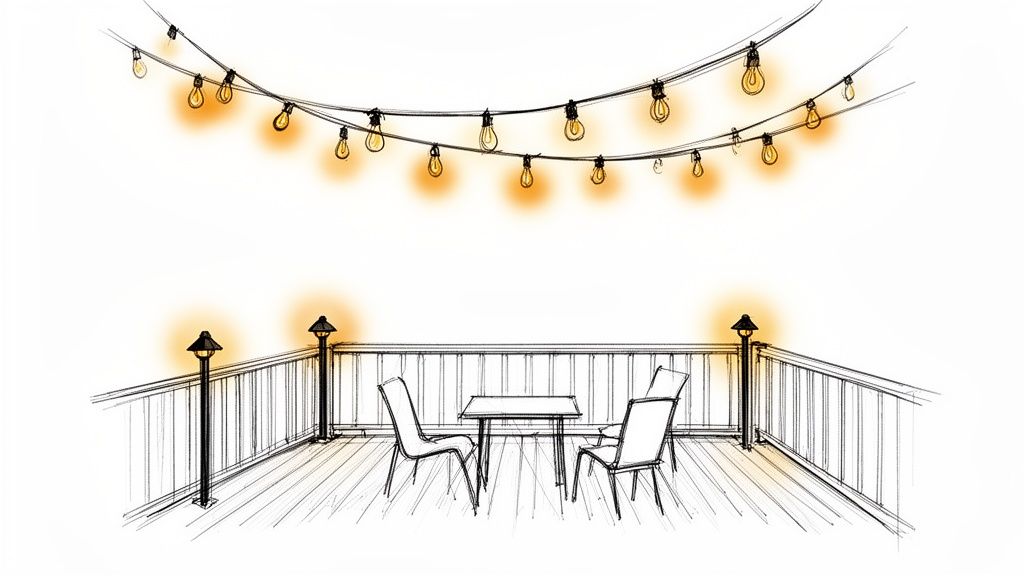
Strategic lighting is one of the most impactful deck decorating ideas for transforming an outdoor space from simply usable during the day to functional at night. Proper illumination extends the use of your deck well past sunset, creating an inviting atmosphere for evening entertaining or quiet relaxation. It also significantly improves safety by highlighting steps, edges, and pathways.
The key is to layer different types of light to build depth and ambiance. For instance, overhead bistro-style string lights cast a warm glow ideal for dining areas, while subtle path lights ensure secure footing without overpowering the mood. This combination of ambient, task, and accent lighting turns a dark deck into a sophisticated and functional outdoor room.
How to Implement This Idea:
To effectively light your deck, consider these practical steps:
Layer Your Lighting Sources: Don't rely on a single fixture. Combine overhead string lights for general ambiance, install solar-powered stake lights along the perimeter for safety, and consider using discreet LED strips under railings or benches to add a modern, polished glow.
Choose the Right Color Temperature: For a cozy and welcoming atmosphere, select bulbs with a warm white color temperature (around 2700K). This mimics the soft glow of traditional incandescent bulbs and is often more flattering than harsh, cool-white light.
Consider Smart Controls and Timers: Timers or smart plug systems can automate the process, ensuring your deck is beautifully lit as dusk falls, and can help conserve energy. Dimmers are also excellent for adjusting the brightness to suit any occasion.
Plan for Power and Safety: Before purchasing lights, identify the locations of your outdoor-rated power outlets. Always use extension cords and fixtures designed specifically for outdoor use to withstand Georgia’s weather, and position them to avoid creating tripping hazards.
By thoughtfully layering different lighting elements, you can create a safe, functional, and pleasant outdoor environment that you and your guests will enjoy long after the sun goes down.
3. Outdoor Dining Sets and Table Arrangements
Creating a dedicated dining area is one of the most functional deck decorating ideas, instantly turning your outdoor space into a destination for meals and gatherings. An outdoor dining set does more than just provide a place to eat; it establishes a clear zone for entertaining, encouraging you to bring the joys of al fresco dining to your own backyard. It transforms the deck from a simple platform into a purposeful social hub.
The primary advantage of a designated dining set is its ability to anchor an entertainment space, much like a dining room does indoors. A six-person teak table, for example, signals that the area is meant for family dinners and hosting friends, while a small, round bistro table creates an intimate nook for coffee. By selecting a set that complements your deck’s style and your entertainment needs, you enhance both its utility and aesthetic appeal.
How to Implement This Idea:
To effectively integrate a dining set into your deck design, consider these practical steps:
Prioritize Traffic Flow: Before purchasing, measure the space and ensure you can leave at least 36 inches of clearance around the table on all sides. This prevents a cramped feeling and allows guests to easily pull out their chairs and walk around the area.
Select Durable, Weather-Resistant Materials: In North Georgia's varied climate, choose materials built to last. Look for tables made from naturally rot-resistant woods like teak or eucalyptus, or powder-coated aluminum frames that won’t rust. Cushioned chairs with quick-drying, UV-resistant fabrics offer comfort without succumbing to mildew or fading.
Position for Convenience: Place your dining set near the entrance to your kitchen for easy transport of food and drinks. This simple logistical choice makes hosting feel more seamless and encourages more frequent outdoor meals.
Plan for Shade and Comfort: No one enjoys dining in the glaring sun. Position your table under a pergola, or ensure it has a center hole for a large patio umbrella. For added comfort during long evenings, select chairs with supportive cushions.
4. Fire Pits and Outdoor Heating Elements
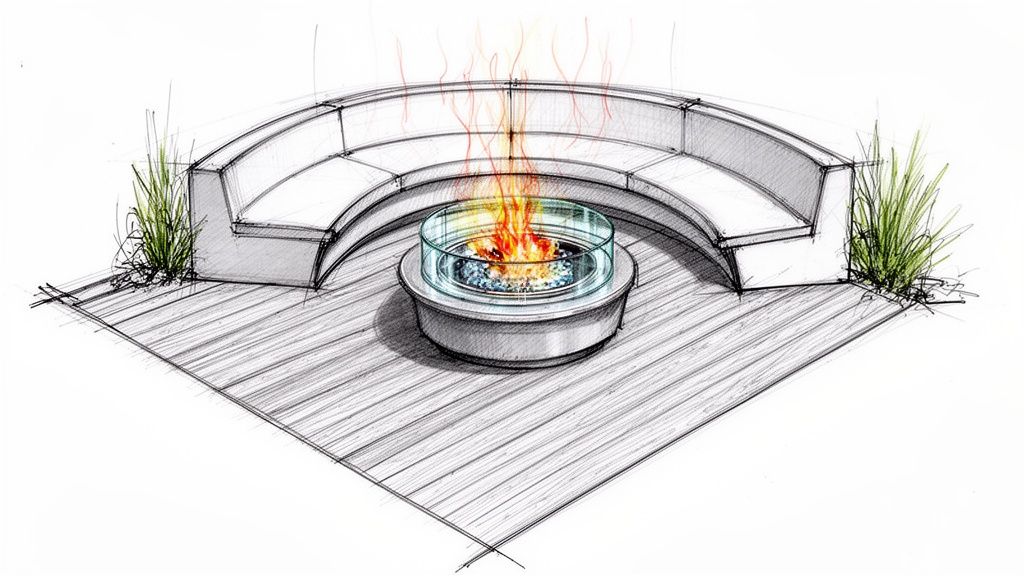
One of the most useful deck decorating ideas for extending the usability of your outdoor space is incorporating a fire pit or heating element. These features do more than just provide warmth on chilly evenings; they create a powerful focal point that encourages gathering and conversation. By adding a source of heat and ambient light, you can transform your deck into a cozy, year-round destination for family and friends, effectively increasing its seasonal value.
The key benefit is the creation of a natural gathering spot. Whether it's a sleek propane fire table acting as a centerpiece for your seating arrangement or a classic wood-burning fire bowl, the radiant warmth and flickering flames draw people together. This makes a fire feature an excellent anchor for a conversation zone, encouraging guests to relax and linger long after the sun goes down.
How to Implement This Idea:
To safely and effectively add a fire feature to your deck, consider these practical steps:
Prioritize Safety and Compliance: Before purchasing, check your local fire codes and any HOA regulations regarding open flames on wooden structures. Many areas have specific rules about placement and fuel types.
Ensure Proper Clearance: Always maintain a safe distance from your home and any other combustible materials. A minimum clearance of 10 to 15 feet is a standard recommendation, but you should always follow the manufacturer's specific guidelines.
Choose the Right Fuel Source: Propane or natural gas fire tables offer a clean, smoke-free experience with easy ignition and no cleanup. Wood-burning pits provide a more traditional, rustic ambiance but require more attention and produce embers.
Arrange Seating for Conversation: Position your weatherproof chairs or sofas in a circular or semicircular layout around the fire pit. This arrangement promotes face-to-face interaction and ensures everyone can enjoy the warmth and view.
Protect Your Deck Surface: Never place a fire pit directly on a wood or composite deck. Use a non-combustible base like a deck protector pad, stone pavers, or concrete blocks to prevent heat damage and create a stable foundation.
5. Shade Solutions: Pergolas, Umbrellas, and Awnings
One of the most practical deck decorating ideas for the Georgia climate is incorporating strategic shade. Effective shade solutions do more than just offer relief from the intense sun; they add architectural character and define distinct zones on your deck. Whether you opt for a permanent structure or a flexible accessory, providing shade makes your outdoor space more comfortable and usable, especially during the peak heat of summer afternoons.
From grand pergolas that create an open-air room to versatile umbrellas that target specific areas, the right choice depends on your deck’s layout and your lifestyle. A retractable awning offers on-demand coverage without a permanent footprint, while a pergola can become a stunning focal point, especially when adorned with climbing vines. These additions protect your furniture from sun damage and make daytime entertaining a much more pleasant experience. For a more permanent structure, understanding the cost to build a pergola can help you plan your budget for this valuable addition.
How to Implement This Idea:
To integrate the perfect shade solution into your deck design, consider these steps:
Assess Your Needs: Determine which areas need the most protection. A large cantilever umbrella may be perfect for shading a dining table, while a full-size pergola might be better for covering an entire seating arrangement.
Prioritize UV Protection: When choosing fabrics for umbrellas or awnings, look for materials with a high UV protection rating. This not only shields you and your guests but also helps prevent your outdoor cushion fabrics from fading prematurely.
Plan for Stability: For umbrellas, especially in open, windy areas, use a heavy, weighted base or a model that can be secured directly to the deck. For permanent structures like pergolas, ensure they are professionally installed to meet local building codes.
Consider Automation: For maximum convenience, motorized retractable awnings can be extended or retracted with the push of a button. This allows you to adapt to changing weather conditions instantly.
Enhance with Greenery: Use a pergola as a trellis for climbing plants like wisteria or jasmine. This creates a beautiful, natural canopy that provides dappled shade and adds a lush, organic element to your deck.
6. Outdoor Rugs and Floor Coverings
One of the simplest yet most impactful deck decorating ideas is to introduce an outdoor rug. More than just an accessory, a well-chosen rug acts as a visual anchor, defining specific zones like seating or dining areas. It adds a layer of comfort underfoot, introduces color and pattern, and makes the deck feel like a finished, intentional outdoor room.
The primary benefit of an outdoor rug is its ability to tie disparate furniture pieces together into a cohesive group. For instance, a large geometric-patterned rug placed under your sofa and chairs immediately establishes a conversation nook. On a larger deck, a striped runner can create a distinct path to a dining set, guiding flow and separating functions without physical barriers. They also protect the deck surface from scratches and wear in high-traffic zones.
How to Implement This Idea:
To effectively use outdoor rugs on your deck, consider these key steps:
Size It Correctly: The rug should be large enough to anchor your main furniture. For a seating area, ensure at least the front legs of all pieces are on the rug. For a dining set, the rug should be big enough so that the chairs remain on it even when pulled out.
Select Weather-Resistant Materials: Look for rugs made from synthetic fibers like polypropylene, polyester, or nylon. These materials are designed to resist fading, moisture, and mildew, which is essential in Georgia’s humid climate.
Prioritize Safety and Maintenance: Use a non-slip pad underneath your rug to prevent it from sliding, especially on smooth deck surfaces. Regular cleaning, such as sweeping and occasional hosing down, will prevent dirt and mildew buildup and extend its life.
Use Rugs to Define Zones: On a large, open deck, use different but complementary rugs to create distinct "rooms." A neutral, natural-fiber-look rug could define a lounging area, while a bolder, colorful rug marks the dining space, adding visual interest.
7. Outdoor Accent Furniture and Accessories
While large seating and dining sets create the foundation of your deck, it's the carefully chosen accent furniture and accessories that inject personality and complete the space. These smaller pieces are essential deck decorating ideas that add layers of style, texture, and functionality. Items like side tables, ottomans, and planters transform a functional area into a truly finished and personalized outdoor retreat.
The power of accent furniture lies in its ability to fill gaps both visually and practically. A well-placed side table provides a convenient spot for a cool drink or a book, while a collection of planters introduces life and vibrant color. These elements allow you to easily refresh your deck's look seasonally or as your tastes change, without committing to a complete furniture overhaul.
How to Implement This Idea:
To effectively use accent pieces, think of them as the finishing touches that tie everything together:
Mix Materials and Textures: Create visual interest by combining different materials. Pair a smooth metal side table with a woven rattan ottoman or contrast sleek modern planters with the rustic grain of your wood deck. This textural variety adds depth and a professionally designed feel.
Layer with Purpose: Arrange accessories to create balanced, appealing compositions. A common design principle is to group items in odd numbers, such as a cluster of three planters of varying heights. This creates a more natural and dynamic look than symmetrical pairings.
Balance Form and Function: Select pieces that are both beautiful and useful. An outdoor-safe pouf can serve as an extra seat, a footrest, or even a temporary table with the addition of a tray. This dual-purpose approach is especially valuable for smaller decks where every square foot counts.
Choose Durable Pieces: Just like your main furniture, accessories must withstand North Georgia's sun and humidity. Invest in planters, tables, and textiles made from weather-resistant materials to ensure they remain beautiful and functional for many seasons.
8. Vertical Gardens and Planters
One of the most resourceful deck decorating ideas, especially for those with limited square footage, is to grow upwards with vertical gardens. This approach utilizes wall-mounted planters, trellises with climbing vines, and tiered plant stands to introduce lush greenery without sacrificing valuable floor space. It effectively turns bare walls or railings into vibrant living art, adding color, texture, and a sense of natural enclosure.
The primary advantage is maximizing your garden's potential in a compact footprint. A living wall can serve as a beautiful privacy screen, obscure an unappealing view, or even function as a convenient kitchen garden for fresh herbs. Tiered planters can create a stunning focal point in a corner, while hanging baskets add dimension and charm to the deck's perimeter. This strategy allows you to surround yourself with plants even on a small balcony or patio.
How to Implement This Idea:
To create a thriving vertical garden on your deck, consider these practical steps:
Select Appropriate Plants: Choose plants that suit your deck’s specific sun exposure. In Georgia's climate, heat-tolerant options like petunias, sweet potato vines, and hardy herbs (rosemary, thyme) thrive. For shady spots, consider ferns, heuchera, or impatiens.
Use Lightweight Containers: When mounting planters on walls or railings, opt for lightweight materials like resin or high-quality plastic to reduce the structural load. Ensure any mounting hardware is securely fastened.
Ensure Proper Drainage: Good drainage is critical to prevent root rot and protect your deck's surface from water damage. Look for containers with built-in drainage holes or add them yourself. A small saucer can catch excess water.
Plan for Easy Watering: Vertical gardens can dry out quickly. Consider installing a simple drip irrigation system or using self-watering planters to ensure your plants receive consistent moisture, especially during hot Georgia summers.
Create Visual Interest: Arrange plants with varying heights, textures, and colors. Mix flowering annuals with trailing ivy and functional herbs to create a dynamic and appealing display that adds depth to your outdoor space.
9. Outdoor Entertainment Systems and Features
To truly elevate your deck into an all-season destination, consider integrating outdoor entertainment systems. This deck decorating idea goes beyond simple furniture by incorporating modern technology like built-in speakers, weatherproof televisions, and projection setups. These features transform your deck from a simple seating area into a complete hub for movie nights, sports viewing, and outdoor parties with friends and family.
The primary advantage is creating a multifunctional space that caters to how we live and entertain today. A weather-resistant TV mounted under a covered porch turns your deck into a prime spot for the big game. Similarly, a projector system with a portable outdoor screen can create unique movie nights under the stars, offering an experience a living room can't replicate.
How to Implement This Idea:
To add an entertainment system to your deck, consider these practical steps:
Plan Power and Placement: Before you buy any equipment, identify where you will install it. Ensure you have access to GFCI-protected outdoor electrical outlets. Position screens to minimize glare and direct sun reflection, which can wash out the picture and damage electronics.
Choose Weather-Appropriate Tech: Standard indoor electronics are not built to withstand Georgia’s humidity, heat, or rain. Invest in TVs, speakers, and projectors specifically rated for outdoor use. Look for features like high-brightness screens (often 1500+ nits for TVs) to ensure visibility in daylight.
Optimize Your Audio: For sound, consider a system of small, strategically placed outdoor speakers instead of one large source. This provides even sound distribution without disturbing your neighbors. You can mount them on deck railings, under eaves, or even disguise them as landscape rocks.
Protect Your Investment: Even weatherproof electronics benefit from extra protection. Use high-quality covers when the system is not in use and try to install TVs or projectors in a covered or partially shaded area of your deck to prolong their lifespan.
10. Color and Theme Coordination with Weather-Resistant Fabrics
One of the most impactful deck decorating ideas is to establish a cohesive color palette and theme. Using weather-resistant outdoor fabrics to coordinate your furniture, cushions, rugs, and pillows transforms a collection of separate items into a harmonious, thoughtfully designed space. A deliberate color scheme elevates your deck from a simple outdoor area to a sophisticated extension of your home's interior style.
This approach provides a framework for all your decorating choices, making decisions easier and ensuring the final look is polished and intentional. For example, a coastal theme could use a base of whites and sandy neutrals accented with navy blue and seafoam green pillows. A modern minimalist deck might rely on a monochrome palette of gray, black, and white with clean lines and subtle textures. The key is using durable, fade-resistant fabrics to maintain the color story through Georgia’s sunny seasons.
How to Implement This Idea:
To create a unified theme on your deck, follow these practical steps:
Start with a Neutral Base: Choose major furniture pieces like sofas or dining sets in neutral colors such as gray, beige, or white. This provides a versatile foundation that allows you to easily swap out accent colors with accessories.
Select a Cohesive Palette: Pick two to three accent colors to layer on top of your neutral base. You can draw inspiration from your home's interior decor for a seamless indoor-outdoor flow or from the natural landscape surrounding your deck.
Prioritize Performance Fabrics: Invest in high-quality, weather-resistant fabrics designed for outdoor use. Materials like solution-dyed acrylics are engineered to resist fading, moisture, and mildew, ensuring your colors stay vibrant.
Layer Colors and Textures: Mix solid-colored cushions with patterned throw pillows and a coordinating outdoor rug. This creates visual depth and interest while reinforcing your chosen theme. For instance, pair solid navy cushions with pillows featuring a subtle white geometric pattern.
Plan for Seasonal Updates: Your neutral base makes it simple to refresh your deck's look. Swap in terracotta and gold pillows in the fall or bright coral and turquoise for the summer to keep the space feeling fresh without replacing major items.
Deck Decorating Ideas — 10-Point Comparison
Item
Implementation complexity
Resource requirements
Expected outcomes
Ideal use cases
Key advantages
Outdoor Sectional Seating Arrangements
Medium — assembly and layout planning
High space; moderate–high cost; weather-resistant materials
Defined gathering zones; increased seating and comfort
Large decks, entertaining, lounging areas
Modular/customizable; maximizes seating; comfortable for groups
Deck Lighting and String Lights
Low–Medium — DIY to hardwired pros
Low–medium cost; electrical or solar options; durable fixtures
Transforming an empty or underutilized deck from a simple wooden platform into a vibrant, functional outdoor living area is a journey of thoughtful choices. The most successful deck decorating ideas are not just about aesthetics; they are about creating a space that seamlessly extends your home's comfort and personality into the great outdoors. This process involves a strategic blend of planning, creativity, and selecting the right elements to suit your specific needs and the unique climate of North Georgia.
The core takeaway from this guide is the power of zoning and purpose. Your deck can be a multi-functional oasis if you define its purpose. Is it a lively hub for family dinners, a tranquil retreat for morning coffee, or a great spot for weekend entertaining? By establishing clear zones for dining, lounging, and conversation, you create a natural flow that makes the space feel larger and more organized. A well-placed outdoor sectional can anchor a social area, while a dedicated dining set under a pergola carves out a distinct space for meals.
From Inspiration to Implementation
Moving from a list of ideas to a tangible plan requires a focus on layering and texture. This is where a good design truly comes to life. Remember the impact of layering different elements:
Foundation First: Start with your largest pieces, like a durable outdoor dining set or a comfortable deep-seating collection. These items form the backbone of your deck's functionality.
Soften the Surfaces: Introduce outdoor rugs to define zones and add a layer of comfort underfoot. A rug can visually connect disparate furniture pieces and introduce color and pattern.
Layer the Light: A single porch light is rarely enough. Combine ambient string lights for a warm glow, task lighting over a grill or dining area, and accent lights to highlight planters or architectural features. This creates depth and mood, allowing you to use the space long after the sun sets.
Add Textiles and Greenery: Weather-resistant throw pillows, cushions, and blankets are the final touches that inject personality and comfort. Complement these with planters and vertical gardens to bring life, color, and a natural softness to the hardscape of your deck.
An effective outdoor space is one that anticipates your needs. It provides shade on a hot day, warmth on a cool evening, and comfortable seating for one person or ten. Each element, from the fire pit to the privacy screen, should solve a problem and enhance your enjoyment.
Mastering these deck decorating ideas empowers you to create more than just a beautiful space; it allows you to build a personal sanctuary. It's about crafting an environment that encourages you to step outside, relax, and connect with family and friends. By investing in durable, weather-resistant materials and a thoughtful layout, you ensure your deck remains a cherished part of your home for many years, capable of adapting to different seasons and occasions. Your deck is a blank canvas, and with these strategies, you have the tools to create something that reflects your lifestyle and brings you daily joy.
Ready to find the perfect pieces to complete your outdoor vision? Seeing and feeling the quality of outdoor furniture in person can make all the difference in your decision. We invite you to visit a Woodstock Furniture & Mattress Outlet showroom to explore our collection of outdoor seating, dining sets, and accessories and get helpful advice from our knowledgeable team.