Tag: office organization

  • Your Guide to Finding a Home Office Desk With Storage

    Your Guide to Finding a Home Office Desk With Storage

    Think of a home office desk with storage as your productivity command center. It’s much more than just a flat tabletop; it's a dedicated station that combines a work surface with built-in drawers, shelves, or cabinets. This setup keeps your essential supplies close at hand but neatly tucked away.

    Why an Organized Workspace Begins With Your Desk

    When remote and hybrid work shifted from a temporary fix to a long-term reality, many of us quickly found the limits of our makeshift offices. The kitchen table or that old folding table might have been fine for a few weeks, but long-term productivity can suffer when your workspace is cluttered, inefficient, and constantly creeping into your personal life. The root of the problem is often a lack of dedicated, organized space.

    This is exactly where a home office desk with storage becomes more than just another piece of furniture—it’s a strategic tool. It draws a clear line between your professional duties and your home life, helping you mentally clock in and, more importantly, clock out. By giving every paper, pen, charger, and file a proper home, you eliminate the visual clutter that can compete for your attention.

    From Temporary Fix to Permanent Solution

    The initial scramble to work from home meant making do with whatever was available. Now, people are shifting their focus to creating sustainable, comfortable, and efficient home office environments. We see this change reflected every day in how our customers are furnishing their homes.

    An organized space cultivates focus and lowers stress. When everything has a designated spot inside your desk, you spend less time digging around for what you need and more time on the tasks that actually matter.

    Recent data backs this up. Professionals are transitioning from temporary tables to more permanent, ergonomic solutions. When investing in home office furniture, 27% of U.S. consumers prioritized desks, while another 10% focused specifically on storage cabinets. This shows a strong demand for furniture that solves both needs at once.

    In fact, the entire U.S. home office furniture market is growing, projected to expand from USD 6.94 billion in 2026 to USD 9.67 billion by 2031. This growth is fueled by that same desire for functional, organized workspaces. You can read more about the home office furniture market trends and their projected growth.

    Choosing the right desk is a critical first step in reclaiming your focus. It's about building a home office that genuinely works for you, not against you.

    Finding the Right Desk Type for Your Workflow

    Choosing a home office desk with storage is a lot like picking the right tool for a job. You wouldn't use a small hammer to break up concrete, and you likely wouldn't try to manage a mountain of paperwork on a tiny laptop stand. The key is matching your desk's features to your daily tasks, your room's layout, and how you like to keep things organized.

    We’ve all seen it happen. A shopper buys a desk that looks great online or in a showroom, only to get it home and realize it just doesn’t work for them. This can lead to clutter, frustration, and a workspace you want to avoid. To help prevent that, let's walk through the most common desk styles and what they're really good for.

    First, take a look at the chart below. It’s a simple way to figure out if your current desk is pulling its weight, or if it might be time for an upgrade.

    Flowchart for deciding if you need a new home office desk with more storage.

    This guide boils it all down to one question: is your current desk a source of clutter because it lacks storage? If the answer is yes, then one of the desks below is likely a better fit for you.

    To help you get a bird's-eye view, here's a quick rundown of some popular home office desk styles you'll find in showrooms.

    A Quick Comparison of Home Office Desk Styles

    Desk Type Primary Storage Feature Best For Space Consideration
    Writing Desk Single slim drawer Minimalist, laptop-focused work Small footprint, fits almost anywhere
    Computer Desk Tech-specific slots & drawers Organizing hardware and peripherals Moderate footprint, very functional
    Executive Desk Multiple deep file & box drawers Paper-heavy tasks, traditional offices Large footprint, needs a dedicated room
    Credenza Desk Integrated long storage unit Multitasking with lots of surface area Very large, L or U-shaped footprint

    Each of these desks serves a different purpose, so let's dive a little deeper into what makes each one unique.

    Writing Desks: The Minimalist Approach

    A writing desk is the essence of simplicity. Think of it as a clean, open workspace with a spacious top and very little built-in storage. You'll typically find a single, slim drawer—just enough to hide a few pens, a notebook, or your charging cables.

    • Who it’s for: It's a great match for digital nomads, writers, students, or anyone who does most of their work on a laptop and prefers a clean, uncluttered look.
    • Storage Tradeoff: You’re trading lots of storage for a lighter, more airy feel. If your needs go beyond a handful of supplies, you may want to pair it with a separate bookcase or filing cabinet.

    Computer Desks: Built for Technology

    As the name implies, computer desks are engineered with technology in mind. They come with features you may not find on a writing desk, like keyboard trays, shelves for a CPU tower, and sometimes even a small hutch or monitor riser. Storage usually consists of one or two box drawers for essential office supplies.

    The main job of a computer desk is to keep your tech organized. While they offer some storage, the primary goal is creating a functional and ergonomic home for your monitor, keyboard, and computer tower.

    Executive Desks: The Traditional Command Center

    When you imagine a classic, commanding office, you’re probably picturing an executive desk. These are substantial pieces of furniture known for their ample storage, which often includes a mix of deep file drawers and smaller box drawers. The generous top gives you plenty of room to spread out.

    This style is a good fit for a dedicated home office where managing physical files and paperwork is a daily task. Their large footprint makes them a challenging fit for smaller rooms or multi-purpose spaces.

    Credenza Desks: Expansive Surface, Integrated Storage

    A credenza desk is a multitasking powerhouse, combining a large work surface with a long, low storage unit (the credenza) that's either attached or sits alongside it. This creates a roomy L-shaped or U-shaped workspace that maximizes both your desktop real estate and your accessible storage. The credenza part usually has a combination of file drawers, cabinets, and open shelving.

    • Who it’s for: Professionals who need to juggle multiple tasks at once. Think designers reviewing large prints, accountants managing stacks of files, or anyone who needs their printer and scanner within arm's reach.
    • Space Consideration: Because of their sprawling design, credenza desks require a significant amount of floor space. They work well in larger, dedicated office rooms where they have room to breathe.

    How to Choose the Right Desk Material for Your Home Office

    When you’re picking out a home office desk with storage, what it’s made of is a huge factor. It’s not just about looks—the material determines how long it might last, how it feels, and how it holds up to morning coffee spills and daily use. Getting this right is all about matching your style with the real-world demands of your life.

    Think of it like this: you wouldn’t choose the same material for a child’s playroom desk as you would for a stately executive office. One needs to be durable, the other needs to make a statement. Let's walk through some common options so you can find a desk you’ll appreciate for years to come.

    Solid Wood: The Timeless Classic

    Solid wood desks are built from lumber cut directly from trees like oak, cherry, maple, and pine. Because each piece of wood has its own unique grain, no two solid wood desks are ever exactly alike. You're getting a one-of-a-kind piece.

    The biggest benefit of solid wood? It’s built to last. We’re talking about furniture that can stand up to decades of use. If you get a scratch or a dent, it’s not the end of the world. In many cases, it can be sanded and refinished.

    • Who it’s for: Anyone who sees furniture as a long-term investment. If you want a piece that could become a family heirloom and appreciate the character of natural materials, this is an option to consider.
    • What to expect: Solid wood is heavy, and it can be sensitive to big swings in humidity, sometimes expanding or contracting slightly. It’s also typically a higher initial investment compared to other options.

    There’s a reason wood is so popular in the furniture world. It’s warm, beautiful, and durable. In fact, desks and tables are expected to make up 38.7% of the global office furniture market by 2026. And within that, wood materials are projected to hold a massive 35.7% share in the same year. You can read more about these office furniture market trends if you're curious!

    Wood Veneers: Appearance and Stability Combined

    So, what is a wood veneer desk? It’s a clever construction method where a thin slice of real, beautiful wood is bonded to a stable core, like MDF (medium-density fiberboard) or particleboard. This lets you get the gorgeous, high-end look of an exotic or expensive wood, but often at a more accessible price point.

    Veneers are also incredibly stable. The engineered core isn’t as prone to warping or splitting as solid wood can be, which makes a veneer desk a fantastic, durable choice, especially if you live somewhere with fluctuating humidity.

    Think of veneer as a blend of two worlds. You get the authentic beauty of a real wood grain on the outside, but it’s backed by an engineered core that gives it strength and stability.

    Laminate and Manufactured Wood: The Heavy-Duty Workhorse

    Laminate desks are the workhorses of the office world. They’re made by fusing a printed plastic surface to a composite wood core. This material is known for being incredibly resistant to scratches, stains, and heat. For a busy home office—especially one that doubles as a homework station—it can be a lifesaver.

    Modern laminates have come a long way, with realistic wood grain patterns and a wide array of colors and textures. They provide a consistent look and are very easy to clean, which is a huge plus for busy families or anyone who is spill-prone.

    • Who it’s for: A good choice for families with kids, busy professionals, or anyone who prioritizes maximum durability and easy maintenance.
    • The trade-off: Unlike solid wood, if you get a deep scratch or chip in a laminate surface, it generally can’t be repaired.

    Metal Desks: Sleek, Strong, and Modern

    You'll see metal, usually steel or aluminum, used often for desk frames and legs. Why? It provides incredible, industrial-strength support. You’ll also find desks made entirely from metal, which lend a sleek, modern, or industrial vibe to a room. It’s tough and easy to clean.

    Metal is also often paired with other materials to create a mixed-material look that is very popular. A sturdy metal frame can easily support a thick, heavy solid wood top, or it can provide a minimalist, airy base for a glass surface. It’s a great way to get design flexibility and rock-solid construction in one package.

    Creating a Comfortable and Productive Desk Layout

    A detailed sketch of a home office setup showing natural light from a window reflecting onto a computer monitor.

    Even a beautiful home office desk with storage can fall flat if the setup just feels… off. You know the feeling. You’ve got all the drawers and shelves you need, but something isn’t clicking. You end the day with a nagging backache or tired eyes, and you can’t seem to find your focus.

    More often than not, the solution isn't a new piece of furniture. It’s all about how you arrange what you already have. Getting your ergonomics and room layout right is the secret to creating a space where you can work comfortably for hours on end. Let's walk through how to set up your desk for lasting comfort and productivity.

    The Foundation of Comfort: Ergonomics

    "Ergonomics" might sound like a complex term, but it’s actually pretty simple. It’s the practice of making your workspace fit you, instead of forcing your body to fit the workspace. When your desk, chair, and monitor all work in harmony, you can reduce those common aches and pains from a long workday.

    A few small tweaks can make a world of difference.

    • Desk and Chair Height: When you’re sitting down, your feet should be flat on the floor with your knees bent at about a 90-degree angle. Your forearms should be parallel to the floor when typing, with your elbows also at a 90 to 110-degree angle. If your desk is too high, raise your chair and use a footrest. Too low, and you may find yourself hunching over.

    • Monitor Placement: Position your monitor so the top of the screen is at or just below your eye level. This simple adjustment helps you avoid tilting your head, which is a huge source of neck strain. The screen should also be about an arm's length away to keep you from leaning in or straining your eyes.

    • Keyboard and Mouse Position: Keep your keyboard and mouse close. You should be able to use them with relaxed shoulders and your elbows near your body. Constantly reaching for your mouse can lead to shoulder and wrist pain down the road.

    Think of your desk and chair as a team. If they aren't adjusted to work together properly, your body will notice. Achieving that 90-degree angle at your knees and elbows is the first step toward a more comfortable workday.

    Arranging Your Room for Flow and Focus

    Once your immediate workspace is dialed in, it's time to zoom out and look at the room itself. Where you place your desk can have a massive impact on your mood, focus, and overall productivity.

    A poorly placed desk can make a space feel cramped, cause frustrating glare on your screen, or serve up a constant stream of distractions. Here’s how to position your home office desk with storage for better results.

    Harnessing Natural Light

    Everyone loves natural light—it's a proven mood and energy booster. But when it comes to a home office, it can be a double-edged sword if you don't manage it correctly.

    • Ideal Placement: The sweet spot is usually placing your desk perpendicular to a window. This gives you plenty of pleasant ambient light without it shining directly in your eyes or onto your screen. Plus, you can easily turn your head for a quick glance outside.

    • What to Avoid: Try to avoid placing your monitor directly in front of a window. The bright light from behind creates intense glare and can cause eye strain. Facing a window can be just as distracting, making you squint all day. If you have no other choice, a good set of blinds or curtains is essential.

    Creating Clear Pathways

    A functional office is one you can move around in easily. Nothing creates a subtle, low-grade stress like feeling trapped at your desk or having to squeeze past furniture.

    Make sure you leave at least 3 feet of clearance behind your desk chair so you can get in and out without a struggle. You should also have clear, easy-to-navigate paths from the door to your desk and any other furniture like bookcases or filing cabinets. This sense of openness makes the entire room feel more inviting.

    To really elevate your space, don’t forget other comfort-boosting elements like a quality ergonomic chair, good task lighting, and even some of the best indoor plants for offices. A bit of greenery can truly bring a room to life. By combining smart ergonomics with thoughtful room planning, you can transform your home office from a place you have to be into a space you genuinely want to be.

    Organizing Your Desk for Lasting Focus

    So, you’ve picked out a home office desk with storage. The drawers are empty, the surface is clear, and it’s full of promise. But we’ve all been there—a few weeks later, that pristine workspace is buried under a mountain of papers, stray pens, and miscellaneous clutter.

    Here's the thing: a desk with good storage is only half the battle. If you don't have a system, those drawers and shelves can just become black holes for stuff you can't find. The real secret is moving from just storing things to truly organizing them. It's about giving every single item a designated, logical "home" so you can grab it without thinking and, more importantly, put it back just as easily.

    An organized home office desk featuring a laptop, file organizer, open drawer with pens and small items, mouse, and coffee mug.

    Building a System That Sticks

    Beating clutter for good isn’t about a massive, one-time cleaning spree. It’s about creating simple habits that are easy to maintain. One effective method is a simple, zone-based approach.

    Think of your desk area in three distinct zones:

    • Zone 1: The Desktop: This is your prime real estate. It should be reserved only for the tools you need for the immediate task at hand. We're talking about your monitor, keyboard, mouse, and maybe a single notepad. Everything else needs a home off the surface.

    • Zone 2: The "Hot" Zone: These are your top drawers or the shelves you can reach without even rolling your chair. This area is for things you use every day, but don't need staring you in the face constantly. Think pens, chargers, your calculator, and files for current projects.

    • Zone 3: The "Cold" Zone: Lower drawers, cabinets, or the top shelves of a hutch are perfect for items you use less often. This is where you can store extra printer paper, backup ink cartridges, archived files, and bulk office supplies.

    By sorting your gear this way, you create a natural workflow. You’ll instinctively know where everything is, which saves you from that frustrating five-minute hunt for the stapler.

    Tools for Taming the Clutter

    Once you've got your zones mapped out, a few simple tools can make your storage spaces work even harder for you. These are inexpensive game-changers that turn a standard drawer into a powerhouse of organization.

    An organized desk isn't about being perfectly neat—it's about removing friction. When your tools are where they should be, your brain is free to focus on what really matters: your work.

    Here are a few essentials to consider:

    • Drawer Dividers: These are invaluable for taming that one drawer that holds all the small stuff. Use them to create dedicated spots for paper clips, USB drives, binder clips, and pens. No more chaotic jumbles.

    • Vertical File Organizers: Instead of letting papers pile up flat, stand them up! A simple vertical organizer on your desk or a nearby shelf keeps important documents visible and easy to grab without hogging your entire work surface. It’s perfect for active project files or mail that needs a response.

    • Cable Management Solutions: Nothing makes a space look messy faster than a spaghetti-like tangle of wires. Use simple velcro ties, adhesive clips stuck to the underside of your desk, or a cable box to bundle and hide all those cords. Many modern desks even come with built-in grommets or channels to help you out.

    Of course, keeping your desk tidy is a lot easier when the rest of your home is in order. The habits you build in one area often spill over into others. If you’re ready to take it a step further, you can learn how to organize your home for good and see how a clear living space can lead to a clear mind at your desk.

    Getting Friendly Advice to Find Your Perfect Fit

    Reading about a home office desk with storage is a great place to start, but many people find that nothing beats seeing furniture for themselves. Photos on a screen can only tell you so much about a piece. To really understand a desk’s true size, its finish, and the quality of its construction, it helps to experience it in person—to open the drawers, feel the texture of the wood, and actually picture it in your home.

    This is especially true as needs for working from home have changed so much. In fact, the global home office furniture market has grown significantly, from $3.03 billion in 2020 to a projected $7.62 billion by 2030. This boom is all about people like you looking for ergonomic, multi-functional desks that are built to last. Learn more about the market's evolution toward multi-purpose desks.

    Trying to sort through all these new options can feel a bit overwhelming, but you don’t have to figure it out on your own.

    Experience and Guidance You Can Trust

    At our North Georgia and metro Atlanta showrooms, we see ourselves as helpful partners in your search. Our experienced staff is here to offer friendly, no-pressure advice that’s specific to your situation, whether you're designing a dedicated home office or just trying to fit a workspace into a cozy corner of your living room.

    We believe the right fit is found through hands-on exploration and honest conversation. Our job isn't to persuade you to buy a specific desk; it's to help you find the right solution for your home and workflow.

    We always encourage shoppers to come in and just browse. When you see the options up close, you can compare different styles and sizes, get a real sense of the value you're getting, and ask all the questions you want. Our goal is to take the guesswork out of the process and help you find a piece of furniture you’ll love for years.

    We invite you to stop by any of our Woodstock Furniture & Mattress Outlet locations to explore our selection for yourself. Let our team provide the helpful guidance you need in a relaxed, friendly setting.

    Common Questions About Desks With Storage

    Even after you've browsed options, a few questions can pop up when it's time to choose a home office desk with storage. Getting clear, simple answers can make that final decision a whole lot easier and give you confidence in your choice. Here are a few of the most common questions we hear on our showroom floors, along with some practical advice.

    How Much Storage Do I Really Need?

    This is one of the most personal questions in furniture shopping, and there’s no single right answer. The ideal amount of storage really depends on your specific job and how you work. The best way to figure it out is to do a quick inventory before you even start looking.

    Think about it: someone who works exclusively on a laptop might just need a single drawer for a notepad and a few pens. On the other hand, if you're wrangling physical files, product samples, or a library of reference books, you'll probably want a desk with several drawers, a hutch, or maybe even a matching credenza.

    Take a look at your current workspace and sort your stuff into a few categories:

    • Daily Access: These are the items you grab multiple times a day. They belong in your top, most-accessible drawers.
    • Weekly Access: Things you use regularly, but not constantly. Lower drawers are the perfect spot for these.
    • Archival: Items you absolutely need to keep but rarely ever touch. These are great candidates for a separate filing cabinet or bookcase.

    Running through this quick exercise gives you a much clearer picture of what you actually need, so you don't end up with a desk that has way too much storage—or not nearly enough.

    What Is the Best Way to Manage Cables?

    Ah, the dreaded cable monster. A tangle of wires can make even the most beautiful desk look cluttered and chaotic. Thankfully, taming that mess is easier than you think.

    Many modern computer desks and executive desks come with smart features already built-in, like grommets (those little plastic-lined holes for routing wires) or channels along the back to tuck cords away. If the desk you fall in love with doesn’t have these, don't sweat it. You can easily create your own system.

    The real goal of cable management is just to get wires up off the floor and out of sight. A tidy setup doesn't just look better—it's also safer and helps prevent you from accidentally unplugging your monitor in the middle of a big project.

    There are many effective and inexpensive options you can grab online or at a hardware store. Adhesive clips that stick to the underside of your desk, velcro ties for bundling cords together, or a cable management box to hide your power strip are all fantastic solutions.

    Can I Mix and Match a Desk With Other Furniture?

    Absolutely! In fact, we encourage it. Your home office furniture doesn't have to look like it all came out of a single box from a single collection. Thoughtfully mixing and matching different pieces is what creates a truly curated, personalized space that feels like you.

    The trick to making a mix-and-match approach work is to have a common thread that ties everything together. This could be:

    • Material: Try pairing a rich, solid wood desk with a sleek metal bookcase.
    • Color: Use different furniture pieces that all share a similar color palette or tone.
    • Style: Combine a clean, modern desk with a vintage-inspired mid-century modern credenza.

    Just be mindful of the scale of your pieces. A massive executive desk might look out of place next to a tiny, delicate bookcase. Using an online tool like our Woodstock Furniture & Mattress Outlet Room Planner is a great way to experiment with different combinations to see how they look before you commit.


    At Woodstock Furniture & Mattress Outlet, our friendly team can help you answer these questions and any others you might have. Visit us to see a great selection of home office desks with storage in person and find the right fit for your space and workflow.
  • How to Set Up a Home Office: A Practical Guide

    How to Set Up a Home Office: A Practical Guide

    Before you even start browsing for desks or chairs, the real work begins with a bit of honest self-assessment. It's easy to get swept up in beautiful home office photos online, but creating a space that actually works for you is a different challenge. A gorgeous setup that doesn't support your daily tasks can quickly become a source of frustration.

    The goal here is to build a workspace around your real-world needs, not just fleeting design trends.

    Laying the Groundwork for a Productive Space

    Illustration of a home office layout and a person working at a desk with dual monitors and a checklist.

    With remote and hybrid work becoming a common arrangement for many of us, this planning stage is more critical than ever. What might have started as a temporary kitchen table setup now needs to be a dedicated, functional part of the home.

    The numbers show a significant shift. By 2026, projections suggest that 32.6 million Americans will be working from home. That's a fundamental change, with nearly 27% of all paid workdays in the U.S. now happening remotely. This isn't a passing trend; it's a new reality, and it underscores just how important having a well-designed home office truly is.

    Measure Your Space & Spot Potential Problems

    First things first, get a clear picture of your canvas. Grab a tape measure and jot down the dimensions of your future office spot, whether it's a whole room or just a cozy nook.

    • Width and Depth: How much floor space are you really working with?
    • Height: Don't forget to look up! Vertical space is a helpful asset for shelving and storage.
    • Obstructions: Make a quick map of where the windows, doors, closets, and—most importantly—electrical outlets are.

    This simple exercise can be a sanity-saver. It keeps you from considering a desk that won't fit or realizing your ideal layout completely blocks the only usable power outlet. Any successful project starts with solid office space planning and design, and your home office is no exception.

    For example, that spot right in front of a sunny window might seem idyllic, but the constant screen glare can lead to eye strain. Similarly, setting up shop next to a high-traffic hallway could mean endless interruptions. Catching these issues now can save you headaches later.

    Define How You Actually Work

    Next, let's be realistic about your day-to-day workflow. Your job's demands should dictate your office's function. Are you a graphic designer who needs a sprawling surface for sketches and a tablet, or a writer who just needs a spot for a laptop and a cup of coffee?

    To get you started, we've put together a quick checklist. Use these questions to nail down what you truly need before you start looking at furniture.

    Home Office Needs Assessment Checklist

    Use this checklist to evaluate your space, work style, and technical requirements before you start shopping for furniture.

    Consideration Area Key Questions to Ask Yourself Example Solutions
    Workflow & Tasks What are my primary daily activities? (e.g., writing, video calls, design) An L-shaped desk for multitasking; a simple writing desk for focused work.
    Tech Setup How many monitors do I need? Do I need a printer, scanner, or other hardware? A desk with enough depth for a dual-monitor stand; a credenza for the printer.
    Storage Needs Am I dealing with paper files or is my work all digital? Where will I keep supplies? A filing cabinet for documents; open shelving or a hutch for books and binders.
    Meeting Presence How often am I on video calls? What's in my background? Is the lighting good? A clean, professional background; a desk lamp or ring light for better video quality.
    Ergonomics & Comfort Will I be sitting for long hours? Do I have any specific ergonomic needs? An adjustable-height desk; a fully adjustable ergonomic office chair.
    Space & Layout How much physical space do I have? Are there any awkward corners or obstructions? A corner desk to maximize a small space; a floating desk for a minimalist feel.

    Thinking through these points creates a personalized blueprint for your office. It turns the vague idea of a "home office" into a concrete list of must-haves that are tailored to you.

    This groundwork ensures every piece of furniture you choose serves a real purpose. It helps you focus your budget on the things that will genuinely boost your comfort and productivity, paving the way for a workspace you'll appreciate for years to come.

    Choosing Your Foundational Furniture: The Desk and Chair

    Your desk and chair are more than just furniture. Think of them as the most important tools in your home office, the things you'll be using for hours, day in and day out. Getting these two foundational pieces right is a direct investment in your comfort, your ability to focus, and your long-term health.

    This decision goes beyond just finding something that fits the room's measurements. It's about matching your furniture to your specific workflow and, just as importantly, to your body.

    One common mistake is choosing a desk or chair purely on looks. Later, people sometimes discover it’s causing back pain or simply doesn't have enough space for their monitor and paperwork. Let's make sure you choose pieces that will support you—literally and figuratively—through every single task.

    Selecting a Desk That Fits Your Workflow

    Your desk is your command center. The right one should feel like a natural extension of how you work, not something you have to work around. Think back to the primary tasks you jotted down in the planning stage. That list is your guide to finding a desk that truly serves your needs.

    Here are a few common desk styles and who they tend to work best for:

    • Writing Desks: These are often simpler, more streamlined, and a bit more compact. They're a good choice if your work is mostly laptop-based, involves a lot of writing, or just doesn't require multiple big monitors and other hardware. Their minimalist design can help keep smaller rooms from feeling cluttered.
    • L-Shaped or Corner Desks: Do you find yourself constantly switching between your computer and non-digital tasks like reviewing documents or sketching out ideas? An L-shaped desk can be helpful. It lets you create distinct work zones—one for your tech and another for your "analog" work—which keeps your main surface clear and ready for action.
    • Standing or Adjustable-Height Desks: For anyone who spends long hours in front of a computer, the ability to switch between sitting and standing is a significant benefit. An adjustable-height desk can help fight the physical strain of being sedentary all day and can even provide an energy boost when you need it most.

    A Quick Word on Surface Area: Don't underestimate how much space you really need. Make sure your desk can comfortably hold your monitor(s), keyboard, and mouse, with plenty of extra room for a notebook, a lamp, and your coffee mug. A cramped desk can often lead to a cluttered mind.

    The Critical Importance of an Ergonomic Chair

    If you’re going to prioritize one single piece of home office furniture, consider making it your chair. An unsupportive chair can contribute to chronic back pain, neck strain, and general fatigue, all of which can impact your productivity and well-being. True ergonomic support isn't a luxury; it's an essential for anyone sitting for long stretches.

    When you're shopping for an office chair, these are the key features to look for:

    1. Adjustable Lumbar Support: Your lower back has a natural inward curve. A good chair needs to have support that fits right into that curve and is adjustable (up/down and in/out) to align with your spine. This is a very important feature for preventing lower back pain.
    2. Adjustable Seat Height and Depth: You should be able to sit with your feet resting flat on the floor and your knees bent at about a 90-degree angle. You also want to be able to sit with your back fully against the backrest and still have about two or three fingers' worth of space between the edge of the seat and the back of your knees.
    3. Adjustable Armrests: Your armrests should be positioned so your shoulders can relax and your elbows can bend at a comfortable 90-degree angle. They should not force you to shrug your shoulders up or slouch down to use them.
    4. Swivel and Casters: The ability to easily turn and roll without straining is key. It helps you reach different parts of your desk and maintain a fluid, comfortable posture throughout the day.

    How to Test a Chair In-Person

    Reading about features is one thing, but actually feeling the support is what really matters. We always recommend trying out chairs in person if you can. Visiting a showroom like ours at Woodstock Furniture & Mattress Outlet lets you physically test how a chair fits your body, which is something a picture online just can't convey.

    When you visit one of our North Georgia furniture stores, don't just sit in a chair for a second and hop up. Take a few minutes. Try out all the adjustments—move the lumbar support, raise and lower the seat, and position the armrests. Lean back. Mimic your typing posture. Does it feel supportive? Is anything digging into your legs or back? The right chair should feel like it was made for you, providing comfort from the moment you sit down.

    Creating an Environment That Helps You Focus

    A well-chosen desk and chair are a great start, but their benefits can be undermined if your surroundings are working against you. Constant screen glare, dim lighting that makes you squint, and the soundtrack of a busy household can impact your concentration. Building a supportive environment means taking control of the light and sound in your workspace so you can do your work effectively.

    This doesn't mean you need a major renovation. A few smart, simple adjustments can transform your office from a place of distraction into one that helps you stay on task.

    If you’re still thinking about the desk itself, this decision tree can help you narrow down a good fit for your work style.

    A flowchart illustrating decisions for choosing an office desk, considering standing, seated, adjustable, and standard options.

    As you can see, figuring out the right desk starts by looking at how you work and what you need to feel comfortable throughout the day.

    Getting Your Office Lighting Right

    Good lighting isn't just about seeing your keyboard. It's about reducing eye strain and helping maintain your energy levels. An effective strategy is what designers call layered lighting, which means you combine a few different light sources for a balanced and functional space.

    • Natural Light: This is a great asset. If you can, position your desk so that natural light hits it from the side. A window directly behind your desk will create a glare on your screen, while facing a window may have you squinting all day long.
    • Ambient Light: This is your general room light, usually from an overhead fixture. It fills the space and prevents the harsh contrast you get when your computer monitor is the only bright spot in an otherwise dark room—a common cause of headaches.
    • Task Lighting: A good desk lamp is highly recommended. It gives you focused, direct light right where you need it for reading papers, taking notes, or any other task that doesn't involve the screen. This small addition can help prevent you from hunching over and straining your eyes.

    Pro Tip: When you're buying light bulbs, check the color temperature, which is measured in Kelvins (K). For a workspace, bulbs in the 4000K to 5000K range are often a good choice. They're typically labeled "cool white" or "daylight" and do a great job of mimicking natural light, which is known to support alertness.

    Taming Distractions with Simple Acoustics

    In a busy home, unexpected noise can be a challenge to productivity. You don't have to soundproof the room, but you can do a lot to absorb and muffle sound by simply adding soft materials to break up hard surfaces where sound tends to bounce around.

    Basically, sound echoes off of hardwood floors, bare walls, and glass. Your goal is to introduce soft textures to reduce that effect.

    • Area Rugs: An area rug under your desk and chair is one of the most effective things you can do to dampen sound, especially if you have hard flooring.
    • Curtains: Swapping out thin blinds for heavier fabric curtains can absorb a surprising amount of sound from outside while also cutting down on the echo inside the room.
    • Bookcases: A full bookcase is an amazing sound diffuser. The books themselves, with their varied shapes and soft paper, break up sound waves and keep them from bouncing straight back at you.
    • Wall Decor: Even something as simple as a fabric wall hanging, a decorative tapestry, or a large corkboard can help absorb ambient noise.

    These small changes, many of which are purely decorative, work together to create a calmer, quieter space. By getting a handle on the light and sound in your home office, you’re not just making it a more pleasant place to be—you’re actively building an environment where you can thrive.

    Mastering Organization and Taming Cable Clutter

    A detailed sketch illustrates effective cable management under a desk, contrasting with a 'before' image of messy wires.

    Let's be honest: a cluttered desk and a tangled mess of wires can derail your focus. An organized workspace isn't just about looking good—it's about creating an environment where you can get things done.

    The trick is to match your storage solutions to how you actually work. When you figure out which tools and supplies you use most, you can find pieces that serve a real purpose instead of just taking up space. This approach makes keeping a tidy desk feel like a natural part of your routine, not a constant battle.

    Think Vertically to Maximize Your Space

    If you’re working with a smaller room, a helpful way to create more space is to go up. Using vertical storage is a game-changer for getting things off your desk and freeing up valuable floor area.

    • Open shelving is great for adding a sense of depth while keeping binders, books, and a few decorative items neat and tidy.
    • Floating shelves can be installed right above your desk to hold reference materials or even a little charging station for your devices.
    • Vertical cabinets with doors are perfect for hiding away the less-sightly clutter, giving you a clean, professional backdrop for video calls.
    • A simple pegboard panel lets you customize hooks and holders for scissors, cables, and other small tools, keeping them right at your fingertips.

    These solutions stop things from piling up on your desk and make it easier to find what you need, when you need it.

    Finally Taming the Cable Monster

    For many of us, that tangle of wires under the desk is a major headache. It’s not just unattractive; it can be a source of frustration. In fact, a 2024 survey found that 68% of remote workers believe that simply managing their cables improved their focus.

    Start with a simple step that saves time later: label each cable at the plug end. No more guessing which cord belongs to which device when you need to unplug something.

    Next, get everything organized with a few easy moves:

    1. Unplug everything and lay the cables out on a flat surface to untangle them.
    2. Bundle related wires together using reusable cable sleeves or zip ties.
    3. Use adhesive clips along the back edge of your desk to guide each cable where it needs to go.
    4. Get a dedicated power strip box and mount it under your desk to hide the entire power brick mess.
    5. Give your connections a quick look every once in a while and replace any frayed cords.

    “A tidy workspace sets the tone for clear thinking,” says organization specialist Dana Meyers.

    These small, low-cost tweaks can bring lasting order to your desk setup. For a deeper dive, check out these excellent home office organizing ideas to really keep your space functional.

    Putting It All Together

    Getting that clean, distraction-free surface doesn't happen by accident. It helps to start with a quick plan mapping out your most-used items, where your furniture is, and how your cables will run. Here are some simple, budget-friendly tools to get you started.

    Solution Type Best For Cost Estimate
    Cable Sleeves Bundling multiple cables together $10–$15
    Adhesive Cable Clips Guiding cables along desk edges $5–$10
    Under-Desk Power Box Hiding power strips and plugs $20–$30
    Wall-Mounted Shelves Storing lighter items off your desk $25–$50

    Keep It Clean with a Maintenance Routine

    Once you've got everything organized, the key is to keep it that way. A simple routine prevents the clutter and cables from creeping back in.

    • Weekly Quick Tidy: Take five minutes every Friday to clear loose papers and check that your cables are still snug in their clips.
    • Monthly Cable Check: Dust off your cable sleeves, check for any wear and tear, and integrate any new cords into your system.
    • Quarterly Furniture Audit: Tighten any loose shelf brackets and make sure your storage units aren't overloaded.
    • Biannual Deep Clean: Clear everything off your surfaces, vacuum under the desk, and get rid of any equipment or supplies you no longer use.

    Don't try to do it all at once. Start by adding one storage element and one cable solution each week. Tackling these tasks in small chunks makes the process feel manageable and helps turn good habits into a routine. With a bit of thoughtful organization, your home office can become the clean, efficient space you need to do your best work.

    Personalizing Your Space and Prioritizing Your Budget

    You’ve got the functional foundation in place—the right desk, a supportive chair, and good lighting. Now it's time for the final, crucial layer. This is where you go from having a sterile workspace to creating a part of your home you genuinely enjoy being in.

    Personalizing your home office and setting a realistic budget are two sides of the same coin. Both are about making smart, intentional choices that reflect your priorities and turn a functional area into an inspiring one.

    Adding Personality Without Adding Clutter

    An effective home office isn't just about ergonomics and organization; it’s about creating a space that feels like yours. This final step is what ties everything together.

    The goal here is to inject your personality into the room without undermining the clean, organized environment you’ve worked to create. A few well-chosen items can make a huge difference in how you feel throughout the workday.

    Think about incorporating elements that bring you a sense of calm or happiness. This could be:

    • Plants and Greenery: A small succulent on your desk or a larger fiddle-leaf fig in the corner can bring life and color into the room. They’re a simple way to add a natural, calming element.
    • Meaningful Decor: Instead of generic office art, pull from things you already own and love. Think a few framed family photos, a favorite piece of art, or a souvenir from a memorable trip.
    • Inspiring Tools: Even functional items can have personality. A unique mug for your pens, a high-quality notebook, or a stylish desk lamp can make everyday tasks feel a little more special.

    The key is curation, not accumulation. Pick one or two items for your desk and use wall shelves or a nearby bookcase for anything else. This approach keeps your primary work surface clear for the tasks at hand while still surrounding you with things that matter.

    A Realistic Approach to Budgeting Your Home Office

    Setting up a home office doesn't have to be an all-or-nothing expense. Instead of trying to buy everything at once, a practical approach is to prioritize your spending based on impact. Some items are worth investing in from the get-go, while for others, you can find great value.

    A tiered approach to your budget might look something like this:

    • Tier 1 (Prioritize Here): Your ergonomic office chair is a key priority. This is an important investment for your long-term health and daily comfort.
    • Tier 2 (Solid Mid-Range): Your desk and task lighting fall into this category. You need a sturdy, stable work surface and good, eye-saving light, but you can find functional options without choosing the most expensive models.
    • Tier 3 (Value-Focused): Storage solutions (like bookcases or filing cabinets) and accessories are areas where you can be more budget-conscious. Functional, durable pieces are widely available at a variety of price points.

    This strategy ensures your budget goes toward the items that have the biggest impact on your day-to-day work experience. A supportive chair paired with a simple, sturdy desk is a much better setup than a pricey desk and an unsupportive chair.

    How to Shop Smart and Find Lasting Value

    As you build out your office, seeing furniture in person can be very helpful. It allows you to feel the sturdiness of a desk, test the drawers on a cabinet, and, most importantly, sit in a chair to confirm it actually fits your body. This hands-on experience removes the guesswork and helps you make a confident decision.

    Visiting a showroom lets you compare different materials and construction quality side-by-side. Our knowledgeable team at any of our Woodstock Furniture & Mattress Outlet locations can walk you through the options, explain the differences between pieces, and help you find furniture that meets both your needs and your budget. We focus on providing dependable furniture that offers solid value for years to come.

    By thoughtfully personalizing your space and strategically prioritizing your budget, you’re not just assembling furniture. You’re creating a complete home office that is functional, comfortable, and a true reflection of you—a workspace you’re happy to walk into every morning.

    Answering Your Most Common Home Office Questions

    Even with good planning, questions often pop up once you start putting your home office together. Getting some straightforward answers can make all the difference, turning a stressful project into a satisfying one. Let's tackle some of the most common questions we hear from our customers.

    "How Much Space Do I Really Need for a Home Office?"

    You probably need less space than you're imagining. A perfectly comfortable and functional workspace can fit into a nook as small as 4 feet by 6 feet. The trick is to stop thinking horizontally and start looking up.

    A simple, compact writing desk often provides all the surface area you need, especially if your work is mostly on a laptop. From there, think vertically. Pair that desk with some wall-mounted shelving or a tall, narrow bookcase, and you've suddenly got a ton of storage without hogging precious floor space. Figure out the "active zone" you need for your computer and a notebook, then build your storage solutions up and around it.

    "What’s the Single Most Important Piece of Furniture to Invest In?"

    Hands down, your office chair is the most critical investment you'll make for your long-term health, comfort, and ability to get things done. Think about it: you'll spend more time in that chair than just about any other piece of furniture in the room. Its impact is huge.

    A high-quality ergonomic chair with adjustable features—especially good lumbar support—is your best defense against the back pain, neck strain, and general fatigue that can happen when working at a desk. While a solid desk is important, a supportive chair can make even a simple table a functional workspace. If your budget is tight, consider putting your money in the chair first.

    A good chair doesn’t just support your body; it supports your ability to focus. When you eliminate physical discomfort, you free up mental energy to concentrate on the tasks that actually matter.

    "How Can I Make My Home Office Look Good on a Budget?"

    Creating a workspace that's both stylish and affordable is very doable. The most powerful first step? It's completely free: declutter. A clean, organized space instantly looks more polished and professional.

    After that, it's all about focusing on the small details that pack a big punch:

    • Light It Up: An interesting task lamp or a cool floor lamp can double as a decorative focal point.
    • Go Green: A few plants are an inexpensive way to bring life, color, and a sense of calm into your office.
    • Shop for Value: Look for retailers that offer durable, well-made pieces at accessible prices. This lets you get lasting quality without overspending.
    • Personalize for Free: Use things you already own and love. Framed photos, your favorite books, or a unique coffee mug can make the space feel like yours without costing a dime.

    "My Office Is in a Shared Room. How Do I Create Some Separation?"

    When your office has to share a room, creating a sense of separation is key. It helps you stay focused during the day and switch off at night. You have to establish a psychological boundary, even if a physical wall isn't an option.

    One of the easiest and most effective tricks is to use a decorative room divider or even a large, open-backed bookshelf to visually fence off the area. Another great strategy is to place an area rug just under your desk and chair—it clearly defines the "office zone."

    Finally, give yourself an end-of-day ritual. Tidy your desk, shut down your work computer, and turn off your task light. This simple routine helps you mentally "leave" the office, which is essential for relaxing and recharging when you're off the clock.


    Ready to turn these ideas into reality? From ergonomic chairs to the right-sized desk and smart storage solutions, Woodstock Furniture & Mattress Outlet has a great selection to help you build a home office that truly works for you. Come visit one of our North Georgia showrooms to find pieces that fit your space, your style, and your budget.

  • 10 Practical Home Office Storage Ideas to Organize Your Workspace

    10 Practical Home Office Storage Ideas to Organize Your Workspace

    A well-organized home office is more than just a tidy space; it's a foundation for focus, productivity, and peace of mind. But finding the right storage solutions can feel overwhelming, especially when faced with paper piles, tangled cords, and a lack of dedicated space for essential supplies. This struggle is common, turning a potential hub of productivity into a source of daily frustration.

    This guide moves beyond generic advice to offer specific, actionable home office storage ideas tailored to different needs, room sizes, and budgets. We'll explore ten practical solutions, from floating shelves to versatile credenzas, breaking down the problem each one solves and how to implement it effectively. The goal is to help you build a workspace that not only looks professional but also functions seamlessly, allowing you to do your best work without the distraction of clutter. By understanding how each storage piece contributes to the overall function of your space, you can make informed decisions. For a broader perspective on creating an efficient and inspiring home office, explore various actionable office interior design ideas that can complement your new storage strategy. Let's transform your cluttered corner into a streamlined command center.

    1. Floating Wall Shelves

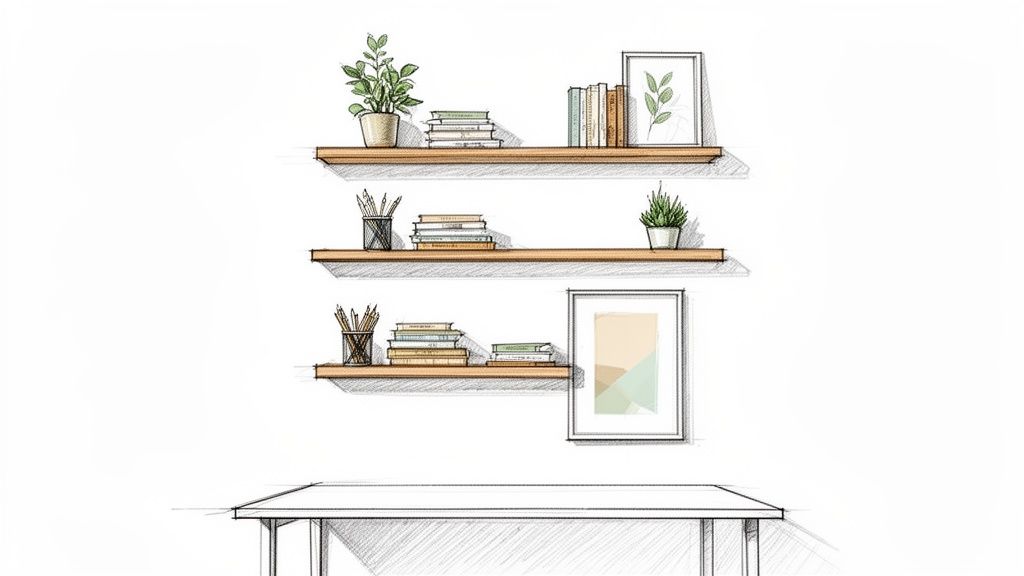
    Floating shelves are a minimalist's dream, offering a great home office storage idea for rooms where floor space is a premium. By mounting directly to the wall with hidden hardware, they create a clean, modern look that draws the eye upward, making a small office feel more open and airy. This approach transforms unused vertical wall space into a functional display for books, supplies, and decor without adding visual bulk.

    A hand-drawn sketch depicting three floating wooden wall shelves above a desk, adorned with books, potted plants, and framed artwork.

    They are particularly effective above a desk, keeping essential items like notebooks, pen holders, and reference materials within arm's reach while freeing up your work surface. This declutters your primary workspace, which can directly enhance focus and productivity.

    Quick Tips for Implementation

    • Installation: Mount shelves at or slightly above eye level (typically 48-60 inches from the floor) for easy access and a balanced look. Always use anchors appropriate for your wall type (drywall, plaster, or masonry) and verify the shelf's weight capacity.
    • Styling: Avoid a cluttered look by leaving about 20-30% of the shelf space empty. Group items by color or function, and mix textures by combining books, small plants, and framed photos.
    • Placement: Consider installing a single long shelf above your monitor to act as a display for inspirational quotes or art, or place a trio of shorter shelves on an adjacent wall to store project-specific binders and supplies.

    For those who prefer a more grounded storage solution with similar vertical benefits, traditional bookcases and shelving units can offer substantial storage capacity and a classic aesthetic.

    2. Under-Desk Storage Cabinets and Pedestals

    Under-desk storage is one of the most practical home office storage ideas for reclaiming your workspace. These compact cabinets and drawer units fit neatly beneath your desk, providing concealed storage for files, stationery, and tech accessories. This keeps your desktop clear and professional-looking, minimizing distractions and maximizing the surface area available for essential tasks. By utilizing this often-overlooked space, you can maintain a clean, organized aesthetic without sacrificing accessibility.

    These units are perfect for hiding the clutter that accumulates throughout the workday. From popular consumer options to professional-grade pedestals, under-desk storage keeps supplies out of sight but within easy reach. This solution is especially valuable in dual-purpose spaces where the office needs to revert to a living area at the end of the day.

    Quick Tips for Implementation

    • Measurement: Before purchasing, measure the height and depth clearance under your desk to ensure a proper fit that still allows for adequate legroom. Account for any crossbars or support structures.
    • Organization: Use drawer dividers and trays to neatly organize smaller items like pens, paper clips, and charging cables. Label each drawer to find what you need quickly.
    • Placement: Position heavier items like reams of paper in the bottom drawers to improve stability and prevent tipping. Consider a mobile pedestal with wheels for the flexibility to move it as needed.

    For a fully integrated solution, consider pairing these cabinets with storage desks, which feature built-in drawers and file storage for a seamless and cohesive look.

    3. Tall Bookcases and Shelving Units

    For those who need maximum storage capacity, tall bookcases and shelving units are classic home office storage ideas that deliver. By capitalizing on vertical space, these substantial pieces can transform an entire wall into a highly organized library for books, binders, and supplies. They effectively centralize your storage, preventing clutter from spreading across your desk and floor.

    This approach is perfect for consolidating a large volume of materials in one accessible location. A well-organized bookcase not only keeps your office tidy but also adds architectural character and a sense of permanence to the room, creating a sophisticated and studious atmosphere.

    Quick Tips for Implementation

    • Styling: Create visual interest by alternating the orientation of books, with some standing vertically and others stacked horizontally. Use decorative boxes or stylish baskets on lower shelves to conceal less attractive items like cables or bulk supplies.
    • Organization: Place frequently accessed items, like reference manuals and daily planners, on shelves between waist and shoulder height. Reserve the highest shelves for archival materials or decor and the bottom shelves for heavy equipment or bins.
    • Safety: For taller units, always secure them to the wall using the anti-tip hardware provided. This is crucial for stability, especially in homes with children or pets.

    If you need a robust storage solution, exploring a selection of bookcases and shelving units can provide durable options to fit any office aesthetic, from traditional to contemporary.

    4. Filing Cabinets and Lateral File Storage

    For those managing important documents, tax records, or client files, a dedicated filing cabinet is one of the most essential home office storage ideas. Traditional vertical cabinets are excellent for tight spaces, but lateral filing cabinets offer wider, shallower drawers. This design maximizes accessibility, allowing you to see and retrieve files more easily while providing a sturdy surface for a printer or other equipment.

    This classic storage solution keeps sensitive paperwork organized, secure, and protected from damage or loss. By centralizing your documents, you eliminate paper clutter from your desk and other surfaces, creating a more professional and efficient work environment where critical information is always within reach but neatly tucked away.

    Quick Tips for Implementation

    • Systematize: Before you start filing, choose a system that works for you, such as alphabetical, chronological, or project-based. Use clearly labeled file folders and hanging organizers with tabs for quick identification.
    • Organize: Place frequently accessed files in the top or middle drawers. Store heavier, less-used documents or archival records in the bottom drawers to maintain stability and ease of access.
    • Labeling: Use a label maker for a professional, consistent look that makes finding specific documents fast and effortless. Keeping a digital or physical inventory of important records is also a great practice.

    For a cohesive office that combines paper management with digital needs, consider pairing your cabinet with storage desks or credenzas, which often include built-in file drawers and other organizational features.

    5. Wall-Mounted Pegboards and Organizers

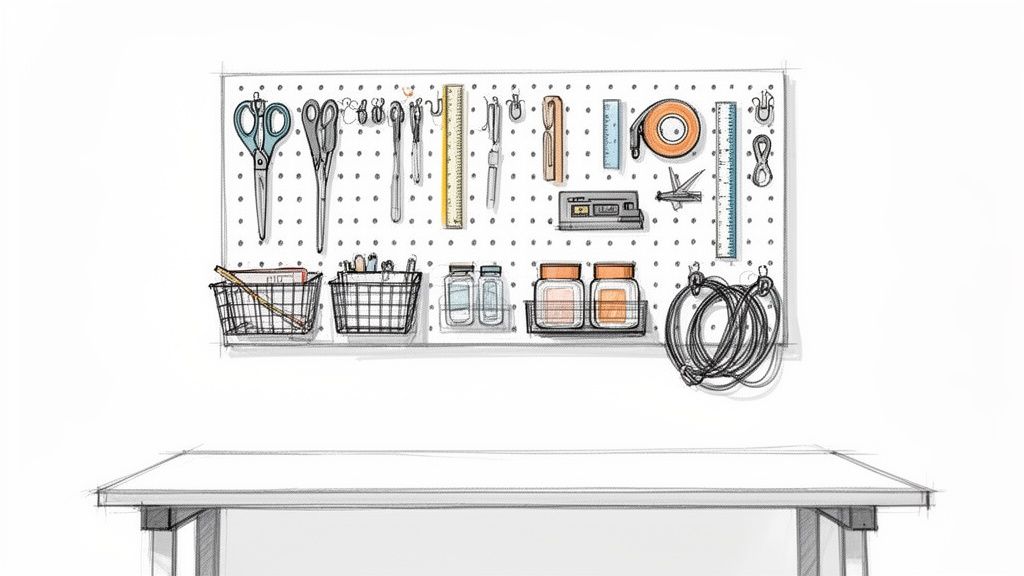
    A wall-mounted pegboard is a highly versatile and customizable solution, making it one of the most adaptive home office storage ideas available. These perforated panels use a system of hooks, shelves, and containers that can be rearranged in countless combinations. This flexibility is perfect for creative professionals, crafters, or anyone whose storage needs change from project to project, transforming an empty wall into a highly functional and visible organization hub.

    An illustration of a white pegboard filled with organized craft and office tools over a desk.

    Popularized by DIY communities and home organization influencers, pegboards keep frequently used tools and supplies off your desk but still within easy reach. By displaying items vertically, they reduce clutter on your primary work surface, which can help improve focus and streamline your workflow. It’s an ideal system for keeping everything from scissors and pens to charging cables and notebooks tidy and accessible.

    Quick Tips for Implementation

    • Installation: For optimal accessibility, mount the pegboard so its center is at or slightly above eye level when seated (around 48-60 inches from the floor). Use heavy-duty wall anchors to ensure it can support the weight of your items.
    • Styling: Group similar items together, such as all your writing utensils or all your cutting tools. Use small bins and baskets to contain loose supplies like paper clips or sticky notes, which helps reduce visual clutter. You can even paint the pegboard to match your office decor.
    • Placement: A small pegboard placed directly above your desk provides a convenient spot for essential tools. For larger collections of supplies, consider dedicating an entire wall to a pegboard system, creating a feature that is both practical and visually interesting.

    For those who need to store more substantial items like printers or large binders, pairing a pegboard with sturdy shelving units or bookcases can create a comprehensive and balanced storage system.

    6. Desk Hutches and Overhead Storage

    Desk hutches are classic home office storage ideas that add vertical storage directly to your workspace. These units sit on top of or attach to the back of a desk, providing shelves, cubbies, and sometimes small cabinets without taking up any additional floor space. This integrated approach keeps your essential books, binders, and supplies organized and within easy reach, clearing the main desk surface for active tasks.

    This solution is ideal for anyone who needs immediate access to a variety of materials throughout the workday. By using the vertical area above the desk, a hutch centralizes storage and helps create a defined and efficient work zone, which can significantly improve focus and workflow.

    Quick Tips for Implementation

    • Fit and Safety: Measure your desk's width and depth carefully to ensure the hutch fits properly and creates a balanced look. Always secure the hutch to the desk or wall according to the manufacturer's instructions to prevent tipping.
    • Organization: Dedicate specific cubbies for different categories, like one for reference books, another for office supplies, and a third for current project files. Store heavier items on the bottom shelves to maintain stability.
    • Lighting: Many hutches can obstruct overhead light. Consider installing a stick-on LED light strip under the lowest shelf to illuminate your work surface and reduce eye strain.

    For a similar, all-in-one solution, storage desks often incorporate built-in shelving and drawers, offering a seamless and coordinated look with ample organizational capacity.

    7. Rolling Carts and Mobile Storage Units

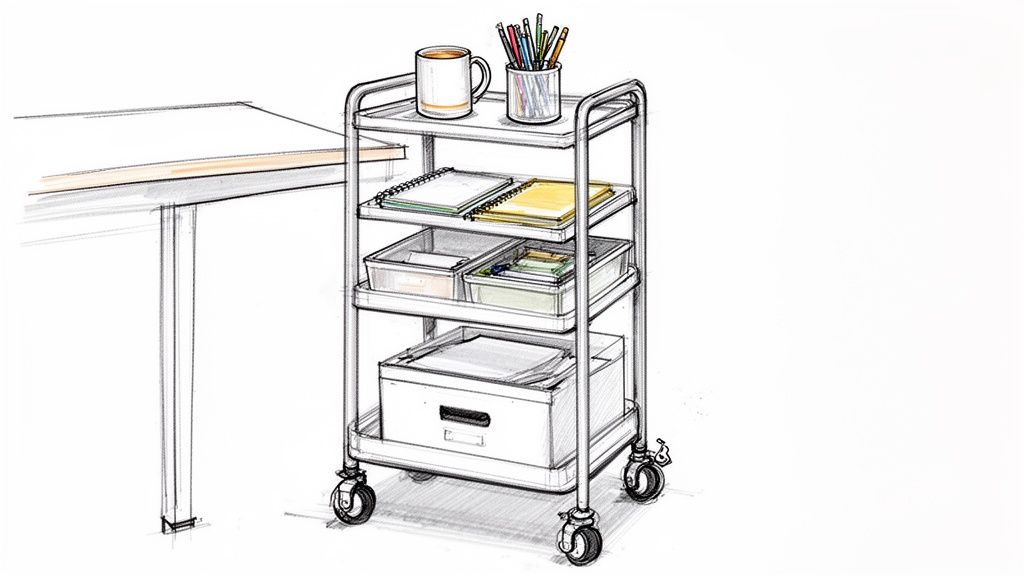
    Rolling carts are the ultimate chameleon of home office storage ideas, offering unparalleled flexibility for dynamic workspaces. These multi-tiered, mobile units can be effortlessly repositioned to serve different functions, making them perfect for multipurpose rooms or offices shared with family members. They provide accessible, open storage for everything from printer paper and ink cartridges to project files and craft supplies, adapting to your workflow on the fly.

    A four-tier metal rolling utility cart organized with various office supplies next to a desk.

    Their portability is their greatest strength. A cart can serve as a "command center" for a specific project, holding all necessary materials, and then be wheeled out of sight when the work is done. This keeps your primary desk surface clear and allows you to quickly reconfigure your space for different tasks or to accommodate guests, a feature that fixed furniture cannot offer.

    Quick Tips for Implementation

    • Organization: Use small bins, baskets, or drawer organizers on each tier to contain loose items like pens, paper clips, and charging cables. This prevents the cart from becoming a mobile junk drawer.
    • Stability: Always lock the wheels once the cart is in its desired position to prevent it from moving unexpectedly. For safety, place heavier items on the bottom shelf and lighter, frequently used supplies on top.
    • Placement: Position the cart next to your desk to act as an extension of your workspace, keeping essential tools within arm’s reach. You can also tuck it into a closet or corner when not in use to maximize floor space.

    For those needing a more permanent and secure mobile solution, file cabinets and credenzas can provide robust, lockable storage with the classic appeal of traditional office furniture.

    8. Desk Drawers and Drawer Dividers

    Organized desk drawers are the unsung heroes of a productive workspace, offering one of the most essential home office storage ideas for tackling daily clutter. By using drawer dividers and organizers, you transform a standard "junk drawer" into a highly efficient system. This approach ensures every pen, paperclip, and charging cable has a designated home, making items easy to find and keeping your desk surface clear for focused work.

    This method is particularly powerful for those who need quick access to a variety of small supplies without sacrificing a minimalist aesthetic. A tidy drawer means a tidy mind, directly contributing to a smoother workflow by eliminating the frustration of searching for misplaced items. It’s a simple change that delivers a significant impact on daily efficiency.

    Quick Tips for Implementation

    • Grouping: Categorize similar items together. Designate specific compartments for writing tools, tech accessories (cables, adapters), sticky notes, and stationery to streamline access.
    • Prioritization: Place your most frequently used items, like your favorite pen or a stapler, in the front-most sections of the top drawer for maximum convenience.
    • Auditing: Once a quarter, take a few minutes to declutter your drawers. Remove items you no longer use, consolidate supplies, and wipe down the organizers to maintain the system.

    For a comprehensive solution, many storage desks and file cabinets are designed to easily accommodate third-party organizers, giving you a head start on a clutter-free office.

    9. Built-In and Custom Storage Solutions

    For a truly seamless and maximized home office, built-in and custom storage solutions offer an unparalleled level of integration. Unlike freestanding furniture, these systems are designed and installed specifically for your room's unique dimensions and your exact workflow needs. This approach creates a cohesive, high-end look by turning architectural quirks into functional features, such as building cabinets into an awkward alcove or designing a wall-to-wall desk and shelving unit.

    This can be an effective home office storage idea for those who need to store a wide variety of items, from files and tech equipment to books and supplies, all within a unified system. A custom solution ensures every inch of space is used efficiently, eliminating clutter and establishing a permanent, professional-grade workspace that perfectly matches your home's aesthetic.

    Quick Tips for Implementation

    • Plan Your Inventory: Before consulting a designer or builder, make a detailed list of everything you need to store. Categorize items and measure larger equipment to ensure the custom design accommodates your specific needs.
    • Future-Proof the Design: Think about your future needs. Incorporate adjustable shelving and flexible compartments that can adapt as your work or technology changes over time.
    • Integrate Technology: Plan for cable management, integrated lighting, and accessible power outlets from the beginning. Hiding wires within the custom cabinetry creates a clean, organized look and improves functionality.

    If a fully custom build isn't the right fit, you can achieve a similar integrated feel using modular shelving units and credenzas. Many retailers offer pieces that can be combined to create a tailored and highly functional storage system.

    10. Credenzas and Sideboards for Office Storage

    Credenzas and sideboards are sophisticated, low-profile cabinets that serve as powerful home office storage ideas, blending concealed storage with elegant design. Originally found in dining rooms, their versatile function makes them ideal for an office, offering a long surface and ample cabinet space without the visual height of a traditional bookcase. This makes them perfect for storing bulky items like printers, paper reams, and binders out of sight, maintaining a clean and uncluttered aesthetic.

    Positioned behind a desk or against a prominent wall, a credenza acts as a functional anchor for the room. Its top surface is perfect for a secondary work area, displaying decor, or housing equipment, while the enclosed cabinets keep visual noise to a minimum. This dual-purpose nature is invaluable in home offices where style and substance must coexist.

    Quick Tips for Implementation

    • Placement: Place your credenza against a wall opposite your desk for easy access or directly behind it to create an executive-style workspace. Ensure it doesn't obstruct major walkways.
    • Organization: Use the concealed cabinets for less-attractive necessities like routers, shredders, and archival files. Organize the interior with drawer dividers and labeled bins to quickly find what you need.
    • Styling: Treat the top surface like a console table. Add a table lamp for ambient lighting, a decorative tray for small items, and a piece of art or a plant to personalize the space. Choose a finish that complements your desk and other furniture for a cohesive look.

    For those seeking functional and stylish storage solutions, a selection of credenzas and sideboards offers numerous options that can elevate a home office from purely practical to professionally polished.

    10-Item Home Office Storage Comparison

    Item Implementation Complexity Resource Requirements Expected Outcomes Ideal Use Cases Key Advantages
    Floating Wall Shelves Medium — wall anchors/stud locating required Low–Medium — shelves, anchors, drill; modest budget Adds vertical, visible storage with modern look; limited heavy-load capacity Small offices needing accessible storage without floor footprint Space-saving, stylish, customizable
    Under-Desk Cabinets & Pedestals Low — mostly freestanding or simple assembly Medium — unit purchase, clearance measurement; optional casters Hidden, organized storage that frees desk surface Professionals needing secure, near-desk file/supply access Concealed storage, filing organization, mobile options
    Tall Bookcases & Shelving Units Medium–High — assembly and anchoring recommended Medium — significant wall/floor footprint; moderate budget High-capacity vertical storage and display; room-defining focal point Users with large book/file collections and ample wall space Maximum storage, display versatility, anchors room
    Filing Cabinets & Lateral Files Low–Medium — place and level; heavier models require help Medium — floor space, moderate cost; optional fireproof models Secure, organized document storage with professional appearance Home-based professionals managing client files and records Security, easy file access, scalable options
    Wall-Mounted Pegboards & Organizers Low — simple mounting and modular setup Low — pegboard, hooks/baskets; very affordable Highly visible, flexible organization; quick access to tools/supplies Creative professionals, makers, and frequent-access users Flexible, reconfigurable, cost-effective
    Desk Hutches & Overhead Storage Medium — mounting, sizing and alignment needed Medium — mounts, matching desk, moderate cost Reachable overhead storage that clears desk surface; may reduce perceived height Small spaces needing accessible overhead storage Accessible storage, integrated look, workflow improvement
    Rolling Carts & Mobile Storage Units Low — minimal assembly; plug-and-play Low — compact footprint, wheels, low–moderate cost Portable, multi-tiered storage; not a permanent solution Shared or multipurpose spaces; frequent reconfiguration Mobility, flexibility, compact and affordable
    Desk Drawers & Drawer Dividers Low — simple inserts or modular organizers Low — inexpensive organizers and dividers Compartmentalized small-item storage; tidy desktop All home-office workers wanting quick access to supplies Low cost, immediate organization, hidden storage
    Built-In & Custom Storage Solutions High — design, professional installation, longer timeline High — custom materials, contractors, higher budget Seamless, optimized storage tailored to space; increases home value Dedicated, permanent home offices and unique space challenges Maximizes space, cohesive high-end aesthetic, durable
    Credenzas & Sideboards for Office Storage Medium — delivery/placement; possible assembly Medium — notable floor footprint; moderate–high cost Concealed, at-height storage that doubles as furniture and surface Professionals hosting clients; need hidden equipment and files Professional appearance, concealed storage, multi-function surface

    Designing Your Ideal Workspace, One Piece at a Time

    Transforming a cluttered corner or a chaotic spare room into a functional and inspiring home office is a journey, not a destination. As we've explored, the path to a productive workspace is paved with thoughtful storage solutions that address your specific needs. From the vertical efficiency of tall bookcases and floating shelves to the discreet power of under-desk pedestals and drawer organizers, the right system brings order and calm to your workday. The goal isn't just to hide clutter; it's to create an environment where your tools, documents, and supplies are exactly where you need them, when you need them.

    The key takeaway is that there is no single "best" solution. An effective workspace is a personalized ecosystem. Your ideal setup might involve a sleek credenza to hide a printer and paper supplies, paired with a wall-mounted pegboard for frequently used tools. Another person might find that a traditional filing cabinet combined with a mobile rolling cart offers the perfect blend of long-term and short-term organization. The most impactful home office storage ideas are those that solve your unique workflow challenges, whether that's taming paper piles, organizing cables, or creating a dual-purpose space that serves multiple functions.

    Putting Your Plan into Action

    Before making any decisions, take a moment to assess your current pain points. Are you constantly searching for a specific file? Is your desk surface overrun with stationery? Identifying the problem is the first step toward finding the perfect solution.

    • Prioritize Function: Start with the pieces that will make the biggest immediate impact on your daily productivity. If paper management is your biggest hurdle, a lateral file cabinet might be a better first investment than decorative shelving.
    • Measure and Plan: Always measure your space twice. Consider not just the footprint of a new bookcase or desk, but also the clearance needed for opening drawers and doors.
    • Think Long-Term: Choose pieces that can adapt with you. A classic credenza or a well-built shelving unit is a versatile investment that can be repurposed in other rooms if your office needs change down the line.

    Ultimately, mastering your home office storage is about more than just organization. It's about creating a dedicated space that respects your work, reduces mental friction, and empowers you to do your best. By thoughtfully selecting and combining these ideas, you can build a workspace that is not only practical but also a place you genuinely enjoy spending time in.


    Ready to see how different storage solutions feel in a real-world setting? Exploring options like storage desks, credenzas, and quality bookcases in person can help you visualize your ideal workspace. The team at Woodstock Furniture & Mattress Outlet is here to help you navigate the options and find pieces that fit your style, budget, and functional needs without any pressure. Visit one of our North Georgia showrooms to get started.