Tag: office furniture

  • How to Design a Home Office: Design Your Ideal Home Office

    How to Design a Home Office: Design Your Ideal Home Office

    A lot of home offices start the same way. A laptop lands on a dining table, papers collect in a stack, the chair feels wrong by lunch, and every small upgrade somehow creates two new problems.

    That’s why how to design a home office is less about decorating and more about building a workspace that matches the way you work. If you start with paint colors, trendy desks, or accessories, it’s easy to end up with a room that looks finished but still feels frustrating.

    A better approach is simpler. Plan the work first. Then shape the room around it. When that order is right, clutter drops, movement gets easier, and the room starts supporting your day instead of interrupting it.

    Before You Buy a Desk – Plan Your Space and Purpose

    It's common to get stuck at the same point. Individuals know they need "a home office," but that phrase can mean a full-time remote workstation, a shared family admin zone, or a quiet place for creative projects. Those are different rooms, even if they use the same square footage.

    A practical planning process starts with function before furniture. One home office design protocol recommends assessing who will use the room, how many hours they’ll spend there, whether they need privacy for calls, and how people will move through the space. It also notes that planned offices reached “optimal productivity” far more often than ad-hoc setups, 78% versus 42%, with 36-inch minimum traffic paths used as a key planning benchmark (workspace planning protocol).

    A hand drawing a three-column diagram on paper labeled with focus, collaboration, and relaxation concepts.

    Ask what job this room needs to do

    If the office has one clear job, your choices get easier fast.

    • Full-time remote work usually needs privacy, reliable lighting, a comfortable chair, and enough surface area for daily tools.
    • Part-time household management may need less desk space and more hidden storage for paper, chargers, and supplies.
    • Creative or technical work often needs specialty surfaces, room for equipment, and better separation between active and quiet tasks.

    Write down your actual tasks, not the label. “Video calls, invoice filing, dual screens, printer access” is more useful than “work from home.”

    Practical rule: If you can list your daily tasks in plain language, you can choose furniture with much more confidence.

    Set a budget around discomfort and friction

    Budget matters, but not every line item deserves equal weight. Spend where bad furniture causes daily aggravation. A chair you use all day deserves more attention than a decorative shelf. A desk that fits your gear matters more than a trendy lamp.

    A simple way to think about it is to separate purchases into three groups:

    1. Must work on day one
      Desk, chair, lighting, and basic storage.

    2. Can be added after the room is functional
      Art, accent pieces, extra shelving, and decorative accessories.

    3. Might be unnecessary once the room is in use
      Oversized bookcases, extra seating, and duplicate organizers people often buy before they know what they need.

    That approach protects your budget from impulse purchases. It also helps prevent the classic mistake of buying a desk first and discovering later that there’s no room left for the chair to move properly.

    Measure the room like you mean it

    Take full room measurements, then note doors, windows, outlets, vents, and anything that affects placement. A quick sketch on paper is enough. It doesn’t need to be beautiful. It needs to be accurate.

    Include:

    • Wall lengths so the desk width isn’t a guess
    • Window placement because glare and natural light both matter
    • Outlet locations so cords don’t end up crossing a walkway
    • Door swings to avoid blocked drawers or cramped corners

    A floor plan saves people from expensive mistakes. It also quiets the mental clutter. Once the footprint is clear, the room stops feeling like a puzzle and starts feeling manageable.

    Create a Functional Layout with Smart Zoning

    The rooms that work best usually aren’t the rooms with the most furniture. They’re the rooms where tasks happen in the right places.

    That’s where zoning helps. Instead of treating the office as one blob of desk-plus-storage, break it into work areas that support your routine. A kitchen provides a good analogy. The point isn’t to walk more. The point is to put the right tools near the right task.

    A proven organizing method for home offices uses dedicated zones for tasks like computer work, printing, meetings, and reference materials. That method aligns with ergonomic research showing that good zoning can minimize movement by 30% to 50% and increase productivity by 25% to 40% (home office zoning method).

    A diagram illustrating smart zoning for a home office, highlighting Work, Collaboration, and Relaxation zones.

    Build the room around three zones

    Most home offices need some version of these:

    Zone What belongs there What goes wrong if it’s missing
    Primary work zone Desk, computer, keyboard, chair, task light You start working in awkward positions or spread into other areas
    Reference zone Books, files, notebooks, binders Active work surface gets buried under support materials
    Equipment and supply zone Printer, paper, chargers, office tools You interrupt focused work to hunt for everyday items

    In a small office, those zones might live within arm’s reach of one another. In a larger room, they can spread out more. The point is separation by purpose, not necessarily by distance.

    Decide what your desk should face

    Desk orientation changes how the room feels. A desk facing a wall can reduce visual distraction and help some people focus. A desk facing the room or door can feel less isolating and works well for people who spend a lot of time on calls or in and out of the office.

    A few honest trade-offs matter here:

    • Facing a window can be pleasant, but direct light can create glare.
    • Facing a wall sharpens focus, but it can feel closed in if the room is small.
    • Facing the door gives awareness of traffic, but busy hallways can pull attention.

    If you’re easily distracted, don’t place your desk where every household movement passes through your peripheral vision.

    Keep movement simple

    A functional layout should let you move from desk to storage to equipment without weaving around furniture. That’s where people often over-furnish the room. A nice bookcase, extra chair, or cabinet may fit on paper but still make the office feel cramped in practice.

    Use your floor plan to test the rhythm of the room. Sit position, stand up, reach files, grab a printout, return to work. If that sequence feels awkward in your sketch, it will feel worse in real life.

    The best layouts don’t feel dramatic. They feel easy. You stop noticing the room because it stops getting in your way.

    Choose Your Core Furniture – Desks, Chairs, and Storage

    A lot of first home offices go wrong here. The room is measured, the layout is planned, and then one oversized desk or one stylish but uncomfortable chair throws the whole setup off. Core furniture should protect your workflow first. Style can follow.

    According to the National Association of Home Builders, 59% of buyers who want a home office prefer a medium-sized room of 100 to 150 square feet, and that space comfortably fits a 48- to 72-inch-wide desk with essential storage. That helps explain why a 60-inch desk works well for many households (NAHB home office sizing data).

    A minimalist sketch illustration of three home office furniture items labeled ergonomic desk, adjustable office chair, and modular storage.

    Desks that match the work

    Desk shopping gets easier once you stop asking what looks best and start asking what has to happen on the surface every day. Laptop only, dual monitors, paperwork, sketching, printing, charging devices. Those needs change the right desk fast.

    Standard rectangular desk

    For many people, this is the most practical place to start. It fits more rooms, leaves more freedom to rearrange later, and usually costs less than bulkier specialty desks.

    Choose it if you need:

    • one clear work surface
    • flexibility for future room changes
    • enough width for a monitor, keyboard, and a small working buffer

    Its limit is spread. If your job creates stacks, reference materials, or equipment that needs to stay out, a straight desk can feel crowded by noon.

    L-shaped desk

    An L-shaped desk earns its footprint when your work has two active modes. Screen work on one side, writing or equipment on the other. That split can cut down on the constant shuffle of moving things around just to clear space.

    It makes sense for:

    • people who switch between computer work and paperwork
    • corner layouts that would waste space with a straight desk
    • setups where tools, chargers, or a printer need a dedicated surface

    The trade-off is commitment. Once it is in place, the rest of the room usually has to work around it.

    Adjustable-height desk

    A height-adjustable desk helps if you routinely change positions during the day. It is less useful as a feature you pay for and never use. I usually tell people to reflect on their habits before spending more here.

    Check three things before buying:

    • stability at standing height
    • enough depth for your screen setup
    • a plan for cables so they do not hang or snag

    If your office depends on strong internet for video calls, cloud files, or multiple connected devices, it also helps to compare Wifi 6 and Wifi 7 before you finalize where the desk will sit.

    Chairs should earn their place

    The chair is where people often get stuck between appearance and comfort. I have seen plenty of nice-looking home offices built around a chair that nobody wanted to sit in for more than an hour.

    A workable office chair should give you:

    • adjustable seat height
    • back support that keeps you from slumping forward
    • a seat and arm setup that lets you pull in close to the desk

    That does not mean every chair has to look corporate or oversized. It does mean a dining chair, accent chair, or fixed-height side chair is usually a short-term compromise. If the chair cannot adapt to the person using it, the body ends up adapting to the chair, and that is where neck, shoulder, and lower-back complaints start.

    For a visual walkthrough of common office furniture choices and setup ideas, this quick video is useful:

    Video overview of common home office furniture options, with examples of desk, chair, and storage setups.

    Storage should stop a specific kind of clutter

    Storage works best when each piece has a job. That sounds obvious, but it is where many home offices fill up with furniture that holds very little and still makes the room feel busy.

    Use the clutter you already fight as your guide:

    • papers piling beside the desk usually call for file storage nearby
    • tech accessories and supplies usually need a drawer unit or small cabinet close to the work surface
    • visual distraction usually improves with closed storage instead of open shelving

    A simple rule helps. Before buying a cabinet, shelf, or credenza, name what will live inside it. If you cannot name the contents, you are probably buying filler.

    Woodstock Furniture & Mattress Outlet is one example of a retailer that carries a range of desk, chair, and storage styles, but the better result comes from choosing pieces by function, size, and daily use instead of buying a matching set just because it is convenient.

    Refine Your Setup with Ergonomics, Lighting, and Tech

    A home office can have the right desk and still feel wrong. That usually comes down to setup details. Screen height, chair adjustments, lighting angles, and cable clutter create the kind of daily friction people blame on “working from home” when the room is the issue.

    The most common problem is simple. A lot of people are still working off a laptop without properly adjusting the setup. In home office data summarized by Home Stratosphere from a Nulab survey, 75% of home workers relied on laptops, and among setups using external monitors, 52% had the monitor positioned too low (ergonomic home office statistics).

    A line sketch illustration of a person sitting in a proper ergonomic position at a home office desk.

    Start with your body, top to bottom

    A simple setup check works better than chasing perfect posture.

    • Head and neck
      Raise the screen so you’re not constantly looking down. If you work from a laptop, a riser or stand makes a big difference.

    • Shoulders and arms
      Let your shoulders stay relaxed. If your elbows flare outward or your wrists bend upward, the desk and chair relationship probably needs adjusting.

    • Hips and knees
      Sit far enough back that the chair supports you properly. Your lower body shouldn’t feel tucked under the desk or stretched to reach the keyboard.

    • Feet
      Keep them planted. If the chair height works for your arms but leaves your feet unsupported, add a footrest.

    Small changes often matter more than expensive upgrades. A laptop stand, separate keyboard, and a few minutes of adjustment can fix a setup that has felt off for months.

    Use layered light, not one bright overhead fixture

    Lighting should support the task, not just brighten the room. A single ceiling fixture often creates uneven light, screen glare, and a flat feeling that makes the room less comfortable by afternoon.

    Try a layered setup:

    • Ambient light for the whole room
    • Task light at the desk for paperwork and keyboard work
    • Soft accent light if you want the room to feel calmer on long days

    Place the monitor so a window doesn’t blast light directly behind it or bounce glare across the screen. If possible, work beside natural light rather than directly facing it.

    Good lighting reduces strain quietly. Bad lighting reminds you it’s there every hour.

    Tidy the tech before cords take over

    Messy cables make a room feel unfinished even when the furniture is right. Even more, they steal usable space and make cleaning harder.

    A few low-effort fixes usually do the job:

    1. Mount a power strip under the desk or place it in a cable tray.
    2. Bundle visible cords with sleeves or reusable ties.
    3. Route chargers to one side of the desk instead of letting them spill across the surface.
    4. Leave a little slack where equipment moves, especially adjustable monitors or sit-stand desks.

    If your work depends on video calls, cloud files, or large uploads, internet performance matters just as much as furniture. If you’re sorting through router upgrade questions, this guide to compare Wifi 6 and Wifi 7 gives useful context for home office needs without getting overly technical.

    Smart Solutions for Small or Multi-Use Offices

    A dedicated office is nice. It isn’t required.

    Some of the most effective workspaces are carved out of guest rooms, living room corners, wide hall landings, or underused bedroom walls. The trick is accepting the room’s limits early instead of pretending it can do everything at once.

    That matters for renters especially. For the 36% of U.S. households that rent, permanent modifications often aren’t realistic, so freestanding and modular pieces make more sense than built-ins. A practical no-damage setup can use a slim console desk, tension rod shelves, and peel-and-stick organizers (renter-friendly home office ideas).

    For the living room corner

    This setup works best when the office needs to disappear visually after hours.

    Use a desk with a lighter profile, not a bulky executive piece. A slim writing desk or console-style desk keeps the corner from looking like commercial furniture landed in the middle of the home. Pair it with storage that closes, such as a small cabinet or basket system, so papers and chargers don’t stay on display.

    A rug can help define the area without building a wall. So can a floor lamp or a narrow bookshelf placed beside the desk.

    For the guest room combo

    Guest room offices often fail because both functions compete for the same floor area. The bed dominates, then the desk gets squeezed into whatever is left.

    A better approach is to choose pieces that perform double duty:

    • Secretary desks hide visual clutter when work ends
    • Fold-down or Murphy-style desks free up floor space
    • Storage benches or ottomans hold office supplies without looking corporate

    This kind of room needs discipline more than square footage. If office supplies spread onto the bed or luggage space, the room starts feeling chaotic fast.

    In a shared-use room, hidden storage does more work than decorative storage.

    For renters and temporary setups

    Renter-friendly offices benefit from furniture that can move, adapt, and leave no trace. Freestanding bookcases can divide space. Rolling carts can hold supplies without committing them to one wall. Peel-and-stick hooks and organizers can create order without tools or patching.

    If you’re in a temporary home, resist the urge to overbuild. Buy pieces you’d still want in the next place. A good desk chair, modular shelf, or compact file cabinet can move with you much more easily than a highly customized nook solution.

    Small offices work when every piece earns its footprint. That’s true in a spare bedroom, an apartment alcove, or the corner of a busy family room.

    Bring Your Vision to Life with Confidence

    You know the room is close when the big questions are settled and the small doubts start creeping in. Is the desk too deep? Will that file cabinet block the walkway? Do you need the shelf now, or after you’ve worked in the space for a bit?

    Treat the final stage like a home project, not a shopping spree. The goal is to build a workspace that supports how you work on Monday morning, not one that only looks finished in photos. That mindset keeps costly mistakes down and makes the room easier to improve over time.

    Use a simple final check before you buy or rearrange anything else:

    • Desk: enough surface for your daily tools, with clear room to get in and out comfortably
    • Chair: adjustable support that still feels good after a full work session
    • Storage: placed where clutter starts, not where an empty corner happens to be
    • Lighting: light for video calls, screen work, and any writing or paper review you still do
    • Tech: outlets, charging, and cable control planned before cords spread everywhere
    • Layout: a setup that supports your work sequence without extra reaching, twisting, or backtracking

    That last point matters more than many first-time buyers expect.

    A home office usually comes together faster when you buy in phases. Start with the core setup. Work there for a week or two. Then fix the friction points you notice in real use, such as a printer with no landing space, a drawer that opens into your chair path, or paperwork that keeps piling up on the desktop. Real-world use answers questions that planning alone cannot.

    If you want another set of eyes before you commit, visiting a showroom can help. Sitting in a chair, checking desktop depth, and seeing storage pieces at full scale often clears up the uncertainty that causes analysis paralysis.

    If you'd like a second opinion before you commit, Woodstock Furniture & Mattress Outlet offers home office furniture, planning tools, and in-store guidance that can help you compare options against your room size, workflow, and budget.
  • A Guide to Ergonomic Home Office Chairs for Improved Health & Productivity

    A Guide to Ergonomic Home Office Chairs for Improved Health & Productivity

    Finding the right ergonomic home office chair isn’t about just picking something that looks comfortable. It’s a process of matching a chair to your body, your health, and the way you work, ensuring you stay productive and pain-free for hours on end. A well-designed chair is less of a simple seat and more of a personalized tool, which makes it one of the most important investments for anyone working from home.

    Why Your Chair Is a Critical Home Office Investment

    The massive shift to remote work has turned millions of spare rooms, kitchen tables, and forgotten corners into full-time offices. While the commute is great, this change has uncovered a huge problem—many of us are spending our entire workday in chairs that simply weren't built for it. The result? Aches and pains in the back and neck, and a noticeable drop in focus and well-being.

    It’s time to stop thinking of a quality ergonomic chair as a luxury purchase and start seeing it as a foundational piece of equipment. It’s a tool specifically designed to prevent the physical wear and tear that comes from sitting all day in an unsupportive seat.

    Diagram contrasting bad sitting posture causing back pain with proper ergonomic posture and support.

    The Growing Need for Better Support

    Here at Woodstock Furniture & Mattress Outlet, we've seen firsthand how many people are looking for real solutions to work-related discomfort. And it’s not just a hunch we have; the numbers back it up.

    The market for ergonomic office chairs was valued at USD 12.08 billion in 2024 and is expected to continue growing. This trend is a direct result of the boom in remote work and a much greater awareness of just how important our well-being is.

    Our goal with this guide is to cut through the confusion and marketing fluff. We want to give you the clear, honest education you need to understand what actually matters in a chair. This way, you can find a suitable fit for your body, your work habits, and your specific needs.

    A truly "ergonomic" chair is the one that disappears. It should support you so well that you forget it’s even there, allowing you to focus completely on your work without distraction or discomfort.

    Understanding the Core Principles

    Before we start comparing features and different models, it's helpful to get a handle on why ergonomics is so important in the first place.

    Grasping the fundamental principles of workplace ergonomics is the key to setting up a healthy home office and getting the most out of your investment. A good chair is only one part of the puzzle; it has to work together with your desk, monitor, and keyboard to create a truly supportive system.

    By the time you finish this guide, you’ll have the know-how to confidently look at any ergonomic chair and make a smart decision that will benefit your health for years to come.

    What Makes a Chair Truly Ergonomic? Breaking Down the Features That Matter

    The word “ergonomic” gets thrown around so much these days that it’s almost lost its meaning. A sticker on the box doesn’t make a chair ergonomic; it's the specific, adjustable features that solve real-world problems like nagging back pain, neck strain, and poor circulation.

    Figuring out what these features actually do is the key to finding the right home office chair for your body. Instead of just giving you a list of parts, let’s connect each feature to a real benefit. This will help you pinpoint your own discomfort and see which adjustments will bring you the most relief. After all, a great chair should adapt to you, not the other way around.

    Lumbar Support That Actually Does Its Job

    One of the most common complaints we hear from folks sitting for long hours is lower back pain. This usually happens because a basic chair doesn't support the natural inward curve of your spine, which makes you slouch and puts a ton of strain on your back.

    Adjustable lumbar support is the direct answer to this problem. This feature lets you fine-tune both the height and depth (the amount of pressure) of the support, positioning it perfectly in the small of your back.

    • Height Adjustment: This makes sure the support nestles right into your spinal curve—not too high and not too low.
    • Depth Adjustment: This lets you dial in the amount of pressure, from a gentle reminder to more firm support, depending on what feels best at that moment.

    When it’s set up right, lumbar support encourages a healthy posture, taking the load off your lower back. Without it, even a few hours of sitting can lead to discomfort that builds up over time.

    Seat Adjustments for All-Day Comfort

    Your chair's seat is the foundation for your entire posture, and a one-size-fits-all approach just doesn't cut it. Two critical adjustments—seat depth and seat height—are non-negotiable for proper leg support and circulation.

    Seat depth adjustment lets you slide the seat forward or backward. You're looking for the sweet spot where you have about two to three fingers of space between the edge of the seat and the back of your knees.

    A seat that's too deep will dig into your calves, cutting off circulation and causing numbness. On the other hand, a seat that’s too shallow won't give your thighs enough support, which isn't comfortable either.

    Seat height adjustment is just as important. Your feet should rest flat on the floor with your knees at roughly a 90-degree angle. This gives you a stable base and stops you from dangling your legs or scrunching them up—both of which can cause pain in your hips and back.

    Armrests That Take the Weight Off Your Shoulders

    Here’s something most people don’t think about: your arms are heavy! When they hang unsupported all day, they pull down on your shoulders and neck. Over an eight-hour workday, this constant tension can lead to chronic pain. This is where a good set of adjustable armrests, often called 4D armrests, can be a game-changer.

    The "4D" just means they move in four different directions:

    1. Height: Up and down to line up with your elbow height.
    2. Width: In and out to match your shoulder width.
    3. Depth: Forward and backward to support you whether you're typing or leaning back.
    4. Pivot: Angling inward or outward to support your forearms during different tasks.

    By keeping your arms properly supported, 4D armrests let your shoulder and neck muscles finally relax. This is a huge benefit for anyone who spends a lot of time typing or using a mouse, as it helps you avoid hunching forward.

    The big idea behind all these features is adjustability. It’s what allows a single, well-designed chair to give a custom fit to all sorts of body types and work styles. Finding a chair with the right mix of these adjustments is a huge step toward a healthier and more comfortable workday.

    Comparing Ergonomic Chair Types for Different Work Styles

    Finding the right ergonomic chair isn't about picking a single model off a list. It’s all about matching the chair’s design to your body, your work habits, and your space. A chair that feels like a dream for one person might be a total nightmare for another.

    The key is to understand what each type of chair was built to do and who it's meant for. Instead of just listing pros and cons, let's look at these chairs based on how you’d actually use them day-to-day. This will help you connect a chair’s features to the real problems you're trying to solve—whether that's fighting off back pain, staying cool, or just finding something that looks right in your home office.

    Mesh Task Chairs For Breathability

    Mesh task chairs have become incredibly popular in home offices, and for very good reason. Their biggest selling point is excellent airflow. If you’re someone who tends to run warm or your office gets a little stuffy, a mesh back and seat can be a game-changer for your comfort over a long day.

    These chairs are typically built with adjustability as a top priority, often loaded with features like tunable lumbar support, seat depth sliders, and 4D armrests. The engineered mesh is designed to be both supportive and flexible, molding to your shape without creating uncomfortable pressure points. They are a fantastic, practical choice for anyone logging long, focused hours at a desk.

    Executive Chairs For Robust Support and Style

    Executive chairs bring a more traditional, stately presence to a room, often upholstered in leather or premium fabrics. But it’s not just about looks. These chairs are usually built with beefy frames and generous cushioning, giving you a sense of solid, all-encompassing support.

    While they might not have the tiny, granular adjustments of a high-end task chair, they almost always include the most important ergonomic features. You can expect things like built-in lumbar support, well-padded armrests, and a quality synchro-tilt mechanism. An executive chair is a great fit if you value a classic aesthetic and prefer a plusher, more cushioned feel over maximum airflow.

    Kneeling Chairs For Active Sitting

    Kneeling chairs take a radically different approach to sitting. Ditching the traditional backrest, they use angled pads to support your shins and seat. This clever design encourages your pelvis to tilt forward, which naturally helps you sit upright and maintain a healthy spinal curve.

    By opening up the angle between your torso and thighs, a kneeling chair forces you to engage your core muscles to stay balanced. This "active sitting" is the enemy of slouching and can be a huge relief for chronic lower back pain.

    These chairs are an excellent tool for people who want to change up their posture, take pressure off their lower back, and even build a little core strength while they work. Just keep in mind, they’re often best used in rotation with a standard office chair, as they can put extra pressure on your shins during very long work sessions.

    If you’re still not sure where to start, this decision tree can help you figure out which features to prioritize based on where you feel discomfort.

    best ergonomic home office chairs

    As the guide shows, simply identifying whether your pain is in your back, legs, or shoulders is the first step. From there, you can narrow down the specific ergonomic feature that will give you the most relief.

    Ergonomic Chair Types Compared by Use Case

    To make the differences even clearer, this table breaks down these common chair styles. Think of it as a quick guide to see which type might best fit your work habits and physical needs.

    Chair Type Primary Benefit Ideal User Profile Common Materials
    Mesh Task Chair Breathability and high adjustability for a fine-tuned fit. Individuals who work long hours and prioritize airflow and personalized ergonomic settings. Engineered mesh, polymer frame, fabric seat.
    Executive Chair Substantial cushioning and a professional, classic appearance. Users who prefer a plusher feel and a traditional aesthetic with solid, integrated support. Leather, bonded leather, high-density foam, wood or metal accents.
    Kneeling Chair Promotes an open hip angle and engages core muscles. People looking to improve posture, reduce lower back strain, and practice "active sitting." Fabric, memory foam, wood or steel frame.

    Getting a handle on these basic differences is a massive step toward choosing a suitable best ergonomic home office chairs for your unique needs. Ultimately, the decision comes down to your personal preference and which style truly supports you through the workday. Nothing beats visiting a showroom to try out a few different types and feel the difference for yourself.

    How to Measure for a Chair That Fits Your Body

    best ergonomic home office chairs

    We've all seen those fancy office chairs packed with levers, knobs, and high-tech features. But here’s the thing: a chair is only as good as its fit. If it's the wrong size for your body, all those adjustments are pointless. Worse, it could even cause more aches and pains than the old chair you were trying to replace!

    The goal is to find a chair that feels like it was made just for you, supporting your body so well that you don't even have to think about it. You don't need to be an ergonomics expert to get this right. You just need to know your own measurements and what to look for when you try a chair out.

    First Things First: Determining the Right Seat Height

    The absolute starting point for a good fit is the seat height. Get this right, and you're building a stable foundation for your entire posture. The goal is simple: keep your feet flat on the floor with your knees bent at roughly a 90-degree angle. This keeps you from putting extra stress on your lower back.

    Here's how you measure it. Sit down on a firm, flat surface — a dining chair or even a sturdy box will do — where your feet can rest comfortably on the ground. Grab a tape measure and record the distance from the floor all the way up to the crease behind your knee. That number is your ideal seat height. When you're shopping, make sure the chair's height adjustment range has your number covered.

    Next Up: Finding the Proper Seat Depth

    Seat depth might be the most overlooked measurement, but it's vital for good leg circulation and thigh support. If a seat is too deep, it will dig into the back of your calves and could cut off blood flow. If it's too shallow, your thighs won't have enough support, putting a ton of pressure on your sit bones. Ouch.

    Here's the trick to finding your ideal depth:

    1. Sit all the way back in the chair so your back is firmly against the backrest.
    2. Now, try to slide your hand between the front edge of the seat and the back of your knees.
    3. You should be able to fit about two to three fingers in that gap.

    That little bit of space is the sweet spot. It means you’re getting full support along your thighs without any uncomfortable pressure behind your knees. Many high-quality ergonomic home office chairs will have a seat depth adjustment, letting you slide the seat forward or backward to get it just right.

    Ensuring the Backrest Aligns with Your Spine

    A backrest has one main job: to support the natural "S" curve of your spine, especially the lumbar area (your lower back). A backrest that’s too short won't do a thing for your upper back and shoulders. And if the shape is off, it won't align properly with your lower back curve, which can feel like it's pushing you out of the chair.

    When you sit down, really pay attention to how the backrest feels. Does the built-in curve fit nicely into the small of your back? Or does it feel like there's a brick back there? Can you lean back and feel consistent support all the way up to your shoulder blades?

    This is where durability really comes into play. Think about it: the average office worker can sit for around 10 hours a day. That adds up to a staggering 17,000 hours in a year! This is why you need a chair that’s built to last, with support that won't sag or give out over time. You can find more interesting facts about office chair use over at millersatwork.com.

    An ergonomic chair should support you without creating pressure points or restricting natural movement, much like a well-fitted pair of shoes.

    The Irreplaceable Value of an In-Person Test

    These measurements will give you a fantastic head start, but numbers on a screen can't tell you the whole story. The single most important step is to test a chair in person. Coming into a showroom lets you get past the specs on a website and actually feel how a chair works with your unique body.

    When you're trying one out, don't just sit there for 30 seconds and call it a day. Try to mimic what you do at work. Lean forward as if you're writing, lean back to take a call, reach for something on your desk, and even do some "air typing." This hands-on experience is the only way you'll know for sure if a chair will give you the comfort and support you need to get through a productive day.

    Proper Setup and Care for Your New Chair

    So you’ve brought home your new ergonomic chair. That's a huge win for your back and your workday! But just unboxing it and plopping down isn't going to magically fix your posture.

    To get the full benefit from your new investment, you’ve got to dial it in for your body and your workspace. Think of it like getting a custom-fitted suit—a few key adjustments make all the difference. Don’t worry, it only takes a few minutes, and we’ll walk you through it.

    Five steps illustrate how to adjust and maintain an ergonomic office chair for proper setup.

    Following these steps in order is the secret sauce. Each adjustment builds a foundation for the next, creating a stable and supportive posture from the ground up.

    The Correct Order for Chair Adjustments

    Believe it or not, there's a right way and a wrong way to adjust your chair. For the best results, you want to start with your feet on the floor and work your way up. It’s a simple 5-step process.

    1. Seat Height: Start here. Adjust the height so your feet are planted flat on the floor and your knees are at about a 90-degree angle. This is your anchor point.
    2. Seat Depth: Scoot your back all the way against the backrest. You should be able to fit two or three fingers between the front edge of the seat and the back of your knees. This is critical for circulation.
    3. Backrest and Lumbar Support: Now, focus on your back. Adjust the backrest’s height until the lumbar curve fits snugly into the small of your back. It should feel like a gentle hug, not a shove.
    4. Armrests: Lower your shoulders and let them relax. Set the armrest height so your elbows rest comfortably at a 90-degree angle. This takes a ton of strain off your neck and shoulders.
    5. Tilt and Tension: Last but not least, set the recline. You want to be able to lean back with a gentle push but still feel fully supported, whether you're sitting upright or reclining.

    Think of this process like tuning a guitar. You can’t just tune one string and expect the instrument to be in harmony. Each adjustment works together to create a perfectly balanced and supportive experience.

    Extending the Life of Your Chair

    A high-quality ergonomic chair is an investment built to last for years, but like any tool you rely on every day, it needs a little TLC. A bit of routine maintenance will go a long way in keeping it looking and feeling brand new.

    This small time commitment protects your purchase and ensures your chair keeps providing the support you paid for.

    Material-Specific Cleaning

    • Mesh: The easiest to clean! Just use a vacuum with a brush attachment to get rid of dust. For any spills, a cloth with a bit of water and mild soap will do the trick.
    • Leather: Dust it regularly with a soft cloth. Every few months, use a dedicated leather cleaner and conditioner to keep it from getting dry and cracked over time.
    • Fabric: Vacuum regularly to stop dirt from getting ground into the fibers. If a spill happens, blot it up right away with a clean cloth and a good fabric upholstery cleaner.

    Hardware and Component Checks

    About twice a year—maybe when the seasons change—give your chair a quick once-over.

    Check that all the screws and bolts are tight, as they can loosen with daily use. If you hear any squeaks, a little silicone spray on the moving joints will quiet them down and keep adjustments feeling smooth.

    Taking these few simple steps ensures your ergonomic chair will be a faithful work companion for years to come. And if you ever have questions or run into an issue, our team here at Woodstock Furniture & Mattress Outlet is always happy to help

    Alright, you’ve made it this far, so you’re well on your way to a more comfortable, productive workday. We've dug into the nitty-gritty of what separates a truly great ergonomic chair from a run-of-the-mill office chair. You know what to look for, how to measure, and which features actually matter.

    But here’s the thing—as much as we can share with you online, the most important step can't happen through a screen. Finding your perfect chair is a hands-on job.

    Why You've Got to Try Before You Buy

    Think of it like buying a new mattress or a pair of shoes. You can read all the reviews in the world, but you’ll never know for sure until you try it for yourself. How does the lumbar support actually feel against your back? Do your feet rest flat on the floor at the right height? Is the fabric breathable?

    These are the details that turn a good chair into your chair. An in-person visit is your chance to connect all the dots from your research and feel how concepts like seat depth and armrest pivot translate to real-world comfort.

    Our showrooms in North Georgia are set up specifically for this. We want you to sit, adjust, and compare different models side-by-side in a relaxed, no-pressure environment. Take your time. This is a big decision.

    An ergonomic chair is more than just a piece of furniture—it’s a long-term investment in your own health and well-being. Spending a little time testing options in person is the best way to make sure that investment pays off in comfort and focus for years to come.

    Let Our Experts Help You Find the Perfect Match

    Our team isn't here to push you into a purchase. We're furniture experts who genuinely want to help you find the right solution. They can answer your questions, show you how to fine-tune the adjustments, and offer personalized advice to help you find that "just right" fit you've been looking for.

    We'd love for you to come by our Woodstock/Acworth, Dallas/Hiram, or Rome showrooms. Come on in, take a seat (or several!), and let's find the ideal ergonomic chair for your home office together.

    Frequently Asked Questions About Ergonomic Chairs

    Even with all this information, we know you've probably still got a few questions rattling around. That’s perfectly normal! Choosing the right ergonomic chair is a big decision for your home office, and we get these questions on the showroom floor all the time.

    To help you feel confident in your choice, we’ve gathered a few of the most common questions our furniture experts hear every single day.

    How Much Should I Expect to Invest in a Good Ergonomic Chair?

    This is probably the number one question we get, and for good reason. The price tags on ergonomic chairs can be all over the map. You can find chairs with "ergonomic" on the label for a surprisingly low price, but a truly high-quality model is a different animal altogether.

    Think of a good ergonomic chair less like a simple piece of furniture and more like a long-term investment in your own health and well-being. These chairs are built to last for years, often backed by warranties that prove it. The cost reflects the complex engineering, durable materials, and incredible range of adjustments designed to keep you comfortable and productive, day in and day out.

    Are Gaming Chairs a Good Substitute for Office Chairs?

    While a gaming chair is certainly a step up from the dining room table, they're really built for a different purpose than a dedicated office chair. Gaming chairs often have that race-car-inspired look—high, winged backs and deep bucket seats. They’re designed to be comfortable and cushioned for leisurely, reclined positions.

    A proper ergonomic office chair, on the other hand, is engineered specifically to support your body in an active, upright working posture. Every feature, from the lumbar curve to the seat depth and armrest positions, is there to promote a healthy posture while you’re focused on a task. For all-day work, a dedicated office chair is almost always the better tool for the job.

    How Do I Know if My Current Chair Is Causing My Discomfort?

    It's not always easy to play detective with your aches and pains, but your chair is a prime suspect if you start noticing some tell-tale patterns.

    A simple self-assessment can be revealing. If you consistently end your workday with lower back pain, neck stiffness, or tingling in your legs that you didn't have in the morning, your chair is probably not providing adequate support.

    Here are a few dead giveaways that your chair isn't cutting it:

    • Slouching: You’re constantly leaning or hunching forward to see your screen.
    • Pressure Points: Your tailbone or the backs of your thighs are sore after a few hours of sitting.
    • Leg Discomfort: Your feet are dangling, or you feel a constant, nagging pressure behind your knees.
    • Shoulder and Neck Strain: You find your shoulders creeping up towards your ears because your armrests are too high, too low, or just plain not there.

    If any of this sounds painfully familiar, it's a huge sign that upgrading to a true ergonomic chair could make a world of difference in your daily comfort.

  • 10 Practical Home Office Storage Ideas to Organize Your Workspace

    10 Practical Home Office Storage Ideas to Organize Your Workspace

    A well-organized home office is more than just a tidy space; it's a foundation for focus, productivity, and peace of mind. But finding the right storage solutions can feel overwhelming, especially when faced with paper piles, tangled cords, and a lack of dedicated space for essential supplies. This struggle is common, turning a potential hub of productivity into a source of daily frustration.

    This guide moves beyond generic advice to offer specific, actionable home office storage ideas tailored to different needs, room sizes, and budgets. We'll explore ten practical solutions, from floating shelves to versatile credenzas, breaking down the problem each one solves and how to implement it effectively. The goal is to help you build a workspace that not only looks professional but also functions seamlessly, allowing you to do your best work without the distraction of clutter. By understanding how each storage piece contributes to the overall function of your space, you can make informed decisions. For a broader perspective on creating an efficient and inspiring home office, explore various actionable office interior design ideas that can complement your new storage strategy. Let's transform your cluttered corner into a streamlined command center.

    1. Floating Wall Shelves

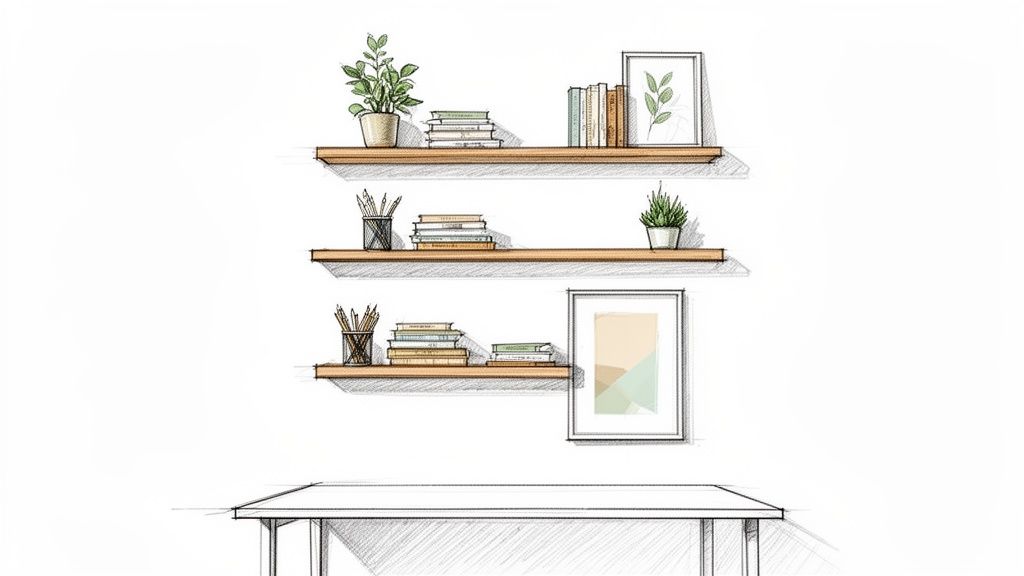
    Floating shelves are a minimalist's dream, offering a great home office storage idea for rooms where floor space is a premium. By mounting directly to the wall with hidden hardware, they create a clean, modern look that draws the eye upward, making a small office feel more open and airy. This approach transforms unused vertical wall space into a functional display for books, supplies, and decor without adding visual bulk.

    A hand-drawn sketch depicting three floating wooden wall shelves above a desk, adorned with books, potted plants, and framed artwork.

    They are particularly effective above a desk, keeping essential items like notebooks, pen holders, and reference materials within arm's reach while freeing up your work surface. This declutters your primary workspace, which can directly enhance focus and productivity.

    Quick Tips for Implementation

    • Installation: Mount shelves at or slightly above eye level (typically 48-60 inches from the floor) for easy access and a balanced look. Always use anchors appropriate for your wall type (drywall, plaster, or masonry) and verify the shelf's weight capacity.
    • Styling: Avoid a cluttered look by leaving about 20-30% of the shelf space empty. Group items by color or function, and mix textures by combining books, small plants, and framed photos.
    • Placement: Consider installing a single long shelf above your monitor to act as a display for inspirational quotes or art, or place a trio of shorter shelves on an adjacent wall to store project-specific binders and supplies.

    For those who prefer a more grounded storage solution with similar vertical benefits, traditional bookcases and shelving units can offer substantial storage capacity and a classic aesthetic.

    2. Under-Desk Storage Cabinets and Pedestals

    Under-desk storage is one of the most practical home office storage ideas for reclaiming your workspace. These compact cabinets and drawer units fit neatly beneath your desk, providing concealed storage for files, stationery, and tech accessories. This keeps your desktop clear and professional-looking, minimizing distractions and maximizing the surface area available for essential tasks. By utilizing this often-overlooked space, you can maintain a clean, organized aesthetic without sacrificing accessibility.

    These units are perfect for hiding the clutter that accumulates throughout the workday. From popular consumer options to professional-grade pedestals, under-desk storage keeps supplies out of sight but within easy reach. This solution is especially valuable in dual-purpose spaces where the office needs to revert to a living area at the end of the day.

    Quick Tips for Implementation

    • Measurement: Before purchasing, measure the height and depth clearance under your desk to ensure a proper fit that still allows for adequate legroom. Account for any crossbars or support structures.
    • Organization: Use drawer dividers and trays to neatly organize smaller items like pens, paper clips, and charging cables. Label each drawer to find what you need quickly.
    • Placement: Position heavier items like reams of paper in the bottom drawers to improve stability and prevent tipping. Consider a mobile pedestal with wheels for the flexibility to move it as needed.

    For a fully integrated solution, consider pairing these cabinets with storage desks, which feature built-in drawers and file storage for a seamless and cohesive look.

    3. Tall Bookcases and Shelving Units

    For those who need maximum storage capacity, tall bookcases and shelving units are classic home office storage ideas that deliver. By capitalizing on vertical space, these substantial pieces can transform an entire wall into a highly organized library for books, binders, and supplies. They effectively centralize your storage, preventing clutter from spreading across your desk and floor.

    This approach is perfect for consolidating a large volume of materials in one accessible location. A well-organized bookcase not only keeps your office tidy but also adds architectural character and a sense of permanence to the room, creating a sophisticated and studious atmosphere.

    Quick Tips for Implementation

    • Styling: Create visual interest by alternating the orientation of books, with some standing vertically and others stacked horizontally. Use decorative boxes or stylish baskets on lower shelves to conceal less attractive items like cables or bulk supplies.
    • Organization: Place frequently accessed items, like reference manuals and daily planners, on shelves between waist and shoulder height. Reserve the highest shelves for archival materials or decor and the bottom shelves for heavy equipment or bins.
    • Safety: For taller units, always secure them to the wall using the anti-tip hardware provided. This is crucial for stability, especially in homes with children or pets.

    If you need a robust storage solution, exploring a selection of bookcases and shelving units can provide durable options to fit any office aesthetic, from traditional to contemporary.

    4. Filing Cabinets and Lateral File Storage

    For those managing important documents, tax records, or client files, a dedicated filing cabinet is one of the most essential home office storage ideas. Traditional vertical cabinets are excellent for tight spaces, but lateral filing cabinets offer wider, shallower drawers. This design maximizes accessibility, allowing you to see and retrieve files more easily while providing a sturdy surface for a printer or other equipment.

    This classic storage solution keeps sensitive paperwork organized, secure, and protected from damage or loss. By centralizing your documents, you eliminate paper clutter from your desk and other surfaces, creating a more professional and efficient work environment where critical information is always within reach but neatly tucked away.

    Quick Tips for Implementation

    • Systematize: Before you start filing, choose a system that works for you, such as alphabetical, chronological, or project-based. Use clearly labeled file folders and hanging organizers with tabs for quick identification.
    • Organize: Place frequently accessed files in the top or middle drawers. Store heavier, less-used documents or archival records in the bottom drawers to maintain stability and ease of access.
    • Labeling: Use a label maker for a professional, consistent look that makes finding specific documents fast and effortless. Keeping a digital or physical inventory of important records is also a great practice.

    For a cohesive office that combines paper management with digital needs, consider pairing your cabinet with storage desks or credenzas, which often include built-in file drawers and other organizational features.

    5. Wall-Mounted Pegboards and Organizers

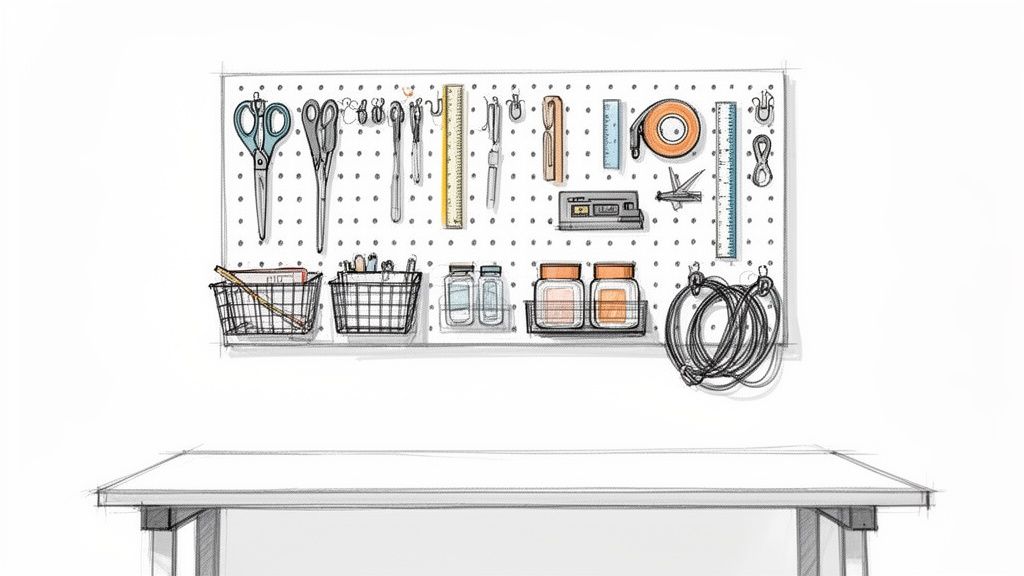
    A wall-mounted pegboard is a highly versatile and customizable solution, making it one of the most adaptive home office storage ideas available. These perforated panels use a system of hooks, shelves, and containers that can be rearranged in countless combinations. This flexibility is perfect for creative professionals, crafters, or anyone whose storage needs change from project to project, transforming an empty wall into a highly functional and visible organization hub.

    An illustration of a white pegboard filled with organized craft and office tools over a desk.

    Popularized by DIY communities and home organization influencers, pegboards keep frequently used tools and supplies off your desk but still within easy reach. By displaying items vertically, they reduce clutter on your primary work surface, which can help improve focus and streamline your workflow. It’s an ideal system for keeping everything from scissors and pens to charging cables and notebooks tidy and accessible.

    Quick Tips for Implementation

    • Installation: For optimal accessibility, mount the pegboard so its center is at or slightly above eye level when seated (around 48-60 inches from the floor). Use heavy-duty wall anchors to ensure it can support the weight of your items.
    • Styling: Group similar items together, such as all your writing utensils or all your cutting tools. Use small bins and baskets to contain loose supplies like paper clips or sticky notes, which helps reduce visual clutter. You can even paint the pegboard to match your office decor.
    • Placement: A small pegboard placed directly above your desk provides a convenient spot for essential tools. For larger collections of supplies, consider dedicating an entire wall to a pegboard system, creating a feature that is both practical and visually interesting.

    For those who need to store more substantial items like printers or large binders, pairing a pegboard with sturdy shelving units or bookcases can create a comprehensive and balanced storage system.

    6. Desk Hutches and Overhead Storage

    Desk hutches are classic home office storage ideas that add vertical storage directly to your workspace. These units sit on top of or attach to the back of a desk, providing shelves, cubbies, and sometimes small cabinets without taking up any additional floor space. This integrated approach keeps your essential books, binders, and supplies organized and within easy reach, clearing the main desk surface for active tasks.

    This solution is ideal for anyone who needs immediate access to a variety of materials throughout the workday. By using the vertical area above the desk, a hutch centralizes storage and helps create a defined and efficient work zone, which can significantly improve focus and workflow.

    Quick Tips for Implementation

    • Fit and Safety: Measure your desk's width and depth carefully to ensure the hutch fits properly and creates a balanced look. Always secure the hutch to the desk or wall according to the manufacturer's instructions to prevent tipping.
    • Organization: Dedicate specific cubbies for different categories, like one for reference books, another for office supplies, and a third for current project files. Store heavier items on the bottom shelves to maintain stability.
    • Lighting: Many hutches can obstruct overhead light. Consider installing a stick-on LED light strip under the lowest shelf to illuminate your work surface and reduce eye strain.

    For a similar, all-in-one solution, storage desks often incorporate built-in shelving and drawers, offering a seamless and coordinated look with ample organizational capacity.

    7. Rolling Carts and Mobile Storage Units

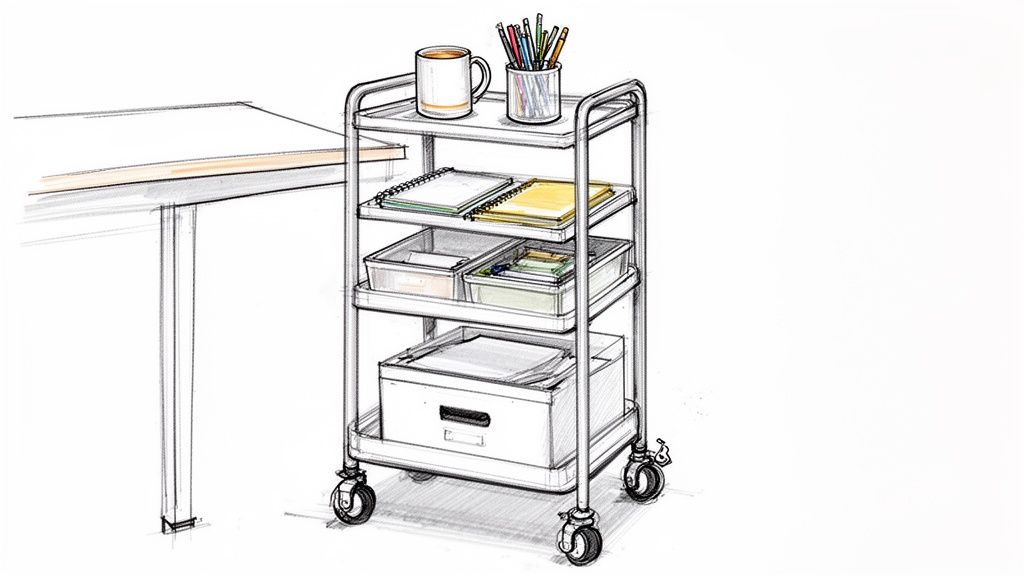
    Rolling carts are the ultimate chameleon of home office storage ideas, offering unparalleled flexibility for dynamic workspaces. These multi-tiered, mobile units can be effortlessly repositioned to serve different functions, making them perfect for multipurpose rooms or offices shared with family members. They provide accessible, open storage for everything from printer paper and ink cartridges to project files and craft supplies, adapting to your workflow on the fly.

    A four-tier metal rolling utility cart organized with various office supplies next to a desk.

    Their portability is their greatest strength. A cart can serve as a "command center" for a specific project, holding all necessary materials, and then be wheeled out of sight when the work is done. This keeps your primary desk surface clear and allows you to quickly reconfigure your space for different tasks or to accommodate guests, a feature that fixed furniture cannot offer.

    Quick Tips for Implementation

    • Organization: Use small bins, baskets, or drawer organizers on each tier to contain loose items like pens, paper clips, and charging cables. This prevents the cart from becoming a mobile junk drawer.
    • Stability: Always lock the wheels once the cart is in its desired position to prevent it from moving unexpectedly. For safety, place heavier items on the bottom shelf and lighter, frequently used supplies on top.
    • Placement: Position the cart next to your desk to act as an extension of your workspace, keeping essential tools within arm’s reach. You can also tuck it into a closet or corner when not in use to maximize floor space.

    For those needing a more permanent and secure mobile solution, file cabinets and credenzas can provide robust, lockable storage with the classic appeal of traditional office furniture.

    8. Desk Drawers and Drawer Dividers

    Organized desk drawers are the unsung heroes of a productive workspace, offering one of the most essential home office storage ideas for tackling daily clutter. By using drawer dividers and organizers, you transform a standard "junk drawer" into a highly efficient system. This approach ensures every pen, paperclip, and charging cable has a designated home, making items easy to find and keeping your desk surface clear for focused work.

    This method is particularly powerful for those who need quick access to a variety of small supplies without sacrificing a minimalist aesthetic. A tidy drawer means a tidy mind, directly contributing to a smoother workflow by eliminating the frustration of searching for misplaced items. It’s a simple change that delivers a significant impact on daily efficiency.

    Quick Tips for Implementation

    • Grouping: Categorize similar items together. Designate specific compartments for writing tools, tech accessories (cables, adapters), sticky notes, and stationery to streamline access.
    • Prioritization: Place your most frequently used items, like your favorite pen or a stapler, in the front-most sections of the top drawer for maximum convenience.
    • Auditing: Once a quarter, take a few minutes to declutter your drawers. Remove items you no longer use, consolidate supplies, and wipe down the organizers to maintain the system.

    For a comprehensive solution, many storage desks and file cabinets are designed to easily accommodate third-party organizers, giving you a head start on a clutter-free office.

    9. Built-In and Custom Storage Solutions

    For a truly seamless and maximized home office, built-in and custom storage solutions offer an unparalleled level of integration. Unlike freestanding furniture, these systems are designed and installed specifically for your room's unique dimensions and your exact workflow needs. This approach creates a cohesive, high-end look by turning architectural quirks into functional features, such as building cabinets into an awkward alcove or designing a wall-to-wall desk and shelving unit.

    This can be an effective home office storage idea for those who need to store a wide variety of items, from files and tech equipment to books and supplies, all within a unified system. A custom solution ensures every inch of space is used efficiently, eliminating clutter and establishing a permanent, professional-grade workspace that perfectly matches your home's aesthetic.

    Quick Tips for Implementation

    • Plan Your Inventory: Before consulting a designer or builder, make a detailed list of everything you need to store. Categorize items and measure larger equipment to ensure the custom design accommodates your specific needs.
    • Future-Proof the Design: Think about your future needs. Incorporate adjustable shelving and flexible compartments that can adapt as your work or technology changes over time.
    • Integrate Technology: Plan for cable management, integrated lighting, and accessible power outlets from the beginning. Hiding wires within the custom cabinetry creates a clean, organized look and improves functionality.

    If a fully custom build isn't the right fit, you can achieve a similar integrated feel using modular shelving units and credenzas. Many retailers offer pieces that can be combined to create a tailored and highly functional storage system.

    10. Credenzas and Sideboards for Office Storage

    Credenzas and sideboards are sophisticated, low-profile cabinets that serve as powerful home office storage ideas, blending concealed storage with elegant design. Originally found in dining rooms, their versatile function makes them ideal for an office, offering a long surface and ample cabinet space without the visual height of a traditional bookcase. This makes them perfect for storing bulky items like printers, paper reams, and binders out of sight, maintaining a clean and uncluttered aesthetic.

    Positioned behind a desk or against a prominent wall, a credenza acts as a functional anchor for the room. Its top surface is perfect for a secondary work area, displaying decor, or housing equipment, while the enclosed cabinets keep visual noise to a minimum. This dual-purpose nature is invaluable in home offices where style and substance must coexist.

    Quick Tips for Implementation

    • Placement: Place your credenza against a wall opposite your desk for easy access or directly behind it to create an executive-style workspace. Ensure it doesn't obstruct major walkways.
    • Organization: Use the concealed cabinets for less-attractive necessities like routers, shredders, and archival files. Organize the interior with drawer dividers and labeled bins to quickly find what you need.
    • Styling: Treat the top surface like a console table. Add a table lamp for ambient lighting, a decorative tray for small items, and a piece of art or a plant to personalize the space. Choose a finish that complements your desk and other furniture for a cohesive look.

    For those seeking functional and stylish storage solutions, a selection of credenzas and sideboards offers numerous options that can elevate a home office from purely practical to professionally polished.

    10-Item Home Office Storage Comparison

    Item Implementation Complexity Resource Requirements Expected Outcomes Ideal Use Cases Key Advantages
    Floating Wall Shelves Medium — wall anchors/stud locating required Low–Medium — shelves, anchors, drill; modest budget Adds vertical, visible storage with modern look; limited heavy-load capacity Small offices needing accessible storage without floor footprint Space-saving, stylish, customizable
    Under-Desk Cabinets & Pedestals Low — mostly freestanding or simple assembly Medium — unit purchase, clearance measurement; optional casters Hidden, organized storage that frees desk surface Professionals needing secure, near-desk file/supply access Concealed storage, filing organization, mobile options
    Tall Bookcases & Shelving Units Medium–High — assembly and anchoring recommended Medium — significant wall/floor footprint; moderate budget High-capacity vertical storage and display; room-defining focal point Users with large book/file collections and ample wall space Maximum storage, display versatility, anchors room
    Filing Cabinets & Lateral Files Low–Medium — place and level; heavier models require help Medium — floor space, moderate cost; optional fireproof models Secure, organized document storage with professional appearance Home-based professionals managing client files and records Security, easy file access, scalable options
    Wall-Mounted Pegboards & Organizers Low — simple mounting and modular setup Low — pegboard, hooks/baskets; very affordable Highly visible, flexible organization; quick access to tools/supplies Creative professionals, makers, and frequent-access users Flexible, reconfigurable, cost-effective
    Desk Hutches & Overhead Storage Medium — mounting, sizing and alignment needed Medium — mounts, matching desk, moderate cost Reachable overhead storage that clears desk surface; may reduce perceived height Small spaces needing accessible overhead storage Accessible storage, integrated look, workflow improvement
    Rolling Carts & Mobile Storage Units Low — minimal assembly; plug-and-play Low — compact footprint, wheels, low–moderate cost Portable, multi-tiered storage; not a permanent solution Shared or multipurpose spaces; frequent reconfiguration Mobility, flexibility, compact and affordable
    Desk Drawers & Drawer Dividers Low — simple inserts or modular organizers Low — inexpensive organizers and dividers Compartmentalized small-item storage; tidy desktop All home-office workers wanting quick access to supplies Low cost, immediate organization, hidden storage
    Built-In & Custom Storage Solutions High — design, professional installation, longer timeline High — custom materials, contractors, higher budget Seamless, optimized storage tailored to space; increases home value Dedicated, permanent home offices and unique space challenges Maximizes space, cohesive high-end aesthetic, durable
    Credenzas & Sideboards for Office Storage Medium — delivery/placement; possible assembly Medium — notable floor footprint; moderate–high cost Concealed, at-height storage that doubles as furniture and surface Professionals hosting clients; need hidden equipment and files Professional appearance, concealed storage, multi-function surface

    Designing Your Ideal Workspace, One Piece at a Time

    Transforming a cluttered corner or a chaotic spare room into a functional and inspiring home office is a journey, not a destination. As we've explored, the path to a productive workspace is paved with thoughtful storage solutions that address your specific needs. From the vertical efficiency of tall bookcases and floating shelves to the discreet power of under-desk pedestals and drawer organizers, the right system brings order and calm to your workday. The goal isn't just to hide clutter; it's to create an environment where your tools, documents, and supplies are exactly where you need them, when you need them.

    The key takeaway is that there is no single "best" solution. An effective workspace is a personalized ecosystem. Your ideal setup might involve a sleek credenza to hide a printer and paper supplies, paired with a wall-mounted pegboard for frequently used tools. Another person might find that a traditional filing cabinet combined with a mobile rolling cart offers the perfect blend of long-term and short-term organization. The most impactful home office storage ideas are those that solve your unique workflow challenges, whether that's taming paper piles, organizing cables, or creating a dual-purpose space that serves multiple functions.

    Putting Your Plan into Action

    Before making any decisions, take a moment to assess your current pain points. Are you constantly searching for a specific file? Is your desk surface overrun with stationery? Identifying the problem is the first step toward finding the perfect solution.

    • Prioritize Function: Start with the pieces that will make the biggest immediate impact on your daily productivity. If paper management is your biggest hurdle, a lateral file cabinet might be a better first investment than decorative shelving.
    • Measure and Plan: Always measure your space twice. Consider not just the footprint of a new bookcase or desk, but also the clearance needed for opening drawers and doors.
    • Think Long-Term: Choose pieces that can adapt with you. A classic credenza or a well-built shelving unit is a versatile investment that can be repurposed in other rooms if your office needs change down the line.

    Ultimately, mastering your home office storage is about more than just organization. It's about creating a dedicated space that respects your work, reduces mental friction, and empowers you to do your best. By thoughtfully selecting and combining these ideas, you can build a workspace that is not only practical but also a place you genuinely enjoy spending time in.


    Ready to see how different storage solutions feel in a real-world setting? Exploring options like storage desks, credenzas, and quality bookcases in person can help you visualize your ideal workspace. The team at Woodstock Furniture & Mattress Outlet is here to help you navigate the options and find pieces that fit your style, budget, and functional needs without any pressure. Visit one of our North Georgia showrooms to get started.