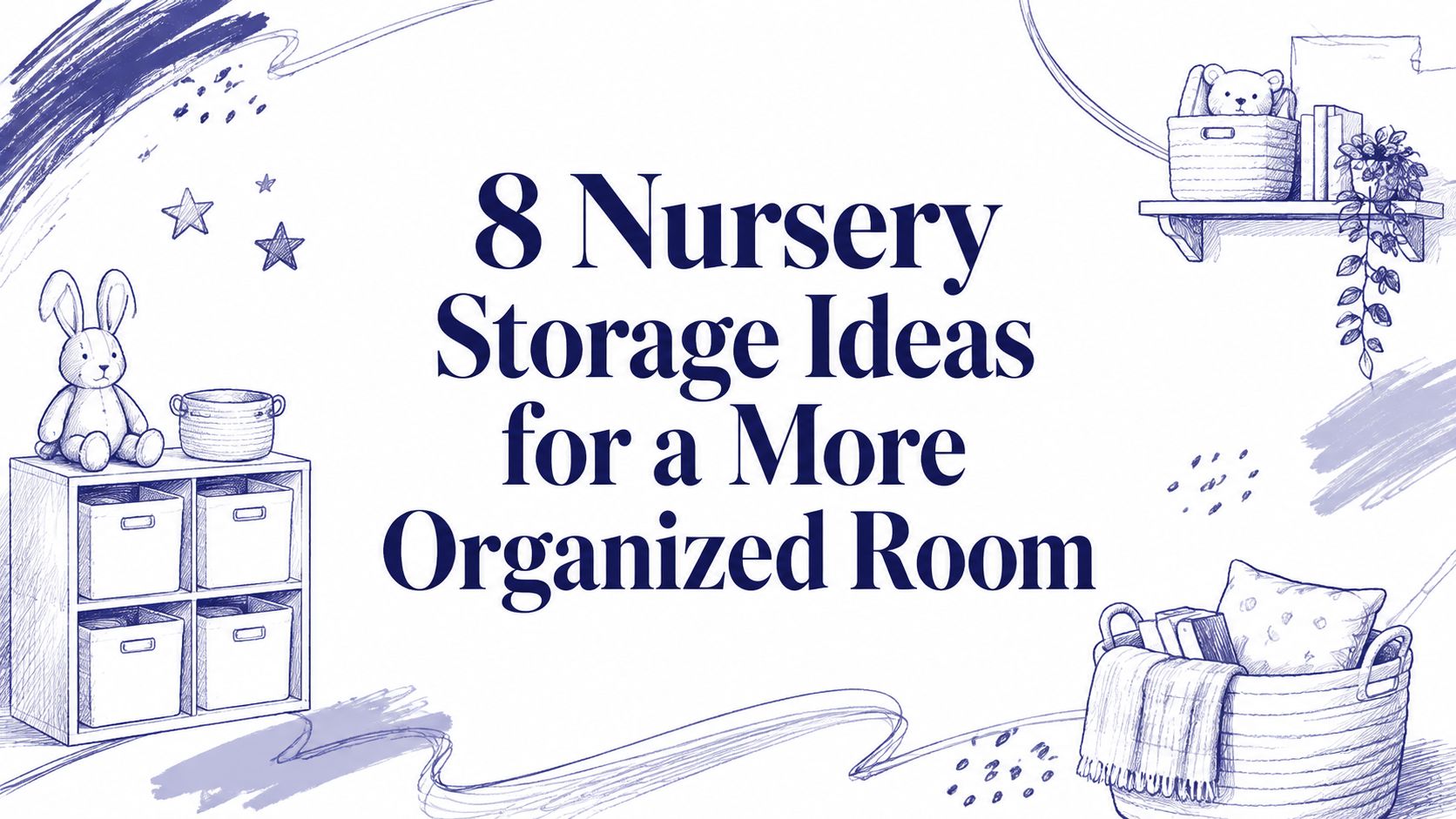
How can a nursery stay organized when the things you reach for most often keep changing, while the room itself has limited floor space? Clutter usually comes from a mix of clothing, linens, diapers, toys, and small daily-care supplies, not from one storage failure. The useful question is where each category belongs.
Floor space can handle flexible bins. Walls can carry vertical organization. Closets are suited to clothing, while dressers and changing furniture can keep daily-care supplies close to the point of use. These eight nursery storage ideas focus on real constraints, including changing clothing sizes, nighttime access, visibility, room flow, future use, and child safety.
A good system doesn't need to fill every corner. It needs to make frequent tasks easier without blocking the crib, changing area, door, or walking path. If you're also furnishing a compact bedroom, these small bedroom space-saving tips can help you think through the wider layout. When proportions and storage features are difficult to judge online, you can explore nursery and bedroom furniture in person at Woodstock Furniture & Mattress Outlet.
1. Vertical Wall Storage with Open Shelving
How can a nursery gain storage without giving up floor space for a crib, changing station, chair, and clear walking paths? Wall-mounted shelves, cubbies, and slim corner units move supplies upward, leaving the floor open for movement.
Start by measuring the wall, the available height, and the space around doors and furniture. Adult-accessible shelves suit blankets, books, baskets, and soft toys used during dressing or bedtime. Items within a toddler's reach require closer review. Open shelving still needs secure brackets, stable baskets, and objects suited to the child's stage.
Practical rule: Use open shelves for items that caregivers can identify and retrieve safely. Place supplies requiring supervision higher up.
A practical layout might put labeled baskets on the lowest shelf that adults can reach, folded blankets in the middle, and a few books higher up. Keep heavier items on lower shelves, and leave enough space to see what each container holds. Matching baskets reduce visual clutter, while labels help caregivers find socks, blankets, or spare outfits quickly, especially during nighttime care.
Visibility is the main advantage of this setup. You can see when a basket is empty, but dust and visual busyness are trade-offs. Use containers for loose supplies rather than filling every shelf with individual items.
The Government of Canada's safe nursery guidance recommends baskets or canvas bins without sharp corners for organizing baby toys. Choose those softer containers, secure the wall-mounted unit properly, and keep small items like button batteries, coins, and loose toy parts away from a child's reach.
2. Closet Organization Systems with Dividers and Rods
Baby clothing creates a special storage problem because the garments are small, numerous, and quickly outgrown. A closet can handle that change better when you divide it by size and use, rather than placing every item on one crowded rod.
A second hanging rod can separate current clothing from the next size or from seasonal pieces. For example, current everyday clothing might occupy the most accessible section, while larger sizes stay grouped in labeled containers or on a separate rod. The exact arrangement depends on the closet's height and the furniture below it, so measure the usable vertical space before buying an organizer.
Keep current clothing visible
Place the clothes used most often at adult eye level. Folded onesies, sleepers, socks, and accessories can go into labeled bins on shelves, while hanging outfits remain grouped by size or type. Leave some open capacity instead of filling every shelf, since a closet that starts overcrowded becomes difficult to update after laundry day.
A lower rod can make part of the closet easier for a growing child to access later. However, lower placement also changes what a toddler can reach, so keep items such as accessories, cords, and unsuitable garments out of reach when necessary. Door-mounted organizers can hold small accessories, but check that they don't interfere with the door's swing.

A labeled “outgrown” section also helps prevent the closet from becoming a mixture of current and finished sizes. Move items out as they stop fitting, then decide whether they belong in keepsake storage, a donation container, or another room.
For a visual example of organizing nursery clothing and storage zones, watch this nursery storage organization video.
3. Under-Crib Storage Drawers and Rolling Bins
The space beneath a crib can store backup linens without adding another cabinet or dresser. Low-profile drawers and rolling bins are useful for crib sheets, mattress protectors, swaddles, sleep sacks, and other items that need to stay nearby but don't need to remain visible.
Start with the measurement that determines whether this idea will work: the clearance beneath the crib. Measure the available height, width, and depth, including room for the drawer or bin to roll out. A container that technically fits but catches on the crib frame will quickly become frustrating, especially during a nighttime change.

Match the container to the contents
Use clear bins when visibility matters, or label opaque containers with large, simple descriptions. One bin might hold spare sheets, another extra blankets, and another seasonal clothing. Keeping categories separate prevents you from pulling every container out to find one clean sheet.
Reserve under-crib storage for items that suit the location. Bedding and soft goods are sensible uses, while fragile items, liquids, or small pieces that could become accessible during play deserve a different home. Sturdy containers are preferable for heavier contents, and rolling hardware should move smoothly without sharp edges or loose components.
Under-crib storage also has a future-use question. As the crib changes configuration or becomes a toddler bed, the clearance may change. Choose bins that can move to a closet or bedroom if the furniture layout evolves, rather than treating the storage as permanently tied to the crib.
4. Multi-Functional Furniture with Built-In Storage
A changing table, dresser, or storage ottoman can solve more than one problem within the same footprint. This is useful when a nursery doesn't have space for separate changing, clothing, blanket, and seating pieces.
A dresser with a changing topper can place diapers, wipes, lotions, and spare clothing directly below the changing surface. Wider drawers can hold folded garments and linens, while a storage ottoman near a glider can contain blankets and provide a place to sit. The right choice depends on what the room already lacks, not just on how many functions a product lists.
Plan for the furniture's second phase
Consider whether the piece will remain useful after diaper changes become less frequent. A dresser that works as clothing storage in a child's bedroom may have more practical value than a changing table that has no later role. Finishes and proportions matter here. A nursery-specific appearance may feel appropriate now, while a simpler design can transition more easily as the room changes.
Drawer organization should reflect actual routines. Put the supplies used together in the same zone, but don't compress every category into one deep drawer. Shallow dividers or small bins can keep socks, creams, and accessories from disappearing beneath larger items.
Stability is a central part of this idea. The furniture tip-over prevention checklist from the American Home Furnishings Alliance says a federal furniture safety standard was applied in September 2023 to new clothing storage furniture over 27 inches tall. The same guidance still recommends anchoring these pieces to the wall as a precaution and placing heavier items in lower drawers. Follow the manufacturer's instructions and review the furniture's stability before adding a changing setup or storing heavy supplies.
5. Wall-Mounted Pegboards and Hanging Organizers
Small nursery items are difficult to manage because they don't fit neatly into large drawers. A pegboard or wall-mounted hanging system can give pacifier clips, bibs, hats, teethers, and similar accessories a visible place near the changing area.
Pegboards differ from fixed shelves because hooks, baskets, and small trays can be repositioned. That makes them suitable for a room where the contents change from newborn-care supplies to toddler accessories. You can begin with a few items near the changing station, then adjust the layout when those supplies are no longer part of the daily routine.
A flexible wall system is useful only when the wall remains calm. Leave empty space so you can change the arrangement without creating a crowded cluster.
Place frequently used items where an adult can reach them without stepping away from the changing surface. That placement improves workflow, but it also means the board may be accessible to a growing child. Small objects, cords, clips, and detachable hooks should be moved higher or into closed storage before a child can reach them.
Build zones instead of visual clutter
A painted pegboard can coordinate with the nursery, but appearance shouldn't determine the layout. Use one basket for bibs, a hook for a diaper bag, and a small labeled container for accessories. Keep the categories narrow enough that you can return each item quickly.
Before installation, identify wall structure, mounting hardware, and the board's total load. A pegboard is not a substitute for a secure cabinet, and its hooks should not carry more weight than the hardware supports. In a rental, a freestanding or removable organizer may be more suitable if wall modifications aren't allowed.
6. Fabric Baskets and Stackable Bins for Flexible Storage
Portable containers suit nurseries where the layout and storage needs keep changing. A fabric basket can move from a shelf to a glider, while a plastic bin can shift from beneath the changing station to a closet. They provide a practical starting system before you commit to permanent furniture.
Assign one container to one clear category. Keep blankets, toys, out-of-season clothing, diapers, and linens separate rather than combining them in one large basket. A readable label gives each item a defined place, so caregivers can return supplies without searching through mixed contents.
Choose visibility based on frequency
Clear or semi-transparent bins show what remains before you open them. Fabric baskets create a softer appearance and hide visual clutter, but similar baskets need labels. Handles are useful when supplies travel between changing and feeding areas.
Stacking preserves limited floor area, yet access and stability must guide the arrangement. Keep the stack low and place frequently used items in the easiest position to reach. A taller stack may store more, but retrieving the bottom bin repeatedly can make the system frustrating.
Soft containers without sharp corners support an open-storage approach described in Canadian public-health nursery guidance. Placement still matters. Keep small toys, cords, and unsuitable supplies beyond a child's reach, and check that containers do not block doors, vents, or the walking path around the crib.
Measure the available shelf or floor depth before buying. A bin that fits the width may still obstruct a drawer, door, or nearby furniture. Leave enough clearance to lift the lid or pull the container forward without moving other items.
The main advantage is reconfiguration. As clothing sizes change or toys separate into new categories, you can relabel, relocate, or repurpose the containers instead of replacing the entire storage system.
7. Over-the-Door Organizers and Hanging Storage
The back of a nursery door or closet door can hold supplies without taking up another section of floor or wall. Pocket organizers work well for diapers, wipes, bibs, spare crib sheets, mattress protectors, and other lightweight items that need regular access.
A clear pocket organizer makes restocking easier because you can see what remains. An opaque fabric version keeps the room visually quieter and can suit a closet door where appearance matters less. Either way, the organizer should match the door's movement. Check the swing direction, available clearance, and whether the pockets rub against nearby furniture.
Keep weight balanced
Put heavier items in lower pockets and lighter items higher up. Distribute the contents rather than loading one side, and inspect the hooks or mounting points for strain. A door organizer that causes the door to drag, fail to close, or swing into furniture isn't creating useful storage.
Interior closet doors are often a good location for items that need access but don't need to stay on display. The main nursery door may be better for lightweight items used during nighttime care, provided the organizer doesn't narrow the path or interfere with quick movement.
This approach also requires a small-item review. Diaper creams, pacifiers, bottle accessories, and similar supplies can become hazards if a child can reach them. Move items upward or into child-resistant storage as the child becomes more mobile. The organizer is a convenience feature, not a replacement for supervision or safe placement.
Over-the-door storage is especially useful for renters because it can add capacity without permanent wall installation. It won't replace a closet or dresser, but it can absorb the loose categories that otherwise collect on the changing table.
8. Closet Hanging Organizers and Shelf Dividers
A closet rod can hold more than hanging clothes. Hanging shelves, shoe organizers, garment bags, and shelf dividers create separate zones for folded clothing, bedding, accessories, keepsakes, and soft toys without requiring a new cabinet.
Start by sorting items into three practical groups: current-use clothing, next-size or seasonal items, and occasional or keepsake pieces. Current clothing deserves the clearest access. Larger sizes can remain visible but less central, while special outfits and keepsakes can occupy garment bags or higher sections.
Use one hanging organizer for one size grouping or category. A label such as “current sleepers” is more useful than a broad label such as “baby items,” especially when several caregivers share the room. Shelf dividers can keep folded stacks upright, but don't overload the rod or place too much weight on one section.
Access test: If you need to remove three unrelated stacks to reach one daily-use item, the closet has too many categories in the same zone.
The system should also be easy to revise. As clothing sizes change, move finished items out and shift the next group forward. Keep a little room for seasonal pieces and laundry rather than planning around a completely full closet.
Distribute weight evenly across hangers and organizers, and follow the closet hardware's capacity guidance. Check that hanging pockets don't touch the floor, block the door, or create a climbing invitation. Shelf dividers and organizers can improve visibility, but they still need sensible placement as the child grows.
Nursery Storage: 8-Item Comparison
| Storage Solution | Implementation Complexity | Resource Requirements | Expected Outcomes | Ideal Use Cases | Key Advantages |
|---|---|---|---|---|---|
| Vertical Wall Storage with Open Shelving | Low–Moderate: simple mounting, stud placement recommended | Shelves, brackets, baskets; moderate cost, uses wall space | Maximizes vertical space, keeps items visible and reachable | Small nurseries, display + frequent-use storage | Frees floor area, flexible styling, cost-effective vs built-ins |
| Closet Organization Systems with Dividers and Rods | Moderate–High: may require custom layout or pro install | Multiple rods, shelves, dividers, labeled bins; moderate–high cost | Centralized, dust-protected clothing storage that scales with sizes | Homes with dedicated closets and many clothing sizes | High capacity, protects garments, efficient rotation by size/season |
| Under-Crib Storage Drawers and Rolling Bins | Low: plug-and-play or simple install | Low-profile drawers/bins with casters; low cost | Utilizes under-crib void for linens and extras; quick access | Tight spaces needing hidden linen/toiletry storage | Out-of-sight access, mobile, preserves floor footprint |
| Multi-Functional Furniture with Built-In Storage | Moderate: furniture selection, assembly, anchoring | Changing-dresser hybrids, ottomans; higher upfront cost | Combines functions and storage in one footprint, long-term use | Small rooms needing multiuse pieces; long-term investment | Consolidates functions, saves floor space, transitions as child grows |
| Wall-Mounted Pegboards and Hanging Organizers | Low–Moderate: simple mounting, modular setup | Pegboard panels, hooks, baskets; affordable | Highly customizable, visible organization for small items | Organizing small/frequently used items; evolving storage needs | Flexible reconfiguration, high visibility, affordable |
| Fabric Baskets and Stackable Bins for Flexible Storage | Very Low: no installation required | Baskets/bins in assorted sizes; very low cost | Portable, reconfigurable containment for toys, linens, clothes | Renters, temporary setups, flexible room layouts | Portable and affordable, easy to add/remove, versatile |
| Over-the-Door Organizers and Hanging Storage | Very Low: hang over door, no tools typically needed | Pocketed organizers or hangers; low cost | Uses unused door plane for quick-access items | Small nurseries with doors; frequently accessed supplies | No permanent install, removable, efficient use of wasted space |
| Closet Hanging Organizers and Shelf Dividers | Low–Moderate: hang from rod, insert dividers | Hanging shelves, pocket organizers, fabric dividers; low cost | Multiplies usable closet space and separates sizes/types | Closets with limited shelving needing more vertical use | Maximizes closet capacity, inexpensive, easy to reconfigure |
Build a Nursery Storage System That Can Change
The most useful nursery storage system starts with the room, not a product category. Measure the available wall, closet, crib, and furniture clearances. Mark where drawers open, where the door swings, and where you need an unobstructed path around the crib and changing area.
Next, identify what needs daily access. Diapers, wipes, creams, spare clothing, and feeding supplies belong near the relevant care zone, while outgrown clothing, seasonal items, and extra linens can occupy less convenient storage. Assign clothing to the closet first, then use dressers, baskets, shelves, and under-crib bins for the categories that remain.
Low storage can support safe access for suitable items, but it shouldn't become a place for every small object. The American Academy of Pediatrics guidance on toy-box safety says toy boxes should have a supported hinged lid that stays open at any angle, along with ventilation holes or a gap to help prevent entrapment. It also recommends open shelves when possible. If you use a toy box, choose one with those safety features rather than treating any lidded container as equivalent.
A concise safety review should include:
- Secure anchoring: Anchor tall or freestanding storage according to the manufacturer's instructions and review wall attachment after rearranging furniture.
- Stable loading: Put heavier contents lower, balance hanging organizers, and avoid unstable stacks.
- Clear movement: Check that bins, baskets, and door organizers don't obstruct the crib, changing area, doorway, or walking route.
- Small-item control: Keep pacifiers, clips, cords, creams, and other potentially hazardous items away from a child's reach as mobility develops.
- Ongoing separation: Nursery toy-safety guidance recommends keeping older children's toys separate from younger children's toys and reviewing toys and furnishings for safety recalls.
You don't need to install all eight ideas at once. Start with one or two changes that address the biggest daily problem, such as a dresser near the changing station or labeled bins for clothing sizes. Revisit the categories as your child grows, because a system that works for newborn supplies may need different access rules and storage locations later.
Woodstock Furniture & Mattress Outlet can help you compare nursery furniture proportions, dressers, changing setups, and storage features in person. The right solution will depend on your home's layout, the room's measurements, and your family's routine.
Visit Woodstock Furniture & Mattress Outlet to explore nursery furniture, dressers, chests, cribs, mattresses, and storage pieces for different room layouts. Bring your measurements and daily routine so you can compare proportions and choose a setup that supports access, future use, and safe organization.