You notice the problem when the same three items keep drifting around the room. A coffee mug lands on the floor beside the sofa. The laptop balances on a throw pillow. The remote disappears because nobody has a dependable place to set it down. In a lot of living rooms, there isn't a missing seat or a missing shelf. There's a missing surface.
That's where a folding sofa table starts to make sense. Not because it's clever, and not because it “saves space” in some vague catalog way. It works when a room needs a usable table some of the time, but not all of the time.
I've seen this most often in rooms where every inch already has a job. The sofa floats in the room. One chair gets pulled to the dining area on weekends. The walkway to the TV can't get tighter. A permanent console table feels bulky, but no table at all gets old fast. A folding version can live behind the sofa, then open when somebody needs a lamp, a drink, a puzzle surface, or a place to work for an hour.
Why a Folding Sofa Table Belongs in the Conversation
A folding sofa table usually enters the conversation after a room has already failed a few tests. People try a side table, but it blocks the path. They try a coffee table, but it makes the room feel pinched. They skip tables entirely, then realize daily life gets annoying.
The most relatable setup is the floating sofa in a modest living room. The back of the sofa faces the entry or dining area, so that strip behind it becomes contested space. It has to stay open enough for walking, but useful enough to support real life. A fixed console can work there. A folding sofa table works better when that zone needs to stay flexible.
The real problem is competing uses
One household wants a place for drinks during movie night. Another needs a temporary laptop perch. Another wants a lamp behind the sofa, but only if the room still feels open. The folding sofa table solves a very specific conflict. It gives you surface area when you need it, then gives the room back when you don't.
Practical rule: If the table has to disappear often enough that you already think about folding it before you buy it, a folding model deserves a serious look.
This isn't a novelty category. It's a response to a recurring frustration in smaller or more flexible rooms. That matters even more now because the broader folding furniture market is still growing, with projections rising from $11.14 billion in 2025 to $11.86 billion in 2026 according to Burgess Furniture's folding table guide. The buying mistake is assuming any folding table will do the job.
Daily use decides whether it earns its place
A folding sofa table only stays useful if three things are true:
- The traffic path stays clear: If people have to turn sideways to pass, the table won't stay open.
- The mechanism feels easy: If opening it is awkward or noisy, it'll end up folded all the time.
- The top supports actual habits: Drinks, chargers, books, and a lamp need a stable surface, not a decorative ledge.
That's why hinge style, open depth, floor contact, and setup friction matter more than trendy finishes. A folding sofa table belongs in the conversation when a room needs flexibility, not when a room just needs “something small.”
What a Folding Sofa Table Actually Is
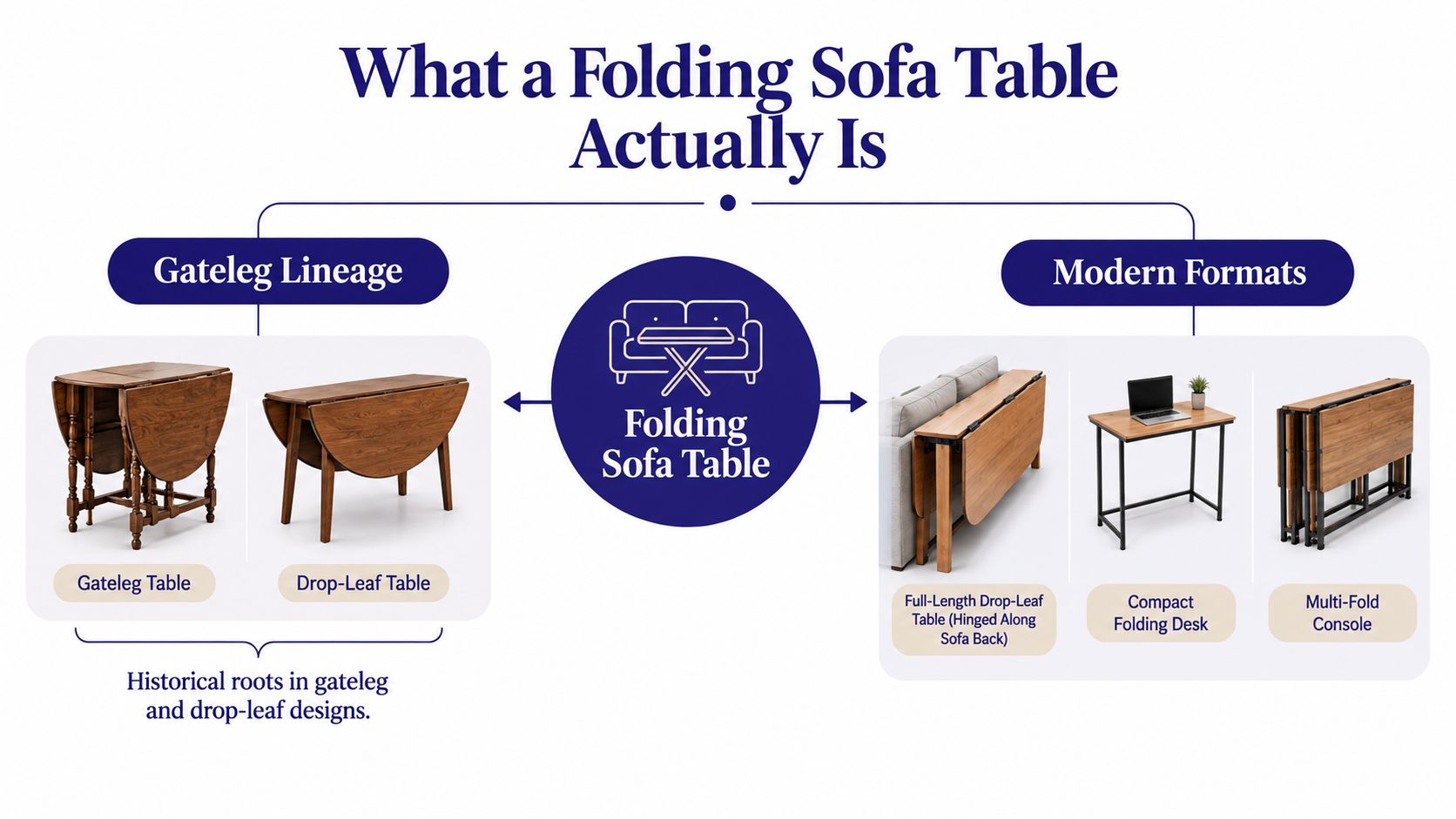
A folding sofa table sits in a family of furniture that's much older than the modern living room. Its roots trace back to the gateleg table, a form that first appeared in 16th-century England and became practical in smaller homes because hinged leaves and pivoting supports let the table expand for use and fold down to save space. By the 17th century, folding versions had spread into American colonial furniture traditions, with surviving examples dating to about 1670 to 1690. The furniture form was established long before the term “gateleg” became widely used in the 19th century, as explained in this gateleg table history.
The modern versions you'll actually shop
Today, most shoppers run into three practical formats:
- Full-length drop-leaf styles: These run behind much of the sofa and open along the back edge.
- Single-side folding tables: One leaf swings out, which works better when only one side needs extra depth.
- Slim console-style panels: These stay narrow when closed and fold flat enough for tight placement near a wall or sofa back.
The category gets confusing because many listings use broad labels. A folding tray table isn't the same thing. A TV tray set isn't built around sofa-back height or behind-sofa clearance. A drop-leaf dining table may fold, but its footprint is usually planned for eating zones, not living room traffic.
The clues that separate a real sofa table from a generic folding table
A true folding sofa table is shaped for the living room. It needs to align with the back or arm height of a sofa, stay shallow enough when closed, and avoid sticking too far into the path behind seating.
Materials also change how usable the piece feels:
- Solid wood: Usually feels steadier and ages better visually, but weight can make frequent folding less pleasant.
- Veneered MDF or similar panels: Often gives a cleaner price point and a smoother finish, but edge wear matters.
- Powder-coated steel frames: Helpful when you want a lighter visual footprint or a more compact mechanism.
The hardware often tells the story. If the hinges, supports, and pivot points feel like occasional-use furniture, that's usually what they are.
Buy by mechanism first, finish second. A good-looking table that opens reluctantly won't stay in service.
Measuring Your Space Before You Buy
A folding sofa table can look perfect on a product page and still become dead furniture the week it arrives. The usual failure point is not finish, color, or even build quality. It is the open-and-close cycle in your actual room.
Start with a simple test before measuring anything. Walk the path people already use behind the sofa, around the chair, toward the lamp, or through to the kitchen. If opening the table would force everyone to turn sideways, reroute around the coffee table, or bump a reclining seat, the table will stay folded most of the time. That is the part buyers miss.
The dimensions that matter are connected. Sofa height affects how natural the table looks and how easy it is to reach. Closed depth decides whether it can live behind the sofa every day. Open depth decides whether anyone will bother using it once the novelty wears off.
Measure for the table closed first
Closed size is the everyday size. Measure from the back of the sofa, including any cushion bulge, to the nearest point the table could interfere with. Baseboards, floor vents, outlet covers, and radiators all count because they steal usable inches.
Height matters too, but not in an abstract way. Measure to the part of the sofa the table visually lines up with, usually the back rail or the arm nearest the placement spot. A table that sits a little below that line often looks intentional. One that lands far above it usually feels awkward and catches the eye for the wrong reason.
Then test the room with the table open
Now mark the open footprint on the floor with painter's tape. Include the full projection of the leaf and the path of any leg, gate, or support bracket as it swings into place. That motion matters just as much as the final size, especially in rooms where a side chair, floor lamp, or outlet is already competing for the same corner.
I have seen plenty of living rooms where the table technically fit open, but nobody wanted to operate it because the hinge side clipped a basket or the support had to be nudged into place around a rug edge. That is how a folding table turns into a permanent console.
A quick room example helps. In a medium living room with a full-depth sofa and a narrow pass-through behind it, a slim table may work beautifully when closed. Add one open leaf, and the path can tighten enough that carrying laundry, setting down drinks, or getting kids past the sofa becomes annoying. If the room has recliners or a chaise nearby, check those movement zones too, not just the empty floor.
Use these checks before you buy:
- Measure sofa-adjacent height where the table will sit.
- Measure true rear clearance, including cushion flare and baseboards.
- Tape out the open top on the floor.
- Open any nearby recliner or door while the taped footprint is in place.
- Walk the route as if you were carrying a tray, vacuum, or laundry basket.
If delivery is part of the problem, not just placement, when to hire movers for tight spaces is a practical read before you order. A table can suit the room and still be miserable to get through a narrow hall or sharp turn.
Folding Sofa Tables and Other Space-Saving Options
A folding sofa table earns its place only if you will use the fold. I have seen plenty of shoppers buy one for flexibility, then leave it shut all year because a simpler table would have fit their routine better.
The better question is how the room changes over a normal week. If the table opens for drinks during movie night, closes for a play area the next morning, and opens again when someone works from the sofa, a folding model makes sense. If you want one stable landing spot for lamps, remotes, and a charger, a fixed table usually feels better day to day because there is no mechanism to operate or wear out.
Here is the trade-off in plain terms. A folding sofa table saves depth, but you pay for that feature with hardware, setup time, and one more moving part to maintain.
Other small-space tables solve different problems:
- Nesting tables help when surfaces need to move toward the seat, then tuck away fast. They are easy to reposition, but they also tend to drift around the room and get separated.
- Lift-top coffee tables suit households that eat, work, or use a laptop from the sofa. They solve reach better than a sofa table does, but they do nothing for the walkway behind the sofa.
- Modular consoles fit rooms that get rearranged often for guests or shared activities. They are less fussy than a folding leaf, though they usually need more floor space overall.
- Fixed slim console tables are often the overlooked option. If your traffic path stays acceptable with a narrow permanent table, a fixed piece usually feels sturdier and asks less of the user.
A few rooms make the choice clearer.
In a studio or small apartment, a folding sofa table can pull double duty as a narrow console most of the time and a temporary work or snack surface when needed. That only works if the open-close cycle is quick and the path behind the sofa still feels usable.
In a family room with kids, pets, and constant movement, I usually steer people toward a fixed slim console or a sturdy nesting set. Hinges and support arms hold up best when people use them deliberately, not when the table gets bumped during a chase around the sofa.
Open-plan rooms are the trickiest. A modular console or even a compact fixed table often wins there because the space is already doing several jobs, and loose reconfiguration tends to be easier than folding and locking leaves every few days.
The shortest version is this: choose a folding sofa table when changing depth is the problem you need to solve. Choose another space-saving table when your real issue is reach, storage, or flexible surface placement.
Setting It Up and Checking Stability
The first setup tells you more about a folding sofa table than the showroom floor ever will. This is the point where smooth hardware, square floor contact, and real stability either show up or don't.
What to inspect before you trust it
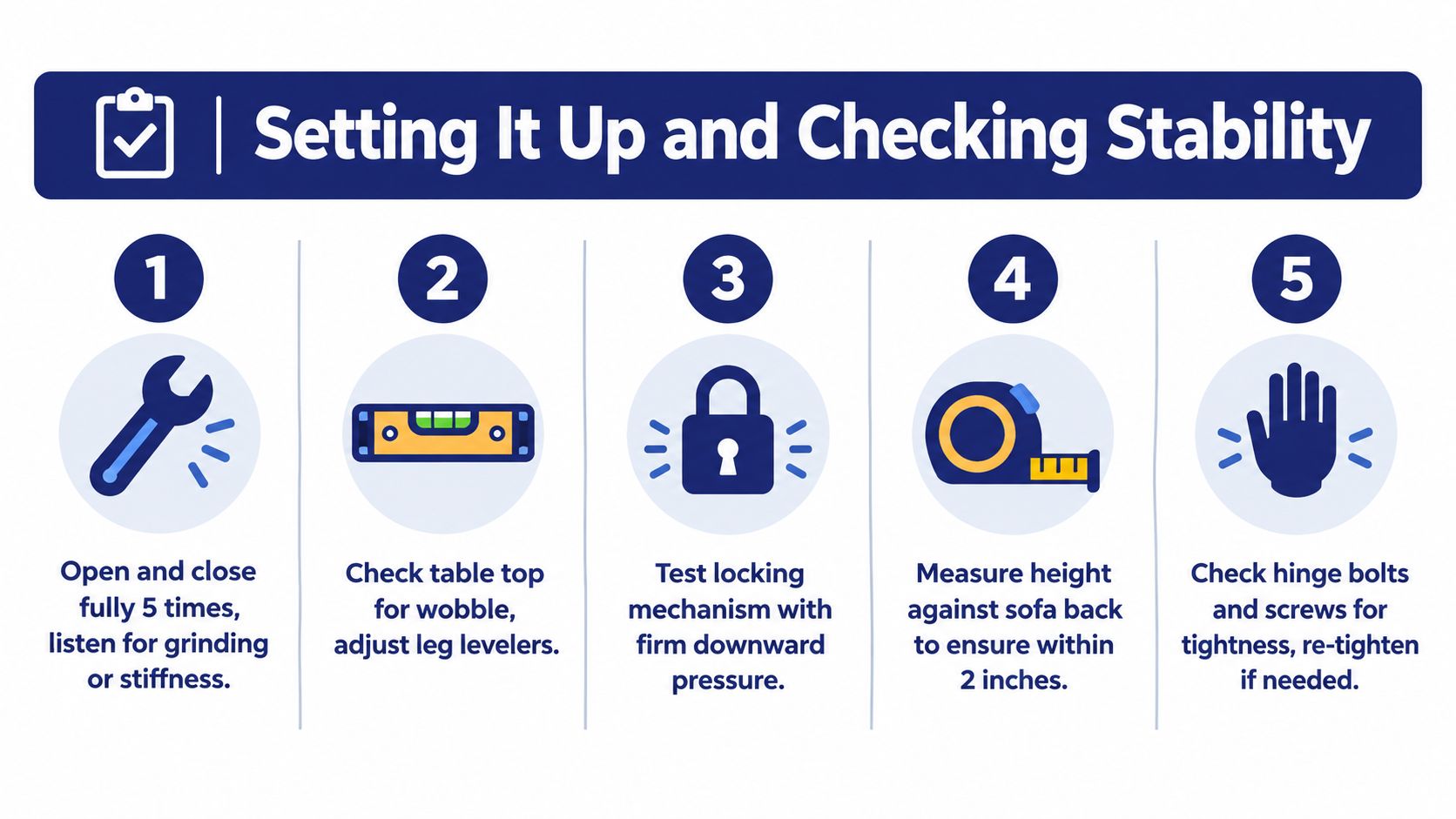
Open and close the table fully a few times before placing anything on it. Listen for scraping, binding, or one side moving differently from the other. Then set it on a flat, level surface and check whether all support points make honest contact.
Independent furniture inspection guidance recommends assembling the product as instructed, placing it level, applying progressive load to the top, and then repeating directional push or side-load checks at the points most likely to tip. The key standard isn't “does it feel okay by hand.” The product should remain stable without overturning, and static loading shouldn't cause deformation, damage, or failure, according to Eurofins' overview of on-site furniture tests.
Here's the practical version for home setup:
- Run the mechanism first: Open and close it several times with no load.
- Check floor contact: Gently rock each corner and look for lift.
- Tighten hardware: Shipping vibration can leave knock-down fittings looser than expected.
- Test the point of greatest strain: Put weight near the edge that creates the most strain.
- Add a side push: Simulate someone leaning from the sofa side, not just weight from above.
Later in the process, it helps to see the motion and sequence in action:
Why repeated cycles matter
A folding table can pass the first-day test and still disappoint later. Formal furniture testing relies on standardized load and cycle methods, not casual “feel” checks. Related fold-out furniture protocols use repeated open and close cycling with inspection after every 250 cycles, with acceptance levels ranging from 1,500 cycles for light service to 2,000 cycles for medium service and higher for heavy service, as described in the FIRA standards update report.
For home use, that translates into one simple habit. Recheck the hinges, rivets, and clearances at intervals. The earliest signs of trouble are usually slack in the joints, widening gaps, or a new wobble that wasn't there before.
Placing and Styling It in a Real Living Room
Saturday night is usually when the placement problem shows up. The table is open for drinks or a laptop, someone stands up from the sofa, and the room suddenly feels tight. A folding sofa table earns its keep only if that open position still leaves a clear path through the room.
I set these up by watching the room in two states: closed for daily life, open for actual use. If the table works in one state and annoys everyone in the other, it usually ends up folded and forgotten.
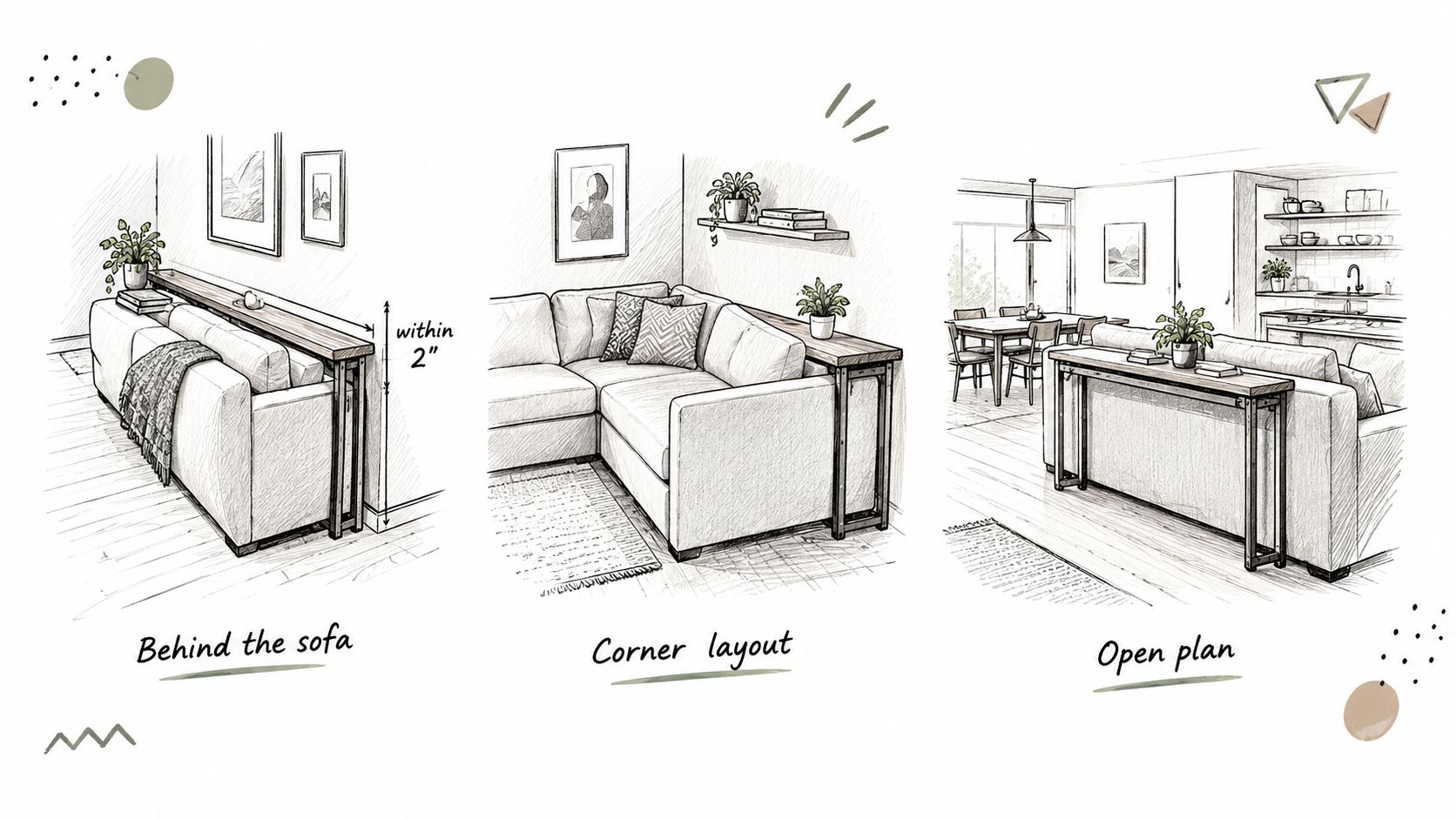
A wall-hugging sofa is the easiest case. Keep the table behind the sofa, with the top close to sofa-back height so it reads like part of the seating zone instead of a random ledge. Open it only toward the room, and only if you still have enough walking space to pass without turning sideways. That setup suits movie rooms, small dens, and apartments where the sofa already defines the room edge.
Floating sofas need more caution. Behind-sofa placement can look right on paper and fail fast in practice because it steals the main path between seating areas. In those rooms, the short end of the sofa often works better. Closed, the table acts like a compact side table. Open, it becomes a work surface or snack perch without cutting the room in half.
The trickiest layout is the living room that also has to host casual meals or overflow guests. Put the table where the leaf opens toward a chair or stool zone, not into the center walkway. A folding top should create a second use, not a new obstacle.
Styling should support the folding cycle. A tray helps because it lets you clear remotes, coasters, and chargers in one move before closing the top. Lamps work if the cord stays well away from the hinge side and the support path underneath. Tall decor at the outer edge looks good in a photo and gets old fast once people start opening and closing the table every day.
Three setups hold up well in real homes:
- A charging station behind the sofa, near an outlet, with a tray for cables and small devices
- A bar or snack surface facing guest seating in an open-plan room
- A landing spot at the sofa end in a room where the seating area meets the entry side
If the table sits on a rug, pick one that can handle foot traffic, chair legs, and the occasional spill without becoming another high-maintenance surface. For nearby soft surfaces and low-maintenance options, Rubber Ducky Rug Cleaning Birmingham's picks offer practical guidance on easy-to-clean area rugs.
One more honest note from the sales floor. Some rooms do not want a folding sofa table at all. If the table will stay open full-time, or if your best placement still blocks circulation, a fixed console or sofa table is usually the better buy. Retailers such as Woodstock Furniture & Mattress Outlet carry console and sofa table styles that make more sense when you need a permanent surface and do not need the folding mechanism.
Care, Maintenance, and Everyday Habits
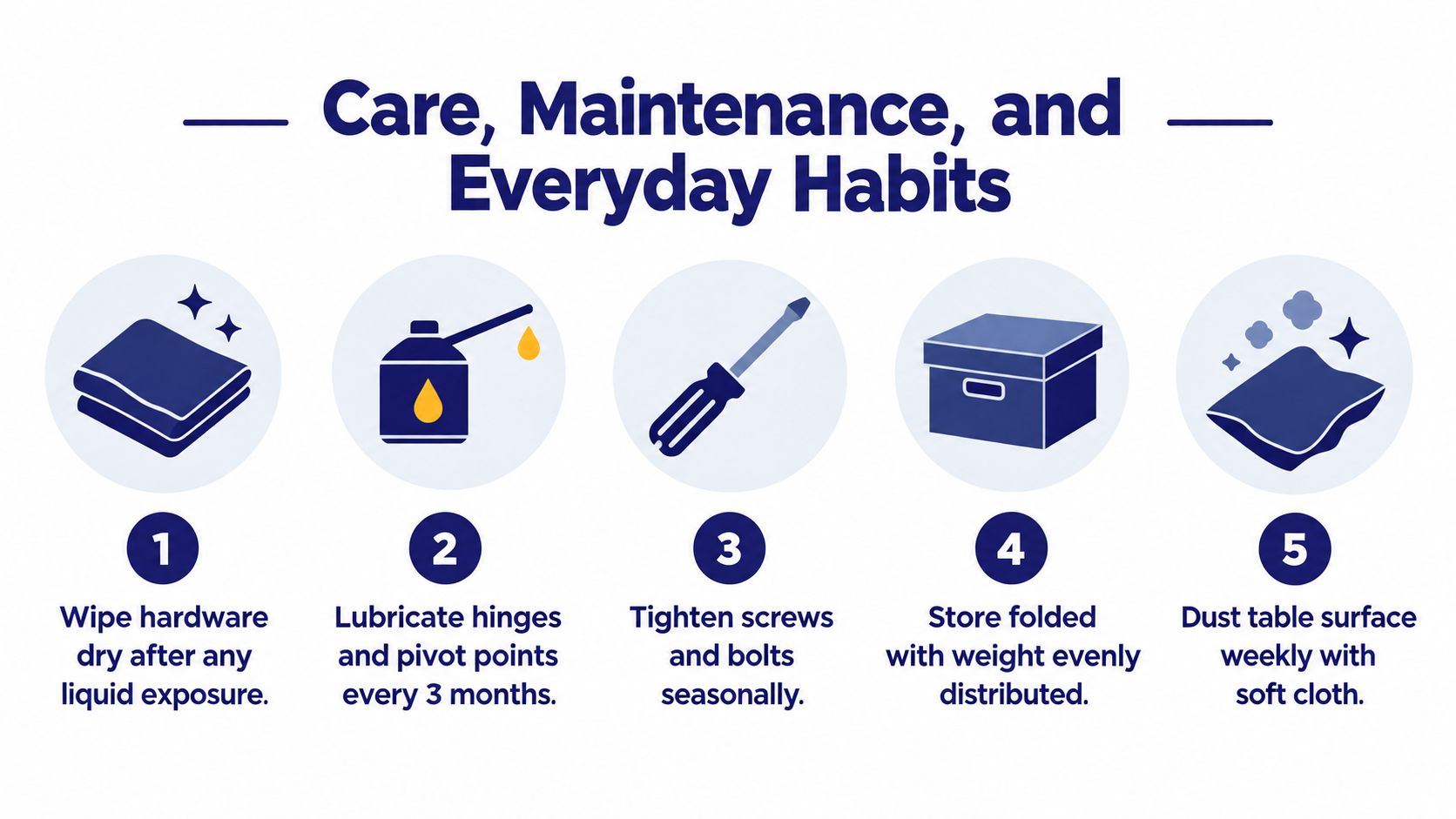
A folding sofa table lasts longer when you treat it like working furniture, not just an accent. The surface gets attention, but the hardware decides the lifespan.
The maintenance habits that matter
Independent guidance around folding tables points to a few recurring risks in everyday use: dragging damage, failure to engage locks before use, and poor storage habits. That's why I recommend a simple routine.
- After spills: Wipe the hardware and the seam near the folding joint dry right away.
- Every few months: Check screws, brackets, and visible pivot hardware for looseness.
- At regular intervals: Inspect the supports and folding points for new wobble or misalignment.
- Before folding: Clear the surface fully so nothing snags or shifts into the hinge line.
For higher-traffic environments, commercial benchmarks can be useful context. EN 15372:2016 applies to non-domestic tables and sets requirements for safety, strength, and durability, which makes it a helpful reference point when a folding design will see harder use in offices, waiting areas, or similar shared settings, as outlined in the EN 15372:2016 standard overview.
Everyday behavior matters more than finish
Most failures don't start with dramatic breakage. They start with small habits. People fold the table with cords still draped across it. They lean heavy items against it in storage. They keep using it after a hinge starts to shift.
Clean nearby upholstery too, especially if the table lives close to a sofa arm where drinks and snacks gather. For fabric-care basics that pair well with this kind of setup, Sunset Shine Home Cleaning's tips are useful if you're keeping a microfiber couch in the same zone.
A folding sofa table earns its place when the open and close routine feels easy enough to repeat. If you build the habit of clearing it, locking it properly, and checking the supports once in a while, it stays in the room. If not, it usually ends up folded against a wall and forgotten.
If you're deciding between a folding solution and a standard console or sofa table, Woodstock Furniture & Mattress Outlet offers living room tables, layout-friendly options, and knowledgeable help comparing what works in an actual room. Bring your measurements, photos, and traffic concerns, and you can sort out whether a folding sofa table is the right call or whether a fixed piece will serve you better every day.