Tag: multifunctional furniture

  • Affordable furniture for small spaces: stylish, budget-friendly solutions

    Affordable furniture for small spaces: stylish, budget-friendly solutions

    Furnishing a small home isn't about shrinking everything down; it’s about being clever and strategic. A common challenge is picking pieces that are both functional and stylish without making the room feel like the walls are closing in. This guide is built on real-world experience helping people solve this exact puzzle.

    Rethinking Your Approach to Small Space Furnishing

    First things first, let's shift your perspective. Stop seeing your home's square footage as a limitation and start seeing it as an opportunity for smart, creative design. When you view furniture as a versatile tool rather than just a static object, you can build a home that's comfortable and genuinely usable, no matter the size.

    This way of thinking is catching on as more people embrace compact living. The demand for furniture designed for small spaces is growing. The global market was valued at $6.68 billion in 2025 and is projected to grow to $10.17 billion by 2032. That surge shows just how many of us are living in apartments and studios where every single inch counts.

    The Foundation of Smart Furnishing

    So, what's the key? It all boils down to prioritizing pieces that do more than one job. When you think this way, you can furnish your home with fewer, more capable items. That saves you both space and, in the long run, money.

    Before you even start browsing, it helps to get a handle on the basic strategies of how to choose the perfect furniture for small spaces. Understanding this foundational knowledge can set you up for success right from the start.

    The most successful small spaces are not filled with tiny furniture. They are filled with smart furniture—pieces that are correctly scaled, serve multiple functions, and enhance the feeling of openness.

    Key Principles to Adopt

    To help you get started, here are a few core strategies that can make a significant difference. Think of these as your foundational rules before you buy anything.

    Here's a quick table to summarize these key ideas.

    Key Principles for Furnishing a Small Space

    Principle Why It Matters Example in Action
    Function First Every item must earn its spot. This avoids clutter and maximizes utility. An ottoman that offers hidden storage and doubles as a coffee table.
    Scale & Proportion The right size furniture prevents a room from feeling overwhelmed or empty. A sleek, armless loveseat instead of a bulky three-seater sofa.
    Visual Lightness Creates an illusion of more space by keeping sightlines open. A glass coffee table or a sofa with visible legs that let you see the floor underneath.

    Embracing these principles is the first step. You'll move from just filling a room with stuff to thoughtfully designing a space that truly works for you.

    Creating Your Small Space Blueprint to Avoid Mistakes

    A common mistake people make when furnishing a small space happens way before they ever step into a showroom. It’s skipping the prep work. Creating a room blueprint is your secret weapon against buyer’s remorse, making sure every single piece you bring home not only fits, but actually works for how you live.

    This isn't just about measuring from wall to wall. A solid plan takes into account all the little things that define how you use a room.

    Mapping Your Functional Layout

    Before you fall in love with a sofa online, it's helpful to get intimately familiar with your space. Grab a tape measure, a pen, and a notebook, and let's get to work documenting these critical details:

    • Traffic Flow: Where do people naturally walk through the room? You’ve got to keep the main pathways clear, especially from one doorway to another. Nothing makes a room feel smaller than having to shuffle around furniture.
    • Door and Window Clearance: Pay attention to which way your doors swing open and how high your window sills are. A console table you’re eyeing might be less useful if it blocks a window or keeps a door from opening all the way.
    • Outlet and Vent Locations: We’ve seen it many times—a customer buys a large bookcase only to realize it covers the room’s most convenient outlet. Mark all your power sources, light switches, and HVAC vents on your plan.

    Here's a tip we share with customers: use painter's tape on the floor. Mark out the dimensions of that sofa or dining table you're considering. This simple trick lets you feel the footprint of the furniture and see how much space it will really take up. It's a useful way to avoid that "it technically fits, but I can't move" feeling.

    Thinking Vertically and Virtually

    Once you have your floor plan down, it’s time to look up. Many small spaces have tons of unused vertical real estate. Think about it—tall, narrow bookcases or wall-mounted shelving can draw the eye upward, which creates a sense of height and openness. Plus, it gets things off your floor, freeing up that precious space for other essentials.

    This whole process can feel a bit overwhelming, but it can be broken down into three simple ideas. First, know your limits by measuring everything. Second, make smart, functional choices based on that layout. And finally, prioritize multi-use pieces.

    Flowchart illustrating the three-step process for furnishing small spaces: limit, smart, multi-use.

    Following this "Limit, Smart, Multi-Use" flow can turn a daunting task into a manageable, strategic game plan.

    To make this even easier, you can take your blueprint digital. Tools like our free Room Planner let you experiment with different layouts without any risk. It can take the guesswork out of the equation and help you sidestep costly mistakes. You can test different arrangements to find a suitable spot for every piece, ensuring your final choices are as practical as they are beautiful.

    Choosing Furniture That Works Harder

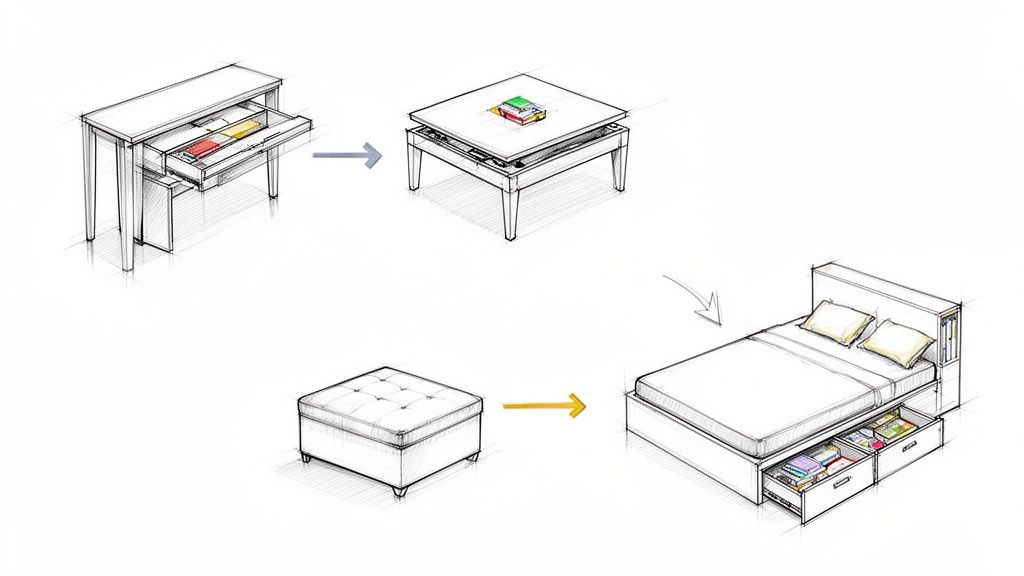
    Hand-drawn sketches of adaptable furniture for small spaces, featuring storage beds and convertible tables.

    When you're living in a compact home, every piece of furniture has to earn its keep. This is where multi-functional furniture becomes a helpful ally, and we're talking about more than just the classic sofa bed. Smart, versatile pieces let you furnish your home with fewer items, which can save you space and, just as importantly, money.

    The idea is to find affordable furniture for small spaces that solves more than one problem at a time. It's a simple approach that can declutter your home and makes sure every piece is pulling its weight. Once you start looking for furniture that works this hard, you'll be amazed at the clever solutions you can find. A great starting point is to browse a curated collection of the best furniture for small spaces just to see what’s possible.

    Solving Common Small-Space Problems

    Multi-functional furniture is really all about tackling the everyday headaches of living in a tight space. It’s less about a gimmick and more about real-world utility that just makes your daily life easier.

    Think about the usual pain points you might run into in a studio apartment or a cozy living room:

    • Nowhere for a home office? A lift-top coffee table can be a game-changer. It goes from a casual surface for your drinks to a desk in seconds. When work is done, it drops back down, and your living room is a living room again.
    • Can't fit a large dining table? Look for a dining table with a hidden butterfly leaf. It can sit against a wall for your daily meals, then expand when you have friends over.
    • Closet bursting at the seams? A platform bed with deep, built-in storage drawers can often replace a bulky dresser entirely. That move alone can free up a significant amount of floor space in a small bedroom.

    The most impressive pieces are the ones that blend their different uses so well you'd hardly know. You shouldn't have to give up style for function—well-designed furniture integrates its multiple purposes seamlessly.

    The Power of Modular and Adaptable Pieces

    Beyond single items that do double duty, modular furniture gives you another layer of flexibility. Modular sectionals, for example, are a fantastic solution for small or awkwardly shaped living rooms. You can rearrange the pieces to create one long sofa, a chaise for movie night, or even separate seating when you have a party.

    This kind of adaptability is exactly why multi-functional furniture isn't just a niche market anymore. People want versatility, and the demand for these smart designs is growing. Industry projections show that beds with built-in storage and convertible tables are leading the charge, with an estimated 200 million units expected by 2025 to meet this need for compact living.

    Ultimately, picking furniture that serves more than one purpose is a smart, strategic move. It helps you create a home that feels uncluttered, works for you, and seems much larger than it really is. By focusing on fewer, more capable pieces, you build a space that adapts to your life, not the other way around.

    Using Visual Design to Make Your Room Feel Bigger

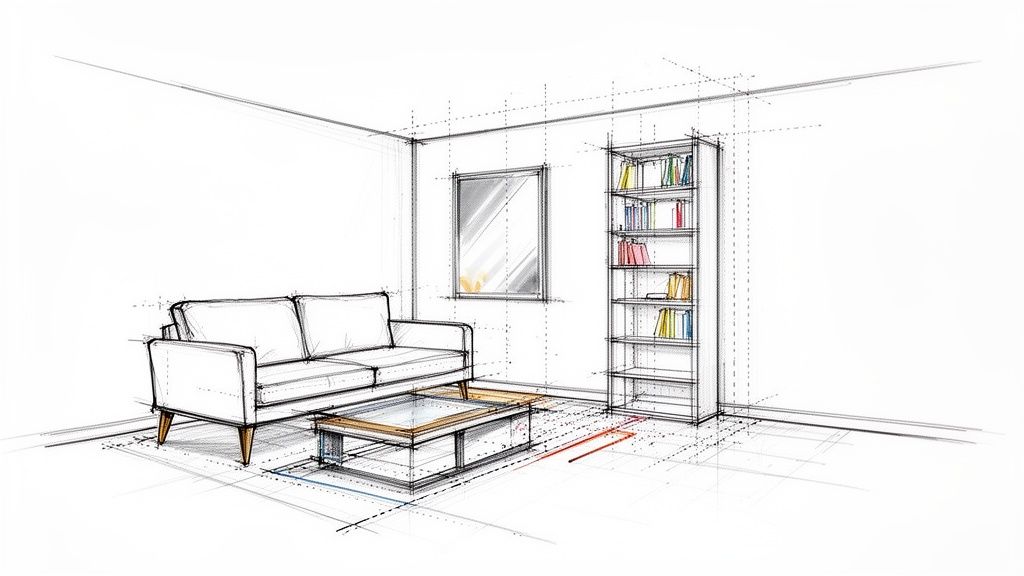
    A hand-drawn sketch depicting a minimalist living room interior with a sofa, glass coffee table, tall mirror, and wall shelves.

    Once you've got your multi-functional pieces picked out, the next step is using a few clever design tricks to make your room feel more open and airy. It’s not just about the floor plan; it's about creating an illusion of space, and the right affordable furniture can do most of the heavy lifting for you.

    One of the easiest and most effective things you can do is choose furniture with visible legs. When a sofa, armchair, or media console is lifted off the ground, your eye can travel underneath it. This keeps sightlines open and gives a sense of spaciousness you just can’t get with heavy, floor-hugging furniture.

    Lighten the Visual Load

    Ever notice how some furniture just feels heavier than other pieces, even if they're the same size? That’s what designers call “visual weight,” and it has a huge impact on how a room feels. Dark, heavy wood can be great for anchoring a large room, but in a small space, it can become overwhelming.

    On the other hand, materials you can see through have almost zero visual weight.

    • An acrylic or glass coffee table gives you a functional surface but seems to almost disappear, keeping the space from feeling cluttered.
    • A metal-frame bookshelf with open sides feels way lighter and more modern than a solid, chunky bookcase.

    Color plays a huge part in this, too. Lighter-hued furniture—your whites, beiges, and soft grays—reflects more light. This naturally makes a room feel brighter and bigger.

    There's a reason a strategically placed mirror is one of the oldest tricks in the design book—it just works. Hang a large mirror on the wall opposite a window, and it will bounce natural light all over, instantly making the room feel more expansive.

    Add Personality Without the Clutter

    Just because your space is small doesn't mean it has to be boring. You can absolutely bring in your personality with patterns and textures, but the secret is to find the right balance. Instead of a huge, bold pattern on your main sofa, try adding interest through smaller, textural elements.

    For instance, you could bring in some warmth with:

    • Throw pillows that have a subtle, interesting weave.
    • A soft, textured area rug to define your seating area.
    • A cozy knit blanket casually draped over an armchair.

    These little touches add that much-needed visual interest and coziness without making the room feel busy or crowded. By combining these smart material and color strategies, you'll find furniture that not only fits perfectly but also makes your home feel more open, comfortable, and inviting.

    Smart Shopping Strategies for Lasting Value

    Finding affordable furniture for a small apartment or home shouldn't mean you have to settle for pieces that fall apart in a year. The approach isn't just about finding the lowest price tag; it's about being smart with your money to get lasting value. The key is knowing exactly where to invest your budget and where you can save.

    Think of it like this: your most-used furniture items are the workhorses of your home. It makes sense to put more of your budget toward the pieces that see daily action and have the biggest impact on your comfort.

    Prioritize High-Use, High-Impact Pieces

    If you're going to invest anywhere, your sofa and your mattress are two important places to consider. These are the items you'll be using every single day, and their quality has a direct line to your overall comfort and well-being.

    • Your Sofa: This is often the centerpiece of a living space. Spending a bit more for a sofa with a sturdy, kiln-dried hardwood frame and resilient cushions is an investment in years of comfort and durability. An inexpensive sofa might look good at first, but it can start sagging, creaking, and losing its shape surprisingly fast.

    • Your Mattress: We can't say it enough—quality sleep is the foundation of good health. Prioritizing a supportive, comfortable mattress is really an investment in yourself.

    Once you have those core pieces locked down, you can be much more frugal with the supporting cast. Things like accent tables, lamps, decorative shelving, and area rugs are suitable for finding great deals. Plus, they are much easier and less expensive to swap out later when you want to refresh your style.

    The convenience of online shopping is fantastic, but it can't replace the experience of seeing and touching furniture in person. Photos can be deceiving when it comes to the true color, texture, and especially the scale of a piece.

    Stopping by a showroom lets you actually sit on that sofa, open the drawers on that dresser, and get a real feel for how a dining table will fit in your space. This hands-on step is helpful for preventing buyer's remorse. It takes the guesswork out of the equation and makes sure that a piece doesn't just look good online, but feels right for your home.

    This practical approach is more important than ever as the furniture market continues to grow. With more people living in smaller urban spaces, the demand for smart, affordable furniture is high. Projections even show U.S. furniture e-commerce revenues could reach $125 billion by 2026, with a reported 62.3% of related searches being made by people ready to buy.

    For our customers right here in Georgia, we see this trend play out every day. There's a high demand for pieces that offer lasting value, like adjustable mattress bases for customized comfort, kids' storage beds that save space, and compact outdoor sectionals for a small patio. You can learn more about how e-commerce is changing the furniture world over on the Cylindo blog. By being a savvy shopper, you can navigate this large market to find pieces that offer both a good price and the quality to last for years to come.

    Your Small Space Furniture Questions, Answered

    When you're trying to furnish a compact home, apartment, or studio, a ton of questions pop up. Here at Woodstock Furniture & Mattress Outlet, our furniture experts have heard many of them from shoppers trying to make the most of their square footage.

    Based on our years of hands-on experience helping customers find a suitable fit, here are the answers to some of the questions we hear frequently.

    What Is the Most Important Piece for a Small Living Room?

    This is one of the most common questions we get, and while the "right" answer depends on how you live, the sofa is almost always the anchor piece that defines the whole room. We often point shoppers toward an "apartment-sized" sofa or a small-scale sectional that fits the layout without taking over.

    Look for pieces with clean lines, a tight back, and visible legs. These features make furniture look less bulky and create a much more open, airy feeling. And if you have friends or family stay over often, a quality sleeper sofa can be a multi-functional investment.

    Pro Tip from the Showroom Floor: Before you buy any sofa, grab some painter's tape and outline its dimensions on your floor. This simple trick helps you visualize its actual footprint and ensures it won’t eat up all your physical and visual space. You'll end up with a comfortable, durable centerpiece that fits.

    Is Dark-Colored Furniture a Bad Idea for Small Rooms?

    We hear this one all the time: "I can't use dark furniture in a small room, right?" That's a myth! While a room jam-packed with dark, heavy furniture will feel cramped, a single dark piece can be a fantastic, sophisticated anchor. Think a navy sofa or a rich espresso bookcase.

    The secret is balance. You just need to create plenty of contrast with lighter elements to make it work. Try pairing that dark anchor piece with:

    • Light-colored walls to reflect and bounce light around the room.
    • A light, airy area rug to define the space.
    • Reflective surfaces like mirrors, glass, or metallic accents.
    • Good, layered lighting from various sources like lamps and overhead fixtures.

    A dark piece adds depth and character when you use it strategically, so don't be afraid to go for it.

    How Can I Create a Dining Area in a Studio Apartment?

    Even in the tightest of spaces, you have some great options for carving out a dining spot. The drop-leaf table is a classic for a reason. You can keep it pushed against a wall with one leaf down for everyday meals and pull it out with both leaves up when you have company.

    Another solution is a counter-height or pub-style table with a couple of stools. This setup can easily pull double-duty as extra kitchen prep space or even a standing desk. For truly tiny apartments, a convertible coffee table that lifts up to dining height is a game-changer. And never underestimate a narrow console table paired with two small stools that can be tucked completely underneath when not in use.

    Where Should I Save and Where Should I Invest When Buying Furniture?

    Our advice is always the same: invest your money in the pieces that get the most daily use and have the biggest impact on your comfort. For most people, this means your sofa and your mattress.

    A well-made sofa with a solid frame and high-resiliency cushions will feel better and last so much longer, giving you far more value for your money. The same goes for your mattress—quality sleep is priceless.

    You can feel more comfortable saving money on the items that are more decorative or see less wear-and-tear. This often includes:

    • Accent tables and end tables
    • Lamps and other lighting
    • Decorative shelving units
    • Area rugs and home décor

    These pieces are much easier and more affordable to swap out later as your style evolves or your needs change. This strategy lets you build a foundation of quality where it really matters and fill in the gaps with budget-friendly finds.


    At Woodstock Furniture & Mattress Outlet, our team is here to help you answer these questions and many more. Visit one of our North Georgia showrooms to see these options in person and get practical advice on finding affordable furniture for small spaces that you'll love for years to come. You can also explore our selection online at https://woodstockoutlet.com.
  • Decorating Tips for Small Living Rooms: Maximize Style in Tiny Spaces

    Decorating Tips for Small Living Rooms: Maximize Style in Tiny Spaces

    A small living room presents a unique design challenge: how do you create a space that’s functional, comfortable, and stylish without feeling cramped? The key isn't about finding a secret way to add square footage, but about using smart, proven design principles to make the space you have work harder. It's about choosing furniture that serves multiple purposes, arranging it for optimal flow, and using visual strategies to create an illusion of openness. This guide moves beyond generic advice to provide practical, actionable decorating tips for small living rooms that you can implement.

    We'll explore how strategic choices in color, storage, and layout can transform a compact area into a welcoming and functional heart of your home. We'll focus on real-world solutions that help you solve common problems, from clutter and poor traffic flow to a lack of light. To further enhance comfort and airflow without compromising on style, exploring a guide to the best ceiling fans for small rooms can provide tailored solutions for your compact living space. By the end, you'll have a clear roadmap for creating a living room that feels both spacious and personal, no matter its dimensions.

    1. Multifunctional Furniture with Hidden Storage

    One of the most effective decorating tips for small living rooms involves choosing furniture that does more than one job. Multifunctional pieces combine essential functions like seating, sleeping, or surface space with concealed storage, allowing you to maximize every square foot without adding clutter. This strategy is foundational for small spaces because it eliminates the need for extra, space-consuming storage units like bookshelves or cabinets.

    By integrating storage directly into the furniture you already need, you maintain a clean, open, and organized environment. An ottoman can double as a coffee table and a hidden chest for blankets, while a sectional can house a pull-out bed and a chaise with a lift-top compartment for board games or pillows.

    Why This Approach Works for Small Spaces

    In a compact living room, every piece must justify its footprint. A standard sofa only offers seating, but a storage sectional provides seating and a place to tuck away seasonal decor or extra linens. This dual-purpose design is the key to creating a functional room that feels larger than it is.

    Key Insight: The goal is to reduce the total number of furniture items in the room. By making each piece work harder, you free up valuable floor space, which improves traffic flow and creates a more breathable, uncluttered atmosphere.

    Actionable Tips for Implementation

    Before purchasing, think carefully about what you need to store and how you will use the piece daily.

    • Measure First: Check the dimensions of the internal storage compartments to ensure they can hold the items you have in mind, whether it's throw pillows, magazines, or electronics.
    • Prioritize Easy Access: For items you use frequently, opt for pieces with easy-to-lift lids or smooth-gliding drawers. Ottomans on wheels offer extra flexibility, allowing you to move them easily for cleaning or rearranging.
    • Organize Internally: Use drawer dividers or fabric bins inside larger compartments. This prevents your hidden storage from becoming a chaotic mess and helps you find what you need quickly.
    • Consider Weight and Durability: Look for soft-close mechanisms to prevent slamming and wear. If you plan to store heavy items, check the weight capacity and construction of the piece to ensure long-term durability.

    At Woodstock Furniture & Mattress Outlet, our knowledgeable team can help you find multifunctional solutions that fit your specific layout and storage needs, guiding you to pieces that offer both style and practicality.

    2. Strategic Use of Vertical Space and Wall-Mounted Storage

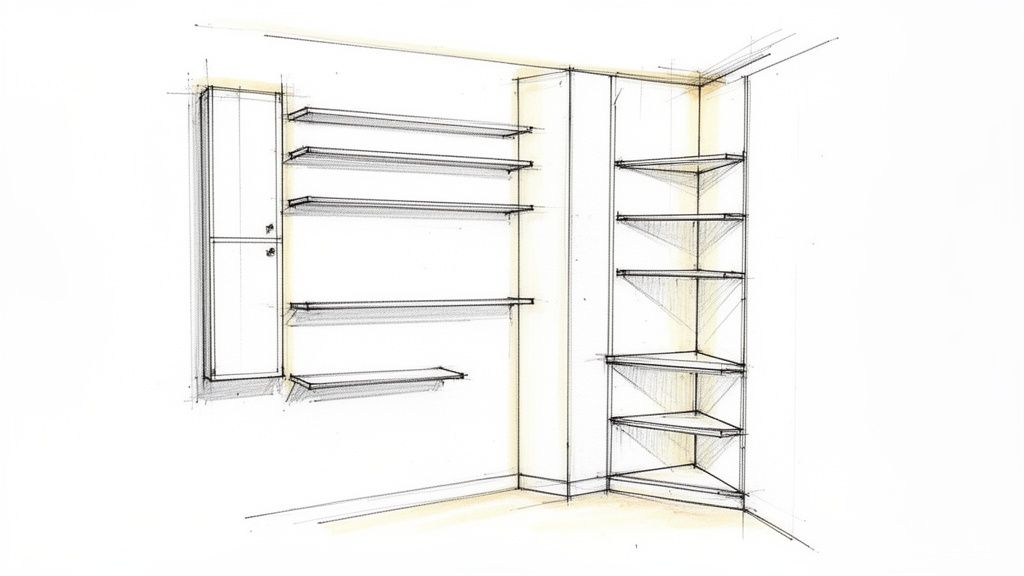
    One of the most impactful decorating tips for small living rooms is to draw the eye upward. Utilizing vertical space with wall-mounted storage is a classic design strategy that maximizes your room’s potential without sacrificing precious floor area. This approach uses otherwise empty walls for practical storage, creating an open, airy feel while keeping essentials organized and accessible.

    By mounting shelves, cabinets, or even an entire entertainment unit to the wall, you reclaim the floor for traffic flow and seating. This technique is especially powerful in compact rooms because it not only adds function but also creates the illusion of higher ceilings, making the entire space feel larger and more expansive.

    Hand-drawn sketch illustrating a custom built-in shelving and cabinet unit in a corner.

    Why This Approach Works for Small Spaces

    In a small living room, the floor is a valuable asset. Wall-mounted solutions like floating shelves or tall, narrow bookcases free up that real estate completely. Instead of a bulky media console sitting on the floor, a wall-mounted version provides the same function while visually "floating," which reduces visual weight and clutter.

    Key Insight: Directing focus vertically tricks the eye into perceiving more volume and height. This visual lift prevents the room from feeling cramped or boxed-in, a common challenge in smaller layouts.

    Actionable Tips for Implementation

    Proper installation and styling are key to making vertical storage look intentional rather than cluttered.

    • Secure Installation: Always anchor shelves and cabinets to wall studs for maximum stability and safety. If studs aren't available, use appropriate drywall anchors rated for the weight of your items.
    • Create Breathing Room: Avoid packing shelves completely full. Aim to leave around 30% of the surface as "negative space" to maintain a clean, uncluttered aesthetic.
    • Balance Open and Closed Storage: Combine open shelves for displaying decor with wall-mounted cabinets or baskets to hide less attractive items like cables, remotes, or paperwork.
    • Style with Intention: Group objects of varying heights, shapes, and textures to create visually interesting vignettes. Use cohesive elements like matching baskets or boxes to unify the look.

    At Woodstock Furniture & Mattress Outlet, you can find a variety of bookcases and entertainment centers that help you take advantage of your home's vertical space, and our team is always ready to offer guidance on selecting pieces that fit your room's scale and style.

    3. Light Colors and Reflective Surfaces for Visual Expansion

    One of the most powerful decorating tips for small living rooms is to harness the power of light. By strategically using light colors and reflective surfaces, you can create a powerful optical illusion that makes a compact room feel significantly larger, brighter, and more open. This technique works by maximizing both natural and artificial light, causing it to bounce around the space and trick the eye into perceiving more depth.

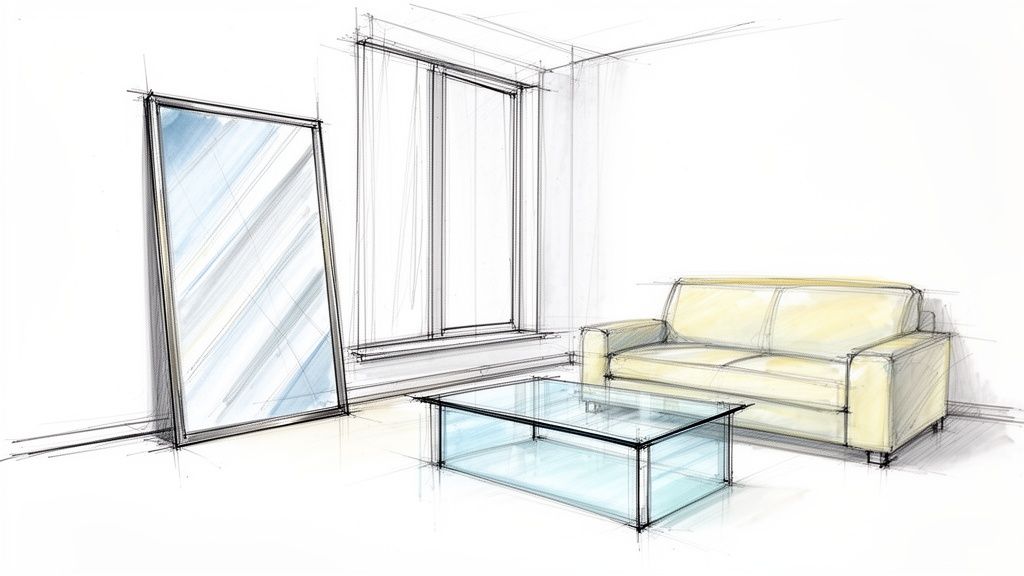
    Light, neutral palettes like soft whites, creams, pale grays, and light blues make walls appear to recede, pushing them visually outward. When combined with reflective elements such as mirrors, glass tabletops, or metallic accents, this effect is amplified. A well-placed mirror can double the visual space and light, while a glass coffee table keeps sight lines clear, preventing the room from feeling crowded.

    A hand-drawn sketch illustrating a modern living room with a yellow sofa, glass coffee table, and large mirror.

    Why This Approach Works for Small Spaces

    In a small living room, dark colors can absorb light and make the walls feel like they are closing in. Light colors do the opposite; they reflect light, creating an airy and expansive atmosphere. Mirrors and other reflective surfaces act as secondary light sources, scattering brightness into darker corners and adding layers of visual interest without taking up physical space.

    Key Insight: The goal is to manipulate light to erase boundaries. A mirror doesn’t just show a reflection; it can create a "window" to a perceived continuation of the room, effectively expanding its dimensions without any structural changes.

    Actionable Tips for Implementation

    To make this strategy effective, balance is key. You want to create a bright space that still feels warm and inviting, not sterile or cold.

    • Choose the Right Paint: Opt for light neutrals with warm undertones to prevent the room from feeling chilly. Test paint swatches on your walls at different times of day to see how they interact with your home's natural light.
    • Strategic Mirror Placement: Position a large mirror directly opposite a window to capture and reflect the maximum amount of daylight. Placing one on a wall perpendicular to a window can also help distribute light more evenly throughout the room.
    • Incorporate "Invisible" Furniture: Select pieces like a glass coffee table, acrylic console table, or chairs with open bases. These items serve their function without visually obstructing the floor, which helps maintain a sense of openness.
    • Balance with Texture: To avoid a sterile look, introduce soft textures through area rugs, plush throw pillows, and cozy blankets. Natural wood accents can also add warmth and ground the light color scheme.

    At Woodstock Furniture & Mattress Outlet, you can find a wide range of accent pieces, from elegant mirrors to glass-topped tables, that will help you bring this light-enhancing strategy to life in your home.

    4. Smart Layout and Furniture Arrangement for Flow

    How you arrange your furniture is one of the most impactful decorating tips for small living rooms. Strategic placement maximizes floor space and creates natural traffic pathways, preventing the room from feeling cramped or difficult to navigate. Instead of pushing every piece against the walls, this approach involves creating intentional zones and ensuring clear sight lines.

    Thoughtful furniture arrangement considers the room's focal points, such as a window, fireplace, or media center, and organizes seating around them. By "floating" furniture away from the walls, you can paradoxically make the space feel larger, more open, and more inviting. This technique transforms a room from a simple container for furniture into a functional and harmonious living area.

    Why This Approach Works for Small Spaces

    In a small living room, every decision must support the feeling of openness. Pushing furniture against the walls creates a tight, crowded perimeter and leaves an awkward, underutilized space in the middle. Floating the main seating group and creating clear pathways directs movement and allows the room to breathe.

    Key Insight: A well-planned layout creates a sense of purpose and order. By establishing clear zones for conversation, entertainment, or reading, you make the room more intuitive and comfortable to use, which enhances the perception of spaciousness.

    Actionable Tips for Implementation

    Before moving heavy items, map out your new layout to ensure it works for your space and lifestyle.

    • Plan Virtually First: Use a tool like the Woodstock Furniture & Mattress Outlet Room Planner to experiment with different arrangements digitally. This saves you the effort of physically moving furniture until you find a layout that works.
    • Create Clear Pathways: Ensure there are at least 18 to 24 inches of clearance for major traffic routes. This prevents the room from feeling like an obstacle course.
    • Anchor Your Arrangement: Use a large area rug to define the main seating area. The front legs of your sofa and chairs should sit on the rug to create a cohesive, anchored look.
    • Float Your Sofa: If space allows, pull your sofa 12 to 18 inches away from the wall. This simple trick creates visual depth and makes the room feel wider.
    • Embrace Angled Placement: Don't be afraid to angle an accent chair or a small table in a corner. This can break up boxy lines and add dynamic visual interest.

    5. Strategic Lighting Layers to Enhance Space and Ambiance

    Effective lighting is one of the most transformative decorating tips for small living rooms, yet it's often overlooked. A single, harsh overhead light can cast shadows that make a room feel smaller and more enclosed. Strategic lighting layers, however, combine multiple light sources at different heights to create depth, eliminate dark corners, and foster a warm, inviting atmosphere.

    This approach involves balancing three types of lighting: ambient (overall illumination), task (focused light for activities like reading), and accent (light that highlights decor or architectural features). By layering them, you can draw the eye around the room, making it feel more dynamic and spacious. Well-placed floor lamps, table lamps, and wall sconces can make a small room feel open, airy, and welcoming.

    Why This Approach Works for Small Spaces

    In a compact living room, shadows are the enemy of spaciousness. Dark, unlit corners can visually shrink the room’s boundaries. A layered lighting plan ensures that light reaches every part of the space, creating an even, consistent glow that pushes the walls back.

    Key Insight: The goal is to create visual interest and guide the eye upward and outward. By placing lights at various heights, from a table lamp to a floor lamp to a wall sconce, you add vertical dimension that prevents the room from feeling flat and cramped.

    Actionable Tips for Implementation

    Think of lighting as a tool to sculpt your room’s dimensions and mood. Start with your overhead fixture and build layers from there.

    • Install Dimmers: Add dimmers to your main overhead lights. This gives you complete control over the ambient brightness, allowing you to transition from a bright, functional space to a cozy, relaxed environment.
    • Warm Up the Tone: Choose light bulbs with a warm-white color temperature (around 2700K). This creates a comfortable and inviting feel, unlike cool or blue-toned lights that can feel sterile.
    • Target Dark Corners: Place a tall floor lamp or an uplight in a dark corner. This simple trick instantly makes the entire room feel larger by illuminating its full perimeter.
    • Balance with Task Lighting: Add table lamps on end tables or a console. Not only do they provide necessary light for reading, but they also contribute to the overall balance and symmetry of your decor.
    • Highlight Key Features: Use accent lighting, like a picture light over artwork or LED strips under shelves, to draw attention to your favorite decorative elements.

    At Woodstock Furniture & Mattress Outlet, we offer a great selection of floor lamps, table lamps, and accent furniture for building your layered lighting scheme. Our team can help you choose pieces that complement your style and solve your small-space challenges.

    6. Decluttering and Minimalist Design Principles

    One of the most impactful decorating tips for small living rooms costs nothing but time: embracing decluttering and minimalist design. This approach centers on intentionally keeping only essential and cherished items, which creates visual breathing room and makes a compact space feel significantly larger and more serene. Clutter consumes both physical and visual space, making a room feel chaotic and cramped.

    Minimalism isn't about creating a cold or empty environment; it’s about quality over quantity. By carefully curating your decor, limiting your color palette, and displaying items with purpose, you create a calm and functional atmosphere. Whether it's a living room organized with Marie Kondo's KonMari method or a space inspired by clean Japanese design, this principle can transform a room from stressful to restful.

    Why This Approach Works for Small Spaces

    In a small living room, every object competes for attention. Excess items, from too many throw pillows to crowded bookshelves, create visual noise that makes the brain perceive the space as smaller than it is. A minimalist approach removes this distraction, allowing the room's architecture and key furniture pieces to stand out.

    Key Insight: Decluttering is the foundation of effective small-space design. Before you can optimize a room with mirrors or multifunctional furniture, you must first create a clean slate by removing what doesn’t belong.

    Actionable Tips for Implementation

    Adopting a minimalist mindset is a gradual process. Start small to avoid feeling overwhelmed and focus on creating a space that feels personal and functional.

    • Curate with Intention: Begin by removing items that don’t serve a practical function or bring you joy. If an item doesn't have a purpose or a special meaning, it may be contributing to the clutter.
    • Implement the 'One In, One Out' Rule: To maintain a clutter-free space, make a habit of letting go of one item every time you bring something new into the room.
    • Keep Surfaces Clear: Limit tabletop and shelf decor to a few carefully chosen items. A clean surface on a coffee table or console creates an immediate sense of openness.
    • Edit Your Textiles: Instead of a dozen pillows and multiple throws, choose two or three high-quality pieces that add texture and comfort without overwhelming the sofa.
    • Digitize What You Can: Reduce physical clutter by scanning old photos, documents, and manuals, then storing them digitally.

    At Woodstock Furniture & Mattress Outlet, we believe a great room starts with a thoughtful plan. Our team can help you select foundational pieces that support a clean, organized aesthetic, ensuring your small living room is both beautiful and functional.

    7. Strategic Use of Area Rugs, Textures, and Layering

    While minimalism is often recommended for small spaces, a room devoid of texture can feel cold and uninviting. Strategic layering with area rugs, varied textiles, and décor adds depth, personality, and warmth. This approach makes a small living room feel intentionally designed and curated, balancing a clean layout with a cozy, welcoming atmosphere.

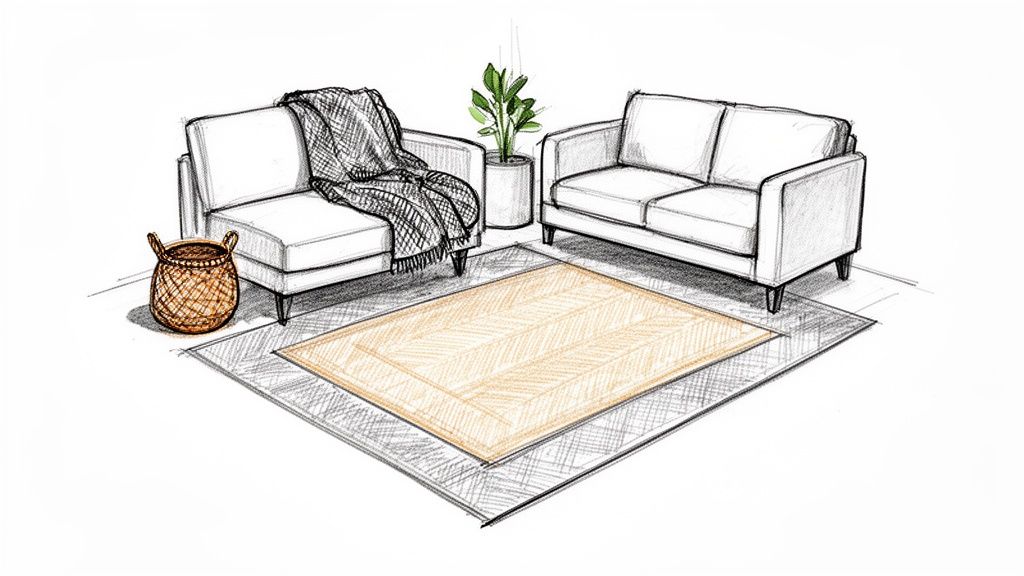
    An area rug can anchor a furniture arrangement, creating a defined zone for conversation or relaxation without the need for walls. Layering different textures, such as a soft wool throw on a linen sofa or a woven jute basket next to a smooth metal lamp, creates a rich visual experience that makes the space feel more substantial and complete.

    A hand-drawn sketch showing two sofas, a plant, and a basket in a small living room setup.

    Why This Approach Works for Small Spaces

    In a small room, adding visual interest without adding physical bulk is essential. Textures and layers engage the eye and create a sense of depth, preventing the space from feeling flat or one-dimensional. An appropriately sized rug can also trick the eye into seeing the room as larger by clearly defining the living area’s boundaries.

    Key Insight: Layering is a powerful tool in decorating tips for small living rooms because it adds character and comfort without consuming valuable floor space. It’s about creating a rich sensory experience that makes a compact room feel luxurious and thoughtfully composed.

    Actionable Tips for Implementation

    To layer effectively, focus on balance and cohesion to avoid a cluttered look.

    • Get the Rug Size Right: A common mistake is choosing a rug that's too small. Ensure the rug is large enough for at least the front legs of your sofa and any armchairs to rest on it. For expert guidance, there are excellent resources like this guide on how to choose the perfect area rug that covers sizing and placement in detail.
    • Mix Materials: Combine a variety of textures for a dynamic effect. Pair soft elements like velvet pillows or chenille throws with rougher materials like jute, rattan, or natural wood.
    • Incorporate Natural Elements: Plants, wooden accent tables, or leather ottomans add warmth and an organic feel, making the space more inviting.
    • Use Pillows and Throws: These are easy and affordable ways to introduce new textures and colors. You can swap them out seasonally to refresh the room’s look.

    7-Point Comparison: Small Living Room Decorating Tips

    Strategy Implementation complexity Resource requirements Expected outcomes Ideal use cases Key advantages
    Multifunctional Furniture with Hidden Storage Medium — choose pieces and ensure fit/assembly Moderate — cost of furniture, measuring, delivery/assembly Increased storage without extra footprint; less visible clutter Small living rooms, studios, multi-use spaces Maximizes usable space; hides clutter; multifunctional use
    Strategic Use of Vertical Space and Wall-Mounted Storage Medium–High — requires secure installation Low–Moderate — shelving, anchors, possible pro install Frees floor area; creates taller visual lines Rooms with free wall area or high ceilings Adds storage with minimal footprint; customizable to wall
    Light Colors and Reflective Surfaces for Visual Expansion Low — paint, mirrors, select finishes Low — paint, mirrors, a few reflective accents Brighter, visually larger room; improved light distribution Dim or small rooms lacking natural light Cost-effective visual expansion; broadly compatible with styles
    Smart Layout and Furniture Arrangement for Flow Low–Medium — planning and measuring required Low — time, measuring tools, possible new scale-appropriate pieces Better traffic flow; clearly defined zones; more intentional feel Irregular layouts; multipurpose living rooms Improves function without large purchases; flexible and reversible
    Strategic Lighting Layers to Enhance Space and Ambiance Medium — planning fixtures and control Moderate — fixtures, bulbs, possible electrician Eliminates dark corners; adds depth and mood control Dark rooms or spaces used for varied activities Enhances perceived space; adaptable ambiance and task lighting
    Decluttering and Minimalist Design Principles Low — requires editing and behavior change Very low — time and organizational supplies Cleaner, calmer room that reads larger Overcrowded rooms; those seeking low-maintenance design Cost-effective; improves maintenance and perceived space
    Strategic Use of Area Rugs, Textures, and Layering Low–Medium — styling and scale decisions Low–Moderate — rugs, textiles, accessories Warmth, visual depth, and defined zones without walls Rooms needing personality while keeping openness Adds comfort and depth; defines areas without built partitions

    Your Space, Your Way: Bringing It All Together

    Transforming a compact living room from a challenge into a chic, functional haven is a journey of intentional design, not of limitation. Throughout this guide, we've explored a variety of powerful decorating tips for small living rooms, each designed to maximize both style and utility. The core principle tying them all together is simple: every element should serve a purpose, and often, multiple purposes.

    The journey begins with a foundation of smart furniture choices. Opting for multifunctional pieces like storage ottomans, lift-top coffee tables, or sleeper sofas isn't just a space-saving trick; it’s a lifestyle upgrade that streamlines your daily routine. By selecting furniture that works harder, you inherently reduce clutter and create a more organized, serene environment. This philosophy extends upward, as we’ve seen how leveraging vertical space with tall bookshelves and wall-mounted shelving draws the eye upward, creating an illusion of height and freeing up precious floor area.

    Key Takeaways for Lasting Impact

    The visual expansion of your space hinges on the thoughtful interplay of light and color. A strategic palette of lighter hues on walls, combined with the reflective power of well-placed mirrors, can dramatically alter the perception of a room's boundaries. But remember, a room devoid of depth can feel sterile. This is where strategic layering comes in.

    • Layer Your Lighting: Combine ambient, task, and accent lighting to add warmth, dimension, and functionality. Avoid a single, harsh overhead light, which can make a small space feel flat and uninviting.
    • Embrace Texture: Introduce varied textures through rugs, pillows, and throws. A well-defined area rug, for instance, anchors your furniture arrangement and creates a cohesive, designated living zone.
    • Curate with Purpose: The minimalist principle of "less is more" can be a powerful tool. Regularly declutter and choose decor that is meaningful and appropriately scaled. This allows each piece to breathe and contribute to the overall aesthetic without overwhelming the room.

    Ultimately, mastering these decorating tips for small living rooms is about creating a space that supports and enhances your life. It’s about being deliberate with your layout to ensure easy traffic flow, choosing pieces that solve real-world problems, and styling with a personal touch that makes the room feel truly yours. A small living room, when designed with care, can be one of the most comfortable and character-filled spaces in your home. It proves that thoughtful design always triumphs over square footage.


    Ready to put these ideas into action? Seeing how different scales, styles, and multifunctional pieces work in a real-world setting can be a helpful next step. We invite you to visit a Woodstock Furniture & Mattress Outlet showroom to explore a selection of furniture suited for cozier spaces and get hands-on guidance from our knowledgeable team.

  • A Practical Guide to Furnishing Small Spaces

    A Practical Guide to Furnishing Small Spaces

    When you’re trying to pick furniture for a small space, it's easy to get tunnel vision. But the secret isn't finding one single, magical piece of furniture—it’s about having the right strategy. The most successful rooms combine multifunctional pieces, the right scale, and a smart layout to create a space that feels open, not cramped.

    Thinking Beyond the Product: The Real Strategy for Small Spaces

    Furnishing a small apartment, condo, or home can feel like a high-stakes game of Tetris. The gut reaction is to start hunting for specific items, like a "small" sofa or a "narrow" table. But a more effective approach starts with a mindset shift. Stop hunting for products and start solving spatial problems.

    This is exactly what interior designers do to turn tight quarters into comfortable, livable homes. They don’t just find smaller furniture; they lean on a few core design principles to make the entire space work harder. Once you understand these concepts, you'll be able to make confident choices that you’ll be happy with for years.

    The Core Principles for Making Small Spaces Work

    At the heart of this strategy are a few key ideas that should guide every single choice you make. When you start thinking this way, you'll be able to look at a piece of furniture and judge it not just on its style, but on whether it truly belongs in your home.

    Here are the big three:

    • Scale and Proportion: This is all about how a piece of furniture’s size relates to the room itself and everything else in it. A well-scaled piece just feels right. On the other hand, an oversized sofa can make the whole room feel claustrophobic, even if there’s still plenty of floor space around it.
    • Multifunctional Design: In a small home, every piece of furniture should earn its keep. Ideally, it needs to do more than one job. Think of a storage ottoman that doubles as a footrest and extra seating, or a console table that can expand into a dining table when company comes over.
    • Visual Weight: This is a key designer concept. It’s not about how much something actually weighs, but how heavy it looks. A glass coffee table has far less visual weight than a solid oak one of the exact same dimensions. Choosing furniture that feels lighter—like pieces with raised legs that let you see the floor underneath—instantly creates an illusion of more space.

    To give you a quick reference, we've put these foundational ideas into a simple table.

    Core Principles for Small Space Furnishing

    Principle What It Means Why It Matters
    Scale & Proportion Ensuring furniture size is appropriate for the room's dimensions and other items. Prevents a single piece from overwhelming the space and making it feel cramped.
    Multifunctionality Choosing pieces that serve two or more purposes (e.g., storage bed, sleeper sofa). Maximizes utility in limited square footage, reducing the need for extra furniture.
    Visual Weight Selecting items that appear lighter and less bulky (e.g., glass, slender legs, light colors). Creates an illusion of openness and airiness, making the room feel larger than it is.

    Keep these three principles in mind as you shop, and you'll be well on your way to making smart, effective choices for your home.

    This problem-solving approach isn't just a design trend; it's becoming a necessity. As more people move to cities, the global market for small-space furniture is growing, projected to hit USD 4.84 billion by 2031.

    Ultimately, when you focus on these principles, you stop just filling a room and start thoughtfully designing it. For a deeper dive into making every square foot count, check out these expert tips for decorating a small apartment to maximize space. It's this mindset that helps ensure every piece you bring home works together to create a space that’s not just beautiful, but truly livable.

    Mastering the Art of Measurement and Scale

    One of the most common mistakes people make when furnishing a small space is buying furniture that’s just plain too big. A piece might look perfect in a large showroom, but once you get it home, it swallows the room whole. Your potential sanctuary suddenly becomes a cramped, frustrating obstacle course.

    To avoid this all-too-common headache, you need to get comfortable with a tape measure. This is about more than just the length and width of the floor. It's about thinking through how you actually live in the space—making sure there’s room to walk, open doors, and just… breathe.

    Thinking in Three Dimensions

    Picture your room like a puzzle. You’re not just fitting pieces flat on the floor; you’re considering how they interact with everything around them. Sure, that sofa might fit flush against the wall, but can you still get into the closet next to it? Will the drawers on that new dresser hit your bed frame when you pull them out?

    These are the practical, real-world measurements that make or break a layout. Always, always account for:

    • Traffic Flow: You need to leave at least 30 to 36 inches for your main walkways, like the path from the doorway to the sofa. Anything less and you'll be doing a constant side-shuffle.
    • Door Swing: Get out your tape measure and check the arc of every door in the room—entry doors, closet doors, even cabinet doors. Make sure they can open fully without smacking into your new furniture.
    • Breathing Room: Furniture shouldn't be crammed together or pushed right up against the walls. Leaving just a couple of inches between the back of a sofa and the wall can trick the eye and make the entire room feel bigger and less stuffy.

    Here's a helpful tip we often share: Aim for about 18 inches between your coffee table and your sofa. It’s a good distance—close enough to be useful, but with enough space to walk through without banging your shins.

    The Power of a Floor Plan

    You don't need to be an architect to map out your room. A simple sketch on graph paper can work wonders, but free online room planners are also a great option. These tools let you plug in your room's dimensions and drag-and-drop furniture to see exactly how things will fit before you spend a dime.

    This is where you can really visualize scale and proportion. You can test whether a comfy sectional works better than a sofa and two chairs, or see if that round dining table opens up the space more than a rectangular one. It’s a completely risk-free way to experiment and dodge those costly "oops" moments.

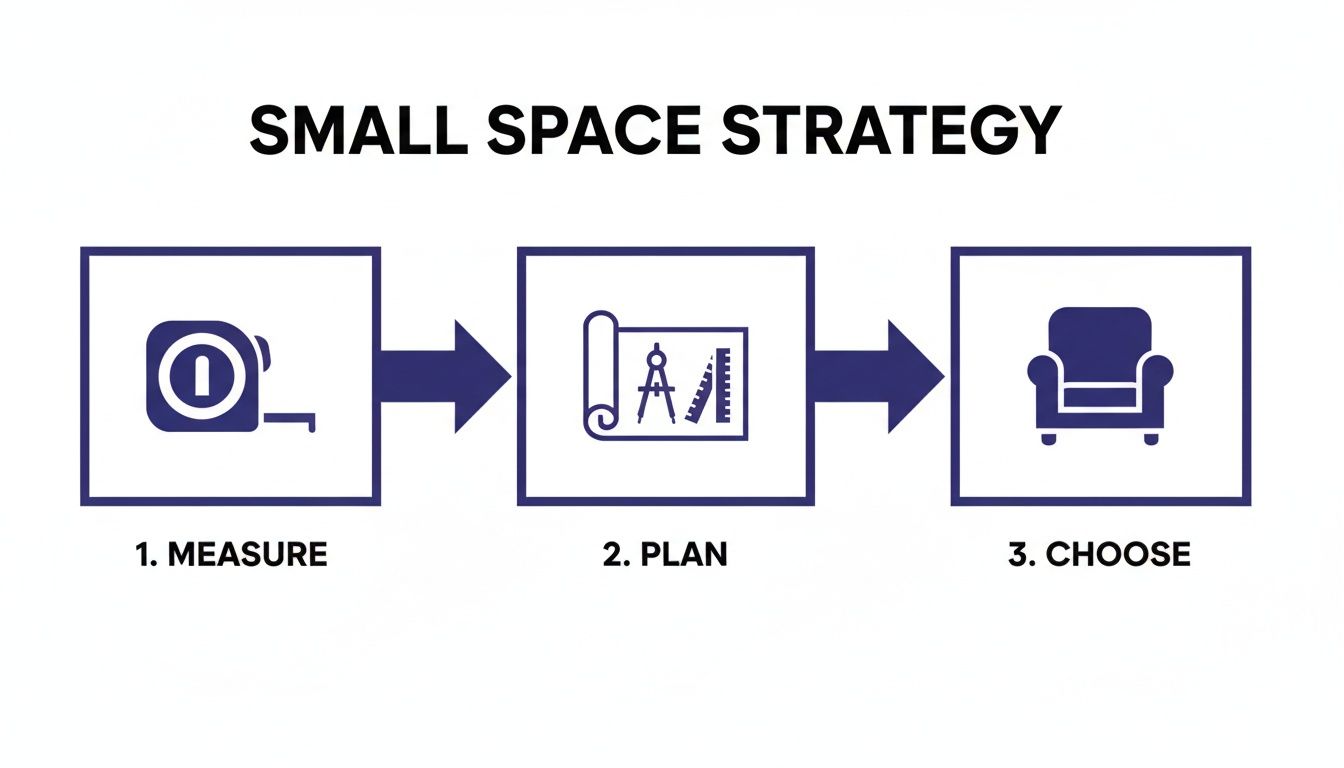
    This simple strategic process is something we recommend to everyone.

    Infographic showing a small space strategy: 1. Measure, 2. Plan using blueprints, and 3. Choose furniture.

    This flow is your roadmap to success: Measure your space accurately, create a solid plan, and then start looking for the right furniture.

    Scale Beyond Size

    Lastly, don't forget that scale is about more than just physical measurements—it's also about visual weight. Think about it: a delicate armchair on tall, skinny legs takes up the same physical footprint as a bulky, overstuffed one, but it feels infinitely lighter and smaller in the room.

    When you nail your measurements and keep visual scale in mind, you’re no longer guessing. You're making informed choices and can pick furniture for your small space with confidence, knowing every piece won't just fit—it will help create a home that feels comfortable, open, and totally functional.

    Choosing Furniture That Works Harder for You

    When you're working with a small home, every single piece of furniture needs to pull its weight. A simple table or chair that only does one thing can be a luxury you don't have the square footage for. The real heroes of compact living are the clever, hardworking pieces that do two, or even three, jobs at once. This isn't about making sacrifices; it's about making smarter choices that solve real, everyday problems.

    Think of it this way: instead of seeing a lack of space, see an opportunity for clever design.

    • Problem: You need a home office but don't have a spare room.

    • Solution: A slim console table tucked behind your sofa can easily double as a desk when you need it.

    • Problem: Your living room is drowning in clutter—blankets, remotes, magazines, you name it.

    • Solution: A storage ottoman gives you a place to prop up your feet, offers extra seating for guests, and provides a hidden spot to stash all that stuff.

    Adopting this problem-solving mindset completely changes how you shop for furniture. You start looking for pieces that not only fit your style but also actively make your home work better for you.

    Sketches illustrating convertible furniture: a console table becoming a coffee table, and an ottoman transforming into a bed with storage.

    Unlocking Potential with Multifunctional Pieces

    Multifunctional furniture has become so popular that it's now a huge focus in modern design. In fact, adaptable and convertible pieces now account for over 45% of the small-space furniture market. The folding furniture segment alone is a multi-billion dollar industry, which just goes to show how many people are on the hunt for these exact solutions.

    So, let’s get into some of the most effective types of hardworking furniture out there.

    Lift-Top Coffee Tables

    A lift-top coffee table is a game-changer for any small living room. When it's down, it’s a standard coffee table. But when you need a place to work or a comfortable spot for a casual meal, the top lifts up and forward. Suddenly, you have an elevated surface that's perfect for a laptop or a dinner plate.

    This one piece can take the place of a separate desk or clunky TV trays, saving you a ton of floor space while adding some serious practicality.

    Expandable Dining Tables

    Hosting a dinner party in a small apartment can feel like an impossible dream. An expandable dining table makes it happen. Day-to-day, it can be a compact table for two, maybe pushed against a wall. When guests come over, you can add leaves or unfold it to comfortably seat four, six, or even more.

    Look for drop-leaf, butterfly leaf, or refectory-style tables. They all have different ways of expanding, but the goal is the same: to give you the flexibility to match your dining area to the occasion.

    Choosing furniture that can adapt is the core principle. A piece that can shrink and grow with your needs helps ensure your home is always ready for both quiet nights in and lively gatherings with friends.

    Beds with Built-In Storage

    The bedroom is clutter's favorite hiding spot. A bed with built-in storage drawers underneath is one of the most brilliant ways to reclaim that space. Those drawers are perfect for storing off-season clothes, extra bedding, or shoes, keeping everything organized and out of sight without needing a separate, bulky dresser.

    If you have a guest room or studio apartment, a sleeper sofa or a Murphy bed that folds up into the wall offers the ultimate space-saving trick, turning a living area into a bedroom in just a few seconds.

    Making the Right Choice

    When you're picking out multifunctional furniture, you'll want to keep a few things in mind.

    • Mechanism Quality: Always test the moving parts. A lift-top table or sleeper sofa should move smoothly and feel solid. A flimsy mechanism will be a constant source of frustration and probably won't hold up to daily use.
    • Style Cohesion: Make sure the piece looks good in all its forms. Does that expandable table look just as nice when it's small as it does when it's fully extended?
    • True Utility: Be honest with yourself. Are you really going to use the storage in that ottoman, or is it just going to become a forgotten junk drawer? Pick pieces that solve a real, recurring problem in your life.

    By focusing on furniture that pulls double or even triple duty, you're not just filling your home—you're investing in smart solutions that make your space more organized, versatile, and just plain enjoyable. To make sure your choices are spot on, dig into some designer furniture for small spaces and style secrets to perfectly blend function with great looks.

    Layout Strategies That Make a Room Feel Bigger

    Once you’ve got the right furniture, how you arrange it is your secret weapon. A good layout can make a small room feel bigger, more organized, and way more functional. Honestly, sometimes the placement has a bigger impact than the furniture itself. It’s all about creating smart visual cues that trick the eye and improve the flow of your space.

    A lot of folks think the answer is to push everything against the walls to open up the middle of the floor. But that can backfire, creating a weird, long “bowling alley” effect. A truly well-designed layout uses every part of the room—walls and vertical space included—to build a real sense of balance and openness.

    Architectural sketch of a modern living room with a white sofa, coffee table, mirror, and bookshelf.

    Go Vertical and Draw the Eye Up

    One of the most powerful things you can do is make people look up. When you draw the eye upward, the room’s height becomes a key feature, making the whole space feel taller and grander. This is where tall, narrow furniture becomes your friend.

    • Tall Bookcases or Shelving Units: Instead of a low, wide media console that eats up horizontal space, think about a taller entertainment unit or an étagère-style bookshelf. These pieces pull the eye upward while giving you tons of storage on a smaller footprint.
    • High-Mounted Curtains: This one’s a classic for a reason. Hang your curtain rods several inches above the window frame and let them extend wider than the window itself. The window will look bigger and your ceilings will feel higher.
    • Vertical Art Arrangements: A gallery wall with smaller frames arranged in a column has the same lifting effect as one huge piece of art. It’s a great way to add personality while making the room feel more expansive.

    Create Distinct Zones for Different Activities

    Even in a tiny studio, you can create the illusion of multiple rooms by setting up distinct “zones.” This little trick helps organize the space and makes it feel more intentional—less like one big, cluttered area. The best part? You can do it all with furniture placement.

    An area rug, for instance, can anchor your living room zone, clearly marking it off from a dining or office nook. A strategically placed open-backed bookshelf can work as a room divider, creating separation without completely blocking light or sightlines. This simple act of zoning makes one room feel like it can do it all.

    A common mistake is thinking a small space must serve only one purpose. By creating a reading corner with a comfortable chair and a floor lamp, you add another layer of function and personality that makes the whole room feel more complete.

    Use Visual Tricks to Expand Your Space

    Beyond where you put the big pieces, certain decor choices can create a powerful illusion of depth and openness. Think of these as the finishing touches that tie your whole strategy together.

    Choose "Leggy" Furniture

    Furniture raised on slender legs—what we call "leggy" furniture"—is a game-changer for small spaces. When you can see the floor under your sofa, chairs, and tables, it creates an unbroken sightline that makes the room feel much larger and airier. In contrast, heavy, boxy furniture that sits flat on the floor can feel bulky and stop the eye in its tracks.

    The Strategic Placement of Mirrors

    Mirrors are the oldest trick in the book because they just flat-out work. A large mirror can visually double the size of your space. For the biggest impact:

    • Place a mirror directly opposite a window. It will reflect all that natural light and the view, making the room feel brighter and more connected to the outdoors.
    • Lean a large floor mirror against a wall. This not only creates a dramatic focal point but also adds a real sense of depth.

    By combining these layout strategies, you're doing more than just cramming furniture into a room. You’re actually shaping the space, turning its limitations into design opportunities. The end result is a home that feels comfortable, open, and perfectly you.

    Using Color and Light to Create an Open Feel

    Once you've got the right furniture and layout nailed down, it’s time to talk atmosphere. Two of the most powerful—and most underestimated—tools in your small-space toolkit are color and light. Working together, these elements can completely change how a room feels, turning a cramped space into one that feels open, airy, and inviting.

    This isn’t just about painting all your walls white. It’s a bit of visual trickery, really. Light, bright surfaces bounce light around, making a space feel bigger. Dark, matte surfaces do the opposite—they absorb light and can make a room feel a bit closed-in. This simple principle applies to everything, from your paint choices to your furniture.

    Building a Light and Airy Color Palette

    While it’s true that shades of white, cream, and pale gray are helpful for maximizing the sense of space, a totally colorless room can feel a little sterile. The real goal is to build a palette that’s light and bright but still has some personality.

    • Monochromatic Schemes: Sticking to different shades of a single light color (like various tones of beige or a soft blue) creates a seamless, uncluttered look. It helps the eye travel smoothly around the room without getting hung up on jarring transitions.
    • Strategic Pops of Color: This is where you bring in your personality. Use your favorite bold colors as accents—think vibrant throw pillows, a stunning piece of art, or a single statement chair. You get all the character without overwhelming the room.
    • Cool vs. Warm Tones: Here's a neat trick: colors with cool undertones, like soft blues and greens, tend to recede visually, which can make walls seem farther away than they actually are.

    Your largest pieces of furniture, like a sofa or bed frame, have a huge impact on the room's overall feel. Choosing these anchor pieces in lighter neutral fabrics can make a massive difference in preserving an open atmosphere.

    The Reflective Power of Materials

    Beyond just color, the materials you pick play a huge role in how light behaves in your room. Bringing in reflective and translucent surfaces is one of the easiest ways to crank up the brightness and create a sense of depth.

    Think about it this way: a dark, solid wood coffee table feels heavy and seems to suck the light out of its corner. But a glass or acrylic table? It lets light pass right through, allowing you to see the floor underneath and making the whole area feel more open.

    Consider working in some of these materials:

    • Glass and Acrylic: Perfect for coffee tables, console tables, or even a small dining table.
    • Mirrored Surfaces: A well-placed mirror or a mirrored closet door can visually double the space. It’s an old trick for a reason!
    • Light-Toned Woods: Woods like birch, maple, or ash have much less visual weight than dark walnut or espresso.
    • Polished Metals: A little bit of chrome, brushed nickel, or brass on table legs and light fixtures can catch the light and add a welcome touch of sparkle.

    Layering Light to Eliminate Shadows

    A single, harsh overhead light is a small room’s worst enemy. It flattens everything out and casts dark, gloomy shadows in the corners. The solution is to layer your lighting by combining three different types to create a warm, balanced glow that makes the space feel surprisingly spacious.

    1. Ambient Lighting: This is your main light source. Think of a flush-mount ceiling fixture or recessed lighting that provides general illumination.
    2. Task Lighting: This is your focused, functional light for specific activities. A floor lamp by a reading chair or under-cabinet lighting in the kitchen are perfect examples.
    3. Accent Lighting: This is the fun part. Accent lighting adds dimension and highlights features you love, like a small lamp on a bookshelf or a picture light over a piece of art.

    By combining these three layers, you chase away all those dark corners and create a bright, welcoming environment where the room's boundaries seem to just melt away. It’s the finishing touch that makes all your other choices—from the right furniture for small spaces to your color palette—truly shine.

    How to Confidently Plan and Purchase Your Furniture

    Alright, this is where the rubber meets the road. You’ve got a solid plan, a clear vision for your layout, and a style you’re excited about. Now it’s time to turn that well-thought-out strategy into reality by making smart, confident purchases that you’ll be happy with for years to come.

    First things first: set some practical priorities. It's rare to furnish an entire space all at once, so figure out where to put your money first. It's often wise to invest in the pieces you use the most. Think about your sofa, your mattress, or a dining table that also serves as your desk. These are the workhorses of your home, and investing in quality here really pays off in long-term comfort and durability.

    From Digital Plan to Physical Reality

    Online room planners are amazing tools for mapping out your vision, but they can't tell you the whole story. There is simply no substitute for getting out there and experiencing furniture in person. A photograph can’t convey how a fabric feels against your skin, how truly comfortable a chair is after you’ve sat in it for a minute, or how the sheer size of a piece feels in a real, three-dimensional room.

    Seeing your top contenders firsthand is a game-changer. It allows you to:

    • Judge True Scale: Get a real feel for a piece’s height, depth, and overall presence in a way that on-screen dimensions just can’t capture.
    • Test Comfort and Quality: Go ahead, sit on that sofa. Open and close the dresser drawers. Give that table a little nudge to check its sturdiness. This is the crucial step that prevents buyer’s remorse.
    • Confirm Colors and Textures: See how that upholstery fabric or wood finish looks under real-world lighting, which is often completely different from what you see in a polished studio photo.

    The Value of a Knowledgeable Guide

    Let's be honest, navigating the world of furniture can get complicated, especially when you’re dealing with the unique challenges of a small space. This is where leaning on the experience of a knowledgeable team becomes helpful. A seasoned furniture expert can often suggest a creative solution you hadn’t even thought of, or point you to a multifunctional piece that perfectly solves one of your biggest headaches.

    A great furniture professional doesn’t just sell you an item; they help you solve a puzzle. They listen to your needs, understand your space constraints, and help you find the right fit for both your home and your budget.

    This kind of collaborative approach takes so much of the pressure and guesswork out of the process. The U.S. furniture market is expected to hit USD 265.56 billion in 2026, which means more innovative, space-saving options are hitting the market every day. For our friends and neighbors in North Georgia, having an experienced guide can help you sift through the noise and find the gems. If you want to dive deeper, you can check out more about the U.S. furniture market trends on Statista.com.

    By zeroing in on your needs, setting a realistic budget, and taking the time to see your options in person, you can move forward with total confidence. The goal here isn't just to buy furniture; it's to make informed decisions that fill your home with pieces you’ll absolutely love for years to come.

    Common Questions About Furnishing Small Spaces

    Even after you’ve got a solid plan, a few nagging questions can pop up when you're dealing with a small space. Don’t worry, we get it. To help you move forward with total confidence, we’ve put together answers to a few of the most common concerns we hear from shoppers every single day.

    What Is the Biggest Mistake People Make When Furnishing a Small Space?

    Hands down, the number one issue we see is choosing furniture that’s totally out of scale with the room. This usually means picking pieces that are way too big or just look too visually heavy for the space. A single overstuffed sofa or a massive, dark wood media console can instantly make a room feel cramped and uncomfortable.

    The fix for this is all in the prep work. Before you even think about shopping, you have to measure your room, note the dimensions of any furniture you're considering, and sketch out a simple floor plan. Taking this one step will save you from that sinking feeling when a beautiful piece of furniture arrives and just completely swallows your home.

    Are Dark Colors a Bad Idea for Small Rooms?

    Not at all! But you do need to use them strategically. While a light, airy color palette is a safe bet for making a space feel bigger, dark colors can create a wonderfully cozy, dramatic, and sophisticated vibe. It’s all about balance.

    If you go for a deep, rich color on a wall, you’ll need to lighten things up elsewhere. Try pairing it with lighter-colored furniture, adding reflective surfaces like a big mirror or a metallic lamp, and making sure you have plenty of layered lighting. This combo keeps the space from feeling like a cave and turns it into an intentional, stylish retreat.

    Here's a helpful tip: a dark, moody accent wall behind a light-colored sofa can actually create an illusion of depth, making that wall seem farther away. It's a powerful designer trick that adds a ton of character without shrinking the room.

    How Can I Add Storage Without Adding Bulky Furniture?

    The trick here is to think vertically and look for pieces that pull double duty. Your walls and the hidden potential inside your furniture are your best friends when it comes to storage.

    • Go Vertical: Instead of a low, wide bookcase that eats up floor space, go for a tall, narrow one. Floating wall shelves are also brilliant because they use wall space without taking up any floor space. This move also draws the eye upward, which makes the whole room feel taller.
    • Embrace Multifunctionality: This is where you can get really creative with furniture for small spaces. Look for an ottoman that opens up to hide blankets, a coffee table with drawers, or a bed frame with built-in storage underneath. These pieces cleverly work storage into the furniture you already need.

    Should All My Furniture Match in a Small Room?

    Definitely not. In fact, buying a perfectly matched "room-in-a-box" set can sometimes make a small space feel a little dated and one-dimensional. A much more modern and effective approach is to create a cohesive look through a consistent color palette, similar materials, or a shared style (like mid-century modern or industrial).

    Mixing and matching adds personality and keeps the eye moving. It lets you build a space that feels collected over time and uniquely yours. As long as the scale and proportions of the pieces work well together, a thoughtfully curated room will always feel more spacious and interesting than one filled with a generic, cookie-cutter set.


    At Woodstock Furniture & Mattress Outlet, our team is here to help you work through these questions and find real, practical solutions for your home. Stop by one of our showrooms to see these ideas in action and explore a great selection of furniture that's well-suited for your space. Explore your options today at Woodstock Outlet.