Tag: mattress types

  • How Long Should a Mattress Last? A Practical Guide to Longevity

    How Long Should a Mattress Last? A Practical Guide to Longevity

    Most people hear that a mattress should last somewhere between 7 and 10 years. While that’s a decent rule of thumb, it’s really more of a guideline than a hard-and-fast expiration date. The real story of your mattress’s lifespan is written by its materials, the quality of its construction, and how well you take care of it over the years.

    The 7 to 10 Year Rule and Why It's Not That Simple

    It’s tempting to hear "a decade" and just set a calendar reminder, but the truth is a bit more complicated. Think of it like the tires on your car. The manufacturer gives you a mileage estimate, but your actual driving habits, the road conditions, and how you maintain them determine how long they really last. A mattress is no different; its durability depends on its materials and how you use it every night.

    A mattress tucked away in a guest room that only sees occasional use is going to hold up much longer than the one you sleep on day in and day out. Things like body weight, sleeping position, and even whether you share the bed play a huge role in how quickly its support systems wear down. The goal is to get past that generic 7-to-10-year rule and learn how to judge your mattress on its actual performance.

    Understanding Lifespan by Mattress Type

    When it comes to longevity, not all mattresses are created equal. The materials used inside are the single biggest predictor of how many years of comfortable, supportive sleep you can expect.

    Here's a quick look at what you can expect from the most common mattress types on the market today.

    Average Mattress Lifespan by Type

    Mattress Type Average Lifespan (Years) Key Durability Factor
    Latex 12 – 15 Natural resilience of rubber foam
    Memory Foam 8 – 10 Density of the foam layers
    Innerspring 6 – 8 Quality and gauge of the steel coils
    Hybrid 7 – 10 Combination of coil quality and foam density

    As you can see, the materials make a big difference. Let's break down why.

    According to research from industry experts, the typical lifespan falls in that 7 to 10 year range, but the timeline shifts dramatically based on what's inside. For instance, latex mattresses often take the lead in durability, lasting up to 15 years, while traditional innerspring models tend to have the shortest lifespan at just 6 to 8 years because their coils can fatigue and sag over time. High-quality memory foams and hybrids usually land somewhere in the middle. You can see more details on these mattress lifespan findings from SleepFoundation.org to dig deeper into the numbers.

    This chart gives you a quick visual breakdown of what to expect.
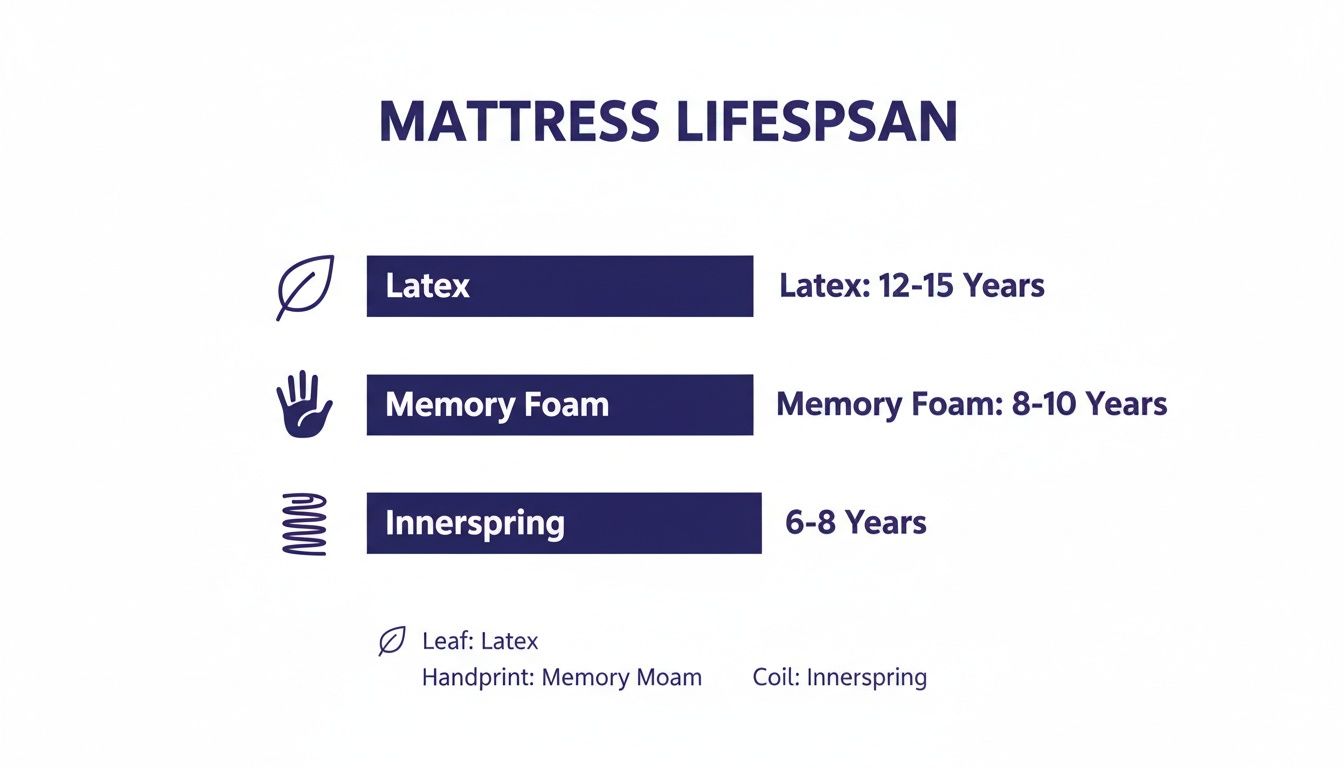
    Infographic showing mattress lifespan: Latex 12-15 years, Memory Foam 8-10 years, and Innerspring 6-8 years.

    The takeaway is clear: latex generally offers the longest potential for use, while you might find yourself shopping for a replacement for a traditional innerspring bed sooner.

    Why Some Mattresses Last Longer Than Others
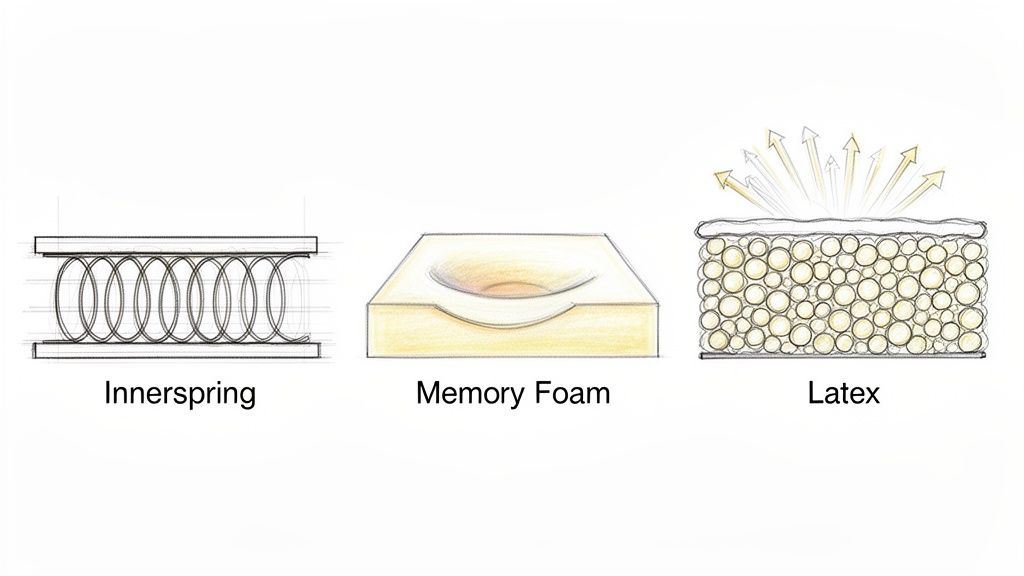
    Three mattress cross-sections illustrating innerspring, memory foam, and latex structures.

    Ever wondered why that old innerspring mattress from the guest room developed a permanent sinkhole years before a newer memory foam bed even started to feel different? It all comes down to the materials inside and how they handle the stress of supporting you, night after night.

    Think of it like bending a paperclip. The first few times, it snaps right back into shape. But if you keep bending it back and forth, the metal gets tired, weakens, and eventually breaks. Your mattress goes through a similar, much slower process of wear and tear every single night.

    The Innerspring Lifespan

    A traditional innerspring mattress is built on a core of steel coils. When the mattress is new, these springs are full of life, compressing and rebounding perfectly to give you that firm, bouncy support. But just like that paperclip, years of nightly compression eventually lead to metal fatigue.

    Over thousands of nights, the coils lose some of their height and strength. This is the classic culprit behind the deep body impressions and noticeable sagging that plague older innerspring beds.

    • Coil Gauge: A key factor here is the thickness of the steel. Thicker, lower-gauge coils are tougher and hold up to fatigue better.
    • Coil Count: While it's a popular marketing number, the total count is less important than the quality of the individual coils.
    • Edge Support: If a mattress doesn't have a reinforced border, the edges will be the first to break down—especially if you often sit on the side of the bed.

    Eventually, those tired coils just can't provide the even support they once did, leaving you with valleys and dips that throw your spine out of alignment and lead to those dreaded morning aches.

    How Foam Mattresses Age Differently

    Memory foam and other polyfoams operate on a totally different system. There are no mechanical springs here; instead, they use a structure of tiny, open cells filled with air. When you lie down, the foam compresses, air is squeezed out, and the mattress hugs your body's curves.

    The aging process for foam isn't about metal wearing out—it’s about the foam losing its elasticity.

    Over time, the cell walls inside the foam can start to break down from the nightly cycle of compression, body heat, and moisture. This weakens the foam's structure, causing it to spring back more slowly… or not spring back all the way.

    This is why a failing foam mattress feels different from a failing innerspring. Instead of one big crater, you’ll probably notice the foam just feels softer and less responsive, developing permanent shallow impressions where you sleep. Higher-density foams have stronger cell walls, which is why they outlast their lower-density cousins by a long shot. A foam's density, measured in pounds per cubic foot (PCF), is one of the best clues to its durability.

    Why Latex Mattresses Lead in Longevity

    When it comes to durability, latex is a standout material in the mattress world, especially natural latex. Its incredible longevity comes down to the unique, resilient nature of rubber foam.

    Unlike memory foam that squishes down by displacing air, latex has a naturally springy structure that pushes back against pressure almost instantly. This "bounce" allows it to endure nightly compression with surprisingly little wear and tear on its internal structure.

    Because of this incredible resilience, a quality latex mattress can easily last 12 to 15 years or more without any significant sagging or loss of support. It simply resists the permanent body impressions that wear down other materials, making it a fantastic long-term investment for consistently good sleep.

    Seven Signs Your Mattress Is Past Its Prime
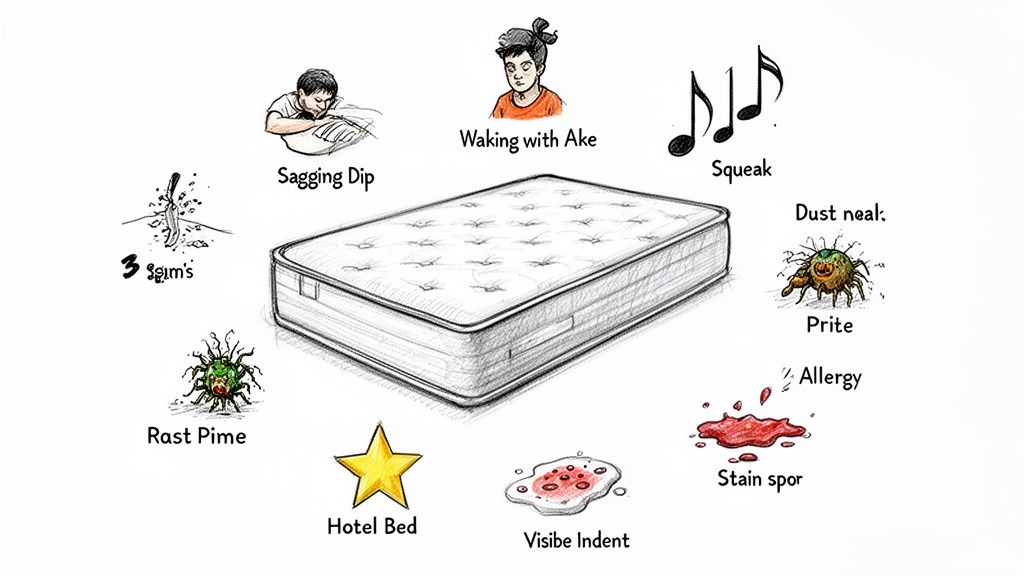
    An illustration of a mattress surrounded by various common problems like sagging, squeaks, stains, and pests.

    Sometimes, the calendar isn't the best way to know when your mattress is ready for retirement. Your body is usually the first to tell you, sending subtle (and sometimes not-so-subtle) signals that your sleep surface is failing. Instead of just focusing on how long a mattress should last, it’s much more helpful to recognize the real-world signs that it’s no longer giving you the support you need.

    These signs are more than just minor annoyances; they're direct symptoms of poor sleep health. When you can connect the dots between your mattress's condition and your own well-being, you'll know exactly when it's time for a change.

    1. Obvious Sagging and Body Impressions

    This is the classic, most visible sign of a worn-out mattress. After years of use, the materials inside—whether it's coils or layers of foam—start to break down and lose their ability to bounce back. The result is a permanent ditch or valley right where you sleep most often.

    A visible sag of 1.5 inches or more is a dead giveaway that the mattress has lost its structural integrity. This dip makes it impossible for your spine to stay in a neutral alignment, which is a direct cause of back pain and stiffness. If you can see that "hammock effect," the support system has definitely failed.

    2. Waking Up with Aches and Pains

    Sound familiar? You go to bed feeling fine but wake up with a sore lower back, a stiff neck, or aching hips. This is one of the most common complaints from people sleeping on an old mattress. As the support layers weaken, they can no longer cushion your pressure points or keep your body properly aligned.

    Your mattress should relieve pressure, not create it. If morning pain has become part of your daily routine and it fades as you start moving around, your bed is the likely culprit. It’s forcing your body into unnatural positions for hours on end.

    A supportive mattress is the foundation of restorative sleep. If you consistently wake up feeling more tired and sore than when you went to bed, it's a strong signal that your mattress is actively working against your body's needs.

    3. You Hear Noises Every Time You Move

    A mattress should be silent. If you're hearing creaks, squeaks, groans, or popping sounds whenever you shift positions or get in and out of bed, that’s a clear sign the internal components are breaking down. This is especially common in older innerspring mattresses.

    These noises usually come from old, fatigued coils inside the mattress or from the box spring underneath. A noisy bed isn't just annoying; it’s a symptom of a support system that has lost its strength and stability.

    4. Your Allergies Are Worse in the Morning

    Over many years, mattresses become a haven for dust mites, dead skin cells, pet dander, and other allergens. These microscopic particles thrive in the warm, humid environment of a bed.

    If you find yourself waking up with a stuffy nose, watery eyes, or other allergy symptoms that seem to get better once you're out of bed, your mattress could be the source. Knowing when your mattress is past its prime is crucial for good sleep, just as it's important to be aware of the 7 clear signs of dirty air ducts that signal a need for attention in your home.

    5. You Sleep Better Elsewhere

    This is one of the most telling signs there is. Does a night in a hotel bed or at a friend's house leave you feeling remarkably refreshed? If you consistently get a better night's sleep away from your own bed, it’s a clear signal that your mattress at home is the problem.

    6. Noticeable Lumps and Bumps

    Run your hand over the surface of your mattress. Does it feel uneven, lumpy, or bumpy? This happens when the foam or fiber comfort layers inside shift and clump together over time. These lumps create an inconsistent sleeping surface that can't provide uniform support.

    7. It’s Simply Uncomfortable

    At the end of the day, the most important sign is your own comfort. If you find yourself tossing and turning all night, struggling to find a good position, or feeling every single movement from your partner, it's time to listen to your body. Trust your instincts—if your bed just doesn't feel good anymore, it's time to start looking for a new one.

    How to Extend the Life of Your Mattress
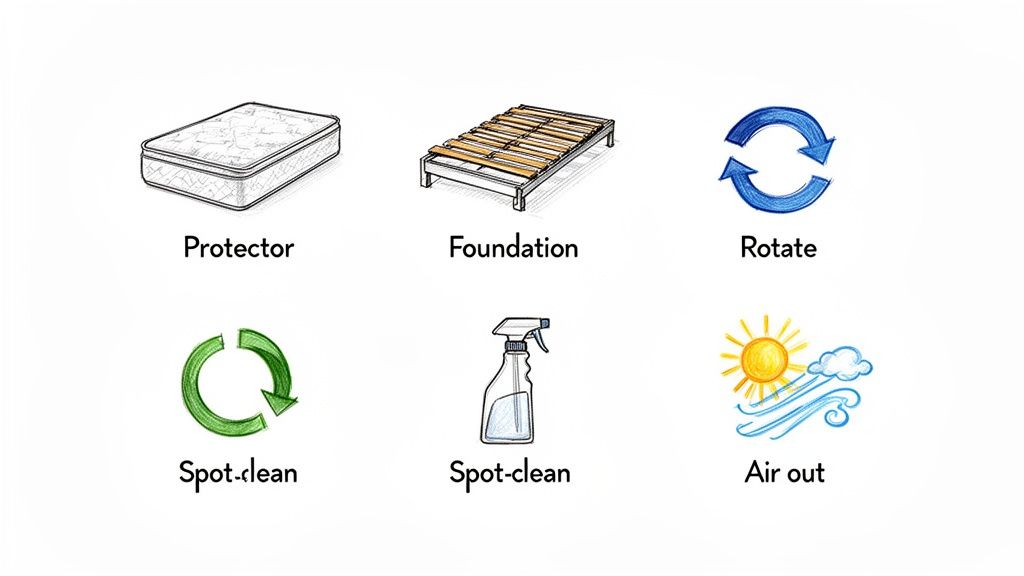
    Illustration showing six tips for mattress care: protector, foundation, rotate, spot-clean, and air out.

    While every mattress eventually wears out, you have a surprising amount of control over how long you get comfortable, supportive sleep. Think of it like maintaining a car; a little consistent care goes a long way and can add years of reliable performance. Taking a few simple steps protects your investment and ensures you get every last bit of value from it.

    These tips are basically the owner's manual for your bed. They're straightforward habits you can build to delay the sagging, softening, and general wear that send a mattress into retirement. With proper care, you can help your mattress reach or even exceed that recommended 7 to 10 year lifespan.

    Start with a Solid Foundation

    The very first step to a long-lasting mattress has nothing to do with the mattress itself—it’s about what you put underneath it. A mattress needs a sturdy, supportive base to do its job. An old, sagging box spring or a platform bed with slats spaced too far apart will cause even a great new mattress to break down prematurely.

    • For Innerspring Mattresses: A matching box spring is usually a good option. It’s designed to work with the mattress to absorb shock and distribute weight evenly.
    • For Foam and Hybrid Mattresses: These heavier beds need a more rigid, solid base. Look for a solid platform foundation or a slatted base where the slats are no more than 2.75 inches apart. This prevents dipping that can damage the foam layers over time.

    Seriously, using the wrong foundation is one of the fastest ways to void your warranty. Make sure your bed has the right support from day one.

    Always Use a Mattress Protector

    If you only do one thing on this list, make it this one. A high-quality mattress protector is a non-negotiable shield against the things that degrade a mattress from the inside out: moisture, spills, and allergens.

    Sweat, body oils, and the occasional spilled coffee seep into the mattress layers. This not only breaks down foams and fibers but also creates a breeding ground for mold, mildew, and dust mites. A waterproof yet breathable protector is an inexpensive investment that keeps your mattress clean, hygienic, and free of stains that can void a warranty.

    For an extra layer of defense against pests and allergens, consider using a mattress encasement for protection.

    Rotate Your Mattress Regularly

    Remember the old advice to flip your mattress? That’s mostly a thing of the past. Modern mattresses, especially hybrids and memory foam models, are built with specific layers from the bottom up and aren't meant to be flipped over.

    For the vast majority of today's one-sided mattresses, the rule is to rotate, not flip. Just turn the mattress 180 degrees every 3 to 6 months. What was at the head of the bed is now at the foot. This simple move ensures wear and tear is distributed evenly, preventing deep body impressions from forming in one spot.

    Decoding Your Mattress Warranty

    It's one of the biggest points of confusion when you're out shopping for a new mattress. You see a 10-year warranty tag and think, "Great! This bed is guaranteed to last me a decade!" Who could blame you? Unfortunately, that common misunderstanding can lead to a lot of frustration down the road.

    It’s really important to see a mattress warranty for what it is: a manufacturer's promise against specific defects in how it was made, not a guarantee of how comfortable it will feel for ten years. Think of it as protection against a product flaw, not an insurance policy against normal wear and tear.

    Prorated vs. Non-Prorated Coverage

    When you dig into the fine print, you’ll run into two key terms: "prorated" and "non-prorated." These words basically decide who pays for what if you have a successful warranty claim.

    • Non-Prorated: This is what you hope to see. For the first few years of most warranties, if a covered defect pops up, the manufacturer will repair or replace your mattress. You might have to cover shipping, but that's usually it.
    • Prorated: After the non-prorated period is over, things change. With prorated coverage, you’ll have to chip in a percentage of the original price to get a replacement. That percentage usually goes up the longer you've owned the bed.

    A typical 10-year warranty might be non-prorated for the first two years, then switch to a prorated plan for the final eight.

    So, What Does a Warranty Actually Cover?

    A warranty is laser-focused on structural failures, not your personal comfort. The number one issue that's actually covered is significant sagging or body impressions that form when nobody is on the bed.

    Here's the catch: most mattress companies define a "defect" as a visible dip of 1.5 inches or more. Anything less than that is just considered normal wear.

    This means your mattress can feel a lot less supportive and develop some noticeable shallow spots long before it ever qualifies for a warranty claim. This is the perfect example of why a mattress's real-world lifespan is often much shorter than its warranty period.

    Common Mistakes That Will Void Your Warranty

    Even if you have a legitimate, deep sag that should be covered, a few simple missteps can get your claim denied. Be careful to avoid these common warranty-killers:

    1. Removing the Law Tag: You know that tag at the end of the mattress that says, "Do Not Remove Under Penalty of Law"? That's not really for you, it's for retailers. But for manufacturers, that tag is the bed's I.D. Rip it off, and you've almost certainly voided your warranty.
    2. Using the Wrong Foundation: If you put a brand-new mattress on an old, worn-out box spring or a bed frame with slats that are too far apart, you're asking for trouble. Lack of proper support will damage the mattress and give the manufacturer an easy reason to deny your claim.
    3. Stains and Spills: This is the big one. Any liquid stain on the mattress is pretty much an automatic disqualification. It's considered an unsanitary condition, and they won't touch it. This is exactly why a high-quality mattress protector is a non-negotiable from day one.

    Choosing a New Mattress Built for Durability

    When the time finally comes to get a new mattress, your goal should be simple: find one that’s going to last as long as possible. Shopping for a durable mattress isn't just about finding the firmest bed on the floor; it’s really about understanding how quality materials and solid construction come together to give you years of consistent, comfortable sleep.

    Thinking about longevity from day one is the smartest way to invest in your sleep health for the next decade. Instead of getting hung up on brand names, let's peel back the cover and look at the components that actually make a mattress last.

    What to Look for in a Durable Mattress

    When you’re testing out new mattresses, some features are dead giveaways for how well a bed will fight off sagging and wear over time. If you keep an eye on these specifics, you can see past the marketing fluff and focus on what truly matters.

    Here are the key factors to check:

    • Foam Density: For any mattress with memory foam or latex, higher density is your best friend. Denser foams have a much stronger cell structure that’s built to resist compression and those dreaded body impressions that form over the years.
    • Coil Quality: In a hybrid or traditional innerspring mattress, you'll want to look for lower-gauge (thicker) steel coils and a higher coil count. Individually wrapped, or pocketed, coils tend to provide more durable, targeted support than the old-school, interconnected spring systems.
    • Construction Techniques: The little details make a huge difference. Pay attention to things like reinforced edge support, which keeps the sides from collapsing when you sit on them. Another classic sign of quality is hand-tufting, a traditional method that physically sews the layers together, preventing them from shifting or clumping down the road.

    Connecting Longevity to Your Needs

    How long you need a mattress to last can also depend heavily on where you are in life. Market analysis shows that how often people replace their mattress changes quite a bit with age.

    Younger folks between 18 and 35 tend to swap out their mattresses every 6.6 years on average. Those in the 36 to 55 age bracket hold on to theirs for about 9.1 years. And consumers 55 and older get the most mileage out of their beds, keeping them for around 11.6 years. You can dive deeper into these mattress statistics and what they mean for shoppers if you're curious.

    This info can help frame your own purchase. If you’re in a temporary spot, like a first apartment, a mattress with a 7-year lifespan might be all you need. But if you’re settling into your forever home, investing in a mattress built to last 10 years or more just makes good sense.

    Here at Woodstock Furniture & Mattress Outlet, our team can walk you through all the different options in a friendly, no-pressure environment. We truly believe the best way to choose with confidence is to feel the difference for yourself. Our goal is to give you the expertise you need to find a mattress that will support your well-being for years to come.

    A Few Lingering Questions About Mattress Longevity

    Even with a solid grasp of mattress types, warranties, and the tell-tale signs of a worn-out bed, a few practical questions always seem to pop up. Let's get straight to the point and tackle some of the most common things people ask right before they decide to buy a new mattress.

    Does Flipping or Rotating a Mattress Really Help?

    Yes, it absolutely makes a huge difference, but what you should do depends entirely on the kind of mattress you own. The vast majority of modern mattresses—memory foam, latex, and hybrids included—are designed with specific layers from the bottom up. They're strictly one-sided and should never be flipped over.

    For these newer beds, you'll want to rotate them 180 degrees (head to foot) every three to six months. This one simple move prevents you from sleeping in the exact same spot night after night, which helps spread out the wear and tear and dramatically slows down the development of sags or body impressions.

    Now, if you've got an older, traditional innerspring mattress, the old advice still stands. Those are often two-sided, meaning you should both flip and rotate them every few months. When in doubt, always check the manufacturer's care instructions for your specific bed.

    Can a Mattress Topper Save an Old Mattress?

    Think of a mattress topper as a bandage, not a miracle cure. It's a great temporary fix, but it's not a long-term solution for a fundamentally broken-down mattress. A good topper can definitely add a layer of softness to a bed that feels a little too firm or has lost some of that initial plush comfort.

    But here’s the critical part: a topper cannot fix a sagging mattress. If your bed already has a noticeable crater or dip, the topper is just going to sink right into that same valley. It won't give you the flat, supportive surface your spine needs. A topper is meant to enhance a good mattress, not resurrect a dead one.

    What Is the Most Durable Type of Mattress?

    When it comes to pure, rugged longevity, latex mattresses are the undisputed champions. The natural springiness and resilience of latex foam make it incredibly resistant to sagging and forming permanent body impressions over time. It's not uncommon for a high-quality latex mattress to provide consistent support for 12 to 15 years, and sometimes even longer.

    Coming in at a close second are high-density memory foams and well-built hybrid models that use strong, individually pocketed coils. For any mattress type, the rule is pretty straightforward: better ingredients make a better bed. Denser foams and thicker steel coils directly translate to a longer and more comfortable life for your mattress.


    Here at Woodstock Furniture & Mattress Outlet, our knowledgeable team knows the ins and outs of every mattress type. We can walk you through the differences in person, helping you feel the materials and understand the construction so you can find a durable mattress that fits your sleep style and your budget. Stop by one of our North Georgia locations and let us help you find your best night's sleep.
  • What Is a Hybrid Mattress and How Does It Work?

    What Is a Hybrid Mattress and How Does It Work?

    Ever felt stuck trying to decide between a traditional spring mattress and one of the newer memory foam beds? You're not alone. It's a common dilemma, and it's exactly where the hybrid mattress comes in.

    Think of a hybrid as a peace treaty between two different mattress technologies. It takes the supportive innerspring coil system from a traditional mattress and tops it with comfort layers made of foam or latex. The result is a single mattress designed to offer the benefits of both worlds.

    So, What Is a Hybrid Mattress, Really?

    In simple terms, a hybrid mattress is a modern solution to the common complaints people have about older mattress types.

    We all know traditional innerspring beds. They have that familiar bounce and solid support, but sometimes they can create pressure points, and you might even feel the springs over time. On the flip side, all-foam mattresses are incredible at contouring to your body, but some people find they sleep a bit warm or miss that responsive, bouncy feel.

    A hybrid mattress is engineered to address these issues. By thoughtfully layering these different materials, manufacturers create a sleep surface that's both supportive and conforming. It’s a unique feel that works well for a wide variety of sleepers.

    The Innovation Is in the Layers

    The real genius of a hybrid is how its distinct layers work in harmony. While specific designs can vary from one brand to the next, just about every hybrid mattress is built on two fundamental parts: a support core and a comfort system.

    • The Support Core: This is the foundation of the mattress, made from steel coils. In most modern hybrids, these aren't just any old springs; they're pocketed coils. This means each spring is individually wrapped in fabric, allowing it to move independently. This is a significant feature because it cuts down on motion transfer (so you won't feel your partner tossing and turning) and provides more targeted, personalized support.
    • The Comfort System: Stacked right on top of the coils, you'll find one or more layers of foam or latex. This is where you get that cushioning feeling. These layers might include memory foam for deep pressure relief, gel-infused foam to help keep you cool, or natural latex for a more buoyant, responsive feel.

    This tag-team approach of bouncy coils and cushioning foam delivers a balanced sleep experience. You get more pressure relief than a basic innerspring without that "sinking" feeling some people dislike in all-foam beds.

    To break it down even further, here's a look at how each component contributes to your night's sleep.

    Key Components of a Hybrid Mattress

    Layer What It Is What It Does for You
    Comfort Layer(s) The top section, typically 2+ inches thick, made of materials like memory foam, gel foam, or latex. Provides pressure relief by contouring to your body's curves, especially at the shoulders and hips.
    Support Core The bottom section, consisting of individually pocketed innerspring coils. Offers foundational support, promotes airflow for cooling, adds bounce, and isolates motion between sleepers.

    As you can see, it's not just about throwing two materials together. It’s about leveraging the strengths of each to create something better than the sum of its parts.

    A Look Inside a Hybrid Mattress, Layer by Layer

    To really understand what a hybrid mattress is all about, we need to peel back the cover and look at how it’s put together. While the exact recipe can vary from brand to brand, most hybrids follow a similar layered construction. Each component is engineered to solve a specific sleep problem.

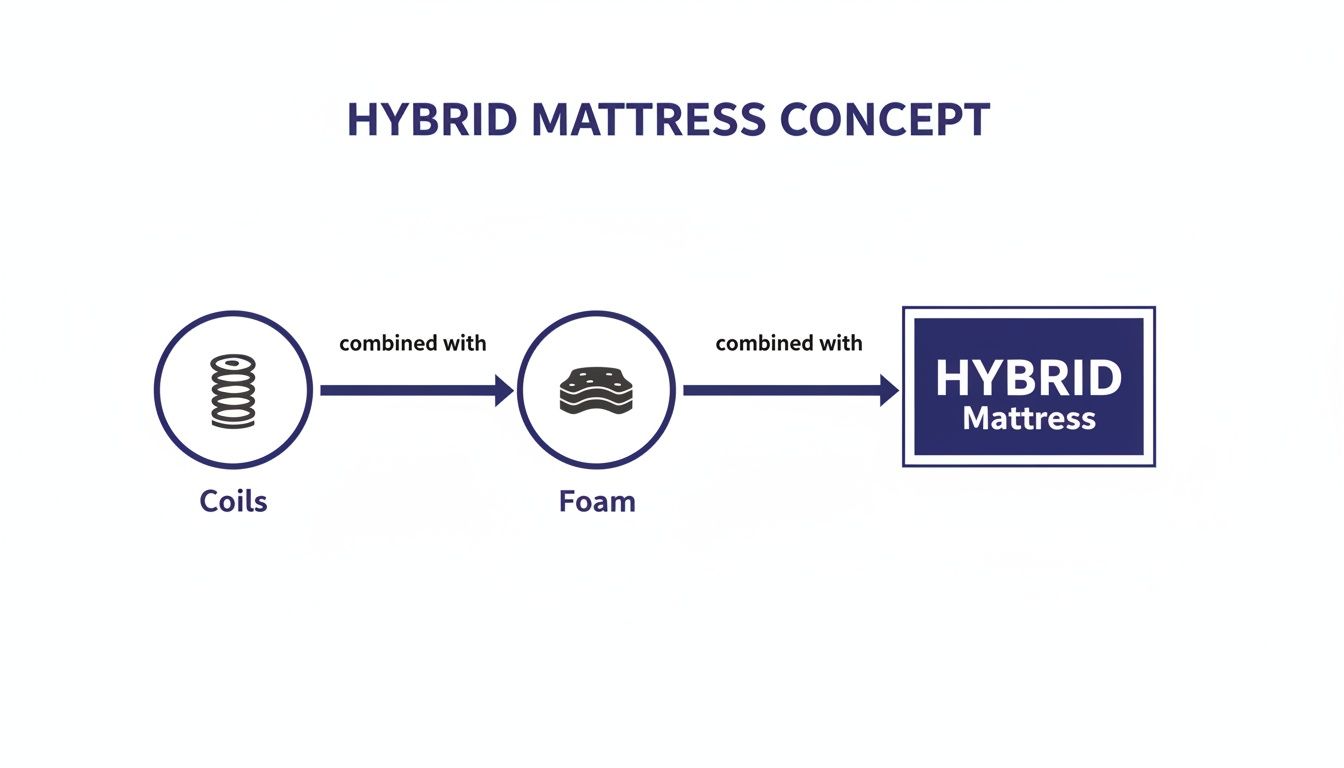
    This visual shows you the basic idea: supportive coils and contouring foam come together to create a hybrid mattress.

    Diagram illustrating the hybrid mattress concept: coils combined with foam to form a hybrid mattress.

    It’s a simple equation, really. Coils plus foam. This combination is the key to a hybrid’s balanced feel, giving you the benefits of both worlds in a single mattress.

    The Foundation: A Sturdy Base Layer

    Every great structure needs a solid foundation, and a hybrid mattress is no different. Way down at the bottom, you'll find a layer of high-density polyfoam, usually about an inch thick. This layer isn’t about comfort; its job is purely structural.

    The main purpose of this base is to give the pocketed coils above it a stable platform. It gives the springs a firm surface to rest on and push against, which keeps them from sagging and helps ensure the whole mattress stays durable for years to come. Think of it as the subfloor in a house—you never see it, but everything built on top of it relies on its strength.

    The Support Core: Pocketed Coils

    This is the engine of the mattress. The support core is made up of hundreds, and sometimes thousands, of individually wrapped steel coils. These are a significant advancement over the interconnected springs of the past.

    Here’s why that matters:

    • Motion Isolation: Since each coil is wrapped in its own fabric pocket, it can compress and react to pressure all by itself. This means that when your partner tosses and turns, the motion gets absorbed by just a few coils instead of sending a shockwave across the whole bed. For couples, this can be a very helpful feature.
    • Targeted Support: The independent coils contour to your body’s unique shape. They provide firmer support where you need it most (like your lower back) and a softer give at pressure points like your shoulders and hips.
    • Enhanced Airflow: Unlike a dense block of foam, the space between all those coils lets air circulate freely. This helps pull body heat away, making hybrids a suitable choice for anyone who tends to sleep warm.

    The Comfort System: The Cushioned Top

    Stacked right on top of the coil system are the comfort layers. This is where a hybrid mattress gets its plush, pressure-relieving personality. The comfort system is typically at least two inches thick and can be made from a few different materials, each designed to tackle a different need.

    What to expect from comfort layers: This part of the mattress is all about cushioning your body and making sure you don't feel the firm coils underneath. The material used here has the biggest impact on how the mattress actually feels when you lie down.

    Some common materials you'll find are:

    • Memory Foam: Famous for its deep, body-hugging feel, memory foam is a champion of pressure relief. This makes it a great fit for side sleepers.
    • Gel-Infused Foam: This is simply memory foam with cooling gel beads or swirls mixed right in. The gel helps absorb and pull heat away from you, tackling one of the most common complaints about traditional memory foam.
    • Latex: Whether it's sourced from rubber trees or created synthetically, latex offers a more responsive, bouncy feel. It contours to your body but springs back into shape quickly, so you never get that "stuck in the mud" feeling.

    The Real-World Benefits of a Hybrid Mattress

    Okay, so we've talked about the different layers inside a hybrid mattress. That's great, but how does that complex design actually help you sleep better? It's all about how the supportive coils and contouring foam work together to solve some of the most common sleep problems people face every night.

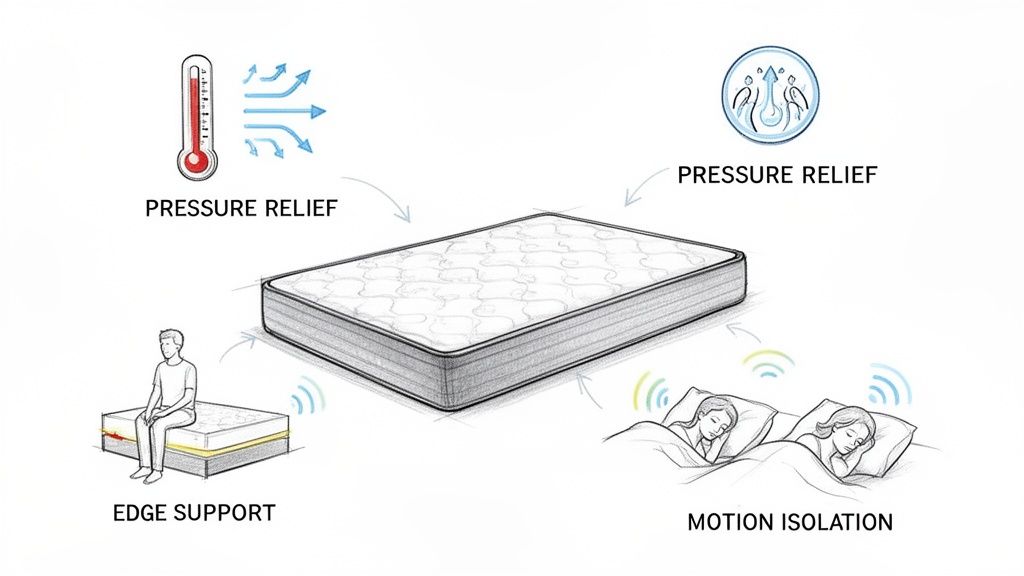
    A diagram showcasing mattress benefits, including pressure relief, edge support, and motion isolation.

    The biggest advantage is a truly balanced feel. If you've ever felt "stuck" in a traditional memory foam bed, you know what we're talking about. A hybrid’s pocketed coil system gives it a responsive, uplifting bounce, making it much easier to change positions without feeling like you’re fighting your way out of quicksand.

    At the same time, those top comfort layers are working to deliver amazing pressure relief, cradling hotspots like your shoulders and hips to keep your spine aligned. While hybrids are fantastic for support, anyone looking for an extra layer of targeted comfort might want to explore the best mattress topper for back pain to customize their sleep setup even further.

    A Cooler and More Comfortable Night

    If you're someone who tends to sleep hot, a hybrid mattress can feel like a breath of fresh air. Dense, all-foam mattresses have a reputation for trapping body heat, which can lead to a sweaty, uncomfortable night. Hybrids are built to fix this.

    The innerspring core is the key. All that space between the coils creates natural airways, letting air circulate freely and carry heat away from your body. This ventilation helps keep the mattress at a much more comfortable temperature. Plus, many modern hybrids add extra cooling features like gel-infused foam or breathable covers to really double down on temperature regulation.

    Robust Edge Support and Durability

    Ever sat on the edge of a mattress and felt like you were about to slide right off? That’s a classic sign of poor edge support, a common complaint with some all-foam models. Hybrids tackle this problem head-on by reinforcing the perimeter with stronger, sturdier coils.

    This simple design choice creates a solid, consistent surface from one side of the bed to the other. Here’s why that matters:

    • You get more usable sleep space. You can sleep right up to the edge without feeling like you're going to roll off.
    • Getting in and out of bed is easier and safer, which is a big deal for anyone with mobility concerns.
    • The mattress holds its shape better and is far less likely to sag at the edges over the years.

    With the right care, a quality hybrid mattress can easily last between 7 to 10 years. That robust coil system provides a durable foundation that resists sagging much better than many all-foam alternatives, making it a smart long-term investment.

    Comparing Hybrid Mattresses to Other Types

    To really wrap your head around what a hybrid mattress is, it helps to see how it stacks up against the other options on the floor. Since it’s a blend of different technologies, a hybrid naturally shares some DNA with innerspring, memory foam, and latex beds, but its unique construction truly sets it apart. The goal isn’t to find one single “best” mattress type, but to find the one that’s the best fit for you.

    It's also worth taking a moment to understand how spring mattresses compare to foam mattresses, since that’s the fundamental combination a hybrid is built on. Knowing the basics of each makes it much easier to see why putting them together is such a game-changer.

    Hybrid vs Traditional Innerspring

    A traditional innerspring mattress is what most of us grew up with. It's built with a network of interconnected steel coils, which gives it that classic bouncy and firm feel. While it’s great for basic support, this old-school design can sometimes create pressure points and doesn't do much to stop motion from traveling across the bed. If your partner tosses and turns, you feel every bit of it.

    A hybrid mattress is the modern evolution of this. Instead of interconnected springs, it uses individually pocketed coils. This simple change makes a huge difference, providing more targeted, body-contouring support and drastically cutting down on that motion transfer. Most importantly, a hybrid then adds thick comfort layers of foam or latex on top, delivering the kind of pressure relief that traditional innerspring beds just can't offer.

    Hybrid vs Memory Foam

    An all-foam mattress, especially one made with memory foam, is famous for that deep, body-hugging sensation. It’s fantastic at relieving pressure and isolating motion, making it a go-to for side sleepers and couples who are light sleepers. The downside? Some people find that memory foam can sleep hot and create a "stuck in the mud" feeling that makes changing positions a chore.

    A hybrid mattress tackles these issues head-on. By pairing those plush foam comfort layers with a breathable coil core, it allows air to flow freely for a much cooler sleep. The coils also provide a responsive, slightly bouncy surface that prevents you from feeling trapped. You still get all the pressure-relieving benefits of foam, but with a more uplifting, easy-to-move-on feel.

    Hybrid vs Latex

    Latex mattresses are loved for their responsive, almost buoyant feel and incredible durability. Much like a hybrid, latex offers pressure relief without the slow-sinking feel of memory foam, and it’s naturally very breathable. An all-latex mattress provides a very consistent feel from the top layer all the way down to the bottom.

    A hybrid mattress can use latex in its comfort layers to give you that same springy, responsive feel, but it combines it with the deep, foundational support of a pocketed coil system. This combo often results in a mattress with a bit more bounce and much more robust edge support than you’d typically find in an all-latex model.

    Mattress Type Comparison

    To make things a little clearer, let's break down how these mattress types perform side-by-side in the categories that matter most to sleepers.

    Feature Hybrid Mattress Memory Foam Innerspring Latex
    Feel Balanced (bouncy & contouring) Deep "sinking" contour Bouncy & firm Buoyant & responsive
    Support Excellent (targeted coil support) Good (conforms to body) Basic (interconnected coils) Good (consistent support)
    Pressure Relief Excellent Excellent Fair to Poor Very Good
    Motion Isolation Very Good Excellent Poor Good
    Temperature Very Good (breathable coil core) Fair to Good (can trap heat) Excellent (very breathable) Very Good (naturally breathable)
    Durability Very Good Good Fair Excellent

    As you can see, the hybrid really shines by taking the best features from other mattress types and minimizing their weaknesses, offering a fantastic all-around sleep experience for many people.

    The rise of the hybrid mattress isn't just a passing trend; it's a huge shift in what sleepers are demanding. The global market for hybrid mattresses was valued at $3.23 billion in 2025 and is projected to hit $5.77 billion by 2030—a growth rate that's outpacing much of the mattress industry. This tells us one thing loud and clear: people want beds that blend robust support, deep comfort, and modern features without compromise. You can dig into more of the data on the hybrid mattress market growth on MordorIntelligence.com.

    Who a Hybrid Mattress Is Really For

    Alright, so we've broken down what a hybrid mattress is, but the real question is whether it's the right mattress for you. No single mattress is a perfect fit for everyone on the planet, but a hybrid's "best of both worlds" design makes it a fantastic choice for several types of sleepers, especially those who feel like other mattresses just miss the mark.

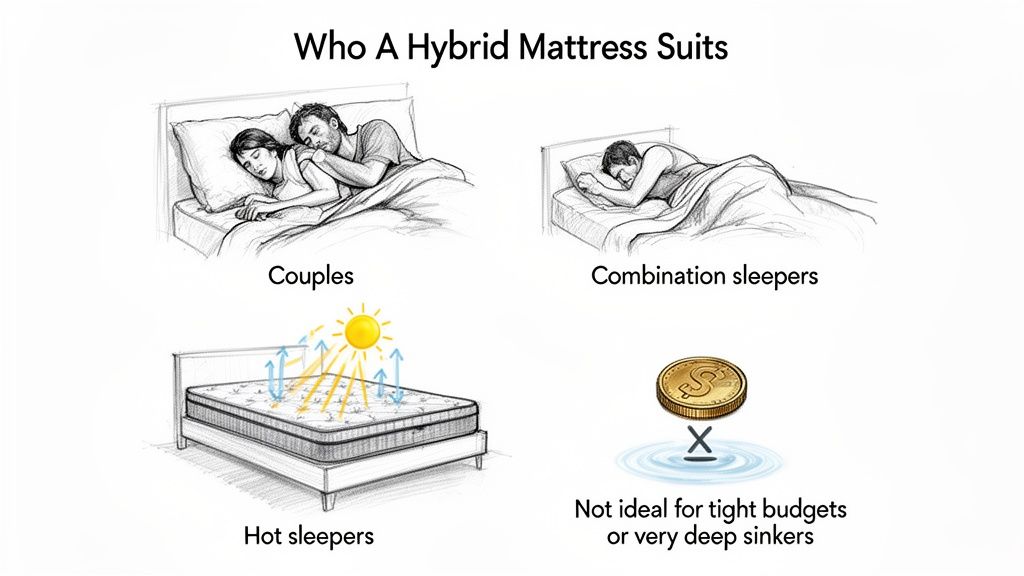
    Infographic detailing who hybrid mattresses suit: couples, combination, and hot sleepers; not for tight budgets or deep sinkers.

    This balanced approach is a game-changer because it solves common sleep problems by blending features that used to be totally separate. Let's take a closer look at who really clicks with this kind of design.

    Couples Sharing a Bed

    If you share a bed, you know the struggle all too well. One person’s late-night bathroom trip or 5 AM alarm can feel like an earthquake to the other person. Hybrids are often a great solution for couples because they nail two key features:

    • Motion Isolation: The pocketed coils are brilliant at this. They absorb movement right where it happens, so you’re way less likely to feel your partner tossing and turning all night.
    • Responsiveness: Unlike some all-foam beds that can make you feel like you're stuck in quicksand, a hybrid’s bounce makes it easy to move around and switch positions without disturbing the whole bed.

    This combination creates a much more peaceful, shared sleep surface. It’s a true compromise where both partners can finally get some undisturbed rest.

    Combination and Hot Sleepers

    Do you find yourself constantly changing positions throughout the night? If you cycle from your back to your side and then to your stomach, you’re what we call a combination sleeper. A hybrid is a great friend here. The responsive coil system and contouring foam layers adapt almost instantly as you move, giving you continuous support without that "stuck" feeling.

    Along the same lines, if you’re the type of person who’s always kicking off the covers, a hybrid is built to help you out. That innerspring core isn't just for support; it creates tons of room for air to flow. This allows body heat to escape instead of getting trapped in dense foam, making it a go-to for hot sleepers.

    The Takeaway: A hybrid mattress shines for anyone who needs a blend of features. It’s for the sleeper who wants the pressure relief of foam but craves the supportive bounce of coils, creating a feel that's incredibly versatile and accommodating.

    Who Might Not Prefer a Hybrid

    Now, in the spirit of good, honest advice, a hybrid isn't for absolutely everyone. If you truly love that extreme, slow-sinking "hug" you get from a super-soft memory foam mattress, a hybrid might feel a bit too firm or responsive for your personal taste.

    Also, let's talk about price. Because of their more complex construction and the quality materials involved, hybrids usually have a higher price tag than a basic innerspring or a simple all-foam model. For shoppers on a really tight budget, one of those simpler mattress designs might be a more practical place to start.

    How to Choose the Right Hybrid Mattress

    Alright, so you know what a hybrid mattress is. That’s a huge first step! But now comes the fun part: picking the one that’s going to give you the best night’s sleep you’ve had in years. Thinking through a few key details will help you sort through the options and land on a bed that truly gets you.

    Start With Firmness

    The first stop on your mattress-buying journey should always be firmness. You’ll usually see this rated on a scale from 1 to 10, with 1 being cloud-soft and 10 being board-firm. Honestly, most people are happiest somewhere in the middle, generally between a 5 (medium) and a 7 (medium-firm).

    So how do you find your magic number? Your sleep position is the best guide you've got.

    • Side Sleepers: You’ll probably feel best on something in the medium-soft to medium range (4–6). This allows your shoulders and hips to sink in just the right amount, keeping your spine straight and happy.
    • Back Sleepers: Look for a medium-firm feel (6–7). This provides the support your lower back needs without letting your hips sag and throw things out of alignment.
    • Stomach Sleepers: You'll want something on the firmer side (7–8) to keep your midsection from sinking down, which is a one-way ticket to back pain.

    Quality Materials Make All the Difference

    Firmness is just one piece of the puzzle. The quality of what’s inside the mattress is what determines how it feels tonight and how it holds up over the next decade. When you’re looking at a hybrid, get a little nerdy about the details. Ask about the coil count in the support layer—more coils usually mean more precise, targeted support where you need it.

    For the foam layers on top, foam density is a key indicator of durability. Higher-density foams simply last longer.

    These material choices are directly reflected in the price. A standard hybrid might run you about $1,300, but one with premium memory foam or natural latex could be closer to $1,500. It’s no surprise that these premium models are popular; they made up a whopping 40% of the hybrid market size in 2024. If you want to dive deeper, you can check out more mattress sales statistics to see how these factors shape the industry.

    Don't Sweat the Small Stuff (But Do Think About It)

    Finally, let's talk about the practical side of things. Are you thinking about an adjustable base? Many hybrids work great with them, which is a game-changer if you like to read or watch TV in bed. Just be sure to double-check with the manufacturer to make sure your mattress and base are compatible.

    There's simply no substitute for trying a mattress out in person. Lying down for a few minutes gives you a real feel for how the coils and foam layers work together to support your body—something you just can't get from a picture online.

    At Woodstock Furniture & Mattress Outlet, our team is here to guide you through all these choices. Our goal is to provide helpful information so you can find a mattress that you'll look forward to sleeping on for years to come.

    A Few Final Questions About Hybrid Mattresses

    To wrap things up, let's go over a few of the most common questions shoppers have when they're trying to decide if a hybrid mattress is the right choice for them.

    Do Hybrid Mattresses Need a Box Spring?

    In most cases, no. Think of hybrid mattresses as part of the modern mattress era, designed for modern support systems. A traditional box spring just doesn't provide the rigid, consistent support they need.

    Instead, a solid platform bed, a sturdy foundation, or an adjustable base will give your hybrid the flat, even surface required to perform its best and prevent premature sagging. It's always a good idea to double-check the manufacturer's recommendations just to be sure you're using a compatible base.

    Are Hybrid Mattresses Good for Back Pain?

    They can be a fantastic option. The secret is that "best of both worlds" construction we talked about. The combination of a supportive coil core and pressure-relieving foam layers is often a perfect recipe for maintaining proper spinal alignment.

    The pocketed coils provide targeted, uplifting support that keeps your hips from sinking too far, while the comfort layers of foam or latex contour to the curve of your lower back. It's this one-two punch of support and relief that many people with back pain are looking for.

    How Long Do Hybrid Mattresses Last?

    With proper care, a quality hybrid mattress should last you a good 7 to 10 years. Their robust pocketed coil systems make them quite durable and much more resistant to developing body impressions and sagging than many all-foam mattresses.

    Article created using Outrank