You got a full night's sleep, but you still wake up stiff. Your lower back feels tight when you stand up. Your shoulders ache even though you didn't do anything unusual the day before. A lot of people assume that's just part of getting older, working at a desk, or sleeping “wrong.”
Often, it's simpler than that. Your body may be spending hours each night in a bent, twisted, or unsupported position.
A mattress can't fix every cause of pain, and it shouldn't replace medical advice when symptoms are persistent or severe. But it does play a daily role in how your spine rests, how your muscles let go of tension, and whether pressure builds in your hips, shoulders, and lower back while you sleep. That's why choosing the best mattress for spine alignment matters so much more than choosing the softest or firmest bed in the showroom.
Good alignment also works better when it's paired with daytime habits. If lower back discomfort is part of your routine, it can help to build strength with Zing Coach through guided exercises that support the muscles around your spine.
Your Guide to Waking Up Without Aches and Pains
Think about two common mornings.
In the first, you get out of bed and feel like you need ten minutes just to straighten up. Your lower back feels compressed. One shoulder is sore. By lunchtime, you feel better and assume the mattress probably isn't the issue.
In the second, you wake up and move normally. You're not perfectly “healed,” but your body doesn't feel like it fought the bed all night. The difference often comes down to whether your mattress kept your spine close to its natural shape.
Why alignment matters more than softness
Your spine isn't supposed to be perfectly straight from every angle. When you stand naturally, it has curves. A mattress should support those curves without exaggerating them.
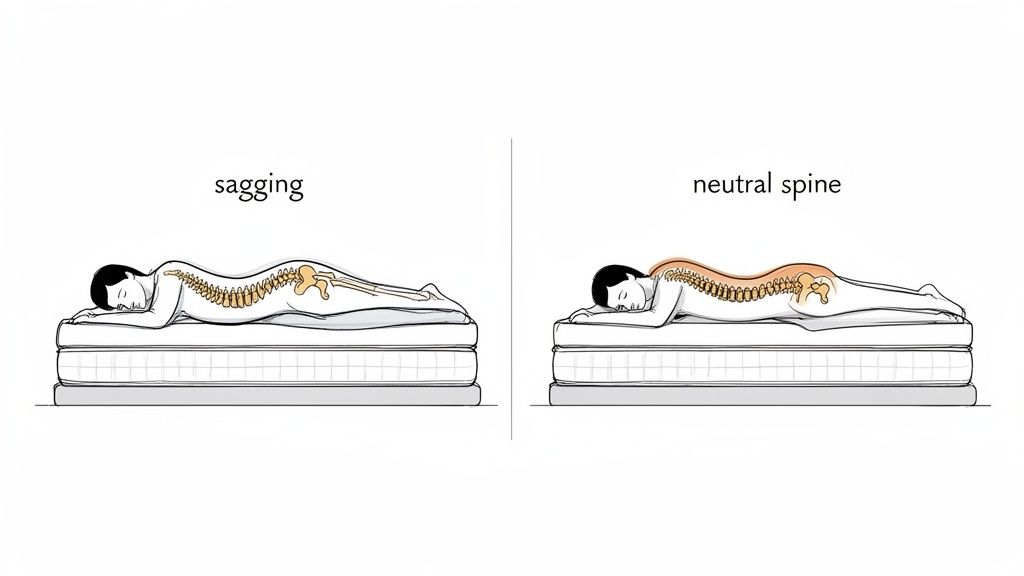
If your hips sink too far, your midsection can droop. If your shoulders can't sink enough, your upper body can get pushed upward. If both happen at once, muscles spend the night bracing instead of relaxing.
A mattress is less like a pillow-top luxury item and more like a support tool. Its job is to hold you in a position your body can tolerate for hours.
What usually confuses shoppers
Many people shop for relief by feel alone. They lie down for a minute, notice whether a bed feels plush or firm, and make a quick judgment. The problem is that comfort in the first 30 seconds and alignment over eight hours aren't always the same thing.
A mattress that feels cozy at first can let the pelvis sink too low. A mattress that feels “supportive” can be too hard under the shoulders and hips.
That's why the rest of this guide focuses on fit, not hype. The goal isn't to tell you that one mattress is universally best. It's to help you recognize what your body needs so you can choose with more confidence.
What Is Proper Spine Alignment While Sleeping
Proper spine alignment means your body stays close to its natural posture while you sleep. Your mattress should support your heavier areas, fill in lighter curves, and prevent twisting.
A simple way to picture it is a garden hose. When the hose lies smoothly, water flows. When it's sharply bent or kinked, flow gets restricted. Your spine works in a similar way. A supported posture gives muscles and joints a chance to rest. A distorted posture can create tension that lingers into the next day.

Back sleeping and the natural S curve
If you sleep on your back, neutral alignment usually means your body keeps a gentle S-shaped curve. Your head shouldn't be shoved forward, and your lower back shouldn't collapse into a deep arch.
A mattress that works well for back sleeping usually does two things at once. It supports the lumbar area and allows the buttocks and shoulders to settle slightly without dropping too far.
Signs of poor alignment for back sleepers include:
- A hammock feeling where your hips dip below your chest
- A flat, board-like sensation under the lower back
- Morning tightness that improves once you start moving
Side sleeping and the straight line test
For side sleepers, the goal is different. Seen from behind, your neck, upper back, and tailbone should stay in a fairly straight line. Your shoulders and hips need enough give to sink in, but your waist still needs support.
Many mattresses fail in this regard. If the surface is too firm, your shoulder gets jammed upward and your spine bows sideways. If it's too soft, your midsection can sag and rotate.
Practical rule: Side sleepers need a mattress that allows pressure relief at the shoulder and hip without letting the torso collapse.
Stomach sleeping is harder on alignment
Stomach sleeping is the toughest position for spine health. It often pushes the lower back into extension and can turn the neck for long stretches.
Some stomach sleepers still prefer it, and real life matters more than ideal advice. If that's you, the main goal is usually keeping the pelvis from sinking too far and avoiding a thick pillow that cranes the neck upward.
A simple way to visualize it
If you were sketching this on paper, you'd draw three silhouettes.
- Back sleeper: a gentle, supported curve
- Side sleeper: a straighter line from neck to tailbone
- Stomach sleeper: the flattest posture possible, with minimal pelvic sink
That image helps when you test beds. You're not asking, “Does this feel fancy?” You're asking, “Does this hold my body in a shape that makes sense?”
How Firmness and Mattress Type Affect Alignment
Shoppers often use “firm” and “supportive” as if they mean the same thing. They don't. Firmness is how a mattress feels at the surface. Support is whether it keeps your spine from sagging or bowing out of position.
That distinction matters because a mattress can feel soft on top and still support you well underneath. It can also feel very firm at first and still create alignment problems if it doesn't let your shoulders or hips settle where they need to.
A 2021 systematic review in PMC found that medium-firm mattresses consistently outperformed very soft or very firm surfaces for comfort, sleep quality, and spinal alignment. That's why “medium-firm” shows up so often in mattress advice. But it's a starting point, not a complete answer.
Why medium firm helps many sleepers
A very soft mattress can let the pelvis sink too low. People often describe this as “hammocking.” A very firm one can push up against the shoulders and hips so strongly that the spine bends away from neutral.
Medium-firm options tend to land in the useful middle. They give enough to contour, but still provide the pushback your body needs.
That doesn't mean every medium-firm mattress feels the same. Construction changes the experience a lot.
What common mattress types tend to do
Here's a simple comparison of how the main constructions usually behave.
| Mattress type | What it often feels like | Alignment strengths | Possible challenge |
|---|---|---|---|
| Innerspring | More lifted, less contouring | Strong surface support, easier movement | Can feel pressure-heavy if comfort layers are thin |
| Memory foam | Close contouring, slower response | Good pressure relief around curves | Some sleepers sink too deeply or feel stuck |
| Latex | Buoyant, responsive, gently contouring | Keeps many sleepers more “on” the bed | Feel can be springier than some people expect |
| Hybrid | Mix of coils and foam or latex | Balances support, contour, and airflow | Quality varies depending on materials and zoning |
The table most shoppers actually need
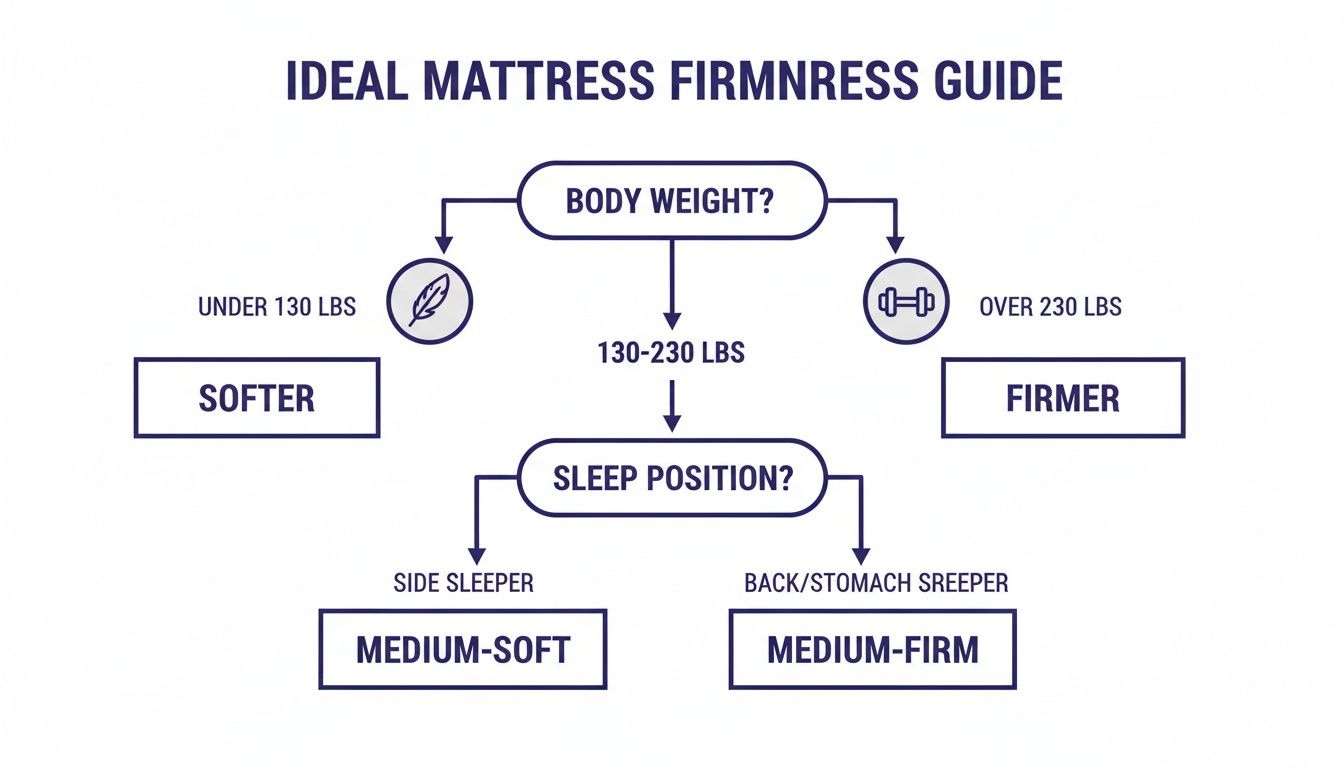
The best mattress for spine alignment usually depends on both sleep position and body weight. A lighter person may not sink enough into a firmer bed. A heavier person may sink too far into the same model.
Mattress Firmness Guide by Sleep Position & Body Weight
| Body Weight / Sleep Position | Side Sleeper | Back Sleeper | Stomach Sleeper |
|---|---|---|---|
| Lighter body weight | Medium to medium-soft | Medium | Medium-firm |
| Average body weight | Medium to medium-firm | Medium-firm | Firm |
| Heavier body weight | Medium-firm with stronger support core | Firm to medium-firm hybrid | Firm with strong midsection support |
This table isn't a strict rulebook. It's a pressure map.
If you're lighter and sleep on your side, a mattress that's too firm may never let your shoulder settle enough. If you're heavier and sleep on your back, a too-soft mattress may let your hips drift downward over the night.
Don't choose firmness by label alone. Choose it by how well the mattress lets your curves settle while still holding up your heavier body parts.
Why hybrids get so much attention
Hybrids are popular in alignment conversations for a simple reason. They often combine a support core of coils with foam or latex comfort layers that relieve pressure. That mix helps many sleepers stay supported without feeling like they're lying on a rigid slab.
That said, a good all-foam or latex mattress can work beautifully for the right person. Construction type doesn't win by itself. The essential question is whether the mattress gives you contour where you need it and resistance where you need it.
Key Mattress Features for Superior Support
A mattress supports your spine through its internal design, not just its firmness label. Two beds can both feel “medium-firm” in a showroom and still guide your body in very different ways overnight.
The easiest way to understand this is to look at how the mattress handles heavier and lighter parts of your body at the same time.

Zoned support and targeted lumbar help
One of the most helpful features for alignment is zoned support. A review from NCOA explains that some mattress designs use firmer material through the center third of the bed to help reduce back strain and support a straighter spinal line.
That center section matters because the hips and lower back often place the most force on the mattress. If the middle of the bed gives way too easily, the pelvis can dip and pull the rest of the spine with it. If the shoulder area is slightly softer while the middle stays steadier, the body has a better chance of settling into a flatter, more natural shape.
You'll see that idea built in a few different ways:
- Zoned coils with firmer support through the center
- Dense foam inserts under the lumbar area
- Center-third reinforcement in hybrid models
- Ergonomic layer designs that give the hips and waist more pushback
This feature is especially useful if your body carries more weight through the midsection or if you switch between back and side sleeping.
Pressure relief should work with support, not against it
Pressure relief and spinal support need to work together. If one is missing, the other cannot do its job well.
Your comfort layers should allow your shoulders and hips to settle in a controlled way, similar to how a well-cushioned running shoe softens impact without letting your foot roll inward. Too little give can create pressure points. Too much give can let the body sag past the point of support.
Material choice changes how that feels. Memory foam usually contours more closely and can help fill in gaps around the waist. Latex tends to feel springier and keeps the body more lifted. In hybrids, the top layers handle cushioning while the coil unit underneath helps hold posture.
A mattress that eases pressure but leaves the waist floating or the hips dipping is only doing part of the job.
Transition layers and support cores do quiet but important work
Shoppers often press on the top of a mattress and stop there. The deeper layers matter just as much.
A transition layer sits between the soft top and the firmer base. Its job is to slow your body's descent so you do not go from plush to hard too abruptly. Without a good transition, a mattress can feel comfortable for a few minutes and still let your alignment drift as the night goes on.
Below that, the support core acts like the foundation of a house. In a foam bed, that usually means high-density base foam. In a hybrid, it usually means coils. A weak core can allow uneven sink, especially under the hips. A stronger core helps the comfort materials do their job without collapsing under the body's heavier zones.
Height and build quality affect how precisely a mattress can support you
A thicker mattress is not automatically better, but very thin models often have less room for separate layers that handle cushioning, transition, and deep support. When those jobs get squeezed into too little space, the mattress has a harder time balancing pressure relief with posture control.
Build quality matters for the same reason. Denser foams, stronger coils, and better layer design tend to hold their shape more reliably over time. That matters for alignment because a mattress only helps your spine if it performs the same way in month twelve as it did in week two.
The same basic idea applies in other sleep categories. Parents comparing safe crib mattress options for infants also have to look beyond surface softness and pay attention to how the product is built for the body using it. Adults need a different design, but the lesson is the same. Structure shapes support.
Adjustable bases can help some sleepers hold a better position
For some people, changing the angle of the body helps more than changing the mattress alone. A slight bend at the knees or a small lift under the upper body can reduce tension through the lower back and make it easier to rest in a more comfortable posture.
This tends to matter most for sleepers who feel strained when lying flat, deal with pressure in the lumbar area, or rest better with gentle elevation. The goal is not to force a new sleeping position. It is to reduce the pull and compression that make one position uncomfortable.
If you are testing mattresses in person, try them both flat and slightly raised. A bed that feels fine in one setup may feel much better in another.
Matching Your Mattress to Your Body and Sleep Style
The biggest mistake in mattress shopping is assuming there's one answer for everyone. There isn't. The best mattress for spine alignment depends on how your body meets the bed.
A side sleeper with broad shoulders has a different problem than a back sleeper with most of their weight through the midsection. A petite sleeper may barely compress a “firm” mattress at all. A heavier sleeper may sink through the top layers of the same bed and interact more with the support core.

Why personal fit beats generic advice
A chiropractic review discussing a systematic review of 39 studies points to an important idea. Customized zonal-elasticity mattresses, with firmer lumbar support and softer areas elsewhere, produced better spinal curvature outcomes than uniform firm or soft designs.
That matches what many people feel in real life. Bodies aren't evenly weighted, and they aren't shaped the same. It makes sense that the best support is often selective rather than uniform.
Common body and sleep patterns
Here are a few examples that can help you identify your own fit.
Side sleeper with wider shoulders or hips
You usually need enough surface give for those areas to settle, or the spine bends sideways. Medium to medium-firm often works better than very firm.Back sleeper with lower back tightness in the morning
Look for support through the lumbar area and enough resistance under the hips to avoid hammocking. A medium-firm hybrid or zoned design often makes sense.Stomach sleeper who wakes up sore through the low back
You may need a firmer feel through the midsection and a lower pillow profile, because too much pelvic sink often drives the problem.Combination sleeper who changes positions often
Responsiveness matters. You want a mattress that can support several positions without trapping you in one shape.
A better way to think about your body
Don't ask only, “What position do I sleep in?”
Ask these questions too:
- Where do I carry more weight? Hips, shoulders, midsection, or evenly?
- Where do I feel pressure first? Shoulder, hip, lower back, neck?
- Do I sleep mostly in one position or rotate through several?
- Do I like a hugged feeling or a floating feeling?
Those answers tell you more than a firmness label ever will.
The right mattress doesn't just match your preference. It matches your pressure points, your proportions, and the way you actually sleep at 2 a.m.
Debunking Common Myths About Mattresses and Spine Health
Mattress marketing has trained a lot of people to think in simple slogans. Spine health usually isn't that simple.
Myth one. Firmer is always better for your back
This is probably the most common myth. People with back pain often buy the hardest bed they can tolerate, hoping it will “support” them.
Sometimes it does the opposite. A too-firm mattress can create pressure at the shoulders and hips and push the spine out of a neutral line. Support isn't about hardness alone. It's about whether the mattress allows the right parts of your body to sink and holds up the parts that shouldn't.
Myth two. The mattress is the only thing affecting alignment
Your pillow matters a lot. For side sleepers especially, the pillow fills the gap between the mattress and the head. If it's too low or too high, your neck can bend out of line even if the mattress underneath you is a good match.
Your sleep position, old injuries, and even your base or foundation can affect the feel too.
Myth three. You should know immediately if a mattress is right
First impressions matter, but they're not perfect. A mattress that feels different from your old one can take some adjustment.
What matters is the pattern over several nights. Are you waking with less strain, or with new pressure points? Do you feel more supported, or more tense?
Myth four. Plush means bad alignment
Plush and unsupportive are not the same thing. Some plush mattresses have strong support cores and thoughtful zoning. Some firmer beds are flat and unforgiving.
The useful question isn't “Is it plush?” It's “Does it keep my spine in a better position while still relieving pressure?”
Your In-Store and At-Home Mattress Testing Checklist
You lie down in a showroom for 30 seconds, the mattress feels pleasant, and you think, “This might be the one.” Then two weeks later, your shoulder is sore or your lower back feels oddly tight.
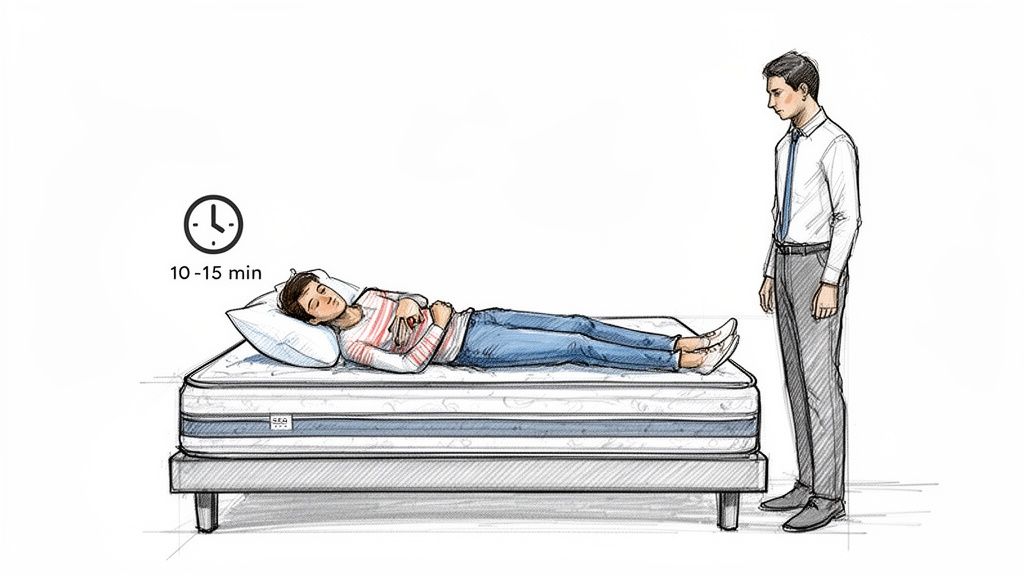
That happens because mattress testing is really body testing. You are checking whether the bed keeps your spine in a steady line for your shape, your usual position, and your pressure points. A quick sit on the edge cannot show that.
Start slow. Give your body time to settle into the surface the way it would after a few minutes of actual sleep.
In store checklist
Use this list to compare mattresses in a way that gives you useful information, not just a first impression:
- Lie down in your main sleep position for several minutes. Side sleepers should let the shoulder and hip settle. Back sleepers should notice whether the lower back feels gently supported instead of floating or being pushed up.
- Use a pillow that matches your real setup as closely as possible. Your mattress and pillow work like two halves of the same support system.
- Notice where your body drops in. Heavier areas such as the hips and torso should sink enough to avoid strain, but not so much that the spine bows.
- Check the spaces that need filling. For back sleepers, pay attention to the curve at the waist. For side sleepers, notice whether the mattress fills the area between the ribs and waist instead of leaving it unsupported.
- Roll into your second-most-common position if you move around at night. A mattress that works only in one posture may not work for your actual sleep habits.
- Pay attention to tension, not just softness. If you feel yourself bracing, holding your shoulders up, or tightening your lower back, your body may be compensating for poor support.
- Ignore labels at first. “Firm,” “plush,” and similar terms matter less than whether the mattress fits your build and sleep style.
A useful test often feels uneventful. That is a good sign. Your body should feel settled, not busy.
Here's a helpful demonstration of what to watch when you test support and comfort:
At home checklist
A home trial is where patterns become clear. One night can be misleading. Several nights in a row usually tell a more honest story.
- Sleep on the mattress consistently instead of switching back and forth between beds.
- Keep your pillow the same at first so you can tell what the mattress itself is doing.
- Track what you feel in the morning. Note lower back stiffness, shoulder pressure, numb arms, hip soreness, or whether you feel more relaxed getting out of bed.
- Pay attention to your usual sleep position. If you keep avoiding it, the mattress may not be supporting you well there.
- Notice whether comfort changes after a few hours. Some beds feel good at first but let the hips sink too much overnight.
- Look for visible sagging or uneven settling if one side starts to feel different from the other.
A simple note in your phone can help. Write down your sleep position, pillow used, and how your back, shoulders, and hips feel each morning. By the end of the trial, you are looking for a trend. Less tension, easier movement, and fewer pressure points usually matter more than whether the mattress felt impressive on day one.
A mattress is doing its job when your body can rest without constantly correcting itself.
If you want hands-on help comparing mattress constructions, support systems, and adjustable base options, Woodstock Furniture & Mattress Outlet is one place where you can test different models in person and ask questions without turning the process into guesswork.