
You're comparing mattresses, and both look comfortably padded. One has a cushion sitting visibly above the mattress; the other looks flatter and more neatly squared at the edges. The labels say pillow top and Euro top, but neither tells you whether your hips will sink too far or whether the bed will hold its shape.
A pillow top has a separate comfort panel stitched onto the surface, while a Euro top keeps its padding beneath the outer cover and flush with the edges. That's the foundational difference. To make a useful mattress pillow top vs Euro top comparison, start with that construction detail, then check the materials and support underneath.
Pillow Top and Euro Top at a Glance
Think of these terms as descriptions of how the mattress is upholstered, not grades of comfort or quality. Giorgi Bros.’ Euro-top guide describes the separate cushioning panel of a pillow top and the integrated, flush finish of a Euro top, while emphasizing that either design can contain foam or fiberfill.
Pillow top and Euro top side by side
| Feature | Pillow Top | Euro Top |
|---|---|---|
| Comfort layer attachment | Separate panel stitched onto the surface | Flush with the edges, beneath the outer cover |
| Profile | Rounded, raised surface | Flatter, squared-off perimeter |
| Initial feel | Usually a deeper cradle and more surface plushness | Often firmer and more uniform near the edges |
| Edge profile | Overhanging edge with less built-in support | Tighter connection to the mattress body |
| Typical added padding | Model-specific; ask for the separate panel's thickness | Model-specific; ask for the integrated padding's thickness |
| Quality indicator | Not implied by the label | Not implied by the label |
What the label leaves out
Neither term identifies the foam type, fiber content, latex, coil system, or material density. You can find a supportive pillow top and a cushioned Euro top because manufacturers can combine these components in different ways.
Padding thickness also needs context. A thick comfort package may provide substantial cushioning, but thickness alone doesn't tell you how quickly it will soften or how well the bed will support your body.
Ask whether the listed thickness describes the decorative quilted panel, the full comfort system, or the entire mattress. Those measurements answer different questions, and comparing unlike measurements can make similar beds look very different on paper.
Shopping rule: Use the top style to understand construction. Use the specifications and your body's response to judge the mattress.
Your priority helps narrow the comparison. If your current bed feels hard against your shoulder, focus on cushioning. If you feel yourself sliding toward the side, prioritize perimeter behavior. If your mattress developed a hollow, investigate materials and warranty definitions rather than choosing a different top label alone.
How the Feel Differs in Nightly Sleep
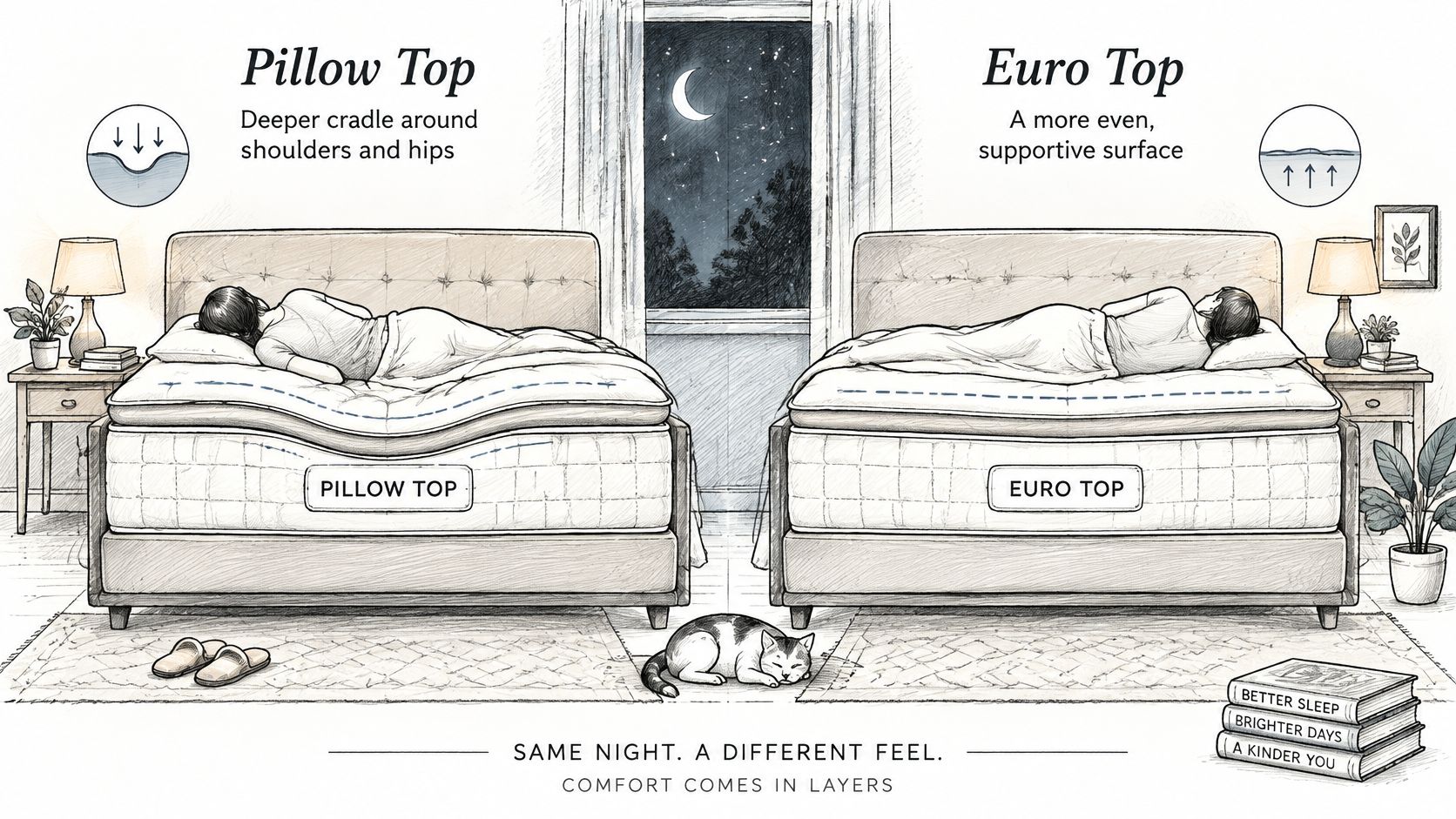
The first sensation you notice is usually how far the surface gives beneath you. A pillow top often lets your shoulders and hips settle into a more pronounced cradle, while a Euro top commonly feels more contained, particularly as you move toward its border.
This illustration shows the difference between the raised comfort panel and the flush construction.
Cushioning and support do different jobs
Cushioning lets the surface conform around your body. Support keeps your heavier areas from sinking farther than is comfortable relative to the rest of you.
The Sleep Foundation's mattress-topper methodology explains the value of layered construction: softer upper materials improve conformity, while denser lower layers help preserve support and adaptability. That's why an inviting surface can work well when the structure beneath it is appropriate for the sleeper.
Say you sleep on your side and your current mattress presses against your hip. A more conforming surface may help distribute that pressure. But if your pelvis sinks into a deep pocket, adding softness hasn't solved the underlying fit problem.
A back sleeper may notice something different. The surface can feel pleasant under the shoulders while allowing the hips to settle too far, so the important question is whether the whole body feels evenly supported.
Test movement, not just softness
Firmness labels aren't standardized across all mattresses. A pillow top labeled firm can feel softer to you than a Euro top labeled medium, especially when their materials and comfort-layer thickness differ.
Use a repeatable showroom routine:
- Start in your usual position. Lie in the center for about five minutes rather than judging the bed while sitting upright.
- Move toward the perimeter. Notice whether your hips and shoulders stay comfortably supported or the surface slopes beneath you.
- Turn over normally. Check whether you can change position without pushing hard against the mattress.
The following video provides another way to visualize the comparison before testing mattresses yourself.
Don't confuse a deep cradle with automatic comfort. Some sleepers enjoy that enclosed feeling; others find it harder to move. A suitable fit should let you rest without persistent pressure and turn without feeling pinned in a hollow.
Durability and How Each Design Wears Over Time
Repeated loading compresses a mattress's comfort materials. With a pillow top, the raised, loftier panel can lose height unevenly in the areas that carry the most weight, even while the support core still feels functional.
That's the wear mechanism to understand before comparing lifespan claims. A mattress can stop feeling comfortable because its upper materials have changed, not because every component has failed.
What the lifespan figures actually mean
Sleep Like the Dead reports that at least 30% of pillow-top owners experience significant sagging or compression within the first three years, compared with approximately 17% of owners of non-pillow-top mattresses. The comparison group is non-pillow-top mattresses generally, not specifically Euro tops, so this isn't a direct Euro-top performance test.
A Tom's Guide comparison gives average lifespan estimates of about eight years for pillow-top mattresses and 10 years for Euro-top mattresses. Treat those figures as broad expectations, not promises about a particular model or your household.
Integrated padding can be more resistant to shifting, but it can still soften or develop impressions. A thick, low-density Euro-top comfort package can wear faster than a thinner pillow top made with more resilient materials.
A longer warranty and a longer comfortable service life aren't the same thing.
Look for the components that carry the load
Ask for foam density where the manufacturer publishes it, along with the material type and thickness of each comfort layer. Density is useful for comparing similar foams, but it isn't a universal firmness rating and shouldn't be compared indiscriminately across different materials.
Sleeper weight, nightly use, permitted rotation, and foundation condition also affect wear. A guest-room mattress faces a different workload from a primary bed used every night.
If you're sorting out material terminology, Protect-A-Bed's guide can help you compare gel foam mattresses. Use that material-level comparison alongside the construction label, rather than treating gel foam as a guarantee of durability.
Recognize early changes
These symptoms are starting points for inspection, not diagnoses. Before assuming the mattress has failed, check its base and document what you're noticing.
Early wear signs and what they usually point to
| Symptom | Often Points To | First Step |
|---|---|---|
| Hollow forming in the middle of the sleep zone | Comfort layer compressing under repeated load | Rotate if the maker allows it, then check how the warranty defines sagging |
| Edge dips when you sit down | Perimeter support weakening | Limit edge sitting and compare edge reinforcement before buying |
| Surface looks lumpy or uneven | Fill shifting or uneven loft | Check how the fill is distributed and follow the maker's care guidance |
| Firm spot on one side | Support core wear or uneven use | Rotate as allowed and confirm whether the core is covered by the warranty |
A firm spot can also be an area that has softened less than its surroundings. Record the location and whether you notice it with the mattress unloaded, while lying down, or both, so you can describe the problem clearly.
Edge Support for Sitting and Sharing a Bed
A comfortable center doesn't guarantee a dependable edge. When you sit down, you concentrate your weight on a smaller area near the border, which tests the mattress differently from lying across its middle.
A Euro top's flush construction can help the surface feel more uniform, while a pillow top's exposed border may compress sooner with repeated sitting. But the upholstery finish isn't the entire edge-support system.
Look beneath the border
The Sleep Foundation's pillow-top and Euro-top comparison explains that perimeter construction can affect stability, while material density, comfort-layer thickness, and the support core remain important. A Euro top isn't immune to edge sag, and an initially firm border doesn't establish how long it will last.
Ask what reinforces the perimeter beneath the cover. Then test the mattress in the ways you'll use it.
- Putting on shoes. Sit where you normally would and notice whether you remain balanced or slide forward as the border compresses.
- Sharing a bed. Have your partner lie beside you while you settle near the side. Check whether you feel secure without moving inward to avoid a slope.
- Using the full surface. Stretch out or change position near the border and notice whether you lose usable space. Families may recognize this problem when a child sleeps sideways and pushes a parent toward the edge.
Run a sit-and-compare test
Sit on the edge for about a minute with your feet on the floor. Have your partner watch how far the border drops and whether the compression stays localized or pulls a wider area downward.
Then lie across the middle and compare the support. A plush surface may compress considerably while seated yet feel stable while you're lying down, so neither test should replace the other.
Judge the edge in the position you'll use, not by pressing it with your hand.
For an adjustable base, ask whether the exact mattress model is approved for that use. Flexibility, fit, and warranty requirements are model-specific, regardless of the top style.
Edge support deserves particular attention if you sit on the bed daily or sleep close to the perimeter. If you rarely do either, it may reasonably rank below pressure relief and ease of movement.
How to Care for a Pillow Top or Euro Top
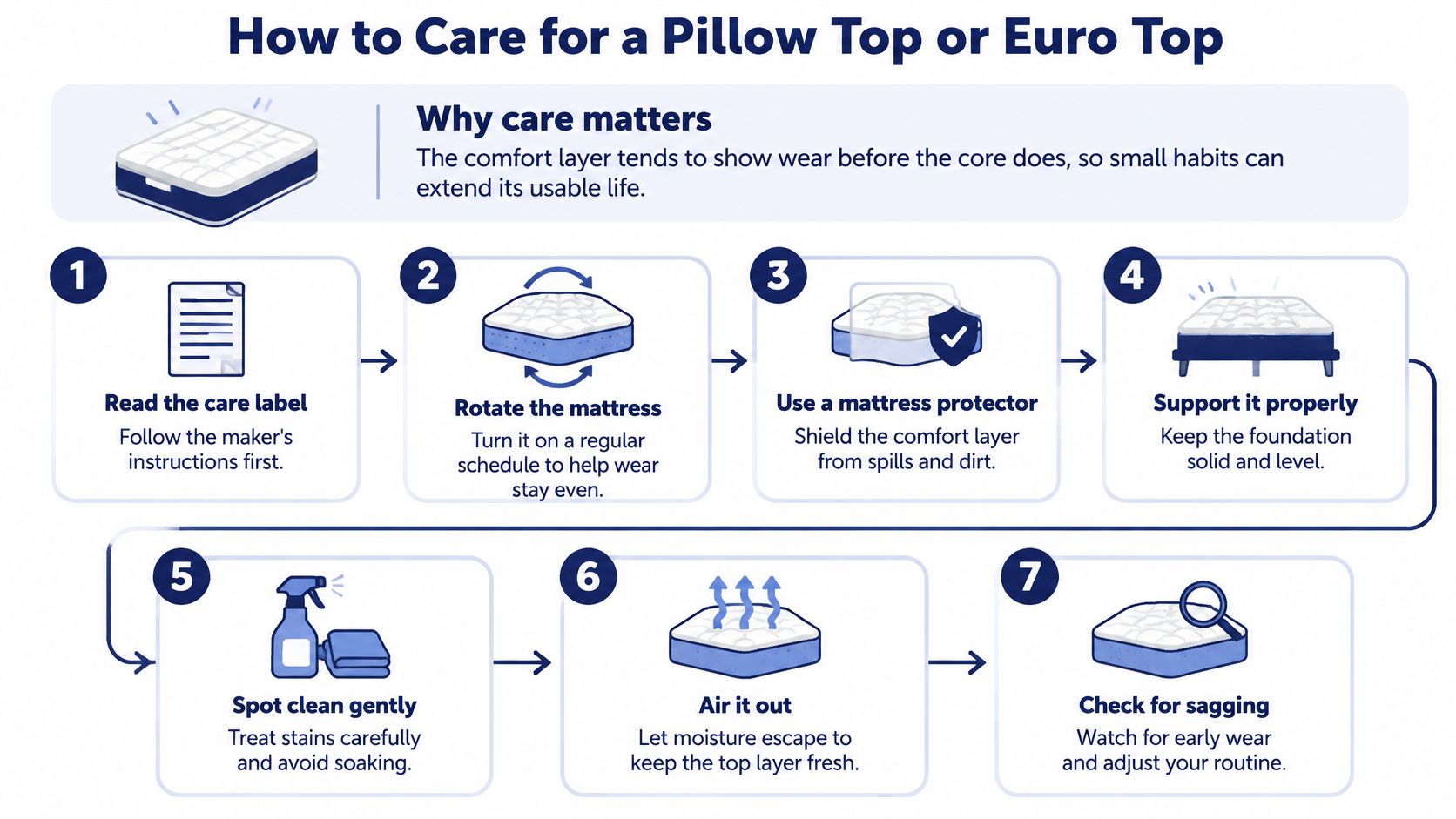
The comfort layer often shows wear before the core does. Small habits can help preserve its usable condition, although care can't make unsuitable materials perform like a different mattress.
A practical care routine
- Read the care label first. Follow the manufacturer's instructions on rotation and flipping, and rotate only if the model allows it; don't assume a padded mattress can be flipped.
- Use a breathable, snug-fitting mattress protector to limit exposure to spills, perspiration, and surface friction. Choose a pocket depth that fits without pulling the padded top tightly out of shape.
- Change where you sit. Avoid loading the same edge repeatedly; use a chair for dressing or shift your sitting position when practical.
- Vacuum the surface with a clean upholstery attachment, then spot clean gently with a mild soap solution if the care instructions permit it. Apply moisture sparingly to a cloth, avoid soaking the padding, and let the area dry fully before remaking the bed.
- Air the bed regularly. Leave the covers back for a few minutes each week to let moisture escape, and keep the mattress away from damp floors.
- Check that the foundation is supportive and level. Inspect slats, center supports, and frame connections against the mattress maker's requirements, because an uneven base can contribute to uneven compression.
The visual checklist below summarizes the main habits, with the manufacturer's care instructions taking priority over any general routine.
Separate cleaning from replacement decisions
Clean bedding and a clean mattress aren't the same as a supportive sleep surface. The SleepHabits bedding replacement recommendations can help you review bedding maintenance separately from changes in the mattress itself.
Check for visible impressions when changing the sheets, and note whether your usual sleeping area feels different. Care may slow wear, but it can't restore padding that has permanently compressed or repair a weakened support core.
Which Design Fits Your Sleep and What to Check Before You Buy
A pillow top is a sensible starting point if you want pronounced surface cushioning, mostly sleep on your side or back, and don't use the edge much. A Euro top is worth trying if you share the bed, sit along the border frequently, or prefer a flatter, more consistent surface.
Neither is a verdict. Your body, the comfort materials, and the support system determine whether that starting point becomes a suitable choice.
Sleeper profiles and the design that often fits
| Sleeper Profile | Often a Better Fit | Why It Matters |
|---|---|---|
| Side sleepers wanting hip and shoulder cushioning | Pillow top | Deeper cradle can relieve pressure points |
| Back sleepers wanting steady, even support | Either, compare the core | Support relies more on core and density than on the top style |
| Couples who share the edge or move often | Euro top | Flush perimeter can give a more uniform surface |
| Frequent edge sitters | Euro top | Edge tends to feel steadier under repeated sitting |
| Heavier sleepers | Either, compare density and core | Long-term support relies on the foundation and core |
| Guest rooms and occasional use | Either, match to use and budget | Lower daily load reduces wear demands |
| Adjustable base users | Check the model's rating | Flex and fit are manufacturer-specific |
Match the household, not just the sleeper label
Use the row that describes your most common sleeping position, then consider how else you use the bed. A couple with a side sleeper and a partner who sits on the edge daily needs both cushioning and perimeter stability.
Don't assume that choosing a compromise firmness will address both needs. Test together, including normal turning and getting in and out, because the mattress responds to your combined use.
For a guest room, a highly specialized feel may be less practical than a balanced surface that accommodates different visitors. For a heavier sleeper, ask which materials prevent excessive settling rather than assuming that a firm-feeling cover provides sufficient underlying support.
Follow a showroom testing order
Start with your body before looking closely at the specification sheet. That keeps appealing terminology from overriding an uncomfortable result.
- Lie in the center, then near the perimeter. Use your normal sleeping position and pillow height, and pay attention to pressure, pelvic settling, and ease of turning.
- Sit along the border. Compare stability, not just how soft the upholstery feels under your legs.
- Ask for the material specifications. Request foam density where available, the type of fill, and whether the comfort system includes memory foam, other polyurethane foam, latex, or fiber.
- Compare thickness and core details. Ask which layers provide cushioning and which components provide deeper support.
- Confirm the base requirements. Identify the approved foundation or adjustable base before deciding whether your existing setup is suitable.
If a specification isn't available, acknowledge the uncertainty. A salesperson's description of a mattress as supportive or durable isn't a substitute for a published construction detail.
Understand what testing can establish
Laboratory testing gives you a more concrete question to ask than whether a mattress is built to last. It can measure changes in height, firmness, and edge condition after repeated loading.
Mattress Nut's summary of ASTM F1566 testing describes 30,000 single-pass cycles, intended to approximate roughly 10 years of use for two 230-pound sleepers sleeping eight hours per night, and lists acceptance limits of no more than 0.75 inches of height loss and no more than a 15% change in firmness. Those are laboratory test figures, not a guaranteed household lifespan or a promise that every mattress has passed that protocol.
Ask whether testing applies to the exact model you're considering and what results the manufacturer publishes. Don't assume a general reference to durability testing establishes the performance of a different mattress.
Read the warranty before deciding
Find the warranty's definition of measurable sagging and how the manufacturer requires it to be measured. Ask whether softening without a visible unloaded indentation is covered, and check the foundation, staining, and documentation requirements.
Keep warranty coverage separate from the return or comfort-exchange policy. A mattress can feel wrong for your body without having a manufacturing defect, so you need to understand both policies before bringing it home.
Final decision: Choose the mattress that passes your comfort and support checks, then use its specifications and policies to judge the uncertainty you're accepting.
If neither style feels right, don't force the choice. A mattress without either padded-top construction may better suit your preference; the purpose of comparing labels is to narrow the search, not restrict it.
Woodstock Furniture & Mattress Outlet offers mattresses, foundations, adjustable bases, and sleep accessories, along with hands-on help comparing how they work together. Visit Woodstock Furniture & Mattress Outlet to try pillow-top and Euro-top options in person and discuss the materials, edge behavior, and support that matter for your sleep.