Tag: mattress comparison

  • A Guide to Top Memory Foam Mattress Brands

    A Guide to Top Memory Foam Mattress Brands

    When you start shopping for a memory foam mattress, you’ll quickly discover that the “right” choice really boils down to your own sleep needs, whether that’s pressure relief, motion isolation, or something else entirely. Well-known brands like Tempur-Pedic have a reputation for deep, contouring support, while others like Nectar aim to strike a balance between comfort and value. The key is knowing how modern foam technology has evolved to solve common sleep problems.

    Why Has Modern Memory Foam Become So Popular?

    Before comparing brands, it helps to understand why memory foam has gained such traction. This material was originally developed for NASA, but it’s come a long, long way from its early days. Today’s memory foam is an advanced sleep surface engineered to solve the specific issues that can disrupt a good night’s rest.

    And people are definitely taking notice. The memory foam mattress market is expected to reach $8.58 billion by 2029, growing at a solid 8.3% each year. This growth shows a significant shift toward better sleep solutions as more people realize just how critical good sleep is for their health.

    The Core Benefits That Address Common Sleep Issues

    At its heart, memory foam delivers three key advantages that many traditional mattresses don't offer:

    • Significant Pressure Relief: Memory foam is viscoelastic. In plain English, that means it softens and molds to your body using your own heat and weight. This allows it to contour to your shape, distributing your weight out and easing pressure on sensitive spots like your hips, shoulders, and lower back.
    • Effective Motion Isolation: If you share a bed, you know the challenge. A partner's tossing and turning can interrupt your sleep. Memory foam is a game-changer here because it absorbs movement right where it happens. When one person moves, that motion doesn't travel across the mattress, letting light sleepers get more consistent rest.
    • Body-Hugging Support: By conforming to your body’s natural curves, memory foam helps keep your spine in proper alignment. Instead of your body fighting against a stiff, unyielding surface, the mattress works with you, providing support exactly where you need it.

    Getting Past the Old "Sleeping Hot" Concern

    We've all heard it: early memory foam mattresses had a reputation for trapping heat. It’s a fair point based on past technology, but today’s leading brands have engineered this problem away.

    Modern foams are built from the ground up with breathability in mind. Innovations like open-cell structures, which create tiny airways inside the foam, and cooling gel infusions actively pull heat away from your body. The result is a much more temperature-neutral sleep experience.

    These advancements mean you get all the pressure-relieving benefits without the overheating issues of the past. To really get a handle on how far the technology has come, checking out a good memory foam mattress guide covering comfort, types, and tips can be a huge help.

    Understanding these basics is the first step toward finding a mattress that truly fits your life, instead of just responding to marketing hype. By focusing on the problems you’re trying to solve—whether it’s achy joints or a restless partner—you can make a much more informed decision about which brand is the right long-term choice for your well-being.

    Comparing Leading Memory Foam Mattress Brands

    Trying to navigate the world of memory foam can feel a little overwhelming. Let's be honest, every brand promises a great night's sleep. The real key is to look past the marketing and focus on how a brand’s design, materials, and overall feel match up with what you actually need. It's less about finding a single "best" brand and more about finding the one that solves your specific sleep problems.

    A big part of that process is just understanding how memory foam stacks up against other popular choices. If you're still weighing your options, our guide on Latex vs. Memory Foam vs. Hybrid: Which Mattress is Actually Right for You is a great place to get a clearer picture of the whole landscape.

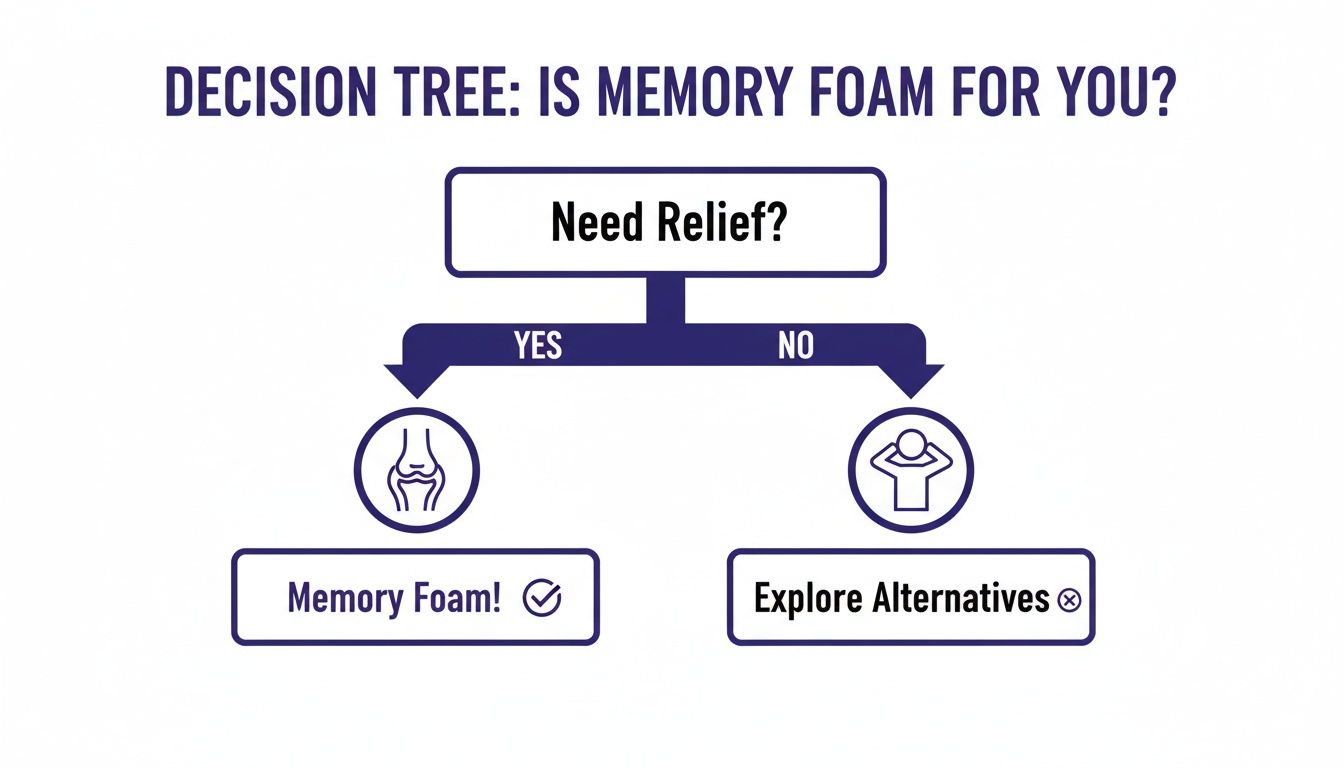
    For many shoppers, the decision really boils down to one question. This infographic can help you figure out if memory foam's signature benefits are what you're looking for.

    A decision tree flowchart titled 'Is Memory Foam For You?', suggesting it for relief.

    As you can see, if pressure relief is at the top of your list, memory foam is an excellent place to start your search. But not all foams are created equal. Let’s take a look at a few of the top brands to see how they each approach that core benefit.

    At-a-Glance Comparison of Well-Known Memory Foam Brands

    Here's a quick side-by-side look at some of the key features that set these popular brands apart. This should help you get a feel for their distinct approaches and who they're really built for.

    Brand Primary Feel and Response Key Cooling Technology A Good Fit for Sleepers Who… General Price Point
    Tempur-Pedic Deep, slow-sinking contouring; a classic "hug" Phase Change Material (PCM) in covers, open-cell structure Prioritize maximum pressure relief, have chronic pain, and are looking for a long-term investment. Premium
    Nectar Balanced, medium-firm hug; moderate response Gel-infused memory foam, breathable cover Want a versatile feel, value a long trial period, and seek a balance of quality and cost. Mid-Range
    DreamCloud Gentle contouring with responsive support from coils Gel-infused foam paired with airflow from the coil base Prefer a bit of bounce, worry about sleeping hot, or need strong edge support. Mid-to-Upper
    Sierra Sleep Traditional memory foam feel; straightforward comfort Varies by model, often relies on basic gel infusions or ventilated foam Are budget-conscious, furnishing a guest room, or need a reliable, no-frills option. Entry-Level

    Think of this table as your starting point. Now, let’s dig a little deeper into what makes each of these brands tick.

    Tempur-Pedic: The Pioneer in Deep Contouring

    Tempur-Pedic is a name most people recognize, and for good reason—they helped define the category. Their proprietary TEMPUR-Material™ delivers a very distinct, slow-sinking feel that provides a deep level of body-contouring. This is that signature "hug" that's designed to relieve as much pressure as possible.

    This brand is a good fit for sleepers who trust proven material science and are looking for a mattress that will last. The dense, high-quality foam is engineered to hold up for years without significant sagging or loss of support. That investment in R&D and durable materials means it comes with a higher price tag.

    Who is Tempur-Pedic a good fit for? Sleepers dealing with chronic pain or joint discomfort who need a high degree of pressure relief and are looking for a long-term mattress investment.

    The brand's market influence is significant. Tempur Sealy is a major player, and the regional mattress sector is growing at a 7% CAGR through 2030. What started as research at NASA has evolved into Tempur-Pedic's material, which now accounts for over 20% of premium sales in the $14.7 billion U.S. foam mattress market as of 2024.

    Nectar: Balancing Comfort and Value

    Nectar has carved out a space for itself by offering a quality memory foam experience that’s more accessible. Their mattresses usually feature several layers of gel-infused memory foam, aiming for that sweet spot of contouring support and effective temperature regulation.

    The feel is often described as a medium-firm, balanced hug. It contours to your body but doesn't have that super deep, slow-sinking sensation you get from some other brands. This makes it a really versatile choice that works well for a lot of different sleep positions and preferences.

    • Generous Trial Period: One of Nectar's notable features is its year-long home trial. That gives you more than enough time to be absolutely sure it's the right mattress for you.
    • Motion Isolation: Like most memory foam, Nectar is great at absorbing movement, making it a solid choice if you share the bed with a partner.

    Who is Nectar a good fit for? Shoppers who want the pressure-relieving benefits of memory foam, a generous trial period to reduce purchase risk, and a strong balance of quality and affordability.

    DreamCloud: A Hybrid Approach with Foam on Top

    While we often group it with foam mattresses, DreamCloud is technically a hybrid. It combines memory foam comfort layers on top of an innerspring coil base. This construction gives it a unique feel that blends the benefits of both worlds—you get the pressure relief of foam with the responsive support and airflow from the coils.

    This design makes it a great pick for anyone who’s new to memory foam or worries about feeling "stuck." The pocketed coils provide a subtle bounce and much sturdier edge support, which makes it easier to move around and get in and out of bed. The foam layers up top still deliver that body-contouring comfort you need for pressure relief.

    Who is DreamCloud a good fit for? Sleepers who want the pressure-relieving benefits of foam but prefer a more responsive feel with enhanced airflow and stronger edge support.

    Sierra Sleep by Ashley: An Accessible Entry Point

    Sierra Sleep by Ashley offers a straightforward and very accessible entry into the world of memory foam. These mattresses are designed with simplicity and value in mind, making them a very practical choice for guest rooms, kids' rooms, or anyone on a tighter budget.

    They might not have the complex, multi-layer designs or advanced cooling technologies of the premium brands, but they deliver the core benefits of memory foam—pressure relief and motion isolation—in a reliable package. This makes them a good starting point if you're curious about memory foam but don't want to make a large initial investment.

    Who is Sierra Sleep by Ashley a good fit for? Budget-conscious shoppers, individuals furnishing a first home or guest room, and those looking for a dependable memory foam mattress without premium features.

    At the end of the day, the most suitable brand is the one that lines up with your priorities, whether that’s premium materials, a balanced feel, hybrid responsiveness, or accessible value. There's no substitute for trying them out, so stopping by a showroom to feel the differences in person can be the most valuable step you take in making a confident decision.

    How to Match a Mattress to Your Sleep Style

    Finding the right mattress isn't about chasing the "best" one on the market. It's about finding the one that actually solves your unique sleep problems. How you sleep—whether you're a side, back, or stomach sleeper—completely changes what your body needs from a memory foam mattress. A surface that feels like a dream for a back sleeper might lead to aches and pains for someone who sleeps on their side.

    This is the key to investing in your rest with confidence. It’s less about the brand name and more about how the foam is built and how it interacts with your body. Once you figure out your sleep style and your main complaints, you can zero in on mattresses designed to give you the right kind of support and relief, night after night.

    For the Side Sleeper, Pressure Relief Is Paramount

    Most people are side sleepers, but that position also puts your entire body weight squarely on your shoulders and hips. If a mattress is too firm, it’ll push right back against those joints, leading to soreness, numbness, and a crooked spine.

    This is where memory foam really shines for side sleepers. Its signature contouring allows those pressure points to sink in just the right amount. That cradling effect helps keep your spine straight all the way from your neck to your pelvis, which is the secret to avoiding lower back pain.

    If you’re a side sleeper looking at memory foam, here’s what to look for:

    • Medium-Soft to Medium Firmness: This range usually gives you the right balance of cushion and support, without letting your hips sag out of alignment.
    • Thicker Comfort Layers: You want a mattress with at least 3 to 4 inches of memory foam up top. That’s what provides the deep, effective pressure relief you need.

    For the Back Sleeper, It's All About Spinal Alignment

    Back sleepers already have a head start, since it's the easiest position for maintaining a neutral spine. The wrong mattress, however, can disrupt that in a hurry. If your memory foam bed is too soft, your hips will sink lower than your shoulders, creating a hammock effect that leads to a stiff, painful back.

    On the flip side, a mattress that’s too firm won’t support the natural curve of your lower back, leaving a gap that strains your muscles. You’re looking for a surface that molds just enough to fill that gap while keeping your spine level.

    A medium-firm to firm memory foam mattress is almost always a good choice for back sleepers. It gives you just enough contouring for lumbar support while being sturdy enough to keep your hips elevated and aligned.

    For the Stomach Sleeper, Firm Support Prevents Strain

    Sleeping on your stomach can be tough on your spine. It can force your neck into an awkward position and cause your midsection to sink, arching your back unnaturally. Because of this, stomach sleepers need a firmer sleep surface than anyone else.

    A firm memory foam mattress is critical here. It stops the hips from dipping too low, which is the main culprit behind lower back pain for stomach sleepers. While memory foam is known for that "sinking" feeling, firmer, higher-density foams provide support with just a hint of contouring, keeping the spine as neutral as possible.

    You’ll want to look for mattresses specifically labeled as "firm" or those with a thinner comfort layer on top of a very dense support core. This design gives you a solid, supportive surface that won't let you sink in too deep.

    Solving Other Common Sleep Problems

    Beyond your go-to sleep position, memory foam has features that can tackle other common issues:

    • If you struggle with back pain: Look for zoned support systems. Some mattresses are engineered with firmer foam in the center third to give your lumbar and hip areas extra lift, promoting better alignment.
    • If you share the bed: This is an easy one. All memory foam excels at motion isolation. If your partner’s tossing and turning constantly wakes you up, pretty much any quality memory foam mattress will be a massive improvement over a bouncy innerspring.
    • If you sleep hot: Make cooling technologies your top priority. Look for open-cell foams that improve airflow, gel or copper infusions that pull heat away from your body, and breathable covers made from phase-change materials.

    At the end of the day, there's no substitute for trying a mattress out in person. Visiting a showroom lets you feel the subtle differences between foam densities and firmness levels firsthand, making sure you find the perfect match for your sleep style.

    What's Actually Inside Your Mattress? A Look at Materials & Certifications

    Knowing what’s inside your mattress goes way beyond just comfort—it’s about peace of mind. As shoppers get savvier, we're seeing more and more questions about materials, safety, and where everything comes from. It's a good thing. Understanding a few key certifications and material choices helps you cut through the marketing fluff and pick a mattress from a brand that actually values quality and transparency.

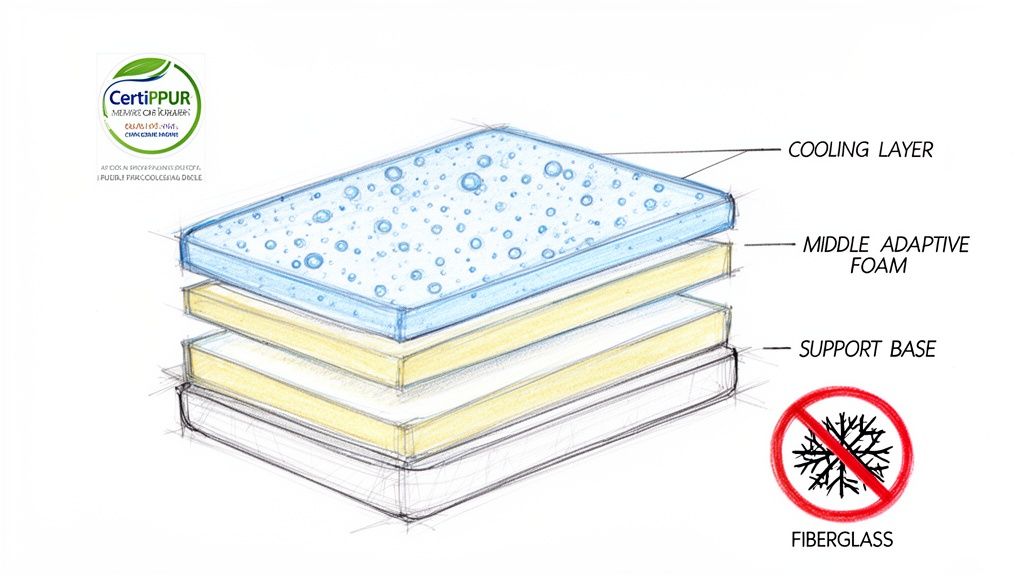
    Exploded view of mattress layers: cooling, middle adaptive foam, support base, CertiPUR-US certified, no fiberglass.

    When you see a memory foam mattress with a CertiPUR-US® certification, it means the foam has passed rigorous, independent tests for content, emissions, and durability. This isn't a marketing gimmick; it's a not-for-profit program that ensures the foam is made without a list of specific harmful chemicals.

    So, What Does CertiPUR-US Certification Really Mean?

    Think of this certification as a clear checklist of what is—and isn't—in your mattress foam. It’s a straightforward way to confirm that the materials were made with your health and the environment in mind.

    A CertiPUR-US seal confirms the foam is:

    • Made without ozone depleters
    • Made without PBDEs, TDCPP, or TCEP flame retardants
    • Made without mercury, lead, and other heavy metals
    • Made without formaldehyde
    • Made without phthalates regulated by the Consumer Product Safety Commission
    • Low in Volatile Organic Compound (VOC) emissions for better indoor air quality (less than 0.5 parts per million)

    Basically, this seal helps you trust that the foam you’re sleeping on every night is contributing to a healthier home.

    The Big Shift Away from Fiberglass

    Another important consideration is the fire retardant used in a mattress. For years, some manufacturers used fiberglass—an inexpensive and effective flame barrier woven into the inner cover of the mattress. The problem? If that outer cover gets removed or damaged, those tiny glass fibers can escape and contaminate your home, leading to skin irritation and respiratory issues.

    Thanks to growing consumer awareness and real safety concerns, shoppers are now actively looking for fiberglass-free mattresses. Reputable brands have listened and are switching to alternative fire-retardant solutions that don't carry the same risks.

    This shift has reshaped the market. The demand for fiberglass-free memory foam has pushed brands like Nectar and DreamCloud to innovate with safer options like wool or specially woven fabric barriers.

    Nectar, which launched back in 2016, has sold over 1 million mattresses by 2025 and holds a 4.7/5 star rating from over 365,000 reviews. A huge part of that success comes from their commitment to CertiPUR-US certified foams that are free of harmful chemicals. You can dig deeper into how the market is changing in a 2025 mattress market analysis on nextmsc.com.

    Choosing a brand that is open about its materials and proud of its certifications is one of the most reliable signs of quality. It shows they’re committed not just to your comfort, but to your long-term health. When you're shopping, don't ever hesitate to ask about these details—it’s one of the most important things you can do to make a purchase you feel great about.

    The Value of Trying a Mattress In Person

    Online reviews and detailed brand comparisons are a fantastic starting point for your research, but they can only take you so far. Comfort is deeply personal, and the subtle differences between memory foam mattress brands are nearly impossible to grasp through a screen.

    What feels like a supportive "hug" to one person might feel way too firm to another. This is exactly why trying a mattress in person remains an invaluable step in the process. A product description can tell you all about foam density and cooling technologies, but it can't tell you how a mattress will actually feel under the unique pressure points of your body.

    What an In-Person Test Can Truly Reveal

    Spending just 10 to 15 minutes lying on a mattress in your favorite sleeping position can provide more clarity than hours of scrolling online. This quick test helps you assess several key factors that are purely subjective and can't be measured by specs alone.

    During an in-store test, you can:

    • Feel the Response Time: How quickly or slowly does the foam adapt when you move? Do you prefer that classic, slow-sinking contour, or a more responsive surface that makes it easier to change positions in the middle of the night?
    • Evaluate the Real Firmness: A "medium-firm" rating can feel drastically different from one brand to the next. Lying down is the only way to know if a manufacturer's firmness level truly matches your body's need for both support and pressure relief.
    • Check the Edge Support: Sit on the edge of the bed. Does it hold up well, or does it collapse? Strong edge support is critical for stability when you're getting in and out of bed and for making sure you can use the entire mattress surface without feeling like you'll roll off.

    The Advantage of Expert Guidance

    Another benefit of visiting a showroom is getting access to knowledgeable, experienced professionals. Instead of navigating endless product pages and marketing claims by yourself, you can have a real conversation with someone who understands the nuances between different models and brands.

    An experienced sleep expert can act as your personal guide, helping connect your specific sleep challenges—like nagging back pain or sleeping hot—to the exact mattress features designed to solve them. This personalized guidance helps ensure you're not just buying a popular mattress, but the right mattress for you.

    They can help you compare different models side-by-side in real time, answering your questions on the spot and pointing out differences you might not have noticed on your own. This interactive experience takes a ton of the guesswork and uncertainty out of the buying process.

    Making a confident, long-term investment in your sleep quality is just plain easier when you've had the chance to feel the difference firsthand. We invite you to visit one of our North Georgia showrooms to lie down on these options for yourself. Feeling how each mattress supports you is the best way to ensure your final choice is a perfect match for years of restful sleep.

    Still Have Questions About Memory Foam?

    Even after digging into the specifics of different brands, you might have a few questions rattling around. That's perfectly normal. To clear things up, we've put together some straightforward answers to the questions we hear most often from shoppers. Our goal is to give you the practical info you need to feel great about your choice.

    How Long Does a Quality Memory Foam Mattress Typically Last?

    A well-made memory foam mattress is an investment in your sleep, and you can expect it to last anywhere from 7 to 15 years. The actual lifespan really comes down to a few things: the density of the foam, the quality of all the materials, and how you take care of it.

    Higher-density foams, like the kind you'll find in brands such as Tempur-Pedic, are engineered from the ground up for durability. They’re designed to resist sagging and keep their supportive feel for years, which is why you’ll often see them backed by long-term warranties.

    To get the most life out of any foam mattress, though, you've got to use a proper foundation. A solid, supportive base is non-negotiable—it prevents premature wear and helps the mattress do its job. Also, one of the easiest and most effective things you can do is use a mattress protector to shield it from spills and allergens.

    Do Modern Memory Foam Mattresses Sleep Hot?

    This is probably one of the biggest myths we have to bust, and it's a reputation that comes from the old, first-generation memory foams. While it's true that early versions of the material had a tendency to trap body heat, today's mattress technology has largely solved that problem.

    The top brands now build in all sorts of advanced cooling features to keep you from overheating. These aren't just gimmicks; they really work. Look for things like:

    • Open-Cell Foam Structures: Unlike the dense foams of the past, modern open-cell designs have millions of tiny, interconnected air pockets. This lets air actually circulate through the mattress instead of getting trapped.
    • Gel Infusions: You'll often see swirls or little beads of cooling gel mixed right into the foam layers. This gel actively absorbs heat and pulls it away from your body.
    • Breathable Covers: Many mattress covers are now made with high-tech fabrics, some with phase-change materials woven in, that feel cool when you touch them and help wick away moisture.

    If you know you're a hot sleeper, just make a point to look for these specific technologies when you shop. They make a huge difference in keeping you comfortable all night.

    Can I Use a Memory Foam Mattress on an Adjustable Base?

    Absolutely. In fact, most modern memory foam mattresses are well-suited for adjustable bed bases. Their flexible construction lets them bend and contour along with the base's movements without causing damage to the foam or the support core.

    This pairing is an amazing way to dial in your comfort and even tackle specific issues like snoring or acid reflux by elevating your head. Raising your feet can also do wonders for circulation and easing lower back pressure.

    It never hurts to double-check the manufacturer's recommendations just to be sure, but you’ll find that the vast majority of today's memory foam models are a great match for an adjustable frame.

    Is There a Break-In Period for a New Memory Foam Mattress?

    Yes, you should definitely expect a break-in period for a new memory foam mattress. It's a completely normal part of the process and can take anywhere from 30 to 90 days. During this time, the foam cells, which have been compressed in a box for shipping, need a little time to fully open up and start adapting to your body's weight and shape.

    Your new mattress might feel a bit firmer at first than the one you tested in the showroom. Just give it time. Sleeping on it consistently is the key to helping it soften and reach its intended comfort level. This is exactly why so many brands and retailers offer long in-home sleep trials—they want you to have plenty of time for the mattress and your body to get properly acquainted.


    At Woodstock Furniture & Mattress Outlet, our sleep experts are here to answer any other questions you have and let you feel the differences between these brands for yourself. Swing by one of our North Georgia showrooms to find the memory foam mattress that’s the right fit for your sleep style. Or, explore our full mattress collection online to get started.

  • Memory Foam vs Hybrid Mattress: A Complete Comparison

    Memory Foam vs Hybrid Mattress: A Complete Comparison

    When it comes down to it, the choice boils down to this: a memory foam mattress is all about deep, body-hugging contour and superior motion isolation, giving you a sink-in feel with minimal bounce. On the other hand, a hybrid mattress brings together coils and foam for a responsive, breathable, and supportive bed that has a little bit of spring to it. The right one for you depends on whether you prefer to be cradled by your mattress or want a more balanced, cooler sleep.

    Memory Foam vs Hybrid Mattresses: A Quick Guide

    Shopping for a new mattress can feel overwhelming, but a helpful place to start is understanding the real differences between the two most popular choices out there—memory foam and hybrid. Each is built with a different sleep philosophy in mind, which results in a distinct feel, unique performance, and benefits for different kinds of sleepers.

    The goal isn't to find a single "best" mattress, because that doesn't exist. It's about finding the mattress that solves your specific sleep problems. We're here to cut through the marketing fluff and give you straightforward information on how they're built, how they feel, and who they're really for.

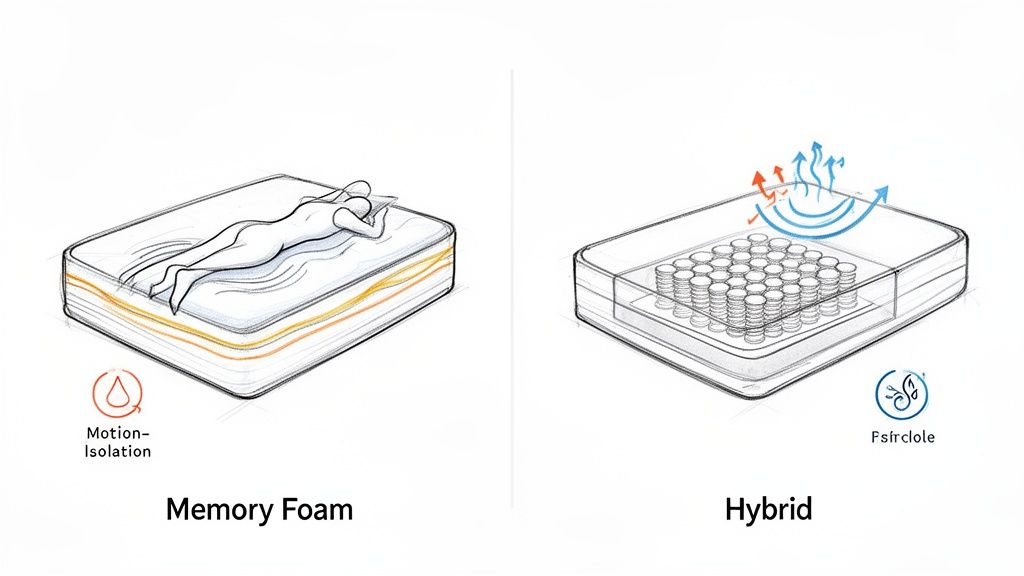
    Illustrations comparing memory foam mattress motion isolation with hybrid mattress breathability and support features.

    To kick things off, let's break down the key differences you'll notice right away.

    Key Differences at a Glance

    For those who just want the highlights, this table gives you a quick snapshot of what sets these two mattress types apart. It’s a great starting point before we dive deeper into what these features actually mean for your sleep.

    Feature Memory Foam Mattress Hybrid Mattress
    Feel Deep contouring, body-hugging, slow response Balanced, gentle contouring with some bounce
    Support System High-density polyfoam core Pocketed innerspring coil system
    Motion Isolation Excellent; absorbs nearly all movement Good; coils may transfer minor motion
    Temperature Can retain heat; look for cooling features More breathable due to airflow through coils
    Edge Support Fair to good; edges can compress Very good to excellent; reinforced perimeter
    Durability Typically 6-8 years Typically 8-10+ years

    As you can see, the core construction really dictates how each mattress performs. Now, let’s get into the details of what these differences feel like in the real world.

    What’s Inside a Memory Foam Mattress? A Closer Look

    To really understand the memory foam vs hybrid mattress debate, we need to look at what’s inside, starting with memory foam. At its heart, a memory foam mattress is made entirely of different foam layers, with each one doing a specific job to create that classic body-hugging feel. The construction is a bit simpler than a hybrid's, but the real story is in the details of these layers.

    The star of the show is viscoelastic foam, a material engineered to respond to both your body's pressure and its heat. When you lie down, your natural body warmth softens the foam, letting it slowly contour to your exact shape. This is what creates that deep, cradling sensation memory foam is famous for, and it’s excellent for pressure relief because it distributes your weight evenly.

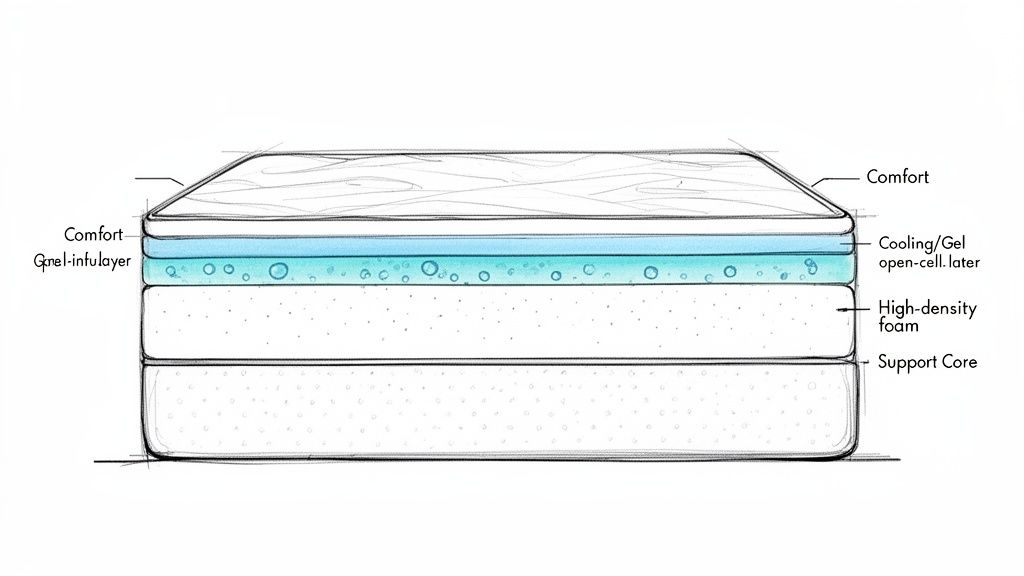
    Underneath those top comfort layers, you’ll find a sturdy base made of high-density polyurethane foam. This core layer is much firmer, giving the mattress its structure, stability, and long-term durability. It’s the unsung hero that keeps you from sinking in too far and makes sure the mattress holds its shape for years to come.

    Detailed cross-section diagram illustrating the various comfort, cooling gel, high-density foam, and support layers of a mattress.

    Foam Density & Type: What It Means for Your Sleep

    Not all memory foam is the same. The density and the specific type of foam used in those top comfort layers will drastically change how a mattress feels, performs, and how long it lasts. Knowing a little about these factors can help you understand mattress specifications more clearly.

    Foam density is a key indicator of quality and durability, measured in pounds per cubic foot (PCF). Here’s a quick breakdown:

    • Low-Density Foam (Under 3.5 PCF): This foam feels on the softer side and bounces back pretty quickly when you move. The trade-off is that it might not be as durable and could offer less support in the long run.
    • Medium-Density Foam (3.5 to 5.0 PCF): This is a common density for many mattresses, offering a good balance of durability, support, and pressure relief.
    • High-Density Foam (Over 5.0 PCF): This is a highly supportive and durable foam. It has a much slower response time, which creates that classic, slow-sinking feeling many people associate with memory foam.

    A key takeaway for shoppers is that higher-density foams often lead to a longer-lasting mattress. While the initial feel might be firmer, these foams are less likely to develop body impressions or lose their supportive qualities prematurely.

    Modern Foam Technologies

    The earliest memory foam mattresses had a reputation for sleeping hot. It made sense—that dense material was great for comfort but could also trap body heat. To address this, manufacturers have come up with clever innovations that are now standard in many modern memory foam beds.

    These new technologies are all about improving airflow and moving heat away from your body, making for a cooler night's sleep.

    • Gel-Infused Foam: Tiny gel beads or swirls are mixed right into the memory foam. These gels are designed to absorb heat and pull it away from your body, helping to keep the sleeping surface at a comfortable temperature.
    • Open-Cell Foam: This type of foam is made with a different internal structure. The "open cells" create millions of tiny pathways for air to move through the mattress, which keeps heat from getting trapped.
    • Copper and Graphite Infusions: Much like gel, these conductive materials are infused into the foam. Their job is to draw heat away from you and distribute it across the mattress so it can dissipate.

    By understanding these components—the viscoelastic comfort layers, the supportive polyfoam core, and the various foam technologies—you can better judge how any given memory foam mattress will actually perform for you. This knowledge lets you see past marketing and choose a bed based on what’s really inside.

    Deconstructing the Hybrid Mattress

    Where a memory foam mattress is made entirely of different foam layers, a hybrid mattress is exactly what it sounds like—a combination of two different mattress technologies in one multi-layered design. The whole idea is to get the benefits of both, pairing the sturdy, responsive lift of coils with the pressure-relieving hug of foam or latex.

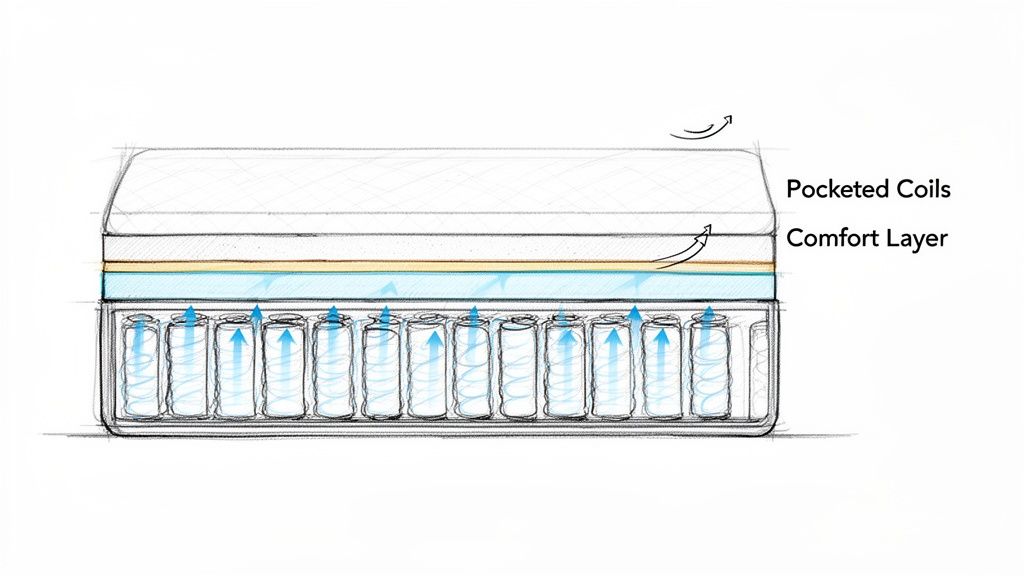
    The foundation of any true hybrid mattress is its pocketed coil support system. This isn't your grandparents' old innerspring bed where all the coils are wired together. Instead, a hybrid has hundreds, sometimes thousands, of individual steel coils that are each wrapped in their own fabric pocket. This allows every single spring to move independently, giving you much more targeted support and greatly reducing motion transfer. It's also the secret to why hybrids tend to sleep cooler, as air moves freely between the coils, preventing heat from getting trapped.

    Cross-section diagram of a mattress showing internal layers: top pocketed coils, comfort layers, and individual pocketed coils with air circulation.

    The Comfort Layers and Coil System

    Stacked right on top of that coil base are the comfort layers. This is where the "hybrid" concept really comes to life, because manufacturers can use all sorts of materials to create a specific feel.

    • Memory Foam: Many hybrids use memory foam comfort layers to provide that classic body-contouring feel and excellent pressure relief.
    • Latex Foam: You'll also find models using latex, which has a more responsive, almost buoyant sensation. It's also known for being naturally cool and very durable.
    • Proprietary Foams: Many brands also develop their own unique foams designed for specific perks like better cooling, quicker response, or extra durability.

    This marriage of coils and foam has become a major force in the mattress industry. In fact, the market for "hybrid or memory foam mattresses" hit a value of around USD 12.5 billion in 2024 and is projected to nearly double by 2033. That kind of growth shows just how much shoppers appreciate mattresses that blend technologies for a more balanced night's sleep. You can always explore more data on mattress market trends to see how these designs continue to evolve.

    How Coils Influence the Feel

    It’s not enough to just know a hybrid has coils; the type of coils makes a huge difference in how the mattress feels and performs.

    One of the biggest advantages of a hybrid is its responsiveness. That pocketed coil system gives it a subtle but noticeable bounce, making it much easier to roll over or change positions at night. This helps avoid the "stuck" feeling that some people experience with traditional memory foam.

    When you're comparing hybrids, there are two key specs to look for: coil count and coil gauge.

    • Coil Count: This is simply the total number of individual coils in the mattress. As a general rule, a higher coil count (usually between 800 to over 2,000) means more precise, conforming support for your body.
    • Coil Gauge: This tells you how thick the steel wire is. It’s a bit counterintuitive, but a lower gauge number means a thicker, firmer wire, while a higher gauge number means a thinner, more flexible wire.

    These details, working together with the comfort layers on top, ultimately decide the mattress's final firmness, the amount of bounce it has, and how well it supports you all the way to the edge. Grasping this combined construction is key to figuring out where you land in the memory foam vs hybrid mattress debate.

    Comparing Key Performance Differences

    Now that we know what’s going on inside these mattresses, we can talk about how those differences actually feel when you lie down. Let's move past the marketing jargon and get into a practical, side-by-side breakdown of what will really impact your sleep, night after night. Each mattress type has its own strengths, and figuring out these trade-offs is the key to choosing with confidence.

    Honestly, this decision is at the very heart of the mattress shopping journey. We see it in our showrooms all the time—that tension between the deep, contouring comfort of memory foam and the bouncy, supportive feel of a hybrid. Both options are incredibly popular for a reason. In fact, foam mattresses brought in around USD 38.7 billion in revenue in 2024, while hybrids are often considered the largest market segment. If you want to nerd out on the numbers, you can explore detailed mattress market insights to see how these trends are shaping the beds we sleep on.

    Feel and Responsiveness

    The very first thing you'll notice is how the mattress reacts to your body. This "feel" is a huge part of the memory foam vs. hybrid mattress debate.

    A memory foam mattress is known for its slow-moving "sink." When you get into bed, the foam uses your body heat and weight to soften and mold to your exact shape. This gives you that deep, body-hugging sensation, almost like the mattress is giving you a gentle hug. Because it responds so slowly, some people find it takes a bit more effort to change positions.

    A hybrid mattress, on the other hand, has a much more balanced and responsive feel. The coil system underneath provides a gentle "bounce" or lift, making you feel like you're sleeping on the mattress rather than sinking in it. This makes it way easier to move around and switch from your back to your side without feeling like you're stuck in quicksand.

    Pressure Relief and Support

    Both mattresses are designed to relieve pressure, but they go about it in completely different ways, which can make a big difference for your spinal alignment and overall comfort.

    • Memory Foam offers amazing pressure relief by distributing your body weight evenly across the surface. Its deep contouring is a lifesaver for cushioning sensitive spots like hips and shoulders, which is why it's so often recommended for side sleepers.
    • Hybrid Mattresses give you a more dynamic kind of pressure relief. You get the contouring comfort from the foam layers on top, but the pocketed coils below provide strong, targeted support. This one-two punch helps keep your spine in a neutral position, a huge plus for back and stomach sleepers who need to stop their hips from sinking too low.

    The core difference really comes down to deep compression versus responsive lift. Memory foam absorbs pressure by letting you sink in, while a hybrid pushes back against pressure with the uplifting support of its coils, all balanced by the softness of its foam layers.

    Motion Isolation

    If you share a bed with a partner, a pet, or a restless sleeper, motion isolation is non-negotiable. This is where you'll find one of the biggest differences between the two.

    Memory foam is the undisputed champion here. Its dense, viscoelastic structure is incredible at absorbing movement. If your partner is tossing and turning or gets up for a midnight snack, you're much less likely to feel any of it on your side of the bed.

    Hybrids have gotten much better in this department, thanks to the individually pocketed coils that move on their own and cut down on motion transfer. But at the end of the day, they still have springs, so a little bit of vibration can still travel across the mattress. While they perform quite well, they just can't match the nearly perfect motion-deadening power of an all-foam bed.

    Temperature Regulation

    Sleeping hot is a common complaint that can completely ruin a good night's sleep, and your mattress construction plays a surprisingly big role in how cool you stay.

    Traditionally, memory foam had a reputation for trapping body heat because it’s so dense. While today's memory foams have come a long way with cooling technologies like gel infusions and open-cell designs, they still mostly rely on passive cooling.

    This is where hybrids have a built-in advantage. That pocketed coil support layer isn't just for support—it allows air to flow freely through the mattress, wicking heat away from your body and preventing it from building up. This superior airflow makes hybrids one of the coolest sleep surfaces you can find.

    When looking at any mattress, it’s also smart to think about the materials and certifications involved. For example, understanding guidelines like those for crib mattress safety standards can give you a wider perspective on material safety and quality construction across the entire mattress industry.

    Matching a Mattress to Your Sleep Style

    When it comes down to memory foam vs. hybrid, there's no single "best" mattress. The only thing that matters is which one is best for you. The right answer almost always boils down to two key things: your go-to sleeping position and your body type.

    How you sleep and how much you weigh are the biggest factors determining the kind of support and pressure relief you'll need to wake up feeling great. A mattress that’s a dream for a back sleeper could be a nightmare for a side sleeper, creating aches and pains. By the same token, a bed that feels perfect for someone under 150 pounds might feel like a hammock for someone over 230 pounds. Getting these details right is the secret to choosing with confidence.

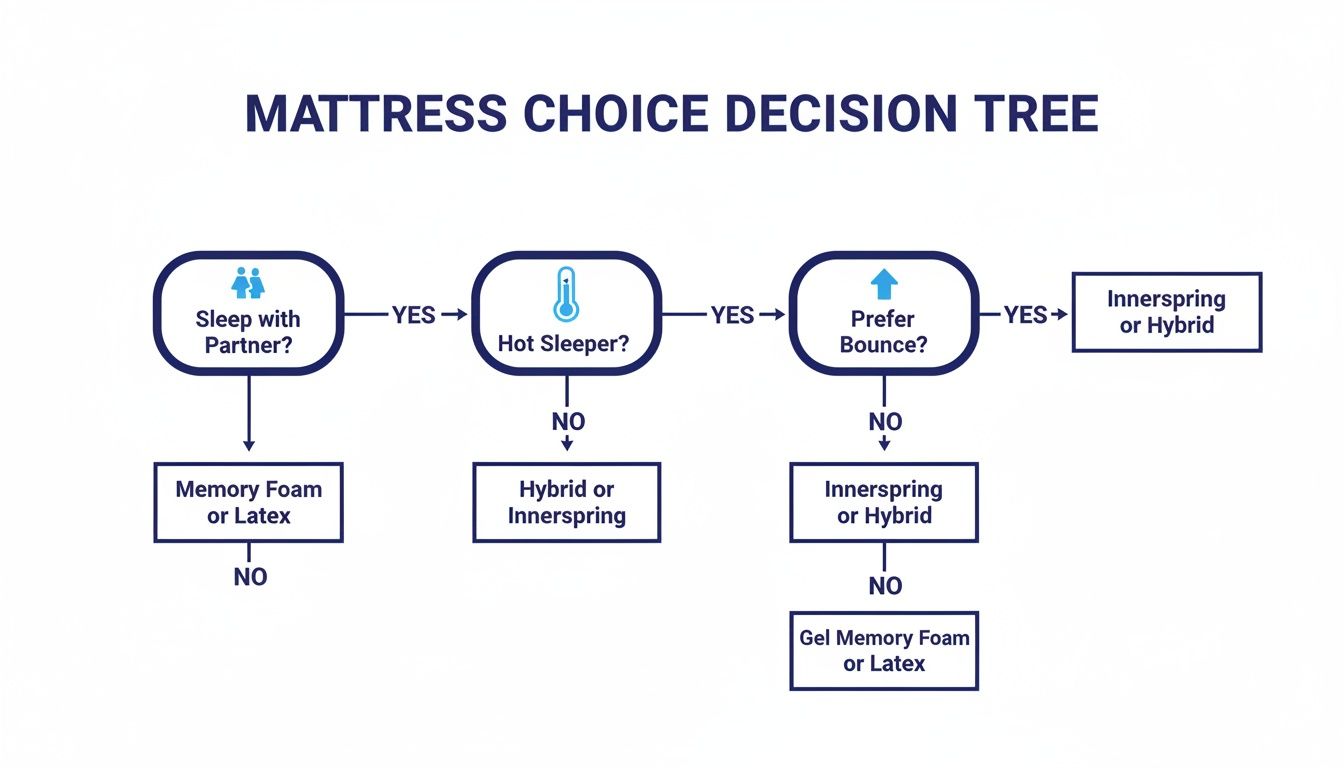
    To make it a bit easier, we've put together a visual guide that walks you through the key questions.

    A mattress choice decision tree flowchart helping users decide between memory foam, latex, innerspring, or hybrid.

    This decision tree shows how things like sharing a bed, sleeping hot, or wanting a little bounce can point you in the right direction.

    Guidance for Side Sleepers

    If you're a side sleeper, your mattress has one critical job: to cushion your shoulders and hips while keeping your spine straight. If it can't contour properly, your spine gets thrown out of alignment, and that’s a recipe for aches and pains.

    This is where memory foam really shines. Its signature slow-sinking feel is perfect for cradling those pressure points, letting your shoulders and hips sink in just enough. The result is deep, targeted relief right where you need it most.

    A hybrid mattress can work very well too, but you'll want to look for one with a cushier comfort layer. The key is finding one with thick enough foam or latex layers on top of the coils to give you that necessary plushness.

    Guidance for Back and Stomach Sleepers

    For back and stomach sleepers, the game is totally different. Your number one priority is solid, even support to keep your hips from dipping too low. If your midsection sinks, it puts a ton of strain on your lower back.

    This is exactly why hybrid mattresses are so often a preferred pick for back and stomach sleepers. The pocketed coil core provides that firm, uplifting foundation that keeps your spine in a healthy, neutral position. You still get the comfort from the foam layers on top, but without sacrificing that all-important support.

    A firmer memory foam mattress can also be a good option, but you have to be sure its high-density support core is sturdy enough to keep you from sinking in too much.

    The bottom line is this: side sleepers need to prioritize pressure relief to cushion their joints, while back and stomach sleepers have to prioritize zoned support to keep their spine aligned.

    How Body Weight Influences Your Choice

    Your body weight is the other huge piece of the puzzle. It directly affects how much pressure you put on the mattress and how it will respond to you.

    • Lighter Individuals (Under 150 lbs): If you're on the lighter side, a very firm mattress might not let you sink in enough to get any of the contouring benefits. You'll likely find that a softer memory foam or a hybrid with a plush top offers better pressure relief and just feels more comfortable.

    • Heavier Individuals (Over 230 lbs): For heavier folks, the name of the game is durability and support. You need a mattress with a rock-solid core to prevent sagging and ensure it holds up over time. The robust coil base of a hybrid mattress is often a clear choice here, providing superior support and preventing that "bottoming out" feeling.

    The market definitely reflects these needs. As of 2024, foam mattresses held about 45% of the global market share, largely thanks to sleepers looking for that deep pressure relief. At the same time, hybrids are often called the fastest-growing segment because of how well they balance that soft comfort with sturdy support.

    Of course, finding the right mattress is just one part of the equation. It's also worth looking into other methods of optimizing deep sleep for your overall health and recovery.

    How to Test a Mattress in Person

    Reading online reviews and comparisons is a fantastic first step in the memory foam vs. hybrid mattress debate. But let’s be honest, the only way to be certain about how a mattress feels is to test it yourself. An in-person visit to a showroom can turn theory into reality, letting you feel the subtle differences that spec sheets just can’t capture.

    A successful showroom visit is about more than just a quick sit on the edge of the bed. To get a real feel for a mattress, you have to simulate how you actually sleep at home. This means taking your time and not feeling rushed or self-conscious about it.

    Prepare for Your Visit

    Before you head out, a little prep work can make your test much more effective.

    • Wear Comfortable Clothes: You’re going to be lying down, so wear something you can move around in easily. Ditch the bulky coat or restrictive clothing.
    • Bring Your Partner: If you share a bed, you absolutely have to test mattresses together. You’ll want to pay close attention to things like motion transfer and whether you both feel comfortable.
    • Know Your Sleep Position: Be ready to get into your primary sleep position—whether you're a side, back, or stomach sleeper. After all, this is how you'll be using the mattress every single night.

    Once you arrive, the goal is to spend some quality time on your top contenders. Don’t just lie down for 30 seconds and hop up.

    Plan to spend at least 10 to 15 minutes on each mattress you’re seriously considering. This gives your body enough time to relax and settle in, allowing you to notice how the support and comfort layers truly respond to you.

    What to Look for When Testing

    As you lie on each mattress, focus on these key points. They’ll help you move beyond a simple "soft" or "firm" assessment and understand how the bed actually performs for your body.

    1. Spinal Alignment:
    This is the single most critical factor. Ask your partner or a sleep expert to check if your spine is straight when you’re in your usual sleep position. For side sleepers, your spine should be horizontal; for back sleepers, it should maintain its natural S-curve without sagging.

    2. Pressure Points:
    Pay close attention to your shoulders, hips, and lower back. Do you feel any uncomfortable pressure, or does the mattress gently cushion these high-impact areas? A good mattress will distribute your weight evenly and prevent that nagging pressure buildup.

    3. Ease of Movement:
    Try changing positions. Is it easy to roll from your back to your side? A responsive hybrid will make this feel effortless, while some memory foams might have a slower response that feels more like you’re sinking into it.

    4. Edge Support:
    Sit on the edge of the mattress like you’re putting on your shoes. Do you feel stable, or does the edge collapse under your weight? Strong edge support gives you more usable sleeping surface and makes getting in and out of bed much easier.

    Visiting a showroom with experienced staff can make all the difference. Our team can offer no-pressure guidance, helping you compare a memory foam vs hybrid mattress side-by-side and find the one that fits your body and sleep style.

    Common Mattress Questions Answered

    Even after we've broken down the construction, feel, and performance of both mattress types, you might still be wrestling with a few last questions. It happens to everyone. So, let's tackle some of the most common things we hear from shoppers to clear up any final confusion.

    Do Memory Foam Mattresses Have a Smell?

    Yes, sometimes a brand new memory foam mattress will have a distinct smell right out of the packaging. This is called off-gassing, and it's caused by the release of harmless compounds called VOCs (volatile organic compounds) left over from the manufacturing process. The good news is that the smell isn't considered harmful and usually disappears within a few days.

    To speed things up, just let the mattress air out in a room with good ventilation. Most modern foams, especially any with a CertiPUR-US® certification, are made with low-VOC materials to keep this to a minimum. Hybrids can have a slight odor too, but it’s often less of an issue because the open coil design lets air flow through and carry it away faster.

    Which Mattress Type Is More Durable?

    This is a great question, and when we're talking about pure longevity, hybrids tend to have a slight advantage.

    • A well-made hybrid mattress will often give you 8 to 10 years of solid performance, sometimes even more. Their steel coil support core is very durable and great at resisting sag over the long haul.
    • A quality memory foam mattress typically lasts somewhere in the 6 to 8-year range. Its lifespan really depends on the density of the foam — the denser the foam, the longer it will hold up.

    No matter which you choose, rotating your mattress every six months is a good practice to ensure it wears evenly and you get the most life out of your investment.

    The key takeaway is that while both offer years of comfort, the robust coil base in a hybrid often gives it a longer functional lifespan compared to an all-foam construction.

    Can I Use an Adjustable Base with Either Mattress?

    Absolutely! This is one of the best upgrades you can make for your sleep, and both memory foam and hybrid mattresses are generally perfect for adjustable bases.

    Memory foam is especially suited for it; it can flex and bend into any position you want without putting any stress on the mattress itself. Most modern hybrids are also designed with flexible, pocketed coils that move right along with the base. That said, it’s always a smart idea to double-check the manufacturer’s warranty and recommendations just to be safe. Pairing your mattress with an adjustable base is a game-changer for reading, watching TV, or even helping with things like snoring or acid reflux.

    What About the Weight Difference?

    There’s definitely a noticeable weight difference, and it's something to think about. Hybrid mattresses are quite a bit heavier than memory foam mattresses, and that’s all because of the steel coil system inside.

    It might not seem like a huge deal at first, but it can be a real challenge on moving day or even when you just need to rotate the mattress. If you live by yourself, move often, or have a tough time with heavy lifting, the lighter weight of a memory foam mattress is a practical perk you shouldn't overlook.


    Ultimately, picking between a memory foam vs hybrid mattress comes down to your personal needs. But you don't have to figure it all out alone. Here at Woodstock Furniture & Mattress Outlet, our knowledgeable team is here to give you straightforward, no-pressure advice and let you test out as many models as you'd like. Come visit one of our North Georgia showrooms and let's find a great mattress for your sleep and your budget.

    Explore Our Full Mattress Collection and Find a Showroom Near You

    Article created using Outrank