You're standing on your patio with a tape measure, trying to picture eight people around a table that hasn't arrived yet. The dimensions on a product page look reasonable. The space in front of you looks generous. The mismatch usually doesn't show up until chairs are pulled out, someone needs to pass with a plate, and the end seat turns out to be mostly knees and apology.
Why a Long Outdoor Table Deserves a Plan Before a Purchase
A couple finds a long outdoor table they love on a wide showroom floor. At home, the story changes. Chairs on one side hit the railing before they're fully out, the grill cart can't pass the end, and getting to the back door means turning sideways between a seated guest and the house. The table itself fits. The meal doesn't.
That gap between table footprint and usable dining footprint is where most long table purchases go wrong. Length on a spec sheet tells you nothing about leg placement, chair width, or whether an older parent can get in and out without help. A table that works on paper can still crowd a covered porch, block a door swing, or leave serving dishes stranded out of reach.
What a Useful Plan Actually Covers
Four questions resolve most of the trouble before delivery day arrives.
- Patio fit first: What's your usable rectangle once walkways and chair pull-out space come off?
- Honest capacity: How many people sit comfortably with your chairs, not the chairs in a catalog photo?
- Material fit: What does your sun, humidity, and willingness to maintain things point toward?
- Daily placement: Where do shade, doors, and foot traffic leave you room to live around it?
None of these require special tools. A tape measure, painter's tape, and your actual chairs answer most of them. If you'd rather sketch options digitally before moving anything heavy, a patio design ai tool from OutdoorBrite can help you test footprints against your space before you commit to measurements on the ground.
A long table isn't a bigger version of a small one. It's a room planning decision that happens to involve furniture.
Treat the purchase that way and the rest gets simpler. You're not hunting for the longest table your patio can physically contain. You're looking for the longest table your household can sit at, serve from, and walk around without thinking about it. That distinction drives every choice that follows, from width and leg style to whether you cover it in winter or leave it out.
Sizing a Long Outdoor Table to the Patio First
Start with the patio, not the table. Measure the usable rectangle, meaning the open floor area after you account for planters, steps, grill clearance, door swings, and anything else that already claims space. Then subtract before you shop.
Subtract Circulation and Chair Space
People need room behind seated diners, not just at the table. Guidance distinguishes between chair clearance and circulation, with 24 to 30 inches commonly cited as a comfortable gap between table edges, at least 36 inches for accessible routes, and 36 to 44 inches for server aisles in outdoor seating clearance guidance from Superior Seating. At home you don't run a restaurant, but someone carrying a hot dish past a seated guest needs similar room.
Work through the math in order.
- Mark the usable rectangle: Tape the true open area, excluding steps and fixed obstacles.
- Reserve a walkway: Keep at least one route around the table that stays clear even with chairs occupied.
- Add chair pull-out zones: Allow space behind each seat for a chair to slide back and a person to stand.
- Test the remainder: Whatever's left is the largest table footprint that won't fight the space.
Take a covered patio that's 12 by 14 feet. Reserve a clear route along one long side and chair space on both sides, and the remaining rectangle shrinks fast. A narrower 84 inch table may preserve a comfortable pass behind diners on both sides. A 96 inch table that's also wider might seat the same group on paper while erasing the walkway, so every trip to the kitchen becomes a negotiation.
Width and Height Matter as Much as Length
Length gets the attention, but width decides whether shared dishes work. For a long outdoor dining table, prioritize a tabletop width of approximately 75 to 90 cm and a height of 72 to 75 cm, dimensions that support place settings on both sides while keeping a conventional dining posture in anthropometric guidance on dining table dimensions. That same guidance puts comfortable linear space at roughly 68 to 75 cm per diner, and warns that less than about 60 cm per person increases elbow interference.
A wider top gives serving bowls a home in the middle. It also pushes chairs farther from the center, eats circulation, and can put dishes beyond easy reach for kids. On a narrow porch, a slightly narrower table with a sideboard or serving cart nearby often works better than a wide table that swallows the walkway.
Practical rule: Tape the proposed table outline on the ground, set your chairs inside the tape lines, sit down, stand up, and walk the full loop with a tray. Ten minutes of this beats any showroom guess.
Finish by checking what tape can't show. Look at leg placement on candidate tables, because inset or pedestal legs change knee room at the ends. Confirm your chairs' arms slide under the apron. Then choose a length. You'll have a method you trust instead of a number you hope is right.
How Many People a Long Outdoor Table Really Seats
Seat count labels assume slim chairs, cooperative elbows, and no serving dishes. Real capacity comes from usable table edge. A common planning allowance is approximately 24 inches of table length per person seated along the sides, and under that guideline a 72 inch table generally accommodates six diners, an 84 to 96 inch table about eight, and a 108 to 120 inch table roughly ten, according to planning guidance on outdoor dining table length from Edward Martin.
Those are starting points. Then your actual setup starts subtracting.
Typical Long Outdoor Table Capacity by Length
| Table Length | Comfortable Seating | Notes |
|---|---|---|
| 60 to 72 inches | 4 to 6 people | Works for six only with compact chairs and usable ends |
| 84 to 96 inches | About 8 people | Three per side plus ends if legs allow |
| 108 to 120 inches | Roughly 10 people | Four per side plus ends, if chair width cooperates |
The ranges in that table follow the same source noted above, which also places a 60 to 72 inch table at four to six people. Treat the high end of each range as a holiday squeeze, not an everyday promise.
Where Capacity Leaks Away
Layout matters as much as length. A 120 inch rectangular table may be planned for approximately ten diners, four along each long side and one at each end, while a six person setup typically uses a 72 to 84 inch length and 36 to 40 inch width, per outdoor dining table sizing layouts from Outer. Change one variable and the count moves.
- Chair width and arms: Armchairs at every place eat inches that armless side chairs don't. Measure your widest chair, not your narrowest.
- Leg and pedestal position: Corner legs can steal the end seat's knees. Inset legs or a trestle base often free the ends but may crowd the middle seats underneath.
- Serving style: Family style platters in the center reduce elbow room effectively, even though the edge measurement hasn't changed.
- End seats: An end only counts if someone can sit there with a plate, knees under the top, and a chair that pulls out without hitting a wall.
Height and width play supporting roles. Typical outdoor dining tables measure about 28 to 30 inches from floor to tabletop, with common widths from approximately 30 to 48 inches, as summarized in general outdoor dining table dimension guidance from Reader's Digest Australia. A 36 inch width keeps food within reach for most diners. Go much wider and shorter arms lose access to the middle.
Plan for the group you host most often, then handle the twice a year crowd with a folding side table or bench you can store. Buying length for one annual gathering means living with a crowded patio the other fifty weeks.
Choosing Materials That Match Your Climate and Maintenance Tolerance
Material photos all look calm and dry. Your table will live through pollen, summer storms, humidity, and the occasional freeze. Choose for that life, and for the upkeep you'll do in year three, not the enthusiasm you feel in week one.
How the Common Options Behave
Teak and dense hardwoods handle moisture well and feel warm and substantial. Left alone, teak silvers over time, which many owners like. Keeping the original color means cleaning and oiling on a schedule. Wood remains a major part of this category, and it asks for the most seasonal attention of the options here.
Powder-coated aluminum is light, resists rust, and moves easily when you rearrange or store it. That lightness cuts both ways in open, windy spots. Finishes can chip at edges and feet, so touch-ups matter where coating meets concrete. It also heats up less aggressively than darker metals in direct sun, though any metal top in full afternoon exposure deserves a cautious hand check.
Steel brings weight and stability, which helps on exposed decks. The trade-off is corrosion watchfulness. Coatings do the protective work, so scratches, joints, and drainage points need periodic inspection before rust gets established.
All-weather wicker over an aluminum frame softens the look of a long frame and pairs well with cushioned seating. The frame does the structural work, so ask what it's made of. Woven surfaces trap pollen and crumbs, so plan on brushing and rinsing rather than a quick wipe.
Wood-plastic composite tops reduce some upkeep, but they aren't maintenance-free. A USDA Forest Service study of wood-flour-filled high-density polyethylene composites found that 3,000 hours of xenon-arc weathering degraded the surface, with cracking in the HDPE matrix driven by moisture-related swelling of wood particles, as reported in USDA Forest Service research on composite weathering. For a long top, favor capped or protected surfaces, sealed cut ends, drainage that prevents standing water, and airflow underneath. Long boards also move more with temperature and moisture, so fasteners and joints deserve a look each season.
Match the Material to Your Reality
Ask three questions before falling for a finish.
- Exposure: Is the table fully exposed, partly sheltered under a roof, or stored in winter?
- Tolerance: Will you oil, cover, and inspect, or do you need rinse and walk away?
- Handling: Does anyone need to move this table alone, and can they?
The most durable material isn't automatically the right purchase. A table too heavy to move for cleaning or storage creates its own kind of wear.
If your patio sits under trees, prioritize surfaces that release debris and dry quickly. If it's unsheltered and sunny, think about heat, fading, and glare off the top at midday. If it's a covered porch in North Georgia humidity, airflow and mold resistant detailing matter more than freeze protection. Where a style you love conflicts with your exposure, a quality cover and a realistic routine can close part of the gap, but not all of it.
Placing a Long Outdoor Table So It Works Every Day
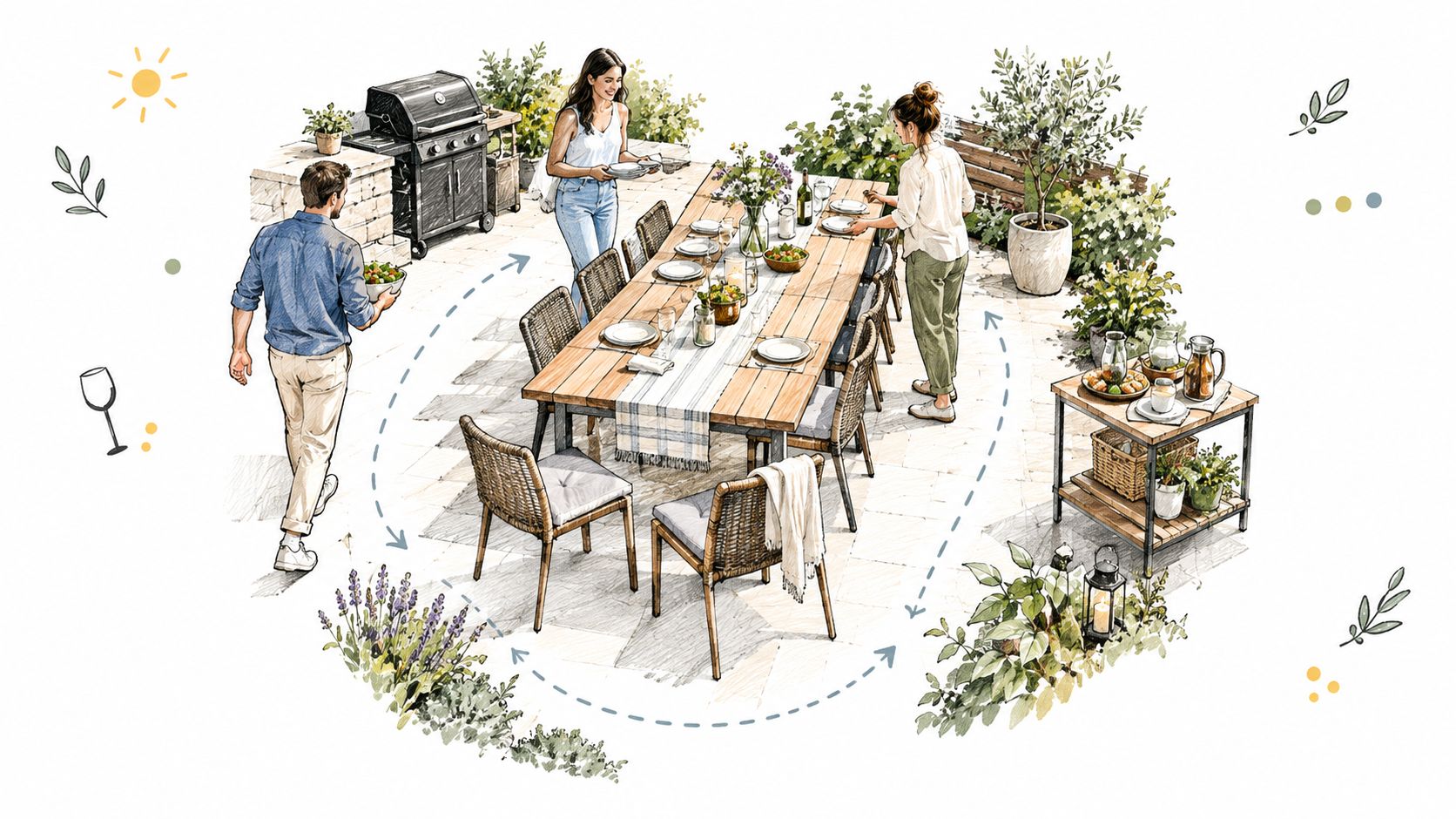
Placement decides whether the table becomes the default dinner spot or the thing everyone walks around. A long top creates issues a small round table never raises, starting with access to both ends. Set the scene with your real furniture before delivery, the way you'd set a table for guests.
Sun, Shade, and the Route to the Kitchen
Watch the sun path across your patio at the hours you eat. A spot that's pleasant at 10 in the morning can put glare straight into diners' eyes at 6 in the evening, and a long table means some seats sit in sun while others sit in shade. If you use an umbrella, check where the post lands. A center post interrupts serving and conversation down the length of the table, and the canopy rarely shades both ends of a long top evenly. Offset umbrellas help, but the base then claims floor space your circulation plan may not have spared.
Walk the serving route too. The path from kitchen door to table gets used with full hands, often by someone who can't see their feet over a tray. Keep that line clear of chair backs, planter corners, and the table's own end.
Centered or Against a Railing
Centering the table usually gives the most balanced circulation and lets every seat pull out freely. Pushing one long side toward a railing or wall frees a generous serving lane on the open side, but diners on the wall side get trapped once everyone's seated. On narrow or covered porches, that trade is sometimes necessary. If you make it, put a bench on the tight side so people can slide in, and accept that side works best for kids and agile adults.
- Door swings: Open every nearby door fully with chairs in place, not pushed in.
- End access: Confirm someone can pass each end without turning sideways.
- Wind exposure: Long tops catch gusts. On open decks, weight, placement out of the wind lane, or removing umbrellas before storms prevents most trouble.
The short clip below is useful for visualizing how table placement, shade, and surrounding seating interact once real people arrive.
Run one ordinary weeknight through the layout in your head. Homework at one end, a laptop somewhere, someone grilling. If the table only works when it's set for a party, it'll frustrate you the rest of the time.
Caring for a Long Outdoor Table Through the Seasons
Care works best as a small calendar habit, not an annual rescue project. Long surfaces collect more pollen, hold more standing water, and show neglect across a bigger area, so little and often beats thorough and rare.
A Seasonal Rhythm That Fits North Georgia
Spring starts with a wash. Clear winter grime and the first pollen wave, rinse well, and let everything dry fully before cushions go back on. Inspect joints, fasteners, and feet while the table's clean, because looseness and finish damage are easiest to spot then.
Summer is mostly water management. After storms, tip off standing water rather than letting it sit, especially along seams, board gaps, and under centerpieces that trap moisture. Wipe spills before heat bakes them in. If your table lives under trees, sweep debris off weekly so damp leaves don't stain the surface.
Autumn asks for a second inspection before leaves pile up. Tighten hardware, touch up any coating chips on metal, and decide on winter storage versus covering. Clean under the table too, since airflow beneath a long top helps it dry.
Winter decisions depend on material and shelter. Covered porches forgive a lot. Fully exposed tables in freeze and thaw cycles benefit from a breathable cover fitted so it doesn't pool water, or from storage if you have the space and the table's weight allows it.
Material Specific Watch Points
- Wood: Clean gently, let it dry, and oil only if you're maintaining color. Sanding and refinishing are occasional projects, not seasonal ones.
- Metal: Check drainage points, weld areas, and feet where coatings wear thin. Address small rust spots early while they're cosmetic.
- Composite and wicker: Skip the zero maintenance assumption. Gentle cleaning, prompt removal of standing water, and attention to cut ends or woven joints keep small issues small.
This kind of routine protects a real investment. Tables aren't a side category in outdoor living. One 2025 market assessment valued worldwide outdoor furniture at USD 56.00 billion in 2025, projected to reach USD 92.08 billion by 2034 at a 5.74% compound annual growth rate, with tables estimated at 35.21% of the market and wood holding 65.8% of revenue, according to Fortune Business Insights outdoor furniture market estimates. Households are putting serious money into outdoor rooms, and a few minutes of monthly attention is what keeps that spend looking intentional instead of weathered by neglect.
A Simple Checklist Before You Commit
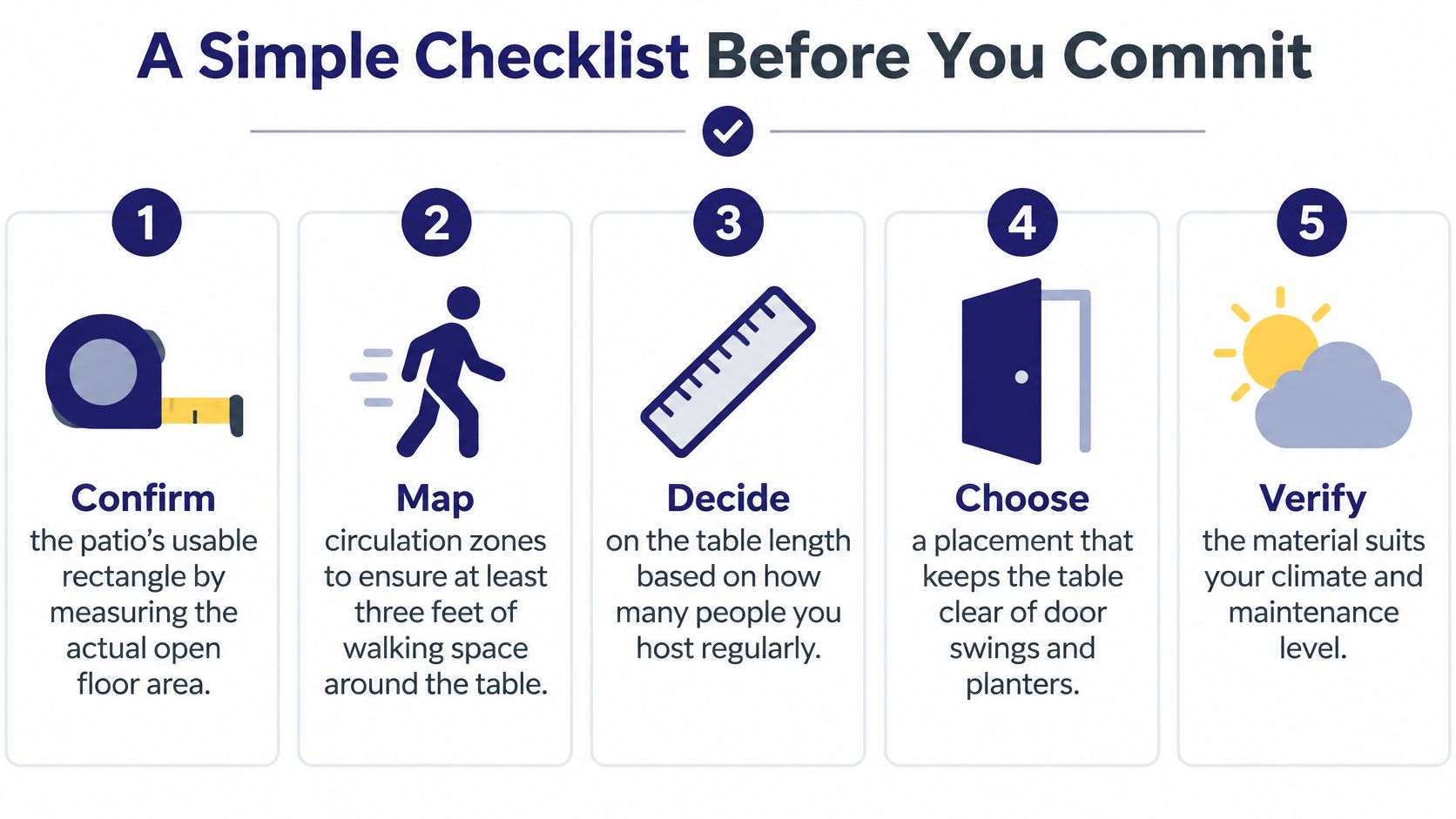
Carry these five checks into any showroom or product page. They'll narrow a long wish list to a shortlist that fits your patio.
- Usable rectangle confirmed: You've measured the open floor and taped the proposed footprint.
- Circulation mapped: A clear route survives with chairs occupied and doors open.
- Realistic seat count chosen: You've counted with your chairs and leg placement, not a label.
- Placement tested: Sun, umbrella post, serving route, and end access all work at your eating hours.
- Material matched: The finish suits your exposure and the upkeep you'll do.
Seeing finishes, feeling surface heat, and sitting in the chairs at full table length settles questions that photos can't. Bring your measurements and your tape outline notes, and test every candidate against them. The right long outdoor table should pass your patio's test, not just the showroom's.
When you're ready to compare long outdoor tables in person, Woodstock Furniture & Mattress Outlet offers a great selection of outdoor dining options at great prices, with knowledgeable, experienced staff who can walk through sizing, materials, and layout with your measurements in hand. Bring your patio dimensions and your checklist, sit at a few tables at full length, and choose the one that fits how your household eats outside.