Tag: living room ideas

  • Living Room Furniture Inspiration: A Practical Guide

    Living Room Furniture Inspiration: A Practical Guide

    Your phone is full of saved living rooms. One has a curved sofa and a warm rug. Another has a vintage chair, a slim lamp, and shelves styled just right. A third looks perfect until you remember your actual room has a walkway to the kitchen, a dog bed by the window, and kids who treat ottomans like jungle gyms.

    That’s where many get stuck.

    They don’t lack taste. They lack a process. Online inspiration usually shows the finished result, not the decisions behind it. It doesn’t show the measuring tape, the traffic path, the toy storage problem, or the moment someone realizes the sofa they loved is too deep for the room.

    A better approach starts with translation. You take the feeling from the photos and turn it into choices you can live with. If you’re collecting ideas from different styles, resources like modern Australian living room ideas can help you notice recurring themes such as lighter palettes, cleaner silhouettes, and relaxed layering instead of chasing one exact look.

    From Inspiration Overload to a Confident Plan

    A living room usually needs to do more than one job. It might host movie night, afternoon naps, homework, game day, holiday visitors, and the daily routine of dropping bags and shoes somewhere near the door. That’s why a room that looks beautiful online can still feel wrong in real life.

    The easiest way to calm the overload is to separate your decisions into a few simple buckets:

    • How you want the room to feel. Calm, cozy, polished, casual, collected.
    • How the room needs to work. Conversation, TV watching, reading, kid-friendly play, guest seating.
    • What the room can physically hold. Door swings, traffic paths, wall length, window placement.
    • What has to stay. Existing rug, fireplace, TV location, favorite chair, inherited table.

    Practical rule: Don’t shop for a sofa first. Shop for a plan first.

    A lot of confusion comes from trying to solve style and function at the same time. It’s easier if you ask two different questions. First, “What atmosphere am I drawn to?” Second, “What shape and scale does my room allow?” Once those answers line up, living room furniture inspiration stops feeling abstract.

    Imagine walking a showroom with a notepad instead of a wishlist. You’re not saying yes or no to whole rooms. You’re pulling out the parts that fit your home. Maybe it’s the rounded arm of one sofa, the wood tone of one cocktail table, and the practical storage of one media console.

    Confidence comes from narrowing the field. Not from seeing more photos.

    Finding Your Signature Style Beyond the Labels

    Style labels help, but only up to a point. “Modern,” “farmhouse,” “traditional,” and “mid-century” can point you in a direction, but they won’t choose a sofa arm, wood finish, or fabric texture for you. Real style gets clearer when you break it into parts you can see.

    A diagram outlining the Woodstock Furniture content promise, focusing on finding your unique signature furniture style.

    Start with shape before color

    Most shoppers notice color first, but shape usually tells you more about your style. Look at silhouettes.

    A room with straight arms, squared cushions, and crisp table edges feels very different from one with rounded backs, soft corners, and sculptural legs. If your saved rooms feel welcoming rather than strict, you may be responding to softer forms.

    That matters right now because curved and organic-shaped sofas have become a major living room direction in 2025, according to House Beautiful’s living room trend report. The same report also notes strong demand for vintage influence, with 81% of interior designers sourcing pieces from the 1920s through the 1990s in 2024, and 23% predicting the Eames lounge chair and ottoman as a top iconic vintage seating piece for 2025.

    That doesn’t mean your room needs to look trendy. It means the market is shifting toward softer forms and more collected spaces. If you’ve felt bored by boxy furniture and all-neutral rooms, you’re not alone.

    Read style like a designer

    Instead of asking, “What style is this?” ask these three questions:

    Design clue What to look for What it usually communicates
    Form Curved, square, low-profile, sculptural, tailored Relaxed, formal, playful, classic
    Materials Oak, walnut, glass, metal, linen, leather, rattan Warmth, polish, durability, texture
    Palette Soft neutrals, earthy tones, deep jewel tones, contrast Airy, grounded, dramatic, layered

    A modern room might use clean lines, but it doesn’t have to feel cold. Add a rounded chair, textured drapery, or warm wood and it softens immediately. A traditional room can feel current if the shapes are edited and the finishes aren’t too heavy. A mid-century direction often works best when you borrow the wood tones and proportions, not every piece.

    Build a mood board that reflects your life

    A useful mood board isn’t a collage of perfect rooms. It’s a filter.

    Try this simple method:

    1. Save only rooms you’d sit in every day. Skip images you admire but wouldn’t live with.
    2. Circle the repeated details. Maybe you keep choosing light oak, curved sofas, vintage lamps, or deep green accents.
    3. Cross out the unrealistic parts. White boucle may not be the right answer for a house with muddy paws and snack hands.
    4. Name your style in plain English. “Soft modern with vintage touches” is more helpful than forcing yourself into one category.

    A strong room usually combines one dominant style, one supporting influence, and a few personal pieces that keep it from looking staged.

    That’s where vintage comes in. You don’t need a full antique room to benefit from the look. One vintage-inspired chair, a wood trunk, a patterned rug, or a statement lamp can give a newer room some history. The room feels less like a catalog and more like yours.

    A few style translations that work well

    • If you like modern but want warmth, choose simple silhouettes in warmer woods and softer fabrics.
    • If you like farmhouse but want less theme, focus on comfort, natural finishes, and fewer decorative signs or distressed extras.
    • If you like traditional but don’t want it heavy, look for classic shapes with lighter upholstery and cleaner tables.
    • If you like eclectic rooms, keep one unifying thread such as repeated wood tones, a consistent color story, or shared curves.

    People often think signature style is something they either have or don’t have. That’s not how it works. Individuals discover it by noticing what they repeatedly choose when they aren’t overthinking.

    Mastering Your Floor Plan with Layout and Sizing Rules

    You can love every piece in a room and still end up annoyed every day. The usual problem is not style. It is fit. A living room works a lot like a parking space. If every car technically fits but no one can open a door or back out comfortably, the setup failed.

    An overhead floor plan illustration showing a living room layout with a sofa, two chairs, and rug.

    That is why floor planning matters so much more than Pinterest makes it seem. Photos usually show one perfect angle. Real living rooms in North Georgia have entry paths, fireplace offsets, vents, window walls, and people carrying laundry baskets through the middle of them.

    The measurements that keep a room comfortable

    Designers use a few spacing guidelines because the body notices bad layout fast. Style by Emily Henderson’s living room layout guidance recommends 30 to 36 inches of walkway space between large furniture pieces when space allows, with 18 to 24 inches as the minimum in tighter rooms. The same guidance recommends about 42 inches between seating pieces if you need room for a table, and keeping sofa and accent chair seat heights within 4 inches of each other.

    Those numbers can sound fussy on paper.

    They make perfect sense once you picture daily use. A walkway that is too tight makes guests turn sideways. A coffee table set too far from the sofa means no one can reach a drink without leaning forward like they are doing a sit-up. Seat heights that are far apart can make one chair feel like a perch and another feel like a hole.

    Here’s a quick reference:

    Layout detail Guideline
    Walkway between large pieces 30 to 36 inches when possible
    Minimum walkway in tighter rooms 18 to 24 inches
    Distance between seating when adding a table About 42 inches
    Seat height difference between sofa and chairs Within 4 inches

    Why scale problems happen so often

    A lot of shoppers start with a single favorite piece and build around it. That is understandable. A sofa gets the attention first. But a living room behaves like a group project. One oversized piece can make every other choice harder.

    A deep sectional may feel great in the showroom, yet create a daily bottleneck at home. Two accent chairs may look balanced in a photo, but if they sit much higher than the sofa, the whole conversation area feels slightly off. People often sense that something is wrong without knowing why.

    Buy for the room’s measurements first, then for the mood you want.

    Another point that surprises people is wall placement. Pushing every piece against the perimeter can make a room feel less finished, not more spacious. In many layouts, pulling the sofa forward a few inches or floating it within the room gives the seating area shape and keeps the room from feeling like a waiting area lined with furniture.

    A simple order for planning the room

    If you feel stuck, work in this order. It clears up a lot of confusion.

    • Mark the non-movable features first. Note the fireplace, windows, doors, floor vents, TV location, and any spot where traffic naturally cuts through.
    • Protect the walking path. Draw how people enter, cross, and exit the room before placing furniture.
    • Set the main seating piece next. In most rooms, that is the sofa or sectional because it controls the rest of the layout.
    • Add secondary seating carefully. Chairs, recliners, or a loveseat should support conversation without pinching the walkway.
    • Finish with tables and storage. These pieces should solve a need, such as setting down a drink or hiding toys, instead of filling empty space.

    If measuring feels intimidating, use painter’s tape on the floor. Tape works like a dress rehearsal for furniture. You can see the footprint, test the walking path, and catch sizing mistakes before anything heavy arrives.

    A short walkthrough can help make those spacing ideas easier to picture:

    Common layout mistakes that throw off the whole room

    • Oversized seating in a pass-through room. If family members cross the room all day, deep chaises and bulky arms can turn a main path into an obstacle course.
    • A rug that is too small for the grouping. The seating zone starts to look scattered instead of anchored.
    • Too many small pieces doing one job each. Separate stools, baskets, tiny tables, and ottomans can crowd a room faster than one larger, useful piece.
    • Ignoring seat height. A chair that sits much higher or lower than the sofa can make the whole setup feel mismatched, even if the colors work.

    Good layout is not about following rules for their own sake. It is about making the room easier to use, especially when your real life includes kids, guests, pets, rentals, or a floor plan that does not look anything like the photo you saved.

    Creative Solutions for Awkward North Georgia Living Rooms

    North Georgia homes don’t always give you an easy rectangle. A lot of people walk into the showroom with photos of long ranch-style rooms, offset fireplaces, stair openings, or L-shaped living areas that don’t behave like the rooms in national design photos.

    That’s where generic advice starts to break down.

    A pencil sketch shows a sectional sofa positioned against a fireplace in an attic living room.

    Stop forcing a full-size sofa into every room

    The old assumption is that a “real” living room needs a big sofa, matching loveseat, and maybe a recliner or two. In a narrow or chopped-up room, that formula often creates the problem.

    According to this awkward-space design roundup, many North Georgia homes have long, narrow, or L-shaped living rooms under 200 square feet. The same source notes a 40% increase in perceived space when people use micro-seating instead of bulky sofas, along with a 35% rise in floated console tables behind sofas to preserve 30 to 36 inches of clearance while adding storage.

    That points to a better strategy. Use slimmer seating. Let the room breathe.

    What works better in tricky layouts

    In a narrow living room, a loveseat or apartment-scale sofa can outperform a larger sectional because it protects the walkway. In an L-shaped room, two smaller seating zones can work better than one oversized arrangement. One zone might anchor the TV. The other might hold a chair, lamp, and small table for reading.

    Try solutions like these:

    • Low-profile seating. Slim arms and shallower depth help keep pathways clear.
    • A console behind a floated sofa. This gives you a place for lamps, baskets, or daily-drop storage without adding visual bulk.
    • Armless or smaller-scale chairs. They often tuck into corners that would reject a larger club chair.
    • Open-leg tables. They make a crowded room feel less blocked than chunky bases.

    Rooms with awkward shapes usually improve when you use fewer pieces with more purpose.

    Material choices matter in real Georgia homes

    Layout gets most of the attention, but material selection matters too. In our area, humidity can be part of the conversation, especially for homes with older windows, sunrooms, or spaces that don’t stay evenly conditioned.

    For wood furniture, sealed finishes are often a safer practical choice than raw or delicate surfaces. Mixed-material tables with metal bases can also make sense in busy family rooms because they tend to feel lighter visually while handling daily use well.

    If your room has an odd corner, don’t rush to fill it with another large piece of furniture. That spot may work better as breathing room, a plant area, or a compact storage piece. A room doesn’t have to be full to feel finished.

    A quick way to diagnose your awkward room

    Ask these questions while standing in the room:

    1. Where do people naturally cut through?
    2. Which corner collects clutter because no furniture really fits there?
    3. Which piece feels physically too large when someone walks past it?
    4. Is the problem the room shape, or just the furniture scale?

    That last question solves a lot. Often, the room isn’t bad. The furniture is just asking too much of it.

    Selecting Smart Furniture for Families and Renters

    The right living room furniture inspiration depends on who’s living there. A retired couple, a young renter, and a household with kids all need something different, even if they like the same look.

    In North Georgia, that practical lens matters. LuxDeco’s corner and room-use guidance notes that 55% of North Georgia households are multi-generational, which helps explain why adaptable furniture matters so much. The same source says modular sectionals can increase longevity by 30% in homes with children, and pieces with 360-degree appeal can reclaim up to 20% of wasted space in underused corners.

    What families usually need first

    Families often start by asking what looks good. A more useful opening question is what will get touched, climbed on, spilled on, and moved every day.

    For many households, smart choices include:

    • Modular seating that can change shape if the room changes.
    • Storage pieces that work from more than one angle, especially in open-plan rooms.
    • Rounded corners on tables and softer edges where kids move fast.
    • Durable upholstery choices that don’t make you nervous every time someone carries a juice box into the room.

    A sectional can be a strong family choice if it fits the room and not just the wish list. The modular aspect matters because the room may need to change over time. A chaise might move. A corner seat might become a sofa and chair setup later. That flexibility helps the furniture stay useful longer.

    Renters need adaptability more than perfection

    Renters face a different problem. They often buy for the next home before they know what the next home looks like.

    That means a giant sectional or an extra-long media unit can be risky, even if it works in the current apartment. Pieces that travel well tend to be easier to live with long term.

    A renter-friendly setup might include a standard sofa, one versatile chair, a movable ottoman, and tables that can shift roles. A small bench might become entry seating later. A drink table might become a bedside table in the next place.

    Key takeaway: The smartest purchase isn’t always the one that fills the room today. It’s the one that still makes sense after your life changes.

    Shared advice for both groups

    Families and renters overlap in one big area. Both benefit from furniture that earns its footprint.

    Look for pieces that answer more than one need:

    Furniture type Why it helps
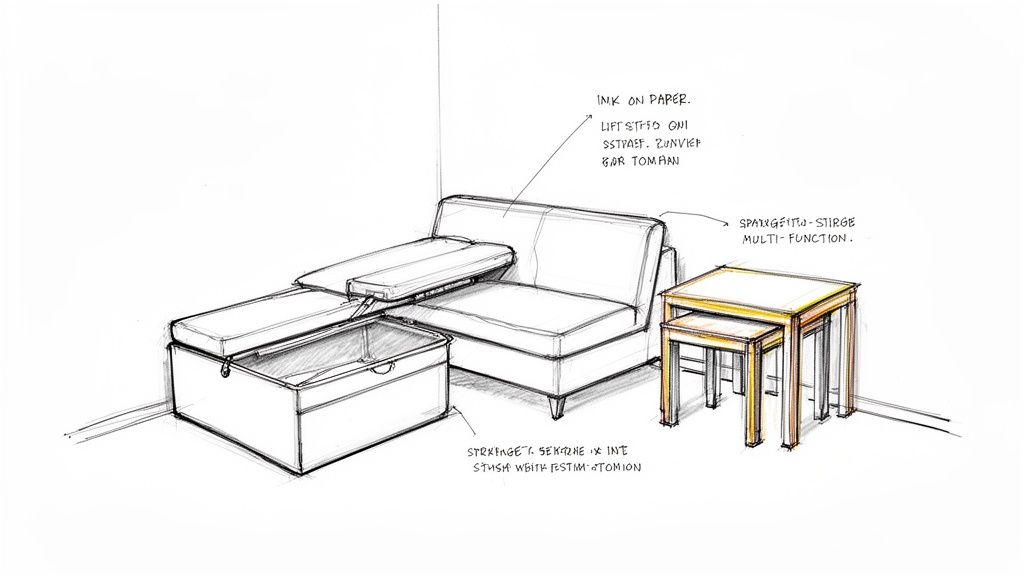
    Storage ottoman Seating, footrest, and hidden storage
    Console with baskets Display on top, practical holding zone below
    Modular sectional Flexible layout as needs change
    Compact accent chair Adds seating without overwhelming the room

    That’s usually the difference between a room that feels polished and one that feels crowded. Not more furniture. Better jobs for the furniture you choose.

    Adding Depth with Focal Points Lighting and Texture

    Once the big pieces are in place, the room still needs finishing. This is the part people often rush, then wonder why the space feels flat.

    A complete room usually has three quiet supports working together. A focal point, layered lighting, and varied texture.

    Start with what the eye lands on

    Every living room benefits from a visual anchor. Sometimes that’s a fireplace. Sometimes it’s a media wall, a large window, or a piece of art.

    A line art sketch of a living room featuring a sofa, rug, and layered lighting design.

    If the room has a clear focal point, support it. Don’t compete with it using too many large statements. If the room has no obvious focal point, create one with a larger rug, a bookcase, art grouping, or a well-scaled media console.

    TV rooms often get stuck here. The screen becomes the only thing people see. One way to soften that effect is to use lighting and material contrast around it. If you’re planning a media-focused room, Home AV Pros' automation insights offer useful ideas for balancing screens, sound, and room design without letting the technology overwhelm the space.

    Light the room in layers

    Overhead lighting alone rarely makes a living room feel settled. It lights the room, but it doesn’t shape it.

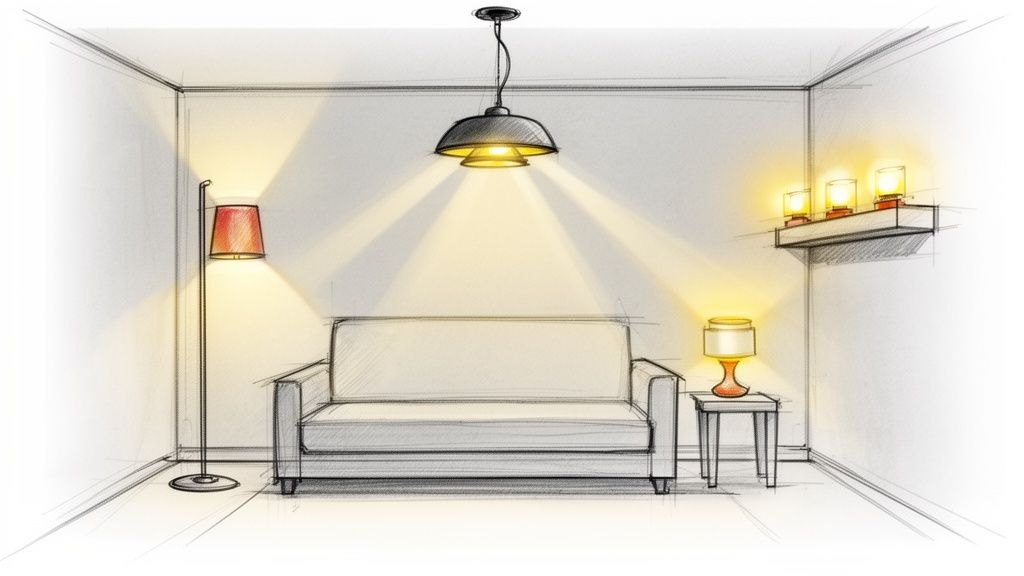
    Use a mix of sources instead:

    • Ambient lighting from ceiling fixtures for overall visibility
    • Task lighting near a reading chair or sectional corner
    • Accent lighting on shelves, artwork, or a console to add depth

    A floor lamp near a chair gives purpose to a corner. A table lamp at one end of the sofa makes the room feel occupied even when no one’s sitting in it. Lighting should help the room feel usable at night, not just visible.

    Texture does more than decorate

    This living room inspiration guide from SJS Designs explains that designers use multi-textural composition to make rooms feel perceptually larger and more refined. The core idea is simple. Contrast keeps a room from looking one-note.

    A few easy pairings do a lot of work:

    • Smooth leather with a chunky knit throw
    • Glossy ceramic with matte wood
    • Linen drapery with a softer upholstered chair
    • A flat-weave rug under a more sculptural table

    You don’t need expensive accessories to make this happen. In fact, texture is one of the most budget-friendly ways to improve a room because it can come from pillows, throws, baskets, lampshades, pottery, and rugs.

    When a room feels unfinished, the problem often isn’t color. It’s a lack of contrast in surface, shape, and light.

    That’s why some all-neutral rooms feel rich and others feel bland. The better ones mix rough with smooth, soft with structured, and light-absorbing finishes with light-reflecting ones.

    Conclusion Your Blueprint for a Beautiful Living Room

    A good living room rarely comes together because someone copied a photo exactly. It comes together because they made a series of clear decisions. They figured out what style elements kept showing up in the rooms they loved. They respected the floor plan. They chose furniture that matched the way they live. Then they finished the room with lighting, texture, and a focal point that made everything feel connected.

    That process is what turns living room furniture inspiration into a room that works on an ordinary Tuesday.

    If you’re still sorting through ideas, it can help to look at how designers build rooms that last instead of chasing short-lived looks. Resources like Lewis and Sheron Textiles design services can be useful for understanding how fabrics, color, and timeless layering choices support the bigger furniture decisions.

    Bring your room measurements, a few saved photos, and a list of what frustrates you about the current setup. That’s usually enough to move from “I like all of these rooms” to “I know what belongs in mine.” Once you can name the room’s job, limits, and style direction, the shopping gets much easier.

    Frequently Asked Questions About Living Room Design

    You get home with a sofa you loved in the store, and within ten minutes the room feels off. The walkway is tight, the lamp has nowhere to go, and the coffee table suddenly looks too small. That kind of frustration is exactly why a few clear rules help.

    These are the questions people ask in the showroom after they have saved the photos, measured the wall, and realized real living rooms have traffic paths, kids, pets, rental limits, and odd corners.

    FAQ Quick Answers

    Question Answer
    How do I know if a sofa is too big for my living room? Start with movement, not the wall. If the sofa pinches your main walking path, blocks the view across the room, or leaves no comfortable spot for a side table, it is too large for the plan. The better test is the usable floor area around it.
    Should all my living room furniture match? Rooms usually feel better when pieces relate instead of matching exactly. A shared wood tone, similar line, or repeated fabric texture will tie the room together without making it feel like a showroom set.
    What’s the easiest way to make a living room feel more finished? Finish the lighting first, then the surfaces. A table lamp, a floor lamp, a rug with some visual weight, and a soft layer like a throw or pillow often make a bigger difference than adding another large piece of furniture.
    Is a sectional always the best choice for families? Families often assume a sectional is the automatic answer, but room shape decides a lot. In many North Georgia homes, a sofa with two movable chairs handles conversation, TV viewing, and toy cleanup better because you can shift the layout as life changes.
    How can renters avoid buying the wrong furniture? Buy for your next layout too, not just your current one. Standard sofas, apartment-scale chairs, nesting tables, benches, and storage ottomans are easier to carry, easier to rearrange, and less risky than oversized pieces built around one exact floor plan.

    A few final practical answers

    A crowded room usually needs subtraction before it needs shopping. Remove one piece and look again. The room often starts working once the pathways open up.

    A cold room does not always need a different sofa. It often needs warmer light, more texture, or a rug that grounds the seating area. Furniture is the frame. The layers are what make it feel lived in.

    If your saved inspiration photos seem unrelated, look for the repeated signals. You may keep choosing low, relaxed silhouettes. You may prefer cleaner arms, warmer woods, or lighter fabrics. That pattern is your style showing up before you have named it.

    If you want a second set of eyes on your room, Woodstock Furniture & Mattress Outlet is a practical place to bring your measurements, inspiration photos, and questions. Sitting in the pieces, checking the scale in person, and talking through an awkward layout can make the next decision much easier.

  • How to Decorate Wall Behind TV: A Complete Guide

    How to Decorate Wall Behind TV: A Complete Guide

    You mount the TV, step back, and the room still feels unfinished.

    That’s the part people don’t expect. The screen is centered. The sofa is in place. The console works. But the wall behind the TV looks like a blank stage with one oversized black rectangle in the middle. When the TV is off, it can read like a dark hole. When it’s on, everything around it can disappear.

    People often respond in one of two ways. They either leave the wall bare because they’re afraid of making it too busy, or they start adding shelves, art, and decor without a plan and end up with a setup that feels crowded. Both are common. Neither means you’re bad at decorating.

    A good TV wall isn’t about hiding the television at all costs. It’s about helping it belong in the room. That usually takes a mix of proportion, backdrop, furniture, lighting, and a little discipline with accessories.

    At Woodstock Furniture, this is one of the most common living room questions people bring in. They’re not usually asking for something dramatic. They just want the wall to look settled. They want movie night to feel comfortable, and they want the room to look pulled together during the rest of the day.

    The Big Black Box Problem on Your Living Room Wall

    The TV often ends up with the most visual weight in the room, whether you intended that or not.

    A sofa has texture. A rug has pattern. A coffee table has shape. A television, by contrast, is a large dark surface with a hard edge. That’s why even a nicely furnished living room can feel awkward once the TV goes up.

    The challenge gets harder in real homes. Maybe you’re working with a wide blank wall. Maybe the TV sits over a low console and everything above it feels empty. Maybe you rent, so built-ins and major paneling aren’t realistic. Maybe you’ve got a soundbar, gaming console, streaming box, and cords that make the area feel more like a tech station than a living space.

    The TV wall usually looks better when it’s treated as a full composition, not a single object.

    That shift matters. Instead of asking, “What should I put behind my TV?” ask, “How should this whole zone work together?”

    Sometimes the right answer is quiet. A dark wall color, a well-scaled console, and clean cable management may be enough. Other times the room needs more structure, such as art near the screen, shelves with some weight, or a textured backdrop that softens the appliance look.

    Decorate wall behind tv projects go wrong when people jump straight to accessories. They buy frames first, then try to make them fit. The better order is simpler:

    • Measure the wall first
    • Place the TV intentionally
    • Anchor it with furniture
    • Add a backdrop
    • Layer decor only where it helps
    • Hide the tech clutter

    That order keeps the room from feeling random.

    Plan Your Layout with Scale and Proportion in Mind

    Most TV wall problems start before any decorating begins. The issue isn’t the art or the paint. It’s proportion.

    A useful rule is that the television should occupy no more than one-sixth of the wall’s width and height, which helps the screen feel balanced instead of oversized on the wall, according to MantelMount’s TV wall decorating guidance. The same source notes that a 65-inch TV, which is about 57 inches wide, fits well on a 10-foot-wide wall, leaving room for surrounding decor.

    An infographic titled Mastering TV Wall Decor illustrating four key planning principles for designing TV wall spaces.

    Start with a tape measure, not a mood board

    Before you pick frames, shelves, or wallpaper, measure three things:

    1. The full wall width and height
    2. The TV width and height
    3. The width of the furniture below it

    Write those down. Most layout mistakes happen because people eyeball the wall and underestimate how much space the screen already takes.

    A TV that’s too large for the wall doesn’t leave enough breathing room. A TV that’s too small for a very wide wall can look stranded unless the rest of the composition supports it.

    Practical rule: If the wall feels empty, don’t assume you need more objects. You may need better spacing and a console with more visual weight.

    Decide what the focal point should be

    Not every TV wall needs the same approach.

    Use this quick framework:

    Room condition What usually works
    The TV is the main use of the room Keep decor restrained and let the screen lead
    The room is used for both entertaining and TV watching Blend the TV into a larger composition with art or shelving
    The wall is very wide Use furniture and decor to spread visual weight across the zone
    The room is small Choose fewer, larger elements instead of many small ones

    Many people tend to overdecorate here. They add too many accents because the wall is large, but the result is visual noise around the screen.

    Pick a balanced layout direction

    There are two dependable layout paths.

    Symmetrical layout

    This works well if your room is formal, your fireplace or wall is centered, or you want the setup to feel calm.

    You might use matching sconces, a centered console, and the same visual weight on both sides. Symmetry is usually the easier path if you want a clean, settled look.

    Asymmetrical layout

    This feels more collected and casual. It works well when one side of the wall naturally needs more support, such as a floor plant, a leaning ladder shelf, or a single stack of framed art.

    Asymmetry looks effortless when it’s done well. It looks accidental when the pieces are too small or too scattered.

    Think about the screen when it’s on and off

    A TV wall has two jobs. It has to look good during everyday living, and it has to function while you’re watching something.

    That’s why backdrop choices matter. Dark paints like navy or charcoal can reduce reflections by up to 70%, improving viewing comfort, as noted in the MantelMount reference above. In practice, that means the wall can do decorative work and performance work at the same time.

    If you’re planning to decorate wall behind tv in a way that still feels comfortable at night, start with proportion first. Most of the later decisions get much easier once the scale is right.

    Create an Intentional Backdrop with Wall Treatments

    Once the layout is settled, the wall itself needs a role. A blank drywall surface often makes the TV stand out more. A thoughtful backdrop helps the screen recede and gives the room some finish.

    The right treatment depends on how permanent you want to be.

    A design sketch illustrating three different wall decor options behind a television, including textured panels, subtle paint, and geometric wallpaper.

    Paint, wallpaper, or panels

    Here’s the trade-off in plain terms.

    Option What it does well What to watch for
    Dark paint Helps the TV blend in and keeps the wall quiet Less renter-friendly
    Peel-and-stick wallpaper Adds pattern and personality with less commitment Needs careful installation near heat
    Textured panels or slats Adds depth and an architectural feel Can be harder to remove cleanly

    Paint is still the simplest solution for many homeowners. A matte or low-sheen dark tone usually works better than anything glossy because glare is the enemy on a TV wall. If you want help narrowing shades, this guide to interior paint color combos is useful for pairing wall color with the rest of the room instead of treating the TV wall in isolation.

    Wallpaper is often the better answer for renters or anyone who wants interest without a full room commitment. It can frame the TV nicely, especially if the room has simple furniture and needs softness or pattern.

    What renters should pay attention to

    This part gets overlooked. Plenty of decorating advice assumes you can patch, paint, and install permanent millwork whenever you want. Real leases don’t always allow that.

    According to Wayfair’s guidance on decorating behind a TV stand, 34% of U.S. households rent, and peel-and-stick wallpaper is a practical removable option. That same guidance notes that TVs can generate up to 200W for 55-inch models, so ventilation behind the TV matters to avoid adhesive failure. You can see that renter-focused advice in Wayfair’s TV wall guide.

    A few renter-safe habits make a big difference:

    • Leave breathing room behind the TV so heat doesn’t build up against wallpaper or adhesive panels.
    • Avoid wrapping removable material tightly behind brackets or vents.
    • Use the console as part of the design, not just the wall, so you’re relying less on permanent changes.
    • Test a small hidden section first if the wall texture is uneven or freshly painted.

    Renters usually get a better result by combining one removable wall treatment with furniture and decor, instead of trying to force a built-in look.

    Match the treatment to the room’s style

    A few examples work consistently well:

    • Charcoal or navy paint suits modern, transitional, and media-focused rooms.
    • Subtle wallpaper helps if the room needs warmth or a softer edge.
    • Wood-look or slatted treatments work when the room feels flat and needs texture.
    • Minimal wall treatment makes sense when the console, rug, and seating already carry enough visual interest.

    This is also where restraint matters. If the wallpaper is bold, keep the art simple. If the wall has strong texture, skip fussy accessories. The TV wall looks more finished when one layer leads and the others support it.

    Mount Your TV and Anchor It with Furniture

    A TV wall usually starts looking finished once the screen has something substantial beneath it. Without that base, even a well-mounted TV can feel like it is floating.

    Mounting sets the height and viewing angle. The furniture below it handles visual weight, storage, and a lot of the everyday tech mess that shows up in real homes.

    Mount the screen with comfort and clearance in mind

    A good mount job starts from the sofa, not the wall. Mark the sightline from your main seat first, then check where the studs, outlets, and devices sit. That order saves a lot of frustration.

    According to Slone Brothers’ TV wall planning guide, the safest setup uses a VESA-compliant mount rated for your TV’s weight and attaches into at least two studs. That matches what I recommend in clients’ homes. A mount can look simple once the TV is up, but the wrong height or poor stud placement is hard to ignore every day.

    Use this sequence:

    1. Mark the viewing height from your main seat
      Eye level matters more than perfect centering on the wall.

    2. Locate and verify studs
      Use a stud finder, then confirm before drilling.

    3. Pick the mount style for the room
      Fixed mounts keep the profile clean. Tilting mounts help if the TV has to go slightly higher. Full-motion mounts work well in open layouts or rooms with side seating, but they need more clearance and can make cable management harder.

    4. Plan around the equipment
      Leave room for a soundbar, game console, streaming box, or smart home hub before the bracket goes up.

    5. Handle cord routing before the final install
      Surface channels, in-wall kits where code allows, and furniture with pass-through openings all work better when planned early.

    Choose a console that actually supports the setup

    The console should be wider than the TV in most rooms. That extra width makes the screen feel anchored, and it gives you useful landing space for speakers, remotes, routers, and decor that softens the hard rectangle of the screen.

    A narrow cabinet under a wide TV almost always feels top-heavy. It also leaves you with nowhere to hide the practical stuff.

    Slone Brothers advises choosing a media unit that is about 10% to 20% wider than the TV. Their example pairs a 55-inch TV with a 60 to 66 inch console. That rule works well because you can compare widths quickly without overcomplicating the decision.

    Quick sizing choices that hold up

    TV setup Better choice Riskier choice
    Wall-mounted TV Console wider than the screen Console same width or narrower
    Tech-heavy setup Closed storage with cable access Open shelf with visible devices
    Small apartment Low, long console to stretch the wall Tall bulky unit that crowds the screen
    Family room Durable top surface and concealed storage Decorative piece with no room for gear

    For renters, this piece does even more work. A strong media console can make the wall feel finished without adding built-ins or heavy wall modifications. If you cannot cut into drywall for cable routing, choose a console with solid back coverage, cord cutouts, or enough depth to hide a power strip and smart device hub neatly.

    Common mistakes to avoid

    A few problems show up often:

    • Mounting the TV too high because the wall looks large and empty
    • Choosing a console that is too narrow or too tall
    • Leaving too much empty space between the bottom of the TV and the top of the furniture
    • Forgetting outlet and device access until after the mount is installed
    • Using open storage for every component when the room already has visual clutter

    The best TV walls are not complicated. They are measured well, mounted safely, and supported by furniture that gives the screen a clear place in the room.

    Decorate Around the TV with Art, Shelves, and Lighting

    At this point, the wall starts to feel intentional instead of merely installed.

    Art, shelving, and lighting can make the TV look integrated, but only when they’re working together. If each piece is trying to be the star, the wall gets busy fast. The goal is a composition with one clear center and supporting elements that soften it.

    A pencil sketch of a television mounted on a wall surrounded by decorative shelves and accent lighting.

    Use art to connect the screen to the room

    A gallery wall works because it turns the TV into one shape within a larger arrangement.

    According to UGallery’s article on art behind a TV, art should sit within 4-8 inches of the TV frame to avoid the “floating” look, and symmetrical odd-numbered elements such as three shelves or five frames help the wall feel more natural and balanced. That guidance appears in UGallery’s TV and art article.

    That spacing matters more than people expect. If the art is too far away, it reads as separate wall decor. If it’s close enough, the TV starts to feel intentional.

    Try one of these approaches:

    • Tight gallery grouping with frames in a similar finish
    • A few larger pieces instead of many small ones
    • A mixed arrangement with framed art and one or two sculptural elements

    The easiest mistake is choosing art that’s too tiny. Small scattered pieces make a large TV look even larger.

    Shelves should support, not crowd

    Floating shelves help when the wall needs height, storage, or texture. They also help when the TV is visually heavy and you need something to distribute attention.

    A good shelf arrangement usually includes variation:

    • Books or boxes to add weight
    • Ceramics or baskets for texture
    • One trailing plant or branchy stem for softness
    • Open space so the shelf doesn’t become cluttered

    Keep the objects edited. The TV wall is not the place for every keepsake in the room.

    If you have to dust around dozens of little accessories, you probably added too much.

    Light the wall so it feels comfortable at night

    Lighting is one of the most useful finishing layers because it changes both mood and function.

    UGallery notes that LED bias lighting can reduce eye fatigue by 40% to 50%, citing the American Optometric Association in its discussion. That’s a practical reason to add it, not just a decorative one.

    Bias lighting works well because it softens the contrast between the bright screen and the darker room. It also gives the wall a finished look when the TV is off.

    A simple lighting hierarchy works best:

    Behind the screen

    LED bias lighting creates a soft halo and improves evening comfort.

    On either side of the TV

    Sconces or picture-style lighting can frame the area, but they should be gentle, not glaring.

    At the console level

    A lamp, small accent light, or warm reflected light can make the whole zone feel more residential and less electronic.

    Keep the composition edited

    A TV wall usually looks stronger when you repeat only a few materials and tones.

    For example:

    Element Good restraint
    Frames One or two finishes
    Shelf decor Repeated materials such as wood, ceramic, and glass
    Color palette A tight range that connects to the rug, pillows, or sofa
    Lighting Warm and consistent, not mixed and harsh

    Decorate wall behind tv projects often improve when you remove one-third of the accessories. The wall should feel composed, not crowded.

    Solve Wire Clutter and Integrate Your Smart Tech

    A beautifully styled TV wall can still look unfinished if cords are visible.

    That’s even more true now that TV walls often carry more than a screen. There may be a soundbar, game console, streaming box, router, smart speaker, charging cables, and ambient lighting controls all competing for space.

    A diagram demonstrating how to hide television cables inside a wall using conduit and cable ties.

    A YouTube source covering modern TV wall setup notes that smart home adoption reached 60% in U.S. households by 2025, and 75% of decor fails cite visible wires as a primary detractor. It also notes that slatted wood panels can conceal wires and reduce echo by up to 20dB, and that consoles should exceed TV width by 12-18 inches for hidden device storage. That guidance appears in this TV wall tech integration video source.

    Pick the right cable strategy for your wall

    Use the least invasive option that still looks clean.

    • Cord covers on the wall are practical if you rent or want a quick fix.
    • Furniture with rear cable pass-throughs helps keep devices hidden.
    • Panels or slatted features can disguise routing while improving the look of the wall.
    • Inside-wall routing looks the cleanest, but it’s usually better for homeowners than renters.

    If your setup also includes a desk nearby or charging stations in the same room, the general principles of effective cable management carry over well. The main idea is simple: secure cables by purpose, reduce visible slack, and avoid letting wires drape where the eye catches them first.

    Give every device a home

    Don’t decorate around tech clutter. Contain it.

    A strong setup usually includes:

    • One shelf or cabinet zone for streaming gear
    • One route for power
    • One route for signal cables
    • Enough airflow around devices that generate heat

    That last point matters more than people think. Equipment crammed into a sealed cabinet may look tidy, but it won’t always perform well.

    Here’s a helpful visual if you’re planning a cleaner setup with concealed routing and tighter control of the wall zone:

    A polished TV wall isn’t just decorated. It’s managed. When the wires disappear and the devices have a place, the rest of the design finally gets room to breathe.


    If you’re updating your living room and want help choosing a console, wall unit, or layout that fits your space, Woodstock Furniture & Mattress Outlet is a practical place to start. You can compare sizes in person, talk through trade-offs with experienced staff, and build a TV wall that looks good without making the room harder to live in.

  • How to Create a Cozy Living Room: Your 2026 Guide

    How to Create a Cozy Living Room: Your 2026 Guide

    Before you think about paint swatches or hunting for throw pillows, let's talk about the most important step to a cozy living room: the layout. A truly comfortable space isn't just filled with soft things; it's arranged in a way that feels natural, open, and easy to live in.

    The goal is to design a room that invites you in, not one that feels like an obstacle course you have to navigate every day.

    Build Your Foundation With Space and Flow

    It’s tempting to jump straight to the fun part of decorating. But getting your space and flow right first will make everything else fall into place much more easily. It's the skeleton of your design.

    Think about how people move through the room. Where do you walk when you come in? How do you get from the sofa to the kitchen? These are your natural pathways. Keeping them clear is essential. A layout that blocks a major walkway will feel cramped and annoying, no matter how beautiful the furniture is.

    Sketch It Out and Plan Your Zones

    You don't need fancy software or an architecture degree. A simple piece of paper, a pencil, and a tape measure are your most valuable tools here.

    Start by drawing the shape of your room. Measure the walls and note where all the permanent fixtures are—doors, windows, the fireplace, and even outlets. This little map is your secret weapon for arranging furniture without breaking a sweat.

    Next, what's the main thing you'll do here? Is it a media room for movie nights, a formal space for conversation, or a quiet spot for reading? Your primary activity determines your focal point. The furniture will naturally gather around something, whether it's a TV, a fireplace, or a big, beautiful window with a view.

    Infographic showing three steps for room layout design: sketching a plan, applying golden ratio, and testing flow.

    This simple process—sketching, arranging, and then physically walking the paths—makes sure your design works in the real world before you commit to anything.

    The Art of Balancing Furniture and Open Space

    One of the most common missteps people make is choosing furniture that’s too big or too small for the room. Getting the scale right is crucial.

    There's a design principle called the golden ratio (roughly 1:1.6) that architects use to create pleasing proportions. You don’t need a calculator, but the idea is to strike a healthy balance between your furniture and the empty space around it. You'd be surprised how much bigger a room can feel with a thoughtful layout.

    Here’s a practical tip you can use right away: leave about 18-24 inches of space between your sofa and your coffee table. It's the sweet spot that keeps the table within reach but gives you enough room to walk by without turning sideways. It's these small, intentional details that make a room feel just right.

    Choose Anchor Furniture for Real-Life Comfort

    Top-down architectural plan of a living room, highlighting furniture layout, pathways, and the golden ratio.

    When you're building a cozy living room, your main seating is where the magic really happens. We're talking about the sofa, sectional, and armchairs—what designers call your anchor pieces. These items set the entire mood for the room and are the foundation of true, everyday comfort.

    But what does “comfort” actually mean? It’s not just a feeling; it’s a mix of specific design choices. Think about the cushions. Do you prefer the firm, reliable support of high-density foam, or would you rather sink into a plush, down-blend cushion after a long day? The seat depth is a huge factor, too. A deeper seat is practically an invitation to lounge and curl up, while a shallower one provides a more upright posture useful for conversation.

    Then there’s the fabric. A durable performance fabric can be a great choice in a home buzzing with kids and pets. On the other hand, a rich velvet or a soft, nubby chenille can instantly make a room feel warmer and more luxurious. The key is to be honest about how you really live.

    Scale and Proportion Matter

    One of the most common issues we see is furniture that's the wrong scale for the room. A gigantic sectional can swallow a small living room whole, making it feel cramped and claustrophobic. By the same token, a tiny loveseat can look adrift in a large, open-plan space. It's all about finding the right balance.

    Your anchor furniture needs to have enough presence to ground the room, but not so much that you have to squeeze past it. Here’s a tip we often give customers: use painter's tape on your floor to mark the footprint of the sofa or sectional you're considering. This simple trick lets you see exactly how much floor space it will take up and, crucially, how it affects your walking paths.

    Key Takeaway: A beautiful sofa that you can't comfortably walk around can become a point of frustration. True coziness comes from a space that feels effortless to live in, not just look at.

    This push for functional, inviting spaces is something we're seeing everywhere. People want rooms that look nice and feel good. The living room furniture market is large, and data shows a clear preference for pieces that deliver on comfort. Plush sofas and sectionals are a significant portion of living room sales worldwide, a trend driven by the desire for that 'hygge' vibe—the Danish concept for all things cozy. If you're a numbers person, you can explore more data on these market trends to see just how much homeowners are putting comfort first.

    How to Choose Your Main Seating

    So, what's the right choice for you? A sprawling sectional, a classic sofa-and-loveseat combo, or something else entirely? There's no single "best" answer—it all comes down to your space and your lifestyle.

    This table breaks down some common options to help you decide.

    Seating Type Good For Space Consideration Coziness Factor
    Large Sectional Families, entertaining large groups, and serious loungers. Defines a zone in an open-concept layout. Needs significant square footage. Can be inflexible and difficult to rearrange. High. A popular choice for snuggling up for a movie night.
    Sofa & Loveseat A classic pairing that offers lots of seating without the massive footprint of a sectional. More versatile than a sectional. Can be arranged in an L-shape or facing each other. Medium-High. Creates a traditional, welcoming conversation area.
    Sofa & Two Chairs Individuals who want flexibility and visual interest. Excellent for smaller or awkwardly shaped rooms where a second sofa would feel crowded. High. Armchairs add personality and create intimate, individual comfort zones.

    Ultimately, choosing your main seating is a very personal decision. A sectional might be a dream for a family that loves movie marathons, while a stylish sofa-and-chair combo could be perfect for a couple who hosts frequent get-togethers.

    No matter what you choose, there’s no substitute for trying it out yourself. Sitting on a sofa, feeling the fabric, and seeing the scale in person at a showroom is a reliable way to know if it will bring that blend of comfort and style to your home.

    Layer Textures and Colors to Add Warmth

    If your anchor pieces are the skeleton of your cozy living room, then texture and color are what give it life and personality. This is where you can create a room that doesn't just look inviting, but actually feels like a warm hug the moment you step inside.

    The key is layering. Think about all the different surfaces in a room—a soft rug under your feet, the smooth leather of a recliner, the grain of a wooden coffee table, and the cool touch of a metal lamp. Each one adds to a richer sensory experience that turns a house into a home.

    Building a Tactile Palette

    To really nail that cozy atmosphere, you need a good mix of textures. Combining hard and soft surfaces is what stops a room from feeling flat or one-dimensional.

    • Soft Textures: These are key for coziness. Think plush velvet pillows, chunky knit throws, soft chenille on a sofa, and deep-pile rugs. They add instant softness and even help absorb sound, making the room feel more serene.
    • Hard Textures: Don't forget the importance of natural, hard materials. Things like wood, stone, and matte metals provide a much-needed contrast. A solid wood console table or a simple ceramic vase adds a sense of grounding and permanence to the space.

    This mix-and-match approach is what gives a space that curated, collected-over-time feel. Wood materials are a foundational element for warmth, making up a significant portion of the furniture market's revenue share. When you pair those natural wood grains with fabrics like velvet and chenille—which many people agree make a room feel cozier—you’re creating a space that’s comforting on every level.

    A Simple Rule for Harmonious Color

    Just as important as texture is your color scheme. Thoughtless colors can feel jarring and chaotic, but a thoughtful palette creates instant harmony. For a helpful approach, many designers use the 60/30/10 rule. It’s a guideline for getting your colors balanced.

    The 60/30/10 Rule: This guideline helps you balance colors.

    • 60% of your room should be a dominant, neutral color (think walls and large area rugs).
    • 30% should be a secondary color (this is often your upholstery and larger furniture pieces).
    • 10% should be your accent color (for pillows, artwork, and smaller decor).

    This simple framework gives your room a pulled-together feel without being overly strict. To max out the cozy factor, lean into warm neutrals like beige, taupe, or greige for your dominant 60%. For your secondary and accent colors, pull from earthy tones like terracotta, olive green, or deep, moody blues.

    Looking for a quick win? Draping a soft throw blanket over your sofa or an armchair can instantly boost the cozy factor. For some great tips on picking the right one, this guide on choosing a fur throw blanket is a fantastic resource. It’s a small touch that makes a huge impact, inviting you to curl up and relax.

    Master Your Lighting to Create Ambiance

    A detailed sketch of a cozy living room with an armchair, knit blanket, pillow, and plant on a side table.

    If you've ever walked into a space and felt instantly uncomfortable or, conversely, immediately relaxed, there's a good chance the lighting was responsible. It’s an element we often overlook, but getting it right is a game-changer. Flipping on a single, harsh overhead light is the fastest way to make a room feel like a cafeteria, not a cozy retreat.

    The secret that designers use is to layer your light sources. It’s like painting, but with light instead of color. By placing different types of lights at different heights, you create soft pools of brightness that draw you in, get rid of stark shadows, and wrap the whole room in a gentle glow.

    The Foundation of Warm Lighting

    Before you even think about fixtures, you need to think about the bulbs themselves. This is where many people go wrong. The color temperature of your lightbulbs is absolutely critical. It’s measured in a unit called Kelvin (K), and it tells you if the light will look cool and blueish or warm and yellow.

    For that truly cozy, curl-up-on-the-sofa feeling, you want bulbs in the 2700K range. This temperature mimics the warm, amber glow of a fire or a sunset—things our brains naturally associate with winding down. It's a good idea to avoid "daylight" bulbs (which are 5000K or higher) in a living room. They can be fantastic for a home office or workshop, but they may make your living room feel sterile.

    Layering Your Light Sources for Ambiance

    A well-lit room rarely relies on a single source. It’s all about creating a flexible, balanced atmosphere with three distinct layers.

    • Ambient Light: This is your room's main, general light. If you’ve got a ceiling fixture, a great upgrade you can make is installing a dimmer switch. This gives you control to go from bright and functional for cleaning, to low and intimate for movie night.
    • Task Light: This is exactly what it sounds like—focused light for doing things. Think about a floor lamp next to your favorite recliner for a perfect reading spot. Or a small table lamp on a console table that provides a useful glow without lighting up the entire space.
    • Accent Light: This is the fun layer that adds personality and drama. You can use a small spotlight to highlight a piece of art you love, or place an uplight on the floor behind a big plant to cast interesting shadows on the ceiling.

    When you combine these three layers, your room not only becomes more functional, but it feels more complete and intentional. And don't worry if your living room doesn't have any built-in ceiling lights! You can still get a fantastic, layered effect. For some great tips, check out this expert guide on how to light a room with no overhead lighting.

    Bring It All Together with Personal Touches & Smart Decor

    A sketch illustrating a cozy living room lighting design with floor, table, and overhead lamps.

    Once you’ve got the big pieces in place—the layout, furniture, color, and lighting—it’s time for the final layer. This is what transforms a well-designed room into your room. A genuinely cozy living room should feel like a reflection of the people who live there, full of items that spark good memories and tell your story.

    This isn’t about creating clutter or filling every surface with knick-knacks. It’s about being thoughtful and intentional with what you choose to display. Every piece of decor should serve a purpose, whether it's making you smile, reminding you of a great trip, or simply holding your cup of coffee.

    Curate Displays That Tell Your Story

    Think of your open shelves, mantel, or console table as your own personal gallery. Instead of grabbing generic decor, use this space to show off what’s meaningful to you.

    • Family Photos: Don’t just line them up. Group framed photos of different sizes and styles for a more organic, collected-over-time look.
    • Travel Mementos: That little pottery bowl you found on vacation or a cool-looking rock your kid found on a hike can be beautiful, conversation-starting objects.
    • Favorite Books: A stack of a few well-loved hardcover books adds color, texture, and a glimpse into your personality.

    When you're arranging these items, aim for balance, not perfect, stiff symmetry. A tall vase next to a short stack of books, for example, is more interesting to the eye. You’re going for a space that feels curated but still deeply personal—a room that gets people talking.

    Our Advice: Don't be afraid to mix old with new. An antique vase passed down from your grandmother can look stunning next to a piece of modern art. It’s that contrast that gives a room its character and soul.

    Embrace Functional Beauty

    Here’s a secret from designers: the most successful cozy living rooms masterfully blend style with practicality. Functional decor is a great tool for creating a space that feels lived-in but never messy. It’s all about finding beautiful, clever solutions for everyday needs.

    That stylish woven basket next to your favorite armchair? It’s the perfect spot to stash an extra throw blanket, keeping it within arm’s reach without looking sloppy. A decorative tray on the coffee table instantly organizes the remote controls, coasters, and a candle into a tidy, attractive group.

    Even the smallest touches can make a huge difference. Adding houseplants is one of the quickest and easiest ways to introduce freshness and organic texture. A simple snake plant or a cascading pothos can soften the hard corners of a room and literally breathe life into your living space, putting the final touch on that perfectly cozy feel.

    Your Cozy Living Room Questions, Answered

    When you’re trying to make your living room feel more warm and inviting, a few questions often pop up. It's something we hear from shoppers all the time. You know what you want the space to feel like, but getting there can be a little tricky.

    Here are our answers to some of the most common cozy-living-room dilemmas we help customers solve every day.

    How Can I Make My Living Room Cozy if I’m on a Tight Budget?

    Creating that cozy feeling doesn't have to drain your wallet. The secret is focusing on small changes that make a huge impact.

    Start with what you already have. Sometimes just decluttering is enough to make a room feel more calm and intentional. After that, try rearranging your furniture. Pulling pieces away from the walls and creating a tighter conversation area can completely change the feel of the room, and it costs nothing.

    Textiles are your next best friend. A few plush pillows and a soft throw blanket go a long way. But one of the most effective changes? Check your lightbulbs. Swapping out harsh, cool-toned bulbs for warm-toned ones (look for around 2700K on the package) is an inexpensive fix that instantly makes a room feel warmer.

    What Are Some Good Renter-Friendly Ways to Add Coziness?

    Just because you're renting doesn't mean you're stuck with a sterile, uninviting space. You can absolutely make it cozy without risking your security deposit. The trick is to use things you can easily pack up and take with you.

    • Area Rugs: An area rug is the perfect solution to cover floors you don't love while adding softness, color, and texture.
    • Layered Lighting: You may not be able to change the overhead fixtures, but you can choose not to use them! A few well-placed floor lamps and table lamps will create a much warmer glow.
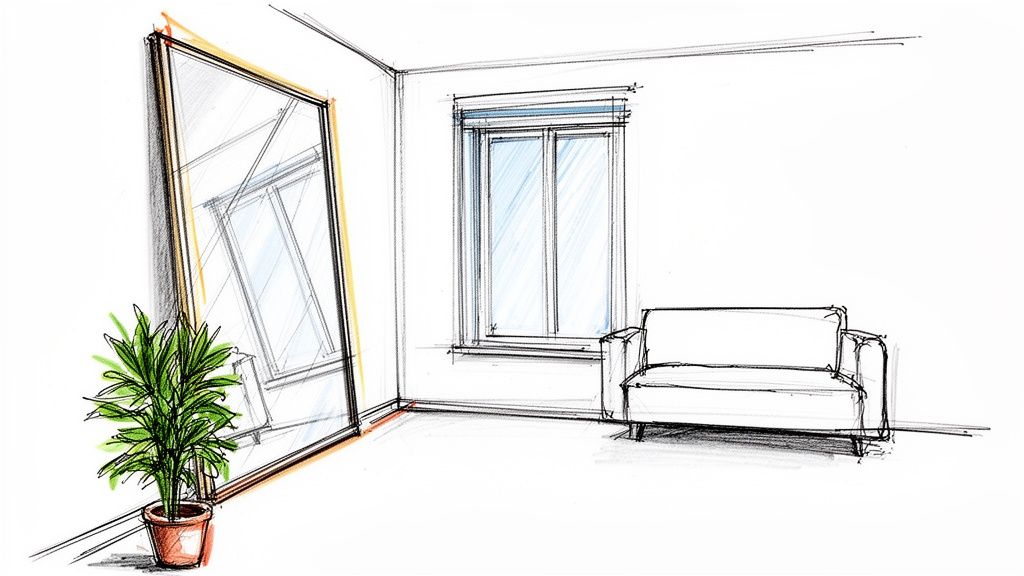
    • Mirrors & Art: Instead of putting holes in the wall, try leaning a large mirror against it. It adds depth and bounces all that warm light around. For art, removable adhesive hooks are a game-changer.
    • Window Treatments: Never underestimate the power of a good set of curtains. They soften the hard lines of a window and make the whole room feel more finished and insulated.

    My Living Room Is Huge and Open. How Do I Make It Feel Less Cavernous?

    This is a problem we see a lot with modern open-concept homes. The key is to stop thinking of it as one giant room and start creating "zones."

    Use a large area rug to anchor your main seating area. This creates a visual boundary, like a room-within-a-room. Arrange your sofa and chairs so they face each other, not just the TV. This encourages conversation and makes the space feel much more intimate. You can even use furniture like a console table behind the sofa or an open-back bookshelf to subtly define the edge of the living "zone" without closing it off.

    It's all about tricking the eye. By creating a specific, well-defined spot for lounging, the rest of the open space just fades into the background. Using your floor and table lamps within this zone is critical—it draws the focus right where you want it.

    How Do I Get That Layered, Cozy Look Without It Just Looking Cluttered?

    There is a fine line between "curated and cozy" and "chaotic and cluttered." It all comes down to being intentional with your choices and having smart storage.

    This is where functional decor shines. Think a stylish storage ottoman for stashing blankets, pretty decorative boxes on a shelf to hide remotes, or a nice woven basket to wrangle magazines. Everything has a place, but it's all hidden in plain sight.

    You also have to be a good editor. Take a look around. Does every item have a purpose? Is it functional, beautiful, or does it hold special meaning? If not, it might just be clutter. Your living room should feel like a personal sanctuary, not a storage unit.


    At Woodstock Furniture & Mattress Outlet, our team is here to help you solve these challenges in person. From finding a functional storage ottoman to trying out different lamp styles, we can provide knowledgeable, hands-on guidance. Visit one of our showrooms to explore the possibilities and start building your cozy retreat.

  • Decorating a Living Room on a Budget in 2026

    Decorating a Living Room on a Budget in 2026

    When you’re itching to redecorate, the temptation to jump straight into shopping is real. But before you start adding throw pillows to your cart, let’s talk strategy. A key to decorating a living room on a budget is to create a smart, actionable plan before a single dollar is spent.

    This isn't about sucking the fun out of it—it's about making sure every piece you buy works together to create a room you’ll actually love. A good plan helps prevent common budget-busting mistakes and helps you focus your spending where it counts.

    Create Your Budget-Friendly Decorating Plan

    Winging it on a decorating project can lead to a room that feels mismatched and a bank account that feels empty. When you start with a clear strategy, your budget stops being a limitation and starts being a creative challenge. It encourages you to make intentional choices that deliver the biggest impact.

    It all boils down to two fundamental first steps: setting your budget and figuring out exactly what "done" looks like for your space.

    Detailed sketch of a living room layout with measurements and design notes for budget decorating.

    Set Your Priorities and Measure Everything

    First, get honest about your priorities. You need to separate the must-haves from the nice-to-haves. That lumpy, uncomfortable sofa you use every single day? That’s a high-priority consideration. A trendy accent chair that looks cool but isn't essential? That can probably wait for phase two.

    Grab a notebook and divide your wish list into three categories:

    • Must-Haves: These are the non-negotiables. Think functional seating, essential storage, or anything that's currently broken or unusable.
    • Nice-to-Haves: These are the upgrades that would improve the room but aren't critical right now, like new side tables or a bigger area rug.
    • Dream Items: That splurge-worthy piece you've had your eye on. It’s okay to dream! Just plan to save for it down the road.

    Next up is an important step you don't want to skip: measure everything. Many design mishaps could have been avoided with a simple tape measure. We're talking about sofas that block doorways and media consoles that are too big for the wall.

    Measure your room’s length and width, note the ceiling height, and jot down the dimensions of windows, doors, and any furniture you’re keeping. This data is the blueprint for your entire project.

    Create a Functional Layout

    With your measurements in hand, it’s time to play with your layout. You don’t need any fancy software for this; a quick sketch on graph paper works well. This is your chance to experiment with different furniture arrangements without physical strain.

    Think about how you actually live in the space. Where does foot traffic flow? Where do you need clear pathways? The goal is to create a layout that’s not just beautiful, but also functional for your daily life.

    As you map things out, don't forget the foundation of the room—the floor. Swapping out old, dated flooring can make a massive impact, and it doesn't have to break the bank. You can find many useful budget-friendly flooring options that deliver high-end style for less.

    By putting in this planning work upfront, you ensure every choice you make is a smart one, getting you closer to a living room you'll love for years to come.

    Get the Most Bang for Your Buck: Paint, Lighting & Textiles

    When you're working with a tight budget, the trick isn't to do everything at once. It’s about being strategic. A few smart, targeted upgrades can make a room feel completely new without a huge expense. If you want a significant visual return on your investment, there are three areas to focus on: paint, lighting, and textiles.

    Sketches of home improvement elements: a paint roller, an illuminated floor lamp, and books on a rug.

    A Fresh Coat of Paint

    Never underestimate the power of a can of paint. It’s one of the most affordable ways to completely transform a room. For just the cost of a gallon and a few supplies, you can change the entire personality of your living room, making it feel brighter, cozier, or more sophisticated.

    Want to make a small, cramped room feel bigger? Go for light, airy colors like soft whites, pale grays, or warm beiges. They bounce light around and create a sense of spaciousness. On the other hand, if you're craving a bit of drama, a single accent wall in a deep navy or moody charcoal can add depth and a high-end feel.

    Let There Be (Layered) Light

    If your room relies on a single overhead light, it's time for a change. That one fixture can be harsh and create unflattering shadows, making a space feel cold and unfinished. The secret to a warm, inviting atmosphere is layered lighting. It’s just a design term for using multiple light sources to create a balanced and functional space.

    Think of it in three simple layers:

    • Ambient Light: This is your main overhead fixture. Consider swapping out an old one for a modern fixture with a dimmer.
    • Task Lighting: This is for getting things done. A floor lamp next to your favorite reading chair or a small table lamp on an end table makes the space more usable.
    • Accent Lighting: This is the fun part! Use small, adjustable spotlights to highlight a piece of art, a plant, or an interesting architectural feature.

    This mix doesn't just make the room work better; it adds dimension and a warm, welcoming glow you can't get from a single light source.

    A room without layered lighting often feels flat and incomplete. By adding just two or three additional light sources like floor or table lamps, you can create depth and warmth that makes the entire space feel more intentional and comfortable.

    Recent design guides show how you can revamp a living room for under $1,000 by focusing on paint, lighting, and one new piece of furniture. A quality gallon of paint can tackle a standard room for less than $80. Adding a dimmable overhead fixture and a couple of stylish, affordable lamps can be done for under $500. For more inspiration on these kinds of makeovers, you can find some great ideas on Povison.com.

    Weave It All Together with Textiles

    Finally, let's talk about the finishing touches that truly make a house a home: textiles. This is where you bring in softness, color, and pattern. An important piece here is the area rug. Getting the size right is crucial—you want a rug large enough for at least the front legs of your sofa and chairs to rest on it. This simple trick anchors the entire seating area and makes it feel unified.

    Once your rug is down, you can have fun with smaller, less expensive items. A new set of curtains can work wonders—hang the rod high and wide to create the illusion of bigger windows and taller ceilings. And don’t forget pillows and throws! A few new throw pillows and a cozy blanket are an easy way to add a pop of color or a new texture, instantly breathing life into a tired old sofa. These are the details that pull everything together and give your room a more professionally styled look.

    Choosing Your Anchor Pieces: Where to Splurge & Where to Save

    When you're decorating a living room on a budget, it’s tempting to spread your money evenly across every piece. A different approach is to consider which items matter most. Not all furniture purchases are created equal, and putting your money in the right places can contribute to a room that looks great and lasts for years.

    The most used pieces are what we call "anchor furniture" – the items you use every single day, like your sofa and media center. Think of your sofa as the heart of the living room. It’s where you unwind, entertain guests, and binge-watch your favorite shows. This is not the place to cut corners.

    Investing in a comfortable, well-built sofa can be a smart decision for your home. A quality frame and supportive cushions can pay off in comfort and durability, meaning you may not be shopping for a replacement in just a couple of years. This is where a good chunk of your budget could go.

    Maximize Your Space with Multi-Functional Furniture

    Once you have your core pieces sorted, it's time to get clever with the rest of your space. When both your budget and your square footage are tight, multi-functional furniture can be a great solution. These hard-working items help you get the most out of your room without adding clutter.

    Here are a few popular double-duty heroes:

    • Coffee Tables with Storage: Look for tables with built-in drawers, a bottom shelf, or even a lift-top that reveals hidden storage. They’re useful for stashing away remotes, magazines, and kids' toys.
    • Storage Ottomans: Is it a footrest? Extra seating for guests? A storage chest for blankets? Yes, yes, and yes. Some even have a reversible top that flips into a hard-surface tray table.
    • Media Consoles with Doors: A media center is for more than just your TV. A model with cabinets or drawers can stylishly hide away gaming consoles, messy cords, and other electronics, keeping your room looking clean and serene.

    By choosing furniture that serves multiple purposes, you reduce the number of items you need to buy. This saves you money and helps a smaller living room feel more open and organized.

    What to Look for When You Shop

    When you’re out shopping for these key pieces, you'll want to focus on three things: construction, fabric, and scale. A sturdy frame made from solid or engineered wood is going to outlast some cheaper alternatives. For upholstery, performance fabrics are a practical choice, especially for busy households, since they're designed to resist stains and wear.

    Finally, always consider scale. A massive sectional might look incredible in a huge showroom, but it could easily swallow your entire living room. Use the measurements you took during your planning phase to ensure your new furniture fits comfortably without overwhelming the space.

    Making smart choices with your anchor furniture is the foundation of any great room design. In fact, furnishings typically claim 25-40% of a total interior design budget. But don't let that number scare you! Savvy shoppers are pulling off entire living room makeovers for $1,000–$3,000 by focusing on durable, mid-range pieces from value-focused stores. To get a better idea of how these numbers break down, you can explore more detailed budget insights on WillettsDesign.com.

    By investing wisely in these core items, you're setting the stage for a beautiful, functional room that will serve your family well for years to come.

    Finding Unique Pieces Through Thrifting & DIY

    Illustration of hands painting a lamp and furniture, with framed textile art and vintage decor.

    While your main furniture pieces set the stage, it’s the smaller, unique items that bring a living room to life and give it personality. This is where you can get really creative and develop a space that feels collected over time, not bought straight off a showroom floor. This is also where you can save a ton of money.

    Thrifting, upcycling, and a little DIY magic are your allies when decorating on a budget. These are the tools that let you craft a one-of-a-kind space filled with character and stories.

    Give Old Furniture a New Story

    Before you run out to buy new accent pieces, take a good, hard look at what you already own. That dated side table from your first apartment or that scuffed-up bookshelf isn't junk—it's raw material waiting for a second chance. With a little effort, you can completely transform a tired piece for a fraction of what a new one would cost.

    Consider these easy upcycling ideas:

    • Paint It: A fresh coat of paint in a bold color can turn a generic wooden end table into an eye-catching statement piece.
    • Change the Hardware: Swapping out old, clunky knobs for sleek modern pulls in brass or matte black is a quick and affordable update that makes any cabinet or dresser look more current.
    • Add Texture: Try applying peel-and-stick wallpaper to the back of a bookshelf or the drawer fronts of a chest for an unexpected pop of pattern and personality.

    Not only do these small projects save you cash, but they also result in a custom piece you won’t find in any store.

    The Thrill of the Hunt for Secondhand Treasures

    For those who love the hunt, knowing what's an estate sale or how to navigate a flea market can be a game-changer. These places, along with consignment shops and online marketplaces, are treasure troves for high-quality and interesting items like lamps, mirrors, side tables, and unique decor.

    Don't overlook pieces with good "bones" just because the finish is a little rough. A solid wood table with a scratched top is the perfect candidate for a weekend DIY project. You're looking for well-made items with character, not perfection.

    This isn’t just about being frugal; it's a key design strategy. You can slash decor costs by 50-70% by personalizing secondhand finds. Plus, today's trends often celebrate unique, one-of-a-kind furniture over mass-produced sets. You can start small—repainting a table might cost you around $50 for a gallon of paint that can be used on multiple projects. Crafting your own wall art from found objects or textiles can make a huge impact for under $200. You can even learn more about how budget-friendly ideas are shaping living room decor on Resident.com.

    By blending new, durable anchor pieces with unique secondhand finds and your own DIY creations, you create a living room that feels curated, authentic, and completely you.

    Shopping Smart and Putting It All Together

    Okay, you’ve got your plan, you know your priorities, and you’ve picked out your anchor pieces. Now for the fun part—shopping! This is where all that careful planning really pays off. Shopping smart isn't just about finding a low price; it's about making choices you’ll be happy with for years to come and avoiding expensive mistakes.

    We always recommend starting your search by seeing and touching furniture in person, especially for big-ticket items like your sofa and chairs. You can flop down on a few couches, feel the fabric, and get a real sense of the quality. This is how you make sure you’re getting true value for your money.

    Finalize Your Layout with Digital Tools

    Before you buy, you'll want to be 100% sure everything will fit. We've all heard stories of a new sofa getting stuck in the doorway. To help prevent that, use technology to your advantage. Many retailers, including us, offer online room planners that let you build a virtual model of your living room.

    You can plug in your exact room dimensions and play around with different furniture layouts. It’s an easy way to see how your design ideas translate from a concept on your laptop to a fully furnished room.

    A diagram illustrating the process of interior design from laptop planning to delivery and room furnishing.

    Using a tool like the Woodstock Outlet Room Planner gives you a fantastic preview of the scale and flow of your space. You can instantly see if that dream sofa will overpower the room or block a walkway. It’s a simple step that saves a world of hassle later on.

    When you're ready to buy, take a quick minute to check the fine print. Understanding the store’s delivery options, assembly services, and warranties can prevent surprise costs and headaches. It’s all part of a smart, stress-free shopping experience.

    The Art of Assembling Your Room

    Once those delivery trucks start rolling in, it's tempting to tear open every box at once. But a little bit of order makes the process smoother and more rewarding. Here’s a simple sequence we recommend for putting your space together.

    • Lay the Foundation. Start with your area rug. It’s the anchor for the whole room and defines your primary seating area. Everything else will build from here.
    • Place the Big Stuff. Next, bring in your sofa. As the main anchor piece, its placement is critical. Get it just right, then add in other large seating like armchairs.
    • Add Your Surfaces. Now it’s time for the coffee table and end tables. Position them where they’re most functional and easily accessible from your seating.
    • Layer in the Finishing Touches. Finally, add your lighting, hang your art and curtains, and style your surfaces. This is where you bring in the personality with pillows, throws, plants, and other decorative objects.

    This isn't just about being efficient; it's about building your room with intention. When you assemble from the ground up, you create a space that feels balanced and cohesive, where every single piece has its perfect place.

    Your Budget Living Room Questions, Answered!

    Embarking on a living room makeover on a budget can bring up a lot of questions. That’s perfectly normal! Getting clear, honest answers is key to making smart choices that make every dollar feel like a great investment. Here are some of the most common questions we hear, with answers to help you plan.

    Where Should I Splurge and Where Can I Save?

    This is probably the number one question we get, and it’s a great one. The rule of thumb we always share is simple: invest in the pieces you use the most. These are your workhorse items, and quality here can pay off in comfort and durability.

    • Splurge Here: Your sofa is the heart of the living room. It’s where you’ll relax, entertain, and spend a huge chunk of your time. A well-made, comfortable sofa is an investment that can last for years. Another worthy splurge is a quality area rug. It anchors the whole room and has to stand up to daily foot traffic.

    • Save Here: Have fun and get creative with your accent pieces! Things like throw pillows, lamps, side tables, and decorative objects are perfect places to save money. They’re easy and relatively inexpensive to swap out later when your style changes or your budget grows.

    And don't forget about DIY art or upcycling a thrift store find! These are fantastic, budget-friendly ways to add a personal touch that makes a space truly yours.

    How Can I Make My Living Room Look Expensive on a Small Budget?

    A high-end look is less about the price tag and more about a few clever design tricks. It all boils down to making intentional choices that create a polished, cohesive feel.

    First, get your lighting right. A single, harsh overhead light can make a room feel cheap. Instead, layer your lighting. A combination of an overhead fixture, a floor lamp, and a table lamp creates a warm, sophisticated ambiance.

    Second, think big with textiles. Hang your curtains high and wide, extending beyond the window frame. This classic designer trick instantly makes your ceilings feel taller and the room more grand. And make sure your area rug is big enough for at least the front legs of your sofa and chairs to sit on it. It’s a small detail that makes a huge impact.

    A clean, uncluttered space always feels more luxurious. Edit your decor down to a few larger, more impactful pieces rather than a collection of small trinkets. It looks more purposeful and less chaotic.

    How Do I Create a Cohesive Look with Mismatched Pieces?

    Let's be honest, most of us don't buy all our furniture at once. A room with soul is often a collection of new pieces, hand-me-downs, and thrifted treasures. The secret to making it all work together is to create a common thread.

    One of the easiest ways to do this is with a consistent color palette. Even if your furniture styles are different, using the same one or two accent colors in your pillows, art, and decor will tie the whole room together beautifully.

    Another great strategy is to repeat materials or finishes. For instance, if you have a wood-frame armchair, echo that wood tone in your picture frames or a decorative bowl. If your coffee table has black metal legs, look for a lamp or curtain rod with a similar black finish. These subtle links are what turn a random assortment of furniture into a thoughtfully designed space.


    At Woodstock Furniture & Mattress Outlet, our knowledgeable team is here to help you find pieces that fit your style and budget, from durable anchor furniture to the perfect finishing touches. Visit us in person to see your options and get friendly, practical advice for your living room project. Explore our selection and get inspired online today.

  • 8 Smart Decorating Tips for Small Living Room Layouts

    8 Smart Decorating Tips for Small Living Room Layouts

    A small living room presents a unique design challenge: how do you create a space that’s functional, comfortable, and stylish without feeling cramped? It’s not about having less, but about being more intentional with every choice. The key is to solve common problems like limited floor space, visual clutter, and poor traffic flow with smart, strategic decisions that maximize both form and function. This guide moves beyond generic advice to provide practical, actionable decorating tips for a small living room, helping you transform your compact area into an inviting and efficient hub for relaxation and daily life.

    We will explore how furniture scale, color, light, and organization work together to create an illusion of greater space and a genuine atmosphere of comfort. For further inspiration on crafting an atmosphere of warmth and personal comfort in any space, explore various cozy home decor ideas. The goal of this article is to equip you with specific strategies, from utilizing vertical space to selecting multi-functional pieces, so you can make informed decisions that reflect your lifestyle. Ultimately, these tips will help you make your small living room work harder and smarter for you, proving that great design isn't about the size of the room, but the ingenuity behind it.

    1. Embrace Multi-Functional Furniture to Maximize Utility

    In a compact living room, every square inch counts. One of the most effective decorating tips for a small living room is to select furniture that does more than one job. Multi-functional pieces maximize your room's utility without consuming precious floor space. Instead of a standard coffee table, consider one with built-in drawers or a lift-top that reveals hidden storage. This approach ensures that each item earns its place, contributing to both the room's style and its overall function.

    This strategy isn't about compromise; it's about smart design. A storage ottoman can provide extra seating for guests, a comfortable footrest, and a concealed home for blankets or board games. Similarly, a sectional sofa with a storage chaise keeps your living area tidy by hiding away seasonal decor or extra pillows, eliminating the need for a separate bulky cabinet. By choosing pieces that serve dual or even triple purposes, you create a space that feels larger, more organized, and perfectly suited to your lifestyle.

    A detailed sketch of multi-functional furniture, including a sofa with a lift-top chaise and nesting tables for small spaces.

    How to Choose the Right Multi-Functional Pieces

    Selecting the right multi-use furniture involves more than just finding an item with a hidden compartment. It requires a thoughtful assessment of your daily needs and long-term goals for the space.

    • Prioritize Primary Use: A sofa bed must first and foremost be a comfortable sofa. Test its cushions and construction for daily use. The guest bed function is secondary, so don't sacrifice everyday comfort for a feature you'll only use occasionally.
    • Measure Everything: Before purchasing, measure not only the space where the furniture will go but also your doorways, hallways, and stairwells. This ensures a smooth delivery and prevents the disappointment of a piece that won't fit through the door.
    • Evaluate Storage Capacity: Think about what you plan to store. A lift-top coffee table is ideal for smaller items like remotes and magazines, while a storage chaise offers deeper space for bulky blankets or pillows.
    • Consider Construction Quality: Multi-functional furniture often has moving parts like hinges, lifts, or pull-out mechanisms. Look for pieces with durable components that can withstand regular use. Our knowledgeable team can help you understand the differences between various options and find well-built pieces that offer lasting value.

    2. Utilize Vertical Space to Draw the Eye Upward

    When floor space is limited, the most overlooked asset in your small living room is the walls. A key decorating tip is to draw the eye upward, creating an illusion of height and openness. Utilizing vertical space means using walls for storage, decor, and functional elements rather than cluttering the floor. This shifts the room's focus from its small footprint to its full height, making the entire area feel more expansive and thoughtfully designed.

    This strategy is about reclaiming unused territory. Instead of a wide, low media console, consider a wall-mounted TV with floating shelves above and below. Floor-to-ceiling bookcases that flank a doorway or fireplace create a grand, built-in look while offering immense storage. By encouraging an upward gaze, you make the room feel airier and more dynamic, transforming empty walls into stylish, functional assets.

    How to Effectively Use Vertical Space

    Implementing this concept correctly involves more than just hanging a few shelves. It requires a balanced approach to ensure the walls feel curated and intentional, not crowded.

    • Choose Tall, Slender Furniture: Opt for tall, narrow bookcases and étagères instead of short, wide ones. These pieces naturally guide the eye upward and occupy a smaller footprint.
    • Mount Shelving Strategically: Floating shelves are a great choice for small living rooms because they provide storage without the visual weight of a traditional cabinet. Install them above a sofa or desk to display books and decor.
    • Create a Vertical Gallery Wall: Arrange artwork and photos in a vertical orientation. This grouping pulls the eye up and can make a low ceiling feel higher than it actually is.
    • Balance Open and Closed Storage: To avoid a cluttered look, mix open shelving with closed, wall-mounted cabinets. This allows you to display your favorite items while hiding everyday essentials from view. We can help you find pieces that offer this blend of style and practicality.

    3. Light and Neutral Color Palettes

    Color has a profound impact on how we perceive the size of a room. One of the most classic decorating tips for a small living room is to use a light and neutral color palette. Shades of white, cream, soft gray, and beige reflect light, creating an open, airy feeling that makes the space seem larger and more expansive than it actually is. This foundation of light colors serves as a canvas, tricking the eye into seeing a brighter, less cluttered environment.

    This approach is about creating visual harmony, not a boring, sterile room. A neutral backdrop allows architectural details and carefully chosen furniture to stand out. Imagine light gray walls paired with white trim and warm, natural wood floors; the combination feels both spacious and inviting. By establishing a bright, cohesive base, you set the stage for a room that feels calm, organized, and elegantly styled.

    Hand-drawn sketch of a living room with a large mirror, potted plant, window, and armchair.

    How to Implement a Light and Neutral Palette

    Successfully using neutrals is a balancing act between creating space and adding personality. The key is to layer textures and subtle variations in tone to build depth and warmth.

    • Layer Tones for Depth: Instead of using one single shade of white or beige, layer several. Combine an off-white sofa with cream-colored pillows and a slightly darker taupe rug. This monochromatic layering adds sophisticated dimension without overwhelming the space.
    • Introduce Texture: Prevent a neutral room from feeling flat by incorporating a variety of textures. Think of a chunky knit throw, a woven jute rug, linen curtains, or a distressed wood coffee table. These elements create visual interest and a cozy, lived-in feel.
    • Use Accents Strategically: Pops of color are useful for personality. Reserve bold hues like emerald green or deep navy for smaller, easily swappable items such as accent pillows, artwork, or a single statement chair. This maintains the room's airy quality while adding a focal point.
    • Balance with Warmth: To keep a light-colored room from feeling cold or clinical, ground it with warm elements. Natural wood tones, brass or gold metallic accents, and leather pieces introduce richness and warmth, making the space feel more inviting and balanced.

    4. Strategic Mirror Placement

    Among the most classic decorating tips for a small living room, strategic mirror placement remains one of the most effective. Mirrors are powerful tools that do more than just reflect your image; they reflect light and create the illusion of depth, visually expanding the dimensions of your room. A well-placed mirror can bounce both natural and artificial light around the space, instantly making it feel brighter, larger, and more open.

    A detailed sketch of a living room showcasing various lighting options and a sofa.

    This technique works by tricking the eye into perceiving more space than actually exists. By reflecting a view or an open area, a mirror adds a new visual plane to the room, preventing walls from feeling like they are closing in. Whether you opt for a large, statement-making floor mirror or a gallery wall of smaller decorative pieces, incorporating mirrors is a simple yet transformative way to enhance a compact living area without sacrificing any floor space.

    How to Position Mirrors for Maximum Impact

    Effective mirror placement is an art that requires considering sightlines, light sources, and what you want to reflect. The goal is to amplify the best features of your room while minimizing any sense of confinement.

    • Reflect Natural Light: The most impactful placement is often opposite a window. This captures the maximum amount of daylight and scatters it throughout the room, creating a bright and airy atmosphere that combats the shadows common in small spaces.
    • Create a Focal Point: Use an oversized or ornately framed mirror as a piece of art. Placing a large mirror above a fireplace, console table, or sofa anchors the space and draws the eye, making the room feel more intentional and grand.
    • Double Your View: Position a mirror to reflect something you love, like a favorite piece of art, a beautiful light fixture, or a glimpse into an adjacent room. Be mindful to avoid reflecting cluttered areas, as this will only amplify the sense of disorganization.
    • Lean, Don't Hang: For an effortless and renter-friendly option, lean a large floor mirror against a wall. This adds a casual, modern touch and avoids the need for installation while still providing a significant space-expanding effect. You can find a variety of mirror styles to complement any decor in our showrooms.

    5. Smart Storage Solutions and Organization

    A small living room can quickly feel cluttered and chaotic, but strategic storage is a powerful decorating tip to reclaim your space. The key is to hide clutter and maximize usable areas while maintaining visual openness. Smart storage solutions go beyond simple containers; they integrate seamlessly into your decor, ensuring items are accessible when needed but concealed from view to create a serene, organized environment. This approach transforms potential clutter zones into functional and stylish parts of the room.

    From built-in cabinetry flanking a fireplace to a sleek TV stand with closed doors, the goal is to create a home for everything. A storage bench under a window can hold seasonal blankets, while a chic ottoman with a removable top can hide away toys or magazines. By thoughtfully selecting pieces that conceal items, you reduce visual noise and make the room feel significantly larger and more intentional. To implement these solutions effectively, consider exploring proven small living room storage ideas that maximize space without compromising style.

    How to Implement Smart Storage and Organization

    Choosing the right storage involves more than just buying bins. It's about creating a system that works for your lifestyle and enhances your room's aesthetic.

    • Prioritize Closed Storage: For items you don't use daily, such as extra cables or seasonal decor, closed cabinetry is ideal. This keeps surfaces clear and maintains a clean, uncluttered look.
    • Utilize Vertical Space: Don't forget your walls. Floating shelves or tall, narrow bookcases draw the eye upward and provide valuable storage without taking up floor space.
    • Establish Zones: Group similar items together. Designate one cabinet for media and electronics, a basket for blankets, and a drawer for remotes and chargers. This makes finding things effortless.
    • Choose Storage that Complements Your Decor: Look for storage pieces that match your room's style. Woven baskets add a natural, textured look, while a sleek, modern media unit can become a sophisticated focal point. The right furniture can add both function and beauty.

    6. Choose Scaled and Low-Profile Furniture

    When decorating a small living room, the size and shape of your furniture can either create an open, airy feel or make the space feel cluttered and cramped. Appropriately scaled furniture is proportionate to the room's dimensions, ensuring that each piece fits comfortably without overwhelming the area. Opting for low-profile designs with clean lines and exposed legs is one of the most effective decorating tips for a small living room because it creates a sense of spaciousness and light.

    This approach is about visual weight. A bulky, oversized sectional with a high back and thick, rolled arms can dominate a room and block sightlines. In contrast, a slim-armed sofa or a compact loveseat with visible wooden legs allows light and air to flow underneath, making the floor appear more expansive. This simple trick draws the eye upward and gives the illusion of higher ceilings and more open space, proving that smart furniture selection is as crucial as layout.

    How to Select Scaled Furniture

    Choosing the right pieces requires a keen eye for proportion and a clear understanding of your room's limitations. Focus on furniture that offers comfort and style without consuming unnecessary visual or physical space.

    • Prioritize Visible Legs: Furniture with exposed legs, like a mid-century modern sofa or a floating media console, instantly makes a room feel larger. This design maintains open sightlines to the floor and walls, preventing the room from feeling boxed in.
    • Opt for Slim Silhouettes: Look for sofas and chairs with straight, slim arms rather than bulky rolled or pillow-top arms. Seating with lower backs also helps maintain an unobstructed view across the room, which is especially important if it faces a window.
    • Measure Before You Buy: Take precise measurements of your living room, including ceiling height and doorways. Bring these dimensions with you when you shop to avoid purchasing a piece that's too large. Our team can help you find options that fit your specific measurements.
    • Test for Comfort: Scaled-down furniture should never mean sacrificing comfort. Sit on sofas and chairs in the showroom to ensure they provide adequate support. Quality construction is key to getting both a compact footprint and lasting usability.

    7. Layered Lighting Design

    One of the most transformative decorating tips for a small living room involves moving beyond a single overhead light. A layered lighting design uses multiple sources to create depth, ambiance, and functionality, preventing the harsh shadows and dark corners that can make a space feel cramped. This approach combines three types of light: ambient (overall illumination), task (focused light for activities), and accent (light that highlights specific features).

    By strategically placing different fixtures at various heights, you draw the eye around the room and create a sense of spaciousness. For instance, a central ceiling fixture provides general ambient light, a floor lamp in a corner offers task lighting for reading, and a small accent lamp on a bookshelf highlights your favorite decor. This multi-source strategy not only makes the room feel larger and more inviting but also adds a layer of visual interest and sophistication that a single light source cannot achieve.

    How to Implement a Layered Lighting Scheme

    Creating an effective layered lighting plan requires thinking about how you use your living room throughout the day. The goal is to build a flexible system that can adapt to different moods and activities.

    • Start with Ambient Light: Your base layer should provide soft, general illumination. This can be a stylish flush-mount ceiling light, a chandelier, or recessed lighting. Installing a dimmer switch is a great option, as it allows you to adjust the overall brightness from bright and energetic to soft and relaxing.
    • Add Task Lighting: Identify areas where you perform specific activities. Place a reading lamp next to your favorite armchair or sofa. If you have a desk in your living room, a focused table lamp is essential. This ensures you have adequate light where you need it most without illuminating the entire room.
    • Incorporate Accent Lights: Use accent lighting to create focal points and add character. Wall sconces can frame a piece of art or a mirror, while track lighting can be aimed at architectural details or a gallery wall. Even small, battery-operated picture lights can make a big impact.
    • Vary Fixture Heights: A key to successful layering is placing lights at different levels. Combine a floor lamp (high), with table lamps (medium), and perhaps uplighting behind a plant (low). This distribution guides the eye vertically and horizontally, enhancing the perception of space.

    8. Minimalist Décor and Intentional Accessorizing

    In a small living room, clutter is the enemy of spaciousness. Adopting a minimalist approach to décor is one of the most transformative decorating tips for a small living room, focusing on quality over quantity and ensuring every item has a purpose. This philosophy encourages you to eliminate unnecessary objects and instead curate a collection of accessories that are either functional or deeply meaningful. The result is a clean, uncluttered, and personalized environment.

    This strategy is about making deliberate choices, not about creating a sterile, empty room. By being intentional with your accessories, you allow each piece to stand out and contribute to the overall aesthetic without overwhelming the space. For example, instead of a busy gallery wall, a single, impactful piece of artwork can serve as a stunning focal point. This approach creates visual breathing room, making the entire living area feel more open, serene, and thoughtfully designed.

    How to Curate Your Décor Intentionally

    Editing your accessories requires a mindset shift from filling empty surfaces to celebrating open space. It's about personalizing your room with items that add value, not just volume.

    • Edit with Purpose: Regularly review your décor. Ask yourself if an item brings you joy, serves a function, or holds sentimental value. If it doesn't, consider storing it or letting it go. The "one in, one out" rule can be helpful; when you bring a new item home, an old one must leave.
    • Create Visual Groupings: When arranging accessories on a shelf or coffee table, group them in odd numbers like three or five. This is a classic design principle that creates a more dynamic and visually appealing composition than even-numbered groupings.
    • Embrace Negative Space: Don't feel the need to cover every surface. Leaving empty space around objects allows them to be appreciated individually and prevents a cluttered look. Treat this "negative space" as a key element of your design.
    • Prioritize Quality and Meaning: Choose décor that you genuinely love and that reflects your personality. A handcrafted vase, a book from a favorite author, or a single beautiful plant can have more impact than a dozen generic, mass-produced items. Our accessory collections offer unique pieces that can help you tell your story.

    8-Tip Comparison for Small Living Room Decor

    Strategy Implementation complexity Resource requirements Expected outcomes Ideal use cases Key advantages
    Multi-Functional Furniture Medium — choose and fit combined pieces Moderate — purchase specialty furniture, delivery/assembly More functions per footprint; added hidden storage and guest capacity Studios, multifunction rooms, tight floor plans Saves floor space, consolidates functions, cost-efficient vs separate items
    Vertical Space Utilization Medium — planning and secure wall mounting Low–Moderate — shelving, brackets, bookcases, possible pro install Frees floor area; creates vertical interest and perceived height Small rooms with limited floor area or high walls Maximizes storage, enhances height perception, customizable
    Light and Neutral Color Palettes Low — paint and textile selection Low — paint, fabrics, accessories Brighter, airier feel; visually larger rooms Any small room needing visual expansion or staging Enhances light, timeless backdrop, versatile for decor changes
    Strategic Mirror Placement Low–Medium — selecting size and secure hanging Low — mirrors and mounting hardware Increased brightness and depth; illusion of space Dark rooms, spaces with windows, staging situations Cost-effective, immediate visual impact, portable
    Smart Storage Solutions and Organization Medium — planning, zoning, and setup Moderate — built-ins, storage furniture, bins Clutter reduced; efficient, accessible storage Homes with many items, families, organized lifestyles Hides clutter, maximizes usable space, improves order
    Scaled and Low-Profile Furniture Low — measurement and selection Moderate — purchase of appropriately sized pieces Maintains sightlines; rooms feel less crowded Narrow rooms, low ceilings, minimalist schemes Visual lightness, better traffic flow, easier arrangement
    Layered Lighting Design Medium–High — fixture planning, wiring, placement Moderate–High — multiple fixtures, dimmers, possible electrician Flexible moods, reduced shadows, perceived depth and space Rooms with poor natural light or multiple activities Improves function and ambiance, highlights features, adjustable
    Minimalist Décor and Intentional Accessorizing Low — editing and curation Low — fewer, higher-quality items Calm, uncluttered environment; focal points emphasized Small modern apartments, low-maintenance lifestyles Maximizes visual space, easier upkeep, emphasizes quality

    Bringing It All Together in Your Home

    Decorating a small living room can feel like a complex puzzle, but with the right approach, it becomes a rewarding opportunity to create a space that is both stylish and highly functional. Moving beyond generic advice, we’ve explored a range of practical, actionable decorating tips for a small living room, focusing on the core principles that make a tangible difference: maximizing light, optimizing your layout, and choosing furniture that works smarter, not just harder.

    The key takeaway is that a successful small space design isn't about restriction; it's about intention. Every piece of furniture, every color choice, and every accessory should serve a purpose. By embracing multi-functional furniture like storage ottomans and sleeper sofas, you reclaim valuable floor space. By drawing the eye upward with vertical storage and tall curtains, you create an illusion of height and openness. These aren't just tricks; they are proven design strategies that directly address the common pain points of a compact living area, transforming a room that feels cramped into one that feels curated and comfortable.

    Your Actionable Path Forward

    Think of these tips not as rigid rules but as a flexible framework for experimentation. The true test of any design is how it functions in your daily life. Start by identifying your biggest challenge: is it clutter, a lack of seating, or poor lighting?

    • For Clutter & Storage Issues: Revisit the sections on smart storage solutions and multi-functional furniture. A single, well-chosen media console or a set of floating shelves can completely change your room's organization.
    • For Layout & Flow Problems: Focus on scaled furniture and strategic placement. Use painter's tape to map out potential furniture footprints on your floor before committing. This simple step can prevent costly mistakes.
    • For a Dark or Cramped Feeling: Prioritize layered lighting and the strategic use of mirrors. Combining ambient, task, and accent lighting gives you ultimate control over the mood and perceived size of your space.

    Ultimately, the most effective decorating tips for a small living room are the ones that resonate with your personal style and support your lifestyle. The goal is to build a haven that feels uniquely yours, a space that is not defined by its square footage but by its thoughtfulness and charm. Seeing and feeling furniture in person is often the final, crucial step in this process. It allows you to verify the scale, test the comfort, and truly visualize how a piece will fit into your home, removing the guesswork and building confidence in your decisions.


    Ready to put these ideas into practice? Seeing appropriately scaled furniture in person can make all the difference. Visit any of our North Georgia showrooms to explore a great selection of sofas, accent chairs, and smart storage solutions perfect for smaller spaces, and let our experienced team at Woodstock Furniture & Mattress Outlet help you find the right pieces for your home.