Tag: living room furniture

  • Side table height for sofa: Finding the right fit for your space

    Side table height for sofa: Finding the right fit for your space

    When you're putting a living room together, the height of your side table is one of those small details that makes a big difference. Get it right, and your room isn't just stylish, it's truly livable. The goal is to create a space that feels balanced and is effortless to use every single day.

    A common rule of thumb we share with shoppers is pretty simple: your side table should be equal to or just a hair shorter than the arm of your sofa. This creates a clean visual line from one piece to the other and, more importantly, makes everything on the table easy to reach. Think of it like a comfortable handshake between your furniture—it just feels right.

    The Golden Rule for Side Table Height

    So, what's the magic number? While every sofa is a little different, there's a simple principle that takes the guesswork out of the equation.

    The core idea is to aim for a side table that is within two inches (higher or lower) of your sofa's armrest. This small window is the sweet spot for achieving both ergonomic comfort and visual harmony in your living space.

    Why This Rule Works

    This isn't just an arbitrary decorator's decree; it's all about practicality. A table at the right height means you can set down your coffee or grab the remote without having to do an awkward reach up or a clumsy lean down.

    Visually, it creates an uninterrupted line that makes the whole seating area feel more cohesive and put-together. It’s a subtle trick that makes the room look like it was designed with intention. This simple visual guide shows exactly what we mean.

    Diagram showing optimal side table height should be equal to the sofa height for perfect alignment.

    As you can see, when the side table and sofa arm are aligned, it creates a layout that’s clean, functional, and just plain easy on the eyes.

    A Guideline with History

    This focus on alignment isn't a new trend. In fact, standard side table heights have hovered between 18 and 24 inches for decades, specifically designed to match the average sofa arm of the time.

    Modern research backs this up, too. One recent survey noted that a significant number of homeowners were much happier with their living room setup when their side tables were within that two-inch range of their sofa arms, noting it made daily life just a little bit easier. If you want to dive deeper, you can learn more about these findings on side table ergonomics.

    To make it even simpler, here's a quick reference table. Just measure your sofa's arm height and find the range that works best for you.

    Side Table Height Quick Reference Guide

    Sofa Arm Height Recommended Side Table Height Why It Works
    20 inches 18 to 22 inches Keeps low-profile sofas looking sleek and uncluttered.
    22 inches 20 to 24 inches A common range that offers lots of versatile table options.
    24 inches 22 to 26 inches Complements traditional sofas and ensures easy reach.
    26+ inches 24 to 28 inches Matches taller, more stately sofa designs perfectly.

    Ultimately, sticking to this "golden rule" is a dependable way to pick a side table that both looks great and works well. It removes the doubt and helps you build a living space that truly fits your life.

    How to Measure Your Sofa for the Perfect Fit

    Alright, so you know the rules of thumb for picking the right side table height. But all that knowledge is only as good as the measurements you're working with. Don't worry, though. Getting this number is incredibly simple and takes just a few seconds.

    Grab a tape measure, and let’s get you ready to shop with confidence.

    Illustration showing a comfortable sofa next to a modern side table with an orange dish.

    The Step-By-Step Measuring Process

    To nail this down, all you really need is a rigid or semi-rigid tape measure. The kind that doesn’t flop around will give you the most accurate reading.

    1. Start from the Floor: Plant the end of your tape measure firmly on the floor, right next to your sofa's arm. If you have a plush area rug, be sure to measure from the top of the rug itself, since that's where your table will actually sit.
    2. Measure to the Top of the Arm: Pull the tape straight up to the very top of the sofa arm. We’re talking about the highest point where you’d naturally rest your arm.
    3. Read the Measurement: That number you see is your sofa arm height. This is the key number you'll take with you when you go shopping.

    What if you have one of those super comfy, overstuffed pillow-top arms? Just give the cushion a gentle press until you feel the solid structure underneath. You want your measurement to reflect the arm’s true height, not the fluffiest part of the pillow.

    Tips for Shopping and Showroom Visits

    Once you’ve got your measurement jotted down, you're set for success, whether you’re browsing online from your couch or walking through a showroom.

    Key Takeaway: When you’re looking at tables online, scroll down to the product details and find the "Height" dimension. You're looking for a side table that is either the same height as your sofa arm or no more than two inches shorter or taller.

    If you’re planning a store visit, bring that tape measure and your sofa's arm height! This is the best way to get a real-world feel for how a table will look and function next to different seating options. And please, don't be shy—the team at Woodstock Furniture & Mattress Outlet is always here to help you find pieces that fit your space and your measurements.

    Why the Right Height Matters for Comfort and Style

    Getting the side table height right isn't just some fussy designer rule; it's one of those little details that makes a huge difference in how your living room looks and feels. It's about turning a simple seating area into a space that’s comfortable, functional, and just plain looks right. This all comes down to two key things that affect you every day: how the room looks (aesthetics) and how it feels to use (ergonomics).

    A sketch illustration showing a hand measuring the height of a sofa with a tape measure.

    Creating Visual Balance and Flow

    Let's talk looks first. When your side table lines up with your sofa's arm, it creates a clean, unbroken line across your furniture. Think of it like a visual horizon in your living room—it’s calming and makes everything feel orderly.

    A table that’s too tall or too short can disrupt that flow. It can make the space feel cluttered or like something is just "off." But when the proportions are correct, the table and sofa look like they were made for each other, giving your room a polished, intentional feel. It’s a subtle trick that has a big impact.

    By creating this strong horizontal axis, you help ground the room and give it a sense of order. This visual continuity makes other pieces, like your lamps or decor, feel connected and purposeful instead of just randomly placed.

    Designing for Everyday Comfort and Ergonomics

    Beyond just looking good, the right side table height is a game-changer for your comfort. A properly sized table makes all those little actions completely effortless. You should be able to set down your coffee mug, grab the remote, or put your book down without even thinking about it.

    If a table is too low, you're constantly doing that awkward forward lean. If it’s too high, you’re reaching up and over in a weird, unnatural way. These may seem like small movements, but doing them over and over can lead to real strain on your arm, shoulder, and back.

    Ergonomic data backs this up. Some studies even show that having a surface at the correct height can significantly reduce shoulder strain during regular use. With so many of us here in North Georgia now working from home, making our living spaces as comfortable as possible has never been more important. You can explore more insights on end table dimensions and comfort if you'd like to dig deeper.

    Ultimately, the goal is to make your living room a place where you can truly relax. Choosing a side table that lines up with your sofa’s arm helps you do just that by:

    • Minimizing Physical Strain: It stops you from awkwardly reaching and bending, which helps your posture even when you're just lounging.
    • Improving Accessibility: Everything you need is right there, within easy arm's reach. It just makes life easier.
    • Enhancing Relaxation: When you're not dealing with those minor physical annoyances, you can fully unwind. A comfortable space is a truly relaxing one.

    Understanding Standard Heights in Furniture Stores

    When you start shopping for a new side table, you might notice something interesting. You’re not sorting through hundreds of random sizes. Instead, most tables seem to cluster within a pretty specific height range. This isn't an accident, and knowing why can make your search a whole lot simpler.

    Most furniture makers build side tables to be between 22 and 26 inches tall. This "sweet spot" was chosen for one simple reason: it’s designed to work well with the arm heights of the vast majority of sofas out there. This gives you a great starting point for finding a good match.

    The Logic Behind Standard Sizing

    Think about it from a manufacturer's perspective. Their goal is to create pieces that work well together right off the bat. Since the average sofa arm height falls somewhere between 23 and 25 inches, it just makes sense to build tables that align with those measurements. This makes the shopping process more efficient for you.

    Rather than feeling limited, think of this standard as a helpful filter. It automatically weeds out poorly proportioned options, leaving you with a pool of good candidates that are already pre-vetted for most living rooms. It’s why when you walk into a showroom, the pieces already feel like they belong together.

    The market backs this up, too. According to some market reports, side tables between 21 and 24 inches tall make up a large percentage of all sales. Their popularity comes directly from how well they sync up with typical sofa arms, creating that balanced and useful setup everyone wants. You can discover more insights about these furniture trends and see how they influence what's available in stores.

    This industry standard isn’t meant to box you in. It’s designed to ensure that almost any table you pick within that range will be a functional and beautiful companion for a standard-sized sofa.

    Your job is simply to take the "Golden Rule" measurement of your own sofa’s arm and then find a table within this common range that fits your style. It’s the perfect way to combine industry know-how with your personal measurements for a great result.

    Solutions for Unique Sofas and Special Cases

    While that “arm height rule” is a fantastic starting point, what happens when your sofa doesn’t play by the rules? We see it all the time here in our showrooms – sofas with super low-profile arms, dramatic high arms, graceful curves, or no arms at all.

    Don’t worry, these unique pieces don’t require you to throw the rulebook out the window. It’s more about knowing how to adapt the rules for your specific sofa. The end goal is always the same: finding a table height that’s easy to use and looks great.

    Low-Profile and Modern Sofas

    Modern sofas that sit low to the ground or have very low arms are a perfect example. If you strictly followed the arm height rule here, you’d end up with a side table that’s too short to be useful. You'd have to awkwardly bend way down just to set down your drink.

    Instead, for these low-slung styles, we recommend matching the table to the seat height.

    • The Guideline: Look for a side table that’s about the same height as the sofa’s seat cushions, or maybe a couple of inches taller.
    • Why It Works: This lifts the tabletop to a much more natural and comfortable height for anyone sitting down. It’s a simple switch that prioritizes function without looking out of place.

    Sofas with High or Curved Arms

    On the flip side, you have sofas with big, statement-making arms, like a traditional chesterfield, or seats with elegant, swooping armrests. Trying to match the highest point of these arms would give you a side table that feels like a towering skyscraper next to you.

    For these sofas, you don't need to match the arm's peak. A better approach is to find a table that lands somewhere between the top of the seat cushion and where your forearm would naturally rest on the arm.

    This sweet spot makes the table perfectly accessible without overwhelming your seating arrangement. It's all about comfortable reach.

    Armless Sofas and Sectional Pieces

    What about sofas that are completely armless? Well, in that case, the main rule doesn't apply at all! The answer here is simple and intuitive: just use the seat height as your guide. A side table that lines up with the seat cushions provides a clean visual stopping point and keeps everything within easy reach.

    This same logic is perfect for those armless pieces you often find in the middle of a sectional sofa. If you’ve got an armless chair wedged between two other pieces, a table that matches the seat height will look and feel just right.

    Reclining Sofas and Chairs

    Finally, we get to recliners, which bring a whole new challenge to the table: making sure there's enough clearance for the footrest to operate. If your side table is too close, too big, or too low, it can get in the way and stop your recliner from, well, reclining.

    When picking a side table height for a reclining sofa, make sure it won’t obstruct the mechanism. A C-shaped table can be a real problem-solver here. The base slides right under the sofa, letting you pull the tabletop over your lap when you need it and push it safely out of the way when it’s time to kick back and relax.

    Finding Your Perfect Match In Person

    Reading about the rules for side table height is one thing, but seeing how they actually play out in a real room? That's the best way to feel truly confident in your choice. While all the measurements and guidelines we’ve talked about will get you incredibly close, nothing beats seeing the furniture for yourself.

    Sketches showing an armchair, a recliner, and a sofa, each accompanied by a matching side table.

    This is exactly where visiting a showroom becomes so important. It’s your chance to go from theory to reality and get a real feel for how a 24-inch table sits next to a 25-inch sofa arm.

    Why an In-Person Visit Makes All the Difference

    Seeing furniture in person takes all the guesswork out of the equation and helps you sidestep those common “if only I’d known” moments. Online pictures are a great start, but they just can’t capture the true scale and feel of a piece.

    • Feel the Scale: You can physically see the height difference and judge for yourself if a table feels right next to a sofa. Is it towering over the arm, or does it look awkwardly short?
    • Test the Reach: Go ahead, sit on a sofa and practice reaching for the table. Does it feel natural to set down your drink? Is it a comfortable height for your book or a lamp?
    • Compare Finishes & Fabrics: See how that rich walnut finish really looks next to a linen-blend sofa, or how a metal table interacts with a leather sectional. This is something photos just can't replicate.

    At the end of the day, the goal is to create a space that’s not just beautiful, but that actually works for how you live. Taking a little time to test-drive your options in a real-world setting is the best way to make sure you get both.

    Get Hands-On Guidance from the Experts

    Shopping for furniture should be fun and creative, not a head-scratcher. When you visit our Woodstock Furniture & Mattress Outlet showrooms, our team is here to help you put everything you've learned into practice. Because our furniture experts are non-commissioned, their only goal is to give you honest advice and help you find a great fit for your home.

    We always encourage shoppers to bring their measurements and a few photos of their living room. From there, we can walk you through our selection of side tables, letting you mix and match different heights with all sorts of sofa styles. This hands-on approach is the secret to building confidence so you can finalize your decision, knowing the pieces you bring home will look like they were made for each other.

    Ready to find your perfect match? Swing by one of our North Georgia furniture stores and let's get started.

    Common Questions About Side Table Height

    Even after you've got the rules down pat, real-life furniture can throw you a curveball. That's perfectly normal! To help you tackle any lingering design dilemmas, we've put together a few of the most common head-scratchers we hear from shoppers on our showroom floor.

    Think of this as your quick-reference guide to give you that last little boost of confidence.

    What if My Sectional has Different Arm Heights?

    This is a frequent question, and for good reason! Many sectionals have a standard arm on one side and a low-profile chaise or even an armless corner piece on the other. It can feel like a puzzle.

    Don't overthink it. The easiest way to handle this is to treat each end of the sectional as its own little zone.

    On the side with a regular arm, just follow our golden rule: pick a table that’s about the same height as the arm. For the chaise or armless end, your new reference point is the seat cushion. A table that’s level with the seat height works beautifully there. This way, both ends look balanced and are just as easy to use.

    Should a Side Table Ever Be Taller Than the Sofa Arm?

    Generally speaking, you want to avoid side tables that are a lot taller than your sofa’s arm. When a table looms over the arm, it can make the whole setup feel top-heavy and off-balance. It breaks up that nice, clean horizontal line you're aiming for and can be awkward to reach across.

    That said, there's a little wiggle room. A table that’s just an inch or two taller is usually no big deal, especially if it’s a slender table that doesn’t feel bulky.

    The most important thing is comfortable access. If a slightly taller table is what you need for a lamp to cast light perfectly, or just to keep you from straining to grab your drink, it can absolutely work. Just be careful it doesn't tower over your sofa.

    What’s the Best Height for an Armless Sofa Table?

    When you’ve got a sofa with no arms at all, our main rule of thumb goes right out the window. So, what’s the new reference point? Simple: the sofa's seat height.

    • Look for a table that’s either the same height as the seat cushions or just a few inches taller. This puts everything at a natural, easy-to-reach level for anyone sitting down.
    • The one thing you really want to avoid is a table that’s shorter than the seat. This forces you to lean down uncomfortably every time you use it.

    By using the seat as your guide, you’ll get a surface that’s not only practical but also creates a clean, intentional look that fits perfectly with the sleek style of an armless sofa.


    Finding the perfect pieces to finish your living room is all about understanding these simple guidelines and then trusting your gut when you see them in person. Here at Woodstock Furniture & Mattress Outlet, our friendly, knowledgeable team loves helping customers test out different heights and styles to find that "just right" side table.

    Explore our great selection online or come visit us at one of our showrooms to find your perfect match. Find the ideal furniture for your home by visiting woodstockoutlet.com.
  • How to Choose a Coffee table for Your Living Room

    How to Choose a Coffee table for Your Living Room

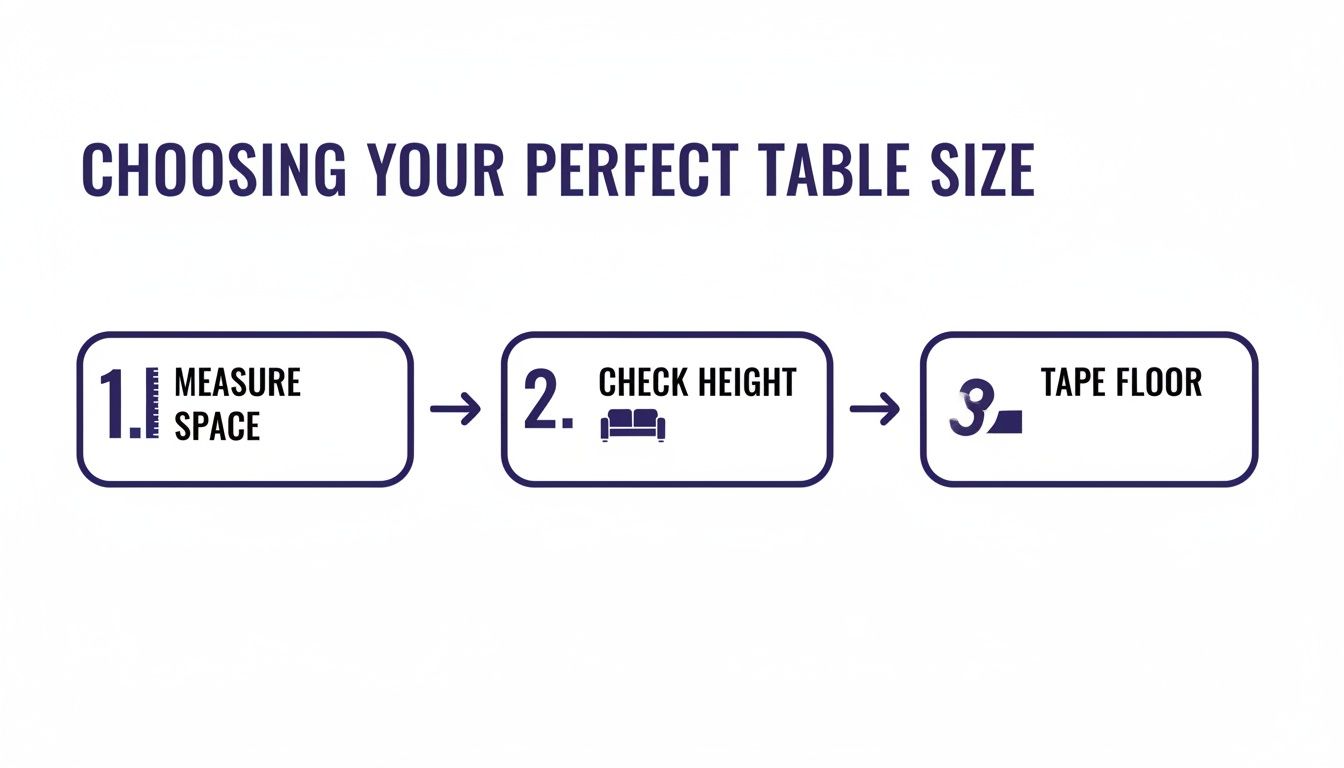
    Choosing the right coffee table starts with understanding your living space and how you use it every day. The key is to grab a tape measure long before you start browsing a showroom. You’ll want to measure your seating area, make sure the table’s height works with your sofa, and leave plenty of room to walk around.

    A well-chosen coffee table should feel like a natural part of the room, not an obstacle.

    Start With Your Space, Not the Showroom

    It's a common experience: you fall in love with a piece of furniture on its own, without thinking about how it’s going to fit—literally and stylistically—into your home. This is one of the most frequent challenges we see shoppers face.

    A table that looks great in a large, open showroom can completely overwhelm a cozy living room. On the flip side, a smaller table can get lost in a large, open-concept space. The most helpful tool here is a simple tape measure, not a glossy catalog.

    Doing this bit of prep work takes the guesswork out of the equation. Before you even start thinking about interesting designs or rustic finishes, you need to nail down the ideal dimensions for your new centerpiece. This approach helps ensure your final choice will look great and function well in your room.

    Define Your Table's Footprint

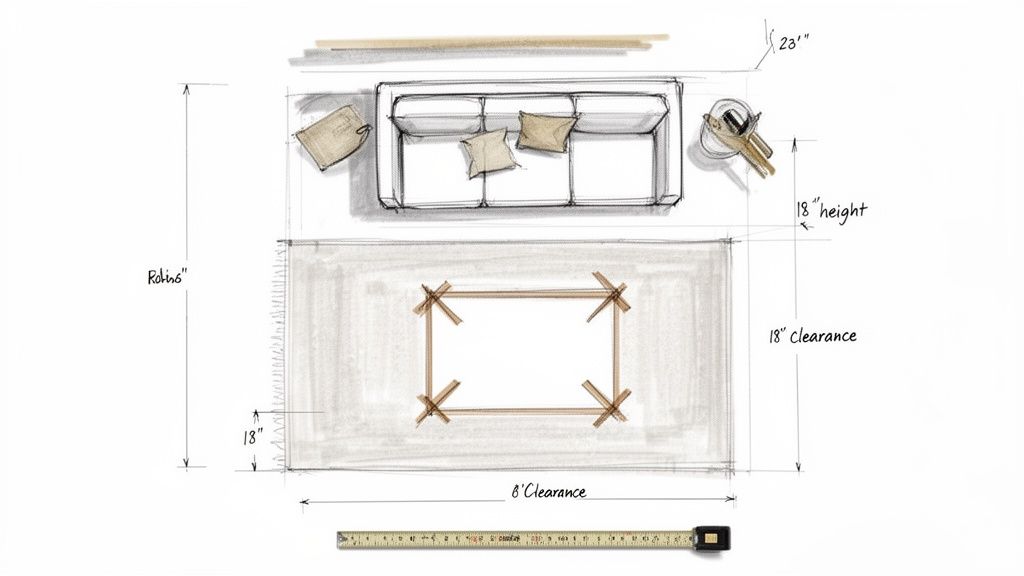
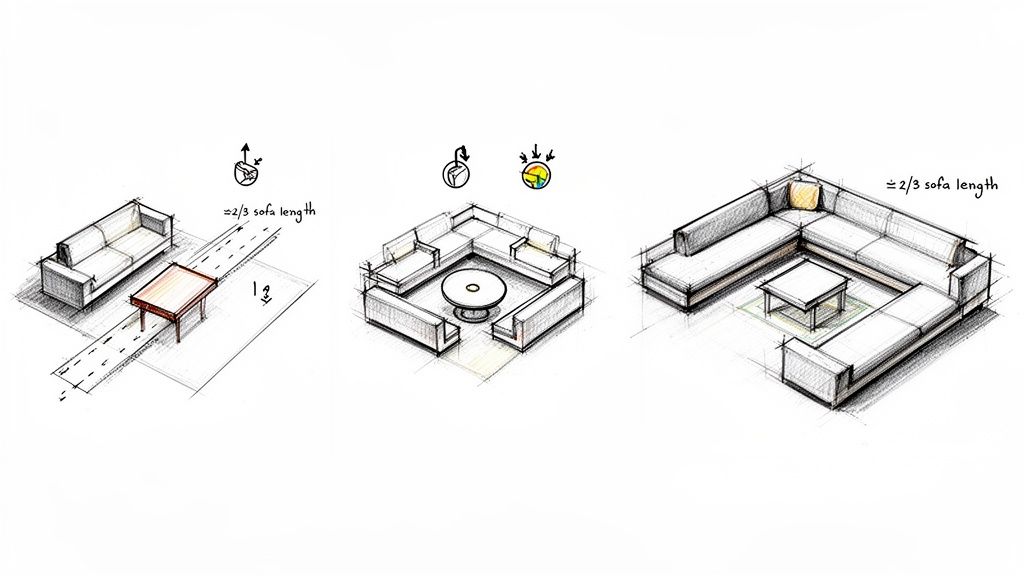
    First, let’s talk scale. A reliable rule of thumb is that your coffee table should be about two-thirds the length of your sofa. This simple ratio creates a satisfying visual balance. If the table is much longer, it can start to dominate the conversation area; if it's much shorter, it can feel like an afterthought.

    Next up is height. For a comfortable setup, find a table that is either the same height as your sofa cushions or just one to two inches lower. This keeps the sightlines across your room open, and more importantly, it makes it easy to reach for your drink or the remote without straining. A table that’s too high or too low can feel awkward to use.

    A diagram outlining three steps to choosing the perfect table size: measure space, check height, and tape floor.

    These core measurement rules are your foundation. To make it even easier, here’s a quick-glance table to keep handy.

    Essential Coffee Table Measurements at a Glance

    This quick reference guide breaks down the standard rules for sizing and placing a coffee table to ensure it fits your living room well.

    Measurement Rule Recommended Distance/Height Why It Matters
    Clearance From Sofa 14 to 18 inches Provides enough legroom while keeping items within easy reach.
    Table Length vs. Sofa Two-thirds the length of your sofa Creates visual balance and prevents the table from overpowering or underwhelming the seating area.
    Table Height vs. Sofa Same height as sofa cushions or 1-2 inches lower Ensures a comfortable reach from a seated position and maintains an open, uncluttered sightline.
    Clearance From Other Furniture At least 30 inches Allows for clear, comfortable walkways and keeps the room from feeling cramped.

    Following these guidelines will help you find a coffee table that not only looks great but also works seamlessly with your lifestyle and existing furniture.

    Visualize It in Your Room

    Got your ideal measurements? Great. Now, go grab a roll of painter’s tape. Mark out the length and width of your potential coffee table right there on the floor. Don’t just look at it—live with that taped-off rectangle for a day or two. It’s a simple trick, but it gives you a real-world feel for the table’s footprint.

    Pro Tip: Walk around the taped area just like you normally would. Do you find yourself having to squeeze by to get to the couch? Does it block a main path through the room? This is a useful way to test your layout and make sure your new table enhances your space instead of getting in the way.

    The global coffee table market is growing—expected to hit $4.85 billion in 2025—which means homeowners have more choices than ever. For shoppers here in North Georgia, that translates to a wide variety of sizes, styles, and materials to fit any home. You can read more about this market growth on Archive Market Research. With so many options available, taking the time to measure your own space first is the most important step you can take to narrow the field and find a good fit.

    Finding the Right Shape for Your Room's Layout

    Top-down sketch of a living room layout showing sofa, rug, coffee table, and furniture dimensions.

    Once you've nailed down the ideal size for your coffee table, the next big question is shape. This is about more than just looks—it’s about how your family and guests move through the room. The right shape guides traffic and works with your seating, making the space feel intuitive. The wrong one can turn your living room into an obstacle course.

    Think about a common living room setup: a standard sofa facing a TV or fireplace. For this kind of straight, linear arrangement, a rectangular or oval coffee table is almost always a good fit. It echoes the long lines of the sofa and gives everyone sitting on it a place to set their drink. An elongated shape also keeps the pathways on either side clear, so nobody's tripping on their way out of the room.

    Matching Shape to Seating

    Your seating arrangement is your best clue for choosing the right table shape. Different layouts just feel better with certain shapes anchoring them.

    • For Traditional Sofas: Stick with a rectangular or oval table. It keeps the proportions right and ensures the surface area is useful for everyone.
    • For Sectionals and U-Shaped Seating: This is where a square or round coffee table really shines. It nestles nicely into the L-shape of a sectional, creating a central hub that’s easy to reach from any seat.
    • For Conversational Layouts: If you have two sofas facing each other or a sofa with a pair of chairs, a large round or square table can be a great choice. It fills that central space and visually ties all the separate pieces together into one cozy gathering spot.

    A quick but important tip for those with little ones: safety and flow are huge. Round and oval tables don't have sharp corners, making them a more forgiving choice for homes with toddlers running around.

    You're really looking to create a nice visual conversation between your sofa and your coffee table. A structured rectangular sofa, for instance, can be beautifully softened by the gentle curves of an oval table. On the other hand, a big, cozy sectional often feels more grounded and complete with a solid square table at its center.

    Creating Visual Balance and Flow

    Take a minute to think about how people actually walk through your living room. Is there a main path that cuts right through the middle of everything? If so, a table with softer edges, like a round or oval one, can make a huge difference. These shapes encourage movement around them instead of creating a hard stop.

    For example, in a long, narrow room where people are always walking past the sofa to get to another part of the house, an oval table gives you the surface area you need but with rounded ends that are much easier to navigate around. It’s a subtle detail, but one that makes the room feel less cramped day in and day out.

    At the end of the day, the shape you pick helps set the tone for the whole room. The sharp, clean lines of a square or rectangular table tend to give off a more formal, structured vibe. In contrast, the soft curves of a round or oval table almost always create a more relaxed, casual, and inviting atmosphere. There's no substitute for seeing it in person, which is why a trip to a showroom can be so helpful to really get a feel for how different shapes and styles interact.

    Choosing Materials That Match Your Lifestyle

    Diagrams showing optimal coffee table placement and sofa arrangements for living spaces.

    A coffee table's material is really its personality. It sets the tone for the room's look and feel, but maybe more importantly, it dictates how much you'll have to fuss over it. The goal is to find a material that fits your real life, not one that just adds another chore to your list.

    Let's be honest for a second. Is your living room a strict "no-drinks-without-a-coaster" zone, or is it more of a relaxed, kick-your-feet-up kind of space? Answering that question will point you toward the right choice faster than any design trend.

    Wood: The Classic for a Reason

    Solid wood is a timeless choice, and for good reason. It brings a natural warmth and texture to a room, grounding the space with an organic feel you just can't fake. Woods like oak, walnut, and maple are incredibly durable and can stick around for decades with a little TLC.

    But, you do have to be mindful. Wood is vulnerable to those dreaded water rings from a sweating glass of iced tea and can get scratched by keys or laptops. While most modern wood tables have protective finishes, they’ll still thank you for using coasters and wiping them down gently. If you're open to pre-loved pieces, knowing how to choose second-hand furniture can open up a world of unique, character-rich wood tables.

    Here's a Pro Tip: If you have an active household with kids or pets, a rustic or reclaimed wood table is your friend. The existing imperfections and distressed finish are brilliant at hiding new dings and scratches. In fact, a little extra wear and tear often just adds to its character.

    Metal and Glass for a Lighter Touch

    If your style leans more modern or industrial, metal and glass are great options. They help create a sense of openness and light, which is a huge plus in smaller living rooms. A glass top lets you see the beautiful rug underneath, making the whole room feel bigger.

    The trade-off, of course, is the upkeep. Glass shows every single fingerprint, smudge, and speck of dust, so it needs frequent cleaning to look its best. Metal frames are tough but can be scratched, and some finishes might show wear over time.

    Upholstered Ottomans and Statement Stone

    Upholstered ottomans are an amazing, family-friendly alternative to a hard-surfaced table. They're soft, have no sharp corners (a win for homes with little ones), and can easily double as extra seating or a comfy footrest. We always recommend looking for one in a performance fabric to make clean-up a breeze.

    For a truly bold and sophisticated look, you can't beat stone. Materials like marble, travertine, or concrete make a powerful statement. They're incredibly durable when it comes to scratches, but they can be porous and stain easily from spills like red wine or coffee. You'll likely need to seal the surface regularly to protect your investment.

    Lately, sustainability has also become a huge factor for shoppers. Data shows that over 70% of consumers are making sustainability a priority when buying home furnishings. This shift means that here in North Georgia, we're seeing a wonderful variety of tables made from reclaimed wood, recycled metals, and other eco-friendly materials. To learn more about this trend, you can discover more insights about coffee table trends on JMDI Furniture's blog.

    Thinking Beyond the Surface With Smart Features

    While it’s easy to get caught up in style, shape, and material, the real magic of a modern coffee table is how it solves everyday problems. These days, a coffee table can be one of the hardest-working pieces in your living room, going way beyond just a spot to set your drink.

    To find the right one, you have to get honest about how you really use your space. Is it command central for family game nights? Your quiet corner for morning coffee and the newspaper? Does it have to double as a home office a few days a week? The answers to those questions will point you toward features that genuinely make your life easier.

    Do You Need a Place for Everything?

    Let's face it, clutter happens. Remote controls, magazines, charging cables, and the kids' latest favorite toys can stage a takeover of any living room. If that sounds painfully familiar, a coffee table with built-in storage is less of a want and more of a need.

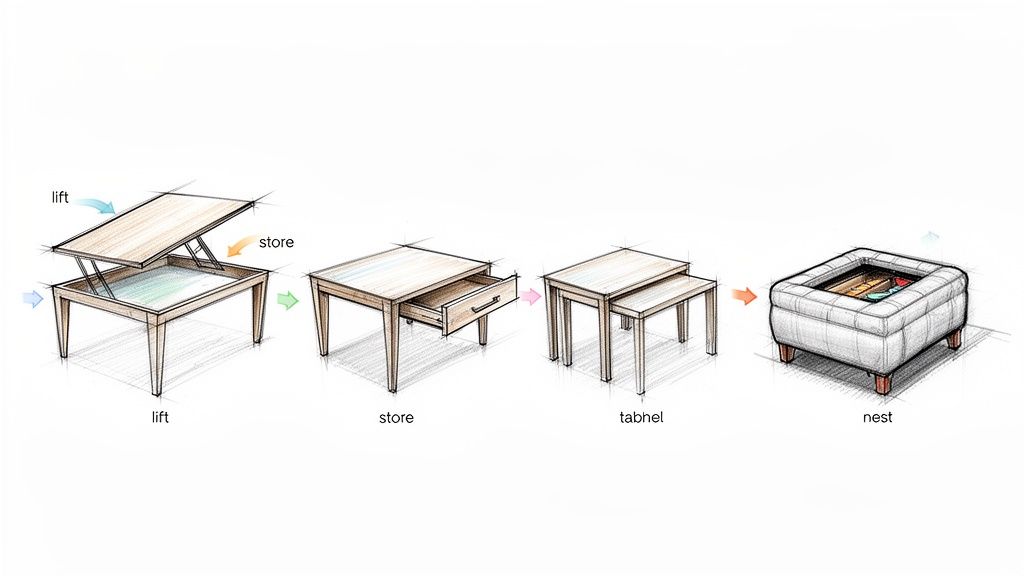
    • Tables with Drawers: These are perfect for hiding away all those small odds and ends you need close by but don't want to look at—think remotes, coasters, pens, and charging cords.
    • Tables with Open Shelving: A lower shelf is a great spot to stack a few of your favorite art books, place a decorative basket for magazines, or keep a cozy throw blanket within arm's reach.
    • Ottomans with Hidden Storage: For the ultimate clutter-busting solution, you can't beat a storage ottoman. Just lift the top, and you've got a spacious compartment ready to swallow up board games, extra pillows, or toys in an instant.

    Choosing a table with the right kind of storage transforms it from a piece of furniture you just have to an active tool that helps you stay organized. It’s a simple change that makes a huge difference in keeping your living space tidy and relaxing with almost zero extra effort.

    Tables That Work Harder for You

    Your living room probably wears a lot of different hats, and your coffee table should be able to keep up. Innovative, functional designs can be a total game-changer, especially for busy households. Some people are even taking this a step further by looking into the best smart home devices to see how technology can add even more convenience to their living spaces.

    A lift-top coffee table is a perfect example of this in action. Do you ever find yourself eating dinner on the couch or trying to work on your laptop? These tables are incredible. The top lifts up and pulls toward you, creating an elevated surface at a comfortable height, saving you from hunching over. In just a few seconds, your sofa area becomes a more usable desk or dining spot.

    If you're working with a smaller room or just need your space to be more flexible, nesting tables are a brilliant choice. You get two or more tables of varying sizes that tuck neatly together to save floor space. Then, when guests come over, you can pull them apart and give everyone their own spot for a drink and a plate of appetizers.

    To help you decide which features might be right for your home, here’s a quick comparison of the most popular functional coffee table types.

    Comparing Coffee Table Features for Your Needs

    Feature Type Best For Key Considerations
    Lift-Top Working from home, dining on the sofa, or crafting. The mechanism should be smooth and sturdy. Make sure the height is comfortable for you when seated.
    Hidden Storage Families with kids, anyone who hates clutter, storing blankets and games. Consider drawers vs. an open cavity. Drawers are better for small items; open storage is great for bulkier things.
    Nesting Tables Small spaces, frequent entertainers, and flexible layouts. Look for a stable design when nested and separated. Ensure the smaller tables are easy to pull out and move around.
    Open Shelving Displaying books or decor, easy access to frequently used items. Can look cluttered if not styled intentionally. Might require more frequent dusting than enclosed storage.

    Ultimately, the key is to look past the aesthetics for a moment and really think about how a coffee table can support your daily life. When you match these smart features to your family’s specific needs, you’ll end up with a piece that doesn't just look amazing—it makes your home function better, too.

    Making a Confident Choice in North Georgia

    Four sketch illustrations demonstrate various functional coffee table designs, including lift-top, storage, nesting, and ottoman with storage.

    You’ve done the homework—you measured your space, considered your family's daily grind, and maybe even bookmarked a few favorites online. So, what’s the final step in how to choose a coffee table? Seeing your top contenders in person.

    Online photos are a great starting point, but they can’t always capture the true color, texture, and sheer presence of a piece of furniture. Visiting a showroom is where you move from theory to reality. It lets you get a real feel for the coffee table’s quality and scale in a way a screen just can’t replicate. You can double-check the height, test the stability, and see how the finish really looks under normal lighting.

    What to Look For in a Showroom

    When you’re on the floor, it’s your chance to play detective and spot the signs of quality craftsmanship. Don’t be shy about it! This is your opportunity to make sure the piece is built to last.

    Here are a few things our own furniture experts always check:

    • Give it a nudge. Gently push on the table to see if it wobbles or feels flimsy. A well-built table should feel solid and grounded.
    • Inspect the details. If it’s a wood table, ask if it’s solid wood or a veneer. Look closely at the joints and connections for any gaps or sloppy construction.
    • Work the features. If the table has drawers, slide them open and shut. Do they glide smoothly? For a lift-top, test the mechanism to make sure it operates easily and feels secure when raised.

    This is also the perfect time to ask questions. Our staff can give you the lowdown on the materials, the durability of the finish, and the best way to care for your new table so it looks great for years.

    Visiting a showroom bridges that critical gap between your research and your final decision. It’s where you can confirm that the table you like online is the table you’ll love in your home.

    Bringing Your Vision Home

    This final, hands-on step is what helps you make a confident investment. By combining your careful planning with the real-world experience of seeing and touching the furniture, you all but eliminate any future surprises or buyer's remorse.

    So, take your time in the showroom. Find a nearby sofa and sit down to see how the table feels from a natural vantage point. Try to visualize it with your rug, your decor, and your family gathered around it. This thoughtful approach ensures the coffee table you bring home is more than just a piece of furniture—it’s a great fit for your North Georgia lifestyle.

    Common Questions About Choosing a Coffee Table

    Even after doing all your homework, a few last-minute questions always seem to surface right when you think you've found the right one. Don't worry, it happens to everyone. Think of this as your final check, where we give straight answers to the most common questions we hear on our showroom floors every single day.

    Should My Coffee Table Match My End Tables?

    This is easily one of the questions we get asked the most. The short answer? No, they absolutely don’t have to match. In fact, your room will probably look a lot more interesting and professionally designed if they don't. The goal is coordination, not a carbon copy.

    Instead of matching, look for a common thread that ties the pieces together. For example:

    • Material: Try pairing a solid oak coffee table with end tables that have oak legs but maybe a different top, like metal or stone.
    • Finish: A dark wood coffee table can look great with black metal end tables. The shared dark tones create a connected, intentional feel.
    • Shape: You could use a round coffee table to soften the lines of two square end tables. This contrast adds visual balance to the room.

    Ultimately, you want a space that feels curated and collected over time, not like you bought everything from a single page in a catalog.

    What’s the Best Coffee Table for a Home With Kids or Pets?

    When your living room doubles as a playground or a dog park, durability and safety are the name of the game. For homes with toddlers, an upholstered ottoman is a fantastic choice. No sharp corners for little heads to bump, and it provides a soft surface for them to play on.

    Another great option is a round or oval wood table. Again, no sharp corners means more peace of mind for you. If you go this route, look for a rustic or distressed wood finish. It's incredibly forgiving and will hide the inevitable scratches from toys or pet claws—in fact, a few dings and scrapes often just add to its character.

    Our Recommendation: Always look for tables with a tough, protective finish that can handle spills and daily use. When in doubt, a solid, heavy piece will always hold up better in a busy home than something more delicate.

    How Do I Know if a Coffee Table Is Good Quality?

    It's easy to get distracted by a table's looks, but a few simple checks can tell you if it’s built to last. When you're in the showroom, don't be afraid to get a little hands-on.

    First, give the table a little shove. A quality piece should feel solid and stable and shouldn't wobble or creak. Next, check out the moving parts. If it has drawers, pull them out and push them back in. Do they glide smoothly, or do they stick and rattle?

    For any wood table, ask if it's made from solid wood or a veneer. Solid wood is almost always more durable and has the huge advantage of being able to be refinished years down the road. Lastly, run your hand over the finish. It should feel even and smooth, with no rough spots or drips. These small details are the biggest clues to good craftsmanship and tell you a lot about how that table will stand up to time.


    Ready to see how the right coffee table can complete your living room? The knowledgeable team at Woodstock Furniture & Mattress Outlet is here to help you explore a great selection of styles, materials, and functional options in person. Visit one of our North Georgia showrooms today!

  • How to Choose a Sofa That Fits Your Life and Your Living Room

    How to Choose a Sofa That Fits Your Life and Your Living Room

    Here’s a simple truth learned after years in this business: good sofa choices come from a simple formula. Plan your space, get honest about your lifestyle needs, and know what real quality looks like.

    You need to start by measuring your room and all the doorways first. Then, think hard about how you and your family will actually use the sofa every single day. Only then should you start looking at fabrics and styles. This practical-first approach is your best defense against buyer's remorse and helps you end up with a sofa you'll love for years.

    Starting Your Sofa Search With a Plan

    A new sofa isn't just another piece of furniture. It’s often the heart of the home. It’s where you crash after a long day, where the family piles up for movie night, and where you catch up with friends. Because it plays such a huge role in your daily life, starting with a solid plan is the key to choosing a sofa that truly fits your life, not just your living room.

    Before you let yourself fall for a specific style or a trendy color, you have to do the foundational work. This is the stuff that grounds your search in the reality of your home and your habits. Getting this right transforms the whole process from overwhelming to empowering.

    Assess Your Lifestyle Needs First

    How are you really going to use this sofa?

    Answering that question with total honesty is one of the most important things you'll do. A sofa destined for a formal, rarely-used living room is a completely different piece of furniture than one that’s the command center for a busy family.

    Ask yourself these key questions to figure out what you need:

    • Who is using this sofa? Is it just for you and a partner? Or does it need to stand up to kids, pets, and a steady stream of guests? This single question will steer everything from the size you pick to the upholstery you choose.
    • What happens here? Is this your go-to napping spot? The binge-watching throne? Or is it more for upright, formal conversations? A deep, plush sofa is a lounger's dream, but a shallower, firmer one offers much better support for sitting and chatting.
    • Got kids or pets? If the answer is yes, then durability and easy cleaning just shot to the top of your list. You'll want to look at performance fabrics or certain types of leather that can handle spills and claws, rather than delicate materials like silk or linen.

    Measure Everything. Twice.

    One of the most common problems people face is buying a sofa that’s too big for their space. Even worse? Buying one that won't even fit through the front door. You can completely avoid that delivery-day disaster by taking detailed measurements before you even start shopping.

    A tape measure is your most important tool in this process. Seriously. Ten minutes of measuring now will save you from a massive headache and the disappointment of having to return a sofa you’ve already fallen in love with.

    Grab a tape measure and get the numbers for these three critical areas:

    1. Your Room: Measure the length and width of the room, especially the wall where the sofa will go. A helpful pro tip is to use painter's tape to outline the sofa's footprint on the floor. This simple trick helps you visualize exactly how much space it will take up and makes sure you have plenty of room to walk around it.
    2. Your Entry Points: Measure the height and width of every doorway, hallway, and staircase the sofa needs to navigate. Don't forget to account for tricky corners or low-hanging light fixtures.
    3. The Sofa Itself: When you're shopping, always find the sofa's official dimensions—length, depth, and height. The diagonal depth is often the most critical number; it determines if the piece can be tipped and angled through a tight doorway.

    Finding the Right Sofa Shape for Your Space

    Once you’ve got your measurements, it’s time for the fun part: finding a sofa shape that actually works with your room's flow and how you live in it. This isn't just about looks; it's about function. The right shape can anchor a conversation area, make a small room feel bigger, or create that perfect cozy corner you've been dreaming of.

    You'll see everything from standard three-seaters to large sectionals and clever sleeper sofas. Each one solves a different problem and fits a different kind of home.

    Matching Sofa Configurations to Your Home

    The right sofa shape doesn't just fit—it enhances your living space. A classic three-seat sofa, for instance, is a go-to for a reason. It’s versatile enough for most traditional living rooms, offering ample seating without totally dominating the space. It’s a reliable choice for apartments and mid-sized homes alike.

    A loveseat, which is really just a cozy two-seater, is well-suited for smaller dens, home offices, or as a partner to a larger sofa. You get comfortable seating without eating up a ton of floor space.

    Then you have the sectional sofa, a practical solution for big families or anyone who loves to entertain. An L-shaped sectional can tuck neatly into the corner of an open-concept living area—something we see a lot in North Georgia homes—carving out an inviting spot for everyone to gather. U-shaped sectionals offer even more room, making them ideal for media rooms where everyone can have a spot.

    • Standard Sofas (Three-Seaters): Suited for defined living rooms where you need a straightforward, versatile seating solution.
    • Loveseats (Two-Seaters): Excellent for smaller spaces, entryways, or paired with a larger sofa to create a full conversation set.
    • Sectional Sofas (L-Shape or U-Shape): Ideal for large or open-concept rooms, maximizing seating and helping to define specific zones within the space.
    • Sleeper Sofas: A practical choice for homes without a guest room, offering a place for visitors to stay overnight without sacrificing style.

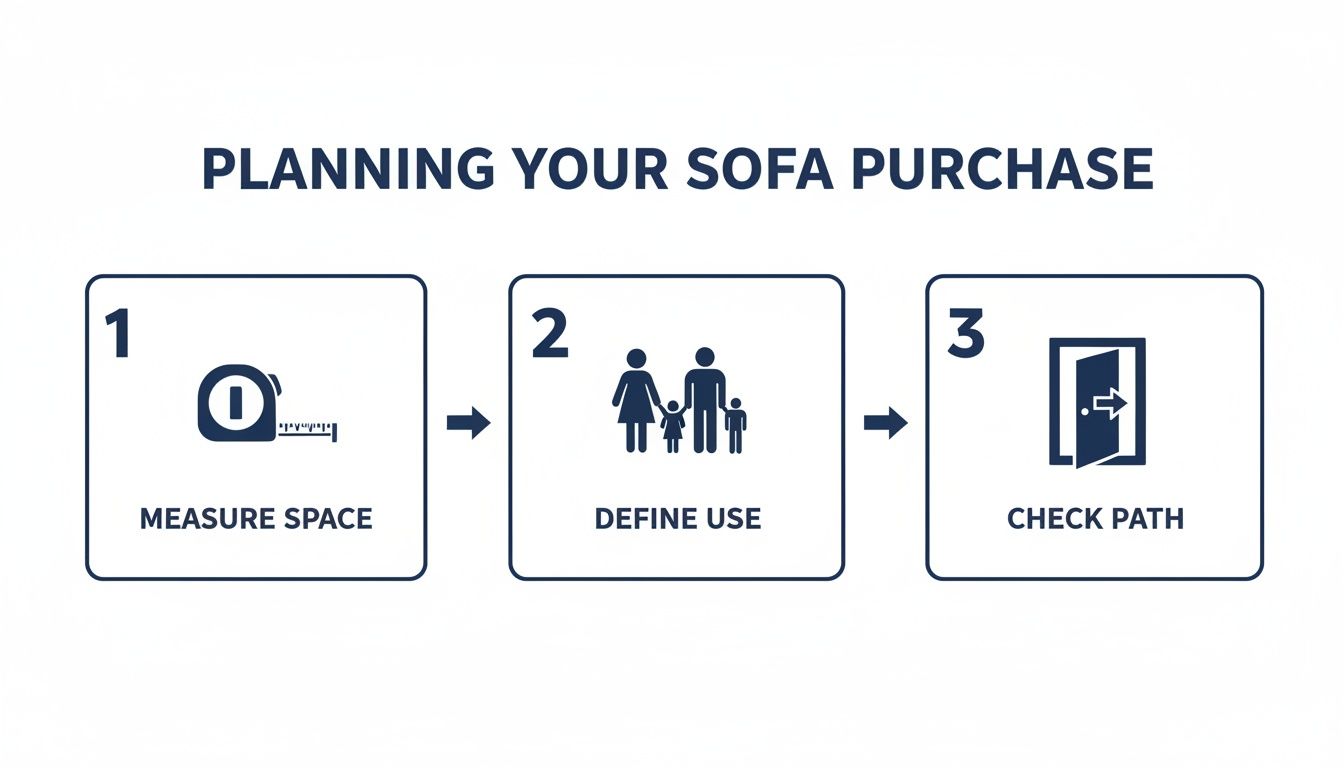
    The graphic below breaks down a simple way to think about your sofa purchase, from measuring the room to thinking about its purpose.

    A three-step guide for planning a sofa purchase: measure space, define use, and check path.

    This just drives home the point: understanding your space and your needs before you start shopping is the key to choosing with confidence.

    Visualizing the Sofa in Your Room

    Even with all the right numbers, it can be tough to truly picture how a large piece of furniture will feel once it's actually in your room. One of the most helpful tricks is to use painter's tape to outline the sofa's dimensions right on your floor.

    This simple move gives you a real-world sense of scale. You can see exactly how much real estate the sofa will take up and make sure you still have room to walk around. Try walking around the taped-off area. Does it feel natural, or are you bumping into things? Does it block a doorway? Is there enough room for a coffee table? A great next step is to consult a detailed guide to sofa dimensions to make sure your choice fits comfortably.

    By mapping it out first, you take all the guesswork out of the equation. You can test different spots and layouts without having to move a single heavy object, making sure the final choice is one you'll love.

    Peek Under the Hood: What Makes a Sofa Last

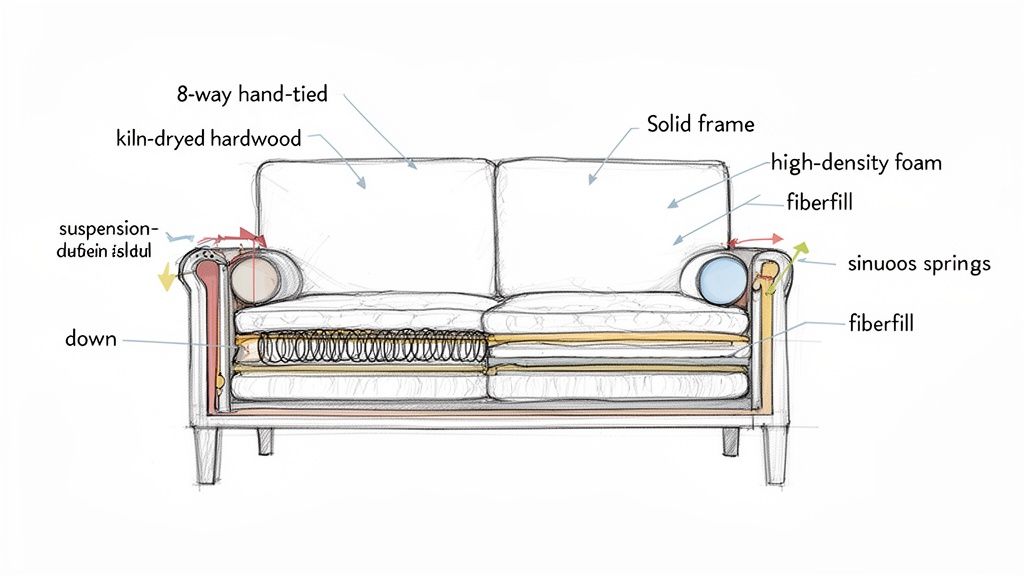
    The fabric and style of a sofa are what you fall in love with, but what’s hidden inside is what makes it last. It all comes down to the frame, the suspension system, and the cushion construction. These are the core components that dictate how well a sofa will stand up to movie nights, energetic kids, and years of daily life.

    Knowing a little about these elements helps you look past the pretty upholstery and ask the right questions. It’s how you choose a sofa that’s built to be the lasting centerpiece of your home, not just a temporary placeholder.

    Detailed diagram illustrating the internal components and construction of a sofa, showing frame, springs, foam, and filling materials.

    Think of it this way: a beautiful sofa with a weak frame or sagging cushions won't be comfortable or satisfying for very long. Let's break down what truly matters.

    The Foundation: A Sturdy Frame

    The frame is the skeleton of your sofa. It provides all the structural integrity. You’ll want a frame made from materials that resist warping, twisting, and breaking over time. A frame built from kiln-dried hardwood is known for its durability.

    Kiln-drying is a process that removes moisture from the wood, which is critical for preventing it from bending or cracking as the humidity levels in your home change. Strong, dense hardwoods like oak, maple, or ash are considered some of the best materials for the job.

    On the other hand, frames made from softer woods like pine are more common in budget-friendly options but can be more susceptible to damage. It's also smart to be wary of frames made mostly of particleboard, MDF, or plastic, as they simply lack the long-term resilience of solid wood.

    The way the frame is joined together is just as important as the wood itself. Quality construction uses techniques like:

    • Dowels and corner blocks: These reinforce the joints, keeping the frame square and stable through years of use.
    • Screws and glue: This combination creates a much stronger bond than staples alone, which can easily loosen over time.

    When you're shopping, don't be shy about asking how the frame is built. A knowledgeable salesperson should be able to tell you about a well-built piece, and it’s a key sign of the furniture's overall quality.

    The frame truly is the backbone of your sofa. To help you understand the differences in durability and value, here's a quick comparison of common materials.

    A Quick Look at Sofa Frame Materials

    Frame Material Durability Typical Cost Best For
    Kiln-Dried Hardwood Excellent $$$ Long-term investment, high-traffic areas.
    Solid Hardwood Very Good $$ Everyday use, offers great value and longevity.
    Softwood (e.g., Pine) Fair $ Light use, budget-conscious buyers.
    MDF/Particleboard Poor $ Temporary or very low-use furniture.

    Ultimately, a solid, well-constructed frame is the first thing you should confirm before falling in love with a sofa's style. It's the difference between a piece that lasts for three years and one that lasts for decades.

    The Support System: Springs and Suspension

    Underneath the cushions lies the suspension system. Its job is to provide support and keep you from sinking straight to the frame. The type of suspension has a massive impact on both comfort and durability.

    One of the most traditional and durable systems is 8-way hand-tied springs. In this method, individual springs are tied together by hand from front to back, side to side, and diagonally. This creates an interconnected web that distributes weight evenly, offering long-lasting support. It is considered a gold standard in the industry.

    A more common and still very reliable option is sinuous spring suspension, sometimes called "S-springs." These are S-shaped steel wires that run from the front of the frame to the back. When installed correctly with high-quality steel, sinuous springs provide a comfortable and durable foundation. You'll find them in many well-made sofas today.

    Be more cautious with webbing suspension, which uses fabric or elastic straps stretched across the frame. It's generally a lower-cost alternative that can be prone to stretching and sagging over the years.

    The Comfort Layer: Cushion Construction

    Finally, the cushions are what you actually feel—they determine the immediate comfort of your sofa. Cushion filling is a balancing act between comfort, maintenance, and longevity, with each type offering different benefits.

    High-density foam is a very popular choice for seat cushions because it provides firm support and holds its shape well. The density rating tells you about its durability; a higher number means the foam is heavier and will last longer before compressing. Often, this foam core is wrapped in softer materials like polyester fiber (Dacron) or a down-and-feather blend to create a plusher top layer.

    • Down-blend cushions: These offer that luxurious, sink-in feeling but require regular fluffing to maintain their shape. They create a relaxed, lived-in look that's incredibly inviting.
    • High-density foam cushions: These provide a firmer, more supportive seat and a crisper, more tailored appearance. They bounce back quickly and require less maintenance than down.
    • Fiberfill cushions: Usually made from polyester, these are a cost-effective option that can feel soft, but they tend to compress more quickly over time and may need replacing sooner.

    The best way to know what you prefer is to sit on a few different types. The "right" cushion is a personal choice, but understanding what's inside helps you predict how it will feel—and wear—in the long run.

    Choosing Upholstery for Real Life

    The upholstery you choose is the single most visible part of your sofa. It's the fabric or leather that sets the style, determines how it feels, and—most importantly—dictates how it will stand up to your actual, day-to-day life.

    Get this choice right, and you'll have a sofa that can handle spilled juice, muddy paws, and years of Sunday afternoon naps. Get it wrong, and you might face a world of frustration. This decision is about so much more than color; it's about picking a material that fits the reality of your household.

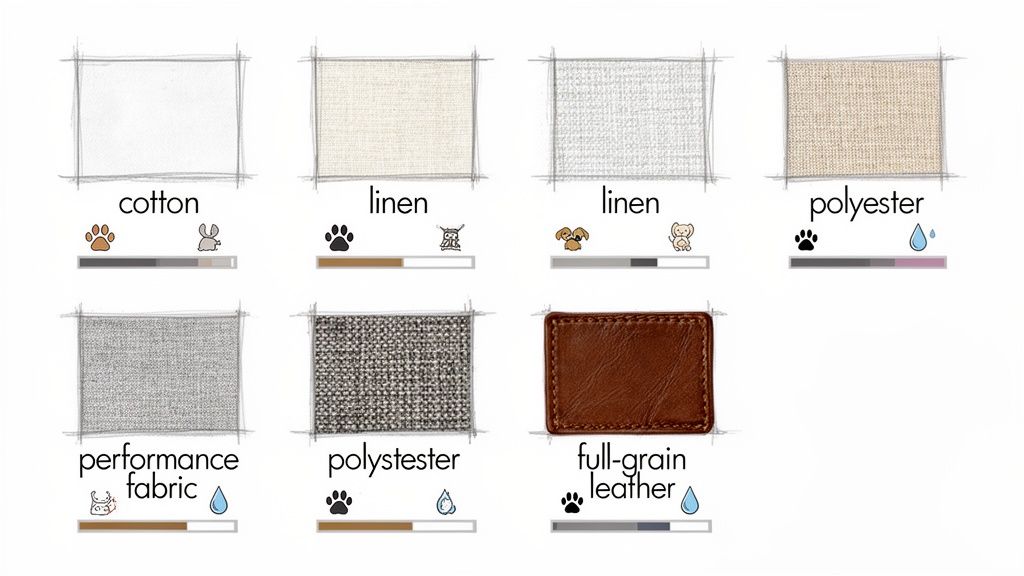
    Guide to sofa fabrics: cotton, linen, polyester, performance fabric, leather, showing pet and water resistance.

    Fabric Sofas: From Natural to Synthetic

    Fabric upholstery opens up a massive world of colors, textures, and patterns, making it a super versatile choice for any home. The fibers used are either natural, synthetic, or a blend of both, and each brings something different to the table.

    Natural fibers like cotton and linen feel fantastic. They're breathable and have a soft, comfortable hand. Cotton is a solid, durable choice but can be a magnet for stains and wrinkles unless it’s blended with something else. Linen gives off that beautiful, relaxed vibe but isn't the toughest, making it better for a formal living room than a family den.

    On the other hand, synthetic fibers are engineered for pure durability. Materials like polyester and microfiber are incredibly popular because they resist fading, stains, and general wear and tear. Microfiber, with its super-tightly woven threads, is especially great at repelling liquids, making it a go-to option for families with kids.

    Performance Fabrics for Busy Households

    If your home is a hub of activity with kids, pets, or just a lot of people coming and going, performance fabrics are a game-changer. These aren't just regular fabrics; they're textiles treated on a molecular level to repel stains, moisture, and even odors.

    Spills often just bead up on the surface instead of soaking in, which gives you a precious few moments to blot them away before they become a permanent part of the sofa's story.

    Brands like Crypton and Sunbrella have become known for producing fabrics that are unbelievably durable but don't sacrifice a soft feel or stylish look. They offer some serious peace of mind.

    Before you commit, it's always a smart move to check the fabric's cleaning requirements. Taking a minute for understanding upholstery cleaning codes will tell you exactly how to care for the material, which is critical for keeping it looking great for years.

    The Timeless Appeal of Leather

    Leather is a classic for a reason. It's known for its incredible durability and the way it develops a rich, unique character over time. A good leather sofa can last for decades with the right care, but not all leather is created equal. Understanding the different grades is key.

    • Full-Grain Leather: This is the top tier, coming from the outermost layer of the hide and keeping all the natural markings. It’s tough and breathes beautifully.
    • Top-Grain Leather: The next grade down, top-grain leather has its surface sanded just enough to remove imperfections for a more uniform look. It's still very durable, just a little less breathable than full-grain.
    • Split-Grain Leather: This comes from the lower layers of the hide. You’ll often find it on the sides and back of sofas as a cost-saving measure. It’s not as durable as the top layers.
    • Bonded Leather: This is a lower-cost option, made from leather scraps shredded and bonded together with adhesive. It gives you the look of leather but doesn't have the durability or longevity of a genuine hide.

    For families, a protected or semi-aniline leather is a fantastic option. It has a protective topcoat that makes it more resistant to spills and scratches, giving you the classic durability of leather with much easier maintenance.

    The Final Checks Before You Commit

    Okay, you're in the home stretch. You’ve pinpointed the style, picked the right upholstery, and you're confident in the frame's construction. But before you make a final decision, a few last-minute checks can be the difference between a pretty good purchase and one you'll love for years.

    This is where you make sure everything adds up—from how it feels to sit on, to the total cost, to how it will actually get into your house. Taking a moment now saves you from any nasty surprises later.

    Take It for a Test Drive: The In-Person Comfort Test

    Reading reviews online is a great starting point, but there’s simply no substitute for parking yourself on a sofa in person. Comfort is incredibly subjective, and a quick "sit test" in the showroom reveals more than any spec sheet ever could.

    When you get to the store, don't just politely perch on the edge. Sit on it like you would at home.

    • Lounge for real. Lean back, kick your feet up if you can, and see how the sofa actually supports you when you're relaxing. Does the back hit you in a weird spot? Is it too low?
    • Check the seat depth. When your back is against the cushions, can your feet rest flat on the floor? If they're dangling, the seat is probably too deep for you. If your knees are pointing up toward the ceiling, it's likely too shallow.
    • Feel out the armrests. Are they a comfortable height for resting an arm or even your head during a nap? An armrest that's too high, too low, or rock-hard can become a major source of irritation over time.

    Helpful advice: If you can, bring the other key decision-makers (or sitters!) with you. A sofa that feels like a dream to someone who's 5'4" might feel all wrong to a person who is over six feet tall. Getting everyone's input ensures the sofa works for the whole household.

    Budgeting Beyond the Sticker Price

    That price tag you see is just the beginning. To get a true sense of your total investment, you have to account for the extra costs that often pop up at the end. Getting a clear, all-in price before you commit is critical.

    Be on the lookout for these common add-ons:

    • Delivery Fees: Always ask what delivery costs and what it includes. Some services are "white glove," meaning they bring it inside, set it up, and haul away the packaging. Others are just a curbside drop-off, leaving the rest to you.
    • Fabric Protection Plans: Retailers will often offer an optional plan to cover accidental stains and damage. Think hard about your lifestyle here—if you have kids or pets, the extra peace of mind might be worth the cost.
    • Old Furniture Removal: Need your old sofa hauled away? See if the store offers this service and what the fee is. It can save you a huge headache.

    Getting clarity on these details up front means no sticker shock when the final bill comes.

    Understanding the Fine Print: Delivery and Policies

    Last but not least, get the full scoop on the logistics and policies that kick in after you've paid. Knowing what to expect makes the entire process way less stressful.

    Chat with your salesperson about how the delivery actually works. Will they call you to schedule a specific time? Do you need to clear a path or measure doorways again for the delivery team?

    Just as important are the store's official policies. Take a minute to look over the warranty information—what exactly does it cover, and for how long? And make absolutely sure you understand the return policy. Knowing the timeframe and any conditions for a return gives you a safety net in case the sofa just doesn't work in your space the way you imagined.

    Even after you’ve done all the homework, there are always a few last-minute questions that pop up right before you’re ready to buy. It’s completely normal. Making a purchase like a sofa is a huge commitment, and you want to get it right.

    To help you cross the finish line with confidence, we’ve put together answers to some of the questions we hear most often from shoppers in our showrooms.

    How Long Should a Good Sofa Last?

    A well-built sofa is an investment that should be a fixture in your home for years to come. If you choose a piece with a solid, kiln-dried hardwood frame and a quality suspension system, you can reasonably expect it to last anywhere from 7 to 15 years. Sometimes even longer with the right care.

    Of course, its lifespan really depends on how you use it. A sofa in a busy family room is going to see a lot more action and wear than one sitting pretty in a formal living room. The upholstery and cushion quality are also massive factors. For instance, high-density foam cushions will keep their shape and support way longer than a basic, low-density fiberfill.

    Are Attached Cushions a Bad Idea?

    Attached cushions have some drawbacks to consider. While they might seem convenient because they stay put, they're often a sign that a manufacturer is reducing costs. Why? Because they don't have to fully upholster every side of the cushion, which saves them time and money.

    But the biggest issue is maintenance. Attached cushions rob you of the ability to flip and rotate them.

    Being able to rotate your cushions is one of the best things you can do to make them wear evenly. It prevents those dreaded "butt divots" from forming in your favorite spot and seriously extends the life and look of your entire sofa.

    Plus, if an attached cushion gets a nasty stain or a tear, cleaning and repairing it becomes a much bigger headache. Detachable cushions just give you more flexibility for keeping your sofa looking great for the long haul.

    Is a Deeper Sofa More Comfortable?

    Not for everyone. Comfort is incredibly personal, and the right seat depth for you comes down to your height and how you prefer to sit.

    A deep-seated sofa can feel incredibly luxurious for lounging, napping, or curling up with a good book. But for sitting upright during a conversation, it can actually be awkward, especially if you're on the shorter side and your feet can't touch the floor. A typical seat depth is somewhere between 21 and 24 inches.

    • If you're an upright sitter: Look for a depth around 21-22 inches. This lets you sit back against the cushions for support while keeping your feet flat on the floor.
    • If you're a lounger: A depth of 23-25 inches gives you that extra room to tuck your feet up or really recline.

    Anything deeper than 26 inches starts to feel more like a daybed, and you'll probably need a small army of throw pillows just to get enough back support to chat with guests. The only real way to know for sure is to try them out.

    How Do I Know If a Sofa Will Fit My Style Later?

    Trends will always come and go, but a classic, well-proportioned sofa will almost never look dated. If you want your sofa to have real staying power, focus on timeless silhouettes—like a simple track arm or a classic roll arm—in a versatile, neutral fabric.

    Think of your sofa as the canvas, not the entire painting. You can easily refresh your living room's entire vibe over the years with new throw pillows, blankets, and a different area rug. These accent pieces are where you can play with trendy colors and patterns without committing to a big-ticket item. A sofa with clean lines and a simple form gives you a foundation that can adapt to your changing tastes for a decade or more.


    At Woodstock Furniture & Mattress Outlet, our team has heard every question in the book, and we're here to help you find a sofa that fits your home, lifestyle, and budget. The best way to find "the one" is to come see the options for yourself. Visit one of our North Georgia showrooms to test-drive a selection of styles and feel the quality in person.

    Explore our collection of sofas and sectionals online to get started.