You've stripped the bed, gathered the sheets, and realized your king-size comforter is almost as big as the washer. Getting it through the door isn't the only question. You also need enough room to rinse the filling and a way to dry it all the way through.
Knowing how to wash a king size comforter starts with its care label and ends with a hands-on dryness check. A warm, fluffy exterior can hide damp filling, so don't judge success by the dryer timer alone.
Settings by Fill Type at a Glance
| Fill type | Water temperature | Wash cycle | Drying |
|---|---|---|---|
| Down or down alternative | Cold or warm | Gentle or delicate | Low heat with dryer balls |
| Polyester or synthetic | Warm | Gentle or normal | Low to medium heat if the label allows |
| Cotton | Warm or cold | Gentle | Low heat, then air dry |
| Wool | Cold | Hand wash or wool cycle | Air dry flat; check the label |
| Blend or unlabeled | Cold | Gentle | Low heat; follow the label |
These are starting settings, not permission to wash. The comforter's care label overrides every row, including instructions about whether washing or tumble drying is allowed at all. The American Cleaning Institute's bedding-care guidance recommends checking the fabric-care label and cautions that some feather and down comforters require dry cleaning.
Match the Filling, Not Just the Shell
A cotton outer fabric doesn't necessarily mean cotton filling. Look for separate descriptions of the shell and fill, then check the care instructions for the complete comforter. Decorative stitching, trim, backing, and mixed materials can change how the finished item should be cleaned.
For washable down, choose a detergent made for down. Down alternative is usually synthetic, so use a down-care product only if it's suitable for that filling; a mild liquid detergent may be the appropriate choice instead.
Cotton and wool deserve particular attention. Don't assume a washable cotton shell makes the entire comforter machine-washable, and don't substitute a gentle cycle for a required hand-wash or professional-cleaning method.
Practical rule: A colder wash or gentler cycle doesn't make a dry-clean-only comforter safe to machine-wash.
What to Do With a Missing Label
The blend-or-unlabeled row represents a conservative starting point after you've confirmed that laundering is permitted. It isn't a safe fallback for an unidentified comforter.
Check the manufacturer's care guidance using the product name, model information, or purchase receipt. If you can't identify the construction or approved cleaning method, choose a professional cleaner rather than experimenting with a full wash. Find the row that matches your comforter, then confirm every setting against its specific instructions before loading it.
Choose Home Washing, a Laundromat or Professional Cleaning
| Option | Fits when | Watch for | Drying |
|---|---|---|---|
| Home washer and dryer | Washer holds 4.5 cubic feet or more, the practical minimum identified by Consumer Reports' washer buying guide, and the label allows machine washing | A compressed load can trap detergent; check dryer capacity separately | Home dryer on label-approved low heat |
| Laundromat large machines | Home washer is too small or the fill is dense | Ask about reservations or time slots; confirm machine size before loading | Commercial dryer; capacity differs by location |
| Professional cleaning | Label says dry clean only, the fill is valuable, or staining needs specialist attention | Ask for the cleaning method, price, and turnaround | Specialist drying process; ask the cleaner |
When Home Washing Makes Sense
Home washing works when the comforter can move freely and you can complete the drying process without rushing. Washer capacity is a screening tool, not a guarantee: a thick winter comforter can need more space than a lightweight comforter with the same bed-size designation.
Don't pack the drum tightly just because the door closes. The filling needs space for water and detergent to circulate, followed by thorough rinsing. If you have to push hard to fit the comforter inside, choose a larger machine.
Check the dryer before starting the washer. A washing machine that accommodates the comforter doesn't prove your dryer can tumble it effectively. Washing at home and discovering afterward that the dryer is too small leaves you transporting heavy, wet bedding.
When a Laundromat Is More Practical
Large commercial machines are useful for thick down comforters and dense synthetic filling. They offer an alternative to forcing an oversized load through home equipment, but you still need to select an appropriately sized machine.
Call ahead to confirm equipment availability and whether the laundromat uses reservations or time slots. At the machine, ask an attendant which drum will accommodate your comforter with room to move. Choose your drying equipment before paying for the wash, and plan to stay available for redistribution and moisture checks.
When to Choose a Professional
Professional cleaning makes sense when the label requires it, when the comforter's construction is uncertain, or when stains haven't responded to careful pre-treatment. A valuable fill or fragile shell may also justify having a specialist assess the item before you attempt washing.
Ask these questions before drop-off:
- Fill experience: Do you clean down specifically, or this comforter's particular filling?
- Drying method: How will you dry it thoroughly while respecting its heat restrictions?
- Expected result: What happens if the filling doesn't regain its loft?
Ask for a quote and expected turnaround, since both depend on the shop and the item. Don't assume a laundry service and a dry cleaner use interchangeable processes.
Pick the route first, then write down the permitted water temperature and drying limit. If cleaning ultimately isn't practical and you're planning a bedroom update, we offer delivery options at Woodstock Furniture & Mattress Outlet; that's separate from arranging comforter cleaning.
How to Prepare and Spot-Treat Before the Wash
Preparation is the time to catch problems you can still fix easily: an open seam, a stain hidden beneath the cover, or a care restriction that rules out your planned wash.
The permanent care label is your most useful item-specific starting point. The Federal Trade Commission's Care Labeling Rule requires reliable care information for covered textile goods, including relevant washing and drying instructions. For your comforter, read the manufacturer's complete instructions rather than borrowing settings from a similar-looking item.
Follow This Preparation Routine
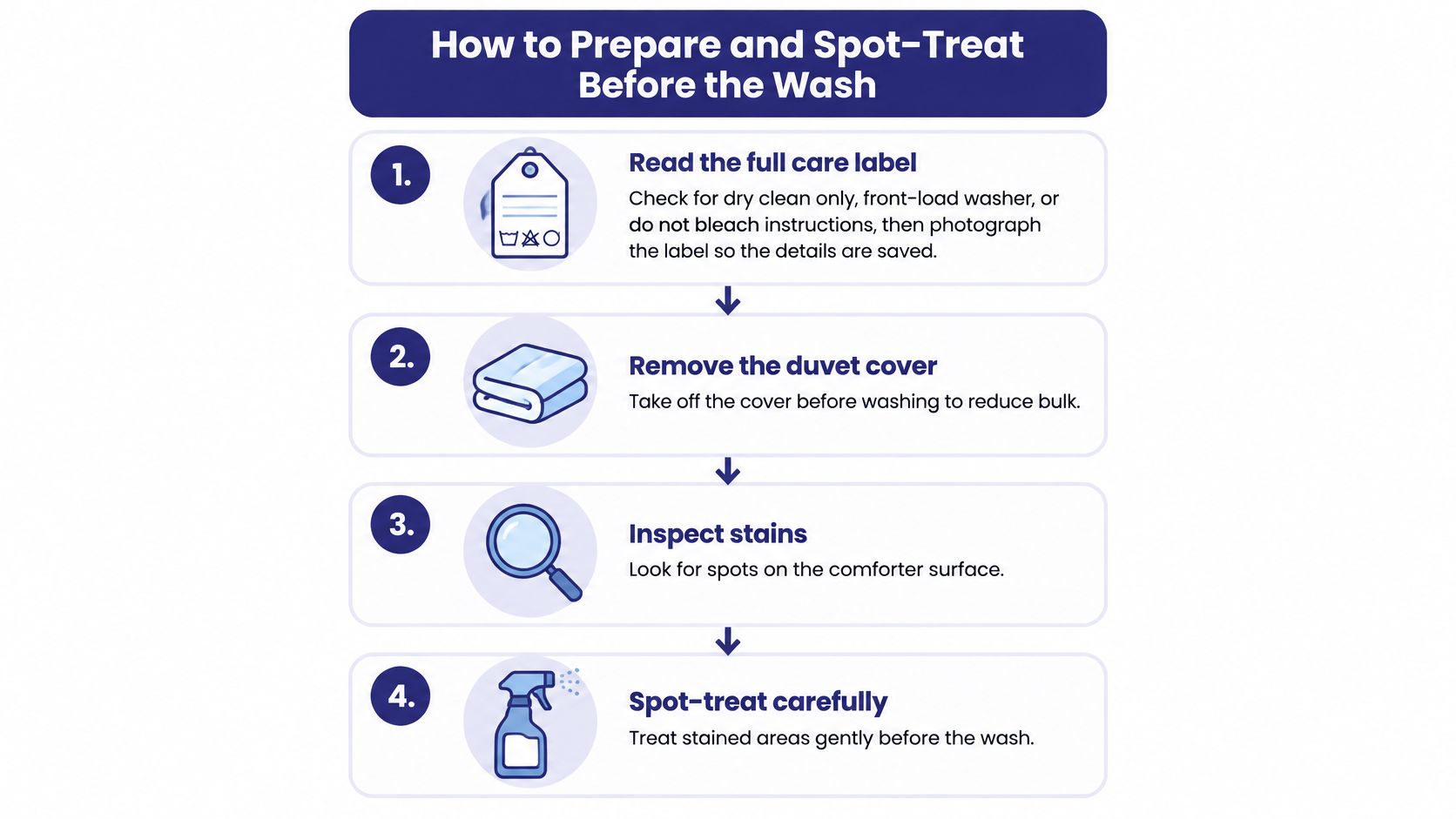
Read and photograph the full care label. Check for dry-clean-only, front-load-washer, bleach, and drying restrictions, and save a clear photo so you won't need to search wet seams for instructions later.
Remove the duvet cover and any detachable pieces. Wash those separately according to their own labels, rather than letting them add bulk or wrap around the comforter.
Inspect seams, corners, and stitched compartments. Repair loose stitching or small openings before washing, because agitation can enlarge a weak seam and release filling.
Check the entire surface for stains, especially the upper edge and areas usually hidden by the cover. Spot-treat with mild detergent or a fabric-compatible stain remover, working gently from the outside of the mark toward its center.
Confirm that the selected washer gives the comforter room to circulate. A machine's capacity rating doesn't override a visibly wedged load; use a larger washer if the comforter stays tightly compressed.
Load the comforter alone and distribute it loosely through the drum. Don't add towels, sheets, or the duvet cover to fill perceived gaps, because those gaps provide useful movement space.
Use this visual checklist while inspecting and treating the comforter.
Treat the Spot Without Soaking the Filling
Test your treatment on an inconspicuous area before working on a visible stain. Apply it sparingly, blot rather than scrub, and follow the product's directions for contact time and rinsing. You're treating the shell locally, not trying to saturate an entire compartment of filling.
Deal with stains before applying dryer heat, which can make remaining marks harder to remove. After washing, inspect the treated area again before transferring the comforter to the dryer.
Check the warranty paperwork, too. Some manufacturers attach care conditions to coverage, so keep the receipt and a record of the care instructions together rather than assuming every cleaning method preserves coverage.
A ready load sits loosely and evenly in the drum, without being jammed into a corner or compressed into a solid bundle. Before pressing start, have the water temperature and drying restriction written down.
Wash the Comforter With the Right Settings
The right wash balances cleaning with complete rinsing. A forceful cycle and extra detergent won't compensate for a comforter that can't move through the water.
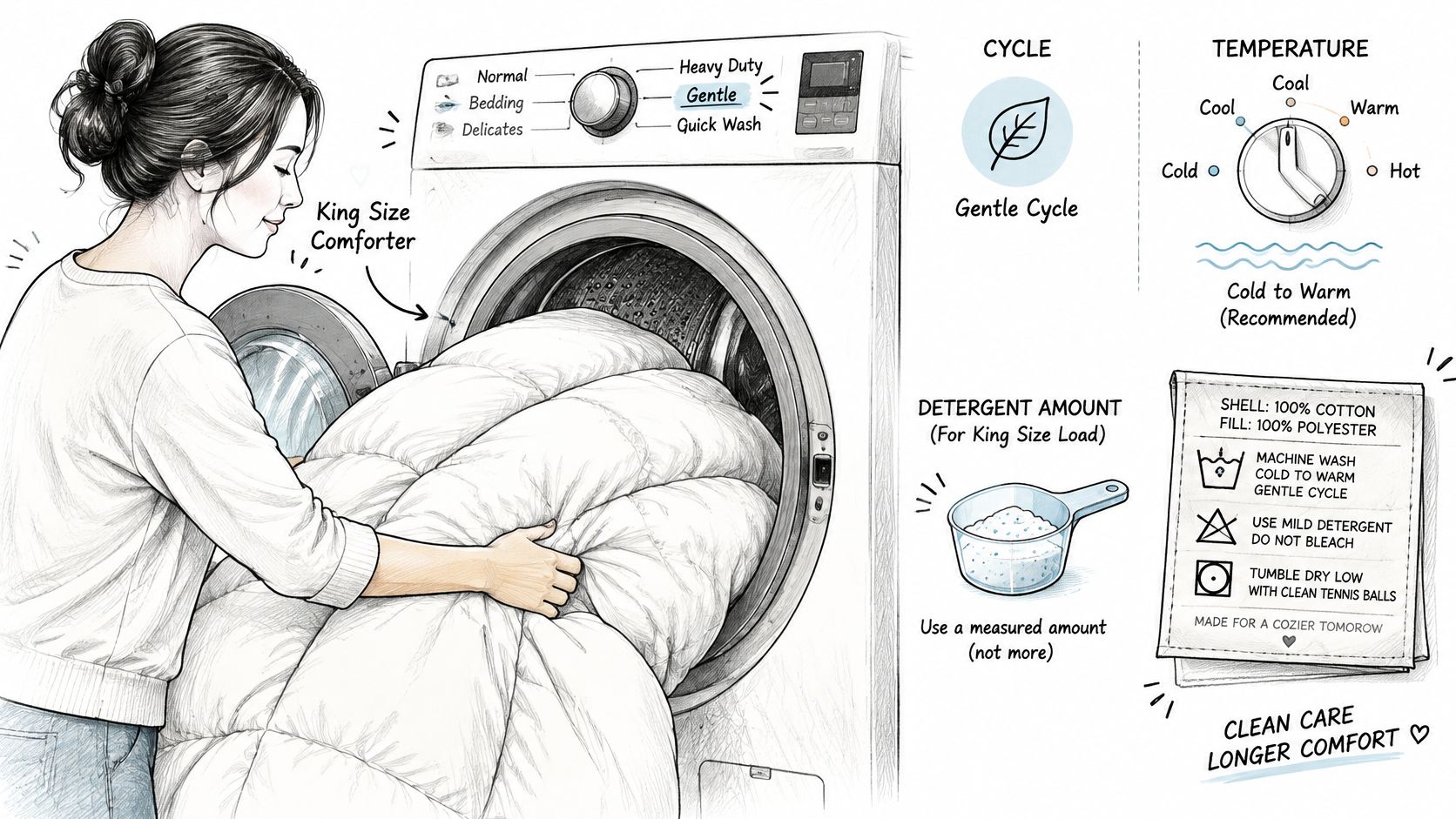
Use the illustration to check your loading approach before selecting the controls.
Set the Washer Deliberately
Choose the label-approved cycle and temperature. Where the instructions allow a choice, use gentle or delicate agitation and the lowest appropriate water temperature to avoid unnecessary mechanical action and heat.
Measure detergent using the detergent maker's directions for your load and machine. Dense filling is difficult to rinse, so don't add an extra pour just because the comforter looks enormous.
Select an extra rinse if available. This helps remove detergent from filling where residue may not be visible on the outer fabric.
Choose the highest spin speed the comforter's care instructions and selected cycle permit. Removing more water mechanically reduces the amount the dryer must evaporate, but don't override a restriction for delicate construction.
Unload promptly when the cycle ends. Support the wet comforter as you lift it out, rather than pulling its full weight by a corner or narrow section of shell.
For washable down, use a down-compatible detergent. For polyester and other washable synthetic fills, a standard mild liquid is often the practical choice unless the manufacturer specifies something else. Don't assume every detergent marketed for natural down is necessary or suitable for down alternative.
Watch for a Load That Isn't Moving
A comforter may settle differently once it becomes wet. If it remains wedged, rolls into a tight mass, or causes repeated balance problems, pause the machine according to its operating instructions and redistribute the load.
If redistribution doesn't solve the problem, stop forcing the fit and use a larger washer. Restarting repeatedly doesn't create the missing drum space, and a completed cycle doesn't prove a compressed center was cleaned or rinsed properly.
The video provides another visual reference for handling bulky bedding.
Before unloading, have a suitable dryer ready: Consumer Reports' comforter-washing guidance recommends approximately 7 cubic feet or more of dryer capacity, two or three clean dryer balls, and pauses about every 30 minutes to shake and redistribute the comforter.
Inspect any treated stains before drying. If the mark remains, keep the item out of heated drying while you reassess the treatment; if it's clean, move promptly into the drying process rather than leaving the filling bundled and wet.
Dry in Stages and Confirm the Fill Is Fully Dry
A comforter can feel warm and fluffy while moisture remains trapped in its fill. Down and down-alternative filling may collect into dense clumps, so judge completion by checking the thickest areas rather than relying on how the shell feels or how long the dryer has run.
The Dutchman's Laundry's comforter guidance says many comforters can take two to three hours to dry and recommends checking the center, corners, seams, and thickest sections. Treat that as a planning estimate, not a finish time. The actual drying time depends on the comforter and whether air can move freely around it.
Use Heat, Airflow, and Redistribution Together
Move the comforter promptly into a roomy dryer. Use low heat unless the care label specifies otherwise. Add clean wool dryer balls or clean tennis balls if the item allows them.
The comforter needs room to lift and tumble. If it rotates as a packed bundle, the fill may stay damp inside. Dryer balls can help separate the filling, but they cannot make an undersized drum adequate.
Follow a staged routine:
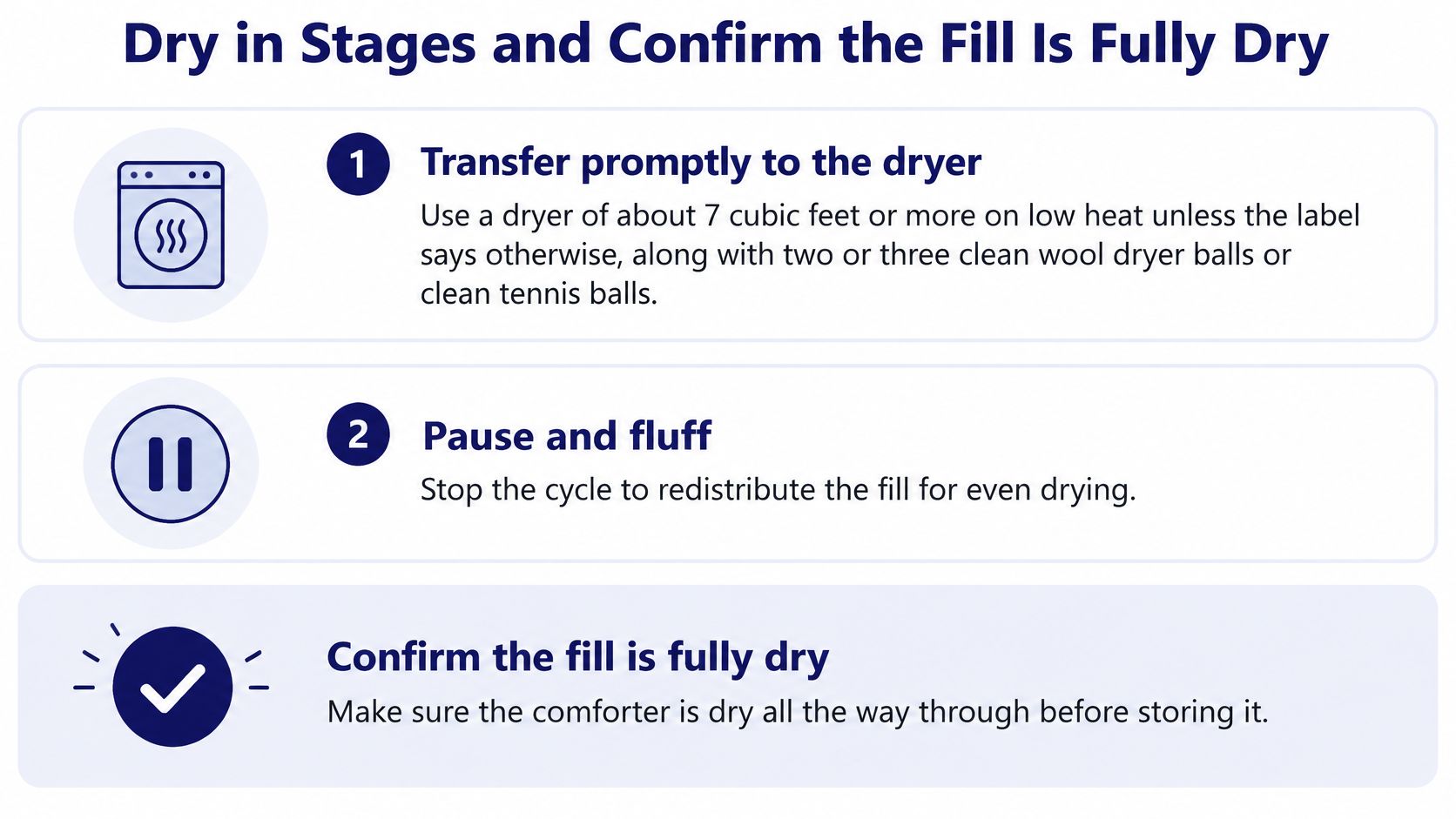
- Pause and open the comforter: Remove it from the dryer, unfold rolled edges, and shake it out so damp areas are not tucked inside.
- Redistribute the filling: Gently separate accessible clumps by hand, especially near the corners. Avoid pulling against the stitched compartments.
- Repeat permitted low-heat cycles: Continue drying with good airflow instead of raising the temperature to speed things up.
- Air it spread out: Lay the comforter across a clean, ventilated rack or suitable surface. Let air reach both sides, and avoid folding it over a chair or leaving it piled on the bed.
Heat that is too high can affect the shell or filling. Low heat alone does not guarantee a safe result either. Movement and airflow help, while pauses let you find sections that are still damp. Finish by airing the comforter spread out until the fill is fully dry.
Perform the Hand Check After Brief Cooling
Let the comforter cool until dryer warmth no longer masks differences between sections. Then check the whole item, not only the areas that are easy to reach.
- Press the thickest filling. Use your palms to feel through the shell for dampness or unusually dense areas.
- Lift each corner and compare its weight and feel with nearby sections.
- Check the center and seams. Look closely where the stitching holds the fill and where it may have gathered.
- Open any remaining folds and repeat the check on the opposite side.
A cool spot by itself does not confirm that the filling is wet. A patch that stays cool, heavy, or damp needs more drying. If tumble drying is permitted, redistribute that area and resume the approved low-heat process. Let the comforter cool again before checking it.
Dryer balls can improve loft. They don't prove the filling is dry.
Adjust for Humid Weather
In humid North Georgia weather, air-drying can take longer. Keep the comforter spread out in a ventilated space and turn it so air can reach both surfaces. Leaving it overnight in a pile will not reliably dry the fill.
For wool or another comforter that requires flat air-drying, skip the dryer and follow the care instructions. For a comforter approved for tumble drying, a brief no-heat or permitted low-heat fluff can help redistribute the fill once it is dry.
Wait until you are confident the fill is fully dry before putting the duvet cover back on or storing the comforter. Trapped moisture can lead to mustiness and mildew.
Fixing Clumps, Odors and Stains After Washing
Clumps are a common post-wash concern, but they don't automatically mean the comforter is ruined. First distinguish filling that's still damp from filling that has shifted or become compacted with age.
| Symptom | Likely cause | Fix |
|---|---|---|
| Clumps or lumps in the fill | Damp filling or too little movement in the dryer | Repeat permitted low-heat drying with dryer balls and redistribute at each pause |
| Musty smell | Moisture left in the center | Dry fully, air out in a ventilated room, and rewash only if the smell stays |
| Stiff or sticky feel | Detergent residue | Correct the detergent dose and add an extra rinse during a label-approved wash |
| Stain still visible | Incomplete pre-treatment or a mark made harder to remove by dryer heat | Re-treat the spot, wash again if permitted, and avoid further heat while treating it |
Problems That May Need Only More Drying
For damp clumps, gently separate the filling and resume drying with enough space to tumble. This may be resolved during the same drying session, without adding another wash.
If the comforter smells musty, don't cover the odor with fragrance. Check for retained moisture, finish drying, and air it in a ventilated room. A persistent smell can require rewashing, but drying alone won't reliably remove established contamination or every source of odor.
Troubleshooting limit: More heat isn't the answer to every lump, smell, or stain.
Problems That Need Another Cleaning Decision
A stiff or sticky surface can suggest detergent residue. Use a label-approved rinse or wash to remove it, and correct the dose next time rather than repeatedly adding detergent to an already soapy load.
For a remaining stain, apply a compatible spot treatment and inspect the result before heated drying. Some marks won't come out completely, especially after heat exposure, so repeated aggressive treatment can create more wear without improving the appearance.
If the comforter remains lumpy, discolored, or musty after a repeat full wash and thorough drying, stop experimenting and have a professional cleaner assess it. These fixes are starting points, not guarantees; the fill, construction, and age affect what cleaning can restore.
Replacement may be more practical when filling is worn or the cost of further cleaning approaches the cost of a suitable new comforter. Compare those options before paying for repeated treatments, and favor bedding whose care requirements fit the equipment and time you have.
Woodstock Furniture & Mattress Outlet offers mattresses, bedroom furniture, and sleep accessories, including sheets, pillows, and protectors. If this laundry project has prompted a bedroom refresh, visit Woodstock Furniture & Mattress Outlet to explore options in person and discuss care requirements before choosing your next sleep accessory.