Tag: home office storage

  • Home Office Storage Cabinets: A Practical Selection Guide

    Home Office Storage Cabinets: A Practical Selection Guide

    You've finished a workday, but the desk still looks like a staging area for three different lives. A printer occupies the corner, charging cables cross the floor, folders lean against a monitor, and the supplies you need tomorrow are buried beneath things you rarely use. In a shared room, that clutter doesn't disappear when the laptop closes. It becomes part of the living space.

    A well-chosen cabinet can solve more than a storage shortage. It can keep heavy equipment stable, place daily supplies within reach, conceal visual clutter, and make a mixed-use room easier to work in and easier to live with. The important choice is not just whether a cabinet matches your desk. It is whether the cabinet supports your workflow without creating new problems around weight, access, movement, or safety.

    Why Home Office Storage Matters

    A home office often starts with one practical compromise. The desk goes in a dining room corner, a guest room, or a section of the primary bedroom. At first, a stack of folders on the floor and a few bins on the desktop seem manageable. After a few weeks, the chair catches on a cable, the printer takes over useful work surface, and family members have to work around office supplies that never found a proper home.

    Home office storage cabinets act as the quiet infrastructure of that room. Closed doors can hide paperwork and equipment when work is finished, while drawers keep smaller items from spreading across the desk. Open shelves can hold reference books or décor, but they work best when you're prepared to maintain a visible arrangement.

    The category is larger than many shoppers realize. The U.S. storage cabinet set market is estimated at USD 8–12 billion in annual retail sales, with roughly 40–60 million sets across price tiers, according to U.S. storage cabinet market analysis. Home office storage represents about 15–20% of category volume, so this isn't a tiny specialty use. Housing changes and continued work-from-home patterns also influence demand, which means a cabinet may serve a first office today and a different room after a move.
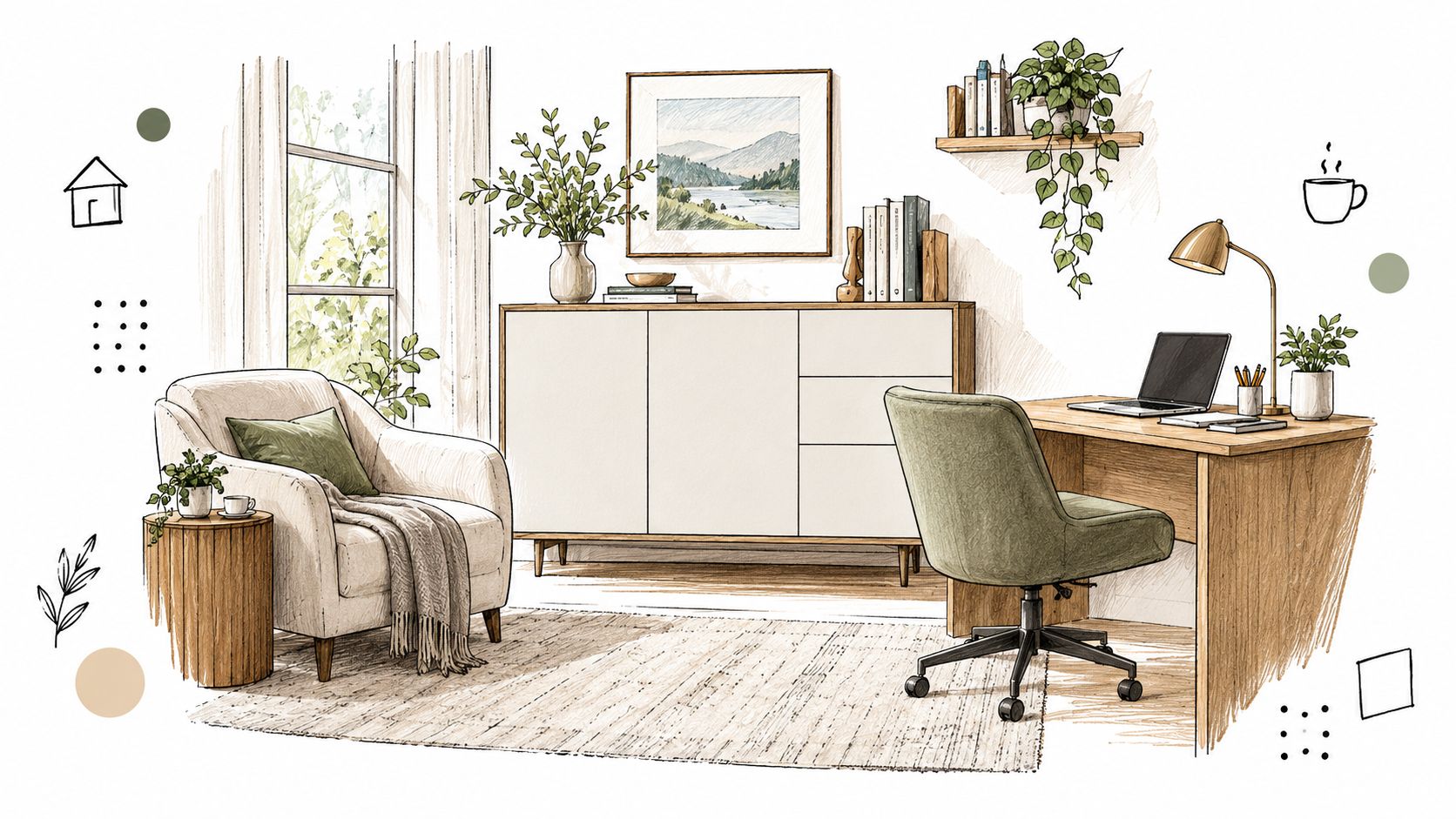
    A cozy, hand-drawn illustration of a modern home office with a desk, armchair, storage cabinet, and plants.

    Practical rule: Storage should reduce the number of decisions you make during the workday. If every item needs to be moved, unplugged, or searched for, the cabinet isn't supporting the workflow.

    Think beyond paper. A home office cabinet may need to hold a compact printer, reams of paper, headphones, office supplies, external drives, or charging equipment. If your household also handles discarded electronics, a resource on data center hardware recycling can help distinguish ordinary office storage from responsible equipment disposal.

    Understanding Cabinet Types and Materials

    The modern filing cabinet grew out of a specific organizational problem. The vertical filing cabinet was invented in the United States in the 1890s, and by the early 1900s, metal filing cabinets had appeared as library cabinets. This marked a move away from general wooden cupboards and bound volumes toward specialized systems for documents, security, and organized access, as described in this history of the filing cabinet and information infrastructure.

    That history still helps explain today's choices. Metal cabinets usually suit shoppers who prioritize filing, lockable storage, and a more office-oriented structure. Steel can provide a firm shell, but the cabinet still needs properly rated slides, stable feet, and sensible drawer loading. A tall metal unit with fully open drawers may be less forgiving in a busy room than a shorter cabinet with a broader footprint.

    Solid wood brings visible grain and can work naturally beside residential furniture. It's often a good fit when the office shares space with a living room or bedroom, although construction details matter more than the label alone. Look at joinery, back-panel construction, hinges, drawer movement, and how the cabinet is supported.

    Engineered wood can offer consistent panels and a wide range of finishes. It's practical for credenzas, bookcases, and hutches, particularly when the cabinet includes adjustable shelves or a reinforced top. The finish and edge treatment deserve attention because moisture, abrasion, and overloaded shelves can affect long-term appearance.
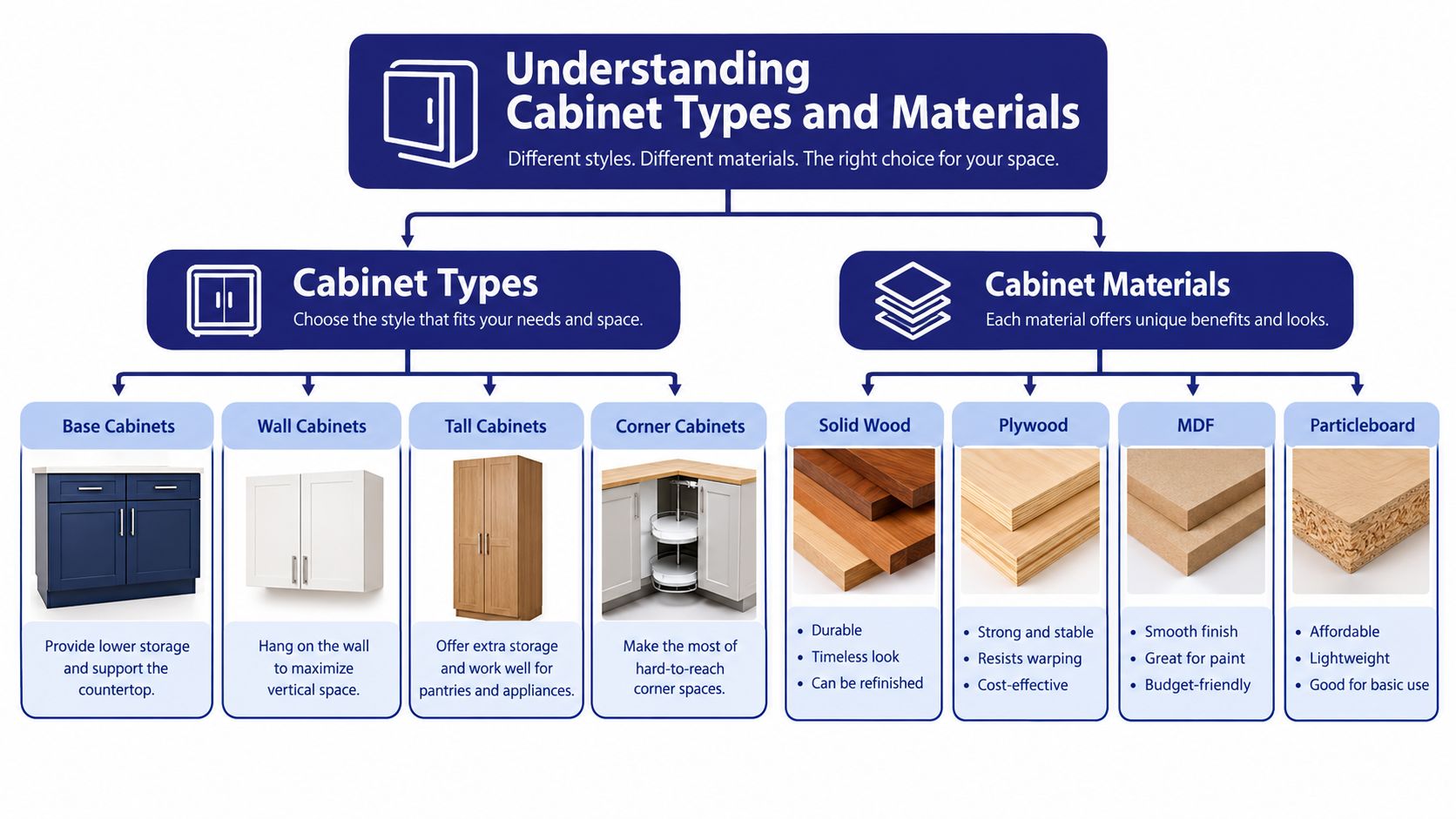
    A diagram infographic explaining different types of kitchen cabinets and the various materials used to construct them.

    A useful comparison is functional rather than decorative:

    • File cabinets: Best for documents, folders, and lockable personal records. They can waste space if your work is mostly digital.
    • Credenzas: Useful for printers, supplies, and mixed storage at a reachable height. Their broad tops can become clutter magnets without assigned zones.
    • Bookcases: Make reference material easy to see and reach. They expose visual disorder and may need anchoring in homes with children or pets.
    • Hutches: Add vertical storage above a desk or credenza. Check ceiling height, sight lines, and whether upper doors are comfortable to operate.

    This video offers another visual way to think about cabinet forms and office organization.

    Measuring Your Space for the Perfect Fit

    Measure the room before you compare finishes. A cabinet that fits the wall but blocks a chair, door, vent, or walkway isn't a functional fit.

    Start with the usable footprint

    Measure the wall width, available height, and clear floor depth. Record the dimensions in several places because older homes and divided rooms aren't always perfectly square. Mark baseboards, outlets, registers, windows, and door swings on your notes.

    Modular office cabinets commonly use base heights around 29.5 inches, with depths of 18, 21, or 24 inches and widths from 12 to 72 inches, depending on configuration, according to commercial cabinet selection guidance. Those dimensions provide a useful starting point, not a guarantee that a particular unit will work in your room.

    Measure for movement

    Leave enough space to pull drawers open without hitting the desk or chair. Test the movement with painter's tape on the floor. Walk through the area while carrying a laundry basket, a box, or a desk chair. This simple test reveals pinch points that a tape measure can miss.

    Depth affects both capacity and stability. A shallow cabinet may look tidy but fail to accommodate binders, printers, or hanging files. A deeper cabinet offers more usable interior space, but it can intrude into the chair zone and make an already narrow room feel congested.

    Plan the vertical dimension

    Check whether doors, drawers, and upper shelves can be reached comfortably. If the cabinet will sit beneath a window or beside a desk, confirm that hardware won't interfere with blinds, task lighting, or monitor placement. Measure the printer and any equipment before choosing an enclosed compartment, and allow room for ventilation and cable entry.

    Evaluating Load Capacity and Durability

    A cabinet can look substantial and still have limits that matter in daily use. Paper, printers, desktop computers, and electronics create concentrated loads, especially when they sit on one shelf or on the cabinet top.

    Read the specification sheet by surface, shelf, and drawer. One commercial-grade metal file cabinet lists a maximum of 41 kg for a metal shelf and 30 kg for an 18 mm MFC shelf with ABS edge banding, according to this file cabinet specification. A separate office cabinet specification lists 225 lb, or 102 kg, on the top and 44 lb, or 20 kg, in the bottom drawer. These figures aren't interchangeable. A top rating doesn't tell you what an adjustable shelf can carry, and a drawer rating doesn't establish the safe load for the cabinet as a whole.

    Look past the headline number

    Shelf material matters, but span and support matter too. A long shelf with limited reinforcement can behave differently from a shorter shelf with a center support. Drawer slides also affect performance, particularly when a drawer is fully extended and loaded with dense paper.

    Stability becomes more important when drawers open. The center of mass shifts forward, which can make a tall or narrow unit vulnerable to tipping. Some cabinets use an anti-tip mechanism or stability caster to help support loaded operation, but that feature doesn't eliminate the need for correct placement and installation.

    Use this sequence before loading the cabinet:

    1. List the actual contents. Include the printer, paper, binders, books, and equipment you expect to store.
    2. Identify concentrated loads. A printer or compact safe may need a reinforced top or dedicated shelf.
    3. Match each load to its rating. Don't assume the strongest listed surface represents every component.
    4. Check the hardware. Look for smooth slides, firm hinges, adjustable feet, and a back that helps prevent racking.
    5. Ask about anchoring. Tall bookcases and narrow cabinets may require wall attachment, especially in active households.

    Stability matters more than appearance once the cabinet is loaded. A unit that shifts, bows, or feels front-heavy will be frustrating even if its finish is exactly right.

    Choosing the Right Style for Your Lifestyle

    The right cabinet depends on how your home changes during the week. A dedicated office may welcome a tall filing wall, while a dining-area workstation may need a low credenza that closes completely after work. A guest room often benefits from furniture that can later serve clothing, linens, or hobby supplies rather than a cabinet designed only for tax documents.

    North American demand is moving toward more adaptable storage. Home-office use accounts for about 30–35% of storage cabinet demand in North America, and modular or stackable systems are projected to rise from about 5% in 2026 to 10–12% by 2035, according to compact storage cabinet market analysis. Those figures point to a practical question: can the cabinet change roles without becoming awkward or unstable?

    Match the style to the room

    A low, closed credenza works well when you need to conceal printers and paperwork in a visible living space. A stackable system can make sense in a small room, but only if the components connect securely and the upper section won't become top-heavy. Open shelving suits books, plants, and frequently used supplies, while doors help control visual clutter.

    Material choices affect ownership too. Reporting on storage furniture identifies finishes such as sintered stone, high-pressure laminates, and durable lacquers as options designed to resist staining and scratching better than lower-cost veneers. The same source discusses longer ownership, repairable hardware, and durable wood or metal bases as factors in storage cabinet material selection.

    That doesn't mean a premium finish is automatically worthwhile. Pay more attention when the cabinet will receive daily contact, support equipment, or move between rooms. If it will hold light supplies in a low-traffic office, a simpler finish may be a sensible choice. Select adjustable shelves, lockable doors, and replaceable hardware when your needs are likely to change.

    A fashion infographic displaying four different lifestyle clothing styles including professional, casual, fitness, and adventure outfits.

    Organizing and Managing Cables Effectively

    A cabinet can hide cables without solving the cable problem. Before placing equipment inside, confirm that the interior has enough depth for the hardware, a safe path for cords, ventilation, and lockable storage where work policies require it. The chair also needs adequate clearance, and power and data cables should have planned entry points, as explained in this guidance on computer desks inside storage cabinets.

    Build separate routes

    Keep power and network cables on separate pathways where possible. Avoid tight bends, pinched cords, and bundles that block ventilation around a printer, router, or computer. An opening at the back of the cabinet is useful only when it doesn't force cables against a sharp edge or prevent the door from closing.

    An under-desk cable tray can hold the power strip and cable bundle beneath the desktop. That keeps the strip off the floor and makes it easier to trace connections when equipment changes. A practical office cable management guide also recommends maintaining separate pathways for network and power cabling while preserving bend radii and airflow.

    Store by frequency

    Place daily supplies within arm's reach. Store occasional items farther away, with each category assigned a clear zone, such as a desk drawer, cabinet shelf, or wall area, following this office supply storage guidance.

    Labeling helps, but consistent placement matters more. Keep charging gear together, reserve one shelf for paper, and avoid using the cabinet as a general dumping ground. If a door conceals clutter but makes every item difficult to retrieve, the cabinet is working against the way you use the room.

    Making Your Final Selection

    A practical selection usually becomes clear when you describe a normal workday rather than choosing from a finish sample. Consider a remote worker who keeps a printer, paper, files, and charging equipment in a shared room. A low cabinet with a reinforced top, adjustable interior storage, cable access, and doors may serve that routine better than a tall bookcase, even if the bookcase offers more visible capacity.

    Another household may need a different arrangement. If two people share the workspace, separate drawers can prevent one person's supplies from taking over the other's area. If the room doubles as a guest space, a residential-looking credenza may transition more easily than a dedicated filing unit. If sensitive records are stored at home, a lockable drawer or compartment may matter more than decorative display space.

    Use a final inspection list before committing:

    • Workflow: Can you reach daily supplies without standing up repeatedly?
    • Equipment: Will the printer, monitor accessories, or charging devices fit with ventilation?
    • Stability: Does the cabinet feel balanced when doors and drawers open?
    • Capacity: Are the shelf, top, and drawer ratings appropriate for the intended load?
    • Movement: Can the chair, people, and doors move freely around it?
    • Future use: Could the cabinet serve another room if your office changes?
    • Maintenance: Can you clean the finish and replace ordinary hardware if needed?

    The U.S. home organizers and storage market is forecast to grow from USD 12.05 billion in 2025 to USD 15.21 billion by 2030, while home-office storage alone is projected to reach USD 2.38 billion by 2030, according to the material and durability discussion cited earlier. Those projections describe a growing category, but they don't choose a cabinet for your room. Your measurements, equipment, habits, and tolerance for visible clutter still matter more.

    If a move or office change is part of the plan, practical commercial relocation planning tips can help you think through inventory, access, and placement before furniture arrives. For a local assessment, bring your measurements and equipment dimensions to a Woodstock Furniture & Mattress Outlet location and ask staff to help compare cabinet types, storage layouts, and room uses in person.


    Woodstock Furniture & Mattress Outlet offers home office furniture such as file cabinets, bookcases, credenzas, and hutches, along with guidance for fitting storage into real rooms. Visit Woodstock Furniture & Mattress Outlet with your room measurements and workflow needs to explore functional options in person.
  • Organize Your Space: Finding a Great Filing Cabinet for Your Home Office

    Organize Your Space: Finding a Great Filing Cabinet for Your Home Office

    The right filing cabinet for your home office is the one that actually solves your paper problem, fits into your room, and doesn't stick out like a sore thumb. Whether you need a tall, skinny vertical cabinet for a tight corner, a wide lateral cabinet that can double as an extra surface, or a small mobile unit you can tuck away, the right choice can make getting organized feel much more manageable.

    Finally Taming the Paper Clutter in Your Home Office

    Let's be honest, staring at stacks of paper isn't just messy—it's stressful. That clutter can harm your focus and drain your productivity. Finding a home for all your important documents isn't just about cramming them into a box; it's about taking back your workspace from the chaos. The real goal is to find a filing cabinet that turns that cluttered corner into a functional, organized space.

    Modern filing solutions are so much more than the drab metal boxes you might be picturing. They can solve the very real problem of disorganization while actually adding to your home's style. Before you start browsing, it’s a good idea to get a handle on what you truly need.

    First Things First: Figuring Out What You Actually Need

    The first step is to take a quick inventory of the paper problem you're trying to solve. Are you wrestling a mountain of old tax returns and business records, or just trying to manage the weekly mail and a few active files? Ask yourself these questions:

    • How much paper are we talking about? For a small amount of general household paperwork, a simple two-drawer cabinet is often more than enough. But, if you're running a home business or have extensive records to keep, a larger three or four-drawer model is probably a smarter long-term investment.
    • What kind of documents do you have? Do you mostly deal with standard letter-size paper (8.5" x 11"), or do you also have legal-size documents (8.5" x 14")? Many modern cabinets come with adjustable rails to handle both sizes, which is a great feature.
    • How often will you need to get into it? If you'll be accessing files every day, convenience is everything. If you're mostly storing things for long-term archival, then security and where you place the cabinet might be bigger priorities.

    To help you put it all together, this quick decision tree can walk you through the process of picking a cabinet based on your clutter, style, and space.

    Flowchart guiding users to find the perfect cabinet based on cluttered space, desired style, and available space.

    As you can see, the path to a suitable filing cabinet starts with identifying your clutter and ends with finding a piece that fits both your room and your personal style. When you break the decision down into these simple steps, you can confidently choose a piece of furniture that brings both order and style into your home.

    Vertical Filing Cabinets for Compact Spaces

    A hand-drawn sketch showing a home office setup with a tall filing cabinet and an attached desk.

    When every square foot in your home office is prime real estate, you have to think vertically. That’s the entire idea behind the vertical filing cabinet. Think of it less like a piece of furniture and more like a skyscraper for your paperwork—it builds up, not out.

    Thanks to their tall and narrow profile, these cabinets are ideal for tucking into an unused corner or right next to your desk. Some shorter models can even slide neatly underneath, completely freeing up your floor.

    Maximizing Storage in Tight Quarters

    The advantage of a vertical cabinet lies in its deep drawers that organize files from front to back. You can pack a surprising amount of paperwork into a single drawer, all without taking up much floor space. It’s no wonder they’re a staple in the booming home office market. Just this past March, a single popular vertical filing cabinet on Amazon saw over 8,000 orders, a strong indicator of what home office users are buying.

    Customers consistently praise well-regarded models for their compact designs that fit perfectly into home environments, sometimes even sliding under a standard desk. For a deeper dive into these market trends, check out this full home office furniture report.

    If you’re deciding whether a vertical model is a good choice for your home office, there are a few features you should consider. They can make a big difference in day-to-day use.

    • Full-Extension Drawer Glides: Ever try to dig a file out of the very back of a drawer that only opens part-way? It’s a common frustration. Full-extension glides let the drawer slide out completely, giving you easy access to every last file.
    • Anti-Tip Mechanisms: This is a crucial safety feature, especially if you have kids or pets running around. Most anti-tip systems work by only allowing one drawer to be opened at a time. This keeps the cabinet from getting top-heavy and dangerously tipping over.
    • Adjustable Follower Blocks: These are the simple, movable plates inside the drawer that slide back and forth. Their job is to keep your hanging folders packed together and standing upright, so they don’t slump down and fall off the rails. It’s a small detail that keeps your files neat and easy to flip through.

    What to Expect From a Vertical Filing Cabinet

    A vertical cabinet is a workhorse. It’s a straightforward solution designed to do one thing exceptionally well: store a lot of files in a small footprint. But it's important to know if its specific design is the right fit for you.

    A vertical filing cabinet is a classic choice for a reason. Its focused design prioritizes document storage above all else, making it an excellent tool for anyone who needs dedicated, high-density organization without sacrificing valuable floor space.

    Here are a few key things to keep in mind:

    • Its Primary Function is Filing: Unlike their wider counterparts, the top of a tall vertical cabinet isn’t really meant for a printer or other office equipment. Its smaller surface is better suited for lightweight items like a plant or a picture frame.
    • File Visibility is "Front-to-Back": When you open a drawer, you’ll be looking down at the tops of your file tabs. This is different from a lateral cabinet where you see the sides of the files. It's an efficient system, but a different browsing experience.
    • Drawer Weight Can Be a Factor: A drawer packed with paper can get heavy. Look for models with quality ball-bearing slides, as they make opening and closing a fully-loaded drawer smooth and effortless.

    Ultimately, if your main mission is to get a mountain of paperwork under control without giving up precious floor space, a vertical cabinet is an outstanding choice. It's a classic for a reason, and it remains one of the most popular and practical solutions for home offices everywhere.

    Lateral Filing Cabinets as Multifunctional Organizers

    Sketch of a white lateral filing cabinet with an open drawer, colorful files, a printer, and a green plant.

    While a vertical cabinet is great for tucking into a tight corner, the lateral filing cabinet is the true multifunctional workhorse of the modern home office. Their wide, shallow design creates a totally different experience, one that many folks find much easier to use. Think of it like getting a panoramic view of all your documents at once.

    Instead of digging front-to-back like you would with a traditional cabinet, you’re scanning your files from side-to-side. This layout makes it a breeze to spot the exact file tab you need without having to pull out half the drawer.

    More Than Just a Place for Paper

    Here’s where a lateral filing cabinet really shines in a home setting: its dual-purpose design. For anyone feeling short on space, that wide, sturdy top surface is an absolute game-changer. It creates an ideal platform for all the office gear that would otherwise clutter up your main desk.

    • A Home for Your Printer & Scanner: A lateral cabinet gives you an ideal, stable surface for that bulky multifunction printer, keeping it handy but out of your immediate workspace.
    • Extra Counter Space: The top can easily double as a credenza or sideboard. It’s a great spot for a lamp, a few decorative pieces, or even a charging station for your electronics.
    • Blending with Your Decor: Because they often resemble a dresser or console table, a lateral cabinet in a nice wood or metal finish can blend right into a living room or bedroom, hiding its office duties in plain sight.

    This versatility means a single piece of furniture can solve two of the most common home office headaches at once: the need for serious document storage and the constant demand for more surface area.

    A Growing Favorite in Modern Homes

    The big shift toward remote and hybrid work has made the lateral cabinet a fan favorite. When you're juggling multiple projects and devices from home, furniture that can pull double duty is worth its weight in gold. In fact, you'll find that lateral styles are a top recommendation for today's home offices, specifically because their tops are a great landing pad for printers and other gear.

    Lateral filing cabinets have become a leading choice for serious organization. 70% of recommended models now feature those wide, shallow drawers that can also serve as a printer stand. This design is a perfect match for the 58% of remote workers who use multifunction devices at home.

    In the US, lateral cabinets are grabbing a huge piece of the market, second only to their vertical cousins. It just goes to show how much their functionality resonates in our post-2020 work lives. You can see how different cabinet styles perform in the market and explore other popular models.

    Understanding Drawer Flexibility

    Another huge plus for many lateral cabinets is the built-in flexibility. Since the drawers are so wide, they can often be set up to hold different paper sizes—sometimes even in the very same drawer.

    Key Filing Options to Look For:

    1. Letter-Size Filing: This is your standard side-to-side hanging file setup.
    2. Legal-Size Filing: Easily accommodates longer legal documents.
    3. Mixed Filing: Some models come with adjustable rails that let you hang letter-size files in one row and legal-size in another, all within a single drawer.
    4. Front-to-Back Filing: You can even find designs that let you arrange the rails for front-to-back filing, giving you the organizational style of a vertical cabinet if you prefer.

    This adaptability makes a lateral cabinet a smart, future-proof purchase. As your filing needs evolve over time, the cabinet can change right along with you. When you need to organize a high volume of paperwork but also want furniture that adds to your room’s function, a lateral design is often a very good choice for a home office.

    Choosing Your Material: Wood vs. Metal

    Sketches showing a wooden filing cabinet and a metal filing cabinet side-by-side.

    The material of your filing cabinet is a huge part of its character. It doesn't just change how it looks, but how it feels and fits into your home office. While you might see some other options out there, the choice almost always comes down to two classics: wood and metal.

    Each has its own distinct vibe, and the right one for you really depends on your priorities. There’s no single "best" material; it’s all about the trade-offs. Are you looking for a piece that blends seamlessly with your home décor, or something with a more functional, modern edge?

    The Warmth and Weight of Wood Cabinets

    Think of wood filing cabinets as masters of disguise. The reason they're so popular for home offices is that they often don't look like office furniture at all. They bring a natural warmth and a sense of substance to a room, making it easy to coordinate with the desks, bookshelves, and end tables you already own.

    A wood cabinet can make your storage feel intentional and polished, looking more like a handsome credenza or dresser than just a box for paperwork. This is great for those dual-purpose spaces we see so often, like a living room corner or a guest bedroom that also serves as your office.

    Key characteristics of wood cabinets include:

    • A Good Match: You can find them in tons of finishes—from a deep espresso to a light, airy oak—making it easy to match your existing furniture.
    • A Solid Feel: Solid wood and high-quality veneers are heavy, giving the piece a sense of stability and permanence that you can feel.
    • Style Options: Wood can be shaped into traditional, transitional, or even sleek modern designs. It offers a much wider stylistic range than your typical metal cabinet.

    Of course, that sturdy build means they are often heavier and can be a bit of a project to move. For many homeowners, though, that’s a small price to pay for a piece that truly feels like part of the home.

    The Sleek Durability of Metal Cabinets

    When you picture a classic filing cabinet, you’re probably thinking of a metal one. Metal cabinets are workhorses known for their straightforward durability and function-first design. They're often lighter than solid wood cabinets, which makes them easier to position or move around if you ever need to rearrange your space.

    Aesthetically, metal leans toward a minimalist, industrial, or modern vibe. A crisp white or black metal cabinet can look incredibly sharp in a contemporary home office. While some folks might find them a bit too "corporate," others love their no-nonsense efficiency and clean lines.

    When it comes to wood versus metal, people often think it’s just style versus utility, but it’s not always that simple. Durability is a huge factor for homeowners, right alongside looks. In fact, recent consumer feedback shows style is a top priority, with highly-rated models being praised for color options that fit different home palettes.

    Interestingly, tests show that high-quality wood cabinets can be just as tough as their metal counterparts, proving resistant to dents in 95% of drop tests. The real choice is about the atmosphere you want to create. You can dive deeper into how shoppers rate these styles and see what makes a model a top pick for home offices.

    Understanding Engineered Wood and Laminates

    As you shop, you'll also see many stylish and affordable cabinets made from engineered wood, often with a laminate or veneer finish. It’s helpful to know what these terms actually mean when you see them on a tag.

    • Engineered Wood: This is an umbrella term for materials like MDF (medium-density fiberboard) and particleboard. They're made by compressing wood fibers or particles together with adhesive to create a dense, stable, and budget-friendly core.
    • Laminate & Veneer: These are the surfaces you see and touch. A veneer is a thin slice of real wood applied over the core, which gives it that authentic wood grain look and feel. A laminate is a synthetic, printed surface designed to look like wood, a solid color, or another texture.

    These materials open the door to all sorts of stylish, modern designs without the high price tag. They offer a fantastic way to balance looks and budget, giving you the feel of a high-end wood cabinet without the extra cost or weight.

    Essential Features for a Modern Home Office

    Once you’ve wrestled with the big decisions like size and material, it's the smaller details that truly separate a good filing cabinet from a great one. These are the features that you’ll interact with every day, and they can make the difference between a piece of furniture that's a joy to use and one that's a constant frustration.

    When you're shopping for a filing cabinet for your home office, these are the functional details that will directly impact your daily routine, convenience, and safety.

    Security and Peace of Mind

    In a home office, a filing cabinet often holds more than just old utility bills. It might contain sensitive client information, personal financial records, or important documents you need to keep private. This is where a good lock becomes non-negotiable.

    Most home office filing cabinets come with a basic locking mechanism. While these aren't Fort Knox, they are a solid deterrent against casual snooping or curious family members. They provide a crucial layer of privacy, which is usually more than enough for the average household's needs.

    For irreplaceable documents like passports, birth certificates, or property deeds, we find a small, dedicated fireproof safe is a much more practical solution than a bulky fireproof cabinet. You can even tuck the safe inside a locked drawer for an extra layer of security and organization.

    Convenience in Everyday Use

    Let's be honest, a filing cabinet you dread opening is one you simply won't use. That's why the features that make it easy to operate are so important. The single most impactful feature here is, without a doubt, the quality of the drawer slides.

    • Smooth Drawer Glides: Keep an eye out for cabinets with ball-bearing glides. This is the secret sauce that allows drawers to open and close smoothly and quietly, even when they're packed with heavy files. It’s a small detail that makes a huge difference in the overall quality feel of the piece.
    • Full-Extension Drawers: This feature lets the drawer pull all the way out, giving you total access to every single file, including the ones hiding in the very back. You’ll never have to awkwardly dig into a half-open drawer again.
    • Adjustable File Rails: Many modern cabinets are built for versatility. They come equipped with adjustable rails that can be set up to hold either letter-size or legal-size hanging folders. This flexibility ensures your cabinet can grow and adapt right along with your needs.

    These little conveniences add up, transforming filing from a chore into a seamless part of your workflow.

    Non-Negotiable Safety Features

    In a home setting, safety is absolutely paramount, especially if you have children or pets running around. There's one feature that we consider completely non-negotiable: an anti-tip mechanism.

    An anti-tip system is designed to prevent a cabinet from becoming top-heavy and toppling over when a loaded drawer is opened. You'll typically see one of two types:

    1. Drawer Interlock System: This is the most common and effective method. It physically stops you from opening more than one drawer at a time. By forcing the weight to stay distributed, the cabinet remains stable and upright.
    2. Counterweights: Some cabinets, especially wider lateral models, have counterweights built into the base to add stability and prevent tipping.

    When you're in the store, always test this feature or ask a salesperson to point it out in the product specs. A filing cabinet drawer full of paper can weigh up to 75 pounds, creating a serious safety hazard if the cabinet isn’t properly stabilized. Prioritizing an anti-tip feature is essential for peace of mind in any home office.

    Finding the Right Fit in North Georgia

    You’ve done the research. You know your vertical from your lateral, your letter from your legal, and you’ve thought about what materials and security features are on your must-have list. Now for the fun part — picking the right filing cabinet for your home office.

    While browsing online is a great place to start, when it comes to furniture, nothing beats the real thing. This is especially true for a hardworking piece like a filing cabinet. You can’t tell how smoothly a drawer glides or how sturdy a cabinet feels from a picture online. For our neighbors here in North Georgia, that’s where visiting a local showroom makes all the difference.

    Experience the Difference Firsthand

    Shopping in person lets you answer all the important questions that a website simply can’t. It’s your chance to see how that oak finish looks under real lighting, not in a perfectly staged photo. It’s the only way to know for sure that a cabinet doesn’t just fit your space, but also feels right.

    This hands-on approach takes all the guesswork out of the equation. You get to:

    • Test the Drawers: Feel the difference for yourself between standard glides and those smooth, premium ball-bearing slides. Is it a full-extension drawer? Pull it out and see!
    • See True Colors: Hold a wood swatch up to your phone with a picture of your desk. See how that cherry, oak, or painted finish really meshes with your other furniture.
    • Assess the Build: Give it a (gentle) shake. Open a top drawer to check for anti-tip mechanisms. You’ll know quality construction when you feel it.

    When you can stand in front of a cabinet, tug open a drawer, and feel its weight, you're not just buying furniture—you're making a confident investment. Our team is here to give you helpful, no-pressure advice, making sure you find a piece that truly works for your home.

    The Value of Local Service

    Choosing the right filing cabinet is one thing, but getting it home is another story. Let’s be honest, a well-built filing cabinet, especially a multi-drawer wood model, is heavy and awkward. This is where a little local help goes a long way.

    Opting for professional delivery saves you the backache and hassle of wrestling a new piece of furniture into your home. Our delivery team makes sure your cabinet arrives safely and is placed exactly where you want it, ready for you to start organizing. Here at Woodstock Furniture & Mattress Outlet, we’re proud to help our neighbors across the greater Atlanta area find furniture that’s built to last. We hope you’ll stop by one of our showrooms and let us help you find a great filing solution for your home office.

    Frequently Asked Questions

    Even after you've landed on a suitable style and material, a few practical questions almost always pop up. We hear them from shoppers every day! Getting these last few details ironed out is the final step to choosing the right filing cabinet with total confidence.

    What Is the Difference Between Letter and Legal Size Files?

    This is a critical distinction because it determines whether your documents will actually fit in the drawers. Letter-size paper is your standard 8.5 x 11-inch sheet that you use for just about everything. Legal-size paper is a bit longer at 8.5 x 14 inches and is typically reserved for things like contracts and other official documents.

    The good news is that you usually don’t have to pick one or the other. Most modern filing cabinets are built to handle both, featuring adjustable rails inside the drawers. You can quickly switch these rails around to hang either letter- or legal-size folders, and some wider lateral cabinets even let you hang them side-by-side.

    Just be sure to double-check the product specs before you buy to confirm it can hold the file sizes you use. Grabbing a cabinet with this built-in flexibility is a smart move that ensures it will work for you for years to come.

    How Many Drawers Do I Really Need?

    That's a great question, and the answer really comes down to how much paperwork you have now—and how much you expect to have later.

    • For most home use, a two-drawer filing cabinet is a great place to start. It gives you plenty of space for household records, tax documents, and active projects without taking over the room. A two-drawer vertical cabinet is especially popular since it can often slide right under a desk.
    • If you run a home-based business, manage extensive client files, or are just a super-organizer, you'll be better off with a three- or four-drawer model. It’s always wise to think about your current volume of paperwork and then add a little extra for future growth. The last thing you want is to outgrow your new cabinet in a year or two!

    Do I Need a Fireproof Filing Cabinet?

    For the vast majority of people, a standard wood or metal cabinet offers all the organization they need. True fireproof cabinets are a whole different beast—they’re incredibly heavy, much more expensive, and have a very industrial look that rarely blends into a home office setting.

    For protecting your most vital documents, a small, portable fireproof safe is a much more practical and affordable solution. You can store irreplaceable items like birth certificates, passports, social security cards, and property deeds in the safe, and then place the entire safe inside a regular filing cabinet drawer. This gives you the best of both worlds: organization and protection.

    This simple approach provides that crucial peace of mind without the cost and hassle that come with a full-sized fireproof cabinet.

    Should I Choose an Assembled or Ready-to-Assemble Cabinet?

    This choice really boils down to a trade-off between budget, time, and how comfortable you are with a screwdriver.

    Ready-to-assemble (RTA) cabinets are almost always the more affordable option. They're also much easier to get into your house, especially if you have to deal with tight corners or a flight of stairs. The flip side is that you have to invest the time and patience to build them correctly, and their final sturdiness often depends on how well they’re put together.

    Fully assembled cabinets are ready to use the moment they arrive and generally feel more solid since they were put together in a factory. The catch is that they are much heavier, bulkier, and can be a real pain to move into place. For these larger pieces, opting for professional delivery can save you a ton of effort and prevent accidental dings to your walls or your new furniture.


    Here at Woodstock Furniture & Mattress Outlet, our team is always ready to help you sort through these options in person. You can see and feel our selection of home office furniture to find a solution that’s truly built to last. Visit us to find a great piece for your workspace! You can also learn more about our delivery services and showroom locations at woodstockoutlet.com.